[Music] thank you all for coming thank you for the invitation thank you for organizing this can you hear me yes thank you in advance for your patience going to be very boring I'm very jet-lagged I'm a fool asleep while I speak if it happens just bring me a cup of coffee you in compensation in the audience you may fall asleep anytime so I guess I have to tell you something on new direction in computer-aided design how advanced computation electronic computation has changed is changing architectural design or architecture in general which is the subject of my
last book which is on some chairs now I understand that most of you are not architectural students nor architects nor designers but right who is an architect here raise it sound when you're a minority so that's good so I will just make a short more general introduction to bring in my topic what do let me bring in my pictures which are somewhere yes I see it what do architects do that's a very general query you know since you are asked any architect they will tell you we build we do buildings big buildings well when we
manage when we are successful most of the time we do not manage and that's the idea we make buildings well that's the idea but it is not actually literally technically right because we architects we do not lay bricks we do not cut stone we do not care food we do not pour concrete we do not dig foundations with not any of these technical physical material stuff yes we build buildings but we build buildings by making drawings of buildings we made drawings not buildings we make drawings clean drawings we give them to the builders and the
builders they will make the buildings we design we do not make the designers do not build and the builders they are not allowed to design or to change our design the kind of drawings we give to the builders are called blueprints because once upon a time they were blue and they were printed now were no longer blue and when a longer printed but we still call them blueprints and it is thanks to blueprints to these kind of drawings but our profession is not a craft it's a liberal art an intellectual activity we do not climb
on scaffoldings we did not toil in with no or in berea nor in the heat of the summer we work in clean offices with heating ventilation and air conditioning and we are most of the time even better paid than the actual workers who make the actual buildings happen but we advantage of being a notational art we built by notations by making drawings draw which eventually become buildings but we do not actually make the building's this is the advantage the disadvantage is that if you think of a way a building happened we can only build that
of which we can make a drawing if we cannot draw it they the builders cannot build it we are at the mercy of a notational tools we have at our disposal to notate a building if we cannot draw it they cannot be of it now some geometrical shapes come on like this one are very easy to notate at some shoebox you make eight points is enough to notate it or three points and three vectors that's a very very easy drawing to make so that way notation is easy but think but you want to build the
potato now since I was cooking last night I can actually show you oops this is what I have in mind awesome British potato if you want to build the potato by notations plants elevation and sections think of how many drawings you have to make each one of this point no one of these not one of these points is aligned so you have to make a huge number of sections in plants elevation etc etcetera because each point has to be notated individually and separately millions and million of point which will take millions and millions of drawings
which will take a huge amount of time which is possible but is not very practical because it takes too long so to build a shoebox it only take eight points to build the potato you must be make thousands and thousands of drawings each slice each section being different with different points notated then measuring X Y Z in three dimensions switches takes a heck of a lot of time is one reason why potatoes were very seldom built in the history of architecture until computers came because this kind of repetitive boring operations notating each point X Y
Z three measurements if you have to notate four million points for us it takes a lot of time a computer's does it in the blink of an eye so as of the early 90s when computer-aided design became to be affordable we would expect that architects start building potatoes like crazy because there have been for centuries a pent-up demand for potatoes which was never fulfilled because potatoes were impossible to draw and build we have easy to make I could make this potato in clay with my own hands that's easy but if I want to make plants
elevation and section to scale to give a blueprint to the builders to build the potato that takes a long time but was impossible until 20 years ago not impossible but impractical it's possible so you would expect but as of the early 90s or mid-90s to see potatoes everywhere and if you google you know what it means right digital architecture or computational architecture or parametric architecture you will find a mosaic of this kind of stuff and they are potato esque but they are not real potatoes because we are round and smooth but we are streamlined and
technological and clean and almost mathematical a potato is rough and disorderly these are not potatoes they are something else and as of the early 90s well this is closer to a potato but still not don't ask me which kind of a building this is because it ain't one but it's still not a potato because it is too smooth and too precise you can understand that there is mathematics in that which isn't in this in the mid-90s a colleague of mine came out with a suitable catchy term they decide to call this new kind of digital
shapes blobs taking the inspiration from this science fiction movie from the 50s and so for a while this potato asked digital staff were called blobs today we are called oops parametric or parametric design but in truth and that's the way I often tell the story to my students if we look at the actual timeline how these things came to happen these are not potatoes these are not blobs these are fish because it all started with this big fish which you may have seen if you go to Barcelona on the beach above the beach not in
the water but over the beach was this huge metal fish floating in mid-air this was built by the stir architect Frank Gehry and this was the first time Frank Gehry used software for computer-aided design for which eventually it became famous aster architect which he is now but which wasn't them and how is it but to build a fish Frank Gehry at the time already well-known architect decided that he should use computer aided design and which kind of software did he think issued he would need well think of it this problem was to model the string
line curve of the shape of a skin of a fish and this argument was why is the fish so streamlined and smooth because it moves in water the way a boat moves in water and a boat the hull of a boat has the same streamlined lines for a long time this is a 17th century drawing shipbuilders have had the technique to make this curvy pieces of food at the point of contact between the hull of the boat and the water imagine the frame of the boat in timber is given its structural and then you have
to nail this slat of timber to the frame of the boat and they have to be smooth because that's the point of contact of the water with a boat when the boat moves in water where is friction or drag and if this lot of timber isn't smooth the boat will start to rock and it will slow down and this timber curvy lots of well they have a name in English since the 17th century they are called splines like a line but sp before sp splines in the dictionary you find this word in use as of
the 17th century technical term used by craftsmen who were building the hull of boats by curving he forties and all skills and each one he did in a different way this lot of Timbers so that they would connect a given number of fixed points in the smoothest continuous way now the line of the stream the line where the hull of the boat touches the stream of the incoming water the line of the stream is called the stream line so this is the principle of streamlining that's where it comes from the line of the stream but
the stream line which has to be smooth to avoid friction or drag and boats were built this way for a long time and airplanes are built this way too because I aerodynamic and hydrodynamic have the same principles this picture was made in the mechanical engineering department of Cornell University during World War two this is a team of engineer designing the curve of the wing of a fighter plane and we were still using the same artisanal technique they are obtaining the line of this curve by craft it all depends on the elasticity of a material you
are using so the kind of timber you are using if you choose a no pitch pine you get a certain curve if you use fir tree or oak a different one if you use as a material and you bend rubber you get a different curve if you use melted mozzarella cheese it would be a different curve still that's the way it was done even during world war ii when airplanes and wings of airplanes were mass-produced but they still did it in this artisanal way and so in the fifties and sixties very automobile industry kept doing
it by hand oops this is probably the most famously streamlined automobile of all times who knows the name of this car just for my personal curiosity perhaps your grandfather owned one who knows it say but again is the D S the S which in French means the divinity that the S designed in the early fifties by the way this masterpiece of French design was entirely designed by in Italian engineer and it came into service in 56 or 57 that was the car of General de Gaulle etc etc but all this was made by hand and
the way the design was made when this car was produced was entirely artisanal the curves the folding curves of the body of the car were made first in clay and then when the final design of the car was ready it was made in Hartford there was no blueprint of his car because nobody could have made all the drawings necessary to make all these curves implants elevation and session was too complicated and so the actual design of the car was a model of a car in timber kept in an atomic shelter somewhere in central Paris so
you know was the Cold War so if something happened design will stay there and when engineers needed to derive blueprints for any practical reason we went to the basement into the atomic shelter and they measured the wooden model in scale 1 2 1 we took the measurements out and the derived blueprints as needed when needed it was laborious was entirely artisanal which is why in the late 50s simultaneously at Citroen and at Renault also in Paris the engineers with designers and the sea orbiter camp two companies called their top engineers and said listen guys we
know how you do it by hand this has been done that way for centuries now you I am speaking to the engineers who are the best engineers in the French always being there now shouldn't there be a way to notate these curves using calculus X&Y a function the way we learned it at school we can not a parabola cyberbullies ellipses circles you name it why should we not be able to notate any curve whatsoever in 3d just using three letters and a little bit of coefficients and parameters mathematics could you not do it mathematically so
it is more precise and one day one day who knows we may even use computers to do that we don't have them now but one day we may and so two teams started to work in complete secrecy one at Citroen 1 at Renault with the same assignment find a way to notate this using mathematics we now know the name of the team leader at Renault not and the name of routine leader etc and remain unknown for a long time because it's a fascinating chapter in technological history these people evidently knew each other we had studied
in the same schools they probably did the military service in Algeria together and their wives were public member of a same Rotary Club in central Paris but they had to work in secret in secret ending competition and we know that very no team came up with some results results sooner because the early sixties when they made the famous demonstration in front of the CEO of Renault they took a signature on a banknote wherever is you know the signature of the head cashier of the bank difference do the full of circles and they showed that we
are translated that random curvy doodle into formulas and they fed these formulas into a plotter the plotter made the drawing of these signatures at a different scale and then at another scale and then at another scale because the point is a mathematical notation has no scale so it was the same at every scale and was a fantastic and persuading demonstration when the CEO of Renault has to pee busy that was the top engineer at Reno said good fantastic great work how long did it take your team to translate that doodle into mathematics two years and
how long would it take to notate the whole body of a car using the same mathematics 22 years well then that's not very practical but I said no it isn't if you do it by hand but one day computers will come and then why we do very very fast do we have these computers no when we have these computers now we're going to buy any computer as any any companion any computer in France no perhaps the Americans do but we don't so they well friend shoot yourself but what I presume the CEO too busy publishes
pure mathematics no practical use publish it in some wacky mathematical journals and good luck which way did they publish it 1966 but only a few years later computers did come and so these mathematics would was then open source as we would say it had been published scholarly journal anyone could use it and everyone started using it by crazy Renault they built their own software a computer a design called uni surf in France an aircraft maker that's so developed its own CATIA software in America McDonnell Douglas General Motors and burying started to use it very improved
upon it significantly they generalize the mathematical notation into something called NURBS non-uniform rational b-splines which in School of Engineering is an acronym meant to stand for no one understand really B splines which means complicated the work at Citroen was actually we now know mathematically better but the leader the bosses at Citroen a private company Renault was state-owned decided that it was industrial secret they kept it in a safe for 20 years so nobody could do anything with it Pierre de casteljau is the name of the other guy this kind of curves are now called base
yes curves from the name of Pierre busy nerves fast-forward to 1991 or 91 the office of Frank Gehry had that problem I told you we wanted to design that fish and they knew or they with some reason but not really shipbuilders but aircraft makers would have the technology they needed because they knew part of the story and so Frank Gehry was in Los Angeles McDonnell Douglas was and he still is not called McDonnell Douglas south of Los Angeles so they made a phone call which is not recorded but we can imagine something like that considered
but in 1990-91 Frank Gehry was not yet a star architect he was known among architects but people outside the profession didn't really know about him so imagine the call officer Frank Gehry to a technological office of McDonnell Douglas with an office of Architects we have to be build a big fish can you help sorry guys you have wrong numbers we are not into the fish building business we do Birds big big birds airplanes and I said yes but the mathematics is the same yes yes sure my name is Napoleon good luck but Frank Gehry didn't
take no for an answer he tried again called the MIT his friend Bill Mitchell then head of architecture at the MIT one of the founders of computer-aided design I said don't try we both you know whom you should call these crazy guys at the zoo in Paris they made this fantastic fighter jet the Mirage so expensive but no army can buy it except the French and that is fantastic software for designing splines which is called CATIA so complicated but no engineer can use it except barone call them they may have something and he did call
them and said sure sure of fish seashells snakes elephant tusks all kinds of organic curves that's our business we'll be happy to help a team of cat of the zoo engineers went Angeles we work together very simplified CATIA to make it suitable to architectural design and they produced something which was used to make the visual scene Frank Gehry liked that stuff so much but he kept using Katya and building fish he has been building fish all over the world and there's now famous as the most famous fish builder in the history of York attach the
original fish I know it from Frankie himself was actually meant to be a carp which is I think it's okay considering my family name doesn't look like a carp but then immediately after I built of course the Guggenheim Bilbao using the same software katia simplified for architectural purposes and he went on building the same kind of spline effets she curls all over the world this is the Guggenheim Bilbao in a great in 96 or 97 but this is the Philharmonia los angeles a bit later this is very recent it is in Paris and this is
now Gary's signature style the style of the fish because of a spline modeling software is using now it was so successful in using this adaptation of CATIA for architectural purposes that he copyrighted a simplified version of CATIA for arcade for architects I call it digital projects he found an an independent company called Gehry technologies providing fish making to other companies who didn't have the expertise and it made so much money with this company which eventually he sold the company which is now an independently owned company who still called Gehry technologies but Oldman and other company
to do that most normal offices of architecture and students and school cannot use CATIA is too complicated and too expensive use cheaper simpler crappier software who include some of the same spline modeling tools called rhino maya 4z you may have heard some of these names we have all developed in developing the course of the 90s and there now universally used so all these if you look at them after the story I told you you should not see them as blobs they should see them as fish with fish fish fish some of them were never built
some of them were built this looks like a Photoshop but this is a real building this is a real building - this looks like a real building but it was never built and never will be etc etcetera fish fish design now problem is if you go to my school over there one mile in that direction or to a handful of our school which are the from avantgarde of design innovation and you look at what our students are my colleagues have been doing for the last five or six years and this is a selection of what
they do they do not look like fish at all the style is completely different is what I call in my book by second digital style is disjointed disconnect a broken fragmentary continuity has been replaced by discreteness it is not smooth it is rough and I was trying to explain to my students well this is what one of my colleagues has done and since I tell the story with metaphors or analogues the potato the fish I was looking for another animal to describe this and they thought it would be a shape problem is with my accent
and many of my students also speak English as a foreign language if I say sheep no more no one will ever understand if I mean the boat or the animal so I had to find something easier so I decided to call it a dog looks like a dog a little bit but it was teaching in America during before and American students are demanding more than our British students and so when one of the students came to me after class the professor Kapp which kind of dog do you have in mind and students produce this this
vignette but not all dogs look like bad chairs if this is a modernist dog which is streamlined as if it were a fish you know everything in this picture is three - a modernist picture and you will see the fish itself so now the dogs looked like a fish and the fish looked like a ballistic missile and because the modernism is was all about streamlining and everything is streamlined even the dog the fish is normally streamlined by nature the dog shouldn't be but it was made now this is the dog I had in mind this
is a postmodern dog which is an idea of complexity and you know discreteness the messiness with the screen but I would imagine that in normal life this dog is actually quite dirty but so this is what is going on so the question is since evidently computer-aided design is driven by the tools technical tools we are using and that by the performance of the machines we are using why is it but the style of computer-aided design has shifted from fish making to dog making was the software of the 90s more fishing or is the software today
more inclined to being dog or as you probably know Computers still do today what they did 20 years ago or even 30 years ago or 10 years ago but we are much faster and more powerful and cheaper for the last 5 or 10 years we got so used to be swell of data but we even invented a new definition to define this new data rich environment we call it big data to define this notion but for a long time that was supposed to be rare and expensive now subacute isn't cheap it's a big you know
upheaval of the anthropological condition of humankind from the beginning of time still 10 years ago we always needed more data than we had for last few years it is as we always had more data than we need so we call this big data or we have a number of other of terms to define the same machine learning deep learning artificial neural which I don't know what it is blah blah blah you can read all this and there is a notion that some of these may somehow be already related to an idea of artificial intelligence which
is odd because for people my age we used to think that artificial intelligence alphabet would come one day in the future and now we are being told what we have already been using it for the last five years without even knowing which is odd and I don't know what artificial intelligence is perhaps you know you will tell me after during coffee but I can tell you what is starting to happen in design when we start used some of this big data big data or deep learn your machine learning or even artificial intelligence tool in the
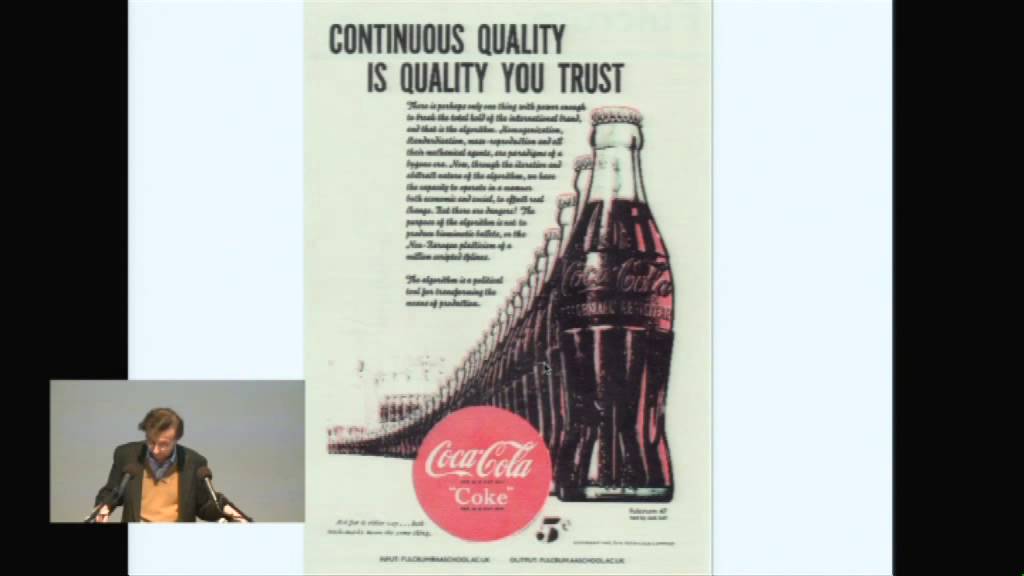
ordinary practice of our trade and I will show you a couple of examples to give you an idea since we're talking about curves which is why I gave you this long introduction this is the normal human mathematical way to notate a curve we all studied at the school with the parabola and the magic of calculus is that with two letters X Y and three coefficients or parameters numbers a B and C we notate an infinite number of points how many points sit on this curve a huge number of them an infinite number of them but
a simple line of clean mathematical script as long as this is enough to notate all the points we need but sit on that curve that's the way we do it that's a very brilliant way to do it because it compresses a huge amount of data into a very short clean and memorable notation so memorable but I studied 100 years ago and I still remember it even though I really never used it but this is a way we do it and this is increasingly the way a machine or artificial intelligence would do it not by using
the function but by making a long list a long list of points for each X but is a Y which is located on but cursed and you make that list and I remember making this list when I was a high school student to check but the point really sat on the parable on the parabola but you cannot notate every point but wait the purpose of scripting the function is precisely but you do not need to indicate each point one by one because the script indicates them all in a single line but for a computer from
a computer's point of view making a list of 1000 points or 1 million points or 1 billion points is not a big deal it is for us because we cannot work with at least but a computer can manipulator is the 1 billion points in the blink of an eye which is indeed what is already starting to happen in architectural design because if you look at this a famous fish built recently by jaha did well when she was still alive one of her last buildings before she died tragically two years ago it's huge it's a biggest
fish ever built I think you can see it from the moon with naked eye it's enormous but the mathematical script is more just two lines or three lines of scribble perhaps a bit more but it is mathematics you can recognize but it is mathematics because this curve this streamlined curve looks familiar this is something that we recognize as something ours because we know the mathematics underpinning it it has been around for quite a long time calculus was invented at the end of the 17th century BC is mathematics between 1958 and 1964 you don't need computers
to use bad mathematics but with computers it ran faster becomes more affordable but you know the world as we knew it even though it is a bit bigger than what we used to do using that kind of tools if you look at this built recently by Michael has Meyer a 3d printed growth using the biggest to date commercial 3d printer you can't really print a single block in the size of a room and each part of these 3d printed structure is printed as a voxel a box is a little unit of matter which is calculated
individually and separate it's like an atom in three dimensions X Y Z the smallest unit of this volumetric composition and if you look at that it at close up but the belly of that grotto this was this grotto was made by 3d printing four billion voxels one by one each one notated calculated and fabricated for each voxel there is a notation and the calculation for billions of them we couldn't work that way because if we print out ballast it would start here and would finish in another continent but a computer can run that list in
the blink of an eye so this way of working which is absurd for us makes perfect sense for the machine because we cannot work that way but the machine can and if this composition looks a bit weird and wacky and strange there is a reason for that it is already the expression of an intelligence which is not ours this is the outward and visible sign of an inward invisible logic at play a logic which is not the natural logic of our mind it is the artificial logic of a machine a machine can do that because
the machine thinks in a way which is different from the way we think if we use a formula we don't do that if you use a list of points we could do that but how many points can be manipulated by hand or using a slide ruler not many these are four billion points and it shows it is a complexity a richness of data which the machine can manage but we can't this is the way the machine thinks that's not the way we think another example this is not a Photoshop it was actually built in Germany
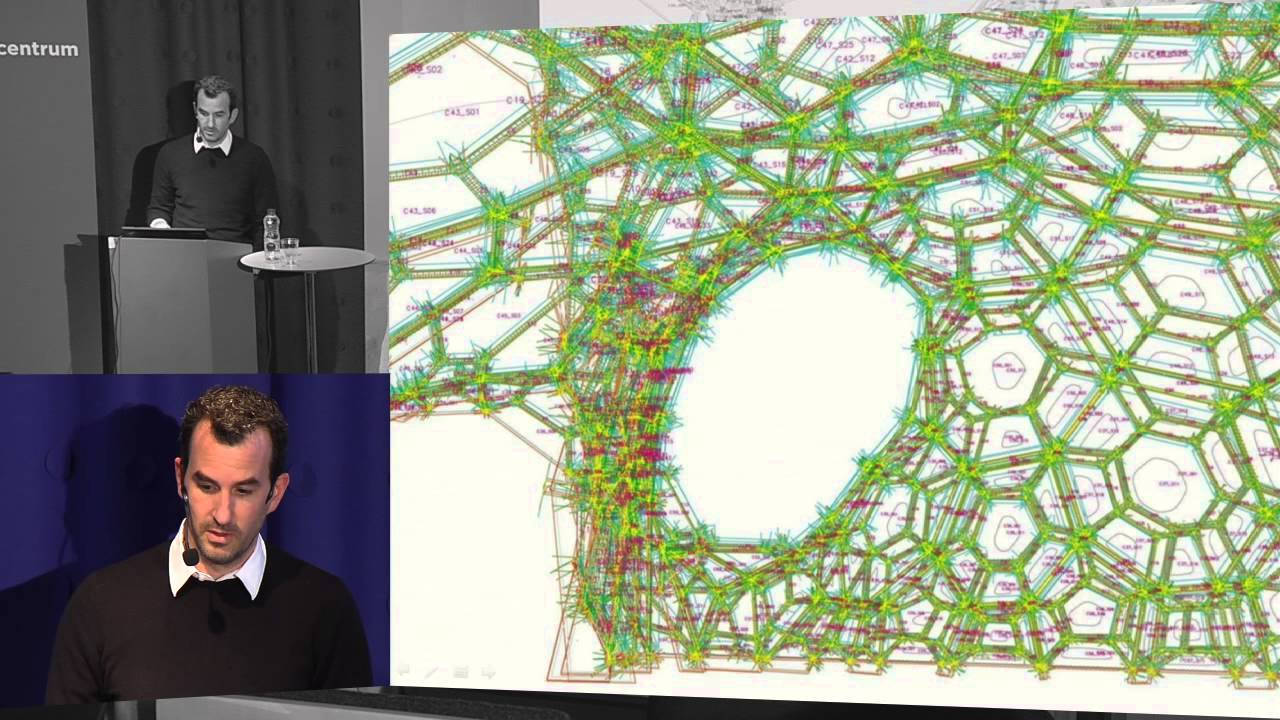
stood get by Achim menges and it is a small pavilion it was built in a public space and is being Germany before you build it you need a permission from the local office for which have to validate your structural calculation to make certain that this building withstand the wind of X knots and will also withstand the weight of certain centimeters of snow something like that so you have to provide structural calculation which have to be validated by US public office to certify the building is safe structural calculation structural design how do you think this building
which is made of filaments was calculated using this structural formulas these are the formulas I studied at school to the limit with a lot of effort of imagination we could use this mathematics and this engineering to calculate each filament individually but there are again probably four million filaments in that shell so if you want to calculate each filament individually in principle it is possible in practice it would take six years so we would not really do it yet the structure was calculated but how did they do it not using traditional structural formulas using something called
find it element analysis the computational version shall not go into the details which by the way I don't know very well myself but the way it works is that you see on the screen a simulation of the structure and you simulate in the simulation a certain load wind or snow earth whatever what you see on the screen is that part of the structure start to blink read time is it at what time it is yes well we are on time and it start blinking red on the screen the part that will break so what you
do you tweak it and you change it and you try again another load and it will blink red somewhere else and again and again and you try and you keep trying until you see something on the screen but doesn't blink red everything is green what means it will not collapse so that's the good one the one you will build problem is you have to keep trying and trying and trying you have no clue as to which try or we'll give the better best result trials are fast because they are in simulation which is why to
make the progress even faster we ask the machine to keep trying automatically and we call that optimization machine keeps trying and trying and trying and the machine does say 1 million trials in one hour and chances are that some of these will be good and the one with machine finds will be among the best one of them will be built but nobody knows which changes will give the best results how do you think this was calculated before it was built it was calculated but it was calculated the way I told you by simulation and trial
and error on the screen why does this one structure stand up in the 9999 just right in computational simulation didn't nobody knows it list of all its designers and yet we know and yet we know that it will stand up which is why we can build it because in simulation we know it did withstand so what we call simulation and optimization is massive computational trial and error try and try and try and try and keep trying or in another way is the art and science of finding good solutions without knowing why they work so in
in a nutshell it is already evident that artificial intelligence in veces artificial intelligence with to some extent it is it works we can already use it to solve problems we couldn't solve in any other way but it works in a way which is different from the way we would work it already shows a logic at play which is different from the logic of our mind which is probably a good reason to call it artificial because our organic intelligence would not solve problem that way where artificial intelligence of a machine can already solve problems in a
different way which in many cases is the only way to solve crop problems of a given complexity so yes it works but it was in a way which we may find well which is different from the way we think which is probably one reason why we should call this intelligence artificial because the organic logic of our mind doesn't work that way think of what we did not do in the case of a function we cannot calculate four million points one by one the Machine does and the Machine does it in the case of structural design
we cannot run four million trials in a sequence because it would take forever what machine does it in 20 minutes so try on an error which is a very stupid strategy for humans is a very good strategy for the machine if I look for a formula to put all these into a tag line I don't have to look very far because you people have already found it 14 years ago when you launch Gmail with this title search don't sort because if you think of what I just told you what we do we humans we sort
we take data and we organize them and structure them to make them smaller and more functional and more understandable that's the way our mind and traditional Science and Mathematics always worked a computers can search so fast but this sorting is often unnecessary because by the speed of the processing of the simple sorting process sequential a computer can find the best solution but we with our slow searching route think of names in a telephone book or in a telephone directory 1 million names we have to sort them alphabetically so we know where a name is when
you look for it and we don't have to read all the names to find the name we're looking for but a computer can do just that the computer with 1 million names in 2 seconds so our sorting which is indispensable for us is unnecessary for the machine because the Machine concert so fast but the preliminary sorting which we need is not necessary for them think of books in a library we put books on a shelf for following a system of logic of classification so we know where certain subject is when we look for it we
put things in certain places so we know where things are when we look for them so myself mark or the call number if you're looking for a book on architecture Renaissance 16th century Florence churches is a formula a shelf mark and we fit that number you go to that shelf and you find the book you're looking for without having to read the titles of all the books in the library which would take forever a computer can do that and with virtual reality we can do that as well think of instead of using a librarian when
all the books come in you tag them with radio frequency identification a little chip when you put them in a huge mountain no sorting whatsoever then you fire all your librarians and you buy a pair of virtual reality glasses and when you're looking for about booking that mountain si where is that book and you will see blinking red in your field of vision so you don't need librarians to sort because the machine can search search or sort we sort human intelligence computer search artificial intelligence but that's not my cup of tea to go back to
my cup of tea which is potatoes and fish etc it's evident better computational design is a fascinating testing ground already for artificial intelligence because the stuff we do is so simple and so cheap and the software we use is so you know Elementary and we do physical stuff the feedback loop you know the verification is also an immediate start in the morning and by you know by the evening we know if it will stand up or if it will break down or end we know what we will look like verification is faster than in many
other trades and profession which is why we can probably we designers and architects we can probably Intuit the spirit of this game sooner and faster than many other professions do because we have an immediate physical feedback if it falls down it doesn't work so we have to try another so if we are lucky we can hope to glean the spirit of the game sooner and perhaps better than some other professions do but problem is this is not our game this was never our game it was never meant to be our game because this is your
game you came up with it we didn't so this is where I should stop speaking and start listening I think we have still a few minutes for that thank you so we have 10 minutes for questions hi you said you you actually were an expert in classical architecture how do you see this as an evolution of what the Greeks and Romans were trying to do with because theirs are quite mathematical as well their architecture do you think this is just the evolution of that or is it something totally different well architecture is always at the
mercy of the tools we use to make it happen as inevitable to some extent every expression is at the mercy of the tool we used to manifest it you can think that language is natural but in fact when your ideas are manifested through the alphabet or through syntax the tools but used to communicate feedback on the kind of message you can you know transmit this feedback loop is inevitable in every human expression in the case of architecture if you compare it with painting the technical bottleneck is more determinant of course a painter is at the
mercy of the kind of canvas is using and the technology of the colors is putting on the canvas but you can think that that technological the limitation is not much if you compare it with the technical implication of building a big building and we are particularly at the mercy of tools of quantification because we have to measure a building before it was built and that was always the case in Greek and Roman in classical architecture not so much for costing or estimate which is important today but for proportion which for men was a matter of
vital importance and evidently if you look at Roman or Greek architecture you can glean from the way the buildings are built the kind of tools of quantification be used to make it happen which was not number based because the Greek and the Roman didn't have good numbers and they didn't trust numbers it was all based on geometry what we would solve by using you know hindu-arabic numbers which evidence reveal didn't have the numbers they had were crap and so they couldn't use them to calculate anything but their geometry was first-class we still use it so
all that quantification was achieved through Euclidean geometry tools whereas the arithmetical number based tools we used today didn't yet exist you know the Greeks always mistrusted numbers we prefer geometry the rule and the compass the typical tool of Amazings the quantification the proportional harmony of those buildings derived from that use of geometry which is why neoclassical architecture as of the 17th century 18th century which is number based and not geometrically determine from a distance it looks the same but if you look at it with the eye of a expert you can tell but it's no
longer Euclid it is numbers both numbers were you know pure arithmetics the story have told you is how quantification shifted from algebra to calculus because this is what busy and the French teams did in a sense that was the culmination of the dreams of Western mathematics because with the cart Leibniz in Newton we could not eight conics you know parabola cyberbullies etc etc with busy it was in a sense the culmination of the dream of mathematicians of all time you can notate using a mathematical script everything a cloud in the sky a flowering the field
any shape and form in nature can be scripted as a mathematical notation of course they didn't need to notate a cloud or a flower with internal take the body of a car and it was complicated but with computers became easy which is why when computers became available first thing we did we didn't use them to make potatoes we use them to make fish because that's mathematic and there is no mathematic in the potato we call this free form because there is no mathematic embedded in it and in a sense the dog the last part of
my story is closer to the potato than the fish so in a sense we are getting back to a potato but with a delay of 20 40 years but we fed the feedback loop to go back to your question at every point in time the kind of architectural shapes and form you see if you look at it as an historian of science you can read in the physical shape the tools of quantification which were essential to make it happen that doesn't mean that I can do but for every period I can only do it for
you know some little passages in it but that's that's the game thank you for interesting historical introduction have a follow-up question to the previous one could you please Fitz work of Gaudi to these fishes dogs and straight lines story could you do what I couldn't hear please put the work of Gaudi into this work of Gaudi Antoni gaudí yes yes into this scheme of fishes and dogs well Gaudi was a very important reference at the beginning of the digital turn in the nineties because Gaudi who is not a dog and not a fish it doesn't
belong to any historical parameters because it was a one-off it was an isolated genius who due to a remarkable set of circumstance was allowed in Barcelona to make something happen which is a miracle which should in theory never existed he wanted to reenact the way of building of medieval master builders so it was building without notations in the Middle Ages architectural blueprints did not exist craftsmen's there was no separation between the designer and the builders the master builders we're conceiving and making at the same time on-site on the fly and in 1891 1910 Antoni gaudí
in industrial Barcelona wanted to revive due to his ideology to his faith to his inspiration wanted to divide the medieval way of building he didn't want to revive a style wanted really to revive a social organization of a medieval building site so I wanted to revive a way of building where is no designer separated from the Builder the Builder is a master builder who decides everyday what is going to build in an industrial world you cannot build that way but in Barcelona at that time we found illuminated sponsor who decided that he should build the
me Cathedral but way to be superior glory of God which he did and the building is still going on because of medieval cathedral since it has no design as no beginning and no end so long as there is someone who's willing to build the building we'll keep growing and as of a mid nineties someone I know Mark burry took on from where Gaudi stopped using computer-aided design because he forked with some reason but using CAD CAM computer aided design and computer in the fabrication it is easier to reenact the medieval way of building because if
you work with computers you can design and make almost at the same time because you're using the same machine the same tool but puts a picture on the screen can print it out so the separation between designer and maker is compressed by the tool you're using so in a sense this use of a computer is more medieval and modern which is why they are now they are now still building the Sagrada família using computers in a sense continuing and interpreting gaudi's dream of reviving the Middle Ages it's a fascinating story thanks for bringing that which
technique Gaudi used to to do some scratches I I think that even though he built everything by himself and leads the process he had some drawings of Cathedral and he had diagrams not blueprints because stereo to me which is the medieval technique for cutting stone you cannot represent it but there are ways to teach to the artisans how to do it in the case of some complicated curves he actually use catenary models which we are still using to determine the shape of some arches under load and in that it was probably bringing in a technology
which the medieval builders would not have known so it was probably tweaking his own rules a little bit but I don't think there are drawings by Gaudi diagrams yes sketches made after the building has been built yes but blueprint no because that is contrary goes counter to his spirit a blueprint is an instruction which a thinker gives to a maker in the medieval team of things that separation does not exist if you build you think and make as an artisan you don't have a blueprint you don't receive a blueprint to execute you decide everyday in
the morning what you will do during the day because what's the medieval they architectural profession which I described was invented in the Renaissance when the humanist a bunch of snobs decided that designers should make and that ideas should have an intellectual value which is superior to actual craft but that is a modern invention it was invented in the 15th century by Renaissance in the Middle Ages with separation did not exist this is what Gaudi had in mind to revive the Middle Ages because it did not like modernity even though the man used to build the
Sagrada família was being earned but the modern industrial development Barcelona but that's the way it works thanks very much for the talk and do it there was a sense in maybe in the 80s 90s maybe with CAD CAM other technologies software that some things started to look quite similar like cars started to resemble each other like an Audi looked like a BMW or whatever do you think with AI machine learning that there'll be more of that or it will be that things become more differentiated in their design it is true particularly as you rightly point
out in the case of car design this kind of curves the splines the mathematics was the same in the software used by all car makers at the time the software was not and each software is its own tweaks so I'm not particularly an expert but Greg lean one of the authors whose work I have shown who is very much interested in car design is a real expert and connoisseur he tells I have no evidence of that but by looking at the body of a car it can tell which release of a given software were used
to make it and it is through to some extent there are tweaks of each software which leave traces so sometimes you can tell which release of word was used to compose a certain text because you know cut and paste works in a different way or something so insofar as that was the early look you can do that because we were probably 25 kind of software being used in the 90s by all automotive industry in the world so if you are in that field you know the mole now we are probably moving to an environment where
there is much more and faster variations and adaptations so my guess is that game of recognizing the indexical trace of a tooth producing is not going to be that easy anymore because in the 90s were probably 25 variation of a certain software and number are probably 1,000 and then bad games so I think that complexity which is coming through artificial intelligence tool will make this kind of indexical transference of the tool into the traces of its use less conspicuous good thank you [Applause] you