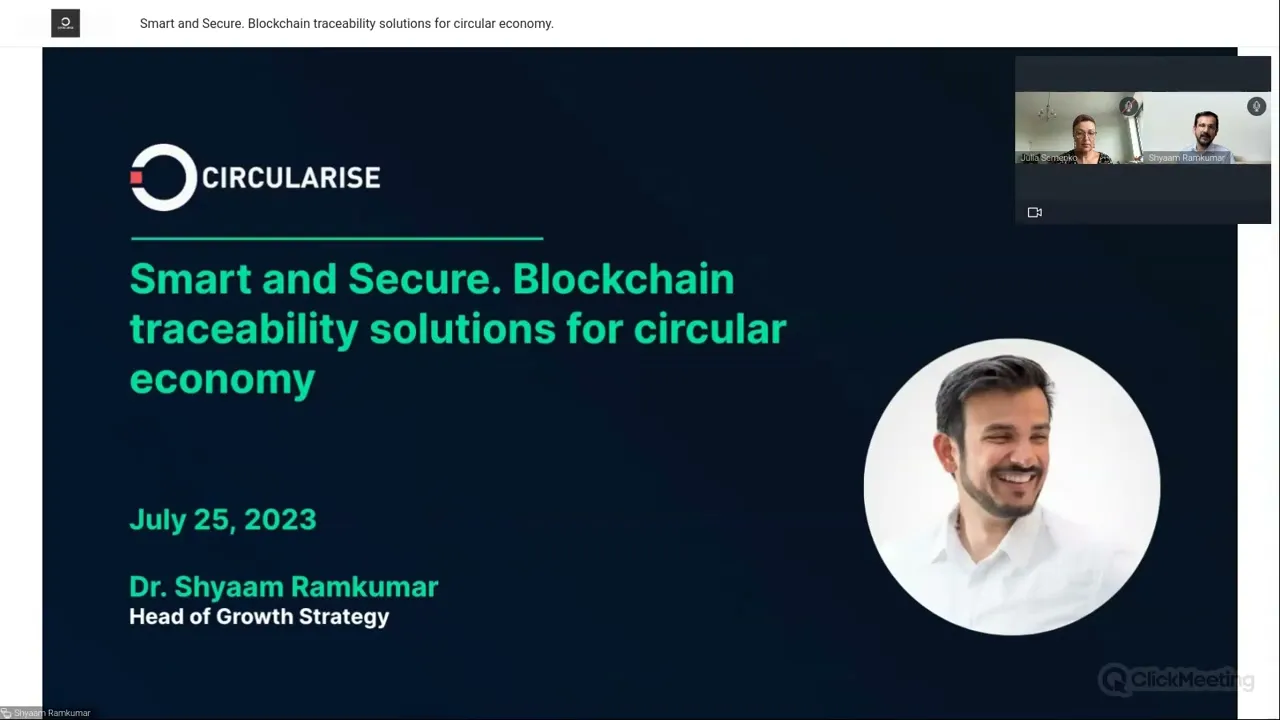
please please comment in the chat that the sound and the uh the video is okay and uh just let's say hello to each other excellent yeah great um yes welcome everyone Thanks for for joining our webinar um yes indeed as Julia mentioned uh today uh we're gonna kind of discuss the um solutions that blockchain traceability can provide to enable a circular economy um it's a growing Topic in uh globally and also in North America quickly becoming a key Focus uh for a lot of companies a lot of governments Etc so kind of go into um
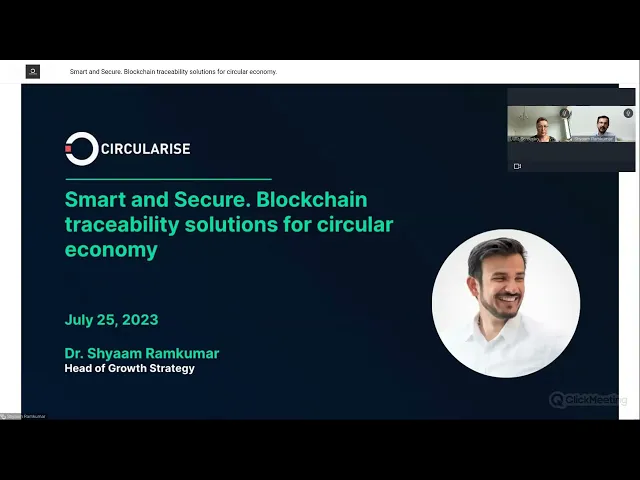
uh the topic of the circular economy and how blockchain can can enable that in a smart and secure way um so yeah um just a quick way by way of introduction as Julia mentioned I'm the head of growth strategy for circularize um for those of you who don't know uh who we are uh we are a solution provider based in Netherlands uh bringing circularity to Global Supply chains through digital product passports and digital traceability Solutions the company was founded in 2016. we are a little over 40 employees now and have finished our series a funding
we also participate in quite a few EU projects as well um and we have a patent actually for our technology smart questioning which I'll share a bit more later on in the presentation and we have the patent both in the EU and recently awarded in in the US as well um and happy to share more about about that and then we'll have some time in the end for questions and answers that you might have but feel free to enter those those questions in the chat as I as I go along the presentation um so yeah
as I mentioned today we'll kind of discuss some of the trends towards the circular economy how it's becoming a growing topic um also share how digital product passports can really enable circularity um but also men describe some of the challenges that come with with dpps as well and um in the end kind of share how circularize is kind of approaching this this topic and how we kind of enable the the sort of smart and secure exchange of data to support a circular economy and the transition to a circular economy so yes many of you um
have probably experienced the the topic uh circular economy is is rapidly growing all over the world um it's uh something that uh really folk uh becoming a big focus in in Europe um and in Asia as well uh but all over the world there's various kind of national policies um local governmental policies Etc that are coming into place to focus on things like reducing waste improving the design of products ensuring that products are kept uh when in the cycle for as long as possible um and it's not just a regulatory or compliance thing um it's
really also a strong Focus among businesses as well so surveys among many leaders of businesses show that it's supposed to be a way for companies to also improve their profitability improve their business opportunities and really make their business future proof so many companies are really analyzing how they can become more circular they understand that it's going to be a kind of core strategy for them and really enable some of their sustainability goals they've set for themselves um and really achieving this circular economy requires Tracing Our Supply chains um so this is a kind of classic
diagram of what a circular economy kind of looks like by The Ellen MacArthur Foundation um many of you are probably familiar with it um and looking at the technical cycles and the biological Cycles the core focus is to really understand how to create these Loops uh within the production process how do we maintain and prolong products for as long as possible reuse and redistribute them refurbish them and then at the very end recycle the materials and then for biological products how do we create these kind of Cascades to make sure that the the nutrients that
we're utilizing in the biological processes are kept in use for as long as possible at the highest sort of value um but in order to do this every sort of actor and every sort of step in the supply chain really needs to understand where do these products and materials come from what are they made of where do they sort of end up what is the sort of environmental impact in order to really make smart decisions about creating some of these loops and understanding what is the most high value most effective way to recirculate them in
our production systems um so that's really where kind of the the idea of traceability is is absolutely crucial in order to enable circularity um but as many of you are probably familiar uh traceability today is really done largely via email you many of you probably receive certificates in PDF forms which you then enter into Excel sheets and manage very complex databases or or Excel sheets with information about certifications about sustainability credits Etc it's quite labor intensive usually very prone to error or fraud very reactive instead of proactive and not really scalable and very cumbersome to
audit as well the verification validation process can be quite long quite extensive and quite time consuming so we really see that supply chain visibility is one of the big barriers to achieving circularity and sort of unlocking that and improving that exchange of information in a smart and secure way can really enable circular transformations to to happen um and yeah a question to you all um how do you all gather data from your supply chain for certifications for lcas for sustainability data uh requirements Etc um I'll have Julius set up the the poll curious to hear
what your answers are here we go please uh pay some attention to this pool and uh just uh vote because there are the multiple choice and you can choose a as much variant as you can and out of what we see now uh some people do not gather the data at all um yes of course email is here in place PDF files and yeah we have even one person who voted for using a software solution for data Gathering that's really cool and yes still PDF and Excel and uh the leaders in the care current practices
and unfortunately a quarter of those who voted do not gather the data but we are happy to see these people at our webinar because probably they are looking for the solution and for the proper solution not to go the long ways through PDF to excel but to to go straight to the uh to the uh really really working one okay thank you for voting thank you for being active with our pool we will not uh torture you with lots of them but later on we will have another one so thank you so much and uh
here are their results and we can go on please some uh restart share in your screen sure let me just restart that and get back to the presentation uh yeah let me know if you all can see now uh no problems I saw in the in the chat um Hans you mentioned that the audio wasn't coming through hopefully you all can also hear me okay now yes all good perfect um yeah so so uh yeah as as many of you answered uh indeed it seems like PDS and Excel sheets are the preferred uh way of
gathering Gathering data um and and that's really what we see a way to move away from and and what um Solutions like digital product passports can really enable um so uh what is a digital product passport it's essentially a sort of um record where it stores all the sort of information about a product so when you receive for example a set of materials for example a polymer from your supply chain and you kind of scan a barcode you can see information about that batch of material so you can see which company produced that material uh
what is the weight of it was it using any kind of system like mass balance for example um to to quantify things like recycled content or bio-based content and then what is the kind of information about the product um the kind of CO2 emissions the water usage hazardous substances any certifications associated with it as well as the activity of how that product was made so in a way it's very similar to your own passport that you use for travel um the analogy is very similar so how do you have a record of the material and
the history of where it came from where it was sourced from How It Was Made Etc and all those Associated environmental impacts um and and really what this allows is you to uh enable tracking of materials and parts all along the supply chain from raw material extraction to the manufacturer to the production of Parts uh to the assembly of the final product um but also Beyond to the sort of sale of the product to the consumers and you can even track it to things like resale repair recycling um and share this information with authority certification
bodies Etc um so yeah essentially with these digital product passports every step of the process enables a sharing of this passport and as it kind of goes through the production process that record of exactly what Transformations happen which actors are involved in the production process what is the kind of material composition what is the Recycled content environmental impact Etc can all be sort of recorded in these passports so you have that full history of what happened to any sort of material part product Etc um and here's an example um of a project that we did
with Linda bezel and Samsonite where essentially we took um so we tracked basically how uh plastic waste bottles um were collected uh in a facility sent to Linda bezel to process into a into a polymer um and capture Associated data around circular characteristics source and composition certifications Etc and then that material was then sent to Samsonite to be put into a suitcase so the suitcase shell is actually made of this polymer which was sourced from plastic waste so it's possible for Samsonite to highlight to Consumers to Regulators to the general public exactly what percentage of
their suitcase was made from recycled material and they could prove that as well by showing the chain of custody in terms of exactly what is the quantity of recycled material in their product where did it come from where was it sourced Etc so yeah really you know it allows companies to verify the use of sustainable materials especially if many of you use recycled content or bio-based content in your products or or in your parts for example how do you kind of validate and verify uh how much of it is recycled uh where did it come
from is it truly recycled content Etc so you can kind of prove that with digital product passports um it also allows companies to track repair activities so if there is a product what are the kind of certificates associated with the repair sharing information about the repairer the date the scope of the repair what sort of parts will replace Etc so how can you capture all of those records in the in the product passport so that future owners of the product or future kind of actors who process it can see that history essentially and then finally
it also allows for the proper disposal of products so many uh product categories have very specific requirements in terms of how products should be disposed but not a lot of visibility in terms of whether those those activities do happen so how do you kind of gather information about um a proper recycling procedures um verification of whether certain components or parts were removed appropriately and processed appropriately so that you have that record to to be certain that proper disposal processes took place um and then lastly it's it's possible to also through digital product passports really gather
impact data as well so every step of the supply chain of course has certain Associated environmental impacts scope uh one and two emissions so especially for for things like scope 3 emissions where you have to capture the entire supply chain uh it's possible to gather data from every single step in order to have more accurate product carbon Footprints more accurate scope 3 emissions Etc um but you know some of this uh this visibility and traceability does come with challenges of course um oftentimes the information that is gathered can be potentially misleading or inaccurate uh there's
no sort of formal structure for collecting this data of course regulations are coming up and there's various certifications and standards and guidelines that can inform that process but it's not always harmonized between different Industries so how do you kind of manage that process there's also no real incentives to share data I'm sure many of you probably have sent supplier surveys and gotten very low response rates uh have gotten a lot of pushback in terms of willingness to share information and a lot of that is because you're dealing with very sensitive data from the supply chain
so how do you kind of make sure that you're using that information appropriately without for example violating the Privacy the confidentiality of your suppliers potentially exposing their secret formulations or proprietary information so that is really a big concern for a lot of companies when they share this kind of information um so that brings us to our second poll as Julia mentioned earlier um curious to understand how many of you experience these issues when getting information from your supply chain um if you could answer what kind of topics you you come across when it comes to
getting this information will kind of push back Etc yes once again it's a multiple choice and you can you can refer to any issues you are facing yeah you see some you were absolutely right in in creating the options he positives because they are all quite quite popular among our audience they all can be faced and it's good because this is the experience that hurts a lot and yeah we will we will then discuss uh yeah will you please be more active in voting for us to understand that we are on the same page with
you and we can continue in with going deeper in this or that uh challenge where you are facing with that yeah and I believe that we are done with voting of course I would be more happy if if all of you won't but okay let's assume that all others do not have any other options by the way we missed this uh this one um also if you have other reasons that you come across feel free to add them we still have a chat if you have to mention any other issues or do not face any
of them just let us knows Richard it will be very nice of you okay we are ending voting and I am sharing the results you see uh uh all of them are quite predictable so let's go further and see what can be done in this city limitations so it's again I yeah perfect let me reshare my screen here um I think you all should be able to see it now um it's great yeah so indeed many of you seem to um uh have a lot of these challenges um especially you know lack of information um
yeah low response rates Etc um so you know we uh at circularize recognize this Challenge and and we've really kind of uh tried to build a our traceability solution to address many of these topics um so particularly when when it comes to information that can be misleading or inaccurate um our solution is built on on blockchain technology there's of course many ways to do traceability you could use databases you could use uh Cloud Solutions Etc um but we elected to use public blockchains to address this topic of inaccurate data acute to the sort of immutability
of Records on the blockchain I'll go into it a bit more as well essentially once you kind of put information on there it can't really be modified or tampered with um so it can't sort of be changed or there's sort of a a record that always is is there um in terms of a lack of formal structure for for collecting data you know are we with our solution we try to make sure that we align with different industry standards uh many of which are being formed now to sort of harmonize data collection processes and especially
when it comes to incorporating and integrating multiple standards as we do on our platform um many of them have overlaps and the kinds of data that is being collected so um how do you kind of gather all that information at once and then kind of share that with the appropriate bodies and certification schemes Etc instead of managing it through multiple systems multiple PDF documents Excel files Etc um and then when it comes to sort of incentives to share data when especially with sensitive data as well um that goes back to what I mentioned at the
beginning of uh the webinar in terms of our smart questioning technology which I'll I'll go into it a bit more as well so yeah essentially uh addressing that first topic of uh um the sort of accuracy of the data um you know by leveraging blockchain we sort of create this immutable record essentially the way blockchains work and blockchain transactions work is when two parties sort of initiate a transaction the blockchain sort of verifies that and creates a a block which is then appended to the the blockchain and then The Ledger is sort of updated so
if any actor tries to provide information that is is incorrect or information that's um not validated by the blockchain it sort of throws up an error so you sort of know since everyone has a copy of all the different transactions it's not possible for anybody to kind of change that record or tamper with it or alter it in any way so that record is sort of immutable it can't be modified it can't be tampered with so once the information is sort of on the blockchain you can be assured that it is sort of verified and
accurate and it's sort of not um an incorrect record of course you know the information still has to go through an auditing process a validation process Etc before it goes on the blockchain but once it's on there you can be kind of assured that it is a um a validated verified record and you know to worry about whether it could be misleading or inaccurate um and so yeah as I said uh with the example before every step in that supply chain gets recorded and so you have that kind of history of all the different transactions
and then because of the nature of the blockchain we're able to create that chain of custody to know exactly how those transactions built up over time um and all you know of course this kind of allows for um traceability with sort of accurate Mass balancing uh as well so if you wanted to know you know in terms of the weight of the product how much of it is recycled content versus bio-based content uh you kind of get a breakdown of the quantities of bio-based and recycled content from the different tier one suppliers and then how
they get it from their tier two suppliers Etc so everything is uh it essentially adds up so you don't have to worry about managing the processes of making sure that numbers match up that the information you're getting from the suppliers matches the records that you have Etc all of that is done sort of through the system essentially um and then as I said uh there's sort of alignment with uh with different standards so um it's possible to align with different protocols like ISO or the greenhouse gas protocol different certification schemes different regulations any specific supplier
requirements in your industry and all of these are just additional data points in the system so if if some of these schemes require a single data point you don't need to collect it multiple times you can just do it once and then you know that that information can be submitted to different kind of certification bodies auditing bodies regulatory bodies Etc uh to comply with those regulations and and you don't need to kind of manage that in different processes um so yeah going back to what I mentioned earlier about uh the blockchain solution and what we
do a little differently from from some of our competitors so many other Solutions use private blockchains it's a little bit easier to set up essentially you have a group of actors that you invite into that blockchain Network um which um increases privacy and confidentiality because you have a trusted group of actors that come together to share that data um but essentially you still have um sort of one kind of entity managing that that process uh in that private blockchain so the kind of decentralization aspect and the open infrastructure aspect is a bit uh bit lost
so that's what we elected to use public blockchain so we use ethereum for for our solution and what it really allows you to do is have that decentralization and also that that sort of open infrastructure so you can imagine you know if um a system were to be created for the chemical industry and then a separate one for the automotive industry and then a separate one for the construction or textiles industry um in order for those kind of different Supply chains to be able to speak to each other essentially you need everybody on one platform
in order for information to be sort of easily exchanged um but with with public blockchains it enables that sort of open infrastructure as long as there's sort of that open protocol to read that information it's possible for uh these digital product passports to be shared across multiple Industries um and multiple Solutions um the challenge of course with uh with with public blockchains is if you were to sort of put that information on the on the public blockchain it's sort of accessible to anybody who can who can read that information so that's where uh the patented
technology that I mentioned earlier in the webinar really comes in that's where we developed this solution called smart questioning and um that's the one that we have a patent for and what it is is it really allows uh companies to kind of disclose information so the analogy for this uh smart questioning technology is if you were to go for example to buy uh alcohol um when you get to the cashier you sort of need to present your ID in order to buy alcohol so you have to verify that you're over 21 years of age and
sort of the way you do that is to show your your ID so you show your ID and of course there's a lot of information on there that you have your picture your date of birth um you have whether you're a donor or not you're gender your height your weight hair color eye color Etc all of this information is is on that ID so you're kind of providing all this data to the cashier when all he really needs to know is whether you are who you say you are and more importantly whether you are over
21. so uh the the kind of idea is how do you kind of verify these two pieces of information without sharing everything else and that's really where our uh what our smart questioning solution tries to do it uses this technique called zero knowledge proofs essentially you have a verifier who writes for example a message and puts in the safe um and then approver who knows that combination code and opens that safe and then if you share that code you know that these two people know the code to the safe and they don't even have to
share the code to the safe they're just sharing that secret message essentially so they are convinced that they are both kind of they both know the code without actually sharing the code with each other um so in a sense that's that's really how our smart questioning technology works it really allows companies to share different levels of data um so instead of for example saying exactly which country they Source their material from they can say yes it was produced in the EU we can verify that or you know for the purposes of for example some of
the requirements of the inflation reduction act which requires materials to be sourced from uh um countries that have a trade agreement with the US you can share that information that yes it comes from a country that the US has a trade agreement with but you don't have to tell them exactly which country um or you can share a range of numbers so instead of the exact environmental impact you can share that the emissions for this material this part is between this range for example um or you can share everything so if the information is not
proprietary or you're comfortable with sharing that information to the supply chain you can share the exact number exact percentage of the Recycled content for example and then more importantly it's it's possible for companies to do our solution to share that information to specific groups so you can you can share it with select business partners in the supply chain specific groups like certain tiers of suppliers for example or everyone the general public regulatory bodies you can make it completely open and transparent so the combination of these two kind of disclosure levels really opens up a lot
of possibilities when it comes to sharing sensitive data um secret formulations of of chemicals um very detailed information about hazardous substances you know there's no need to share uh the secret sauce that many of your your companies have it's only necessary to share enough information to comply with certain regulations or answer certain questions that your your customers have or um that you need from your suppliers so this is kind of how it works in practice so you can imagine a supplier who makes a polymer for example enters all this information in their digital product passport
certifications of their site where their site's located certification of their product chemical composition sourcing composition LCA data information about the batch of products and all this information essentially gets hashed on the public blockchain so that the data isn't on there it's just a reference to the data um and then a downstream company like a brand for example if they want to access this data they only see the information that they're allowed to see so you'll notice here they're not allowed to see certification a for the chemical composition they can only see that for example cadmium
and fluorescent coding is above a certain threshold but they can't see the exact percentages and then other pieces of information are hidden from them as well um so so that really kind of shows how a company Like A supplier for example can share important information that the brand needs to know without disclosing too much proprietary data and if you think about you know PDF files and Excel files the kind of information that's requested is is a little too much for suppliers to to want to expose especially when that information needs to be verified so this
brand for example even though they only see this percentage they know that it's verified because it's it's on the blockchain there's kind of certifications associated with it so so they don't need to know the exact number to know that it's greater than 20 essentially so it really allows companies to be able to share data in a very secure way without giving away too much information about what they do uh so once you do this across the entire supply chain you really get that kind of visibility uh across all the different tiers and you'll notice um
this is the same images before but wanted to highlight for example some of these gray boxes so you'll notice that recycled content bio-based content has been shared by all these different actors but for the ones in gray that information is not shared so essentially these suppliers in tier one in tier two tier three they decided not to share the information about the bio-based content and the Recycled content because perhaps it's too sensitive they don't want to disclose that that data um so it's possible to kind of anonymize certain pieces of information and anonymize uh that
kind of data to specific actors um or if they wanted to give ranges instead that was uh that could certainly be possible as well um and then it's yeah similarly also possible to get uh data from the supply chain for for carbon footprinting and scope 3 in the same way um so um perhaps you don't uh want to disclose exactly the um the the specific footprint uh of your product or material um there's a lot of concern for many companies that uh it's it's possible to sort of reverse engineer uh their production steps and processes
by sharing the exact emissions factors and footprint data um so how do you kind of allow the possibility for companies to share this this critical information without kind of exposing uh private and confidential data about their operations about their their systems so really that's that's um kind of what our our solution tries to do and and if you think about the entire kind of supply chain um especially when products are produced and they get to the end of life um a lot of recyclers for example struggle with this topic of well what is in the
stuff that I'm receiving how do I put it back into the production system in a high value way and really enable circular economy possibilities if I don't know does it contain flame retardants does it have a specific kind of toxic material that I should be concerned about um one of the kind of early early projects that circularize worked on uh that kind of a bit of the origin story of the company uh was TVs for example um the the founders our Founders went to a recycling facility in Italy and they had a hard time with
dealing with Mercury tubes that are present in certain models of TVs but not others so essentially what these recyclers had to do was unscrew the back of every single TV to determine whether it had a Mercury tube or not um and if they knew that information the Sorting process would have been infinitely faster so uh that information about does this TV have a Mercury tube or not the OEM didn't really know so they kept going up the supply chain until they found the person that had this information and if they were only able to make
that information available by the time it got to the recycling process in the recycling step and if there was a way for that recycler to ask that question does this TV have a Mercury tube yes or no that's all I really need to know you don't have to tell me the composition of the TV you don't have to tell me any any other details um then they could process it more easily uh and so you know with this kind of traceability solution it really enables that to happen so how can we determine what is the
best high value use case for for reuse for repair for recycling Etc by really understanding the products that we produce without exposing too much of the sensitive information of our production processes um and that's really I think how these kinds of solutions can enable us circular economy and increase collaboration across the supply chain um so yeah that's really what we try to do with our system uh really try to close those those Loops by tracking materials from their origin uh and and following those materials to the different parts how they become different products uh incorporating
you know you can also include things like repair manuals additional information about the products uh for the following Downstream actors um potentially also get information from users in terms of usage logs maintenance history Etc this is all valuable information that can just be an additional page for example in the digital product passport you know similar to how you have additional pages in your passport when you go on more trips um all of this data can be tacked on uh as the production process kind of progresses um and then finally when the the product does reach
its ends of life um how can collectors and sorters and recyclers identify what is the best high value use for this product can it be reused for example does it have a possibility for a second life through refurbishment or does it really need to be recycled because it's reached its sort of maximum limit and in which case uh how can it be recycled more effectively or what what materials are in it how can it be reprocessed so that it enters back into the same industry or other Industries in the most appropriate way um so it
really opens up possibilities for higher circular Loops essentially so um you know with the traditional linear economy as many of you know we kind of add a significant amount of value to our products and essentially destroy them uh by not taking advantage of some of these these opportunities and that's largely because we don't really have the information available to understand what these high value opportunities are essentially so with more traceability in a very secure and smart way it really allows for some of these circular Loops to happen more effectively um so yeah our our company
you know um Works mostly in Europe but we are getting stronger and stronger interest in in the Japanese Market than I myself though the team is based in the Netherlands I'm based in Atlanta so I am uh in in North America um and um what we see is a lot of interest as well from North American companies given different regulations that are that are being passed in Europe that affect of course the us but also a lot of policies and Industry initiatives for example that are emerging in the US towards uh circular economy towards sustainability
supply chain traceability Etc so um there's a lot of focus that we've had um with different companies in the Plastics and chemical space we've worked with a lot of companies across Europe and Japan um in some of these industries uh also worked with Automotive companies electronics companies um worked with rare earth materials Etc um so those are all kind of areas that we are looking to to bring some of these Solutions and expertise into North America to enable traceability of Supply chains here and allow companies in the US to better understand how their supply chains
work what kind of materials they receive what are kind of circular opportunities they can unlock so definitely looking forward to seeing how we can engage with with many of you uh based in the States on some of these topics and really help you prepare for some of the developments that are that are happening in Europe that affect global Supply chains but also more importantly some of the activities that are happening in the US to really drive forward circularity sustainability and carbon footprint goals um of state governments National governments and your companies yourselves um so yeah
I'd like to open it up for any questions and answers about um these different topics um feel free to add it in the in the chat hey uh we have got one uh to warm up uh yeah from ibonne uh so she asked whether will the DPP of the suitcase be made of hundreds of dpps for every raw material and every part every step of the process uh it it probably it has become more clear from the um from the uh screenshots of the demo you sure you show during the presentation but it will be
good if you expand a little bit on that yeah of course no indeed so uh essentially every single part every material um indeed has its own kind of passport with information about that specific batch of materials that um specific lot of products for example um and has that history for um how it got to that stage of the production process and that that chain of custody that I uh shared with you all in in the different slides really kind of links those passports together um so how does the passport of a suitcase um if you
kind of look at the the polymers used how does that link to uh the passport of line to bezel and the kind of polymer that they're making and the batch that they created that went into that specific suitcase and then for that batch of materials um what is the kind of collection of pet bottles that were used as inputs into that so um essentially having these different passports for all these different parts and materials and components allows you to create that link between them to really show how those products were produced and also allows a
lot of companies to highlight some of their their contributions to the environmental impact and how they're kind of positively enabling companies to have lower lower Footprints increase recycled content increase bio-based content Etc you are more than welcome to to ask more questions because yeah um sham knows everything about the circular economy and the challenges and the requirements and the tools and in case you are not ready to go out to come up with your questions right now please write down the direct email address of our today presenter to contact him later because he is a
really really valuable source of the information uh about the sustainability it is built of Supply chains and the general concept of bringing the circular economy into reality okay and maybe you would love to to add something if you don't have a if we don't have any for the questions from our audience yeah of course um no happy to uh to expand on on some of these things um I think also maybe a follow-up to um to what uh Yvonne asked um about dpps for every single part every single material um of course you know um
circularize uh as a company we don't expect to be able to capture every single material of every single part of every single product um produced in the world uh that's really why um as I highlighted in in some of the slides we take that open uh infrastructure approach with with public blockchains Etc um because we recognize that companies might not use circularize they might use other solutions for creating some of these passports and tracing their supply chains but what we really want to do what we kind of Envision with is these Solutions is how even
if even if another company uses another platform or another system how can the digital product passports that they developed with these other platforms Etc how can they be exchanged and shared in an easy way so uh you know I I mentioned earlier that we want to move away from email but one of the kind of beauty uh beautiful aspects of email is the sort of open protocol so it really doesn't matter whether you know I use apple mail and you use Gmail someone else uses Outlook it's still possible for us to exchange messages through these
different applications because of the the open protocol behind behind email and and that's really what we want to strive for with digital product passports and traceability in general how do you have that open protocol so that regardless of what solution different suppliers in the supply chain different Industries different companies have there's still that ability to exchange data between those different systems so it's possible to have that open protocol for digital product passports and read the information from different supply chain actors in a smart and secure way and that's really why we kind of built our
solution using public block chains using kind of that open protocol approach um to kind of enable that that future well that's really cool that you mentioned that because it's partially answered the question from Willie thank you very much for that question because uh for some products there are a big second-hand market and can dpps be applied to that yeah absolutely uh of course you know many of the slides that I um showed you some of the visuals focused on Upstream uh where you kind of track where do products come from what are the origins Etc
but it's also possible to kind of start that process um for a recycled product for example so we for example did a project uh with Audi um looking at uh an initiative they they started called material Loop where they took an end of life vehicle and dismantled it and tried to extract different materials from uh the dismantling process to then be put into a new vehicle um and so we as part of that project supported them with our traceability solution to be able to identify for a recycled car for example um where were the recycled
materials sourced from so you can kind of trace it back to which cars were kind of broken down and what kind of materials were extracted from them and how did that end up in a new car so for example with uh with second hand Second Life For example as long as there's a way to kind of track um who the new owners are what the kind of subsequent steps are in the recycling process or the ReUse process of the repair process as long as that traceability happens it's possible to link those activities back to the
DPP of the original product so you can see for example what are those additional lifetimes uh what are those further steps that happened once the product reaches its end of first use or end of life for example and what kind of happens to it afterwards thank you and I must admit that uh you have managed to explain so complicated things in such a simple words that uh probably it was really really useful for everyone from the very very beginners to to the those who consider themselves to be an expert in this field to go deeper
in the secrets and real working tools of our traceability system I assume that if we do not have any further questions we can wrap up the session and I really invite everybody to visit secularize.com because it's a really valuable source of uh detailed information on regulations Solutions challenges and all the trends we are facing all together now towards the sustainability and circularity and yes of course thank you sham for running this webinar today and it was a real pleasure to host you today over here yes thank you thank you Julia and thanks everyone for uh
for joining um yeah as Julia mentioned please um check out our website um our LinkedIn um we also have a newsletter if you're interested in subscribing um and then I believe the uh recording of the webinar uh as well will be made available in case um any of your colleagues might be interested if some of them weren't able to make it to this session today um and yeah would love to to hear from you um please don't hesitate to reach out to us yeah sure I will send out the recording to everybody who registered and
probably didn't manage to join us today in a live broadcasting but anyway the recording will be sent out tomorrow and we'll be happy to answer your first questions uh and actually to move together towards the circularity okay have a great rest of the day or great evening if you joined us from Europe and thank you sham again it was a pleasure to be present at this webinar it was really really deep and good thank you thank you take care everyone