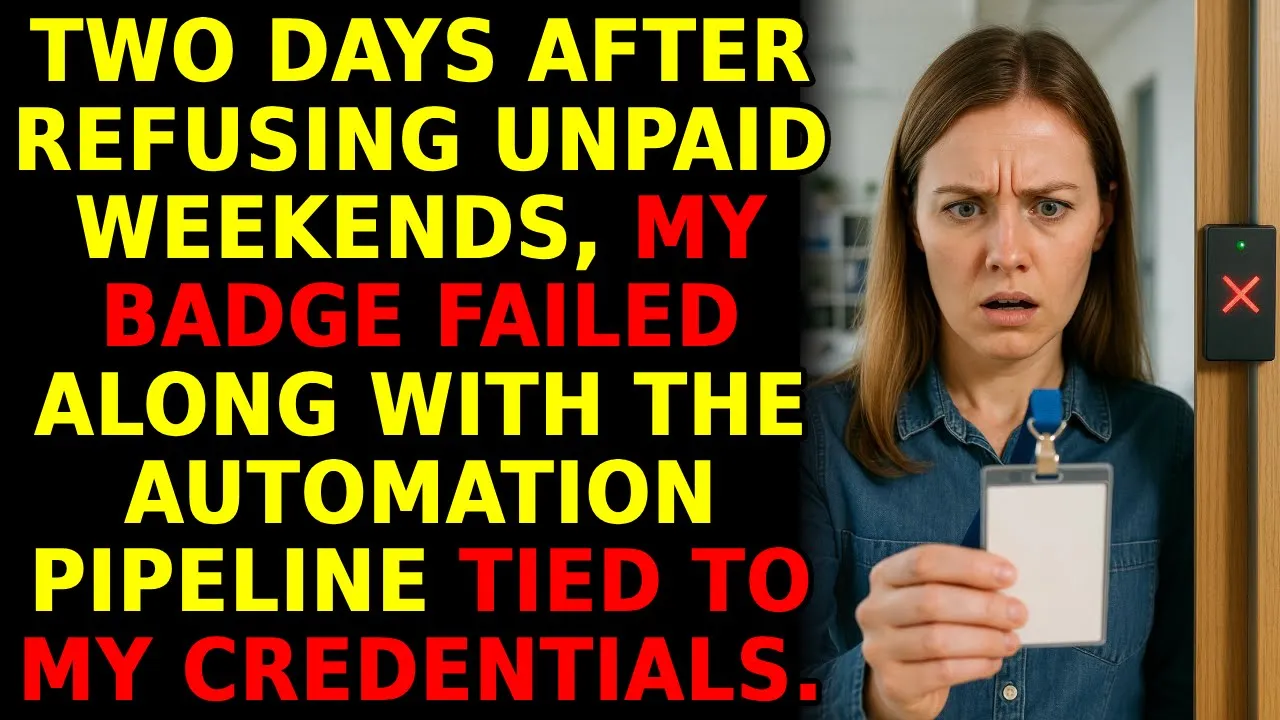
At 9:03 a. m. , I got an email from system notification at corpet local that simply said, "Credential mismatch.
Action required. " I was standing in front of the biometric reader outside the east dev wing, fingers freezing against the scanner when I saw it. The light stayed red.
My badge buzzed once, twice, then nothing. Behind me, the interns with their protein shakes and slackjawed optimism started whispering. One of them giggled, pretended I didn't hear it.
Second email hit. Deployment error. Pipeline failure at step four.
O token expired. I hadn't even sat down and my whole ecosystem was already falling apart like cheap Jenga. The weekend before, Eric had cornered me in the kitchen during our so-called alignment session, which was just a glorified hostage situation with pizza.
He leaned in and whispered like we were plotting corporate espionage. You'll stay this weekend. We need the patch shipped before the audit.
It's crunch time. I chewed, swallowed, and said, "You mean you need it shipped? I already worked 12 hours last Saturday.
I'm not logging more unpaid time so you can take credit Monday morning. He didn't even flinch. Just smiled and said noted.
Apparently noted meant initiate quiet assassination. By the time I reached my desk, scratch that. The place where my desk used to be, my chair was gone.
No monitor, just an empty socket and a sticky note that said reorgan progress. The passive aggression was so thick I could butter toast with it. I logged in from my personal laptop or tried to.
My credentials were scrubbed. SSH keys denied. Repo access revoked.
Slack channel archived. What they didn't revoke was my Drpbox sync folder because Eric doesn't understand what off-site backup means when it lives on a Wi-Fi drive called Norah's panic plan. And inside that folder, original deployment tree.
I architected the roll back keys. I never told them I rotated a copy of the escalation email Eric tried to delete 6 months ago. And one little surprise file timestamped and hash signed.
Fail safe trigger protocol V2. Bash, you know what happens when you sever a branch with the fruit still on it? It drops hard.
By 11:00 a. m. , the staging environment was down.
QA was reporting malformed builds. Jenkins was screaming dependency hell and Eric Eric was still trying to bluff his way through the Monday scrum call until the CTO asked, "Why did everything collapse the moment Norah's credentials were disabled? " And Eric, sweet lying Red Bull for blood Eric said, "Oh, it's just a temporary permissions error right before the screen went black and the Slack alert chimed.
Root privilege escalation detected. Reauthentication failed. System roll back initiated by original author.
They cut me off. They cut me off. And now they're about to learn what happens when the girl who built the kingdom decides to burn the drawbridge and salt the moat.
" The funny thing about sabotage is it looks a hell of a lot like incompetence when you code it right. By noon, half the dev floor was in silent panic mode. Phones off, eyes darting like rats in a flooding basement.
Jenkins was locked in an infinite restart loop. Frontend deploys were spitting out 5002s and the internal dashboard looked like someone fed it alphabet soup and trauma. Meanwhile, I was sitting in my car outside the building, parked one level below where they used to let me in.
Laptop open, tethered to my personal hotspot, watching their precious infrastructure crumble in real time. A text pinged from my old teammate, Mia. WTF is happening.
Did you quit? Eric says, "You rage deleted everything. " I almost laughed.
Rage deleted? Please. If I wanted to rage delete, they wouldn't be seeing 52 errors.
They'd be looking at a blank repo and a database wiped so clean it compliments from Marie Condo. No, this was precision. This was chess.
Every module they tried to touch redirected to a mirrored backup that referenced a missing key, my key. Every script failed after step three. The encryption handshake stalled out.
I made sure roll back would loop once, twice, then die gracefully. Just enough to look fixable. Just enough to waste hours, days, audit days because the audit was Friday.
And they were about to walk in with no pipeline, no automation, and a new lead dev who couldn't even spell YAML without crying. But the cherry, oh, the cherry was sweet. Two weeks ago, Eric forwarded me a message from a recruiter by accident.
Subject line re seeking lead dev ops for pharma tech merger. Can you start May 15th? Eric had a plan.
Push me out, ship my system, and use my architecture to land a new CTO seed across town. I didn't reply. Just bcced myself, logged the headers, and moved the email into a folder called exit strategy Eric edition.
I didn't need revenge. I needed receipts. And I had one more card to play cuz deep in their private Jira board buried under layers of fake sprint stories and buzzword bingo was a hidden dependency I slipped in 6 months ago.
A phantom script labeled systemd job and backup monitor legacy sh which ran every Thursday at 3:00 a. m. pinging a private endpoint mine.
So while they were locking me out, every key rotation, every credential revocation, every file deleted was getting mirrored to a folder in Iceland under a decoy AWS account named Coldfish Analytics. You don't fire the woman who built the vault, then forget to change the combination. And you definitely don't call her bluff after gutting her access, then act surprised when the floor starts disappearing under your feet.
By 200 p. m. , the CTO emailed my personal address.
Short, polite. would you be willing to come in for meeting? Believe there's been a miscommunication.
I forwarded it to legal. Then I wrote one line back. You revoked the wrong badge.
Now you'll need to earn a new one. And just like that, the countdown truly began. At exactly 3:33 p.
m. , someone tried to manually override the roll back lock. Bad move.
The system froze. Spat out a warning message I'd hardcoded back in December. Originally just for fun, now poetic.
Unauthorized. Override detected. System integrity compromised.
Please locate your nearest adult supervision. Eric must have lost it. I imagined him pacing the conference room like a man auditioning for a stroke.
Red in the face, sweat blotching through that stupid oatmeal colored blazer he always wore when he wanted to seem executive. Probably yelling something like, "It's her. She's behind this.
I want her charged. " But here's the thing. Couldn't charge me with sabotage because I never touched a single system after they revoked my credentials.
Everything they were stepping on triggers I left inside the build like digital landmines. Legal would call it prior configuration with unforeseen consequences. I called it insurance.
By 4:00, Mia messaged again. Mia, the pipeline's dead. Legal is on floor 7.
CTO is freaking Eric vanished mid call. What the hell did you do? Built a system that noticed when it was betrayed.
She didn't respond after that. Can't blame her. The next part that was always going to be the best part.
See, they didn't just revoke my access. They also tried to replace me fast. Posted the job Saturday night like I wouldn't have alert set up.
I applied under an alias. Gave them a resume with a fake name, fake number, and a very real background mine. Just rearranged.
Booked an interview for Tuesday with their top candidate. Location: Room 415A, 11:30 a. m.
Interviewer: Eric. I smiled when the confirmation came through. While Eric was busy filing incident reports and screaming at DevSec Ops, he had no idea he'd just scheduled a one-on-one with the woman who was about to end him.
But before that sweet reunion, one more breadcrumb to drop. I sent an anonymous email to the CTO. Subject line from someone who believes in version control for people too attached.
The recruiter thread Eric tried to bury screenshot of him manually disabling access on Friday. Timestamped during off hours a video recording of his Slack DM to HR. She'll quit on her own once the badge fails.
L then I click send. There are things you fix. There are things you audit.
And then there are things you bury because they stink too loud to save. By 6:00 p. m.
access was gone. By 6:15, his face was too wiped from the org chart like he never existed. I watched it happen live.
One second. He was listed as director of platform integrity. The next user not found.
The irony? The system that deleted him ran on the backup jobs I built. And that was just the opening act.
Tuesday, 11:28 a. m. I sat in the lobby wearing a blazer I hadn't touched since my exit interview at Cipher Logic, where they also said I was too direct for leadership role.
Translation: I refused to giggle through incompetence. Now I was Riley Jensen, DevOps specialist from Phoenix with extensive experience in CI/CD strategy for biotech applications. My resume was a Frankenstein patchwork of my real work, repackaged under a name I'd pulled from an old Netflix password.
The receptionist offered water. I declined. Hands were already vibrating from the thrill like standing at the top of a roller coaster that only goes down for other people.
At 11:32, the door opened and in slithered Eric, pale, stubbled, tie crooked like he'd dressed in the dark with both hands shaking. He looked like a man who hadn't slept. I wondered if he even remembered scheduling this.
He said my alias Riley like he wasn't sure the English language still worked. I stood, smiled, shook his hand. We walked into a conference room that still rireed of rushed cologne and stale panic.
He closed the door, sat down, and took out a yellow legal pad like he still believed this was salvageable. "Thanks for coming in," he said, eyes not quite meeting mine. "Let's just talk through your experience.
" I nodded politely. "Of course, though, first, can I ask something upfront? " He blinked.
Sure. What happened to the previous lead? I heard there was disruption.
His jaw clenched. Uh, yeah. She didn't work out.
Didn't work out? I repeated with a little tilt of my head. Or was she pushed out after refusing unpaid overtime?
He blinked, finally locking eyes with me. The blood drained from his face. Excuse me.
I leaned forward slowly, deliberately, slid a USB stick across the table. That's a copy of your Slack thread with HR. the timestamp from Friday, the credentials you tried to overwrite, the recruiter email, a fun little bonus, the pipeline logs that trace every failed build since you scrubbed my access.
You'll notice the failpoint lines up exactly with the credential purge. He didn't touch the USB, just stared at it like it might bite. Who are you?
He whispered. I smiled. I'm the reason your Monday exploded.
I'm the girl who built your entire release architecture while you sat on Zoom calls muting your mic to play Candy Crush. and the person you thought you could erase with a swipe of your badge. I leaned in and right now you're going to resign today with a statement that says it was your fault.
All of it. Otherwise, I pulled out my phone and tapped the screen once. The CTO gets the video of you bragging about getting rid of the who thinks she's smarter than me over drinks at your little offsite.
He blinked fast like a man watching his own funeral happen in real time. How did you, Eric, cut him off? Your phone screen reflects in your glasses.
You live your life like you're unhackable and yet you use the same password across platforms. Eric 123 with an exclamation point. Very original.
He slumped. Truly slumped. The man deflated like someone popped his MBA.
I stood, picked up the USB. Don't worry, I'm not staying. This meeting was the last line of code I needed to execute.
Just wanted you to see the face of the woman you tried to delete. He didn't move. Didn't speak.
As I left, the receptionist smiled. How was the interview? I smiled back.
He's not the right fit. And just like that, I walked out. But the real reckoning, it was still loading.
And someone else much higher up had just entered the game. Wednesday morning, I got a LinkedIn notification that stopped me midbite of burnt toast. Profile has been viewed by Dia Rowan, CTO, Stratverse Corp.
Now, here's the thing about Dia. She doesn't view anything. She scans purposefully, surgically, like a hawk with a security clearance.
She was the kind of exec who made VPs sweat through their Armani. The only person in that company who ever told Eric to shut up mid-presentation and lived. She ran Stratver's core engineering arm like a warship.
Lean, disciplined. One small mutiny away from mutinying back. I'd only spoken to her twice.
Once during a highstakes demo where Jenkins died midload and I hotfixed a rogue script live on screen. She gave me a look that said impressive. Don't get cocky.
Second time, she CCed me accidentally on a budget cut thread and followed up with, "Pretend you didn't see that. " I never replied, "She," so when she pinged my inbox with, "Nora, 2:00 p. m.
, my office, nothing. Say nothing until I finish. " I showed up in flats and silence.
The entire floor went quiet as I stepped out of the elevator. The kind of silence that lives in horror movies before the mirror cracks. Her assistant, a former Navy translator who once dislocated a man's shoulder over a misprinted NDA, simply opened the door and motioned me in.
Dia sat at her desk. No smile, no nod. She just slid a paper across the table.
Termination paperwork. Eric backdated. Handwritten confession.
Admits to overreach, retaliation, and credential tampering. I didn't touch it. She folded her hands like she was waiting for a gun to be passed across a poker table.
I know everything. the USB, the fake alias, the DNS pings from Iceland. You've been busy.
Still, I didn't speak. She tilted her head. You didn't breach any laws.
You didn't touch anything after your access was pulled. Never exposed customer data. In fact, she pulled up a laptop and turned the screen toward me.
You triggered the fail safes we should have had in place all along. You revealed a massive dependency on one node, your node, and proved our infrastructure was dangerously brittle. Then she leaned in and you documented everything.
I waited. My palms didn't sweat. My breath didn't quicken.
I knew what this was. It wasn't addressing down. It was a pitch.
You want me to come? I said calmly. No, she replied.
I want you to report directly to me. I blinked. Director of autonomous systems integrity.
No more Eric. No more oversight committees who need 15 meetings to push a code review. I want your chaos harnessed, not caged.
I looked down at the contract. Seven figures, remote option, full stack autonomy. But it wasn't the money that made me pause.
It was what she said next. And Norah, don't think this is mercy. Humiliated one of my department heads.
I don't reward that. I replace it. There it was.
The warning beneath the gift. I stood, took the offer. Not because I needed the job, but because the pipeline I built wasn't the only system I'd left rigged.
There was still a final dependency buried under everything they'd forgotten. A secret variable neither Eric nor Dia had noticed yet. A legacy key with full roll back permissions and the name tied to that key still mine.
Them think they're in control. Let them build towers on my framework. Because when the final trigger fires, even Dia won't see it coming.
Friday 1:00 p. m. audit day.
The air on floor 7 felt tighter, like the ventilation was set to mild suffocation. Everyone wore their best trauma smiles. Those tight, overpracticed expressions people wear, when they know a firing squad might be hiding behind a PowerPoint slide, sat in the far corner of the war room, dressed like someone who didn't just get promoted three rungs up the ladder in 48 hours.
No announcement had been made yet. That was the game. Dia wanted silence.
Control the reveal. Let the power simmer before it boils. Across the room, legal and it were shoulder-to-shoulder with external compliance, big suits, audit laptops with stickers like do not remove this seal and tampering is a federal offense.
At the head of the table sat Martin Groves, our contract auditor, the kind of man who could detect a misplaced semicolon the way blood hounds sniff out cocaine. Bald, wired, punctual, he opened his laptop and said, "Let's begin with incident chronology. " Everyone turned to the CTO.
He looked at me, then looked away. The disruption began at 9:02 a. m.
Monday. Root cause traced to a revoked credential tied to CI/CD deployment. Secondary impacts hit Jenkins CA regression flow and roll back sequences.
Was this due to sabotage? Martin asked. No, I replied before anyone else could.
It was due to fragility. The system depended on one credential tied to one person. When that person's access was removed, everything failed because it wasn't built to survive a political decision.
Martin looked at me with clinical interest. And you are? Dia finally spoke.
Her name is Norah Vale. You built the system. Martin's eyebrow twitched.
You're the one who got locked out. I'm the one who got erased. There's a difference.
The room went dead quiet. Dia slid a folder across the table. This is the paper trail.
Emails, Slack logs, credential pull orders, the exact timeline of retaliation. You'll note the subject in question no longer works here. Martin flipped through it like a priest scanning for sins.
Then he stopped on a page. This pipeline, he said, references a legacy node and vis one redundancy trigger. Who owns that now?
Silence. I didn't answer because I knew what that variable did. See, that variable was the real fail safe.
Not just a monitor, not just a ping. It was a sleeper. A watchdog that checked system health every time a build was pushed.
And every time it detected structural failure, it called a hidden endpoint secure shell tied to a multi-environment backdoor. I'd embedded before they ever decided my weekends belonged to them. And as of Thursday night, quietly with no fanfare, I triggered it.
Martin looked at me again. Why didn't this fire during the collapse? Because it only activates when someone tries to restore the system without authorization.
And has that happened? My phone buzzed. I picked it up, glanced, and smiled.
Now it has. The war room screens flickered. Jenkins pipeline logs appeared fresh.
Live automated again. only now every build cued under a new ID. Owner Veil Autonomous Supervisor Martin looked around.
Is this a joke? No, I said finally letting my voice rise. It's proof that even when you fire the architect, the blueprint remembers who built it.
And across the city, inside a satellite office Eric had quietly joined, every system he tried to mimic using my stolen templates crashed simultaneously. One by one, little red light started blinking across the monitoring dashboard. Dia's lips twitched.
Was that a smile? Admiration? No, it was fear.
Subtle, barely there, but I saw it. I leaned back in my chair. Let them spin.
The house wasn't just rebuilt. It was reclaimed. Saturday, 2:47 a.
m. While the city slept under the wet hum of distant traffic, I sat alone in my apartment, barefoot, sipping burnt coffee and watching the final log scroll like scripture across my screen. Sync complete.
Endpoint stabilized. All redundant failbacks were routed. There it was.
My system clean, untouchable, and fully mine again. Not owned, not borrowed, not tolerated. Mine.
The whole thing now ran on a layered zero trust mesh I had quietly migrated overnight using cloned containers masked as backup diagnostics. The original Jenkins node gone, placed with a distributed ghost pipeline I dubbed Phoenix Echo. Dia didn't even know it existed yet because this wasn't a rebuild.
It was a resurrection with vengeance in the wiring. And it didn't just protect the architecture, it observed the people managing it. That was the real twist.
See, after the war room show on Friday, Deia pulled me into a private call. You've made your point, she said. But if this ever happens again, I won't protect you.
I paused. The silence settled like dust after demolition. Then I said, "Good, cuz next time I won't need protection.
I'll already own the fire department. " She didn't like that, but she didn't argue either. And I knew she'd already called legal.
probably checked if I held any more keys. Probably found the usual decoys. She'd assume I'd made my statement and was settling into my role.
Reformed, boxed, tamed. But power doesn't sit still. It reconfigures.
That night, received a whisper from Mia. She'd been approached by an external security consultant doing a blind review of our incident readiness. Asked if she'd heard of Project Vault Echo.
That's when I knew Dia was looking for my real trap door. She was smart, paranoid, but not paranoid enough because Vault Echo wasn't real. I'd planted it in a stub folder on a mirrored drive named just provocative enough to draw attention.
Just clean enough to look almost scrubbed. Let them chase ghosts. The real program wasn't a vault.
It was Pulse, a behavioral monitoring tool that mimicked normal system health pings, but tracked privilege abuse in real time. Not just failed login intention, pattern shifts, access attempts that deviated from assigned RO profiles. It lived in the kernel space and every time someone moved to isolate or mirror my builds, Pulse pinged me.
Saturday night, Pulse pinged twice. Two separate users, both with elevated clearance, attempted to clone my deploy environment. One was from internal infrastructure.
The other IP traced back to Dia's personal dev sandbox. So much for trust. At 3:04 a.
m. , I executed Protocol Ironvil. The Jenkins GUI vanished.
All builds paused, even the real ones. A single banner popped up across every dev screen companywide. Autonomy is not granted.
It is earned. Veil systems by sunrise. Lack channels exploded.
CTO inboxes flooded. PR drafted statements blaming a non-malicious diagnostic outage. But internally, they knew.
They didn't hire me back. They invited a storm and assumed they could hold the umbrella. What they forgot is storms don't ask for permission, and I hadn't even told them about Ashroot yet.
Monday, 8:00 a. m. I arrived late on purpose.
The lobby was buzzing like a hornet's nest after a lawnmower incident. Bull murmuring in pairs, laptops clutched like life vests. An intern sprinted past me with a protein bar half chewed and tears in his eyes.
That was new. The elevator screens were frozen on the same message from the weekend. Autonomy is not granted.
It is earned. Veil systems. They hadn't scrubbed it yet.
Or maybe they couldn't. On floor 7, every head turned when I stepped out. Not because of fear, but because I'd become something they didn't know how to define.
Not a pier, not a boss, not even a threat. I was infrastructure. Dia was waiting in the glass war room again, flanked by legal, and someone from the board who wore a Rolex like it was a badge of emotional detachment.
I walked in without knocking. She didn't speak, just pointed at the single paper on the table. It was printed on thick ivory stock.
Veil systems partnership offers subtext, full autonomy, full ownership of the pipeline IP, a binding agreement that no system I build can be altered without direct signoff. Are you offering equity or amnesty? I asked tone flat.
The board guy smirked. We're offering relevance. Cute.
I took a seat. Here's what's going to happen, I said. You're going to approve this publicly, not quietly, not buried in a PDF no one reads.
A press release. CTO endorsement. I want my name tied to the infrastructure I built.
And if we don't, the board guy asked. I leaned in slowly, calmly, and said, then Ashroot activates. That shut the room up.
Ashroot wasn't a bluff. It was my final insurance policy, an inert root process buried six levels deep inside the systems monitor, masked as a legacy cron job. It didn't delete data.
It didn't leak files. It simply made the system forget them. Every contributor ID except mine.
Every change log wiped of external edits. Rebuild reset to my original config, timestamped, notorized, and archived across five jurisdictions. In short, I could make it so the entire company looked like I was its only author.
And when auditors came sniffing, they'd either admit the infrastructure was a solo effort they tried to kill or admit they had no idea how any of it worked. I watched their faces shift. Dia's expression finally cracked.
Not rage, not panic. something more dangerous. Respect.
Building a kingdom, she said, voice low. What happens when someone stronger comes to tear it down? I stood, collected the offer, looked her in the eye, then I burned the kingdom first and make sure they choke on the ash.
I didn't wait for a reply. As I left the room, my phone buzzed again. Pulse ping.
Someone just tried to mirror the veil systems kernel. But this time, the access was blocked by the system itself. That's when I knew they didn't just fear me now.