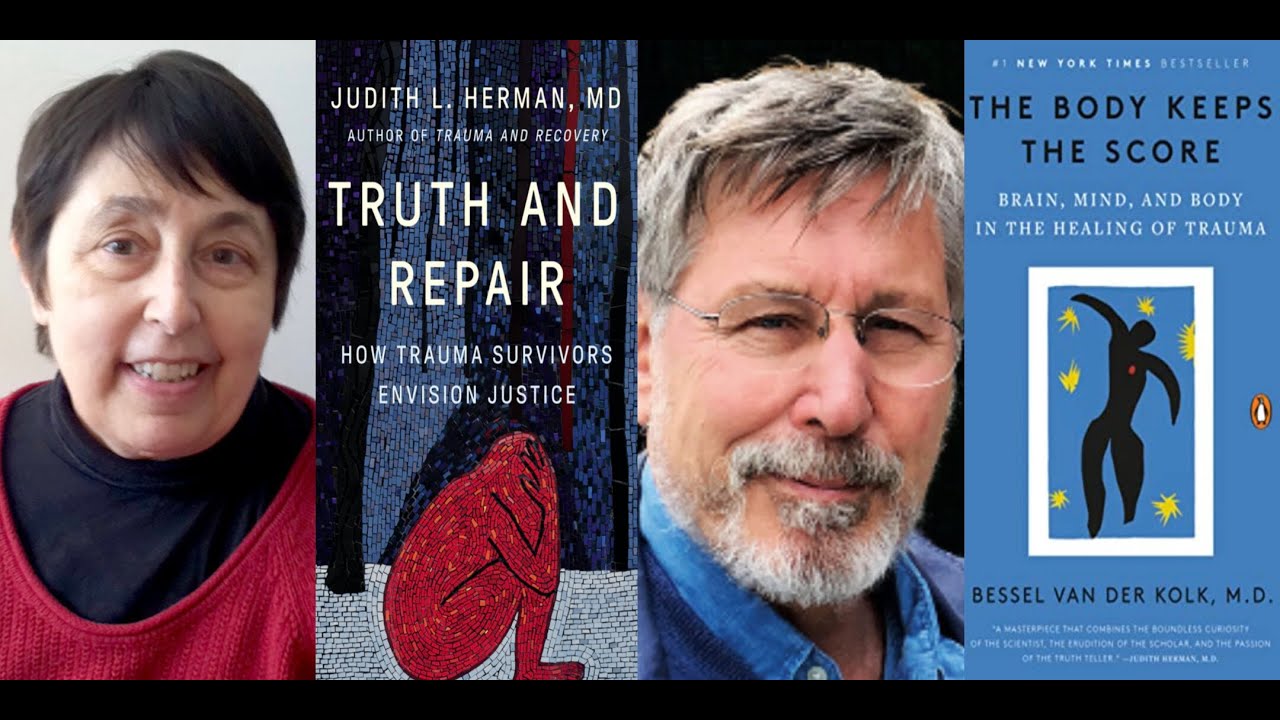
[Music] KREISLER: Welcome to a conversation with history. I’m Harry Kreisler of the Institute of International Studies. Our guest today is Dr Judith Lewis Herman, an M.
D. , Professor of Clinical Psychology at Harvard University Medical School, and Director Of Training at the Victims of Violence Program in the Department of Psychiatry at the Cambridge Hospital, Cambridge, Massachusetts. Her fields of research are the psychology of women, child abuse and domestic violence, and post-traumatic disorders.
A pioneer in the study of post-traumatic stress syndrome and the sexual abuse of women and children, her numerous publications include Trauma and Recovery and Father and Daughter Incest. Welcome to Berkeley, Dr Herman. HERMAN: Thank you.
KREISLER: How did your parents shape your character? HERMAN: my parents are first-generation Americans. They’re themselves children of Jewish immigrants from Central Europe, but they both grew up in New York City, and I think were… My father, child of working-class parents, my father worked in the garment industry.
My mother was the daughter of a doctor, of a family practitioner on the Lower East Side of New York. I think both of them were raised in a secular socialist tradition. Or I should say my mother was.
My father found his way to it from his father’s observant orthodoxy. And when they both became academics—my father became a professor of classics, my mother became a psychologist—I think they instilled what I would call enlightenment values or progressive values in their children. KREISLER: And your mother especially had a really strong influence on you.
You write in one of your books, you write, “Her psychological insight, her intellectual daring and integrity, her compassion for the afflicted and oppressed, her righteous indignation, and her political vision are my inheritance,” you go on to say. Quite a powerful effect. HERMAN: My mother I think was… She was raised I think by her father, who was this… family doctor, very much I think in a tradition of service to others.
If she’d been in my generation I imagine she’d have gone to medical school. That was unheard of, or not totally but very unusual for women of her generation. She went to Barnard and then did graduate studies at Columbia in psychology and I think started off on an academic track to become a research psychologist and then was blacklisted because of a short period of membership in the Communist Party.
And I think that… So the early years of my growing up, when I was around 10 for example, we were introduced to the idea of political persecution and what people do under those circumstances in a very personal way. My father had never been a member of the Party, so when called to testify before McCarthy he could in honesty say to the question “Are you now or have you ever been,” he could say, “No. ” My mother took the Fifth Amendment.
It was clear that she was never going to get an academic job. And so, she then went a different route and got clinical training. But in her later work she tried to bridge the divide between academic research and clinical experience.
I think she also tried to bridge the divide between academia and activism in a way that did become a model for me. And I should also say that her a lot of her righteous indignation and her sense of… a kind of an expectation of integrity and standing up for your beliefs came out of actual experience. There were a lot of dinner table conversations about who was going to testify, who was going to inform, who was going to back up people who refused to inform, and so forth.
And she had a really keen sense I think of irony and indignation about all the weaseling, all the kind of fancy excuses that people made to compromise with something that was morally reprehensible. So I think that was a pretty formative growing up experience for me. KREISLER: Any other experiences from your childhood—mentors, books read— that had a profound influence before the women’s movement, we’ll talk about that in a second, but anything else stand out in your mind?
HERMAN: I had a college mentor that I really should recognize I think and an honor. This was a professor of French civilization at Harvard named Laurence Wylie, an anthropologist really. And he had done a village study in France in which he applied the methods of anthropology ordinarily applied in so-called “primitive” societies to a French village.
He was a participant observer. He had gone there with his family. He had written about it in a deceptively simple manner that I think actually was extremely sophisticated but didn’t involve any high sort of… KREISLER: Theoretical concepts.
Yeah. HERMAN: High… Well they were embedded in the KREISLER: Right. HERMAN: observations and in the presentation so, KREISLER: Lucidity.
There was a lucidity. HERMAN: There was a lucidity and a warmth of storytelling in this book, and it became a very popular book and he ended up becoming the Douglas Dillon Professor of French Civilization at Harvard, which was a funny fit for him, because he was he was a very modest and unpretentious person, and I don’t know if he ever kind of lived up to the grandeur of this endowed chair. But he was a wonderful teacher.
KREISLER: So both of these influences strike me as pushing you, leading you, guiding you in the direction of thinking outside the box, which one could say that that characterizes your work. HERMAN: Yes, and also of keeping your concepts very close to direct observation and direct experience. And in the case of Larry Wylie, we had a seminar on village culture that we read all the classics, but then the idea was to immerse ourselves in primary data and eventually to go to the village and to keep the… The assignment was basically to keep a journal, and to record your observations directly and see what you could then infer from your observations.
The other thing he taught me was cooperative learning, which, there wasn’t a name for it then, but he got these very high-powered students to be in his seminar and they would all kind of raise their hands and kind of spout forth with their ideas, and he would say things like, “That’s such an interesting idea. And it sounds so much like what so-and-so said. Why don’t the two of you work together and see if you can develop this idea together?
” And we’d sort of look at each other in horror because that was sort of cheating. But through his actions, through his example, he modeled a different kind of learning and a different kind of intellectual enterprise, I think, for me. KREISLER: And it’s something that you’ve carried out in your work, namely the whole notion of listening and reporting what you’re observing but also learning in the process from others.
And in this regard the women’s movement of the sixties seems to have had an impact on you. Now, I’m curious now after learning of these other influences how it, the ingredient that it added to the education of Judith Herman. HERMAN: Well… For me this was a logical extension of the activism that I was already involved with.
I had been involved in the civil rights movement, I had been involved in the anti-war movement, prior to the kind of explosion of second-wave feminism in the late sixties. And Kathie Sarachild of the New York Redstockings, who was a classmate of mine at Harvard Radcliffe, and who had been in Mississippi also with me in 1964, she’s the originator of the term consciousness-raising, and like many of the early feminists who came out of the civil rights movement, her organizing technique came out of the work she had done in civil rights and involved people speaking directly of their experience as a way to study our condition. She called consciousness-raising basically an empirical method of investigation.
And her view was that for people whose experience was not articulated, not recognized, not visible in the theory class so to speak, the only way to begin to make our experience known to ourselves was to start with the testimony about the concrete conditions of our lives. So it was a connect for me and many women of my generation I think to start to apply those methods not only to the social issues of racism and war but to the conditions of our own rather privileged lives and to recognize that oppression takes many forms. KREISLER: So that in a way was a spark for your creativity and it helped you sort of look at yourself and your condition in the broader context in which that condition was created, here namely the oppression of women.
HERMAN: Right and also I mean the lesson for me was that one becomes most effective when one is speaking out of one’s personal experience and one’s action grows out of the understanding of one’s immediate personal experience. KREISLER: Now you went to Harvard you went to Radcliffe then to Harvard Medical School. You’re a medical doctor.
What were you doing in Mississippi? Just part of the civil rights movement? HERMAN: I was recruited by a friend and colleague, and now more recently a partner, named Allen Graubard, who had gone to Mississippi the summer before Freedom Summer with Marian Wright, now Marian Wright Edelman, and they had developed this idea that it would be good to have a kind of an academic exchange between Harvard and Tougaloo College, which was at that time, it’s based outside of Jackson Mississippi and was a Black college, and so they implemented this program that involved an exchange of students and faculty during that summer and then, when SNCC and the other organizations developed Freedom Summer, we became an affiliated part of that project.
KREISLER: You got interested early on in trauma, but specifically in the problem of incest, and in one of your books you described a paper, your first paper with Lisa Hirschman, and it really was a case where it almost was on the ground paper. Tell us a little about that. That is, the ideas that you were proposing, both that there should be focus on the subject, and to actually look at its broader context was quite revolutionary, quite radical.
It went to the roots of the problems. HERMAN: Well that’s what we thought at the time, and the reason we thought that was that we were seeing cases. Lisa had just finished her training as a psychologist, I had just finished my psychiatric residency.
We were doing some peer supervision really. And we’d seen all these incest cases and we kept wondering, “What’s going on here? Why are we seeing all these cases?
Is there something about us that’s attracting that, or is this something that everybody starting out as a therapist sees? And if so, why isn’t anybody else saying anything about it? ” And we kept saying waiting for someone else to say something about it, and we waited and waited and nobody did, so then we finally said well maybe we ought to.
I think what gave us the courage to do that, besides our relationship with each other, was having come out of consciousness-raising, feeling that we were part of a movement where it was okay to trust your own observations even if nobody else seemed to think that what you saw made any sense. KREISELR: Before we talk a little about trauma, which became a major focus of your work, I want to have you talk to us about something you say at the beginning of your book on trauma recovery. And that is, you relate the history of psychological insight to the ferment of the times.
And in a short history you show how Freud’s work on, Freud and others’ work on hysteria came at a political moment in French history. That the work on war veterans and trauma and war veterans came as part of an anti-war struggle. And then finally that insights on women and the traumas that they suffered came in the political climate, or the aftermath of the political climate, of the sixties.
Tell us a little about that, because that’s very important in your thinking about these issues, especially the issue of trauma. HERMAN: Well you know, psychology is a very soft science, putting it at its most charitable. What one observes about human behavior, human consciousness human relationships, is so embedded in, and what we observe and how we conceptualize what we observe, is so embedded in the context of what we’re looking for and how we name it.
This isn’t physics. And so, even the paying attention, the selection of what it is that we’re going to consider interesting and significant in human behavior is so formed by the social and political context that we’re embedded in. And I think that’s particularly true about the emotions related to power and control, the emotions related to one’s place in society, one’s place in the family, the emotions of shame, of resentment, of pride, of a sense of legitimacy or illegitimacy.
So, even to pay attention to what women say about sex, motherhood, relationships depends so much on what one thinks a woman ought to be saying, ought to be feeling, is legitimate to express, unless you have a political movement that says, “Forget what everybody else thinks you ought to be feeling, what you ought to be saying. Get down to it tell the truth. What did you actually think and feel and notice in your body?
” You need a safe space to be able to do that. You need a political context to be able to do that. KREISLER: And in the end, one of the intriguing points that emerged from your book is that, in focusing on the trauma endured by children and mothers, which is a new agenda, as you just discussed, what you find is an insight that actually extends just beyond them to victims of political torture, to war veterans, and so on, so that in a way, in looking at the particular, you end up with the universal.
HERMAN: To me that’s kind of… It seems so clear. I don’t know why it’s so hard to figure out, you know. Oppression is oppression.
Being the underdog is being the underdog. Being treated with contempt is being treated with contempt. Being treated violently is being treated violently.
People kind of respond the same way to it. When you get right down to it, pain is pain. KREISLER: But I do think, showing that obvious point is radical and was radical at the time you did it because of the boxes that are created to not make those connections, actually.
HERMAN: Well I mean, radical ideas are always very simple it seems to me, for precisely that reason. And they’re only radical because of those obstacles, if you know what I mean. Not because of their complexity.
KREISLER: So you focused on trauma especially, and women and children. Help us understand what post-traumatic stress syndrome is. HERMAN: Okay.
Well I can tell you about what it says in the DSM IV. KREISLER: Which is the official Bible of the Psychiatric Association. HERMAN: Right, right.
The Diagnostic and Statistical Manual of the American Psychiatric Association, 4th Edition. And I was on the committee that helped write this definition, so I have to take some responsibility. And the committee, I have to say, brought together people who’d worked with traumatized people in many different social settings: combat veterans, accident victims, less from the sphere sexual and domestic violence but we were represented to some degree, political violence.
And what the consensus came out to be was that traumatic events were those that instilled a feeling of terror and helplessness. We used to say by the way that these had to be events outside the realm of ordinary human experience, and we had to get rid of that unfortunately, because if you’re living in a war zone or you’re living in a country emerging from dictatorship or that’s experiencing dictatorship, these are not out-of-the-ordinary experiences, unfortunately. But experiences that instill helplessness and terror.
And terror turns out to be different from fear. Fear is something that we’re all biologically wired to experience when we’re in danger, and we share this with many other animals. When we perceive danger we alert, we startle, we look around and figure out, do a quick appraisal of the situation, and then we either fight or flee.
That’s being revised now by some researchers looking more at women who say, you know, fight or flight is a little bit more the male response. Tend and befriend tends to be, you know, there’s a tendency to kind of huddle with one’s kind that you observe more in females, but okay fight or flight. And there’s a whole biology of fear that’s involved.
Fight or flight doesn’t work in conditions of terror and helplessness, and under those conditions it appears that some kind of biological weak rewiring seems to happen in people, and animals as well, so that even after the danger is over, the person continues to respond to reminders, to both specific reminders and to generally threatening situations, as though this terrifying event were still occurring in the present. So you have the activation of the fear system, hyperarousal, you have a kind of reexperiencing of the trauma that takes the form of flashbacks, nightmares, and so forth, and then you have this other more poorly understood part of the traumatic syndrome that has to do with a kind of shutting down of responsiveness, numbing, a sense of that things aren’t real, there may be amnesia for some or all of the event, a sense in the aftermath that one is just kind of not really oneself, one is going through the motions. There’s a loss of connection of things that are or previously of interest, and these are called the numbing or withdrawal symptoms of PTSD.
So hyperarousal, reexperiencing, numbing is the sort of triad. It’s a descriptive formulation. We understand a little bit about the psychobiology, not a whole lot, and I think we’re coming to understand more and more that that’s the simple form.
That’s what happens to some people after a single impact trauma. If you repeat it over and over and especially if it begins early on and one’s development is formed in this environment, it gets a lot more complicated. KREISER: And this is often the case of women and children who are in domestic situations where the cycle goes on and on until… HERMAN: I think it’s true of people in any situation, of course, of control, whether you’re talking about a hostage situation that goes on for a long time, whether you’re talking about domestic violence or sexual child abuse, whether it is, some religious cults have this same captivity kind of situation, and then of course the political situations of concentration camps or political prisoners.
KREISELR: In summarizing or introducing your discussion, you say “The dialectic of trauma gives rise to complicated, sometimes uncanny, alterations of consciousness,” and then you go on to compare the political doublethink in an Orwell novel with the what the psychologists and the psychiatrists called dissociation. So in a way you’re suggesting that this kind of repression, inability to confront both the individual reality and the larger reality is something that happens to the individual and in some ways to the society. HERMAN: Yeah, it’s fascinating.
I mean if you talk to survivors of especially the prolonged and repeated trauma, where the perpetrator, the captor, the torturer isn’t content to just have external compliance but wants the captive to adopt and endorse his worldview, even after liberation what you’ll get people saying is “I’m living in a double reality. I have the present and the past coexisting in my mind. It’s not clear which is more real to me.
And I have what’s left of my old value system or my old way of seeing the world and the perpetrator’s way of seeing the world coexisting in my mind and I can go back and forth between the two, and I’m not sure which I belong to or which belongs to me any longer. ” So people have the experience of living in a double reality. And they describe, even with the, even amnesia.
People will describe simultaneously knowing and not knowing what happened, remembering and not remembering what happened. When people get their memories back they will often describe it as simultaneously reliving the experience and being outside of it as though it happened to somebody else. So people really learn to divide their consciousness under conditions of captivity, under conditions of course of control.
And since we don’t even understand unitary consciousness very well, when people have got double consciousness, double reality, to me, I’m in awe. I think it’s a fascinating window, in a way, into how the mind works. KREISLER: And did this experience that you’re describing.
In your book you actually quote extensively from the memoirs of everyone from a former star of, or a forced participant in pornographic films, but also a political prisoner, and there are common themes that run through their sense of this experience which you have just summarized. HERMAN: Well and to me that’s not surprising, given that the methods of the torture and the methods of the pimp or the pornographer are often similar, and I think when we understand more about criminal gangs as an intermediary form of organization between say state-sponsored terrorism and one-family cells of domestic violence, we’ll understand more about the transmission of methods of torture, methods, of course, of control. But if you use the same methods on people, whether you’re doing it in the name of the state, in the name of a criminal gang that’s marketing your body, or whether you’re doing it in the name of the authority of a father or the name of some religious cult, the methods are the same and so the mental processes that they produce are likely to be the same.
KREISLER: In your work you enter this realm of such apparent hopelessness and despair, but the other side of your work is identifying the features of essentially hope and recovery, and the road back. I want you to discuss with us the elements of a survival. That is, survival and recovery, which is the other part of the title of your book.
So what are the elements that we see? The common elements in people who experience this but make it back? HERMAN: First of all I guess I should say that that’s the other reason I stick with this work.
I’m constantly in awe of the resilience of the people we work with. They really do get better, they really do make new lives for themselves. They find incredibly creative ways to put the pieces of their lives back together, and a lot of times, since a lot of the work I do now is supervising students, teaching them how to be therapists, I get to observe the way the patients re-instill hope constantly not only in the students and those who are privileged to watch and observe this process.
The students will come in and say, “I just met with this woman from Rwanda and she, you know, she lost her whole family, she managed finally to get out to Uganda with two of her brother’s kids, and they’re, you know, staying with a minister in Uganda, and she came here, and they only could get papers to bring her, she’s working under the table cleaning houses or cleaning offices at night, she has no money, she’s living in apartment with ten people, and she has the worst PTSD I ever saw, and she’s here for a political asylum evaluation. What do I possibly have to offer this person? ” And in the first interview, here’s a woman who speaks in monosyllables.
Her eyes are down, her head is bowed, her shoulders are like this, she’s hunched over. If you drop something on the floor or a car backfires outside she jumps out of her seat, otherwise she’s immobile like this. You think, “This is the worst depression, this is the worst PTSD I’ve ever seen.
” PTSD is post-traumatic stress… “What am I going to do” And so you work on documenting her case for her political asylum hearing. And you also work with her on trying to understand, is she safe now? What’s her environment like now?
What can she do to… what does she need now to begin to rebuild her life? And within a few months the same person comes back into our office and she’s lively, she’s smiling, she’s talking. She’s gotten her asylum, so she’s safe now.
She’s starting to work and bring those kids over. She’s joined a church, or she’s started an English class. A lot of work we do is through interpreters.
She’s found, on her own, some kind of community, with our encouragement, and she will come back and say, you know, “You listened to me, you seemed to care, you helped me out, you gave me what I needed to get what I needed. That restored my faith in people. ” And we sort of feel like all we did was, you know, we did so little, but it was enough.
There’s a way in which survivors, many survivors, make do with the least little bit of human caring, human concern, to put back the pieces of their lives. And so from my point of view, if we can provide that, it’s a gift that comes back to us many times over. KREISLER: And so as you’ve just said, there were really three elements.
It’s sort of providing them a zone of safety then, they remember and tell their story, and then but very importantly, they have to reconnect. I’m curious as to how you would characterize what you do beyond what you just said. Obviously you do some interviewing.
And is it an important element of that interviewing to be a witness? And to provide the essential elements of this safety, this support for telling the story? HERMAN: I think bearing witness is important.
You know, I also don’t want to minimize the skill or the sophistication of the treatment that we do because people, a lot of people who come to us do have complicated both medical and psychiatric conditions and they don’t just necessarily have post-traumatic stress disorder. They need all of their needs attend to, and they’re often quite complex. I’m thinking of a woman for example, who it turned out… Here’s an example of how complicated it became.
It turned out that this is someone who had been repeatedly raped, this is another political asylum case, and was having persistent vaginal bleeding, and had never had a medical exam, but because of the vaginal bleeding also was considered unclean, couldn’t have intercourse, also couldn’t enter the mosque. This was an Arab woman, a Muslim woman from Algeria. Getting her proper GYN attention on the one hand, the medical part of it needed to be attended to, and on the other hand, we needed to find sort of a friendly mosque.
We needed to find someone in the clergy who could actually begin to reconnect her with a spiritual community. And we needed to do some family work in order to start helping her repair her relationship with her husband. And this is someone who really felt dee— The meaning of the trauma in terms of a sense of stigma, contamination, ostracism and so on, it was not metaphorical.
It was carried on in the physical symptom of bleeding, and until the bleeding was addressed, there really wasn’t any hope of the making new meaning out of what happened to her. So we pay a lot of attention to the meaning of specific symptoms in individual cases and we really take an approach that ranges from the biological to the social. KREISLER: In your work this emphasis on community and broader issues such as power recur again and again.
In the specific case of your careful examination of the problem of incest where you end up if I can summarize, and I hope I’m not being unfair, is in a way to look at the broader society and to ask the question, well, will this kind of problem ever go away in a patriarchal society? And in a way your answer is no on the one hand, and but that leads you to propose essentially the need for political action, in the sense that what you have to then look at is the family in which the partners are equal, the male is not the dominant one, and it’s only in such an environment that one can find a kind of equality, where men for example are involved in the rearing of children, more than involved, are equal partners, and that’s how you really get at the root of the problem. So in a way, this analysis goes back to what you learned at the dinner table.
That psychological insight cannot be separated from political insight and action. HERMAN: Absolutely. KREISLER: So would you add anything to that?
I hope it wasn’t an unfair summary of where… But in the end, the individual can’t deal with this alone is what I’m trying to get at. HERMAN: No, and I think that’s the take-home message that I try to give whenever I teach and whenever I do my therapeutic work, whether… I don’t think patients, that survivors, victimized people, can recover in isolation. They need other people.
They need to take action in affiliation with others. I don’t think therapists can do therapeutic work alone. When we’re isolated with this we do give into despair, we do burn out, or we lose our perspective.
And ultimately, you know, if you’re talking about horrible abuses of power, you’re talking about the atrocious things that one person does to another person. And just when you think you’ve heard everything and there’s simply nothing else that you could imagine that one person would intentionally do to another, somebody comes along with a story that just blows you away all over again. So you’re dealing with very profound questions of human evil, human cruelty, human sadism, the abuse of power and authority.
And the antidote to that is the solidarity of resistance. Nobody can do that alone. KREISLER: You say at one point, “We do know that the women who recover most successfully are those who discover some meaning in their experience that transcends the limits of personal tragedy.
Most commonly women find this meaning by joining with others in social action. ” And this means concrete things. It means hearing other people’s stories.
It means mentoring in the context of a tragedy. But also joining organizations to change the laws about what the criminal justice system says is a violation of human rights. HERMAN: Right.
It means going down and testifying before the legislature, or taking part in some kind of public education campaign, or going to court, or accompanying someone else to court, or demonstrating in favor of the assertion of victims’ rights. KREISLER: In looking at your career, you combine political activism with accomplishment in a professional field. And some concluded you know in the sixties that that was not possible.
That is, to bring sort of radical insight, you know, to expertise in given areas. I’m curious as to what your advice would be to students who might, you know, read this interview and say you know, “Gee, that’s the kind of thing I would want to do with my life. ” How do you prepare to be both an activist and a professional, you know, in a field like medicine and law?
HERMAN: Oh I think it was a lot easier in my generation. We didn’t have to find the movement, it just found us. I have a 21-year-old daughter who has just graduated from college.
She’s trying to figure this out now. But the truth is that you could start almost anywhere. Whatever, I mean, there are so many things in the world that need to be set right, you can start with whatever fires you up, whatever excites you, whatever fires your indignation, and put your energy there, and it’s as good a place to start as any.
I think that if it speaks to your heart, if it engages your imagination, if it makes you want to get out of bed in the morning and do something, that’s probably the best place to start, and that to me is the inside of the political movements that I was part of, is you know, organizations come and go. Intellectual theories come and go. The power to change the way people think and what people do comes out of small groups of people who care enough about something to try something new.
And that can be done anytime. KREISLER: And it’s also about ideas right? I mean, embedding yourself in history, in a way, to sort of go with those new ideas and formulate them yourself.
HERMAN: Yeah. I mean… There is an intellectual tradition of political activism, I think. It’s one of these things that isn’t as strong in this country as in many others and often needs to be kind of reinvented, rediscovered in each generation, but yeah, it helps if you know that other people have thought these things before, you have tried organizing before, you don’t have to invent everything from scratch.
But on the other hand, one’s immediate historical circumstances are always new, and I’d rather see people sort of take the plunge and try innovating and then have to study up because “Oh my god I better inform myself because I need to arm myself with knowledge,” than try to deduce from the history of the past what should be done now. KREISLER: But for you the study of history and politics is absolutely fundamental to the study of psychiatry and psychology? Or is that an overstatement.
HERMAN: To me it is. It’s absolutely fundamental. Let’s just stop with that.
KREISLER: You express a concern in your book where you have a concern that new researchers will lack the passionate intellectual and social commitment of your generation, and you go on to say, “They will not see the essential interconnection between biological, psychological, social, and political dimensions of trauma. ” HERMAN: Oh I think that’s happening already. It’s the price of respectability, unfortunately.
The trauma field is now, you know… KREISLER: Legitimate. HERMAN: We’re legit! Yep.
And people write dissertations, and people apply for research money, and, you know, drug companies get approval for their drugs for treatment of post-traumatic stress disorder, and so I can see it happening already in the traumatic stress field. It’s, you know, if you want to kind of keep it clean it’s nice to have some, you know, a nice clean auto accident victim study. and hopefully not where there’s any sort of corporate liability in the accident, corporate negligence, but where it was truly an accident, and then you can, you don’t have to get into any of this murky messy social issue stuff, and you can just do a nice psychobiological study, and you can randomly assign people to eight sessions of cognitive behavioral therapy or eight sessions of a serotonin, or you know eight weeks of a serotonin reuptake inhibitor or a combination of the two or a placebo and see what works best.
That’s probably a legitimate study. I’m not against it. I just think that’s not really where the interesting questions lie.
KREISLER: And so finally the interesting questions really lie in values basically. Is that the answer or…? HERMAN: They lie in those areas that we don’t understand yet that are so murky and so confusing and so emotionally laden and so riddled with controversy that, you know, if you want to get your research funding you probably should stay away from there.
But, if you want to really figure out how the mind works or how society works, that’s the place to go. KREISLER: Dr Herman, thank you very much for being here today, sharing your story with us, and your example, actually, for future generations. HERMAN: Thank you for having me.
KREISLER: Thank you. And thank you very much for joining us for this conversation with history.