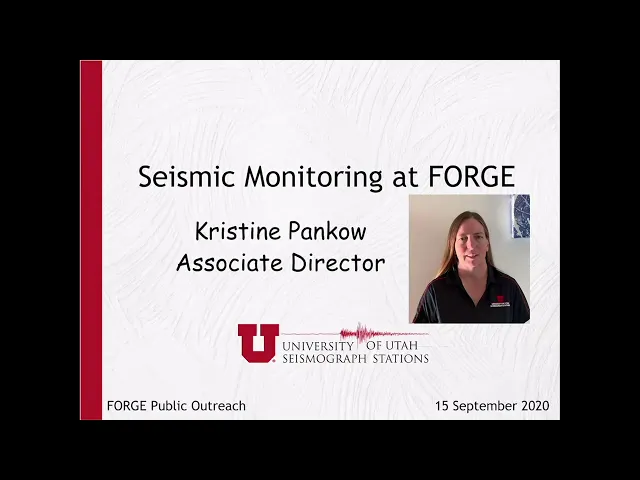
[Music] hello i'm dr christine panko i'm the associate director of the university of utah seismograph stations and i'm here to talk to you about seismic monitoring at the forge site so why are we talking about seismic monitoring well commonly when we talk about seismic monitoring we're talking about earthquakes but different types of activity can also generate seismic ground motions and in utah we actually see seismic ground notions of ground motions that we record on our seismometers from earthquakes the gray dots in the map they occur along the i-15 corridor and something we call the intermountain seismic belt we also get seismic ground motions and seismic events from industrial activities so we see small um seismic events induced by mining in the wasatch plateau and the book cliffs shown by the hatred in central utah there's water injection induced seismic events out in the paradox basin on the colorado border we have quarries and mines shown in orange and yellow circles on the map and in addition to the industrial activities we have military activities where where there's things being exploded out at dugway and at the utah test and training range so all of these different activities produce ground motions and actually in geothermal areas we also like in mining induced seismicity you can also induce earthquakes so you induce these seismic events they don't tend to be large events but they do happen most notably basil switzerland and in korea so before we even put forge in and talked about forge we looked at seismicity here to see what the potentials for this for induced events might be and you know again on the left we have a map of earthquakes so again this is um for earthquakes for utah red circles or magnitudes larger than four you know in utah we know we can get these events throughout the state so it's not just in the wasatch front along the wasatch falls so throughout the state we see magnitude four and larger earthquakes and if we zoom in on the milford area we actually see that there was magnitude 4 earthquake near milford back in 1908 um and there's was magnitude 3. 9 in 1998 so these are just earthquakes they're just the result of stressing in the crest from natural tectonic processes in our analysis of the the milford area we found some seismic events we primarily characterize seismic activity in this region as having low seismic rates and and small magnitudes the majority of seismic events on the map shown in the blown up map here are less than magnitude 2. and they sort of divide into three areas there's a polygon labeled quarry these are largely related to the mining and quarry activities on north uh west of milford the larger events those fours tend to occur near the airport area they're very infrequent so seismic activity in this area is even lower than rates in other parts of the milford valley most of the seismicities tends to occur under the middle mountains some of this being natural seismicity related to just again natural tectonic forces in the crust um we have a swarm zone where we get little bursts of seismicity occurring in this area and then there's also seismicity that's associated with the blundell power plant but again these are really small earthquakes and they've been going on for a very long time they aren't felt because they're so small but they occur just in the background okay and that's a lot of what happens with induced seismic events is they're just really small and they occur in the background sometimes they can get larger and so we looked at what we might expect for a larger event in this area looking at what the activities associated with forge and fluid volumes we're looking at maybe magnitude two or three to be conservative we've been looking at models for magnitude 4 to see what the implications might of that might be and whether or not you get to these larger events depends on having pathways to basement faults so we also went and looked for basement faults and our imaging techniques aren't perfect but we don't really see any clear signs of large fault structures that would support a larger earthquake in the area but as i said it's somewhat imperfect but we don't we don't see anything that leads us to that conclusion so we've been working on this magnitude 4 as our scenario earthquake and for those of you who were in the area in january you felt the magnitude 3.
9 or many of you did that occurred under the southern mineral mountains about the same distance from milford as the forge site you know about 140 people reported feeling this we didn't have any damage this is what we'd expect for this size of event and this is what we expect if if for some unusual reason we get a magnitude 4 under the forge site so we even go further we've been working on mitigation strategies so the first thing you should know is that seismograph stations monitors earthquakes in utah 24 7. there's a duty seismologist and a senior scientist on duty 24 hours a day seven days a week in addition if something happens we are backed up by the united states geological survey through the advanced national seismic system typically in rural areas we set our thresholds for waking people up in the middle of the night at about three and a half because they aren't commonly felt some some places are magnitude three in urban areas they're set to two and a half so sort of under the salt lake valley wasatch front area or st george our alarming thresholds are two and a half so we're going to put the two and a half out here at forge so we know what's going on so that means that someone's going to get up in the middle of the night if there's a two and a half or larger event and review that seismic event within about 30 minutes we'll also produce shape maps and stuff will propagate to the web in real time automatically we've also put together a mitigation plan and again we've been looking at the magnitude four we don't want to get to four or larger we want to make sure that these are these earthquakes aren't anything that's induced at the forward side doesn't really notice and we certainly don't want damage so we're going to do what we can to mitigate the possibility of a magnitude 4 or larger and so how we're going to do that is we're going to look at the rate of earthquakes that occurs in the size so in any given 24-hour cycle if we see 10 magnitude 1 or larger earthquakes in that forged footprint area or a magnitude 2 or larger earthquake we're going to be more cautious we're going to call a meeting we're going to slow things down and we're going to potentially change activities at the well so that we you know will change the injection rates or volumes if there's a magnitude 3 in this larger area all activity stops they'll flow things back and and everything will change and we'll look at what what's happening um to better assess the situation okay so all of this information you're going to be able to find it's going to go to the website quick. utah.