[Music] than all you said things I don't understand so but thank you also for the chance to come and uh and be with everybody here um and uh I'd also like to congratulate um Dr Mon who's been doctor for 48 hours um or perhaps 47 right now um so I wanted what I wanted to do was to um coming out of some discussions over the last uh few days um back up a little bit from what I was going to talk about and talk about the philosophical project that has led me to a variety of
technical things which maybe we could get into later or over dinner or whatever um but this has been a long philosophical route um it actually started in uh October of 1967 When I Was An undergraduate um in the middle of the 60s and I was a typical 60s college student in the United States I was completely torn between politics and religion on the one side and staying up all night talking to friends on the one hand and then also um I was a physics and math major and uh and those two parts of me ripped
apart and uh a computer was delivered um they were brand new there were no computer science then um and I was interested in it I was partly interested in AI although I didn't even know the name um but also interested in what computers were in particular whether um the computer could play a role in healing this gap between the part of me that was interested in complexity and politics and religion and so on on the one hand and the kind of power and elegance and so on and so forth which I saw in physics um
and in particular was respect to the Human Condition could you have an account of The Human Condition which would have some of the power of the Sciences without being desiccating and reductionist and all of these kinds of things which I thought scientific accounts historically had been so that was my naive 16-year-old View and uh I started to uh to program I don't did we end up Harry with markers or not yes um somewhere it doesn't really matter no you got them okay yes Slow Down slow down but I was speaking so slowly um I thought
the markers might help me slow down so um um so the first thing that was interesting um and and I think this is a serious point which which Alexander thesis and that work of others in this room illustrates is that I started programming I started hanging out in the uh computer center I had a girlfriend who had another boyfriend and that was a great motivation for learning how to program and what I learned was that the theories that were articulated about computation didn't match what it was that I felt like I was learning as a
programmer and with respect to AI in particular cognitive science and so on I think it's really interesting um if this is the mind and this is Computing and if artificial intelligence or cognitive science is roughly that there's some equivalence between the mind and the computer you know mind is a kind of computer or something the debates about this are not conducted at the level of the phenomena the debates are conducted in terms of a theory of the mind and a theory of computing and then people write papers at this level and there's lots and lots
of papers about whether the mind is computational and there's one theory of the mind and then there's another one drus criticizes um Minsky and comes up with a different theory of the mind and then Andy CL comes up with a different theory of the mind and there's all this contestation with respect to the theory of the mind but I was concerned on this side of the equation because the theories of computing that they were comparing the theories of mine to didn't strike me as true of the Computing that I was actually dealing with so I
wanted to know about this side of the picture and I thought I would spend six weeks or something figuring out what Computing was and then if I understood what Computing was for real I could actually address this question which I wanted to spend my life on and I've actually spent my whole life on this side of the question the six weeks is barely over now um and it turns out that this is interesting for many more reasons it's much more interesting than I expect um one thing that's interesting is that there isn't just one theory
of computing there's two you know there are a variety of different conceptions of computation out there and a lot of people seem to think oh they're all equivalent partly because of a mathematical proof of equivalence in um formal computer science but the thing about the mathematical proof of equivalence in computer science is that it's so coarse grain that it runs rough shot over every philosophical distinction you could conceivably imagine I mean you know uh materialism and dualism and behaviorism and representationalism and all these kinds of stuff that theory just obliterates so if we're going to
actually understand what the mind is like we need to understand um the theories in in uh in some difference I'm just going to mention four although there's more out there than uh than than that one idea is that computers are formal symbol manipulators that's an idea that you read about in philosophy and in cognitive science and a little bit in AI there's another theory which I'll call effective computability which is the theory of computing that deals with touring machines and is the mathematical theory that computer scientists deal with a lot of people assume these two
are the same I think they're radically different another idea is that um computers are information processors and information has become a hugely popular word it's probably more popular than interdisciplinarity now um so there's a question of whether whatever information is and do these things process information and there's a question of what information has to do with either of these two um and uh there's a an idea that computers are digital in some important sense which it's sort of obvious that that doesn't exactly mean this but people still sort of assume that and so on and
so forth so my first project was to try to understand um as I said whether any of these theories was actually add quate to computation and uh um and I just want to say the first substantive result is they're all wrong they're just not one of them I believe is adequate to explaining computation nor any combination um now in a in in in before we're done uh I will answer some other questions like what's right if those are wrong and if those are wrong is that a negative result I think the fact that they're wrong
is actually interesting but has a huge amount of positive stuff to it um but uh but I will just claim that not one of those will do justice to the thing that I call computation in the wild the actual fact that computational stuff has drenched society and has a lot of power in society and is changing the internet and and changing people's ideas of themselves and so on and so forth um obviously the ideas we have about Computing are affecting Computing and what Computing is actually like is affecting the imaginations especially of young people in
ways that are related to the theories and so on and so forth so If This Were A Summer Long seminar as opposed to a 40-minute talk we would have to be more subtle and nuanced but just to be blunt for today I'm just going to say that they're wrong and um and I'm going to tell you why in a minute but I want to make a couple of Meth logical points first just two really um because when I say that they're wrong I tend to get two kinds of answers one of them is you're crazy
now I get that a lot I get it a lot especially from computer scientists who say look of course you're wrong this is the Right theory of computing because that's how Computing is defined now I don't know what a definition is I don't actually like definitions myself but the interesting issue of authority in that is that people and actually people say this for lots of different ones they say that's how Computing is defined so the theoretical computer scientist will say it's defined to be the computation the effective the mathematical comput um calculation of effective functions
there's huge problems with that characterization which we could go into um if you talk to philosophers they say it's defined as formal symbol manipulation I remember talking to Fred Drey a philosopher you may know of about cognitive science and I I was saying look computation is not formal symbol manipulation so therefore whether the mind is a computer he wrote a presidential address for the American philosophical Society arguing that computers can't add and his idea that computer can't add was based on this conception and I said look what if that conception was wrong and then he
said well then philosophy is not interested in computation they're only interested in the idea they're not interested in the phenomenon and that's the kind of thing I get from a lot of people who say the definitions are um have authority I don't believe that I actually think it's much more interesting to understand what actually happened historically you know starting maybe with bu or or uh in the mid 19th century with a rise of information as a notion um you know touring and all this kind of stuff and actually take an empirical stance so I want
to basically take an empirical stance and I will take Ai and cognitive science to be ostensively defined I will say basically Ai and cognitive science is the following thesis that things like that are like things like that and just you know everything else then depends on um you know everything else can be brought into question um so that's one thing people think they're defined another thing is that people think well look but we build them we must understand them I think I don't need to spend a lot of time on that but that is clearly
false um we build well we build cach M you know these machines that you can take uh Euros out of at the corner of the bank I know how to build one of those but that doesn't mean I understand money um I have a nine-month way of building people um it doesn't follow that I understand people if I use the nine-month way a lot of people assume that the nine-month method is completely different from what it is that we do in the laboratory and I don't know um why they think that um so I want
to take this as an empirical phenomenon and I want to take it as a non-transparent phenomenon um so those are two methodological assumptions a third methodological point is that a lot of people think well okay maybe we'll give you the idea that the status of theory is problematic but some things we know at least we know these are machines at least we know their technology at least we know they only do what we tell them to do now I don't know who says they're machines I've never seen anybody do a double blind uh imp iCal
study to test whether a computer is a machine or not I don't even know what it would be to do with such a study this is basically a presupposition certainly nobody who has worked with computers for very long thinks that computers only do what you tell them to do so that presupposition is manifestly I think false of practice for lots of reasons having to do with complexity and learning and so on whether they're technology or machines whether in particular they're the Zenith of the mechanist philosophy stemming from the 17th century are these things mechanical that
is to say are they explanatorily accountable for in terms of being mechanisms I don't want to assume an answer to that and if you think about it there's an astonishing fact about computer science which is that all the technical terminology words like symbols and data and interpretation and reference and identifier and name and syntax and so on all the technical terminology comes from the interpretive cursive logic you know rationalist tradition not from machinery and forces and pulleys and fluids and and and weight and so on and so forth so that's a kind of just an
interesting very superficial observation which is that's interesting all of this stuff is being described using words which come from that part of our tradition that deals with texts and discourse and interpretation and semiotics and exegesis and hermeneutics and so on and yet the things are actually built in I just read this morning in these Fab lines um this company in um in uh China has just invested 17 billion dollars to expand one Factory um you know so there's a lot of mechanism there what's the relationship between the mechanism and this discourse that comes from the
interpreted discursive Traditions um so I don't want to buy that they're machines and I don't think what anybody should because suppose the mat lab where I went to school constructed a device that was actually intelligent now you might say no machine suppose Alexander has argued that no machine can be intelligent and MIT produces a machine that is to say MIT produces something in its AI lab which is intelligent there's two possibilities one is Alexandra was wrong sure enough a machine can be intelligent another possibility is on the day when in fact they got this thing
to be intelligent it ceased to be a machine and it became being or doine or something like that who knows who knows what baggage the word machine technology and so on and so forth brings with it so I want to set that aside as well that kind of set of obvious assumptions so in some methodologically I want to set aside presumptions its definition I want to make it empirical and I don't even want to assume the broadest characterizations in terms of of mechanism or Machinery um okay so that's methodology then we need to look at
these four accounts um now I'm going to tell you what's right later but I'm going to tell you what's wrong first and I'm going to tell you what's wrong in two stages one in particular with respect to each account and then um and also a little bit what's right in particular and then also I'm going to sake some remarks at the end about what's wrong in general General with all of these and what's right in general and then I'll try to tell you what I think the right answer is um formal symbol manipulation which I
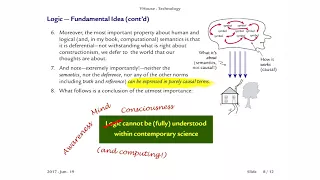
will associate with formal logic namely people who like to write letters rotated by degrees um I think there are two insights in this tradition which interestingly enough have been almost entirely lost even in the logical tradition so I have to go back to what I think logic actually meant at the beginning of the 20th century basically the following two things one is that this is fundamentally a meaningful system there's something like semantics this or interpretation whatever your favorite word is a ano esque Arrow of directedness There's issues of of of that but it's essentially I'm
just going to use the word meaning issues of semantics are fundamental the second point I think is that it has to be mechanically realized we don't want to be cartisian dualist about it it has to be physically realized and then the the real insight is the following I believe the mechanism that you build is subject to Norms that come from here that are not themselves mechanical and I would actually summarize the entire sweep of 20th century logic uh this was actually in the words of John barwe A friend of mine who was a world famous
logician fundamentally you cannot reduce semantics to syntax that's basically what he took all the 20 centur logic as a demonstration of and I think the reasons are profound and metaphysical basically that semantics is not a local mechanical phenomenon it has to do with relationships to the World At Large syntax has to be mechanical and these systems are mechanical systems that are constitutively governed by semantic non-local Norms that's what I think the Insight is um mechanism honoring semantic Norms that's I think a profound Insight which has almost entirely been lost in contemporary cognitive science what's wrong
with logic lots of things one idea is that these are formal symbols the idea that this that the way that intelligence arises is out of these particularly chunk symbols you know consisting just of predicates and relation symbols and terms and so on and so forth the way logic does it there's lots of evidence that the brain doesn't work that way the mind doesn't work that way um the idea that the syntax is independent of the semantics which is one of the readings of this word formal I think is also demonstrably false uh dfus is critique
that the ontologically the world is not um doesn't consist of objects chopped up in nice um it's not like God put white labels on all the objects and the tables in the property in advance and so on and so forth you just read them off that's not the way the world is um for example the idea that all the symbols are inside the head and all the semantical stuff is outside the head um also problematic um the word formal is interesting because one of the things I did 20 years ago was I tried to survey
the number of things formal mean so I talked to a lot of people I talked to Freeman Dyson in physics about what formal means if you're a formal physicist I talk to musicians and you know it's it's everyone's sort of favorite non-formal word and can mean syntactic or can mean mathematical or it can mean not really with any heart heart and soul my favorite definition uh of formal was authorized in the sense that so this is an American example if you get a formal invitation to the White House that means you actually get to go
there um I think the authorization behind the notion of formal is interesting but anyway there's a whole critique of formality we can actually spend it an entire afternoon or summer on um as to what it's doing but I think the formality is wrong I think all of those use of formality wrong so there's tons wrong with that account but I think this idea this is a big idea and a good one what about effective computability the theory of touring machines and uh and all of that kind of stuff I'm just going to say this what's
wrong about it is it doesn't deal in meaning at all what I think it is is a mathematical theory of causality so this thing I think is the Triumph of the philosophy of mechanism but the problem with it is that what computer science is trying to do is to in fact Advance the hegemony of a mechanist reduction of intentional phenomena by actually thinking that you can give this account of it and then there's this wondrous historical point that for a variety of reasons that start out on page seven of touring's original 1937 article all of
this discourse that I mentioned before of signs and symbols and representation and and names and all this kind of stuff gets picked up and put inside a mechanist framework so now if I go to a computer science department I talk about sematics and I talk about meaning and I talk about intentionality and I talk about directiveness and I talk about truth and I talk about reference and I talk about consistency and I talk about all these semantical phenomena they say oh yeah yeah yeah yeah yeah and they have mechanical interpretations of all of those words
so I've lost vocabulary with which to talk to people trained in computer science about what I think the real issues of meaning and representation intentionality and world directedness and and so on and so forth are so that's a kind of perverse situation in intellectual history at the moment that computer science has picked up all the rationalist vocabulary and dump it inside mechanism but I think when you clear all that out this is just a theory of bumping and shoving it's just a mathematical theory of bumping and shoving and the problem with that is a theory
of computing is I don't think Computing is just bumping and shoving because if it were it would just be all machines and so that's not going to be enough to capture what's going on with respect to the computation stuff um what about information processing this is certainly the most popular conception of computing in the newspapers well as I say information is um a popular word these days the problem is you know and uh florid goes around talking about the philosophy of information being this wonderful thing I mean he's tring he's a booster for philosophy information
you know people are starting institutes everywhere there's this uh center for the theory of information and stuff people are trying to make you know G has this popular book called the information I don't know if it's in French yet it probably will be if it's not people are trying to make a huge deal out of the notion of information I don't think florid is right I mean let alone the fact that he's sort just a a popularizer I don't think there's any reason to believe that these two phenomena are necessarily the same I'm not saying
they're orthogonal but I don't think they're the same if I come to you ector I believe is Alexander's um young son whom I met the other day if I come to Alexandre so don't take this seriously all right and I say unfortunately ector was just hit by a bus and has been taken to the hospital seven uh blocks down the street and uh he's in emergency room and he's on a heart machine Alexander is not going to say well that's interesting seven btes you know seven bits of information with error correction I can put that
in two bites of code and all this kind of stuff you know that that was an interesting amount of information you just gave me right he's not going to talk to me at all he's going to get out of here and fly over to the hospital because information in that sense if I say I have information about his kid is about something so it's basically a a a semantic notion and there's a huge uh philosophical tradition is as many of you I'm sure know starting with stamp and Drey and milin and a lot of people
in U well a lot of people in analytic philosophy are trying to use a notion of information which is semantic which they're going to derived from evolution in order to construct a scientific account of semantics and then normativity and then they're going to get is out of a and that's part of the Naturalization of of a things basically that's the kind of intellectual project they're part of there's another notion which doesn't say what's the information about it says how much it's just a measure quantity these are the people that tie information to heat you know
loss of a bit information is equivalent to one over planks of a certain amount of thermodynamic heat um the the hgs boson the God's particle was recently discovered communicates with other fans and bosons by passing information and so on and so forth there's this much information in the universe how much Universe can you pack how much information can you pack into a black hole this is a pure quantitative measure I went to a conference 20 years ago talking about this the the unification of quantum mechanics in with a notion of information and I put up
my hand and I said what about um I asked the a speaker I asked a question of the speaker I said what about what are you going to say about what information is about and the speaker came to a complete halt someone in the audience stood up and said about that's a word for philosophers information is a scientific notion it has nothing to do with aboutness and there was a huge cheer in the uh in the audience I think that's kind of indicative that we maybe don't have exactly the same notion here so so first
of all the notion of information falls apart into more than one notion um what's going on here what's right about this oh what's wrong with it well first of all I don't actually think Computing is just information processing if if your computer messes up and doesn't get an email it's not just information about your email that it didn't deliver it actually didn't deliver the email itself right computers are actually causally engaged in the actual practices we're engaged in they don't just process information about the practices we're engaged in if they put up a window they
don't just put up information about it being 3 in wide they actually put up a window that is 3 in wide the actual material properties themselves matter not as semiotic indicators so I don't think information processing is is wide enough to deal with Computing I don't think the Notions of semantic information are true of the kinds of information on the net because these Notions all require Notions of proper function function and Notions are veridicality and a variety of other things the quantitative notion may be relevant to the physics but it doesn't deal with the with
the meaningfulness so it's all kind of a mess what's going on I think is the following both the semantic notion I believe and the quantitative notion are intellectual attempts of people to deal with the fact that the world has relational coherence it's not just local and just as I think now dynamicists laugh at the first half of the 20th century about just looking at linear Dynamics because that's a such a small case compared to Dynamics full bore I actually think the 22nd century will laugh at the 20th century for having been looking at physics as
just the local bumping and shoving basically without dealing with the issues of of non-local coherence which is just I think of enormous importance to any notion of meaning I think you can see that in quantum entanglement I think you can see that in Notions of semantic information I think the quantitative measure is to some extent a measure of non-local coherence but they're trying to reduce it to a to a local property that the higs boson passes to the fance and and and and other bosons and so on so I think there is a background notion
a theme that underwrites these and I think the relationality of the world the nonrandomness of the world is important to Computing but this is not going to work as a theory um and digitality I'm not going to say anything about except this so John hogland an old friend of mine um who passed away had this wonderful quote he said digitality is an engineering notion root and Branch it's a method for coping with the vagaries and vicissitudes the noise and drift of Earthly existence kind of a Biblical um reference what I think is right about that
is that I think digitality which is an extraordinarily interesting metaphysical notion very poorly theorized interestingly enough there's very little philosophy of digitality what I think is powerful is hogland recognized which is implementing something digitally is a fabulous way of providing insurance against the mess of the world below but the minute you implement something digitally it's quite good to implement continuity on top of it again and in fact if you look at a lot of computer science it's basically attempting to get rid of the digitality up here so I think what's what is right about digitality
is a notion of things being digitally implemented I don't think it's a theory of computing for two reasons one is I don't think computational phenomena at the level that we care about them why is the world changing how is this affecting our conception of people and our place in the universe and and all that kind of stuff I don't think at that level computation is interestingly digital number two I don't think you can Define computation digitally what I think you want to say is why is digital computation such a powerful notion of computation and I
think it is a powerful kind of computation to implement it digitally but in order to do that you have to have a notion of computation which is not itself digital or else the thing just becomes a topology so I don't think that's right so they're not right they're all wrong um okay so I feel a little bit like Jules Vern Around the World in 80 Seconds um but uh so what's going on well I still want to say something that's wrong with these in general but in order to say what's wrong with them in general
I think we have to understand something that is actually true of computation as opposed to something false of computation and that is actually already up here um first of all I believe I would be prepared to go to court to argue this I mean there are certainly people who who deny it so so um so I want to to to be clear about admitting that that this is not universally agreed but I believe that computation is fundamentally a meaningful intentional sematic interpretive um phenomenon that issues of interpretation semantics intentional directedness whatever it is however whatever
your favorite characterization of intentional phenomena I think is actually true of this thing that's one thing I think one I and I think computers are in in in one sense mechanism in the sense that they're the kind of mechanism that mechanism is recognized in the formal symbol manipulation view in spite of all of its problems which is that it's mechanisms that honor the intentional stuff of all the possible machines you could build the ones that are computers I believe are those that are sort of dynamic dynamic mechanisms that make some antic intentional sense in certain
sense so I'm going to characterize that as an interplay of meaning and mechanism um interplay isn't the right word because for lots of reasons but anyway basically that any account of computation has to deal with their meaningful aspects and it has to deal with their mechanical aspects I think dealing with mechanical aspects is something that computer science has a lot of understanding of because it can build this stuff all the way up from transistors but somehow these things interplay now what I think is wrong with all of these accounts in general as opposed to what's
wrong with them in particular is that they have one of two one or both of two failures they're radically too narrow so for example the formal symbol mation thing this idea that there are symbols in the world is ontologically discreet the way Gus doesn't like and Hy wouldn't like um Microsoft Word doesn't deal with the world that way Microsoft Word you know when you write a program you write the program in symbols but then you compile it and you end up with this bit strings and stuff and the symbols are part of the programming language
they're not part of the process specified in the programming language and I think to think from the fact that the program is written in words that the process that results in written words is about as wrongheaded as thinking that just because I can come up with a cad diagram for a Renault car and on the cad diagram are all these symbols that therefore cars run on symbols they don't run on symbols symbols were used to specify the car and I think in fact most of the symbols in computer science are used to specify computations they're
not actually constituents of the computation for that reason I think the formal SYM population thing is radically too narrow not only for the mind but for computers in general a lot of these things are radically too narrow information is I think a radically too narrow conception of the ways in which computers are meaningful or else they they only deal with one aspect so I think the theory of effective computability could actually be used for all devices meaningful or not meaningful so it only deals with that but it doesn't deal with the meaningful aspect so therefore
it's not right it's not adequate to the N computation so they fail in that way so what's right well here's the problem in order for there to be a theory of computing which is what I started looking for in ' 67 I believe it a theory of computing would have to do two things first of all it has to deal with this thing it would have to be a theory of mechanism and a theory of intentionality and how it is that that that we're not dualists how it is that materially embodied intentionality can actually arise
in a physically constituted material substrate and so that's hard of course it would also have to say how computers are special because if computers are going to be a subject matter if the notion computational is going to have any bite as an intellectual notion for example if I'm going to say that I'm going to embra the computational theory of mind the computational theory of mind is not supposed to be obvious it's not supposed to be obvious if you're not a cartisian dualist that therefore you believe in the computational theory of mind if but presumably if
you're not a cartisian dualist you believe that your mind is in some sense or your body or you embedded in society or you historically embodied in stuff in a material world you know or Society itself or whatever religious practices involve an interplay of meaning and methodism right that's kind of obvious if you're not a dualist in order for there to be a notion of computation it has to say something about the particular kind of interplay of meaning and mechanism that computers are and my belief is there isn't any such theory that you know when Humphrey
Bogart was asked about the waters in casala and somebody says to him what Waters and he says I came for the waters somebody says there's no Waters in C something like that he says I was misinformed my feeling is that we were misinformed there's no such there's no nothing special about computation it just is this as whoops as best we can do it right we are trying to construct the best systems that in fact we can build that we know how to build mechanically all the way down through the bottom that we can actually build
up in such a way as to in fact demonstrate and exemplify and participate in and extend and so on and so forth our intentional practices we had books of course in writing those were pretty substantial invention but those were pretty passive we kind of put a battery behind a book and we got activity and we're just dining out on the power of meaningful mechanisms of which were instances so I don't think that another possib when the M lab Builds an intelligent device and Alexandre is in a um existential crisis as to whether this device is
a machine anymore I think nobody should be in an existential crisis about whether it's a computer anymore because I don't think it being a computer has really says anything okay so now you might think you might think that that's a pretty negative conclusion so when I went off as a 16-year-old to figure what computation was and spent 50 40 what is it 45 years figuring out that I might have wasted my life my answer is well actually there's nothing but I actually think that the fact that there's not going to be a theory of computation
remember at the beginning I made a big deal distinguishing Computing from the theory of computing the fact that there's not going to be a theory of computing as Computing I think makes theories of computing and Computing both much more interesting than they would have been if there had been a theory of computing and the reason is this um if you go to a contemporary University there's lots of things you learn in computer science or AI or various other things you might learn about implementation you might learn about architecture you might learn about Notions of modularity
you might learn about forms of naming and identity and and reference and so on and so forth you might learn about the ontological profusion of computational entities for example the entities on the web you learn all of this stuff I teach in a philosophy department and the philosophy Department people will start talking about things like materialism and reductionism and supervenience and a variety of things like that they've got a certain amount of technical terminology for a variety of things they also talk about you know philosophy of language you learn about intentions and extensions and you
learn about causal theories of reference and descriptive theories of reference and so on and so forth and you know I realize I apologize I come from an analytic tradition by and large right you learn lots of other things which you take lots of other places the fact that computation is not special means that this box goes away there's nothing intellectually that is restricting what it is that computer scientists and people with computational experience actually are developing an understanding of that restricts their understanding to anything less than the full case of meaning meaningful mechanisms and that
means that the philosophical discussions of reductionism and supervenience and type type reduction token token reduction all this kind of stuff and the issues of of Black Box abstraction and and gray box abstraction and and and and you know apis and modularity and parameter passing and all the kind of stuff are accounts of the same phenomenon of how do you describe a system at one level of abstraction in relationship to the same system at a different level of abstraction so just this last week I taught um one of the last classes in my undergraduate course and
I was talking about whether if people were anxious about the exam they should take Prozac or they should go see a counselor and they should go see a counselor if what what was that caused them anxiety was something intelligible at the level of a discursive account in which case they should lie on a couch and if what it was that made their anxiety intelligible was actually intelligible that the level of serotonin level then they should take Prozac and if it's at some other level an intermediate brain structure that's not actually accountable to is not actually
effable in the in in the in the non- ineffable sense right can't actually articulated at the level of discourse conceptual language which is so high level and can't be articulated the level of these broad chemicals that just bathe the brain but it's in fact something more specific they're out of luck you got to wait 100 years because we don't actually have a vocabulary or we don't have we don't have clinician who can actually deal with the brain below the level of Discord but above the level of things that hold of it as a whole but
the point was I was able to talk to the computer scientist in terms of implementing stuff and talk to the philosophers I've got a class that's half half of each and say look these are the same understandings that you have and okay so that's the first intellectual consequence of the fact that computation is not special the second consequence of the fact that computation is not special I think ties in well it ties into Alexander's thesis for example you're in a spotlight here inevitably because you're holding the camera if you think about physics mechanics the kind
of mechanics you learned in high school you have physics labs and you know you have a inclined plane and a b and a ball that's going down at a certain speed and it's going this velocity and what's how is it going to whatever you got a hyper cyllid or something like this there's a certain account of the world at the level that in fact mechanics talks about and then we have sociology and anthropology and philosophy and so on and so forth which deal with the structure society and and and religious traditions and and enor and
politics and and enormously rich and important I mean I still think you know the most important stuff what I think the rise of computing is doing I mean it's not the only thing it's doing but one way to understand it is that it's in it's giving us a laboratory of middling complexity between Pascal and Hyer roughly when I worked at Xerox we had copiers with 25 million lines of coding that's a fair amount of code for a copier the brain has 10 to the 11th neurons and 10 to the 14th connections according to the standard
mythology that's a lot more complicated than 25 million but it's 25 million is a lot more complicated than five and what I think is happening is whereas historically we've had a kind of conven vence of separation between the vocabulary and the conceptual frames and the forms of explanation and the forms of expectation and the senses of ethics and so on and so forth between the level of Science and Technology and the level of people and Society politics and culture what I think the arrival of the Computing is doing is it's basically opening up a continuum
between these things and interestingly enough I think it's opening up a Continuum in ways that are much more interesting than understanding people religious than to actually see whether stick you in an fmri and see whether certain parts of your brain might out and why is it a better answer because first of all it's engaged with us at the level of politics society and so on and so for but also because caring for the world and and actually being dedicated to your neighbor being dedicated to that that transcends yourself in fact is sort of constitutive of
intentional directedness in the full-blooded sense and the Neuroscience people I think are a priori committed to a mechanical account and so therefore I think they represent what the theoretical computer scientists represent which is the hegemony of a kind of mechanist philosophy from the 17th century trying to in fact take over the human tradition they're also trying to take over the computational world theoretically but what I think is a glimmer of optimism is once we erase that box and recognize that these phenomena are in fact meaningful phenomena and that we have to understand them politically and
culturally and so on and so forth we've got a chance of rescuing the stuff that matters most from the hemony of our kind of um pan mechanism that that that that I don't know I don't believe it all right I should probably stop I never even got to ontology and metaphysics but we could talk about that um but anyway my computer timed in so it must be over um thank you thank you [Applause]