You don't argue away the existence of an agent by showing that there is a mechanism. And I don't quite understand how you manage to get, if I understand you right, God and science as alternative explanations. Well, I think you do get rid of an agent if the agent is superfluous to the explanation.
John Linux has a real gift for exposing the presuppositions, the limitations, and the contradictions that often crop up in these conversations aimed at answering the big questions in life. You may be familiar with Dr John Linux from moments like this one. The universe, its laws, the capacity for mathematical description and so on that these things are derivative, including the human mind from the logos.
That makes very much more sense to me as a scientist that it's the other way round when there is no explanation for the existence of the universe. Do you just believe the universe is a brute fact? The universe is an easier brute fact to accept than a conscious creator.
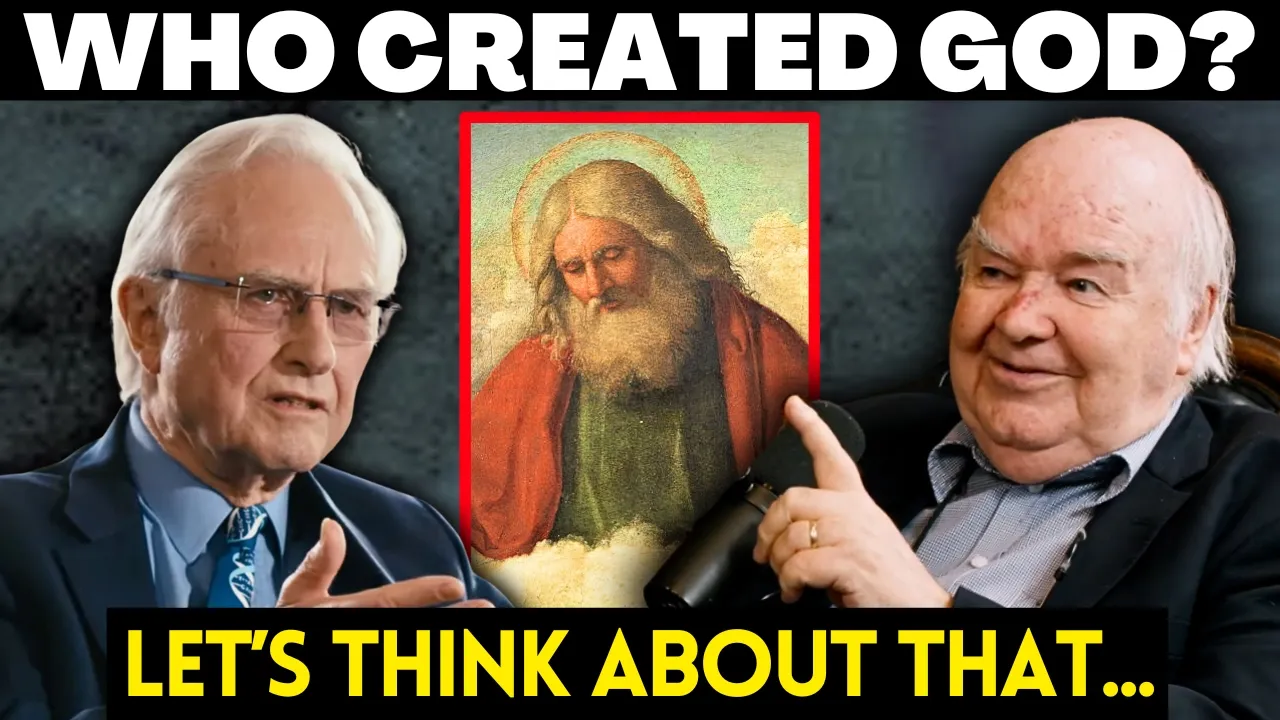
Well, who made it? It's you who insists on asking that question. No, no, you asked me who made the creator.
The universe created you, Richard. Who made it then? A god is a complicated entity which requires a much more sophisticated and difficult explanation than a universe which is according to modern physics a very simple entity.
It's a very simple beginning. It's it's not a negligible beginning but it's a very simple beginning that has got to be easier to explain than something as complicated as a god. Yeah, you can't explain the existence of God.
But I think you may have missed my question. But I'm drawing a parallel. You see, you say that it's at least if Don't let me put words in your mouth, of course, because that would be unfair.
But I'm getting the message that it's ridiculous for me to believe in a God who created the universe and me because they have to ask who created God. All I'm doing is turning that question around and saying the universe you admit created you because there's nothing else. Well, then who created it?
I understand your you perfectly. I'm making the we we we both of us are faced with the problem of saying how did things start. Yes, I'm saying it's a hell of a lot easier to start with something simple than to start with something complex.
That's what complex means. But I don't think so. If I pick up a book called The God Delusion.
It's a pretty sophisticated book. It's got lots of words in it. But actually, as I look at page one, I don't even need to go beyond page one.
I conclude that it comes from something more complex than that book itself, namely you. Yes. But I've noticed that as clear as it seems that the point being made is, there will still be examples in the comment section of this channel that are either expressing a legitimate confusion or perhaps a resistance to the implications of the point being made.
In either case, in this video, what I want to do is feature a portion of a conversation that I recently had with Dr Linux dealing with these same topics at the intersection of faith and science and I hope wherever you're at on your spiritual journey. I hope that this video I hope that this portion of conversation will be helpful to you. So let's dive in.
The first is the basic issue in that debate with Dawkins, which was the second major debate I had with him was that he claims that if you believe that God created the universe, then you will have to logically be able to ask the question, who created God? And then you're going to be asking an infinite sequence of questions. who created, the creator that created and so on so forth.
And I was making the point that that sounds very plausible. In fact, that argument as to who created God formed the central to my amazement, the central argument of his book, The God Delusion. It was his way of dismissing God.
It's such a ridiculous thing to have a backwards sequence of infinite questions. Who created them and so on. But I made the point that if you ask the question, who created God or who created anything, let's call it X, then you're assuming that X is created.
So the very formulation of his question is assuming that he's talking about a created God. And of course, created gods are what we normally call idols. And we don't have to uh turn to Richard Dawkins to know that they're a delusion.
The point is that what he's forgetting is the biblical claim that the God who created the universe is himself unccreated but eternal. And that is basically the point I was making. If you're going to ask who created the creator, then you're assuming the creator was created.
But the sting in the tail for him was he believes the universe created him. So if his question is legitimate, I put it to him, then I can rightly ask you who created your creator and of course he's no answer to that. And I've been waiting many years to hear it.
So it's a simple confusion. The basic idea behind it all is do the questions go backwards forever or not. And the answer is that they don't not on either side.
Uh the ultimate reality for a Christian believer like myself is God uncreated and eternal. And the ultimate reality for many atheists is the universe, mass energy or these days the most popular one is simply nothing. But nothing has to be redefined in a very special way as a quantum vacuum and I've dealt with that in detail in one of my books.
So uh that's the basic issue there. Now what was your second question? My second question and perfect dovetail into it was with that groundwork being laid then why in your view is the mind of God or that idea of eternal uncaused consciousness or intelligence why is that a better explanation for the reality that we all inhabit than the alternative explanations to it?
Well, the alternative that you mention is regarding the universe as a brute fact and that is scientifically very unsatisfactory for the first the first thing to say Paul Davis who's a physicist and not a theist. He is desperately dissatisfied with that kind of attitude that we ask for the origin of everything but except for the whole universe itself and we're content with regarding it as a brute fact that's very unscientific. But secondly, the precise question as to whether I believe there's a mind behind the universe, that depends on uh very different kinds of evidence.
And the two that I would advance are these. One, the universe is at least in part mathematically describable. It's describable in terms of a very sophisticated language.
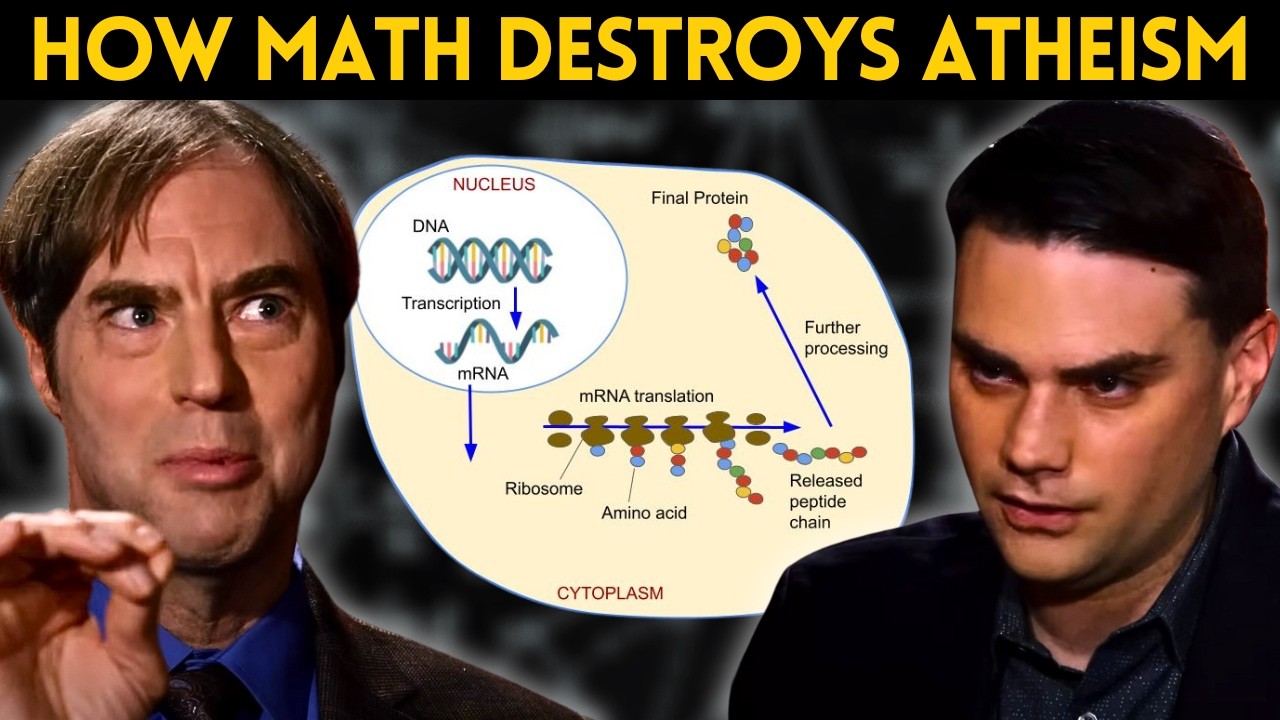
Now all our experience of language is that it proceeds from a mind. Now it's not only that but in biology we've discovered the longest word that we know to exist a chemical word which is the human genome with 3. 4 billion chemical letters in exactly the right order with a semiotic semantic dimension.
It codes for the proteins and and so on. So those to my mind are very powerful pointers that the origin is not less than mind. It certainly could well be more than mind.
But we fly against every analogy that we know if we're not prepared to postulate mind. Now the final point here is I often test this with scientists and I ask them to give me a reductionist explanation of say the the word roast chicken. Let's take the word roast on a menu.
R O A S T. If they're reductionists like Dawkins and they believe that it can all be explained in terms of physics and chemistry, I say, "You look at that and what do you say? " And they say, "Roast, what does that mean?
" And they explain what that means. And I say, "How do you know what it means? " Well, of course, they know that because they've learned English.
Now I said if you're a reductionist then please explain to me how those marks on paper the letters R O A S T carry meaning. And if you're a reductionist you must be able to do that in terms of the physics and chemistry of the paper and ink. And of course they cannot do it because they know that even a fiveletter word like R O A S T roast they immediately infer that irrespective of the many processes mechanical or otherwise that put that word on the menu they know there must be a mind behind it and and so therefore what we're saying is this is the logical extension of all our experience.
And no one would ever think of calling that mind a mind of the gaps or that I was being very lazy and postulating a mind behind the word roast chicken on a menu because it's in the nature of things that in order to explain it physics and chemistry of paper and ink are simply inadequate. you have to allow a much bigger source of real explanatory power and and the only one is mine. So I approach it in that kind of way.
This is interesting because I I have left commentary and posted some of your lectures and debates and things before on this channel and one of the common comments that I see that comes up continuously and to me it seems almost like a predetermined response that someone has learned to say. It's the idea of we don't know therefore God. But what you're saying here with your roast analogy is something different than that.
But I think it would be helpful for those people who I can tell at this point in the conversation are itching to type in we don't know therefore God. Can you give an example of what a legitimate God of the gaps argument would be and then by contrast help us distinguish between that and what it is that you are actually saying. As we all know, debt doesn't just show up one day, right?
It grows little by little like a mold, insidious, and damp, credit cards, car loans, medical bills, and then suddenly you're juggling payments, and you are stuck. But here's the good news. You're not actually stuck.
You just need a reset. You just need a strategy. You just need some people to come alongside you and help you manage the current situation.
So, that is why I'm introducing you to American Financing because they help homeowners like you every day. They use your home's equity and roll the highinterest debt that you have into one simple affordable payment. They're saving homeowners an average of $800 a month.
There's no judgment, no pressure. They just have a real solution that helps put you back in control of your finances again so that you can breathe again, sleep again, and start thinking about the future again. It starts with one call.
It only takes 10 minutes to get started. And there are no upfront fees, by the way. So, it costs nothing to find out how much you can actually save with this solution.
Also, if it makes sense to do and you're in a dire straight, you may be able to delay your next few mortgage payments to get back on a secure foundation. American Financing salarybased consultants are ready to listen, ready to help. So, take back your peace of mind with American Financing today.
Call American Financing today at 866889-5154. That's 866889-5154. Or go to americananfinancing.
net/wisdom. I think the short answer to that question is there are different kind of gaps in our knowledge. There are gaps that science closes.
Uh for example, uh in the ancient Greek world, people were afraid of lightning and thunder. So they postulated gods of lightning and gods of thunder. Now a very brief encounter with atmospheric physics, that god with a small G will disappear.
It was a god of the gaps and it's squeezed out. But then there are very different kind of gaps. I call them good gaps as distinct from bad gaps.
And they're the ones that science reveals. And of course, the example of the menu is one of those that it's not within the explanatory power of physics and chemistry to explain meaning and language. and semiotics.
And most people when they're faced with a question will realize that instantly. You have to be pretty obstinate, a pretty obstinate materialist to go against that. And we must realize that when people like Isaac Newton made their major discoveries like his law of gravitation, he did not say, "Now I understand how it works.
I don't need God to do it. What he did was the exact opposite of that. He wrote probably the most brilliant book in the history of science, the Principia Mathematica.
And at least in the early editions of it, he said he hoped it would persuade a thinking person to believe in God. In other words, the law of gravitation, which is a work of genius, was saying to Newton, what a brilliant God it is who did it that way. So that the more he knew of science, the more he thought he was seeing God a at work.
And of course, a moment's thought shows that that's the way our minds work in everyday uh experience. The more I know of painting, the more I recognize the genius of Rembrandt, not the less. The more I know of engineering, the more I will recognize the genius of the people that designed the space shuttle, not the less.
And so, in other words, as science expands, then my worship for God increases. Now there's something at the heart of this Brandon that's very important and that's the way in which people like particularly Stephven Hawking the late Stephven Hawking insistent that you have to choose between God and science. Dawkins is a bit like that but Hawking was very much like that.
And I couldn't fathom why he thought that way for a very long time until I realized that he had two fundamental problems. The first was, and this was very strange to me, he didn't really understand certain things about science and the way it works. And the second thing he didn't understand is the nature of God.
So, let me just take those two things briefly. You see, the idea that God and science are competing explanations is a failure to understand the nature of explanation itself. Easy way to illustrate this is to think of the question, why is the water boiling?
It's boiling because there's heat energy from a gas flame, let's say, being conducted through the copper kettle agitating the molecules of water and so the water is boiling. That's a scientific explanation in terms of heat transfer. But I could equally well validly say h the water's boiling because I want a cup of tea.
Now that is an agent explanation, a personal explanation, but anybody can say and I find children can sometimes see it more rapidly than professors sadly that you need both explanations to get a full explanation. In other words, both of them are simultaneously true. They do not conflict.
They do not compete. They complementment each other because they're different kinds of explanation. And to put it very simply, God no more competes with science as an explanation of the universe than Henry Ford competes with automobile engineering as an explanation for the motor car.
You need both. And explanation is a very key issue here. Once you begin to see that then just as you admire Henry Ford's genius when you see the motorc car, so you can admire God's genius because there's not a competition there.
There's simply complimentary explanations with explanatory power that copes with the total situation. Although I would hasten to add as a scientist that scientific explanation is rarely even complete at a scientific level. For instance, I mentioned the law of gravitation.
Well, does it explain gravity? The answer to that is no. Many people think it does, but Newton realized that it doesn't.
He he said I well he said it in Latin nonfingo hypoti I do not make hypothesis. In other words I do not know what this mysterious gravity is. What I can do is give you a mathematical way of calculating its effect.
But that's a very different thing from knowing what it is. Nobody yet really knows what it is. So even within its own limitations a scientific explanation is rarely exhaustive.
So if we stand back from that we see that uh this idea of explanation leads us to postulate an intelligent God who creates but isn't competing with a scientific explanation but actually makes sense of the scientific explanation which is another dimension here. Now, the final point here is that very often when we're talking with people like Hawking or reading what they have to say, their idea of God is defective. And that's why they make another mistake, they're thinking of God as a kind of Greek god of the gaps of the type that I've mentioned.
But you see, as I often say to people, the first statement in the Bible is not in the beginning, God created the bits of the universe we don't yet understand. But it's God created the heavens and the earth. That is the whole show, everything.
The bits we do understand, the bits we don't. And on the basis of my analogy of automobile engineering and and painting and so on, it's the bits we do understand that actually are pointers towards the existence of an intelligent God because he as explanation is not competing with science as explanation. There's a great deal of intellectual fog here.
Brandon, if you like these kind of videos but aren't subscribed, help us reach that million milestone. and it also helps other people see this type of content in the future. I'll leave a link in the description where you can watch a documentary that I made.
It's got Nabil Keshi, Lee Stroble, William Lang Craig, and a bunch of other people in there that answer a lot of the questions that I've had about God over the years. I think you'll really like it, and it's totally free.