Okay, Christ is risen again. [Applause] Well, I'm Father Nathan Simeon of the Searchers of the Lost podcast and this is Our Lady of Wisdom. It's our Ital Greek parish which we're hosting this event at. So, you're all very welcome. It's good to see all of your faces out there. For today's debate, the question is the Orthodox Church, the one holy, Catholic, and apostolic church. It will be Denny or Ubie Petros's job to defend this claim that it is in fact the one holy, Catholic, and apostolic church. It will be Alex Voice of Reason's job to
be the pyist. That term in ancient philosophy didn't simply mean a bad guy who yells at people. It actually meant someone who is attacking the other position philosophically. And so there's the proper terms for apologetics, a palmist And an apologist. And so it will be Alex's job to demonstrate that the Orthodox Church is not in fact the one holy Catholic and apostolic church. Keep your eye on that ball because that is the topic of today's debate. The rules of the debate will be in following. We'll start off by Ubie's presentation in opening 20 minutes, followed
by Alex 20 minutes. Then Ubie will be offered a chance of rebuttal, voice of reason, another 15 minutes. We'll have a 10-minute break. Our bathrooms are found down the hall here. Okay. If those those bathrooms are overcrowded, you can also go through the church. Cross yourself. As you walk through the church, please take off your hats. As you walk through the church, the restrooms are found in the narthx. That means in the very rear of the church. Okay, you come back after 10 minutes and then we'll begin the cross examination again started by Ubie Petrus
And then followed by voice of reason. After that we get one hour open debate. Again we'll be starting with Ubie and finishing with voice. Okay. After that, I'm sure we will have a closing statement and that's going to be for both sides and then we're going to have another 10-minute break and then we'll have a oneh hour question and answer period. If We go under and the presentations and time that is then it will carry over. Okay. It will carry over into the what the final hour is that we what we did we agreed on
open debate. The open debate. So we'll carry it over to the open debate. So I'll be keeping track of that. If you get hungry and you purchase food, it's outside. I think you can still purchase food through an application if you have your phone. But if you get hungry, we do we do have Philly cheese steaks outside awaiting you. We also have a snack bar over here, so please go ahead and grab that if you're getting hungry. We have um t-shirts over here as well as um some pilgrimages that we're going to be doing. One
of the pilgrimages will be to the Holy Land in November and that will be um Voice of Reason, Roots of Orthodox and I will be taking a group to the Holy Land. And then if you're local from Vegas and You'd like to join me, I'm also taking a group next June to do a Byzantine Italy tour and the the information is over there. We al also have some t-shirts, okay? So check that out. I also wanted to make sure you know maybe you don't know this, I'm very very cheap and so I'm not paying either
of our guys and this is what they do. This is how they they well that's this is what Alex does to make his ends meet. U Petrus is actually a local electrician. So you can Also ask him for that help. But but if you want to be a kind and generous person, I have a tip box over there. Okay? If you write a check, just put cash because what I'll do is I'll split whatever is given to these two fine gentlemen. Okay? Who have worked very hard for you and are getting nothing from Father Nathan.
Okay? Outside of the tip box that you leave behind. Okay? That covers all of the Basics. I want to just offer one introductory statement. You might be wondering why a Byzantine Catholic priest would want to host such a debate that appears divisive. Well, I will tell you why by using the words of both of our respective churches. Pope John Paul II and Utuminct says, "By engaging in frank dialogue, communities help one another to look at themselves together in the light of the apostolic Tradition. This leads them to ask themselves whether they are truly expressing in
an adequate way all that the Holy Spirit has transmitted through the apostles." And that is what we're doing. Frank dialogue with one another. Dialogue also means debate. From the great and holy council of 2016, the Orthodox Council on Pentecost, we read the following. The Orthodox Church, which prays unceasingly for the union of All, has always cultivated dialogue with those estranged from her, those both far and near. In particular, she has played a leading role in the contemporary search for ways and means to restore the unity of those who believe in Christ. and she has participated
in the ecumenical movement from its outset and has contributed to its formation and further development. This final line we can all agree Catholic or Orthodox is absolutely correct. It is clear that in Theological dialogues the common goal of all is the ultimate restoration of unity is faith and love. And you might put that a different way. Okay, it's truth and love. We're searching for the truth and we're searching for love. Okay? Meaning union with God. So that's the aim of our our debate. And without further ado, I'll ask both of our presenters to come say
hello for a second before we begin our formal debate. Since uh since Denny is starting First, why don't you introduce yourself first? Thank you so much for coming today. Anyone who's outside, if you could ask them to hurry in. We're good. We're good. Okay, good. Uh, so first and foremost, I want to thank all of you for purchasing tickets and reserving time from your schedules to come today. I especially want to thank Father Nathan Adams for not only moderating today, but taking on the Tremendous responsibility of organizing this entire event. It's a significant investment both
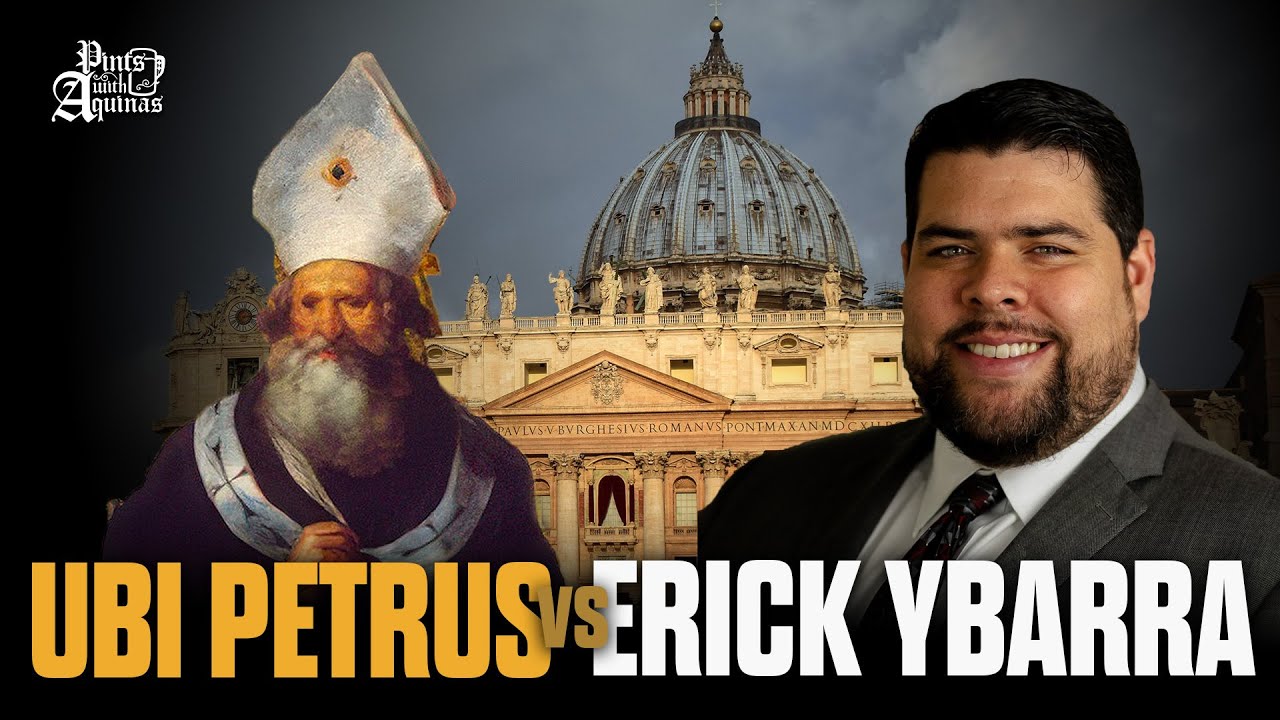
in terms of time and cost. I'd like to thank the bishop for allowing this to be held here. A tremendous thank you to Deacon Stefan who kindly loaned us these two podiums. It's very nice of him. He drove all the way downtown to get them. to Steve who has handled the audio and of course to the parishioners here for all of their hard work and sacrifices over the last Two months to organize this especially this last week. I'd also like to thank Dan Yova who created the amazing thumbnail. He won out threequarters of the votes
and uh to Randolph Media for hosting the live stream. Is it still morning time or we It's still morning time. So, good morning to everybody. Thank you all so much for being here on this amazing I what I would call a historic day. I know that many of you I've already talked to and You said that you've that you're joining us from out of town, out of state. Some of you drove long distances. Some of you flew long distances. That means the world to me. I know that it means the world to Denny and to
the community here at Our Lady of Wisdom. And of course, I want to thank the great father Nathan Simeon for hosting this, for moderating this. He put so much care into this, so much care. He he has an amazing team, a beautiful family, an amazing team around Him that was able to make this happen. Um, there was so much hard work that that happened behind the scenes for for all of this to come together. So, thank you so much, father, and and to your wonderful community here for putting this together. And I want to thank
my wonderful opponent for today's debate, Ubie Petus Denny. He is so sharp. He knows his stuff. And I'm so honored to be able to be his interlocutor here uh Today. He is the best of the best. So, I hope that you guys enjoy an amazing debate. Thank you all for having me and thank you for everyone that's come up to me already to take pictures and say hello and uh after this we'll do a lot more of that. So thank you all very much. So that's I asked them to say hello to you so that
they would both thank me in front of all of you guys. That's that's what I was shooting for there. So thanks guys. You really you Really pulled through for me. U truly it was my my parishioners who have done just everything. They met with me uh three times, 15 volunteers, pulled together 45 volunteers. So, they really they really did a lot of work. Um, but I, you know, I probably didn't like hype up our speakers enough. I just I assume that all of you do know who they are. Do all of you know who they
are. Yeah, that's why you're here. Yeah. Cuz you want a good debate. Okay. So, You know that. You know that these guys are both world class apologists in their own right. And so having them together is just it's really an incredible opportunity for all of us who are here. Okay, just one quick question for you all. I just I think it'd be interesting if we get a little bit of the demographics. Um for just out of interest, how how many Orthodox Christians do we have here? Okay. Okay. So, we're looking at about one 120th. Yeah.
Keep your hands high. Yeah, you better represent if you're if you're the Orthodox here. Uh how about Catholics? Do we have Do we have any Catholics here? Okay. Okay. All right. Let's Let's make sure to guard Denny when he walks when he walks out of the room. Oh, I got your back, Denny. I got your back, my friend. How about Protestants? We have any Protestants in the house? Okay, we got a few of you guys. Any Okay, the best beard in the House belongs to a Protestant. Oh, yes. Do it. Very cool. I'm sorry. Any
any Aryans? None of you guys joined us. Oh, that's too bad. Okay. And anybody just seeking, they just want to know the truth. They're here to learn about the truth. Okay. Great. Well, welcome. Welcome. Thank you for joining us. All right. Well, you're tired of hearing from me. I guarantee that. Let's let's begin um with Ubie Petros starting Us off with the opening 20-minute debate real quickly. Is there anyone outside who needs to come in? Okay. In the Nian Constantinopolitan Creed, the church is described as one, holy, Catholic, and apostolic, giving rise to the phrase
the four marks of the church. This debate focuses on whether the Orthodox Church fulfills the definitions of that specifically one and Catholic. And I want to begin with two quotations from the late Pope Benedict I 16th. The first is from the work principles of Catholic theology. Quote, "Rome must not require more from the east with respect to the doctrine of primacy than what had been formulated and was lived in the first millennium. When Athanogorus designated him as a successor of St. Peter as a most esteemed among us as one who presides in charity, this great
church leader was expressing the ecclesial content of the doctrine of the primacy as it was known In the first millennium. Rome need not ask for more reunion could take place in this context if on the one hand the east would cease to oppose as heretical the developments that took place in the west. in the second millennium and would accept the Catholic Church as legitimate and orthodox in the form she had acquired in the course of that development. While on the other hand, the west would recognize the church of the east as orthodox and legitimate in
The form she has always had. I want to repeat that. She has always had. Notice that verb tense. So for Pope Benedict the 16th, it is the papal church that has developed, not the Orthodox Church, which has remained in the form we have now. In addition to having been pope, Benedict had been the head of the congregation for the doctrine of faith, formerly known as the Inquisition. So this is not a nobody. This is not a random bishop of a titular Sea. This is someone who understood Roman Catholic theology better than really anyone else. In
an interview, he is asked how communications of the Orthodox Church have gone. And in his response, he expresses sentiments similar to what he expressed in the previous quotation, stating, quote, "These churches, the Orthodox, have an authentic doctrine, but it is static. It's petrified, as it were. They remain Faithful to the tradition of the first Christian millennium, but they reject later developments on the grounds that Catholics decided upon these developments without them. For them, questions of faith can only be decided by a real ecumenical council, one which includes all Christians. Therefore, they regard as invalid what
Catholics have declared since the split. So, something that's static, something that's petrified is the same as it always has Been. And that's how he describes our theology. I want you to keep those statements in the back of your mind as I describe ecclesiological issues faced by the first millennium churches and as my interlocator rails against what he sees as divisions within the Orthodox Church. What I need to prove in this debate is that the Orthodox Church is one and is Catholic in the same sense that the authors of the creed understood Those terms. In order
to prove that I would like to focus on three historical examples. The first is St. Cyprien of Carthage who wrote a short work entitled on the unity of the church. He saw the church as a communion of local churches who were one via admitting one another to the eukarist. The members united together via adhering to their one bishop in each city. St. Cyprien died out of communion with Rome having been excommunicated by Pope St. Stefen. The Second is St. St. Matiius of Antioch who also died out of communion with Rome. He was there we go.
Okay. Died out of communion with Rome. He was supported by the majority of the east while his rival Polynus of Antioch was supported by Rome and Alexandria. The three Capidosians St. Basil the Great, St. Gregory the Theologian and St. Gregory Nissa were in communion with St. Malletius and were also in commune With Rome even though St. Matiius was never once in communion with Rome being considered a pretender to the sea of Antioch. This internal schism was not healed until 418 a full 37 years after St. Matiius's death. Though it appears St. Matiius wanted communion with
both Rome with Rome, it was not granted to him despite sharing the same faith as Rome. On screen you can see a map of what communion looked like. It was a mess. Third, during the so-called Acacian schism, St. Macedonius II of Constantinople, St. Elas of Jerusalem, and St. Favian II of Antioch, these saints had Orthodox doctrine and apostolic succession. But when they reached out to Rome requesting communion, they were rejected because they would not reject blessed Aakius of Constantinople who had been excommunicated from uh by Rome. There are numerous other examples, but I wish to
highlight these as they are well Documented and occur early on. Further, it cannot be argued that they died passively out of communion with Rome. Rather, Rome outright rejected them from communion. Now, the phrase one holy catholic and apostolic church is believed to have been added to the creed at the council of Constantinople 1 in 381. The bishop heading that council was none other than St. Matios of Antioch who was not in communion with Rome at all because Rome recognized Paulinus as The rightful bishop of Antioch. In fact, at that council, there were numerous bishops who
were in communion with St. Mleteius and also in communion with Rome, such as St. Gregory the Theologian. So if the authors of the creed intended one to mean all those in communion with Rome or not including internal schisms, why would they do so at a council headed by someone who was not in communion with [Music] Rome? Why would they do so at a council headed by someone who was the reason for an internal schism? They must have had a different understanding of what one meant. Further, at the time they inserted the word Catholic into the
creed, the Roman Empire was probably about a quarter Christian with those being concentrated in the major cities. Even St. John Chrysstm writing in the late 4th century thought Antioch was about half Christian. Keep in mind Antioch was the most Christian city in the empire. With the notable exceptions of Ethiopia, Armenia, and Georgia, very few Christians existed outside of the empire. No Christians existed on four of the seven continents. In fact, until the late 15th century, Christians existed as a majority on only one continent while being a visible minority on two others. St. St. Ignatius of
Antioch first used the term Catholic to mean Orthodox belief. By the late 4th century, St. Siriel of Jerusalem used it to denote geographic location, correct dogma, the members of the church coming from all ethnic and racial groups and from all classes. It was simply one of four standards. But when he wrote this, no form of Christianity could fulfill a literal meaning of 1, three, and four. And Nian Christianity could only claim the second one. So he was not using this In a comparative sense. Had he meant it this way in the terms of more widespread,
he would have had to have admitted that Aryanism fulfilled that definition better because it was more geographically widespread and had more adherence. It is ironic that at the time that the term Catholic was added to the creed nine Christianity was dwarfed by Aryanism in much the same way the papal church is much larger than the orthodox church. St. Vincent of Loren and St. Jerome remark on Aryanism that quote Aryan poison had infected not an insignificant portion of the church but almost the whole world. Later on he says again almost the whole world was overwhelmed by
a ruthless tempest of unlooked for heresy and then we have the famous line from St. Jerome the whole world groaned and was astonished to find itself Aryan so much for Catholicity meaning geographical extent. Let us ignore the compounding factor that Donatism was rampant in North Africa and focus purely on Aryanism. Was the church less Catholic because Aryanism was significantly larger? Was the church less Catholic because Aryanism had spread its tentacles not only throughout the empire but to the tribes in Northern Europe? At the time of the schism between east and west, the best information I
can find indicates the east had about three times more bishops than the west. Did that make the Catholic Church or rather did that make the Orthodox Church more Catholic than the papal church? In fact, until the 14th century when it was massacred by the sociopathic Tamarlain, the Assyrian Church of the East was actually far more geographically widespread than any other church. So when the church fathers occasionally speak of the church as inhabiting the whole world, they had a pretty low bar of both what inhabiting and world meant. It appears they understood it to mean present
in some form, no matter how small, in the Roman world and its immediate borders. For the most part, Petristic writers spoke of Catholicity in terms of comp Oh, whoops. I have on screen. Um, for the most part, Petristic Writers spoke of Catholicity in terms of completeness and dogma. We see this in St. Vincent of Loren when he states Quote that is truly and in the strictest sense Catholic which as the name itself and the reason of the thing declared comprehends all universally okay he's talking about dogma this is another example of what I argued in
December in the debate I did on pints of Aquinus against Ibara you cannot simply assume terms meant in the 4th century what they were defined to mean in the 15th or the 17th or the 19th you have to view them through the lens Of how history was acted out to see the context in which those terms were being used and to understand what those terms meant to those people and at that time. Anything else is simply anacronistic isogesis. In other words, reading your current ideas back into ancient texts and not letting them speak for themselves.
One of the various works I used to prepare for this debate is a work entitled Ancient Christian Doctrine Volume 5 edited by Angelo D. Betterardino, professor of petroglyian Petristic Institute in Rome known as Augustinianum. He was also at one time the president of the Augustinianum. The series goes through the NY Constantinopolitan creed providing copious petristic commentary on key points and volume five covers the line under question today. We believe in one holy Catholic Apostolic church. Further, one of the consulters for the series is the diminishing professor and archbishop Augustine Dinoya who is under secretary for
the congregation for the doctrine of faith formerly known as the Inquisition. So, as you can see, the editor of this volume and the writer, the editor of of the series, one of them, um, they're not random people. They're highly trained, highly trusted members of the Roman Catholic administration, the Vatican. And this is what they write about this. The unity of the church was affirmed not only in rhetoric, but in organization. Each local church was led by a bishop in communion with other bishops according to the principle of one bishop for one city and his territory.
Unity was expressed by the celebration of the eukarist. He continues on contact with other Christian communities serve to maintain and Develop a consciousness of being a unity of many communities like a federation of churches. For this reason, discussion and communication and not imposition from above created real communion between the churches. The foundation of unity is the same faith received from the church. So we see the first ingredient of being one church that these various churches share one faith. In the following quotations, I've removed the names of the authors he Provides to make the reading more
smooth. quote, "But all the other churches that are in communion with one another are true and authentic. Meetings between the bishops, contact through letters, journeys, and especially the sinods are the means by which coinia or communion is exercised between the churches. The ancient church assigned a preeminent role to the criterion of historic apostolicity as an irrevocable and Necessary criterion to centure the uni to centure the unity ecclesial communion of the one church of Christ. Here we see the second ingredient apostolic succession. He then follows it with dozens of pages of petristic quotations on what creates
unity. And after reading all of them, you come to the conclusion that apostolic succession combined with orthodox dogma are the ingredients for valid sacraments, namely baptism and Eucharist. And it is the baptism we share and the eucharist we share that make the church one. This is what St. Paul argues for in 1 Corinthians 10:17. This is also what we see St. Basil states as you can see them on screen. Because there's one bread, we who are many are one body for we all partake of partake of the one bread. St. Basil's liturgy and unite us
all to one another who become partakers of the one bread and the cup and the communion of the one Holy Spirit. This is why the celebrants at each liturgy commemorates a bishop who unites him to his equals and patriarchs commemorate one another. All bishops who possess both apostolic succession and Orthodox dogma were obligated by the bonds of charity to admit one another to communion. When they did not, it was considered a crime against the unity of the church. But it did not mean the church lacked unity. Only that those members lacked charity. That is why
it is called an internal schism. Both parties remain within the church due to their apostolic succession and orthodox dogma but are temporarily not commemorating one another. That is the only way one can understand the situations of St. Cyprien of Carthage, St. Matius of Antioch and the three figures from the acacian schism. This unity is not an administrative model in which a single superb bishop overrules all other bishops at his whim. That is a model that is more in common with the governmental systems of the Soviet Union and the Chinese Communist Party than the first millennium.
Rather, our communion is like that of adult siblings. We are from the same mother and father. And though they cannot force us to continue on as a family, we decide to maintain our familial ties. Through regularly communicating, visits, exchanging gifts, and caring for one another in times of need. No one forces That from the top down. We do it because we care about our ties, because we have charity. Now, a sibling may do something truly horrendous and be removed from the familial structure until amends are made. Sometimes two members of the family may not talk
to one another at all times while they still speak to the other siblings, thereby maintaining an imperfect unity with the hope of a future reunion because they are after all for better or for worse one Family. Contrast this to the papal system in which there's a single normative C and only those who are in commune with that normative C are the true church. This creates a system the end result of which is that only the pope is the true church. Try to square that with the Matian schism St. Cyprian or the Acacian schism you will
fail. Now you don't see quotations from church fathers on what doesn't bring unity but you do see quotations on what does bring Unity and when father Bardino compiled his floral not one of them says a church is one because it's under the pope. This is conspicuously absent. They allite site apostolic succession, Orthodox dogma which allow for baptism and a valid eucharist which are in turn will create unity. I'll close with this fantastic quotation from St. Augustine. He says one loaf, one body is what we being many are. One loaf. He said however many Loaves may
be placed there, it's one loaf. However many loaves there may be on Christ's altars throughout the world, it's one loaf. But what does it mean one loaf? He explained very briefly, one body is what we being many are. There's one body of Christ about which the apostle says while addressing the church, you are one body of Christ and individually members of it. What you received is what you yourselves are thanks to the grace by which you have Been redeemed. You add your signature to this when you answer amen. What you see here is the sacrament
of unity. But just as one loaf is made from a single grain from single grains collected together and somehow mixed in with each other into dough. So in the same way the body of Christ is made one by the harmony of charity. And what grains are for the body of Christ, grapes are for his blood. Because wine too comes out from the press. And what was separated one by One and many grapes flows together into a unity and becomes wine. this both in the bread and the cup. Thus both in the bread and the cup
there is mystery the sacrament of unity. And so we see that despite the variety of liturgies, despite the variety of means of receiving receiving converts in the first millennium, despite the internal schisms oftentimes led by saints, despite the limited geography of the church, the church Oftentimes dwarfed by rival heresies. The first millennium church was one and was Catholic just as the creed expresses and just as the Orthodox Church is now. If internal schisms and a variety of views on reception of converts disqualifies the Orthodox Church from being one and Catholic, then let us also write
off the entire first millennium and all of its saints. If it was good enough for the undivided church, why is it not good enough for my interlocator? Thank you. [Applause] Uh, I'm not going to be using any visual aids for this part. So, just my voice. Is that okay with everybody? Just the voice. Just voice of reason. Thank you, Denny, very much. And, uh, let me know, father, we can start the timer. I'll begin when you begin. I got I keep my own time because I'm very afraid of We good. I don't I don't want
to I don't want Anyone to look into my personal business. Alex. Alex, if you need more time, don't worry about going over. You're I appreciate it. UB is a man. Another round of applause for Ubie, by the way, please. Thank you very much, Ruby. All right. Ready? All right. Let's begin. Today, Eastern Orthodoxy is finally in the hot seat. All apostolic Christians believe that the church founded by Jesus Christ is visible and identifiable. The visible church is identifiable by four marks, one, holy, Catholic, and apostolic. These four marks or four pillars are essential in identifying
the true church. Meaning that the true church must have all four of these marks. If any Christian communion is missing even just one of those four, we can conclude that that communion is not the true church of Jesus Christ. The Eastern Orthodox Communion claims to be The one holy Catholic and apostolic church. While it is one, while it is uh holy and it is apostolic, today I will demonstrate that the Eastern Orthodox Church is not one nor is it Catholic. It is missing two of the four pillars and therefore it is not the true church.
Let's begin with one. Jesus prayed for his church to be one in John 17 and St. Paul says there is only one body. But what does it mean to be one? In Acts 2:42, we read that the first Christians Held steadfastly to the apostles teaching and fellowship, to the breaking of the bread, and to the prayers. They were all united in matters of faith and worship. St. Paul also tells us that the local leaders of the church have true authority. While the book of acts shows that these local authorities were all united under one universal
authority which was established by Christ in Matthew 16, Luke 22 and John 21. So Christians are united in matters of Faith and worship under a common governance. But is this what we see in the Eastern Orthodox Church? They are they united in matters of faith, worship, and governance? Let's look at each of these. When it comes to faith, we find that the Eastern Orthodox Church has internal disagreement and is not united. Eastern Orthodox bishops do not agree with each other on essential doctrinal beliefs. For example, they do not have a defined cannon of scripture. They
cannot tell us how many books belong in the Bible. Some will say 73, others 76 or 81. Some will even say only 66. Why can't the Eastern Orthodox Church tell us how many books are inspired by God? They only need to provide one number, but the bishops cannot agree on what that one number is. Why aren't they one in this matter? How do we identify who's right and who's wrong? They are also not united in their sortiology. Some say that salvation can Only be attained if one is a visible member of the Eastern Orthodox Communion
and that there is no grace outside of it. Others say that there is grace outside of it and even salvation. And others even go to the other extreme and believe in universalism that everyone will be saved. In fact, universal universalism is becoming more and more mainstream as a belief in Eastern Orthodoxy even though it's been condemned as a heresy by the church east And west as far back as the fifth century. They're also not united in their understanding of the filioquay, purgatory, transubstantiation, the immaculate conception, the role of St. Peter the Apostle or the extent
of the authority of the bishop of Rome before the great schism. Why aren't the Eastern Orthodox united in any of these doctrinal matters? How do we identify who's right and who's wrong? Not only is their disunityity in doctrines of faith, But they are also divided in their moral doctrines. The Eastern Orthodox are not united on the question of the morality of artificial contraception. Some Orthodox bishops refuse to call it intrinsically immoral and therefore allow for its use. While other bishops do call it intrinsically immoral and therefore say that it can never be used. If this
is a matter of morality, which means that this can be harmful to souls, why can't the Orthodox Church come to One agreement on this matter? Contraception is either immoral or it isn't. And the true church of Jesus Christ should be able to tell us whether it is or not. The Catholic Church promagated its own teaching on contraception in the 60s, calling it intrinsically evil, which means it's always a sin to use. The ecumenical patriarch of Constantinople, Athanagoras I stated his full agreement with Pope Paul V 6, saying that he could not have Spoken any other
way. Why aren't the Orthodox bishops today in agreement on such an urgent issue? Why aren't they in agreement with the patriarch from the 60s? Why aren't they one? How do you identify who is right and who is wrong? A related issue is that of divorce and remarage. The Bible and Christian tradition make it clear that divorce and remarage is impossible and that attempting to do such a thing is the sin of adultery. Many Orthodox bishops agree With this, but most Orthodox bishops today actually allow for divorce and remarage up to three times. If divorce and
remarage is is adultery, it can never be allowed. So why do so many Orthodox bishops allow for it and even up to three times? Why three and only three times? That seems like an arbitrary number. So they can't say how many books are in the Bible, but they can say up to how many times one can divorce and remarry. They justify this By appealing to prudence. But sin can never be prudent. Allowing for anything as a matter of prudence is only valid for those actions which are not objectively sinful. But divorce and remarage is always
objectively sinful. Matrimony isn't the only sacrament that has been desecrated for the sake of prudence. They have done the same to the sacraments of initiation. The Eastern Orthodox can't even identify valid sacraments outside of their own Communion. Some bishops say that baptisms outside of the church are not valid. Others say that they are valid. Others say that only those in other apostolic communions are valid and still others say only those done with triple immersion. They cannot agree. They also can't agree about whether holy orders are valid in the other apostolic churches which also means that
they can't agree on whether any of their other sacraments are valid. The Eastern Orthodox Church can't tell us if the Catholics, the Orientals, or the Assyrians have a valid priesthood or a valid Eucharist or valid crisismatians or confessions or anointings of the sick. Some Orthodox bishops say they do, but others say they don't. This is related to their disunityity in sotiology. Why aren't they one in this matter? How do we identify who's right and who's wrong? And this leads to another enormous point of disagreement And disunityity within the Orthodox Church. This is huge. The reception
of converts. They can't agree on how to receive them. I am a fully initiated Catholic. If I wanted to become Eastern Orthodox, there are three different ways that I can come into the church depending on which bishop receives me. Option A, through reception of the Eucharist after I go to confession and make a profession of faith. Option B, through crismation first. or option C Through baptism first. Even though I'm already baptized and crisismated, these bishops can agree with each other on whether I actually am or not. Some will say I have both. Others will say
I only have one and others will say I have none. If I'm not baptized, I am according to them a godless pagan. But they can't agree with each other. And it gets more complicated from here because if I'm received through option A, there are bishops who would have received me Through option B or C who will not allow me to receive the Eucharist in their churches. If I come in through option B, there are bishops who would have received me through option A that still won't let me receive the Eucharist. They would say that my
reception into Orthodoxy would not have been valid, which means I would not be Orthodox at all and therefore can't receive the Eucharist. Even though the bishop who did receive me would give me communion And other bishops who agree with him would as well. I personally know Orthodox priests who privately disagree with how their bishops tell them to receive converts. So these priests out of obedience to their bishops will baptize and/or crisismate Christians whom these priests believe are already baptized and/or crisismated. So in order to obey their bishops, these Orthodox priests have to violate their own
conscience and knowingly commit Sacrilege. Orthodoxy is so divided that the bishops can't even agree on the validity of some of their own sacraments. Nor can they even tell us definitively if their converts are actually Orthodox or not. Which is why many of these converts are denied the Eucharist from bishops and priests who they are supposedly in communion with. But if they're not united in their Eucharist, then they are not one communion. Why aren't they one in this Matter? Who's right and who's wrong? Speaking of Christians being denied the Eucharist, how can the Eastern Orthodox Church
be one in light of the schism between Gre the Greek church and Moscow? The Russian Orthodox Church does not allow its leoty to receive the Eucharist from the Greek Orthodox Church and the Greeks are not allowed to receive from the Russian Orthodox Church. Moscow claims that Constantinople and Alexandria are in schism. And in fact, Just a few years ago, the Moscow patriarchet sent Russian bishops into Alexandria and set up a rival altar in opposition to the Greek patriarchet. Not only that, but Moscow has even stolen many Alexandrian priests and even bishops by convincing them to
break communion with the Greek patriarch Theodoro II and join the Moscow patriarchet. So we have a rival altar, stealing clergy and a parallel church. They are not united in worship. So who's Right and who's wrong? And all this break this break in worship is all because of an issue of a governance which the Eastern Orthodox are also not united in. How is autophily granted? The Orthodox Church can't give us a straight answer. Some say only an ecumenical council can grant this status. But some say that the ecumenical patriarch of Constantinople of Constantinople can do it
on his own. But we know that neither of these options work in practice Because the Orthodox can't even convene a universal council and most of the autophilist churches within Orthodoxy achieve that status apart from and even in opposition to Constantinople. In fact, after the fall of the Byzantine Empire, almost all of the churches that have since become autophilis did so not because of any church decree, but because the states were automatically declaring the Orthodox churches within their own national boundaries autophilis And independent of any other patriarchy. So these churches would even go into schism and
just wait sometimes for decades until Constantinople would be forced to recognize their autophilis status because of political reasons. Autosephille in the Orthodox Church is about geopolitics and not about ecclesial rule. In 1970 the Moscow patriarchet granted autophille to its churches in North America now known as the OCA. But Constantinople has never Recognized this status and claims that Moscow had no authority to grant them this status. Most churches side with Constantinople, but according to the OCA, the churches of Bulgaria, Georgia, and Poland do recognize their status. Moscow also granted autonomous status to the Orthodox churches of
China and Japan, neither of which Constantinople has recognized. They claim to be united, yet they are not one in governance. After the fall of the USSR in 1991, Ukraine claimed yet Moscow immediately rejected it and Constantinople never recognized it. Ukraine wasn't even united in this because there were two different church bodies in that country claiming status. But in October 2018, Constantinople finally announced that they would be granting to those two churches in Ukraine. This would result in Moscow breaking full communion with Constantinople not allowing Russians to share in sacraments with Greeks. This Schism persists to
this very day. The disunityity and governance is what led to the disunityity in worship which we've already covered. Is this how the Christian church is supposed to operate? Imagine if the apostles stopped sharing in sacraments with each other because they couldn't be united in their governance of the church due to the petty political conflicts between empires, kingdoms, and countries. We can't imagine that happening with the Apostles, but we are seeing it happen in Eastern Orthodoxy. So, how do you identify the Eastern Orthodox Church? Is the church identified with the Greeks or with the Russians? Who
is the true church and who are the schismatics? Who has the four pillars? who's right and who is wrong. The issue of disunityity and governance within the Orthodox communion also exposes another fatal flaw for them. They are not Catholic. Catholic means universal. Eastern Orthodoxy is not universal. Jesus Christ told his apostles to teach all nations. But the problem in Orthodoxy is that the nations are divided. The nations are so divided that the Orthodox churches within each nation identify themselves in name according to ethnicity, nationality or language. We have the Greek Orthodox, Russian Orthodox, Georgian Orthodox,
Serbian, Bulgarian, Romanian and Albanian Orthodox and so on and so forth. And as Most Orthodox inquirers who don't become Orthodox will tell you, the main reason that they don't become Orthodox is because they don't fit into the particular ethnic group or culture of their local Orthodox parishes. We have all heard the stories of visitors at Orthodox churches who are looked at with suspicion or even shunned and made to feel unwelcomed just because they're not the right ethnic group or nationality. I actually personally know An amazing Greek Orthodox priest who is rejected by those he pastors
because he's not ethnically Greek. And his own congregation is always asking the bishop to remove this priest and to give them someone who is Greek. I've even personally seen rivalries between priests because one is Greek and the other isn't. Does that sound like a universal church? It isn't. It's actually a group of individual national churches that are in loose communion With one another, yet they frown upon any crossover or intermingling. And we know that most of these churches even exist only because the state allows them to exist. And many of them are actually used to
further the political interests of the state. The state knows that it's easier to control the people if you can control the churches. They trick the people into thinking that their loyalty to God is directly tied to their loyalty to their nation. In the '9s, the Russian Orthodox Church outside of Russia, Rokor, accused the patriarchet of Moscow, of being controlled by the Russian government and broke ties with them. They reunited in the 2000s not because the two churches reconciled themselves but because Vladimir Putin paid Roor a visit. Even the name of the communion, the Eastern Orthodox
Church. Why specifically Eastern? It refers to Eastern Europe, which is what one thinks About when thinking of Orthodoxy. Orthodoxy is synonymous with Eastern Europe, but not with Asia or Africa or not with the Americas or even with Western Europe. It's not universal. There are approximately 300 million Eastern Orthodox Christians in the entire world. There are about 800 million Protestant Christians worldwide and almost 1.4 billion Catholic Christians. The average Christian in the world is Catholic and Protestantism Seems to be more universal than even Eastern Orthodoxy whose authority can only be as broad as the patriarchal or
national level. but not the universal level. And when you're not universal, you cannot be one. Which takes us all the way back to the disunityity in doctrine. What happens when patriarchs disagree? Why hasn't the Eastern Orthodox Church been able to hold a universal council to solve any of these important issues? Why can't they even Agree on how many ecumenical councils they have? Some say seven, others say eight or nine, and they don't all agree on how binding the Senate of Jerusalem of 1672 is. After 100 years of preparation, when they finally had what was supposed
to be a panorid in Cree in 2016, at the very last minute, onethird of the autophilis churches didn't even show up. Antioch, Georgia, Bulgaria, Russia, and the OCA all decided to stay home. And to this day, those churches Don't accept the Senate as binding. They don't accept it as panor. It's no surprise that the Eastern Orthodox Church doesn't even have a universal catechism when they can't even agree on how many councils they have or which ones are even universally binding. They can't even settle the calendar controversy. When the majority of churches after World War I
switched from the old Julian calendar to the new Catholic Gregorian calendar, there was a Schism in within Greece over it. This led to the formation of the old calendarist or the true Orthodox Church. This new and true Orthodox church quickly had an internal schism of their own when they couldn't agree with each other about the validity of the sacraments of the Orthodox Church of Greece. One of those breakaway groups from the True Orthodox Church is called the Genuine Orthodox Church. And they say that all of the other Orthodox Churches have apostatized Who's right and who's
wrong? Is the Macedonian Orthodox Church part of the church? How about the Bellarusian Arosphilis Orthodox Church? Neither of which are recognized by any other Eastern churches. Who decides if these groups are Orthodox or not? They claim that they are. How reliable even is the Eastern Orthodox Church? Every single Eastern patriarchet has fallen into error and even heresy at one point Or another. If this church can and has so easily fallen into error, why shouldn't we expect it to happen again? And what will happen when it does? Which of them are in error right now? Today,
my opponent in this debate has a very difficult task ahead of him. He has the burden of defending a position that history and present circumstances simply do not allow him to defend. I have made exactly 20 points that he now has to contend with. 11 of them are about Doctrinal disunityity in both faith and morals. Two of them are about disunityity in worship between Greeks and Russians. Four of them about disunityity in governance. And four of them are about the lack of universal authority. My friend Ubie can win this debate in only one of three
ways. He can either go through each of these 20 points one by one and attempt to refute them all. Or he can reject the premise entirely, and it sounds like he did in His opening statement, and argue that the church of Jesus Christ does not need to have universal unity in matters of doctrine, worship, and governance, and that the church is one and Catholic in other ways. Or he can just answer the simple question that I've asked repeatedly throughout this opening statement. How do we identify who is right and who is wrong? How do we
identify which Eastern Orthodox Church is the true church? They Can't all be the one true church because they're not one. So which one is true? Which one is universal? Which patriarchet or which metropolitan or which dascese has the four pillars? Which one is the one holy catholic and apostolic church of Jesus Christ? Today Eastern Orthodoxy has the burden of proof. Thank you. Okay, at this point we're going to begin a 15minute rebuttal with Ubie and then we'll have another 15-minute rebuttal With Alex and then we will have a nice break. Is there anyone outside who
needs to be let in? What was absolutely conspicuous in that presentation that you gave was that you cited absolutely nothing official. It was all just he says she says. That was pathetic. That was awful. I I mean I expect that stuff from like Michael Loftton, but you know, oh, you know, some Orthodox done did say that And some Orthodox say done did said this, but you know, they ain't got no magisterium. Well, okay. So, you need to actually site official documents. So, all right. For example, which documents are you citing to show how churches receive
people? You don't have any. I've read them. We receive people in the same way. I've been Orthodox for 22 years. I've never once had someone refuse me communion because I was received by cruismation. Never once. And I've been To St. Anony's. I've been all over the world. So, I think that's more so a fantasy or the person who told you that was maybe melodramatic. As far as schisms, let's say you said there's like old calendars. Well, you guys have the SSPX, you have set of a contant, you have the SSP V, you have all sorts
of odd groups. You have the Filipino National Tr, you know, the Brazilian National Church, you have the Polish National Church, which refers to uh Poland as fourth Rome. No, Scranton, Pennsylvania's po uh fourth Rome. Um the canon of scripture, we actually have a defined canon of scripture. It is defined in the confession of Dosa. Um the numbering of the books is different because some churches consider certain books to be one or two but it's the same content with notable exceptions. Um on say it's like fourth Edris one church accepts and another Dozen. But no one's
excommunicating each other over these. And so you have to ask yourself if we use the first millennium as the standard was there unified cannon in the first millennium. No there wasn't. Okay. Uh let's see. Not united in such teriology. What are your official statements for saying that? You don't have any uh on universalism. I have yet to meet one person in person who's a Universalist. I mean, David Bentley Hart goes on there and goes, "Well, you know, some Orthodox say this." I'm think, "Okay, I need actual names. We need we need stats. Contraception. Uh the
Catholic Church had no stance on contraception till the 60s. Was the Catholic Church deficient until the 1960s? Because what I find with you guys is that you come up with a statement for Something and then you expect us to immediately go, okay, we got to come up with a statement, too. But we're an independent church. We don't think it's really something that needs to be dogmatized. In the same way that you guys don't think that say the difference between essence and energies and toism and scodism needs to be dogmatized. You don't think it's important to
dogmatize whether or not Mary died. I mean ex cathedral statement. We Still have no idea if Mary died or not before she was assumed to heaven. Like you made mention that why don't people agree with the Thanogorus? Uh because she's not an infallible autocrat. By your standard, we could simply bring up the examples of German bishops blessing sodomy, which they've shown absolutely no slowing down with. Same with the Dutch bishops, absolute Mess. Divorce and remarage, uh, cannons of St. Basil the Great, they allowed it. I did a whole, uh, documentary on it. I mean, why
was the Catholic Church in communion with a bunch of churches allowed for divorce and remarage if it was so bad? I mean, they were in communion for a thousand years. Like, now it's just suddenly bad. The other is why does it matter if sacraments outside of the church Why Does it matter if there are sacraments outside of the church if we're receiving people the same way? Even when you read the cannons of St. Basil, he doesn't He goes, "Well, some people receive this way, some that way. You know, around here we do it this way.
Let's see. Uh, the Russians are allowed to receive from the Greek church. It's a one-way schism. The Constantinople did not reciprocate against Russia. Um, you mentioned rival altars, parallel church. Uh, that sounds like when Latin missionaries came into Byzantine Catholic church land. I mean, just right away the first thing they did was they, "Oh, you're married priests." No, no, no. You got to be celibate. Oh, you have a beard? Oh, no. Shave that off. Leaven bread? Forget it. They set up rival altars throughout. I have yet to see anyone disagree on the mother church being
the source of Autofili. Um the question is who the mother church is. So the debate between Russia and Constantinople right now is who is a mother church of Ukraine? And we see debates like that again in the in the first millennium. I mean it's you look at how Jerusalem became a patriarchy. You had to get the emperor involved. They had to do with a jurisdictional dispute between um between one the bishops in what is Now the patriarchet of Antioch and uh or Jerusalem and and Antioch and that was in you know first part of the
first millennium as far as the apostles not getting along. Yeah, we saw throughout the book of Acts they don't I mean we saw that Mark just abandons Paul. We see St. Paul tell off St. Peter. We see St. Peter fail miserably in that sense. We see them dispute over whether or not believers need to be Circumcised. I mean, they they did break communion. It was it was fairly normal. Um I've been attending Greek parishes for I don't know how long. About 22 years ago, I converted. I've never had issues with anyone. I'll tell you where
I did have issues though was I tried to attend a Marinite Catholic mass and they weren't very friendly. It was, you know, like, well, you're not you're not Lebanese. What are you doing here? Um, I mean, Case in point, I mean, I drive by to get here, I drive by a Greek church that has 95% English liturgies. I drive by an OCA church that has all English liturgies. Um, I drive by an Arab church that has about 90% English liturgies, but I also drive by a Marinite church that has a Tagalogic liturgy, an Arabic liturgy,
and an English one, and a Spanish one. I drive by a Korean Catholic church that has not a word of English. It Is completely Korean. I mean, by that standard, it's like, where would I fit in? Everyone agrees on how binding Jerusalem 1672 is. They signed off on it. We have the signatures. If anyone wants to disagree with that, we can point out Catholic bishops who disregard Vatican 2. We can point out Paul V 6th who referred to the first seven councils as ecumenical and all the others general councils of the West. Because here's the
thing. The Catholic Church has no actual official dogmatic list of what the ecumenical councils are. There's no list. There's also no official dogmatic list of who the popes were. So, how do you have a real ecumenical council if you don't know who the real pope is? At Florence, Eugene referred to Flor Pope Eugene referred to uh Florence as the ecumenical council. It's not now. How many of the ecumenical councils had full representation? I can tell you right now that Nika did not have I mean they had a Spanish bishop from Rome or representing Rome supposedly.
The second ecumenical council began as a local council and it wasn't received into the west until I mean it's mentioned at Calcedon in the mid 400s and then really until the early 6th century it wasn't received. Ephesus a Schism blew up during it. It took a couple years to solve. You also had Aakius of Boa who uh was in communion with both sides who fixed it. At the fifth ecumenical council, the pope was excommunicated, had to come back and apologize and admit he was wrong. At the sixth ecumenical council, I think you actually did have
full representation. And at the seventh, you only had two patriarchates there that the three others Were priests whom the emperor summoned and said, you know, hey, how about you you pretend to be these people? which is why the fotine council right away one of the goals was to make sure that everyone accepted the seventh ecumenical council. So by your standard the first millennium just keeps failing. I mean like like you you would not do well in the first millennium church. I mean you really wouldn't. We have a universal catechism Was formulated in 1642 at Yasi.
It's extremely boring though. But I think you're overemphasizing what you consider the official catechism of the Catholic Church to be. It is not magisterial. It cites magisterial documents. It's updated re regularly. Um you pointed out heretical patriarch patriarchs and bishops. Um there have been numerous heretical popes. I mean we saw like you know vigilious and he's council excommunicated him. He thought it was Not acceptable to condemn people after death. He was wrong. We have an orius. We have Pope St. Vitalian who endorsed monothealatism and monoergism for years until he finally turned around. We have Pope
Liberius. Also, how do we know who the real Pope is? One of the standards is he's accepted by everyone. Okay. Who? Anyway, I'm done. [Applause] 15, right? 15 minutes. All right. Starting starting now. Well, I have to say I am very impressed. Very impressed, but at the same time a little disappointed because Ubie, my friend, you did exactly exactly what I know you were going to do. I knew that you were going to come out and say that I showed no sources. Don't worry, my friends. I have my laptop plug plugged in. I'm about to
show you all the sources that say everything that I said in my opening Statement. And you did the other thing that I was really hoping you wouldn't do, but you you my you wasted your time because you have spent your entire rebuttal and actually a big portion of your opening statement debating Catholicism. U we're not here to debate Catholicism. We're debating Eastern Orthodoxy. These people paid good money because the ticket said is the Eastern Orthodox Church, the one holy, Catholic and apostolic church. And you have not Proved that yet. Ubie, as a matter of fact,
it looked like Ubie did actually take one of the three options that I gave him. I said that he, you know, there was one of three ways he could attempt to win this debate. And it looks like the option that he chose is to basically say that the true church of Jesus Christ doesn't need to be united in matters of faith, worship, or governance. So according to my friend Ubie, the true church doesn't need to But to to be united in any of those things. In his opening statement, he brought up uh the Pope Benedict
quote about east and and west about petri primacy. Ubie actually contradicted himself because he was pointing out again arguing against Catholicism even though we're not here to argue Catholicism. He said that um uh that Pope Benedict said that the church, the eastern churches don't need to accept anything more than what they accepted in The east. But that contradicted the point that he was making trying to say that the Catholic Church now uh is trying to enforce things that were not believed in the first millennium. So which is it Ubie? Are you correct or is Pope
Benedict correct? Because uh according to the pope the quote that you read, Pope Benedict isn't trying to force anything on the Eastern churches from uh from after the first millennium. Um he mentioned development in the west Not the east. He said that the Eastern Orthodox Church is petrified if that's how he wants to describe it. Okay. He mentioned Cyprien of Carthage. You know what's so interesting about Cyprien of Carthage? The baptism controversy about if we should rebaptize those who get baptized outside of the church, if we should rebaptize, that was actually settled during the time
of St. Cyprien. The reason St. Cyprien was excommunicated was because he was saying That you should rebaptize. But then the North African councils which the Eastern Orthodox Church accepts, those North African councils said that St. Cyprien was wrong. And yeah, he also mentioned the senate of Jerusalem in 1672. Canon 15 of that senate says that you do not rebaptize converts but many of the Eastern Orthodox churches do. So who's right? The Eastern Orthodox churches of today that the majority of them do rebaptize or the Senate of Jerusalem 1672. Oh, he brought up uh St. Mitius
of Antioch and the Malaysian schism. The thing that he left out is that the Malian schism actually wasn't a schism. They weren't in schism from Rome. The Malian schism was an internal conflict within the church of Antioch over who was the correct bishop. But when you look at the two guys that were claiming to be the correct bishop, Paulinus and Mitius, guess who they both appealed to? They both appealed to the pope. And they Said the pope is going to straighten this out. And what he said about Mitius not being in communion with with the
pope, that's not true. Not a single Orthodox uh scholar would ever say that. And quite frankly, you would be I'd like to see your sources on that. Um and then he brought up uh uh the occasion schism. The occasion schism is that unfortunate event in history where all of the Eastern Orthodox Christians became monophysites. They became monophysites For about a good what was it 50 years would be. They were monophysites. They all fell into heresy. And who had to bail them out of monophysism? The pope. It's called the formula of Hermisdas. Who received them back
into the Orthodox church into the true Orthodox church because they fell into monopysism. Um Constantinople one not in communion with Rome. That's weird because Pope uh Pope um Demises had liates there at that Constantinople one. So what do you mean that they weren't in communion? He had liates there. Um that uh Aryanism is more geographically widespread. So according to me, that would mean that Aryanism is more universal than Orthodox Christianity. Well, paganism was more universally widespread than uh Orthodox Christianity during the time of the apostles. Does that mean that Christianity was wrong? Because the Christian
church started with just 12 Guys and a few other guys. Um, let's see. And the arguments that he was giving about unity, about being united in the Eucharist, well, that would include all of the other apostolic churches. Uh, he said that baptism and Eucharist make the church one. And by saying that, he's actually just conceded the debate, saying that baptism and Eucharist make the church one. Ubie, you now have to pick who is Orthodox. Is it Greek? Is it the Greeks? Or is it the Russians? Because as you've already uh pointed out, you conceded the
Russians do not allow uh for their people to receive the Eucharist from the Greeks. So if baptism and and communion makes you one, he has to pick who's one. He has to decide who's in and who's out according to his own standards. He's going to have to pick a side. Um let's see. Oh, and then again, he said imperfect unity. And then he contrasted That with the papal schism. We're not arguing Catholicism. Um he said that nowhere does it say in the sources that he had that the church is one because it's under the pope.
We're not arguing Catholicism. He mentioned again one loaf. Again, let me just bring up the schism between Constantinople and Russia, they don't share in the one loaf. Um he had his uh his um despite discourse where he was saying despite all of these things in the first despite All of these things in the first millennia, they were still united. Well, the reason that they maintained the unity in the first millennium with all of these issues is because they actually were able to get together to hold an ecumenical council to fix these issues, which is something
the Eastern Orthodox Church hasn't been able to do since the great schism. So, u and he conceded that they don't need they don't need to be united in those three ways. So, I don't Know how much time I have left. I'd like to plug in my computer so that I can show you guys all of the Is that it? Oh, no. I still got I still got some time. Uh so, I could show you guys all of the great sources. Um, let me read the ones that I have printed out here first though because he
uh so he Okay, so first of all, he brought up the schisms and Catholicism, right? We're not debating Catholicism. He brought up uh the uh confession of Dosytheus. What's Interesting is that the confession of Dosytheus teaches quite a few things that most Orthodox today do not actually hold to like the confession of Dosytheus. I have it. Let me see. I have it right here. The confession of do of dosiththeia says uh oh is it well is it really universally binding because canon 15 of that council says that converts are not to be rebaptized. Canon 16
teaches that babies who are not baptized are subject To eternal punishment for the sin of their parents which most Orthodox reject. Canon 17 teaches transubstantiation calling it metoios in Greek which most of orthodoxy today also rejects. And canon 18 teaches purgatory and even goes as far as to say that purgatory happens in hell which most Orthodox also reject. Uh maybe this is why Metropolitan Kalisto Square said in his 2015 book that the councils that that council's statements of faith have In part been received but in part set aside or corrected. There's a good source for
you bud. Uh what else do we have? So uh he is he brought up um no canon in the first millennium. Well it's interesting because the North African code the same code that actually said that uh St. Cyprien of Carthage was incorrect in his understanding of rebaptism. They actually did codify the cannon at the councils of Hippo and Carthage in 393 and 397. And those Councils were actually uh were uh accepted by the Eastern Orthodox Church. And Ubie is correct that 1672 the senate of Jerusalem actually does uh have the same cannon that those councils
have that the Catholic cannon has. The only problem is that the fileric catechism from Moscow from 1830 that catechism explicitly says and I have I have it here don't worry me explicitly says that those seven books are not scripture that they don't belong in the bible they have The protestant cannon. Um so uh he said the question is about who is the mother church? Well, Ubie, when is the Eastern Orthodox Church going to decide who is the mother church? Is it going to be Constantinople? Is it going to be Moscow? Who is the mother church?
Because Moscow claims to be the mother church, claims to be third Rome. They said that Constantinople lost its place as New Rome and now Constant Constantinople is third Rome. Ubie, in This debate, my friend, I'm afraid that you're not going to have to decide between the Greeks and the Russians if you have any chance of winning. Um, he brought up Latin missionaries. We're not debating the Catholic Church. Um, he brought up Oh, he also said that the apostles were not unified. He brought up all of the problems, the personal conflicts that the apostles had that
we read about in the Bible. He literally threw the apostles under the bus and Said that they are not unified, but they were actually united in matters of faith, doctrine, and governance according to the Bible. So, according to Ume, if you have personal disputes, that also means that you're not unified. He just said the apostles are not unified. That is crazy. Um, he talked about the Marinite Catholic Mass and how he tried going there one time and that he was met with an icy reception. Ubie, I'm so sorry that you went to a Catholic church
And they said, "Oh, look, that's Ubie Petrus, the guy that for 20 years has been trying to disprove Catholicism. That's kind of weird. So, I'm sorry you got an icy reception, Ubie. It's just it's it's the probably the line of work that you chose, but we can talk about that during the cross exam. Don't worry." Oh, okay. So, uh, languages in liturgies. Uh, he said, "Where would he fit in?" Well, I happen to recall that he listed all of these churches that do The liturgy in English. Ruby speaks English. He's been speaking English during this
debate. So I think you would fit in any of the in any of those. Um he brought up Catholic bishops who disagreed with Vatican 2. We're not abating Catholicism. He brought he said that there's no list of popes. We're not debating Catholicism. Um he said that uh the pope said that Florence would be the authentical council. You know who agreed? All of the Eastern Orthodox Bishops who said, "Yeah, this will be the Aumenical Council." And then they went back home to Eastern Europe and there was a revolution and there was uh riots in the streets
because of it. So they said, "No, never mind." They had all signed it and then they uh they said, "No, never mind. Take our signatures off of that." Um uh he said that uh Pope Agilius was excommunicated in Constantinople 2. Are you sure Ubie? Because Constantinople 2 did remove Vgilius from the dipics. But when the that council was actually officially published, the official acts of that council do not have vigil Pope's removal from the dictics which I know which I already know you you know Ubie. And as a matter of fact, the only reason Constantinople
2 is actually a binding ecumenical council was because Pope Agilius ratified it himself. And when he didn't, he didn't even mention the council by name. So he only let Constantinople too be binding uh because he because because he had the authority to do it. Which is why the emperor had to kidnap Pope Julius from Rome drag him all the way to Constantinople to force him to ratify the council. Even though he could have had the patriarch of Constantinople in that very city do it. He could have had Alexandria do it or Antioch or Jerusalem because
the Roman emperor Justinian who was a monophysite by the way um he actually had all of the Patriarchs in his back pocket cuz he put him there. He was literally removing and putting in patriarchs. Why did he feel the need to have to go and drag the pope from Rome all the way to Constantinople to make him sign Constantinople too? Interesting if the pope But we're not debating Catholicism, guys. Let's keep going. Um uh he says that uh something about the universal catechism of uh 1642. I already brought up the filerret catechism from the Russian
Orthodox Church from 1830 which explicitly contradicts almost everything that was taught in the cate of Jerusalem in 1672 about like what books belong in the Bible that don't belong in the Bible um about like you know transubstantiation and all these things. the Phil Red Catechism 1840. Ubie, I think you might have to tell all the any Russians in the audience, any anybody that goes to the Russian Orthodox shirts that they may not be Orthodox. I don't know. Um he Talked about heretical popes. Uh we're not debating the papacy. He asked who's the real pope and
we are not debating the papacy. Let's talk really quick while I have time. Let's talk a little bit about um I don't know if he even touched oh about universalism. He said he's never met a universalism. Well, uh, Metropolitan uh, Metropolitan Halerion in 2008, the Russian Orthodox uh, scholar Bishop uh, in his presentation at the first world apostolic congress of Divine mercy held in Rome in 2008, he said this. He argued that God's mercy is so great that he does not condemn sinners to everlasting punishment. And he said that the orthodox understanding of hell corresponds
roughly to the Roman Catholic notion of purgatory. It's a metropolitan that said that uh, Dr. David Benley Hart which Ubie mentioned. There's also father Aiden Kimbo from eclectic orthodoxy. There's the arch priest Sergius Bul uh Bul Bulgakov. There's uh Paul Evokimov, St. Sophroni, the Arch of Mandrite Lazarus and Metropolitan Kalistos Wear who said in uh in the inner kingdom the collected works volume one Crestwood New York uh 2000 there's the the the citation for you Ubie. He said, "Dare we hope for the salvation of all?" And a lot of scholars actually will say that, "Yeah,
Metropolitan Kalisto Square was actually a universalist." Um, should we talk about Contraception? I don't it will be I don't even think Ubie touched on that. I don't think he wanted to talk about contraception because that's a hot button issue that he didn't even want to that he didn't want to bring up. Um, but let's talk about contraception because um, so there are many Greek Orthodox churches that say, let me actually plug this finally in so you guys can see some sources that I Had. And I know how to do this. They taught me how to
do this before we started. I think I got it. I think I checked this out. Is it working? Is it Is it working? Did I do it right? Did I break it? Did it Did it not work? They're not working. Help me. You young boy. You know how to help me. Please, please hurry. There's not the clock is running. Hurry. Hurry. Hurry. Hurry. I'm sweating. Yeah. All right. All right. Woo. Get out of here. Thank you. All right. I love this guy right here. He's a man. Bishop Timothy Kalisto Wear said in his book, The
Orthodox Church, concerning contraceptives and other forms of birth control, differing opinions exist within the Orthodox Church. In the past, birth control was in general strongly condemned. But today, a less strict view is coming to prevail. Not only in the west, but in Traditional Orthodox countries, many Orthodox theologians and spiritual fathers consider that the responsible use of contraception within marriage is not in itself sinful. And we also see here um right here uh Mayendorf one of the greatest Eastern Orthodox uh scholars in the game. Mayandorf he said this straight condemnation of birth control. H well um
so it says that it never where it in red where it says never claiming Universal validity. One question which actually requires a personal act of conscience. These are forms of birth control which will be acceptable and even unavoidable for certain couples. And um he says the question of birth control it's acceptable form can only be solved by individual Christian couples. So the this uh scholar right here says that the church of Jesus Christ isn't able to solve this issue for you. It's up to your yourselves. You can keep Going. No no we got to respect
we got to respect the time. Few more minutes. What does the audience want? Few more minutes. Do the What do the audience want? You want the voice of reason to keep going? You probably want Ubie to get to Oh, wait. We have a break after this, don't we? All right. Okay. Cool. Cool. All right. Excellent. Thank you, Ubie. Ubie's a man. Another round of applause for Ubie Really quick cuz he's Thank you. Thank you. So if you um so in that same book from Timothy Kalisto's wear there's a it came out in 1968 um and
I'm I'm not really good with technology. I know I have it somewhere here. I'll see if I can find it. But um in 1968 uh in that book the Orthodox Church he he says in the first print that uh contraception I have it here. Watch. Let me read it. It's It's but well I lost it. I I I'll I'll put it up here in a minute. I can do it during the the hourlong thing. But in the first edition of that 1968, he actually says that contraception is forbidden. And then when it was reprinted uh
in the 80s, it went back to like a like a more moderate stance. Well, there's some, you know, speculation about whether it can be permitted or not. And then in 1994, I believe, which is when the latest, uh, Version of that book came out, it says that it's pretty much allowed. So, if Eastern Orthodoxy is the true church, how do we identify it? And why is it that um, you know, like uh, Kalistos where Metropolitan uh, has gone back on what the Orthodox Church has taught? Um, so there's so much more that I could get
into, but I think I covered everything that will be brought up. Thank you for the extra [Applause] Time. Okay, everybody, we are about to get started again. Let's make those closing statements with each other. We now will begin a 15-minute cross examination from both sides. Then we'll have an open debate for 1 hour and then we'll have five minute closing statements from from each side. Okay. So once again, how are our how are these guys doing by the way? We're doing good. We're doing Good. So So in that regard, I want to remind you we
have a tip box for them. Okay, it's located right over there. I need it. You can give him the money. I don't I don't need tips. All right, come on. Tips are nice and we all enjoy those those things. So, we appreciate it. We'll get Alex a bus back home. Tips are nice. Smiles are nice. All right. Well, without further ado, uh We'll start with Uie Petrus, who will give us the start with the 15-minute cross- examination. Okay. There we go. All right, let me uh set my timer here. Is there anyone outside who needs
to come in? Okay, it's 15 minutes. Okay, Alex, would you agree that internal schisms such as the current one between Constantinople and Moscow or in the past ones between Antioch and Jerusalem or The ecumenical patriarch and Bulgaria or between Roore and the Moscow patriarchy are a common feature of the Orthodox Church and that something from the Catholic perspective makes the Orthodox Church fail the litmus test of Rome. Is the question is do these schisms make the Orthodox church does it invalidate it? Do let me I think I know what you what you the answer is.
The answer is no. These schisms in orthodoxy do not invalidate Orthodoxy. No. Does it invalidate whether or not the church is one by the Catholic standard? Well, which is the standard you're using, which is why I attack it. If Eastern Orthodoxy is true, it wouldn't violate it. But you have to identify which one is the true church. So if people break away from the true church of Jesus Christ, people are going to do that because we have free will and we're sinners. But the true church of Jesus Christ should always be able to Identify itself.
So So in the case of say like, oh, I don't like Jerusalem and Antioch splitting. Uh everyone else is still in communion with one another. So you have an imperfect schism. You have an internal schism is what we call it. So do you see that as invalidating the claims of the Orthodox Church to be one to you're talking about the Eastern Orthodox Church? Yes. Do you see that schisms like that? internal schisms where you have one two parties not in Communion, right? But they're in communion with everyone else. Do you see that as invalidating a
claim to be one? It does if the true church can't be identified. Okay. So, okay. So, if I were just to say I mean how how you're then pausing a situation where how do I phrase this? Okay. Well, I'll move on. Hey, maybe if I if I clarify, if Jerusalem and Antioch go into schism with each other, we should Be able to identify who's actually in schism and who's Orthodox. But but you can't because for again, you cannot because they're in communion with everyone else because they're in communion with So Antioch is in communion with
everyone else. Jerusalem is in communion with everyone else, but these two are not com uh commemorating each other. Does that in your view fail the test of one? Uh, no. Because it would mean that either one or the other Would be in communion with the universal church, but they're both not in communion with the universal church. It depends on who's in schism and who's not. No, no, no. But let me phrase this another way. So, let's say you and I are not talking to each other, right? You and I are each talking to everyone in
this room, right? Okay. Now, remove that from you and I. Let's say I'm Jerusalem and you're Constantinople. I'm Jerusalem. Okay. Well, no. It's Concentr. Can I be Antioch? I'll be Antioch. No. Well, I'm the Arabic speaker. So, okay. You're Antioch. I'll be Jerusalem. Okay. You can be Jerusalem. I like Jerusalem. They have patriarch. Well, they're very corrupt. So, [Music] um I walked into that one. Wait, are you saying the Church of Jesus Christ can be corrupt? Just kidding. Yeah. So, um I mean, would you see that As as hindering the oneness of the church? Uh
uh, no. because they're both in that body is the situation. They're both in communion with everyone else. They're not commun commemorating one another. So this is the same situation with Moscow and Constantinople right now, right? So one of those two, right? Cuz the way that communion works, it's not enough to just be in communion with the visible head. You have to be in communion with everyone that is in Communion with the visible head. So even if let's say I'm not the visible head and Antioch isn't the visible head, maybe someone in this audience is the
visible head. I can't say I'm going to be in communion with the visible head, but I'm not going to be in communion with Antioch. If I'm not in communion with Antioch, but then I'm not in communion with the visible head either. But then the question is, the question remains, who came out of communion? Did Jerusalem go into schism or did Antioch go into schism? Why are they not in communion with each other? Who left communion or who excommunicated who? And how do you identify who is in the church and who is? Okay. So, so again,
so again, they are both in communion with everyone else. This is a purely internal schism. So this would be a situation like say if the dascese of I don't know Dallas, Texas just stops well let's say that let's say the uh uh the church the Catholic Church in Canada stops commemorating the Catholic Church in America but they're both in communion with everyone else. Would that would that damage the unity of the Catholic Church? It would be an imperfect communion. Okay. All right. Thank you. Mhm. So uh would you agree that the statement that the Catholic
Church does not suffer from internal schisms like the Orthodox Church is that correct? that the Catholic Church does not suffer Maternal schisms. Correct. The Catholic Church does not suffer. The Fotian schism was partially motivated by a territorial dispute between Constantinople and Rome concerning jurisdiction over Bulgaria. Does a Roman Catholic Church have anything similar to that today? Anything similar to what now? To the Fotian schism and which was largely over territorial dispute over Bulgaria. Do you have anything in the Catholic Church where, for example, two Different churches within the Catholic Church get into a territorial dispute
and break communion? Do you have anything like that now? Yeah, but we're not debating the Catholic Church. No, no, no. But do you? No. Well, well, we're debating the standard. You've set the standard as a Catholic church. I now disregarding that. I'm telling you why that standard doesn't work. So, do you do you see anything like that in the Catholic Church today where where people Leave the Catholic Church? Yeah, but No, that's not No, that's not what I But I said, "Would you agree with the statement that the Catholic Church does not suffer from internal
schisms?" Internal schism? Oh, I'm sorry, Mr. I apologize. No. The Foteen schism was partially motivated by a territorial dispute between Constantinople and Rome concerning jurisdiction over Bulgaria. Does the Roman Catholic Church have any similar situation like that today? Over Land? Not that I know of. Okay, same question. Can you think of anything similar to that within the Orthodox church today? Similar over territory. Well, for example, like I mentioned in my opening statement, the autophily of the OCA is something that Constantinople has never recognized. Um, and again, the Auto the Bellarusian Autophilis Orthodox Church, the um
is it the Macedonian Orthodox Church? These are all uh bodies that claim to be Orthodox. But no, no, I'm asking about schisms over territory. Schisms over territory. So like say like Ukraine I hope. Yeah. Okay. Uh in the fifth century Pope St. Bonafice entered into a protracted dispute with the church of Constantinople over control of the Balkans. It finally resulted in the emperors handing control of the Balkans to the church of Constantinople who then refused to return it to Rome. Mhm. This culminated at the seventh ecumenical Council when the pope in his letter requested that
the church of Constantinople return control of the Byzantine right parishes in southern Italy and the Balkans to Rome, but the council simply ignored it. Can you think of anything similar like that in the Catholic Church today? Or is that a problem the Catholic Church just doesn't have now? No, the Catholic Church doesn't know that problem. All right. Oh, wait. I'm sorry. No, you're right. They do. Like what? Well, we're not debating the Catholic Church. No, I'm asking I'm asking. No, I'm asking cuz I'm I'm attacking your standard right now. So, we are debating your standard
and you don't want to because you realize if we debate this Oh, hold on. Wait. I'm the one interrupting because I'm asking you. Oh, you're right. You're right. Interrupt. Yeah. Thank you. No, we're attacking your standard right now because you're judging the Orthodox Church by the standards of the Catholic Church. I'm pointing out to you exactly why that standard is absolute nonsense. Okay. So, what is it in the Catholic Church today that coaleses or is similar to the situation of Pope St. Bonafice and the church of or uh uh uh Pope St. Bonafice getting into
an argument with the church of Constantinople over territory. Yeah. I don't know. Okay. Uh same situation. Can you think of anything similar to that now in the Orthodox church? Over territory? Yeah. Ukraine. Okay, there you go. Can you think of anything like the Malletian schism within the Catholic Church today? Over who is the ordinary of a particular to territory? I'm sure it happens more often than we think. Re really where? I don't know. You don't have examples. Okay. Can you think of anything like that within the Orthodox church today over who is the ordinary of
a particular territory? Yeah. Yeah. Okay. There you Go. Are you aware that internal schisms are a common occurrence in the first millennium? Schisms in the first millennium. Yeah. And we can always identify who's if a church is a true is if a church is true to the first millennium ecclesiology, would it have the same ecclesiological problems as a first millennium church? If the church is true to the I'm sorry, can you say one more time? If a church is true to the first millennium Ecclesiology, wouldn't it have the same ecclesiological problems as a first millennium?
What do you mean by problems? Oh, I don't know what I've just been asking you about for the last like 8 minutes. I've just been asking you about internal schisms. So, if internal schisms are a normal part of the first millennium church, right? If a church is true to the first millennium, why wouldn't they have internal schisms? Oh, okay. I understand the question. Uh, Yes, schisms are a reality of the church, but it can always be identified. Okay. So, in other words, the Catholic Church doesn't have the same problems as a first millennium church. Well,
actually, in terms of ecclesiology, because you just spent the last several questions, you just admitted that the Catholic Church doesn't have these problems anymore. You then admitted that the first millennium church did. You then admitted the Orthodox Church does. Yeah. So, so you have just seated that the Catholic Church does not have the same ecclesiological problems as the first millennium church, but the Orthodox Church does. No, actually in the Catholic church any ecclesial ecclesiological problems that they have can be solved in the same way they were solved in the first millennium because in the first
millennium you can identify who the orthodox church was and that's the Catholic church. If the German Bishops are teaching the stuff that they're teaching the SSPX ecumenical council identifical council who is a true church vigilious or the bishops who uh uh removed his name from the diptica the the true church is anyone that was in communion with vigilious someone who was excommunicated he wasn't his name was no he he his name was removed that's excommunication they're no longer communicating with that person if you do Not communicate with a person communion they are excommunicated Okay. So
it you are saying that someone who was removed from communion who then later had to admit that they were wrong that you had to be in communion with them to be in the true church. Well actually he didn't admit that he was wrong. No he did in the letter in the letter to Uticius. In the letter to Uticius which is in the acts of the council he admits that he was wrong. He says he was led aside by Satan and then he cites St. Augustine saying this is the example of someone admit they were wrong.
So again, if someone has been excommunicated, if a can a pope be excommunicated in the Catholic Church today? Nope. Okay. So you don't have the problems of the first millennium church. All right. Next question. So if a church is let's see were the Gallagans and Fonians part of the one holy catholic and apostolic church prior To Vatican 1. Who know? The Gans. Gallicans. The Gans. Were they part of the church before Vatican 1? Yeah. I don't know. You don't know. What about the Fabonians? Say it again. The Fabronians. I don't know who these people are.
Okay. Uh the the Gallicans were about one quarter of Catholicism. Everything under the French crown was Gallican. Uhhuh. Okay. Was there a uniform method of receiving converts in the first millennium? A uniform method Of receiving converts. What are they converting to from from anything? From anything? From any schismatic group? From any let's just say schismatic group. Let's let's just say uh I don't know from say Novationism. Oh, from Novationism. It depends if their baptisms were valid or not. Okay. So, was there a like Okay. Was there a uniform way of receiving people? Was it I
mean, because The way you're look making it out to be is that the first millennium would have just immediately baptized everyone? Were there different standards between different churches? Because when I read the cannons of St. Basil and baptism, he goes, "Well, some people do it this way, some people do it that way." Mhm. It depends on what the situation is and who's being who's being brought back into the church. It depends on if they had already received a valid baptism or Not because I'm sure as you know and you'll admit that there were different ways
of doing it, but it wasn't because the church didn't have a uniform standard. It's because some people's baptisms outside of the Orthodox Church were valid and others weren't. So, they had Why did Pope Why did Pope St. Stefan accept Gnostic and Marcianite baptisms? Gnostic and Marcianite baptisms. I don't know if that would be the case, but if that's the case, he did. St. Cyprian Goes after him for it. St. Stefan the standard was not Staint Stefan because he accepted Morenite agnostic baptisms. Uhhuh. Yeah. If he did, it would have been because he determined that they
had a valid baptism because they use proper form and matter. Really? That's the only reason he would have accepted it. Okay. So, you think that there were Gnostic and Marcianite baptisms that had proper form and matter? Say that again. You think that there were Marcianite Gnostic Baptisms at proper form and matter? Uh, maybe there were if they baptized with water in the name of the Father, Son, Holy Spirit. I can guarantee you none of them were. Um, I'm sorry. I would like to see a source for that. Just kidding, bro. I'll dig it up during
the It's a letter of St. Cypran of Carthage. Um, let's See. These are for my subscribers on Patreon. They have questions. Oh, boy. If Roman Catholicism theoretically became outsized by another Christian group, would you still view it as the true church? If Roman Catholicism was what now? Became outsized outsized by another Christian group, would you still view it as a true church? Yeah. Okay. So, even though it wasn't the largest, even though it wasn't geographically spread throughout the world, because it Would have the other pillars as well. Okay. So, you only need three of the
four, not four of the four as you argue. It would have all four, but it doesn't mean that there was other non-atholic groups that could be bigger. But I would like to point out that Catholicism is the largest uh religion in the world. And we're not debating Catholicism today. I'm still waiting. We're debating. No, we're debating the standard that you've set. Uhhuh. Uhhuh. And you don't want to debate that standard because it's an embarrassment for you. That's why that's why you keep detracting from it. One minute. Okay. One minute. Next question. At the time of
the schism, the number of bishops and overall Christian population of the east was much larger in the Latin West. Easing the size argument, wouldn't this make the church of the east much larger? I'm sorry. Say it again. How can we say that the church, the papal church, was the true church had it fit the your definition of Catholic if it was only one quarter of of the schism between east and west? because we identify the church with its head. So, so then size is not an issue at all and universal. So, geographic size numbers and
then geographic location is not important. Universality means that it is present in all parts of the world and Catholicism Is present. Is a Catholic church present in North Korea? Uh, no, it's not. Catholic church is a Catholic church present in Antarctica. No, not in Antarctica because there's an Orthodox church in each of those countries. All right, good. Really good. Everybody give it up for [Applause] Ubie. Got me with the Antarctica one. That's those penguins. Are you ready, brother? Whenever you're Ready. Take your time. We're good. We're ready. 15 minutes. Right. Okay, we'll begin. Um, so
for these questions, I just want to know what the Eastern Orthodox Church teaches. Okay, question number one. Is the use of contraception objectively sinful? Uh, no. Is remor is rem uh So, what about all the churches that teach that it is objectively sinful? I need to see official statements on that. Sure, I'll I'll send them to you. Um, but if there Are churches if there if there are churches that teach uh that contraception is uh indeed intrinsically evil and simple, are those churches in schism? No, it just means the issue isn't settled. So they're not
Oh, so the issue isn't settled in orthodoxy. It's not an issue that needs to be settled. So the issue of contra the morality of contraception is an issue that doesn't need to be settled. Okay. Uh remarage after divorce objectively sinful. No. No. Well, depending on the circumstances, St. Basil allows it in certain circumstances. Oh, we'll get into that in a little bit. Is marriage Okay. Um so this evening after this debate, we're going to be celebrating the divine liturgy in this Catholic Church. Will that be a valid Eucharist? Uh, I don't know and I don't
care. You don't know and you don't care. Does the Does the Eastern Orthodox Church have anything to say about it? Uh, Officially, we just receive people in a certain way. And when I say and that's not what I asked you. I asked you if the Eucharist that we're going to be celebrating today tonight, if that's a valid Eucharist. Uh, well, again, when I say and if you're not able, if you don't know what the answer is, you could just say you don't know what the answer is. Well, I could answer. Go ahead. Would you like
Okay. Um, when I say I don't care, I mean in the sense that it Doesn't matter to me whether or not it is because one, I'm not in that church. too if we receive and really quick and I'm going to be able to interrupt you cuz it's my cross- examination time. I didn't ask you if you cared or not. I asked you what the Eastern Orthodox Church teaches. There's no subtle teaching on it doesn't matter because we receive people along certain lines. I didn't ask you about reception. I just asked you about the sacraments outside
Of I explained to you why it doesn't matter. Why? Why it doesn't matter? Okay. Interesting. If we baptize everyone, it doesn't matter what background they come from. If we were crisismate every other Christian, it doesn't matter what bapt they come from. I didn't ask you about what background they came from. I just asked you if the Eucharist that we're celebrating tonight is going to be valid. It's a simple yes or no question. Just based on what the Eastern Orthodox Church teaches, not your opinion. What does your church, your communion teach about the Eucharist that we're
going to celebrate tonight? Uh I'd have to look it up on You'd have to look it up. Okay, let's move on. What about What about Chrismation? Is the Chrismation valid of who? Of the here in the Catholic Church. Well, I Well, I can answer all of your questions on valid sacraments or not. So, are the sacraments outside of Orthodoxy valid or Not? Um, I don't know and it doesn't matter. You don't know and it doesn't matter. So, do you mean the Eastern Orthodox Church doesn't know? The eth Eastern Orthodox Church has made various decisions about
how to receive people. And do they contradict with each other? Uh, they may or may not. They may or may not. So, does that mean they're not united? Well, they're not in the reception of convers. They're no more united. They're no more disunited than The first millennium. I didn't ask you about the first millennium. I ask you about the church today. Is the Eastern Orthodox Church today united in how they receive converts? Yes or no? Uh yeah. Are they Are you sure? Absolutely 100% sure. Okay. So then when one bishop receives me through uh through
only receiving the Eucharist and then another bishop receives me through only crisismation and then a third bishop receives me through uh through baptism, Why is it that they can't agree with each other over whether my uh sacraments, if my baptism was valid or not? Half of the bishops will say my baptism as a Catholic is valid. The other half will say it's not. Why can't they all give me a straight answer about whether I'm baptized or not? Because if I'm not baptized, I'm a godless pagan according to them. So, can't they be able to identify
who's godless pagans and who is it? Uh, the reason is that None of them would receive refuse communion to you based on how you were received? No bishop that I'm aware does that. Those who pull we'll pull up the it's it's my crossexam. We'll get into that. We got we only got a little bit of time. Um, let's see. Um, so are the Greeks part of the Eastern Orthodox Church? Of course. How about the Russians? Of course. Are the Greeks and Russians in communion? Uh, well, the Greeks are in communion With the Russians, but not
the other way around. Then how can they both be part of the Eastern Orthodox Church when they're not in communion? The same way that you and I may not talk to each other, but we'll talk to everyone else in this room. So, because we can because we talk to each other because So, okay. So, then the question is, who's the visible head then? Who do I need to be united with in order to know? Who do we need to be united with in order to know That we're part of the true church? Those who have
apostolic succession and correct dogma. Okay. So, Catholics, orientals, and Assyrians are all part of the true church. Uh, they don't have correct dogma. But you just said apostolic succession and correct dogma. Oh, and how do you identify correct dogma? Could it be with the four pillars? You can identify correct dogma based on the decisions of all those churches who are communing Beforehand simultaneous or agreeing not simultaneously but agreeing on what dogma and the Eastern Orthodox Church doesn't agree on what dogmas. No, we agree on dogmas actually. So why does the senate of Jerusalem 1672 say
that it's the 73 book canon of scripture but the ferret catechism of Moscow of 1830 says that it's a 66 book candidate of scripture because the the matter of the canon is not dogmatic because it's not dogmatic. So the Eastern Orthodox Church Can't tell us what belongs in the Bible and what doesn't. It's not dogmatic. We agree on the core. So the answer is no. The Eastern Orthodox Church can't tell us what belongs in the Bible and what doesn't. Okay, let's move on. Well, we we have it in the Confession of Dosus. It's only two
books and it says that it's 73 books, but the Russians say that it's only 66 of them are inspired. Let's move on because Moscow also says, let's move on cuz we don't have that much Time. We can talk about it during our open uh dialogue. But um Moscow says that Constantinople and Alexandria are in schism. Is Moscow correct? I'm sorry. Could you ask again, please? Uh, Moscow says that Constantinople and Alexandria are in schism. Is Moscow correct? I don't believe so. No, you don't believe they're correct. So then Moscow is wrong. Moscow is wrong on
that. Okay. So then does that mean that Moscow in excommunicating Constantinople and Alexandria? Does that mean that they separated themselves from the church? Well, no. Because they're still united imperfectly and indirectly. How are they united imperfectly and indirectly? Is it because of Antioch? Uh, because they're in communion with everyone else. because they're in communion with everybody else. So, how do you know which bishop you need to be united to? Because we don't have a normative head. It's those with apostolic succession correct dogma. Those with apostolic succession and correct. So, so uh let's say that I
that I excommunicate everybody that I don't like and I'm just in in in let's say Antioch for example because Antioch claims to be in communion with both Moscow and with Constantinople. As long as we all have one bishop that we all have in common, can we say we're all one true church? Even if the rest of the bishops don't talk to each other, but we're all united to Antioch. So, are we Still one church? Are you referring to one in the sense that the framers of the Nian Constantinopolitan Creed intended the term? Did you ask
me a question? This is my cross- examination. Ask me, ask me, ask me, ask me. Oh, is it was it a clarifying question? Cuz my question was, my question was, is this a clown show? Are you serious? Hold on. No, it's it's a good question. My question is Antioch claims to be in communion with everybody. Right. I understood your Question then I asked you. Do you mean one in the terms that the first council of Nika and Constantinople intended the term one? Do you mean one in that sense or do you mean one in the
sense that medieval canonists in the west framed it in the way that the church has always intended one to mean like what the Bible teaches? One in worship in doctrine and governance. That's what the Bible teaches. I I don't know what you mean by those terms. I mean there's one in Worship in Catholic versus marinite. So, so worship mean uh worship just means that you can receive the Eucharist at each other's churches. Can uh can um uh Greeks receive the Eucharist in Russian churches or and vice versa? Uh for the most part actually the Russian
bishops will give it. Yeah, for the most part Russian bishops will do that even though the patriarchet officially says no. So now are you saying that those Russian bishops are disobeying their own Patriarch? Um I think that honestly they are and I think that the situation between the Greeks and the Russians is absolutely tragic, but I don't think it's anything outside of the norm of the first millennium. So how okay so you were saying that the church of Jesus Christ in the very beginning for the all the all the time that they were always to
be disunited in matters of worship doctrine and governance and that's fine and that that's still true unity just Because they all had somebody in common that they were talking to. Well you said that they ought to be or that they could be that they that they were the question is were they even if they were all just because they had one bishop in common. Well, just because we're all in communion with Antioch, we can consider ourselves one church. Even though Moscow is setting up a rival patriarchet in Alexandria, that's not a schism. If your question
is if they could be, the answer Is yes. If your question is ought they to be, the answer is no. My question is are they? I want to know who's in the Orthodox Church and who isn't. Everyone Everyone is in communion with I mean everyone is everyone has apostolic succession correct dogma. It's a sin against charity not to commemorate people who have those two and and uh and you would agree that Moscow doesn't commemorate Constantinople or Alexandria even though Moscow Constantin Constantinople and Alexandria have apostolic succession and according to you they have correct dogma but
Moscow doesn't commemorate them. So so so are they one church even though they don't commemorate each other? They are one church. So Moscow can say Alexandria and Constantinople are in schism. I'm not in communion with him. And you say that's still one church. Yes. Okay. All right. Let's move on. Um let's see. Who can grant autophily? I'm sorry. Who can grant autophily? It's the mother church is typically and who's the mother church? The one that founded that church. The one that founded that church. So does that mean that Russia was able to grant autophily to
the OCA? Uh yeah, in that case, yeah, there were so Russia's correct about that. The thing though is that you you have to it's initiated by one group and then proclaimed by all. Can you show me where the Eastern Orthodox Church teaches that Whoever found found founded that territory that they have that they're the mother church of that territory? Uh yes, actually it's in the preconciliary documents to create 2016. It's called granting autonomy. It touches on autocuff. Okay. Would that be from the council of cree? Yes, it would. Oh, did you know that Antioch isn't
in didn't accept the council of cree and neither did four other patriarchets? Uh they didn't reject it. They actually signed Off. Actually, they they did reject it. No, they they signed off on the pre-conciliary documents. Actually, that's not true. But Yes, I read them right before I got here. They signed off on them. We we can get into that. Antioch and actually not just Antioch but four other patriarch. It said that the council of Cree was indeed not binding. And that's kind of awkward because you just said that because everyone is a communion with Antioch.
That must mean that we're all one church. But then you also just said that Cree is binding but Antioch doesn't accept. So Antioch is out of the church. I faith that cre was binding. I said that everyone signed a priest. Is universally binding? No, it's not universally binding. Only those documents that everyone has agreed to are universally binding. Oh, so the only universal the only universally binding documents are the ones that everybody Agrees upon eventually. That's how we decide dogma. Is that Oh, so it's just about uh uh consensus. Well, it's just about the Vincent.
So, it's a democracy. The church of Jesus Christ is a democracy. You just vote on it. All the bishops do. Do you realize cuz you said it yourself in your opening statement that there were more Aryans in the early church than there were Orthodox Christians. So, does that mean that if they had gotten together to figure it Out, all of the Aryans would have voted for Aryanism and Aryanism would have been Orthodox Christianity because they had because the church is not a democracy. If Wait a second. The church is not a democracy. You just said
that whoever accepts them, everyone that accepts them, that that's how we identify Orthodox, but now you're saying it's not a democracy. No, that's not what I said. Which is it? That's not what I said. And honest right now, which Is it? What it is is all those churches when they all agree together, that's what it forms. It's not a democracy. So when they all agree together and what if one disagrees like or what if five disagree about cre? Well then it's just held off until one oh so then it's not so what if just one
disagrees? Well it's just held off. So then you can't identify what is orthodox and what isn't unless everybody agrees on it and one person in comm all those churches that Were in communion prior to formulating agreement. So Ubie, is this the reason that the Eastern Orthodox Church hasn't been able to have an ecumenical council in the last since the great schism because they can't agree with each other on what is and what isn't? Or maybe we just don't think there's important issues to So you think in the last thousand years there have not been any
important issues in over a thousand years that the Eastern Orthodox Church Has had to address in a thousand years. We had seven ecumenical councils in the first 700 years of Christianity, one every hundred years. But in a thousand years, there haven't been any issues that the Eastern Orthodox Church needs to address. Thank you. Thank you. We got to move on because we don't have much time. Is purgatory an orthodox doctrine as I mean is purgatory an orthodox doctrine in some Well, you could say that like there are views similar to it Of postmortem purification. Yeah.
So you would say that the council of Jerusalem taught it, right? Yeah. And is the council of Jerusalem 1672 binding? It's been accepted by everyone. Anyone who denies it is not. So, why do so many Orthodox reject purgatory nowadays? Um, because so many Catholics accept homosexual marriage and contraception. You just said that Eastern Orthodox reject purgatory because Catholics accept No, that's not what I said. What? Say it again, please. Cuz my heart stopped. Say it again. You said it again, please. I misheard you. Say it again. Please say it again. You said that some Orthodox
reject purgatory and then you tried to use that to write off a binding council. And I said, "Well, if that's a standard, why don't we just write off Catholic morality?" Oh, we're not debating Catholicism in this debate. How funny that you keep bringing that up and you can't stay on Topic. My question was Hold on a second. We're not pretend that I'm not Catholic. Ubie, pretend I'm not a Catholic. I want Pretend that I'm an Eastern Orthodox. Hold on a second. My Hold on. Hold on. You're just using the wrong Hold on a second. I
pretend that I'm an Eastern Orthodox inquirer and I'm trying to make sense of Eastern Orthodoxy and I'm asking you these questions cuz I wanted to make it make sense. You said that Jerusalem 1672 is a Binding council cuz everyone agreed upon it, which I agree with you by the way. It's true. But now, uh, there are bishops today that say that it's not binding and they actually disregard the cannons of that council. My question to you is, if it's binding and they reject it, does that mean that they're not part of the universal church? Um,
what I think is funny just one moment is that you can you answer the question? Yeah, just hold on a second here. Okay, go Ahead. Take your time. Take your time. You said there's no canon in the Orthodox church and you admit Jerusalem accepted one and then you're like, yeah, Jerusalem is a binding council. So, you just So, so then you just admit So, that's another contradiction. You said that the the cannon of scripture isn't a matter of dogma, but Jerusalem 1672, which told us that those six seven books do belong in the Bible. Uh,
you are saying that that's binding. So, which is It? Is the minimum a matter of dogma or no? sets. Let me but again let me go back to the question. All of Hold on hold on hold on. All of those bishops that rejected Jerusalem 1672 and reject purgatory and transubstantiation and the canon of scripture and they reject all of these things. Those bishops have rejected a council that was agreed upon by everybody. The only time it's ever happened in history when they could agree on Something. Are they part of the church or not? Cuz now
they're rejecting what this council teaches. If they Well, it's formal and informal heres heretics. So they're heretics. Sorry. Formal. So you're saying that all of the bishops that reject what the 1672 taught, they're all informal heritage. Normally if there are bishops who say like I mean you're just like taking an article and go no we just can't accept this. You know We say like okay all right. Yeah. Yeah. One second. Let me get the food out of here. Are you guys having fun? Ubie, is it hot in here or is it just me? Uh, I'm
actually cold right now. You're cold? But I'm always cold. So Oh, man. I'm That's why I moved to Las Vegas. Thank you so much, Father. Thank you so much, Father Nathan. Thank you, Father. Yeah. Whenever You ready? Cross. Let's get it on. All right. Okay. I have a question for you, Alex, right away. Uh, wait, let me let us know. Do we have I think we have an extra four minutes on it, too, right? We have an extra. Oh, so nice. Thank you. It was only four and a half when I stopped early. So, I
appreciate the extra one. They spoil us Around here. Yeah. So, a question for you. Can dogma be set as a minimum? Can dogma be set as a minimum? What do you mean by that? So could you say that X is dogma but you can believe something beyond that as long as it doesn't contradict X? Yeah. Okay. And you can do the same with practices. Correct. Oh yeah. Okay. So that's a situation with the canon and the Orthodox Church in Jerusalem 1672. That's that is a situation of the canon And the Orthodox Church in Jerusalem 1672.
It sets a minimum because the books under dispute and they're not even under dispute. It's two specifically and I forget their names. I think it's fourth Mcabes and right third or fourth third. Yeah. Now as for the canon in the can in the uh uh catechism of St. Ferrett um it has to do with whether or not the books are I mean I think they use different terms more so as I've researched it. They don't reject those Books. It's not like Protestantism where they go no these are just completely unacceptable for actually the the the
catechism the same for the I can pull it up. I have it here. Well, I I I know. I'm I'm asking when it describes the books. Yeah. What is the meaning of that term? How did they It says that they don't belong in the Old Testament. That's what it says. Can you get the actual quotation? Yeah. Yeah. Well, let me let me find it really quick. I have It right because Russian Bibles have those word those books in them. So, and that's another question is so we have Russian Bibles that do have the Deuteronal books
in there, but they have a a catechism that says that those books don't belong in there. So, So, so can you get the actual quotation? Sure. Yeah. Let me see. I I want to I want to see it saying these don't belong in here. Sure. So for candidate of scripture, so the fileric catechism, uh It's going to be points 31 through 35. Let me pull it up really quick and we can show it on the screen. The Filer Catechism. I have it right here. One second. Points 31 through 35. Please bear with me. What a
great sandwich, by the way. Really great. Did you guys enjoy your sandwiches? Yeah, it's pretty good. Let's give it for the the cooks. Our compliments to the chefs. Sure. So, 31 through 35. So, so let me How do I share this again? Uh oh, wait. I think I know how to do it. Okay. I think I figured it out. Watch out. You have a cord behind it. So, right here. I hope everybody can see it. Uh can I Are we good? Can Can you just read it because it's counting down? Sure. Yeah. So the Philipp
catechism starting in point 31 it it's a question and answer format as as you're aware. So the Question 31 says uh how many books were in the old testament and then they quote sir of Jerusalem St. Antonius the great St. John Damascus reckoned them 22 agreeing therein with the Jews who so reckoned them in the original Hebrew. So Aanis um oh this is just a citation. Um so it says only the ones that are in the Hebrew that's the 66 book canon. We keep reading on. It says, "Why should we attend to the reckoning of
the Hebrews? Because as the Apostle Paul says, unto there were committed the oracles of God." And by the way, these are all Protestant arguments. Um because the Russians were heavily influenced by by Calvinism. Um and then if you go down to 34, uh why is there no notice taken in this enumeration of the books of the Old Testament, of the books of the wisdom of the son of Sierak and of certain others? And it says right there because they do not exist in Hebrew. How are we to Regard these last named books and he says
Athanasius the great says that they have been appointed of the fathers to be read by proelites who are preparing for admission uh into the church. So right here when the question asks how many books are in the in the old testament it says in 31 it says the 202 canon which you know corresponds to the 66 books that protestants have in their old testament. And then it goes on to say they explicitly ask about those other Books and they say they don't belong that they're not Hebrew. Uh because it asks how many of the books
are in the Old Testament. It says those and then it says uh it says why do we how why should we attend to the reckoning of the Hebrews because they have the oracles of God. And then it says specifically uh in 34, how are we to not uh the sorry I need to zoom in on this. The books of the Old Testament specifically of wisdom uh of and the son of Sierak and of Certain others. And it just says it basically the question is why aren't they in the Bible? And it says because they do
not exist in the Hebrew. And it says how do we regard them? And it says people that are coming into the church can read them and that's it. Okay. So it's different levels of canonicity is what it is. And that's the same thing in the Greek tradition as well. Okay. So there's different levels of canonicity. So the question, what I want to know is Has the Eastern Orthodox Church ever answered the question, are they inspired or not? Well, that depends on what's meant by inspired, meaning that they're of divine origin. Well, I mean that they're
that that literally the Holy Spirit wrote these books. How many books did the Holy Spirit write? That's the question. I don't think that the church has ever gotten into whether or not something was Dictated from the mouth of the Holy Spirit to writers. I don't I don't think that that level of precision is involved. I think it's I the question in the east is always whether or not they can be read in church. And so, Father Nathan by that standards, that's what canon means. What can be allowed in church? Correct. So, Father Nathan's church by
that standard has a larger cannon than your church. That's actually not true. the cannons of if you actually Read the Eastern Catholic catechisms that's actually not true. The Eastern Catholic Catechisms actually teach that the 73 books that the Catholic Church has always held to that the 73 books are the only inspired books. Now, you're right. There is a difference between inspiration and canonicity. All inspired books are canonical but not all canonical books. You missed what I was saying because the definition of canon in the east is what can be read in the Churches. But the
question that we want to know is what are what is inspired because you will admit that in the early church there were books that were read in the early church that are no longer read today in any of our churches. Right? You mean like Hermas like Hermas and Clement and uh you know the dedicay and although there are some Orthodox groups that do have those books in their cannon such as who? But the question is who who has that in the cannon? So uh There for example the uh Orthodox Christians of North Africa. There are
Orthodox Christians in North Africa that have those books in their cannon. Really? Who they do? The Orthodox Christians of North Africa in the Alexandria patriarch in Ethiopia and Aritria. Well, Ethiopia is a monophasite church. Okay. Yeah. It's not Eastern Byzantine church. Are there any Greek Orthodox Christians in Northeast Africa? Uh if there are, well, there are, but They don't follow the Ethiopian cannon. They follow the they follow the Alexandrian cannon which is the uh which is the uh one at Jerusalem. Okay. So then all those books in that cannon are they considered divinely inspired or
not? Divinely inspired in some way. I mean the question again is do they belong are can they be read in church? Mhm. So the books that father Nathan can read at church is much larger than the books that say a Latin right Catholic Can read in the church. But the question is of inspiration. No the question in the east is what can be read in the church. again. Okay. So, again, you resent the fact that I keep arguing against a standard that you're setting up. You say, "We're not talking about Catholicism. We're talking about Well,
Hold on. Can I say Sure. Yeah. Yeah. Go ahead. You say we're not talking about Catholicism. We're talking about Orthodoxy." Right. But then you don't Want your standard critiqued. I'm critiquing your standard to point out why it's not a good standard. Okay. So, then tell me, what standard can you use? What standard can the Eastern Orthodox Church use to let us know what books belong in the Bible and don't belong in the Bible? the same one I've told you multiple times. And so then you admit that there are different uh lists, different collections um in
the Eastern Orthodox Church. Some have 73, some 76 Um of books that can and cannot be read. The actual text is only about two books. So they're not united in the canon. Eastern Orthodoxy is not united in the canon over two books that I don't think are even lurgically read anymore. So Eastern Orthodoxy is not united in the canon over just two books. No, we're united in the core books. Okay. So, so but Moscow would say that those core books are only 66. No, because they said that there are other books that can be Read.
There's still there those are in Russian Bibles. Mhm. That are published by the patriarchy. But they but they say that only the 66 books are the books that could be considered divinely inspired. But maybe let's move. Well, again, you're missing the point. There's what can be allowed in the church, read in the church. That's a separate question from divine inspiration. It's not one that really even matters. Why can certain books be read in certain Churches and not others? Because they have correct dogma. Because they have correct dogma. Okay. The church judges the Bible, not the
other way around. Am I correct? The church. Say it again. The church judges the Bible, not the other way around. Correct. The church judges the Bible. Is that the question? The church The church put it together. Correct. Church approved it. Correct. So when when it was so when it when the church put the Bible together, you Agreed as the Eastern Orthodox that they accept the North African code, right, of the North African councils of the late uh fourth centur uh fourth and fifth centuries. Well, you you're assuming that by accept we mean that it's a
binding rule as opposed to something that can be used. It's accepted via Trulo, which accepted hundred and hundreds and hundreds and hundreds of cannons. Many of them are contradictory. So there's hundreds of different cannons In Eastern Orthodoxy that contradict each other. No, that's not what I said. You just said that council I said there are hundreds of cannons some of which contradict one. I'm sorry. You mean the the cannons of the council not the cannons of scripture. So for example okay that was my fault. Sorry. So so for example Trulo they accept the cannon of
uh North Africa which by the way was always being re it was always being renewed and edited. It was not a Consistent thing. So they accepted that from I think the year 419. They accepted you know Leodysia and much others. You have to understand that cannons are broken down in terms of canonical literature. Not talking about the canon of the Bible. They're broken down into those that are say pastoral. Those are for administrative purposes. Uh you know ones are pastoral can be used by the bishop at his discretion. So for example, even though up to
three Marriages are allowed in the Orthodox church, most bishops are going to be very very very hesitant to give anyone more than two. And they're also going to want to know exactly what happened with the first one. For example, in a case with adultery, the bishop is not going to grant someone who committed adultery a second marriage. Mhm. They're probably going to grant it to the innocent spouse, which by the way, the Catholic Church is finally coming around to The Catholic Church is coming around to what? We're not debating the Catholic Church, but it's okay.
You don't got to Oh, shoot. I accidentally got um I think I knocked my microphone. I apologize. Oh, some water on it. We had a wardrobe malfunction. You come up. Are we good? Well, we had a water bottle malfunction. Okay. Um, can you still hear me? All right, Jonathan. So what what do you make of the uh medieval like candidates and Scholars um that say that so for example like there's a father Patrick Viscuso he's an orthodox professor of canon law at the antio house of studies I have this book and he the book the
orthodox canon law in that book he says that the later bizant this is about divorce and remarage he says that the later byzantine canonical sources that discuss the grounds of divorce and remarage were based not on the new testament but on the legislative work of the byzantine Emperor Justinian the great. And then he says um he documents how the three of the most renowned medieval Eastern Orthodox canisters John Zenorus, Theodore Bosamon, and Alexios Aristenos all treated Emperor Justinian civil code as a valid canonical interpretation of St. Basil the Great's very odd allowance of remarage after
divorce. So these scholars say that uh it's actually the Justinian code that the Eastern Orthodox are following, not anything that comes From the New Testament. Uh no, I don't agree with that that analysis. That's that's what the scholars say though. I I know. But education was all Are the scholars wrong when they say that? Are you okay that Alex is up on the screen or not? Oh yeah. Is that okay? Well, you can have I was just reading. Yeah, they can read what I'm reading. Yeah. If you want me to turn it off, I'll turn
it off. Um, are the scholars wrong? Are those uh the names of what? Zonautus and The others. Well, they were wrong about a lot of things. They were wrong about the sardan cannons. So, they're wrong uh in saying that the Eastern Orthodox Church, all of these great and these are like the most renowned scholars of the medieval time and Eastern Orthodoxy. It was a really sad time. Say that again. I mean, saying like this was like the greatest scholars of the medieval evil time was like these are the greatest scholars of you know, it's like
being The nicest guy in prison, huh? Yeah. Yeah. No, it's it's like saying it's like saying the smartest guy in the ghetto. I mean, it's just Well, there's some smart people. I come from the ghetto. What are you talking about? No, you don't. You come from Santa Fe. Albuquerque? What are you talking about? Santa Fe. Is Albuquerque that bad? I've never been there. Street. Anyway, um anyway, okay. So, these candidates were incorrect about divorce and Remarage, right? Um, I mean, I would have to see their specific remarks on it because I made a documentary about
divorce and remarage called divorce and remarage in the I think in the church fathers I want to say. It's about 2 hours long. It's up for free on my channel. You can watch it and I go through all of the evidence. Right. So, so Zenora's so he says this is a quote from him where he says that Basil, he states that these things Prevail according to the ecclesiastical custom of the time. uh and from the novel emp uh the novel of the emperor Justinian promugated later concerning the dissolution of marriage which is situated in book
28 title 7 of the basilica and the following is reckoned amongst the causes by which it is permissible for women to dissolve marriage. So if the husband lies with another woman in the same house or city and after being warned on the part of The wife he does not desist from sexual intercourse with that woman it is permitted for wives to dissolve marriage on account of jealousy. So, so Zenoris is saying that the cannons of Justinian say that you can get divorced just if you're if you're jealous. And then Balsamman says that um that when
when St. Basil was asked about what ought to happen to the spouses if one of them might enter another marriage or even fornicate uh that he made a reply from a Various writing and the custom held at the time. But since novel 117 of Justinian situated in title 7 of book 28 all but transformed everything in such a cannon. So these scholars are saying that Justinian's code the civil imperial law is what was superimposed onto uh canon of St. Basil the great and that that was the interpret the hermeneutic interpretive key of that cannon and
that is what allowed for divorce and remarage. So it started with the emperor Justinian. So if I recall correctly St. Basil states that the man if he is cheated on he might divorce and remarry but the woman and he cites the local custom of the time. He states he doesn't think it's fair but he goes this is just the custom. So and then Justinian is now saying you can get divorced and remarried whether you're a man or a woman. You can initiate a divorce or initiate a marriage. And the point, the reason that we we're
going through all Of this is to show that your own Eastern Orthodox scholars are saying that this is something that comes from the Roman civil law, not from the ecclesial law. Is Justinian a saint? Justinian is indeed a saint. So a saint said that women could remarry and saints are not infallible. Saints can be an error on many things. Okay. But a saint said that. Oh, wait. St. Justinian is a saint for you guys. He's a saint. But well, no, he's a business. Father Nathan is St. Justinian a saint in your church? Yeah, he is.
Well, here's the thing though. Actually, no. Justinian is No, Justinian is not a saint in the Eastern Catholic churches either. Really? He's No, Justinian isn't a saint. No, Justinian um Justinian was a monophysite and he was Theodora. He was not. He was a monophosite. No, his wife Theodora and Theodora is also a saint in the Eastern Orthodox Church. What is your evidence that he was a monoposite? She was a Monophysite. Say it again. Okay. Well, we can set aside Theodora. What is your evidence that St. Justinian was a monophosite? So um Justinian towards the end
of his life he was actually uh had favoritism towards the monophysicites and scholars say that the reason Justinian wanted Constantinople 2 to get ratified so bad was because we know that Constantinople too was once again reiterating the condemnation on historianism. So he was against Notorianism but the reason he wanted to get ratified so bad was to bring the uh the monophysites back in because he was actually favorable to monophysite uh theology. So was there anything in the second council of Constantinople that was actually monophysite? Well, it was well because it was actually going against uh
notorianism not mono monophysitism because what Justinian was trying to do was he was trying to reconcile the calc. So is There anything is there anything in the second council constant? Uh no because if there had been so then what is your evidence what is your evidence then that Justinian was a monophysite because I think what's happening is you're confusing the fact that as he got older he became scenile and he indulged in something known as aphartodosetism when he was scenile. Mhm. Okay. Now, I don't know what bizarre things I'm going to indulge in theologically if
I live Long enough to be scenile. Some would argue I'm already scenile, but uh I hope that people don't judge me based on what I decide to do as someone who's scenile. I I don't think it's charitable, too. No, and I would agree. But we can always we can go back to the again to the beginning is that the Justinian's code which he promagated when he was in senile uh that Justinian's code um is what the Eastern Orthodox Church actually appeals to in Order to uh justify their teaching on divorce and remarage. Roman civil law
not anything from the old I I made a whole documentary on we we appeal on various other cannons as well. I mean anyone here who watch the documentary the the only cannon is canon 9 from Basil and canon Basil's canon 9 doesn't say what the Eastern Orthodox Church Jesus did in terms in terms of whether or not a woman who was cheated on could remarry in that specific instance. Uhhuh. It says that now you do see you do see from the west you see I believe it's St. Theodore of Canterbury he actually allows it. Uhhuh.
And that's presism. He actually allows women to remarry. He allows women to remarry. Yeah. He allows women to remarry. St. theater of Canterbury if I recall correctly. Oh okay. Um you also have a situation for example I'll give you example I want to say it was uh oh I forget the name of the pope but it's in A documentary. Um he told uh oh what was the name of the missionary to the Germans. He said if a wife cannot fulfill conjugal obligations that the husband might remarry even while the wife is alive. That was from
a pope. You have sinnels from Rome, I believe in the 800s, even allowing for remarage after divorce. Uhhuh. One one second. I'm trying to pull something up. Um, so really quick, I want to know. Um, So what is the standard for ecumenical council for universal council? Can you define ecumenical because there's there's a historical meaning to that. You're right. I don't like the word ecumenical because we know that it means imperial just a universally binding council. What is the standard for universally binding counsel? The standard is that everyone who's in communion prior to the definition
accepts it and remains in communion After. Prior to what definition? The definition they decide to promulgate. The the definition that was said to promugate the council. So let's say a council is called and there's 10 churches there. Yeah. Let's say eight of them accept it and two don't. Well, that's not really a binding decision, is it? Because if it if it's based on consensus, you have to have the consensus. So you have to have a Okay. So you're saying that you have to have a Consensus of the uh entire church in order for a council
to be uh binding. But you would admit that a lot of our ecumenical councils from the first millennium didn't have a consensus, right? Yeah. And they weren't binding councils until they did. So they weren't binding councils until they did. So are you saying that the council of Calcedon wasn't a binding council until they got a Greek patriarch in in Alexandria? Well, they had a Greek patriarch in Alexandria during Calcidon St. proarius and but you would meet that the Greeks I'm sorry the um the Alexandrian Christians who rejected calcidon they were there and they rejected it
and we you know they they're the oriental orthodox church now most of Egypt most of Egypt was not monophysites until about the Islamic conquest but but but still it remains that calcedon was a council that not everybody agreed upon one patriarchet disagreed about calcedon Yet is still universally disagreed on So Alexandria Alex accepted it. They had it. I mean up until the Islamic conquest, I think they entered what the Muslims entered Alexandria in what 641 I think. So until prior to that, do you realize that in the mid6th century there were only four or five
monophysite bishops out of a syninnol of 100 bishops. But according to your standard though, just with those four or five, just with those four or five standard, You're saying of the you're you're saying that if there's even one that doesn't that's not universal. I didn't say that if there's even one bishop in a sinnod. A sinnod is decided just like in the Roman Catholic Church, it is overwhelming majority. Mhm. And so in most cases, a patriarch will not vote against a sinod because they can depose him. And so even in the case of the Armenians,
Mhm. all three Catholic of the Armenians accepted it. The inheritor Of the Armenian church, the Armenian Caledonian church is actually the Georgians. But you would admit that Alexander Deioscarus did not init Calcidon. He rejected Calcidon and that's why they excommunicated him and that's now known as No, they excommunicate him because they summoned him to a council three times and he refused to come. It's in the actual consilia. Are are you saying that Yascer has actually accepted Calida? I'm saying It doesn't matter because they summoned him three times. Hold on. You you just said that there
needs to be consensus but then when I bring out an instance where there isn't consensus and a patriarch disagrees you said that now it doesn't matter. So in the apostolic can in the apostolic cans does it say that if a cleric is summoned three times after the third time the council may depose them for non-attendance. Does it say that? Mhm. Okay. That is the condition under which was deposed. The council then went on to formulate a definition without him because he broke the cannons and was deposed canonically. That's why because he wasn't part of the
church. He was no longer known. He was deposed because he wouldn't show up even though they kept summoning him. And so at that point he wasn't part of the church. Not at all. He was a deposed cleric. Okay. So So I Mean he might be as a layman, but he was no longer the patriarch. He's no longer a bishop. He was no longer a priest. Who can who can depose patriarchs now? Well, the situation in Bulgaria and I want to say was it 95 or '98, I forget, they had a situation where you had rival
patriarchs and so you had the ecumenical patriarch summoned an ecumenical council. Well, so-called ecumenical uh it was an imperial, but uh all of the patriarchates came together, they Decided who the lawful patriarch was, they decided in favor of Maxim and they went home and they it was done. So when you say that we can't handle a council, we can't call one for say a thousand years. We called one in the '9s. We had the polyomite council the polyomite councils. So first of all the one in the '9s was that universally binding. Every single patriarchy accepted
it. They all showed up. They all voted in favor of maxim. So in the '90s they had a Universally binding council and and you mentioned Constantinople 5, right? So Constantinople 5 is that's a universally binding council. Well, the series of councils known as the polyomite councils. Okay. I mean, how could they not be when we commemorate them during Lent? No. Well, I actually agree with you, but here's the the the problem. So, Constant Constantinople 5, which is actually a collection of three senates, right? 1341, 1347, and 1351, which Taught polyism. But the thing that Eastern
Orthodox always failed to bring up is that there was actually another senate that was held in 1345 in which the ecumenical patriarch of Constantinople actually condemned and excommunicated Gregory Palamas as well as Palamos's disciple Isidor Bukiras. But two years later a supporter of Palamas, John uh Kakunes became the emperor. There you go. Thank you. and he called the cinnid um of 1347 in which he Deposed the patriarch of Constantinople John the 14th and he replaced him with is uh with Isidor Bukiras who was the exact guy that John the 14th had just excommunicated two years
before. So what we see here, the reason that the that Constantinople 5, the polyomite cinnids are considered binding on Eastern Orthodoxy is because a polyomite emperor put in a polyomite patriarch and together they enforced polyomism onto the entire church. And It's exactly like what happened with the code of Justinian that allowed for divorce and remarage um in the imperial law. You could say that the polyomite councils were enforced through the imperial power and that would be the only venate St. Greg Palamas as a saint. Say that again. Do you venerate him as a saint? I
sure do. Do you celebrate his memory in the council memory? Okay. So, in other words, the emperor was unright to do it. It was theologically correct. But here's the problem. Because on the one hand, you're criticizing how they did it. But then you're like, "Oh yeah, he's a saint. It's a theology is perfectly acceptable, but beware." I'm talking about the the canotical implications of you're saying that an emperor is able to uh just remove a patriarch that he doesn't like and put in a patriarch that he does like. Well, legally they can do that, but
that doesn't make dogma. What makes dogma is All of what makes dogma is again all of the patriarchates agreeing. And and by the way, let me just say that um saying that Gregory Apollamus is a saint, what that means, all that means is that he's in heaven, it doesn't necessarily mean for us that he was right in every single thing that he taught. Is my grandma a saint? Say that again. Is my grandma a saint? Is your grandma a saint? Is she Is your grandma dead? Yeah, she Well, I hope she's a saint, brother. Yeah,
I I Hope so. I mean, so saint just means you're you're in heaven. You're in heaven, right? Okay. You think you think your grandma was infallible. Oh, she's a wonderful lady. Oh, okay. All right. We'll leave it we'll leave it at that. Well, speaking of I'm glad you brought that up and not not your grandmother. Rest in peace. Um but um speak, you know, we're talking about Palamas. So, okay. So, you as an Eastern Orthodox, you actually um so you you would say, You know, constant Constantinople one, the ecumenical council of Constantinople one, that is
a um a binding council, right? It's binding on your conscience. Well, I mean, yes. Is it dogmatic? Okay. At this point, right? Cuz it was accepted at Calcidon. Uh, well, the the Western church, they didn't explicitly accept it until the early 500s. Okay. So, you would say something about Constantinople 2 and three, right? It's dogmatically binding for all Orthodox. Once all of the patriarchates accept it, there's no choice. And then Constantinople 4 as well. Uh, yeah. Once all of the patriarchates accept it, there's no choice. Okay. Did all the patriarchets except 8. So your Constantinople
is Constantinople 869. Did what? So Constantinople 869, right? That's the one that about it. And you believe that that's a dogmatically binding uh council. No, if I recall correctly, I'm trying to think back Because I read the council consiliary acts of 869 a while ago, but I'm trying not to delve too deep into it until Price comes out with the 879 acts. Right. If I recall correctly, it wasn't accepted by all of the patriarchets. So Constantinople 4 wasn't accepted by all the patriarchs. 869 869. So the reason I'm asking is and the reason is that
even father Richard Price who translated it. He doesn't think that Rome ever Accepted Constantinople 869. So so so that so that's why I'm asking because if Rome didn't didn't accept it like father Richard Price says and but we have many orthodoxs that say that they call that the uh the eighth or ethical 869 or 87 86 869 is the one that was abregated. I'm talking the the the it's called the ethcumenical council by some orthodox constant constant before 4. Yeah. 879. 879. Yes. What about it? So you consider 879 constant before to be An ecumenical
council. It's a binding council. Yeah. It's a binding universal. Everyone's accepted that. It's 869 that Rome Father Price thinks Rome didn't accept it. I mean the first session had 12 bishops. Okay. So then what? Okay. Well again we're not debating Catholicism but Okay. So no mentioning 12 bishops is not Catholicism, right? So you accept from everything from Constantinople one to Constantinople 5. I know this might be a little awkward That I would like to direct your attention towards the screen. Um there's something that I wanted to show you. Give me one second. Um I wanted
to see there's two quotes that I have that I'd like to show you. Um, there's two quotes that I don't know if you're able to see it on the screen. So, there's two quotes side by side. I I know it's super awkward because the the I I mean, maybe I could just read them to you. Sure, read them. Okay. There's two quotes side by side. So, one quote says basically it's saying um Well, who are they from first off? Well, I'll get to that, but there's a reason that I'm going to get to that because
I there's something that I want to Yeah, go ahead. I'm losing patience here. Okay, you go. Me, too. If anyone However, if however anyone calls, If however anyone, you know, yeah, you're reading it and the audience is reading it, too. Capture the Nitro. We do not call So, so when you read these, all I'm going to ask you, Ubie, the question for you is with these quotes, all I want to know is um are these quotes um orthodox or are there heterodox? Well, I would have to know because this is dealing with the trinity, I
would have to know which language are translated from Because means different things in each petristic uh situation. So in Greek for example it's ita and that refers to something that sort of that that hypoatically generates another hypoatic hypothesis whereas in Latin causa just means anything that's involved. So the first quote would you say that that was uh was that orthodox or was that heterodox the first quote what language does it translate from? I don't know it's from Greek. It's from Greek. Okay. Yeah because it it was originally written in Greek. So the question the question
that I have for you is this the first quote orthodox or heterodox? Can you read the quotes out loud? Sure. Yeah. Yeah. So, basically uh the the the part that is the most uh important is uh where it says uh for one is direct. So, it's talking about the uh about the trinity, right? About the procession of the Holy Spirit. It says for one is directly from the First cause and another by that which is uh directly from by that which is directly from the first cause. So it's saying the father begets the son and
then the holy spirit comes from the son. So that's the first quote. I mean again I I I literally have to look at it in Greek and last to see if it's cor translated correctly. I mean for one is directly from because what happened is that you get translations from Greek done by people who have an Axe to grind and they start to import in Latin terminology. So for one is directly from the first cause. Another by that which is directly from the first cause. Yeah. So you've been Eastern Orthodox for 20 years. So just
what you know as an orthodox is the first quote orthodox or is it heterodox? That part in red. I I need to see it in the original language. You need to see it in the original. Do you read Greek? Yes. You read Greek. And you can see Absolutely. So do you uh No, I don't. I don't read Greek. That's why I'm showing it to you in English cuz I don't read Greek. Um the audience. Do you read Greek? We have a we have an English speaking audience. So I think we should stick to English. But
just just uh taking that at face value, would you say that that quote is an orthodox quote or a heterodox quote? Just at face value. Just what what I presented here on this on the screen. What would you Say? Or if if you want to maybe read the second quote and I'll read it out loud for the audience too. Maybe maybe the second quote might be easier because the second quote the relevant part I'll start talking about. This one out. Oh, did it go out? Hold on. Sorry about that. I unplugged it. Let me reshare.
Let me reshare it. Okay. So the second quote, the relevant part, it's talking about the same thing. It says um because so in the Red where it says because of this the spirit is mentioned after the son of the father because we are not able to pronounce both of them at the same time with our tongue just as they came forth from the father. So what would you say about that quote? Is that orthodox? That's from one of the three capidosians. I believe the second one is from the capidosians. I think so. I'm not really
into trinitarian thought in terms of like the Filioqua debate. Okay. All right. That's not that's not your It's not my wheelhouse. I'm more into history, but I mean, okay. I would something like that. I would have to look at the whole work and then look at the language. But would you based on just what it says there in English, would you be comfortable in saying that one is orthodox and one is heterodox or they're both orthodox? Both heterodox. What would you say? Well, again, I'd have to say it in the Original language. You would have
to see it in the original language. Yeah. So would you agree that they contradict each other based on what you said? Because basically one is basic because you brought up the filioquay. It seems like one is teaching the filioquay but another one is saying no. Another one is so one of them teaches a hypoatic procession. Yes. One is teaching a hypoatic procession of the Holy Spirit. Think it's in the first one. So let's See. So maybe read it again. Tell me what you if if that is orthodox or not orthodox. And you might want to
read the entire quote from the top so that you can and again bear with us guys. This is important. It's it's important to this to this debate for those of you who love filioquay and all that and both Ubie and I admit that neither of us are that that's not really our expertise about you know uh the filioquay but both of us Do know enough that we'd be able to to tell if one is orthodox or one is heterodox distinguish from another I believe that is one is a first cause another is a cause and
again as that which is of a cause we recognize another distinction that one is directly from the first cause and another by that which is strictly from the first cause when we got in the binds. Um I mean the first one honestly whoever's dealing with it is Dealing with it in terms of Aristotleian logic just speaking about causes and various causes. So that could really be I mean anyone from I mean whenever I mean and then the second one first would seem to be a son. The second one though seems to be more so from
the capidosians. But I'm not seeing anything about a a hypothatic filioquay in it. I don't see anything saying that the spirit proceeds from the the father and the son as from one cause which is a Hallmark of the filioquay you know. So it so it says so that the attribute of being only in the first quote the attribute of being only begotten abides without doubt in the sun and the interposition of the son while it guards his attribute of being only begotten does not shut out the spirit from his relation by way or of nature
to the father and then in the second one it says so if you look at the the yellow Quotes right it's almost saying the exact same thing but they're coming to different conclusions the yellow quote in the second one says so when the sun is placed directly with the father, he preserves his his own only begottenness without hindering the spirit from being from the father by procession. So they actually they both come to the same conclusion that about the procession uh of the spirit but they both take different routes to get there because The first
quote says that it's from the father uh and the son together and the second quote says that the holy spirit the son and the holy spirit proceed from the father at the same time and that's why he says in the quote that we can't pronounce the name of the son and of the spirit with our tongues at the same time. So basically what he's saying is that the son and the holy spirit are both like the second person of the holy trinity at the same time that come down Together. Would you say that that's orthodox
or is that heterodox? Well I don't think that's what he's saying because your position in order to prove a hyposatic filioquay you have to say that the spirit proceeds from the son and the father as from one source. So so saying that both of them are involved we can agree with that. We we call it the energetic filioquay or energetic procession. So you have to be very precise in what you mean and I Don't think that those quotations are necessarily precise enough and on top of it I mean to be entirely honest with you again
I'm I'm not necessarily interested in the filio way. I mean not that I don't think it's important. No no right in terms of like it's not an area that I study heavily. So I would for something like that I would go defer to someone like say Perry Robinson. Okay. So he's an actual metaphysicist. So you would Say one second. I have a question for you. St. Max confessor. So you're aware of his letter to Marinus about the filioquay. Yes. Okay. Do you think that's an orthodox statement on the filioquay? The letter of orthodox as in
like little o orthodox or like orthodox as in eastern orthodox? Oh, little o. Little o. Yeah, I would say it's orthodox. So you say that it's a correct expression of the Roman Catholic teaching on the filioquay. Yeah, I haven't read it in a while, but yeah, from what I remember from it, why did the Latins reject it at Florence? Well, as you know, because it was prop proposed by the Greeks and Latin go, no, this isn't good. No. So So as you know, the reason that they were very uh hesitant to accept anything at that
council is because they knew that they had forgeries among them and they just weren't sure if that would have if that was the Greeks proposed it, the Greeks Proposed it as a bridge of union. They could have taken the formula. the Greeks took that formula and at Florence they go, "No, this isn't good enough. This for this formula is faulty." Right? And they they say that the reason they that they didn't if if that was the one that they rejected, because we're not too sure what it was that they actually rejected. No, no, we're quite
sure. We're quite sure because the Greeks came and they go, if we word it this way, is This acceptable form of union? And the Latins at Florence said, "No." So again, the debate is about whether it was authentic or not. No, the debate because it didn't to them to them. The Greeks took it and said, "Okay, let's take the language from this, the theology from this, put it here. Is this something that can bridge the gap?" Mhm. So, it totally removes whether it's authentic or not. It's purely the theology itself. But you would say that
The Eastern Orthodox bishops still signed off on whatever the decision was at the beginning, right? For what? And at Florence? No. The Eastern Orthodox bishops didn't accept Florence when it first happened. Well, there were 32 bishops there. 30 30 of them accepted it, right? And then you have hundreds of other bishops back home. And then those councils there when they went back to it because a leate because here's the thing. Does the signature of a legate is That binding upon the person who sent them? Is the signature of a legit binding upon the person who
empowers them? The signature of a leot binding upon the person who empowers them? Uh, no. Okay. Because all of those bishops there were legit. Mhm. So you're what you're saying is these legots accepted it. Therefore, the people who sent them and empowered them are bound by the legots decisions. That's your whole argument on Florence. Mhm. that the leg That the leg signed off and then they went back and then they re done the you no your argument hinges on a legit binding the person who empowers them as opposed to the person empowering them having to
affirm the legit's decision to so because a leg decision is typically just a rain check. I don't know if you guys are are old enough to remember what a rain check is. It's Yeah. Okay. Yeah. See I see some ladies there who look very young but you know you remember it. Yeah. you you go, "Well, I'm going to put money down on this, and if I don't come by back by a certain time, I don't get it." It's like sort of like a minor down payment. Well, that's what a legit decision is. Now, if you
argue, if you argue that leate's decision does indeed bind the person who sent them, you have to accept that Nicholas, Pope Nicholas, accepted the deposition of Ignatius because his legates accepted it. Now, Nicholas didn't he didn't back up the Decision of the legates at all. In fact, one of them you just, you know, hushed away and the other he hushed away for a bit and then they I want to say you got a I want to say you got a bishop brick somewhere in Italy probably somewhere nice with air conditioning. But I know I want
to take my shirt off too. It's hot. Well, I'm actually kind of cold right now. Oh man, you're crazy. So the uh and really quick just to make sure for the audience cuz I don't want to lose the Audience. Remember how we said that we don't want to get too in the weeds for the audience? We want to keep it How's the audience feeling? Are we too in the weeds? You guys want us to get back into Are we okay? Is the audience all right? Are we can we Okay, just making sure. Maybe we need
to get back to What are we debating again, Ubie? We're debating the Eastern Orthodox Church is the one holy Catholic Apostolic Church. So, let's get back to that. Let's let's discuss that. Okay. Um Okay. So, according to the Eastern Orthodox Church, hey, what's that noise back there? All right. I got Oh, man. Yeah. I'm surprised at how many women there are here today. There's quite a few. I mean, [Applause] I I didn't know there were this many women who were interested in church history, which is very heartwarming because most of our parishes are just Absolute
boys clubs. So, yeah. How much time do we have, father? Another 25 or 23. All right. Okay. So, what do you want to talk about? Um, let's talk about the thesis of the debate. Make your best case for why the Eastern Orthodox Church is one and Catholic because it follows a standard of the first millennium. And what is that? That standard is that you are one because of apostolic succession and correct dogma which then are the Ingredients for baptism, a valid baptism, valid Eucharist, which are the uh the the unifying factors as discussed. Okay. So
you're saying that correct dogma is how you identify the four pillars with apostolic succession. You have to have both. It's like a mother and a father. Well, apostolic succession is one of the pillars, right? Apostolic. Yeah. So you're So the way that it works is that you find the church with the four pillars to be able To identify what is dogma. But you are saying that the church with the correct dogma is the church with the four pillars. And in a way I'm tracking with you because I'll agree the church with the four pillars is
going to have the correct dogma. But the question that I'm asking is the question that I kept asking in my opening statement. How do you identify that church? How do you identify it? How do you know which church has correct dogma? Well, for one, you can look at St. Sonas of Leons talks about this. The Gnostics ask him the same question. He goes, you go to those churches that were founded by the bishops. And can I read this quotation from you? you like, but I think the audience would absolutely adore hearing it. They seem like
the kind of people who like great Petristic quotations. I agree. Yeah. Oh, no. I have it right here. I'm sorry. So, okay. These are several from St. Erinos of Leon and they're actually going to answer all your questions. So this is from against heresies 5:20 and then one. But the path of those belonging to the church circumscribes the whole world as possessing the church tradition from the apostles and allows us to see that the faith of all is one and the same since all receive one in the same God the father and all believe in
the same Dispensation regarding the incarnation of the son of God and are attentive to the same gift of the spirit and are conversant with the same commandments and preserve the same form of ecclesiastical constitution and expect the same advent of the Lord and await the same salvation of the complete person that is of the soul and body. And undoubtedly the preaching of the church is true and steadfast in which one in the same way of salvation is shown Throughout the whole world. For to it is entrusted the light of God. Therefore the wisdom of God
by means of which it saves all. Wisdom what that is declared in its going forth. It speaks faithfully in the streets is preached on the tops of the walls and speaks continually in the gate of the city. For the church preaches a truth elsewhere. It is a sevenbranched candlestick that bears a light of Christ. Now he goes on later on I believe it's in book 110 Um he early on he says as I have already observed the church having received this preaching and this faith although scattered throughout the whole world yet as if occupying but
one house carefully preserves it so also believes these points of doctrine just as if she had but one soul and one in the same heart and she proclaims them and teaches them and hands them down with perfect harmony as if she possessed only one mouth. For although the languages of the world are Dissimilar, yet the import of the tradition is one and the same. For the churches which have been planted in Germany do not believe or hand down anything different, nor do those in Spain or in Gaul, nor do those in the east, nor those
in Egypt, nor those in Libya. He goes through all of these, okay? He goes, "Nor will any one of the rulers of the churches, however rightly gifted, he may be in point of eloquence, teach doctrine differently from these." Uh he goes on and on and then he says and this is a much shorter quotation that was from uh book 1102. This is from against heresies 341. Suppose there arise a dispute relative to some important question among us. Should we not have recourse to the most ancient church [Music] as plural with which the apostles held constant
intercourse and learn from them What is certain and clear in regard to the present question. For how should it be if the apostles themselves had not left us writings? Would it not be necessary in that case to follow the course of the tradition which they handed down to those to whom they did commit the churches. So St. Nice of Leon. His standard is those churches that were founded by the apostles. Which geographic area had more churches founded by the apostles? The East or the west? The east. Okay. And again, we're not admitting Catholicism, but I
I'm just not going to say it because then I'm going to look like a hypocrite for not saying it. There's something that Senas of Leon says in that quote if you just keep reading that. And we're not we're not going to get into it. If you want to have a He says that he want he goes you have to agree with this church and it's not created. Which church? Which church? Which church? Oh, he talks about the church of Rome, which you have to agree with. And then he says veneer, but it's not clear that
he says agree. He says all Christian churches in the world need to be in agreement with No, he says, it means like to come to to move towards. But then he follows it by pointing out that you can go to any apostolic and get that because in the mind that agrees with the church of Rome. No, because in his mind, no church founded by an Apostle could disagree with another church founded by an apostle. That was his entire method. But then what happens when patriarchs do disagree? like when Antioch and Jerusalem disagree or when uh
you know Antioch and and uh Constantinople disagree or when Constantinople and Alexandria disagree. What happens when Asians what happens when Christians in Asia Minor say they want to celebrate Easter on the 14th of Nissan and the Pope goes I'm going to Excommunicate you. What did St. Nathan what did St. do? He pointed out to him that celebrating Easter on the 14th of Nisa was a human apostolic tradition given to them by John and then pope said okay cool and he didn't excommunicate them. That's all that happened. Well, it says says he tried to say that
again. Use says that that uh uh Victor tried to excommunicate, right? He sent out letters. He stopped because St. Arena said, "Hey, just so you know, the Apostle John was using this calendar." So, there was a dispute and we see that St. He didn't side with Ram, he side with the Asian church. He apostolicity. What he did was he pointed out a fact that the pope wasn't aware of and that's what stopped him from excommunicating. No, he had to because St. Anaeus went in his in his uh in his back and forth with the pope,
he never said, "You don't have the authority to excommunicate another apostolic church, he didn't say that. He Just told him, hey, just so you know, there celebrate a 14th of Nissan because the apostle John was using that." He also never said he also never said that anyone couldn't excuse anyone. Any bishop can separate from their life, right? But again, Saresy, St. of Leon did say that he even went out of his way to uh trace all of the apostles or I'm sorry all of the bishops of Rome from Peter to the present day the first
13 was it and he said everyone needs to Be in agreement with the church of Rome but again we're not debating but he says that he says that about all apostolic churches uh so but again so but he doesn't say that every Christian church in the world needs to be in agreement with any other church he says that because he's the bishop of Leon so he could have given his own apostolic succession like his own line of this was the first bishop of Leon who was ordained by this guy who was ordained by This apostle
and I'm in that in in that seat right now. You have to agree with me. He said that he went out of his way to give all of the bishops of Rome, not of Leon. Why does he say Rome? Why does he Rome? Because he says it's the most famous church because he's because he's Catholic. Serene was Catholic. What's No, what's the reason that he gives What's the exact reason he gives? Because because of Peter he goes it's your name will be Petrus is Latin for Where Peter is. St. St. A says the reason why
he chooses Rama is because it's the most famous church because what he said it's because it was where Peter was. He said it was the church of St. Peter and he also mentioned St. Paul but he says every Christian church in the world needs to be in agreement with the church of Rome because it's why is it the most famous church? Because it was the church where Peter died Peter and Paul but again Again no no how do you how do you then square that with this? Suppose there arise a dispute relative to some important
question among us. Should we not have recourse to the most ancient churches churches, right, with which the apostles held constant intercourse and learned from them what is certain and clear? He speaks of all the churches that the apostles founded as being able to determine what certain and clear way in regard to the present question for How should it be if the apostles themselves had not left his writings. So the problem that you have is you are trying to take an unclear statement from him from the word it's veneer it's conven if I recall correctly the
word agree is like a fourth or fifth meaning of that Latin verbs are incredibly unclear so it's it's not really clear what he means by like is it agree is it come with is it like coincide with we don't know but we Do know absolutely without a doubt what he means here and he states that all apostolic churches are a resource for those to find out what is certain and clear. So, so you're saying so the and that's by the way against heresies 34, right? Yes. Yeah. Absolutely. So you read that church that quote twice
and you kept putting emphasis every time you said church is instead of church when you put the emphasis on church is are you maybe implying or insinuating that These churches were not united. You wouldn't say that, right? They were united. I'm implying that's a federation of churches just as uh better the professor from the So then it goes back to my my my question today in the Eastern Orthodox Church when patriarchs disagree what happens uh they sort it out amongst themselves. They sort it out amongst themselves. Okay. If they can't sort it out amongst themselves
what happens? They always do. They all what? They always do. Well, they haven't yet with Moscow and Constantinople and Alexandria. So 5 years in something like that. It's well we've had other schisms that uh you know in the early church as well that were able to be solved right away with an ecumenical council. Why haven't they been able to such as what which ones were solved by an ecumenical council? Oh let's go down the line. So what schisms were solved by an ecumenical council? Yeah. Um so shoot we're going to go through all so we
have so so na one and and can you can you define what you mean by healed or solved where the schismatics came back into the church. Okay. Right. Mhm. Um so so nice did the Aryans come back into the church right away or was it centuries later? Was centuries later. It was after Constantinople one. No it was long after that. You had Germanic tribes that were Aryan. Okay. What about at Constantinople one? So that one, how Many people were actually Numatu Makoy? Well, that wasn't even that wasn't ecumenical until until 451. Okay. So, it wasn't
accepted as ecumenical until long after the situation solved itself. Okay. What about the situation of uh the council of Ephesus? Did that heal the notorian schism? So, did did it did it heal the notorian schism? Cuz I I know there's still notorians around today. So, it at Calcidon you have monopysism that still exists 1600 years later. Then You have Constantinople 2 tried to handle the situation of monophysism again. It brought some of them back in. You still have the only one I can think of that solved it and it was I wouldn't even say it
solved it because Amarinites were monothealites until the crusades and no I don't believe they were in communion with Rome the whole time. That is the only one that hundreds of years later about 500 400 years later or so you could say that solved it. Then you Have iconoclasm. Well, we still have Protestants today. So that's still there. Mhm. None of these councils actually solved any of these major schisms. Now you might say these aren't schisms, these are heresies. So So right. So to clarify my language, what I meant to say is that the councils are
able to tell us who's right and who's wrong and what orthodoxy is. So when patriarchs disagree with each other on matters of doctrine or matters of Worship or matter meaning that they won't give each other the Eucharist or matters of of governance right you would say that like in the early church um if they held an ecumenical council it would maybe not solve the schism because everyone has free will and they don't have to obey the ecumenical councils but it would at least be able to identify what the orthodox position is and what the heretical
position is. Right? If everyone cons if all of the the Patriarchets all the the all the members of the federation of churches agree they all agree. Yeah. And when was the last time? So when was the last time that happened in a way where the councils are still being observed to this day? Because creed and even 1672 the council of Yazi and uh uh all of these sides that Orthodox will claim are universally binding. We have evidence of so many bishops that actually don't hold to all of them to to hold the teaching. So you
Have a bishop that denies some aspect of the council of Jerusalem 1672. Who who is it and what do they say? So So the council of Jerusalem in 1672. Watch I have it right here. The council of Jerusalem in 1672. Let me pull it up really quick. I have it right here for you. Right here for you. One second. Let me find it. for univers universal councils. Sure. So I have So so Kalisto where on the senate of Jerusalem in 1672 in the Orthodox church an introduction to Eastern Orthodox Christian a book that he had
to have published by an independent publisher because his own church wouldn't publish it. So his own church wouldn't publish the book. Own church wouldn't publish it. Okay. So Kalisto he was a titular bishop. Okay. So, so this is good because now we're getting somewhere because you're helping me identify what Is um orthodoxy and what isn't. So, would you say that Kalisto's book about the Orthodox Church that it's not orthodox? It's published by Penguin. It's published. So, be okay. So, because it's published by Penguin, it's not Well, he couldn't get it published by an Orthodox publisher.
Okay. So, then do we identify what is orthodox and what isn't orthodox based on who publishes books? Well, I don't know if like say the pope comes out and goes, you know, this is a Dogma versus say Billy Bob in a trailer somewhere in upstate New York. I I think you can make a pretty clear definition. So, let me let me simplify the question. How do we know that Kalisto was wrong in his book? Then according to you, you say he was wrong in rejecting 1672 and he's a metropolitan. Well, for one, you would have
to actually see Well, for one, his his uh his church itself signed off on the Council of Jerusalem 1672. It's endorsed it repeatedly. In fact, it was A standard that they used for accepting in the nonjurers. And you're right, and I agree with you. It was they accept it. Now, the question is, how do we know that Kisto is wrong? Because of the history of his church, they have repeatedly accepted it. Now, he's trying to separate from it. Now, I think I think what is trying to say is that some of the language some people
don't find helpful. That is not a problem of the church. That was a problem of the people Who don't find it helpful, who often times have heavy baggage. But you're but now you're saying that Kalisto's wear is now in the wrong metropolitan Kalisto's wear was for him to reject the count because what he said is that uh that it's not fully binding and that it even he even says in the quote that certain parts of it have been corrected. Oh you have issues like I I wouldn't say correct I'd say clarified. Well he said corrected
though that's what he says in Which edition he says that it had been corrected. The one that I have here was I just had it. Hold on. It was. So, it's Do you have it on you by any chance? I know you have a lot of books on you, but it's page 196, the third edition. I I don't I don't typically recommend that book. I don't So, the the third most parishes don't. Yeah. So, the third edition, it's not in my parish bookstore for a good reason. So, so the third edition on page 196, he
says that There are aspects of that council that had to later be corrected. Well, okay. So, in the case of the Nian Creed, do you know how many versions of that were floating around? Right. There was a lot of versions. So, yeah, they corrected it. There was an Armenian version that had all sorts of interpolations. So then so you saying that because we know that there's when you say the nine creed, do you mean after Constantinople one? Yeah. I mean no I mean Nika Nika One. So So nobody uses the creed from Nika anymore because
we use the N you know Constantinopolitan creed. Well some of us do, right? And well I know what you mean by that. That's a low blow. Just I know what you mean. I know what you mean. You guys don't say the filio at your parish, do you? No we don't. Okay. But we but but the eastern catechism says that the filioquay is orthodox uh theologically but well we don't have this isn't a filioquay Debate. Um but anyway so the point is that metropolitan um you know Kalistos where in the third of edition of his book
said that that council had been had to be corrected. So would you say that he is the one that is now he is an error for saying that right? I think he's mistaken on that square had a lot of odd opinions on his own. Okay. There's a reason there's a reason why he was a titular bishop. Okay. So then you don't accept this book because it was Published by Penguin. No. No. I I just don't think that it's it's not something public. It's not binding. You would say that it's not binding. No. It's not something
that would have what you would call an impremature in the hill. Okay. But so other bishops that would reject, for example, like transubstantiation. No. Bishop rejects transubstantiation. There are so there are bishops that actually do say so. There are bishops who say that we don't believe that. There are bishops that say that transubstantiation goes too far and so far enough that it goes into error and you're right that 1672. Who are these bishops? Okay, so I know bishops personally that have told me that I can't say their names cuz I told them that they told
me it off the record, but I'm saying so if a bishop Well, hold on. That's that's not something an honest source is not something you can say. You're right. You're right. I shouldn't Have brought that up, but just generally that's why I was speaking generally. Just generally speaking, if an Orthodox bishop or even a priest were to say transubstantiation is is an error, then we know that we can identify that that priest is wrong. Right? Are they talking about like the entire scholastic framework around it? Or are they talking about the bread and the wine
become the body and blood of Christ? It changes substance. There are some clerics that Just say that it's just not orthodox and they don't qualify it very much. Well, then we can't quote them. They just go, "Well, I don't know why." I mean, that's not an opinion. I mean, that's an opinion, not an actual like No, I'm misphrasing that. They need to explain why what it is. My pro my here's my situation that I find or no, sorry, I'm sorry. The situation I find is this. You find people who get hung up on certain language
in the confession of Blessed, right? Mhm. That's their problem, not ours. So would you say like for example like in canon 18 where it says that um it it says right here in canon 18 that the canon 18 teaches purgatory and it even goes as far as to say that purgatory happens in hell in candidate 18. Well isn't that St. Augustine says that purgatory is on the uh uh purgatory is in the realm of hell. So so so would you say can you read the actual Quotation? Sure. So let me pull up the confession of
citius candidate 18. How much time do we have father? I just want to make sure four minutes. So I got to do this quick confession of let me pull it up really quick and I guess we'll have to end on this because there's an entire framework around purgatory that we don't necessarily have that has to do with indulgences. We do believe in a post-mortem purification And and you see that in things like the toll houses. Sure. So, so, so it says, "The souls." Okay, now I can read it. The souls of those involved in mortal
sins, which have not departed in despair, but while still living in the body, though without bringing forth any fruits of repentance, have repented by pouring forth tears, by kneeling, while watching in prayers, by afflicting themselves, by relieving the poor, and finally by Showing forth by their works their love towards God and their neighbor, and which the Catholic Church has from the beginning rightly called satisfaction, uh depart into Hades, and there endure the punishment due to the sins they have committed. But they are aware of their future release from there and are delivered by the supreme
goodness through the prayers of the priests and the good works which the relatives of each do for their departed, especially The unbloody sacrifice benefiting the uh the most with which each offers particularly for his relatives that have fallen asleep and which the Catholic and apostolic church offers daily for all the like. Of course, it is understood that we do not know the time of their release. We know and believe that there is deliverance for such from their dire condition and that before the common resurrection and judgment, but when we know not. So, the relevant quote
here is Where it says that they descend into Hades to be punished. Right. Uh well, Hades is just not heaven. I mean, yeah. So, every priest has to believe that. And I'll tell you why. They do memorial services. They commemorate people at the liturgy. So if you have a priest who doesn't accept that, there's massive problems elsewhere. Okay. So then you can say that Eastern Orthodox should stop saying that they that they reject purgatory. Uh well, it depends on what You define purgatory as. If that's your definition of purgatory, then sure. Then we don't know
if that's your definition of purgatory. Sure. So just a postmortem, a postmortem purification or sanctification. Yeah. So then we're good. Ethiopian I mean the monophosites, US, the Syrians. So you heard it from Abby Petrus. All you Eastern Orthodox, stop saying that you reject purgatory if that is your understanding. If that is if that is what you mean and that that Does match with the Catholic understanding of it. How much time, father? Do we 30 seconds? What do you want to say in a minute and 30 seconds? One last shot for you to prove that the
Eastern Orthodox Church is the one Holy Catholic and apostolic church. What? That they're united. Oh, that's right. Yeah. They're united in doctrine, worship, and governance. At least prove to me that they're one. Why are he dead? What does the audience think? It's you're It's not fair for me to ask the audience, but Yeah, they're like 90% Catholic. I mean, maybe 95. I told Father Nathan, you're going to get hardly any or But if we get even one No. Yeah. But according to your to your idea, right, Ubie, if we get even one Catholic that says
that I lost, then that means that it's not binding, right? What what the other ones say, if even one if it's not a Consensus, then it's not binding on anybody. Well, you'd have to you'd have to group them. Like you'd get the tall ones, the fat ones, the skinny ones. Oh my gosh. They'd be different churches. You're really making enemies for yourself. Ones, the young ones. You'd have to. And then if one of those groups, say like the fat ones, didn't accept you, that would be a problem. 30 seconds. 30 seconds. Can we throw it
on to the Q&A and I can perhaps use the L. Can you guys So, we'll talk about Okay. So, just just 30 seconds. So, I think Are you guys ready for the Q&A? I think we're ready for it. Oh, we got closing statements, too. Oh, can we uh take a break and then do that? Okay, I'll stop right there. I mean like like a two minute break. So So basically I want you guys to do your closing statements because I have to go service and we've gone over Oh welcome. [Music] So, what do you want
to do with Bish? You guys can keep going as long as you're I say give me give me two minutes and then we can come back do like a quick closing statement. I I haven't even written one quick and then from there Jonathan and Anthony can handle the Q&A situation and we'll just set an an alarm account a countdown for 1 hour. Does it sound Can you uh raise your hands if you have questions that you That you want to ask? Does anyone have questions that they So, if you have a question, go talk to
Jonathan Anthony and they will coordinate or no, who is it? Who's handling the Q&A? Sorry. I'm sorry. Can you stand up? It's this guy handling the Q&A. So, go talk to him, by the way. Yeah, we have a lot of people. Yeah. Q&A. Just keep it keep it on topic, please. The comments to a minimum. Yeah. You want to have a question and not load questions and not Two or three questions. You want to have one question and you got to tell which guy you want to answer. Yeah. There we go. I won't be here
for that. So, I'm trusting you. And also the big guys in the back. The rule is you come up, you state who the question is for, okay? And then you ask it one question per person. You get to the back of the line if you don't Okay. Yes. All right. I set the alarm. We got 59 minutes and 32 seconds. 59 minutes. Okay. We're probably not going to use all of it, right? But here, let's let's start it over. All right. We have a full 60. Oh my gosh. A full 60. Okay. Hi. Uh my
question is for Alex Voice of Reason. uh you mentioned that the Eastern Orthodox Church hasn't summoned a council recognized as ecumenical in centuries and that this challenges it claimed to be the one holy catholic and apostolic church. I was wondering how you would respond to the historical Reality that in the first millennium the bishop of Rome did not convene ecumenical councils either. They were called by Roman emperors not the pope. The pope participated through legates and often ratified the decisions but he didn't initiate or govern govern those ga uh gatherings. In fact, as Roman Catholic
Bishop Christopher Butler acknowledged during his ecu uh ecumenical work around Vatican 2, the absence of the Eastern churches at Vatican 1 and two calls into question their universal or ecumenical nature, suggesting these may be local councils rather than ecumenical. With that in mind, I'm curious if the pope didn't call ecumenical councils for the first thousand years. And if the Orthodox critique is that true councils require the whole church's participation, how does the lack of new ecumenical councils by the Orthodox without an emperor or a united Christendom invalidate their Ecclesiology? So, the Catholic position is that
the pope doesn't have to convene a council, nor does a pope even have to be at a council. All a pope has to do is ratify the council. So other bishops could even get together, hold a council and if the pope wants to ratify it, he can make it universally binding. Uh so the pope doesn't have to be uh involved in every single last detail and even in the early church we know that uh the council of Calcedon was called at the of Leo, pope Leo um and also I believe was it na 2 that
the pope he asked the emperor to convene it too. And the reason that ecumenical councils had to be convened by emperors is just because in the in the ancient Roman Empire there was no separation between church and state. There was a distinction. So the imperium the state had to also uh you know ratify something if it was going to be accepted by the imperium. Um so yeah so the pope Doesn't have to convene or even be at a council. All he has to do like in the first millennium was ratify him. And I would also
point out that you know even in ICO1 uh you know which happened in the east the uh the head of that council was the pope's uh the pope's representative uh St. Hosius of Cordoba. He was the one that was running the show because the pope told him to. So really good question. Thank you. Hello. Awesome debate first of all by The way. Um so my question is for Ubie Petrus. So under your model of what the true orthodox church is, then how can I or what is a good reason by using your model to abide
by the orthodox church and not the orientalists under the eyes of a Christian discerning the two during Calcidon and after its completion. Can can you repeat that again? There's a lot of feedback. Am I here? Sorry. And let me let me apologize to you be the reason that I kept saying what what when we Were doing the our questions is the same reason I'm having a really hard time hearing up here. I have I also have very poor hearing as an echo. It's hard. Yeah. So by using your model, why should I accept the Orthodox
church and not the orientalists under the eyes of a Christian at the time of Calcidon by using your model? So if you you're talking about the monophasites. So correct me if I'm wrong. Why should you go why should you side With Calcidon and not with say the monophysites if you were living at the time of Calcedon? Yeah, pretty much. Yeah. Okay. So, the reason is that even the mon what are now the monophysite hierarchies. They accepted it early on. There's an excellent book on this entitled The Rise of Monopysism by friend Fr. and he describes
that the monoposite hierarchies were effectively just people Similar to a situation like say Lev and the Catholic Church where they just break off and they go on ordination sprees. Jacob Baradus founded the entire Syriak or almost the entire Syriak church ordained tens of thousands supposedly people. You have one bishop in Egypt who ordained 72 bishops. They were down to four or five monophasites in Egypt. The overwhelming majority of those synods were were calcedonian. Um you know even at I can't remember which Emperor it was but uh after Calcedon he pulled the bishops on it,600 bishops
and only one very very local senod said they didn't accept calcedon. So the monophasites were really like a a late fifth century breakaway movement who went on ordination sprees. Now the question is why did they become semi-large and the answer is because the Muslims invaded and then made favor them because you know the role job of most invaders is to stoke or ferment you know Dissension so you can divide and conquer. Did that answer it for you? Yeah. Okay. My question is for uh Ubie. Oh, okay. Surprised there's more Catholics here. Um, in the cross-
examination, you try to prove how the Orthodox Church is the same as the church in the first millennium by appealing to internal disputes or schism, territorial disputes, etc., and how to receive converts. But you conveniently left out That the first millennium church was able to resolve these issues by several appeals to Rome and by holding ecumenical councils. Since your church does not appeal to Rome and hasn't had an ecumenical council since the first millennia, then your church actually doesn't look like the first millennium church. It may look like it in terms of the chaos and
disagreement, but not in its ability to resolve conflicts. Uh you your claim that the church is one in Catholic by stating that you share in one Eucharist and one baptism with your other churches. But Protestants can make a similar claim by saying they share spiritual communion or shared beliefs across denominations even without a central authority. So my question is what concretely distinguishes the Orthodox claim to Catholicity and unity from Protestantism's decentralized communion of believers? Because the spiritual communion that Protestants Have is it's not a communion of dogma whatsoever. They have totally different dogmas. That's one.
Two. You state that the first millennium church was able to appeal to Rome. Can you tell me some instances that you think that Rome appealing to Rome solved schisms? Yes, absolutely. I pulled some up here. Um if you'd love me to look because I can tell you right now the majority of the time it was the emperor that solved it. Yeah. Um well we can you know I Don't know if you'll count this as one but Pope St. Clement intervention in Corinth. We could look at poem St. Julius with Aryan controversy. Well hold on a
second. What about Pope St. Clement? I did a video on that. Uh his intervention in the letter uh first clement. Well we we don't know what actually happened there. Well we can go to other ones if that's fine. Okay. What's the next one? Uh P St. Julius the 1st was the Aryan controversy That that didn't solve it because they had to call the council of Sardica to solve it and get the emperors involved. Uh Pope St. Leo the Great Council of Calcedon. Well, that created a schism and it was the emperors that then ended up
having to enforce Calcedon and and even the situation at Calcidon, it created more issues over canon 28. And they didn't appeal. I mean, some people appealed to Rome to have like depositions overturned. But you have to Understand Leo begged the emperor not to have another council. He begged him not to. And the emperor went and did it anyway. But even if you were to say that the maybe the pope's appeals didn't work out the way you like them to or that they didn't even work at all, is still the other leg, which is the ecumenical
councils, which your church has still not been able to call any. Well, we had the polyomite councils. We've had Jerusalem 1672. We've had lots of them. I mean, we had one, what was it, 1995 or 1998? The one in Bulgaria. We can get together and solve things when we want. The question is that what's important to you guys, what you think needs dogmatic decisions. We don't necessarily think they do. I mean, case in point, what's correct? Tomism, Scottism, polyomism. The Catholic Church goes, "All of them are fine." We go, "No, it's only polyomism." See? Thank
you guys both for being here. Um, Appreciate it. The intellectual profound level of discussion is is amazing. Oh, thank you. As a a Catholic and uh speaking on behalf of the entire Christian population, one of the things that is the great atrocity of Christianity is division. Sorry, who is the scholar? Question director. Oh, for both of you. Oh, okay. And the the question getting to that is what can be done to unify Christ's church more. This is a problem. Christ loves every single One of his followers and we have profound division. And I can only
imagine how sad that makes our perfect God. And so the question is for all Christians, what can be done to unify us? And I know that that's not geared specific to this debate, but it's definitely a big part of the spirit of it. First, so what I would say is the only way uh that the divisions can be solved is when you know all Christians realize That you can't have Jesus apart from his church. And that if you're going to really follow Jesus according to how he's calling all of us to follow him, you follow
him by following his church. Because the theology of the church is that the church is actually the continuation of the incarnation in the world. So Jesus Christ remains with us here in the world through his church. So we have to be united to that church and we have to follow that church to know Objectively speaking that we are indeed following Jesus. The problem with all the division is that there are many Christians of all different stripes and denominations that run around and they claim to follow Jesus, but they're all following him in a different way.
So the question is well how do we how do you know objectively that you truly are following Jesus and the step one in that is to find the true church and then once you figure out what that true church is Find the true church then you'll you'll be you know on your way and it all comes from I want to follow Jesus according to how he wants me to follow him not how I feel like following him not what I think is right it's what is the objective standard of how to follow Christ and I
think that's you know that's the first step and we can only get through there through education so that people realize that I think that Christians need to um they need better Theology of the church of what the church actually is on a very practical level what each person can do I I mean you should just be a Christian fast pray uh you know give alms attend services because the thing is is that caring about the divisions amongst others is really uh it's a distraction from caring about the divisions within yourself and your own issues of
the passions. And if you heal yourself, you're or not heal Yourself, but if you allow yourself to be healed through the means that say the Orthodox Church is a fasting, prayer, okay, you're going to be much more effective in that. But the goal shouldn't necessarily be to try and heal whole communions. It should be to heal yourself or to allow yourself to be healed. That's why I think but all that's really above my pay grade because I'm I'm just a peeon of a layman. You know, I mean, it's Well, uh, somebody Well, no, there was
a priest here earlier. Where did he go? He went to go celebrate that Eucharist. And you're not sure if they're valid or not, but it's just kidding. All right. Uh, hello you guys. Uh, thank you for the great debate. I really appreciate it. Uh, this question is for Ubie. Um so my question is with the admission of Pope Leo I 14th uh the topic of reunification is highlighted once again Um it says uh excuse me knowing that the west has papal authority to lead the charge who would lead the charge in reunification for the east
if their oneness or unification isn't totally clear? Uh well, you know, you're dealing with a federation of churches. That's what you're dealing with. So, I mean, ideally, it would be the patriarch of Constantinople, but ultimately, let's say were it to happen, Which I'm convinced it never will. I'm not I'm not convinced monophysitism and everyone else will ever come or not. I know they're not actual monophysites. I know that they they're radical. They're cerillians, but the oriental communion that will never heal. the eastern western thing will never heal. None of these will. Um the thing with
Moscow and the E and the EP, I think that'll probably heal probably. I don't know, let each of the patriarchs die and new Ones come in and they'll heal. So, uh I would say the ecumenical patriarch would lead it. The problem is you're dealing with a federation of churches. And so one of those quotations from Pope Benedict, I think it's the second one, he talks about this. You're dealing with a federation of churches. And so it's our it's our that's our strength right there. You can't just come in and strongarm everyone. You you could not
come into The Orthodox church and strongwarm it into a novous order of Byzantine liturgy. No one could do that. So things develop very slowly, very slowly in very superficial ways. So I'm sorry I can't really answer your question more than that. This is for Ubie. U as a quick procedural matter since you during the discussion uttered a lie about a trailer in upstate New York. Oh, the Diamond Brothers. Do you do you choose ad Homonyms and cowardice or would you commit to publicly debate brother Peter on Eastern Orthodox issues? Oh man, I'd love to. Okay.
Yeah, if he can come here, he can come out and we can debate him. Or it could be live, right? Oh, yeah. Live live stream. Live streamed. Well, I don't really like Oh, so you're putting Why? Why a condition like that? Um because I like inerson debates more. I mean, was I not talking about this before the debate? Okay. So, and you're Not just making that excuse because you think that's unlikely that they would agree to that? No, because uh I put a video out and poor free Where's Poorfree? Oh, he's not here. Uh he
would be able to vouch for this. I put it out on my Patreon. I stated I'm really only interested in I'm really only interested in in-person debates. They're more entertaining. You get way better views on them. Way better views. I don't I don't find the experience of what's effectively a Zoom conversation question. Yeah. One person, one question. Okay. So, if that's my one question, so you're just to clarify your answer, you won't under any circumstance debate them live on online online on live stream. I'm not doing live stream debates. I'm simply doing the in person
ones. Sorry, that was ridiculous. This question is for Ubie. Oh wow. Can we get some questions for Alex here? I So I'm kind of a shy person. So in Matthew 16:18, Jesus promised Peter that the gates of hell will not prevail against the church. Considering that the Eastern Orthodox generally believe that the Catholics don't have a valid priesthood and the Orthodox patriarchs just congratulated Pope Leo on his appointment and acknowledge him as the successor of Peter. How do you reconcile the blame contradiction from The Eastern Orthodox to the promise Christ made in Matthew 16:18? The
gates of hell prevail against the Catholic Church if their priesthood is now invalid. So you're assuming that Matthew 16:18 is about [Music] Rome. You you have to first prove that because that that is used in ecu that's used in the sixth ecumenical ecumenical council to refer to Constantinople like the actual empire. Can I have a water by chance? I have it open for you. Oh, thanks. Thanks. You're a sweetheart. Got you, brother. Thank you. Anything for you? My question is for Ubie. Ubie, if you're I I trust uh as a Catholic that the Pope would
not lead us into error with when it comes to faith and morals. Uh with that in mind, would you trust the patriarch of your church if he came back into communion with Rome? Would you trust him and follow his lead? It's a Great question. Yeah. I mean, if I was in his if I was under him, yeah, I'd have to, you know, I mean, if if you just there's a certain line. I mean, if he said all of the sudden like there's a fourth member of the Trinity, you'd have to No. Like, okay, this is
ridiculous. But we have to really base our I should rephrase that actually. If there was a consensus among the churches, yeah, I would have to I would have to humble myself to that. But bishops can do crazy Weird stuff. I got a question for Alex actually. Oh my goodness. Well, I'm honored. Is practice beyond or outside of doctrine, sacraments, and tradition a necessary or sufficient condition for ecclesial unity? For example, does the dispute between Russia and Greece compromise true unity in the Orthodox Church? Brother, you're going to have That was I'm kind of slow and
that was a little too fast for me. You say it one more. I'm so sorry. You say it one more time. Is practice beyond or outside of doctrine, doctrine, sacraments, and tradition a necessary or sufficient condition for ecclesial unity? For example, does the dispute between Russia and Greece compromise true unity in the Orthodox Church? So to answer you the first question, um no, in the Catholic Church, u what makes you united is that you're united in doctrine, worship, and governance. But The worship it doesn't mean that everyone has to be a western Latinright Christian or
that everyone has to pray the rosary or that everyone has to do this. Um practices are natural organic developments that uh devotionals that actually you know form over time. So the beauty in the Catholic Church is that in the Catholic Church, the Catholic Church isn't just the Latin right, it's the Latin right, the Byzantine right, the Alexandrian right, uh the Armenian Right, and the Syriak right. So all of the genuine authentic uh ancient expressions of Christianity are all represented in the Catholic Church. So you know, here we're going to celebrate the liturgy of St. John
Chrysstumm and the Catholic Church down the street, you know, is going to, you know, celebrate a uh, you know, um, a Roman liturgy, but the Romans can come here and receive the Eucharist and the the the Italo Greek Byzantines can go over there and receive The Eucharist because we're united in worship. We're united in the reception of the Eucharist even if we have different different rights. So if uh so with Constantinople and Moscow um you know that's mostly over an issue of um of governance and I would even say that you know the cool thing
about because a lot of people think that the Catholic Church that the pope is supposed to be like a dictator that the pope just runs everything but that's actually not how So a lot of people don't even know that here in in the United States there are 12 bishops there's 12 dascese at least at least a dozen dascese in the United States where the bishop actually gives baptism confirm permission, confirmation, baptism and confirmation to infants at the same time, which is a practice that was always, it was an ancient practice. And that's because the pope
says that the bishops as the custodians of the mysteries, the Custodians of the sacraments, they have true authentic authority to administer the sacraments according to how they see. Um, so there's actually a lot of freedom in the Catholic Church because we're as long as we're united in doctrine, governance, worship, um, there's freedom in in all other in all other matters. um with Moscow and Constantinople because that's an issue of of governance. Um that's why you have to be you have to be united in Governance and if there's a dispute there, the question is again like
I kept saying in the opening statement, who's right and who's wrong? I hope that answers your question and if it doesn't, I'll try again. It's good. Okay, thank you. So my question is actually from you for UB again. Um by the way, I'm a I'm a Marinite Catholic. Oh, or are you Lebanese? I'm not Lebanese, nor do I speak Syriak. And my priest is from Lebanon. So if you're ever looking for a more welcoming environment, I'm sorry that you had a terrible experience. No, this is this is No, no. When you when you see him,
does your priest say things like I have no idea. He doesn't speak the language. He doesn't know. He doesn't know what that man says. We love to have you over. you you listen to Lebanese people and they'll start counting in French and then switch over To this sort of you know very cute sounding Arabic and then randomly throw in French words and then English and so it's like it's like oh okay so I had a question about the Council of Florence you briefly touched on it um but maybe I'm looking for some clarification if the
Council of Florence was a valid ecumenical council freely attended theologically thorough and signed by the Eastern bishops on what ecclesial Ecclesiological basis can be later overturned by popular election and does this not imply that the authority of the church resides more in a in retrospective consensus than in the teaching office of their bishops in the council? Okay, so I'm that was a very good question but that was very very good. So the issue with the council of Florence that we have is you had 32 bishops from the entire east were sent to Florence. Some of
them were uh legots of Antioch, some of Alexandria, some of Jerusalem, etc. You had 30 of those 32 sign off. Now, as a discussion went about legates, legates themselves, they cannot bind the person who sent them because they have authority because the person who sent them has power, right? So, legate is simply putting a rain check on something. It's it's not even really a down payment. It's say, "Hey, we want this. We'll be back for it." So they had To wait for the home sinnance to actually sign off on it. And I mean at the
end of the day you probably had 10% of the bishops even if you said those bishops didn't reag on it. Maybe I have to look at how many bishops there were in in you know the 1440 or so uh or 1439. But I I assume you maybe 10% of the bishops ever even signed off in Florence. Now you do have the situation where after the council and the patriarchet of Constantinople they tried To enforce it and when Constantinople fell the last liturgy that was celebrating Haga Sophia was a Byzantine Catholic service you know so uh
it is based on consensus of the bishops. Does that answer it? Thank you. By the way, was I correct about there being a Tagalog service or was it Spanish? At the Marinite church, is it a is there a service that's in Tagalog or is it in Spanish? I only Oh. Oh, I'm talking about the one. Okay. Okay. I'm all right. Because I drive by it regularly and and you know, sorry. Well, thank you so much for coming out. That's really nice of you. I appreciate that. Hello guys. Hello Ubie. Alex. Nice seeing you guys again.
Thank you guys for coming. And for all the people here, I thank you guys. I think we're very thankful for the event. Very edifying Raifications. [Applause] My question is for Alex to keep it uh his uh tippy toes, you know, more on his toes rather than newbie. Um I'm unorthodox. I recently converted last year. I was debating between East and Rome. Uh coming from a Protestant background, I guess my question, but just to give you context. Um and although a lot of people are flocking towards um the apostolic churches, you Know, the orientals, the Roman
Catholicism and Eastern Orthodoxy, um one thing I found and many other people found was that while there is spirituality in the Roman Catholic tradition, churches and or the audience as well, uh systemically, you know, within theology is more consistent within orthodoxy once you look into it in my home opinion and many others think likewise as well. Um and also there's a spiritual decay uh within Protestant Churches but not only there but to some extent within the Catholic churches as well because of the modernization because of liberation in the west. Now the question is because of
that why is it that some people are flocking from even Rome towards east? Maybe not hugely but still people are going there either for the spiritual nourishment or holistically more and also for this the theology for example like Dr. Joshua Siwad if I'm not Suadi Suadaji. Thank You. He just he's an ex Catholic uh philosopher who just went there and he's he knows the Catholic faith very well. Mhm. And so because of people like him and other you know layman people um why is it that you Alex think that that's the case here in the
west due to the state of the the church in the west here? Sure. So let me let me just start off by saying that Jasu Saji has actually been uh um I don't want to say condemned but a lot of Eastern Orthodox Theologians don't claim him they because they say that he basically teaches he has a heretical view of the trinity. Um so they're they're they he became Orthodox but even the Orthodox are like very nervous about him. Um but um so I think that in the west because and this is something that you know
we see in the west is that in the west things that are foreign are very sexy and they the east anything that's eastern that's foreign it's like sexy so They want to go there cuz they they find it to be sexy right that's like really really what it comes down to like oh this is different this is uh you know u exotic they like exoticness but what I would say is that the theology of Byzantine Christianity, the liturgies of Byzantine Christianity, you know, um, pretty much everything about Byzantine Christianity that you find in Eastern Orthodoxy,
you have it right here in this, this is a Catholic church. I don't Know if you've been in there, you're welcome to join. you're going to think you're in an Orthodox church because everything that you can find in in in Eastern Orthodoxy, everything the everything that you find and that you love in Eastern Orthodoxy, you also have it in the Catholic Church in the Eastern rights, but you also have the universal magisterium that is able to um basically answer all of the questions that Eastern Orthodoxy isn't able to answer. Um, and Um, and yeah, I
and I, you know what, I think it's valid if you're a Westerner, but you feel called maybe to the Eastern tradition. There's nothing wrong with that. You know, I'm I'm a Westerner that I was called to the Byzantine tradition. I'm a Roman Catholic that, you know, uh, practices as a Byzantine. Um, there's nothing wrong with that, you know, and that's the beauty in in the Catholic Church is that you can do that. You could be a Roman Catholic and you could Go to a bis to a Byzantine Catholic church and everything is fine. And you
know, but um like with the other apostolic churches, let's say you're a Byzantine and in the Eastern Orthodox and you really want to experience the the uh Syriak liturgies, you don't have that in Eastern Orthodoxy, but you have it in Catholicism. Or if you want to experience the liturgy of St. Isaac of Armenia, you don't have that in Eastern Orthodoxy, but you have it in Catholicism. Um everything that is good about Christianity that is ancient, that is authentic, that is beautiful, including the theology, you can you can be a Catholic and Palamas St. Gregory Palamus
can be your guy and you can love Palamos and you can and you can you know you know Father Nathan Simeon is a Catholic priest and Palamus is his guy. So everything that you're looking for we have it here. We have it here. And and the thing is that most Westerners don't Know. They don't know about the Eastern rights of the Catholic Church. And I really believe that if they knew they wouldn't have to go through the process of of leaving the Catholic Church and then going to to the to Eastern Orthodoxy. They could literally
just, you know, if if there's one close by, go to the Byzantine Catholic Church down the street if there's one down the street and go there and and and you'll be happy. And you're able to walk in on Day one without announcing yourself, without having to talk to the pastor or anything. And you can go and you can receive the Eucharist and you're good cuz we're united in worship, united in doctrine, united in governance. But the cool thing in the Catholic Church is that there's different theologies that you can hold to that don't contradict each
other that are all fall under the doctrine that that is binding. So always remember that theology isn't binding in Itself. Doctrine is what's binding. So you're bound to the doctrine, but the theology is how we understand how we think about the doctrine. And the beauty of the Christian faith is that the westerners have a way of thinking. The easterners have a way of thinking. You know, the Syriaks have a way of thinking, but the cool thing is that they have all of these different ways of thinking that lead you to the same doctrine. That's what
you're looking for Is doctrine. Thank you very much. That's a great question. Question for Ubie. Mhm. Under your concocted standard that the most recent thousand years of Christianity must track the first thousand years of Christianity, does it not give you any pause whatsoever that the Orthodox haven't been able to convoke an ecumenical council in the last thousand years when seven such councils were convoked in the first thousand? or that The Orthodox have been in a form of subjugation for the last 500 years uh under Islamic conquest, the Zar Peter, communism, etc. While the Catholic Church
engaged in widespread evangelization in the first thousand and second thousand years is [Music] uh okay thank you. So, uh, could you rephrase the first part of it? You said, So correct me if I'm wrong. You said, would it give me pause that the Orthodox Church has not been able to call an ecumenical council in the second thousand years while it did in the first? Is correct? Okay, that was an aspect of it. Yeah. Does it give you pause to think that I've answered that question five or six times during this debate and you weren't paying
attention? I I don't think you're answering the question because what did I say happened? What did I say happened in Bulgaria? what 95 or '98 it's an ecumenical council. What were the Polyomite councils? Ecumenical council was Jerusalem 1672 was a binding council on us. Okay. Now two as far as evangelization goes I mean can you name one country that converted to Catholicism and it wasn't like under an imperial Catholic power? I mean that condition doesn't matter but The entire new world Mexico etc America all converted to Catholicism. No if you look at the DNA studies
even Mexico is only about half native. The rest is European. It was population transfers. It's the same with North America. North America is hardly any native. It's I mean it's almost all population transfers. That's how North America converted. Okay. So it spread just via population transfer. Is that your in North America? I mean who are the gigantic native populations in North America who converted to Catholic? Again Central American you have a mix. Well okay well in about half. What is your background? What are you? Irish, German, Italian. Italian. Okay. What are you? What are you?
Native. How what percent? 35%. Okay. What about Okay. What about you? Okay. What about you guys? On average in Mexico, the DNA is about half European. I mean, what percentage what percentage of Americans are actually native and and like like US Americans and Canadians? There's very few. Well, I mean, there's almost all population transfers. Even look at Argentina. Argentina is all European. There's no natives there anymore. right Here we in our own Catholic church has gone from being a dascese to a large arch dascese because we've had such an influx of people coming here who
want and joining the Catholic church becoming Catholics and so there are a lot of people newly finding the Catholic church Catholic Church don't become Catholic if they weren't cradle Catholics raised that way. Oh, I see what you mean. Catholic just because they're Italian or Or Mexican or Filipino. What percentage of Catholics in America are converts versus they were born into it? It's almost all of them are born into it. Catholic. Oh, yeah. There's that. dictate because of their genetics. Well, I don't think you should follow anything because of your genetics. My point was is that
the majority he he he said North America, South America, they converted. I said it Was a population exchange. That was my point. Well, congratulations Yeah, speaking of that, I'm on evangelical just trying to figure things out here. So, uh, this is for voice of reason. It's kind of like flipping the topic, I guess. So, hope you forgive me here, but what do you think makes the Catholic Church, and I know this you could talk about this for for hours, but like a one and two minute answer, the Universal Catholic Apostolic Church. I know that wasn't
the top of the debate but yeah what do I think makes uh the Catholic church that uh because we see clearly from scripture and from tradition that Jesus Christ established the church with one particular uh with with one head there's a church with one head the first one was Peter the apostle and the unique successions of Peter the apostle always had that authority of the one head and The ecumenical councils of Ephesus Calcedon Constantinople 3 and na 2 they all teach that that the the bishop of Rome, the unique successor of Peter, is the head
of the Christian church. Um, so the reason that I'm Catholic is because the Catholic church can identify its head. No other church can identify its head. And when I read the Bible, when I read the New Testament, I see like I mentioned in my opening statement that even the local authorities were all United under one universal head. Who is the universal pastor so to speak of the church? Because in the New Testament, it was Peter. And if the apostles were all receiving divine revelation and they needed a head, they needed one guy of out of
the 12, they needed one guy to be in charge of the other guys, then how much more so do their successors, the bishops, the bishops need one guy to be the head of all of them. And that's exactly what the Catholic Church uh That's exactly what the ecclesiology of the Catholic Church is. It matches the New Testament. Thank you so much for the great question. Hey guys, what? Just want to say uh uh thank you guys both for being here. Um thank you for coming. Yeah, I'm a I'm an Orthodox and I'm not here. This
is more like for my son. He wants me to ask a question to Ubie. Oh, right on, man. He's outside watching. He's outside watching. He's outside watching and he I Think he's just interested in the whole YouTube thing. The whole uh Oh, how could you not? I know. I know. So, this question, Mickey, this is for you. This is for Ubie. Tell him that I have a question. Say, I'm outside watching. My question is, quote, "If you do something bad in the beginning of your life that is bad enough to go to hell, can you
redeem yourself?" Well, of course you can. Of course. I mean, why would God want to see his creation destroyed? And Part of becoming a more forgiving, part of learning to forgive yourself for things that you've done is having children. Because there's nothing your children could ever do that you wouldn't forgive them and love them for. There's things they could do that would break your heart, sure, but there's not you would never stop loving your children. And when you have children, you start to understand, you get a glimpse of how God views us because we're not
just Creations. We're not just a, you know, a nice rosemary bush outside or, you know, a chandelier. We're God's children. And so in the same way that we will always love our children, we will always do whatever it takes to bring them home and to heal them and to see them in in good health that we give our lives for them. So God will do the same with us. And so something like that you should really go to your parish priest or a priest whom you feel very comfortable with and tell Him you know what
is it you know if if there is something I mean just for anyone but you should always always remember that the temporary sting of embarrassment is nothing compared to the love of God. St. Isaac the Syrian says, "All of humanity's sins are like a handful of dust thrown into the ocean of God's mercy." Thank you. That was beautiful. That was beautiful. Well, I just plagiarize people with excellent answers. I do the Same thing, brother. I do the same thing. I rip everybody off. All right. Uh, so this question is um yet another question for Ubie.
Okay. [Music] Um, if Matthew 16:18 is not about Rome, if Matthew 16:18 is not about uh, you know, Peter being the rock, what is it about? Like what is what is the meaning? It's the establishment of the episcopacy. Okay. So, so St. Cyprian of Carthage has This great line where he takes that and he go he describes as the establishment of the episcopacy. Okay. Sorry, I didn't mean to interrupt. There's more to the question. Yeah. Yeah. I was just going to say so like because like what is the meaning of you know you are Peter
and on this rock I will build my church. Well Peter is the archetype of bishops. All bishops have the petri pet ministry. And so what I tend to find is a problem Within or what I see as an issue within how it is thought of within Catholicism. And I think that this is differentiated. In fact, I know it's more or less differentiated on the official level is there's a difference between the role of Peter, the lineage of Peter and the death place of Peter. The death place of Peter is Rome. The lineage of Peter is
Rome. It's Alexandria. It's Antioch. It's Jopa. It's Cesaria Philippi. It's all these different cities. Even Corinth Lays a claim to being uh uh founded by St. Peter. And then you have the role of St. Peter. What was the role of St. Peter? It's the episcopacy. That's why the bishop holds the keys. So early on in the first millennium, the term of of the power of the keys was to bind and to loose sins. And that's a job of the bishop. The bishop is the true priest. So a parish priest, a deacon, they just participate in
the bishop's priesthood. That's all. The bishop is the true Priest. That's why the word that's used in the septilogent for the high priest. It's only used by petristic authors for bishops. No one else. Because each parish, each each bishop is the high priest, it's it's temples coming together. That's what it is. Because where can you give the where could you give the sacrifice in the Old Testament? It was in the temple. Okay. Where can you give the bloodless sacrifice? It's In the church building. Now, you will say, "Okay, but Father Nathan celebrated liturgy in there."
Okay. All right. Sure. But early on, only the bishop celebrated the liturgy. the priest just assisted him in fa if he couldn't do it they would do it or they they take out the Eucharist to people wherever available. So it was the bishop doing it in the church. It was one church, one bishop. One church building. So that church building was the temple. That That bishop there was the high priest. The high priest was Peter. Peter is the high priest. In the the uh New Testament, the difference is that each dascese is a temple. It's
not located. It's not limited to just one place like the Jews thought. It's throughout the world. Hey, I'm I'm Catholic, but my question is actually for Alex. So, I was wondering if doctrinal unity is so important, why does the church not Settle seemingly very important and distinctive issues like the essence energy distinction. So, actually um the Catholic Church actually says that there is a form of polymism that you can actually hold to that isn't heretical. And um if there isn't um cuz as we see and would agree with this that usually whenever the church has
to come together to actually define something or to settle an issue the issue is always settled um if it is Indeed a heresy and a lot of people are believing in it then the church says we need to do something here to to solve this heresy. But uh like the essence and energies distinction and the uh poly polyomism u the church actually says that it actually it would be considered orthodox a version of it. There is a version of polyism that if you take it to its logical conclusion, it can actually lead to problems with
uh uh basically you come to the conclusion of Two gods. But if you take more of a I guess a moderate polyism um uh it's actually completely orthodox and uh again it's the theology but that theology of polyism is in line with the doctrine um of the trinity. Um, and again, if you were to ask like the average like Catholic, like Roman Catholic, hey, tell me about the essence and energies distinction, they have no idea what you're talking about. So, uh, the reason that the church hasn't, uh, Said anything about it, having to either condemn
it or or affirm it, even though it has actually affirmed a version of it, is just because not enough people, you know, it's not it's not a pressing issue, uh, uh, to have to um, and and that's it. Yeah. But but again the church has said that yeah there's a version of polyamus that you can deal hold to and you know the Catholic church venerates St. Gregory Palmas here you know in the Byzantine Church we venerate St. Gregory Palmas. So um but let's say that all of a sudden you had an influx of all of
these you know Catholics whether Byzantine Catholics or Roman Catholics that started holding to that more extreme version of polyomism with essence energies distinction uh that would lead to the problem of two gods. Then the church is going to step in and say, "Hey, hold on." Because that's what the church does. It puts the guard rails. It Says you can only go up to to this far. If you go up this far, you're still within orthodoxy. But if you go above, now you're now you're in heterodoxy. You're going into heresy. So So that's why Yeah. Thank
you. Thank you so much. Great question. Uh my question is for Yubi. U first off, I want to say thank you for representing Orthodoxy. Thank you for coming out here. You came out from Victorville. We had a very nice discussion at lunch. You're a very nice young man. Yeah. Uh, thank you. Um, earlier you you said purgatory wasn't completely false. Um, can you I'm sorry. Earlier you said purgatory by a certain definition isn't false. Can you clarify which definition of purgatory isn't false? Which one isn't or is uh isn't false or which isn't false and
which is false? So the one that isn't false is the one when he read the confession of St. Dos or sorry blessed doius. That's a version that we Can agree with. anything that falls outside of that uh would have to be examined for whether it would be in our view correct or not. I do think I mean you have for example I don't believe this is ever a dogma of the Catholic church but you you did have a belief that there were actual physical fires in purgatory that was something that was held uh by many
Catholic theologians around the time of Leon uh second Leon uh I believe when the orthodox were There it's 1274 I think so that would be a false version but if it can agree I mean keep in mind purgatory just means like a purging a purifying so I mean we do believe that when people die that they can go through a purification Yeah, no problem. Thank you. Uh my question is for Ubie. Uh Ubie, so you mentioned uh someone else's question how in the Americas uh most uh converts they're converted. They're uh not Native. Um oh
mo mo mo mo most of the population is not converted like actual natives of the west. Most of the Catholics in the country are not converted from say these native groups that came across a barian straight right in the in the Americas. Uh but in Mexico in uh 1531 we had our lady of Guadalupe. Um during that time we had 8 to 10 million uh indigenous Mexicans convert which uh after um smallox came the total population of natives were 8 to 10 Million. Um so that was about 90 to 100% of uh Mexicans that converted
to uh Catholicism. So I'm wondering uh what what do you think of uh apparitions of the blessed virgin Mary? That's an area that I I keep meaning to get into and I just haven't. I really haven't. Um it's even as a Roman Catholic, I I was not particularly interested in the apparitions. I will say, interestingly enough, is that the Catholic Church, as far as I know, they don't dogmatize that The apparition occurred. They simply dogmatize that it was reported that this is what happened. It was reported that this happened. From what I understand, I'm willing
to be corrected on that. Um, but I mean, in terms of like what you said about um the conversion of the natives, I I've wondered about this and I was thinking about this on the way here because I knew someone would bring it up. By the way, that's extremely nice Suit. It's really nice. Thank you. Um uh but I I wonder how many of those people came into it thinking that they could preserve their pagan religion because you know that the Guadalupe image it it's set up to look like an Aztec goddess from what I
understand. It's an area I don't really not interested in. So, I wonder how many people came into it thinking, well, we can preserve the Aztec religion and then their their ancestors, you know, just sort of ended Up going into actual like Catholicism, so to say. Yeah. So, so the tunic uh it's on a cactus tunic. Uh there's no brush strokes on it. Um Yeah. And in the eyes there's an image of what occurred and Right. Right. Uh under magnification. So within that tunic um you know there's there's a serpent being stepped on which um shows
that uh within the Aztec uh religion the serpent god is is being stepped on which has connections to Catholicism right which uh has uh connections to Christianity as well with uh with sin with Satan you know being overcome uh so that was that distinction there is your family Mexican which part of Mexico. Um, so it's kind of funny. My family's also from New Mexico. So a lot of a lot of um New Mexican families um mine included. I don't know about yours, but uh they've been in New Mexico since New Mexico was part of Mexico.
So it's wow far back. My my brother the reason I Asked my brother-in-law and my sister's husband is from Mutualan. Okay. Yeah. Nice. So thank you. No problem. Thank you. Uh, this is for Alex. I have a quick question. I'm gonna look at the camera so it good for the video. I have to look at the camera. No, so it can be clips. If you don't mind, could I while you're handling this if I'm going to run to the Uh, yeah. Yeah. Yeah. Go ahead. In a moment. Wait, you're asking the Question? I'm going to
ask a question. It's your question. Yeah. Yeah. Yeah. Yeah. Or does someone send you this question or is it yours? It's my personal question. Are you going into the business for yourself? Okay. All right. So, Alex, what the heck? Alex. So, Alex, what's your opinion on Mormonism? What's my opinion on Mormonism? Um, Well, that that we're not we were discussing Catholicism in this debate. Definitely not Mormonism, but um Mormons are very nice people. Very, very nice, very sweet, kind people. And I think that they would make amazing Catholics. They would be wonderful, beautiful Catholics cuz
boy, do they know how to make babies and just populate the world. And I think I think uh I think that us Catholics can can learn from them about the joys of uh you Know I think they would be great Catholics if if they abandon all of their heresies. But God bless him. Pray for him. Sure. You hold it. Hey, Alex. Hey, brother. Thanks for join or for coming doing this. Thank you so much for being here. The the question was for both. We'll see if makes it back. But I'll answer first and then Okay,
sounds good. Um, so is it based off of the definition Of uh Catholicity? So he was saying how when the split occurred in 1054, the east was larger in number. Today, Catholic is larger in number, but it seems like what I usually hear about the definition of Catholicity is we're greater in number. So that would mean it it did kind of switch from one to the other. So I I want a clarification on um the definition that you would give and why it's consistent with both and I actually went the same for Ubie. I'll Say
that again if you sorry about that. Sure. And the way that Catholicity has always been understood by you know the church by the church fathers is Catholicity means that the gospel made it to all known parts of the world. And so it doesn't necessarily mean that there's going to be a Christian majority in every single you know province or country or whatever it is. It just means that the gospel of Jesus Christ is known and that his church is there somewhere Um in the inhabited world. So he got me with that Antarctica line but Antarctica
is not inhabited. So it doesn't count but wherever there are people in the wherever there are people in the world the Christian the gospel is there and the church of Jesus Christ is there and and the only Christian communion that can say that is the Catholic Church. Only the Catholic Church can say that they are in you know almost every single country with the exception of maybe and They they used to be they used to be in uh in you know Korea before the what happened with the split with North and South but the Catholic
Church is very strong in South Korea. Um you know so and if you could clarify that the so why wouldn't the East have been more Catholic during the split? It would be the question was for both. So it's a it's a I'm Orthodox by the way. or new newly baptized former Protestant. Uh congratulations. Thank you. Uh it's a Definition definition of Catholicity. It see it seems like like today's uh Catholics will point to we have greater in number, we are more Catholic, we're more universal. Um and you pointed out well at if I understand the
argument correctly that in the split in 1054 that the cath or that the the eastern side was greater in number and so you know no I don't think any side would say well we were and now you are or we are now and you used to be if I I would take so I'm Curious on a definition of clarification from from both sides. Hopefully that makes sense. Thank you. Already go ahead. Uh oh. To about what apostolic about Catholicity about how Catholicity is understood as far as like because because I said in my opening statement
about like the numbers, right? And now that I you know I could have ordered it better and said that Catholicism is Catholic Catholic Christianity was what reached the in the entire known world And inhabited world. But how would you understand Catholicity from the Orthodox perspective? Well, I mean, there's within the Petristic Writers, there's it's a variety of definitions of what it means, but they seem to think of it in terms of it lacks nothing. Once in a while, you'll see someone say like, "Well, it's in the whole world." Which for them, I mean, like in
the 400s, Christianity was in the whole world. No. Um, but it's all relative to to the Situation, I think. And so, a lot of these I mean, I don't want to say that like St. Serial of Jerusalem was being disingenuous when he said it was throughout the whole world. I don't think he was. I think he just I mean sort of that like flare that they would use when they would speak like you know everyone knows that it's like no no not everyone knows that you you follow what I mean? Yeah. They make a lot
of absolute statements. It's always this Way. Everyone knows you know. So I think that's what he was probably getting at in terms of like the geographic because he gives four he gives four definitions of what four standards of Catholicity right so it's amongst all races of people it's amongst all classes of people uh I want to say the dogma misses nothing and it's spread throughout the world but at the time that he said that it wasn't spread Throughout the world at all I mean that was in the late 300s it was really quite sparse, you
know. So, I'm actually really interested in this uh the topic of the debate is right the is the Orthodox church the one holy catholic apostolic church. Is this for me or for him? For both of you actually. Okay. Yeah. And so, um you you were talking about how the first millennium church it looks the same as the second, Right? And so, um the question for you and then I have a question for him real quick. Question for you is since and I'm sorry I'm not that well versed in orthodoxy. I'm sorry if this is a
stupid question. That's fine. No, I mean the fact that you've one, the fact that you came here today, I'm very thankful for. Two, thank you for coming. And then the fact that you have come and asked questions is very humbling. I'm always humbled when people ask me questions Because I'm just kind of like, who am I? You know, I'm just a guy who likes history, Latin, and Costco pizza. Um, so, you know, I mean, but pizza is Italian, so you're closer to Rome than you thought. You know, I Oh, man. He got you there, buddy.
forgotten. You're there. I I was there a while ago. I was there a while ago and I'd forgotten how great the hot dogs were. Those are Frankfurters. That's that's Protestant, right? Oh, man. No, I mean the the I Mean, you're really universal. You're asking excellent questions and I I mean you you say them very articulately and so yeah, thank you for coming. So my question is for you. Since the Orthodox Church teaches that a council only becomes ecumenical when it is received by the whole church or by consensus, wouldn't the continued rejection of Orthodox councils
by the bishop of Rome who historically was part of the consensus? I'm having a hard time Hearing. Could you could you read a little louder? Yeah. Since the Orthodox Church teaches that a council only becomes ecumenical when it is received by the whole church, wouldn't the continued rejection of Orthodox councils by the bishop of Rome who historically was part of that consensus mean that or orthodoxy by its own criteria can no longer hold a truly ecumenical council? Oo, this is an excellent question. I was waiting for someone to ask something Like this. Okay, so the
question is who left who? Right. Right. So the bishop of Rome at a certain point just goes look guys, you accept this or else. And we're like, "Huh?" It's like, "Peace out. I'm out of here." Okay. Now, if you follow the Catholic view, it's that the entire East rejected the Pope. That's not how we look at it. We look as a pope rejected us. So, if you're a spouse in a marriage, look at it this way. If you're In a marriage and say the spouse and and god forbid this happens to you, but like you
know, well, let's let's give a better example. Say a board meeting. Let's say one board member goes, "You know what? you guys can either do this, you can vote on this, or else you're you're no longer on the board, so to say. Well, they don't have a right to do that. They remove themselves from it. And then everyone who's left on that board is like, "Hey, uh, Bob just left. Like, where's Bob going?" And then Bob goes and starts up, you know, all right, I'm assigning new board members here and there. So, the situation is
again, who left who? I mean, we weren't the ones that made the demands early on in the Gregorian reforms, which by the way, that's that's a great book by uh uh how h before the Gregorian reforms. That's an excellent book. Yeah. Really, it's about that thick. You can get PDFs of it if because It's about 40 bucks, but it's very good. And he leads up to what brought in the Gregorian reforms and points out just how radically things changed in the 8 900s. You also have a very nice suit. Thank you. Where did you get
Where did you Are you from Las Vegas? Uh Kansas City, born and raised, but I live in Las Vegas. Okay. Well, which part of Las Vegas do you live in? Up north near Summerland. Oh, okay. I live way down south. Yeah. Not too far. I'm really impressed with one. How many of you are still here? And how many of you came dressed very nicely? Appreciate that. Well, thank you. I appreciate you. I don't have a question for you, though. I have a question for Voice of Reason. Sure. Yes. Thank you. I thought you were coming
for me as well. Yeah. No, not this. He's coming for me again. Coming for me, actually. So, Alex. Yes, sir. I think as I Understand your argument, one one of your main themes is about being able to identify the true church, right? And you're leveling that argument, pushing that forward against the Eastern Orthodox, saying you can't really identify identify that. And I'm I'm wondering how you can really maintain that type of argument when uh Joseph Ratzinger and Dominus Yus specifically taught that the Eastern Orthodox was a true particular church, Right? So how do you reconcile
that seeming your argument seems to contradict itself? So actually what the uh Catholic Church has always taught about the Eastern Orthodox churches is that they begin because we believe that they are apostolic. They have apostolic succession because of that they have valid sacraments. So you can consider them holy. The Catholic Church has always said that all of the not just the Eastern Orthodox but the Orientals and The Assyrians um that uh they are true local churches. They are churches on the local level. But none of them none of those communions can uh call themselves the
universal church. They're only churches on the local level that have separated themselves from uh the universal church. Because if we were to just all of a sudden say, "Oh, they no longer have sacraments. They no longer have holy orders. They no longer have then we would be an issue because that Would mess with our sacramental theology because the sacramental theology is that the sacraments leave an indelible mark on your soul." So because I'm baptized, the Catholic Church cannot ever take away my baptism. The Catholic Church can never say you're no longer baptized. In the same
way, a priest that is a validly ordained priest, the Catholic Church can never take his priesthood away, he remains a priesthood forever according to the order of Melkisedc. But if they Choose to uh exercise their priesthood apart from the unity of the universal church, they are exercising their priesthood now validly because it's an ontological reality. Um they're exercising the priesthood validly, but illicitly because they're doing it outside of Christ Church. Um, so they are validly uh and illicitly celebrating something that can only listen be celebrated within the unity of the universal church. Um, so The
best that they could ever be would be local churches, but thank God that over the last thousand years since these schisms have occurred, um, as I'm sure as you know, all of the Eastern, Oriental, and Assyrian churches, they all have Catholic counterparts. So slowly but surely these schisms are being field are being healed and local orthodox churches are coming back into communion with the universal church. This church is a great example a great Example of it. It was an Eastern Orthodox church that came back you know into communion with the Catholic Church and now they're
part of the universal church once again. And what makes you part of the universal church because you can identify it is when when you are united to the head. And who is the head? the unique successor of the apostle St. Peter who died in Rome and therefore discharged the fullness of his authority in Rome and all of his successors in Rome have that unique uh uh or his unique successors and they have that charrorism that he had to be the head and the head figure of unity for all of the other successors of the other
apostles. We we just hit the one hour mark. Uh what do you say? Yeah, we just take That was a fantastic question, my friend. God bless you. Great question. How you doing, gentlemen? Hello. Hello. How are you doing? Glad to have you here. On behalf of Father Nathan, I'm Very happy to have you here and to our community, and we enjoyed your whole day. There's just two simple questions I'd like to ask you. All right. After Constantine recognized the church, what was it called? After Constantine recognized the church, what was it called? Yes. Like was
it called the Orthodox Church? Was it called the Catholic Church? What was it? What was the name he gave these people? Christians and Well, if I you mind if I answer it first? Sure. Sure. So, uh even if you even read in the when I read the confession of Dosius, even the Eastern Orthodox Church to this day, they call themselves the Catholic Church. So Catholic even though the word is an adjective that just means universal um it was used as a uh as a noun going back as early as you know signations of Antioch in
the year 107. Um so it was always called the Catholic Church. It Was always called the Orthodox Church. Um but Catholic is mostly what it was called. Like I said both communions the Catholic Church and the Eastern Orthodox Church claimed call themselves the Catholic Church and and so do the Orientals and the Assyrians as well. Yeah. The Assyrians. Yeah. Yeah. Right. Yeah, thank you. No, thank you so much. Yeah, great question. Douglas, is that it? Thank you. Any any parting words? So, thank you guys all so much for Coming. It's been absolutely fabulous having you
here. Um, anyone who wants to get a hold of me, you can just go to the uh you can find me on Twitter, which is Ubie Petrus. Uh, you can find me on Facebook as well. Um, I have a Patreon where I have videos posted. All my new material goes behind that and I raise money in order to do it. Uh I am taking a flight tonight. So if you come to St. John the Baptist Church uh looking for me, you will not find me there in the Morning. I'll be at another parish, but the
week after that I will be there. So thank you so much. [Applause] And I have nowhere I got to be so we can hang out. Look at all the cigars that I have. If you guys want to hang out, I'm ready to hang out. Yeah, I have to I have to hit the road, but I I thank you. I do have about 10 15 minutes to say hello to people um while I pack things up and then I have to drive all the way Back down to Henderson and start packing for a flight. So, thank
you so much to all of you involved, to Randolph Media, to Jonathan here, to Father Nathan, to the bishop, to everyone in the parish who worked so incredibly hard to put this together, to all of you who asked questions. Um, to the gate people, you were a gate man, I believe. Um, it's absolutely wonderful. And thank you for letting me debate in front of you. Now I better take this off before I Accidentally walk off with it. Yeah. Thank you so much. Thank you so much, man. Appreciate it. Thank you. [Music] You both in a
picture real quick. Yes. Peace.

![[FULL DEBATE] Dr. James White vs Voice of Reason](https://img.youtube.com/vi/r-UZDiEEmns/maxresdefault.jpg)