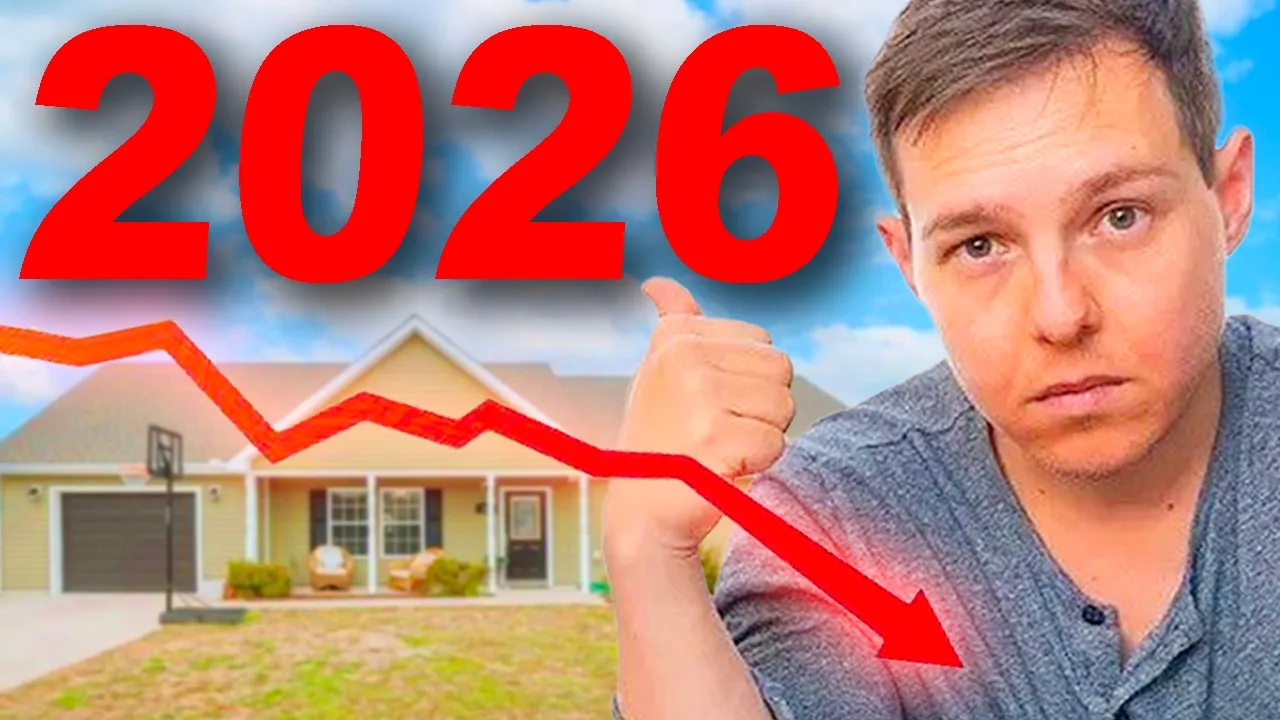
what's up you guys it's Graham here and we got to talk about what's happening with housing prices because despite record high values constant increases and the worst affordability in 40 years there's actually some good news in that a few major housing markets are finally beginning to fall for example One Market just dropped 3% thanks to Rising inventory to other states are starting to witness price reductions with more available homes than there are buyers and 24 of the largest 150 metros are already seeing year-over-year declines but of course to make matters even more confusing some markets are only getting more expensive with places like San Diego seeing a 99. 2% increase Las Vegas starting to rebound as prices go up by 7. 8% and more specific Metras are appreciating by more than 20% that's why I thought it'd be really interesting to break down exactly where housing prices are falling the most across the United States why median values could actually begin to come down over the next year or two and then most importantly what you could do about this to come out ahead on today's episode of don't forget to clean your cat's litter box although before we start as usual if you appreciate information like this in more of a podcast style setting it would mean the world to me if you hit the like button or subscribe if you haven't done that already it's totally free and that ensures that you don't miss out on any future updates like this so thank you guys so much and also big thank you to incog for sponsoring today's video but more on that later all right so in terms of what's going on it's first important to understand the term seasonality see for those unfamiliar real estate generally tends to follow a very predictable cyclical pattern of Peaks and valleys where prices rise R and fall on a rather consistent basis as you can see here that's because historically people are most likely to buy a home and move around spring and summer and sellers are most likely to take their homes off the market in the winter leading to this midyear Feeding Frenzy of homes that begins to drive prices higher as demand increases as far as why this happens redin analysts say it's mostly dictated by weather where cold and wintry conditions can make it hazardous are simply undesirable for buyers to travel to tours and sellers know that homes have more curb appeal when flowers are in bloom lawnz or Lush now even though most seasonal pricing tends to be a difference of 8 to 12% off the sales price some locations like the Northeast and Great Lakes lead the nation with a 22% variation between summer and winter sales prices which means right now is probably going to be the most competitive time to get a home under contract with just under 70% of all sales activity taking place in just the few of these busiest months like we're seeing today in fact the National Association of realtor said that sales activity between February and March typically increases by 30 4% while prices rise by 3% and the busiest months tend to occur in June July and August I say all of this because when it comes to housing prices there's almost always going to be a significant difference between summer and winter months so once you understand this everything else we go over is going to start to make a lot of sense now before we dive into these specific locations seeing the biggest decreases and increases across the country I just want to say accurately predicting the real estate market is incredibly challenging especially since each market is so localized but one method tries with fairly decent accuracy dating all the way back to the late 1800s and that's what's known as the 18-year cycle this was originally identified by the British real estate Economist Fred Harrison and by using these techniques he correctly predicted the housing market crashes in the early 1990s and in 2008 a full decade before they happened and according to him he thinks the next Real Estate crash is going to occur in 2026 as he explains every 18-year cycle begins with a 14-year expansion where prices rise followed by a subsequent four years where prices fall and it all begins once a market starts recovering from a crash during this time demand is low the market is uncertain Banks aren't lending a lot of money and new construction somewhat stall however in the next phase demand begins to pick up rents begin to increase as more inventory gets sold and construction picks up to satisfy some of the extra demand in the third phase though the market starts to overheat and prices rise at an unprecedented rate as more inventory floods the market some even call this the Winner's curse where people buy in just because they're expected to automatically make a profit because they bought something however in the fourth phase this demand begins to fizzle out overbuilding causes prices to fall buyers wait on the sidelines because they see the market falling and expect that they could buying even cheaper Banks begin to scale back sellers reduce their asking prices and then the cycle begins to repeat itself now obviously all of this is overly simplified and things like Regional variability policy changes interest rates and investor sentiment could lengthen or shorten these time frames by however many years but if he's right then our next downturn could just be 2 years away for example in terms of a more specific timeline he points out that the market generally takes about four years to start its upward trajectory which would have last occurred from 2008 to 2012 from there we typically see about 6 to S years of modest growth which is largely what we saw from 2012 through 2018 his midcycle dip even occurred throughout some of the major markets in the United States with several CI seeing a price drop in 2018 and 2019 but then we have the final boom phase lasting 6 to 7 years where prices grow faster than at any other point in the cycle taking us through 2026 now even though this could be certainly chocked up to crazy conspiracy and just because it's happened in the past doesn't mean it's going to happen again although the founder does believe this method is still valid saying we'll be in uncharted waters it's anybody's guess as to the rate of collapse of housing prices however in terms of exactly where prices are falling the most today and which cities you're seeing the largest declines here's where things get really interesting hold on one sec hello seriously it's a robocaller look as much as I enjoy talking about real estate the sad reality is that data Brokers are out there who sell your information to third parties spammers or other people who might want to Target you and it's happening at an alarming rate like anytime you give out your information online anytime you sign up for a product or service or anytime you make a purchase your information's potentially floating around the internet internet somewhere in the hands of maybe someone you don't want having it I've even had several times in the past where fraud alerts have shown up on my credit card from people trying to make a purchase in another state this has happened for over a decade now no matter how careful I try to be now of course the good news is that you have a right to protect your privacy and request the data Brokers remove the information they have about you the bad news is that this could take years to do yourself manually which is why our sponsor in cogy is there to help they could do all the work for you by reaching out to data Brokers on your behalf requesting personal data be removed and dealing with any objections the websites or data Brokers might have and since many data Brokers continue collecting your information even after they've removed it and cogni also takes care that your data stays off the market by conducting repeated removal requests all you have to do is create an account grant them the right to work for you and sit back while they keep you updated every step of the way so if you're interested in having your personal data be removed check out incog at incog docomo in the description and use the code GR at checkout for 60% off your annual plan again the link is down below in the description to get started today and now let's get back to the topic at hand in terms of where real estate values are falling the most two states are taking the lead with that being Florida and Texas as Business Insider reported both states have been building more homes than any other part of the us in a race to make room for pandemic era newcomers or basically the states that saw the largest pandemic boom were also the same areas that saw the most development most pric growth and most oversaturation to the point where now they're no longer the most cost effective and are no longer the most attractive leading of course to in some of these areas more Supply than demand of course in terms of more specific cities realtor.
com reported on the 11 markets that are seeing the largest decline so far in the United States and at the top of the list is Miami with an 11. 2% drop year-over-year Denver came in with a 6. 3% drop Seattle at 55% Kansas City at 4.
9% Oklahoma City at 4. 3% % and San Jose at 4% on top of that even Manhattan real estate prices are beginning to turn the corner with the average sales price falling 3% thanks to Rising inventory in fact there is now 9. 8 months worth of inventory listed for sale in Manhattan which means they are officially in a buyer Market of course it might be too early to tell if it's a one-off event or if this is a start of a new trend but it is very interesting to see exactly which markets are most affected now second when it comes to Falling prices there's another more Sinister aspect to consider and that's a term called shrinkflation yep you heard that correctly the same term that usually refers to foods and products suspiciously getting smaller over time while remaining the same price has now officially made it to the housing market and in a way it's working see here's the thing for those unaware over time the signs of the average house has increased by a lot for example you could see that in the 1970s the average household size was three people who lived in a house that was roughly 1,650 ft but over time the average home just kept getting bigger and bigger and bigger and bigger while the average household kept getting smaller and smaller or I guess put it another way fewer people are now living in more square footage that's why even though the average price per square foot has stayed the same adjusted for inflation houses are getting more expensive because in fact they're getting bigger as a really crude visual of this that I just made myself on Photoshop imagine that the average home was $84,000 in 1980 for 1,600 ft or $299,000 in 19 90 but for 2600 ft of course if you're curious what the data shows us in percentage terms both the afterm median size of new US houses has increased by 62% since 1973 frankly the reason for this is really twofold one Builders want to maximize the scare footage on a vacant land for resale value so they'll typically max out whatever they're able to construct and two buyers today want extra space for activities especially as it becomes more common to work from home so they'll gladly pay for it however that's now seeming like it's starting to change because construction costs are increasing and buyer affordability is declining Builders have begun to create smaller homes in an effort to charge less and like I mentioned earlier it's beginning to make a noticeable difference like a recent analysis found that single family homes have decreased in size to the lowest level since 2010 and Builders are beginning to focus their efforts on creating more starter homes Zillow even reported an increase of 99.
5% in single family homes with fewer than three bedrooms not to mention when I started looking into this I found an Indiana based home builder who recently introduced detached homes that are 50 to $75,000 less expensive and 3 to 500 ft smaller than regular builds I guess to me this just seems like more of optimization or as they say instead of building a formal dining room the focus is Shifting to larger kitchen islands with seating also Builders are sacrificing primary bedrooms with walk-in closets and opting for another small bedroom after all as a real estate agent I would see so many homes with wasted space and empty rooms that would just rarely ever realistically get used today just seems like that is a lot less common and Builders are scaling back in some of the waste because they don't want to spend the extra money themselves either now sure some people could compare this to a Budget Airline who cuts cost 15% at the expans of cramming in extra seats and getting rid of an extra 3 in of leg room but it does result in lower prices and more efficiency if that's what you're after personally though I will say as someone who's lived in a four-bedroom home and a 900t one-bedroom duplex in most places there's weird spaces that you just don't get use of there's unnecessary square footage that you're paying for and weird Dimensions that Builders typically create to maximize profit even though it serves you very little purpose I think if most home buyers and Builders were honest with themselves you probably need a lot less scare footage than you think most dining rooms just sit around collecting dust living rooms and kitchens can often be combined in an open floor plan and if you're looking to optimize instead of maximize resale value I bet most homes could be a little bit more cohesive of course I don't say this to defend home builders but the reality is that extra score footage that you don't actively use gets very expensive it's the reason you pay higher property taxes higher Insurance costs and also higher utility bills so if you could go without it and save some extra money all things considered I'd say it's worth it even though technically you end up paying a little bit more per square foot than before the savings is probably there but overall though at the end of the day outside of a few specific markets that have declined nationally average prices have still risen 6.