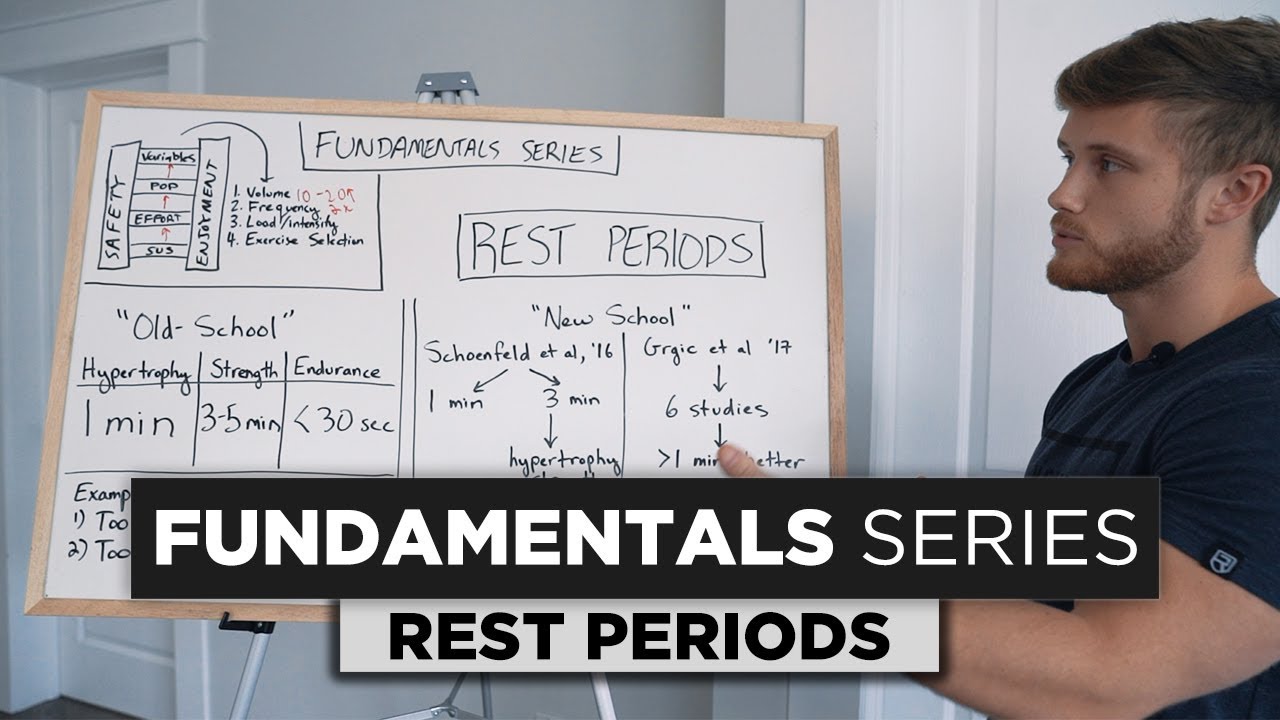
short rests or long rests which is better for maximizing muscle growth traditionally short rest intervals were believed to be optimal for building muscle indeed a 1987 study by kramer and colleagues found that bodybuilders used around 10 to 90 seconds of rest between sets this was in contrast to power lifters who rested around 120 to 140 seconds between sets even today if you follow any social media general fitness pages or have read any classic personal training textbooks you may have come across the notion that shorter rest periods are superior for building muscle whereas longer rest periods are better for building strength the idea shorter rest intervals are superior for muscle growth thus have origins in scientific research research has shown that when using shorter rest intervals anabolic hormones mainly growth hormone are elevated significantly more than using longer rest intervals it speculated this greater acute elevation in anabolic hormones would result in greater muscle growth however we cannot necessarily assume just because something induces a greater acute hormonal response it will cause greater muscle growth interestingly when looking at the current research greater acute anabolic hormone elevations do not appear to be correlated to muscle growth as a result the idea that shorter rest intervals produce greater muscle growth due to the greater acute hormonal response is not supported opposed to the research assessing the acute hormonal responses to various rest intervals it would be much better to look at research assessing measures of muscle growth before and after a set duration in groups using different rest intervals let us evaluate this research for compound exercises the weight of the current evidence suggests that longer rest intervals may be superior to shorter rest intervals for building muscle compound exercises involve the movement of two or more joints resulting in multiple muscle groups being trained examples include the back score bench press deadlift barbell row overhead press and many more let's briefly overview the research on compound exercises and rest intervals longo and colleagues had 28 untrained individuals perform leg presses for three sets to failure which is the point at which no more repetitions can be performed with an eighty percent one rep max load twice per week for ten weeks increases in quadriceps cross-sectional area were superior when resting for three minutes between sets compared to resting one minute between sets schoenfeld and colleagues had 13 men with at least six months of training experience perform a range of exercises each for three sets to failure with an 8 to 12 rep max load three times per week for eight weeks the exercises were the back squat leg press leg extension bench press overhead press lat pull down and cable row except for the leg extension all of these exercises are compound increases in elbow flexor triceps brachii anterior quadriceps and vastus lateralis thickness favored the group resting for three minutes compared to the group resting for one minute between sets baresh and colleagues split 12 men with some training experience but not in the three months before the study into a group resting 2. 5 minutes between sets or a group resting one minute between sets both groups trained four times per week for 10 weeks with workout 1 and workout 2 each repeated twice per week a range of compound exercises were used the group resting 2. 5 minutes between sets experienced greater increases in thigh and arm cross-sectional area fink and colleagues split 14 untrained individuals into a group resting 2.
5 minutes between sets or a group resting 30 seconds between sets both groups train the bench press and back squat for four sets to failure with a 40 one rep max load twice per week for eight weeks you may be questioning the percent one rep max load however for hypertrophy this is perfectly fine the current evidence suggests that loads between 30 percent and 85 percent warn rep max produce similar hypertrophy provided reps are performed to failure increases in triceps cross-sectional area were similar between both groups but increases in thigh cross-sectional area favored the group resting 2. 5 minutes between sets there actually is one paper finding shorter rest intervals to be superior for muscle growth with compound exercises villanova and colleagues split 22 untrained elderly men their average age was 68 years old into a group resting four minutes between sets or a group resting one minute between sets both groups perform the leg press machine chest press lat pull down seated row dumbbell step-ups dumbbell romanian deadlifts knee extensions and leg curls for two to three sets with 46 reps three times per week for eight weeks increases in lean body mass were superior for the group resting one minute between sets however this study does have limitations the subjects were elderly men later we'll explore how age impacts recovery between sets but more importantly volume load the product of sets times reps times load was equated between the one minute rest group and the four minute rest group this would have meant that the one minute rest group was training closer to failure to illustrate this let's say your one route max on the bench press is 100 kilograms and you had to perform three sets of eight reps with 75 kilograms which would be more difficult resting one minute between sets or resting four minutes between sets of course resting one minute between sets would be harder as you would be training closer to failure on your subsequent sets thanks to the decreased recovery time therefore it's unclear what the result of the villanova and quality study would look like if both the one-minute rest group and four-minute rest group took their sets to failure remember the four studies we have looked at so far finding greater hypertrophy for longer rest intervals had subjects take their sets to or close to failure so the current evidence suggests that when subjects train with the same program and proximity to failure longer rest intervals so 2. 5 to 3 minutes seems to produce greater hypertrophy than shorter rest intervals one minute or less with compound exercises the same training program detail is worth elaborating on the same training program would imply that a longer rest group and a shorter risk group perform the same number of sets on their exercises there is some evidence suggesting that if you use shorter rest intervals performing more sets may be compensatory meaning that more sets and shorter rest intervals could produce similar hypertrophy to fewer sets and longer rest intervals returning to the longer and colleague study they found that when subjects trained twice per week for 10 weeks performing four to five sets to failure on the leg press with an eighty percent one remax load and one minute of rest between sets produce similar increases in quadriceps cross-sectional area to performing three sets to failure on the leg press with an eighty percent one rep max load and three minutes of rest between sets italian and colleagues found that resting two minutes between sets produced similar increases in quadriceps cross-sectional area to resting five minutes between sets when participants performed an average one more set when resting two minutes between sets although two minutes of rest between sets would not be seen as a short rest interval to many people another way one could potentially interpret this study is that despite the more sets two minutes of rest between sets could be sufficient and resting for longer may not be required unfortunately there currently isn't any other papers comparing two minutes or rest between sets to other longer rest intervals for hypertrophy as a result we can only conclude that based on the current evidence with all else equal longer rest intervals so 2.
5 to 3 minutes produce greater hypertrophy than shorter rest intervals of one minute or less with compound exercises however when all else is not equal this might not be the case specifically performing one or two more sets with shorter rest intervals may be able to produce similar hypertrophy to longer rest intervals unfortunately with isolation exercises the evidence is less clear on how long you should rest isolation exercises primarily involve movement at one joint resulting in primarily one muscle group being trained examples include bicep curls triceps push downs lateral raises leg extensions leg curls and many more returning to the baresh and colleague study a range of isolation exercises were used as already mentioned increases in arm and thigh cross sectional area were greater for the group resting 2. 5 minutes between sets compared to the group resting one minute between sets therefore this study implies longer rest intervals are also favorable with isolation movements however it could be argued that the use of compound exercises in the study somewhat confounded our ability to truly deduce if longer rest intervals are better with isolation movements what about the research evaluating rest intervals with isolation exercises exclusively fink and colleagues had 22 individuals perform bicep curls preacher curls hammer curls close grip bench presses tricep skull crushers and dumbbell extensions except for the close grip bench press all of these exercises are isolation but the close grip bench press was used to isolate the triceps so this is not really a problem the researchers had one group perform these exercises with a 20 rep max load and 30 seconds of rest between sets and another group performed them with an 8 rep max load and 3 minutes of rest between sets both groups took their sets to failure and performed the same number of sets for some reason the paper did not state the number of sets performed both groups trained twice per week for eight weeks increases in arm cross sectional area favored the group using a 20 rep max load and 30 seconds of rest between sets therefore this study suggests that with isolation exercises shorter rest intervals may be superior load was not controlled the group that rested 30 seconds between sets used a 20 rep max load while the group that rested 3 minutes between sets used an 8 rep max load it could be argued that this somewhat confounded the study recall earlier i mentioned that the current evidence suggests that loads between 30 and 85 percent of one rep max produce similar growth when reps are performed to failure this would imply that the use of different loads should not matter another study by okazi and colleagues assigned to each arm of nine untrained men into one of three conditions three sets to failure with an eighty percent one rare max load and three minutes of rest between sets three sets to failure with a thirty percent one rate max load and ninety seconds or rest between sets or a drop set condition the drop set condition had the arm perform an initial set to failure with an eighty percent one rep max load immediately after they performed four drop sets to failure starting with a sixty five percent one rep max load then a fifty percent one rep max load then a forty percent one ramx load and finally a thirty percent one rep max load all three conditions involve training the unilateral dumbbell biceps curl two to three times per week for eight weeks increases in cross-sectional area of the elbow flexors which included the biceps braca and brachialis were similar between all three conditions therefore this study implies that with isolation exercises rest intervals may not matter at all not only did three minutes of rest produce similar growth to 90 seconds of rest but virtually no rest between sets the drop set condition was not any worse now the drop set condition did technically perform five sets which is two more than the other two conditions more sets generally result in more growth and so this could have helped out the drop set condition so the current evidence is completely conflicting with regards to rest intervals and isolation exercises with one paper finding longer rest intervals to be superior another finding shorter rest intervals to be superior and even one finding no differences between various rest intervals to mighty the waters even further there is one paper finding drop set training so no rest between sets to be superior to traditional training for hypertrophy with an isolation exercise finke and colleagues split 16 men untrained in the last year into a normal set group or a drop set group both groups trained the triceps push down twice per week for eight weeks the drop set group performed a single set to failure with a 12 rep max load immediately decreasing the load by 20 each time failure was reached three times in a row the normal set group performed three sets to failure with a 12 rep max load and 90 seconds of rest between sets increases in triceps cross-sectional area favored the drop set group in this study the drop set group did technically perform one more set than the normal set group similar to the ocassion colleague study this could have helped out the drop set condition given the conflicting evidence we don't really have any grounds to conclude if shorter rest intervals or longer rest intervals are better for hypertrophy with isolation exercises i think it's sensible to suggest that one should aim to rest however long they feel is comfortable and practical with these movements although we were unable to conclude if longer or shorter rest intervals are preferred with isolation exercises we did conclude that with compound exercises longer rest intervals appear to be favorable why might longer rest intervals produce greater hypertrophy with compound exercises some researchers have suggested this is because longer rest intervals allow for a higher volume load the product of sets times reps times load for instance in the already mentioned longo and colleague study they measured the volume load completed over the 10 week duration in the two conditions performing three sets on the leg press twice per week for 10 weeks total volume load was higher in the condition that arrested three minutes between sets versus the condition that arrested one minute between sets the authors contended that this higher volume load accumulated with the three minute rest condition explained the greater increases in quadriceps cross-sectional area observed for this condition however this assumes that higher volume loads result in more growth when overviewing the research this isn't the case to be clear volume in the form of weekly sets is related to hypertrophy for instance a meta-analysis by schoenfeld and colleagues found that with all else equal the more sets that are two or close to failure performed per week the greater the muscle growth but the number of weekly sets that are too close to failure and volume load is not the same thing remember in the longer and colleague study both the three minute rest condition and one minute rest condition involve three sets to failure on the leg press each session but as just mentioned volume load was higher for the three minute rest condition here's the important point we have strong evidence volume load is unrelated to muscle growth this comes from research on rep ranges as already mentioned loads between 30 percent and 85 percent one rep max appear to produce similar muscle growth provided reps are taken to failure based on this three sets to failure with an eighty percent one rep max load should produce similar muscle growth to performing three sets to failure with a sixty percent one rate max load let's say an individual's warner max is 100 kilograms on an exercise when performing three sets to failure with an 80 one rep max load so 80 kilograms assuming a longer rest interval we might expect them to get seven reps on the first set six reps on the second set and five reps on the final set this would give us a volume load of four thousand three hundred and twenty kilograms when performing three sets to failure with a sixty percent one rep max load so 60 kilograms providing a longer rest interval we might expect them to get 15 reps on the first set 13 reps on the second set and 11 reps on the final set this would give us a volume load of seven thousand and twenty kilograms if volume load was an indicator of muscle growth we would expect three sets with a sixty percent one rep max load to produce greater hypertrophy than three sets with an eighty percent one rep max load but from the research on rep ranges both protocols would probably produce similar hypertrophy therefore the idea that longer rest intervals produce greater hypertrophy because they enable higher volume loads cannot be true moreover if volume load was the reason why would this not apply to isolation exercises longer rest intervals would allow a greater volume load with isolation exercises yet as established the research on rest intervals and isolation exercises is conflicting a stronger hypothesis behind why longer rest intervals appear to produce greater hypertrophy with compound exercises relates to central fatigue i must credit chris beardsley eric helms and james krieger from where i initially came across this hypothesis it was their work that inspired me to research this area much further to understand this hypothesis we need to understand central fatigue the reason muscles produce force is because they receive signals originating from the central nervous system the central nervous system consists of the brain and spinal cord there are two neurons involved here an upper motor neuron and a lower motor neuron upper motor neurons originate in the cerebral cortex which is the outer layer of the cerebrum the cerebrum refers to the two hemispheres of the brain upper motor neurons mostly end at a region in the spinal cord lower motor neurons mostly start at a region in the spinal cord and end at a particular muscle upper motor neurons transmit electrical signals to lower motor neurons which relay this signal to a muscle causing muscle contraction central fatigue refers to a decrease in these electrical signals to the muscle [Music] at the level of the muscle this means that not only do the recruited muscle fibers produce less force but fewer muscle fibers are recruited overall this is the opposite of what we want for maximizing muscle growth we want high levels of muscle fiber recruitment and high levels of force produced by each of those recruited muscle fibers during a set on an exercise two or close to failure central fatigue likely develops there are numerous potential mechanisms behind how central fatigue occurs during exercise one particular mechanism that is linked to hypertrophy training sets is afferent feedback afferents are neurons that transmit information from organs to the central nervous system there are sensory neurons linking muscles to the central nervous system two of these group three afferents and group four afferents have been associated with central fatigue group three afferents are primarily sensitive to strong levels of muscle contraction but they do also appear to respond to the build up of metabolites group 4 afferents are primarily sensitive to the buildup of metabolites within the muscle but they do also appear to respond to strong levels of muscle contraction just to be clear the build-up of metabolites refers to the increase of various products linked to chemical reactions in the muscle such as lactate inorganic phosphate and hydrogen ions when training to or close to failure the majority of a muscle's fibers would be producing strong contractions additionally the buildup of metabolites likely occurs too especially during higher repetition sets in response to these conditions group 3 and group 4 afferents can directly or indirectly reduce the electrical signal sent down by lower motor neurons [Music] this means less force production from recruited muscle fibers as well as a reduction in the overall muscle fibers recruited which as established is what we do not want it's impossible to remove central fatigue during our sets however we would want to begin our next set once this central fatigue has disappeared and this is the basis of the hypothesis it's believed longer rest intervals would make it less likely for us to begin a set when central fatigue is still present however why would this particular argument only apply to compound and not isolation exercises some evidence indirectly implies that the more muscle mass involved in an exercise the greater the central fatigue generated because compound exercises involve a greater amount of muscle mass compared to isolation exercises this would imply that sets of compound exercises produce greater central fatigue and thus require longer rest intervals compared to isolation exercises but i have come across research opposing this central fatigue hypothesis a review paper by weevil and colleagues actually suggests that the less muscle mass in an exercise the greater the central fatigue generated an isometric unilateral elbow flexion contraction produced greater central fatigue than unilateral knee extensions these knee extensions also produce greater central fatigue than cycling out of these three modes of exercise cycling involves the greatest amount of muscle mass followed by unilateral knee extensions and then unilateral elbow flexion contractions furthermore as far as i'm aware there are no studies investigating how quickly central fatigue disappears after sets of typical weight training exercises but there is indirect data that would imply central fatigue disappears fairly rapidly kennedy and colleagues had subjects perform a maximum voluntary contraction of the quadriceps for two minutes immediately after there were minimal signs of central fatigue another study by kennedy and colleagues had subjects perform a two-minute maximum voluntary contraction of the adductor pollicis which is a muscle of the hand central fatigue had almost fully dissipated after one minute of rest todd and colleagues had subjects perform a two-minute maximum voluntary contraction for the elbow flexors central fatigue had dissipated within 30 seconds of completing the exercise of course these protocols are not identical to sets with typical weight training exercises most exercises are performed with a concentric and eccentric phase while the mentioned studies involved maximum isometric contractions moreover all of these studies involve two-minute contractions most typical sets last far less than two minutes this is an important point there seems to be a belief that heavier loads and therefore shorter set durations cause the most central fatigue however this is a misconception lighter loads and therefore longer duration sets seem to cause greater central fatigue this study had subjects perform an isometric contraction with their quadriceps for 33 straight minutes at 15 percent of their maximum voluntary isometric contraction strength the authors noted central fatigue dissipated within three to nine minutes after this protocol another study had subjects perform an isometric contraction with their elbow flexors for 43 straight minutes at 15 percent of their maximum voluntary isometric contraction central fatigue took roughly 20 minutes to disappear smith and colleagues had subjects perform an isometric contraction with their elbow flexors for 70 straight minutes at five percent of their maximum voluntary isometric contraction 30 minutes after finishing this central fatigue was still present they did not take any further measurements after these 30 minutes so we do not know when central fatigue fully dissipated therefore given typical hypertrophy sets are generally shorter in duration than two minutes their indirect evidence would suggest that central fatigue should disappear quicker than the values we saw for the various two-minute isometric contractions potentially implying that central fatigue disappears after 30 seconds or less of typical hypertrophy sets but as we saw with the research 2. 5 to 3 minute rest intervals produced greater hypertrophy than one minute or less with compound exercises as a result there seems to be a potential flaw with the central fatigue hypothesis i should note the research we have looked at assessing how long it takes for central fatigue to disappear used isometric contractions for only one muscle group essentially meaning they are isolation exercises but remember although there is some indirect evidence suggesting compound exercises could induce greater central fatigue than isolation exercises the review paper by weevil and colleagues suggests otherwise at the end of the day to truly know if central fatigue could be the reason behind why longer rest intervals are superior with compound exercises we would need research assessing how long central fatigue takes to disappear after various sets with compound exercises as well as isolation exercises aside from distinguishing between compound and isolation exercises it's often overlooked that sex age and even your current strength levels can play a role in determining the duration of rest intervals most of the studies looked at so far had men as their subjects though a few studies did have both men and women as their subjects but this clouds our ability to draw out any potential differences between men and women some evidence suggests women may be able to recover quicker between sets compared to men rata mess and colleagues recruited 22 men and women with at least one year of training experience the subjects performed three sets on the bench press with a 75 one rep max load on three separate occasions they perform this protocol with either one minute two minute or three minutes of rest between sets the subjects were encouraged to perform 10 reps per set looking at the results regardless of the rest interval used women performed a higher number of reps over the three sets compared to the men indicating they had a greater recovery ability other studies also have similar findings however the authors noted that when they adjusted for bench press strength there was no difference in repetition performance between men and women over the three sets this would suggest that gender per se did not explain the faster recovery rather it appears your strength level impacts how quickly you recover in other words the weaker you are on an exercise the quicker your performance can recover conversely the stronger you are on an exercise the longer it would take for your performance to recover in this study the woman's average bench press one rep max was 36 kilograms while the men's average bench press warner at max was 112 kilograms given the women were weaker than the men in this study this seemed to explain why they were better able to sustain their repetitions from set to set to further test this idea the researchers had a second part of the study 22 men were split into a low one rep max group or a high one rep max group on average the low one rep max group's bench press was 81 kilograms while the high one rep max group's bench press was 141 kilograms the subjects performed three sets on the bench press with a 75 one rep max load on three separate occasions they performed this with either one minute two minutes or three minutes of rest between sets the subjects were encouraged to perform 10 reps per set looking at the results regardless of the rest interval used the low warner max group were able to sustain their repetitions across the three sets better than the high warner max group therefore regardless if you're a man or woman the weaker you are on an exercise the faster you can probably recover between sets of that exercise and so your rest intervals need not be excessive here having said all of this there is other evidence suggesting that when women and men are matched for strength women are still able to recover faster philco and colleagues match nine men and nine women for strength of their doctor policies the researchers had subjects perform a fatiguing isometric contraction of their doctor pollicis one minute after this the woman had recovered to 71 of their baseline strength while the men only recovered to 65 of their baseline strength research comparing various physiological and anatomical differences between men and women also support the idea women may intrinsically have the ability to recover quicker between sets some evidence indicates women have greater blood flow than men greater blood flow to the muscle would accelerate the recovery process between sets additionally some evidence suggests that women have a higher proportional area of type 1 muscle fibers compared to men type 1 fibers often called slow twitch muscle fibers have faster recovery abilities and are more fatigue resistant compared to type 2 fibers which are often called fast twitch muscle fibers based on this woman would not only be able to recover quicker between sets but each set would also generate less fatigue so irrespective of whether their exercise is isolation or compound women can probably rest shorter than men would without any problem although we could not conclude anything with isolation exercises we did conclude that with compound exercises 2.
5 to 3 minutes of rest between sets was superior to shorter durations but this conclusion was from studies that mainly involved men women may be able to get away with resting one to two minutes between sets of compound exercises [Music] all but one of the studies assessed so far have focused on young men and women two studies suggest that elderly men and women may be able to recover faster between sets than younger men and women theo and colleagues recruited 20 young women between 20 and 30 years old and 16 elderly women between 60 and 80 years old the researchers had these subjects performed three sets with an eight rep max of load on an isokinetic dynamometer designed to provide knee extension and knee flexion resistance on three different days they performed this with either 15 seconds 30 seconds or 60 seconds of rest between sets for both the young and elderly women 60 seconds of rest resulted in the maintenance of knee extension torque throughout the three sets while the 30 and 15 second rest intervals did not neither the young or old woman were able to maintain knee flexor torque across the three sets with 15 seconds of rest between sets but both were able to maintain knee flexor torque with 60 seconds of rest between sets but the elderly woman were also able to maintain knee flexor torque throughout the three sets with 30 seconds of rest between sets this implies that for the elderly 30 seconds of rest between sets was sufficient to recover knee flexion talk whereas the younger woman required 60 seconds of rest between sets therefore this study partially supports the idea that elderly women may be able to recover quicker between sets compared to younger women another study by botaro and colleagues recruited 17 young men their average age was 25 years old and 20 elderly men their average age was 66 years old the subjects performed knee extensions for 3 sets of 10 reps on two separate occasions they performed this with either 60 seconds or 120 seconds of rest between sets with both rest intervals the young men experienced a greater decline in peak knee extension torque across the three sets compared to the elderly men indicating the elderly men had a quicker recovery between their sets in the two studies the elderly subjects were weaker compared to the younger subjects as discussed already this strength difference likely would partly explain why the elderly may be able to recover quicker between sets however there is also evidence that with aging there is a decrease in the size of type 2 muscle fibers and an increase in the proportion of type 1 muscle fibers as mentioned type 1 fibers have quicker recovery abilities and are more fatigue resistant compared to type 2 fibers this would be another potential reason behind why the elderly may be able to recover quicker between sets compared to the young when we looked at the research on compound exercises and muscle growth the study by villanova and colleagues was conducted on elderly men the average age was 68 years old increases in lean body mass were greater for the group resting one minute between sets compared to the group resting four minutes between sets on the face of it this would support the idea that the elderly can successfully use shorter rest intervals but recall volume load was equated between the two groups meaning the one minute rest group would have been training closer to failure than the 4-minute risk group therefore it's unclear how this study would conclude if both groups took their sets to failure so more research would be required to truly get an idea of what rest intervals promote greater hypertrophy in the elderly ultimately from the acute research the elderly can probably wrestle less between their sets compared to the young with isolation exercises the only sensible advice to give based on the current evidence would be to select a rest interval the elderly may find comfortable and practical for compound exercises given the majority of the evidence implies that 2. 5 to 3 minutes of rest between sets produces greater hypertrophy than shorter restorations in young men it could be assumed that the elderly may be able to achieve optimal muscle growth with a rest interval shorter than this perhaps one to two minutes of rest between sets of compound exercises is sufficient [Music] there is some evidence that a person could over time slowly decrease the duration of their rest intervals without compromising muscle hypertrophy de souza and colleagues split 20 men with at least one year of training experience into a constant rest group or a decreasing rest group both groups trained six days per week for eight weeks for the first two weeks both groups trained identically they performed all exercises for three sets with a 10 to 12 rep max load and two minutes of rest between sets workout 1 and workout 2 were each performed 3 times per week from weeks 3 to 8 both groups performed each exercise for 4 sets with an 8 to 10 rep max load but their rest intervals differed their weekly workout schedule also changed the constant rest group continued using two minutes of rest between sets the decreasing risk group throughout these six weeks gradually decreased the duration of their rest intervals weekly from 105 seconds to 30 seconds of rest between sets after the 8 weeks increases in thigh and arm cross sectional area were similar between both groups put differently gradually decreasing your rest duration week to week appeared to not compromise muscle growth in comparison to a group consistently resting two minutes between sets a range of compound and isolation exercises were performed by both groups returning to our findings much earlier the research is conflicting on whether long or short rest intervals are optimal with isolation exercises but with compound exercises 2. 5 to 3 minutes of rest between sets produced greater increases in muscle hypertrophy versus shorter rest durations based on this information you could argue that the constant rest group was not resting optimally anyway as they rested only 2 minutes between sets given 2.
5 to 3 minutes of rest is preferred for compound exercises we cannot truly conclude that gradually decreasing rest intervals does not compromise muscle growth at the same time though it's important to consider that the conclusion 2. 5 to 3 minutes or rest is preferred for compound exercises comes from research comparing this rest interval to durations of one minute or less it's possible that when comparing 2.