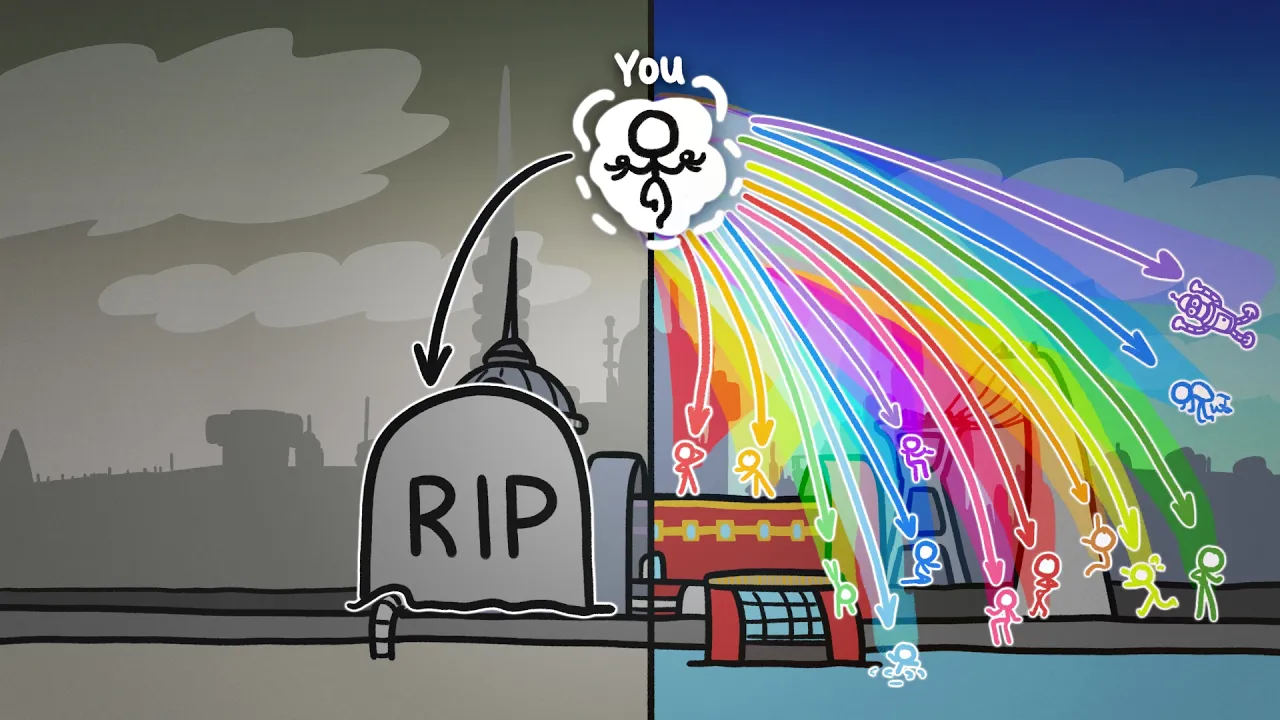
One day in the future, either everybody on Earth will be your great-great-great-great-great-. . .
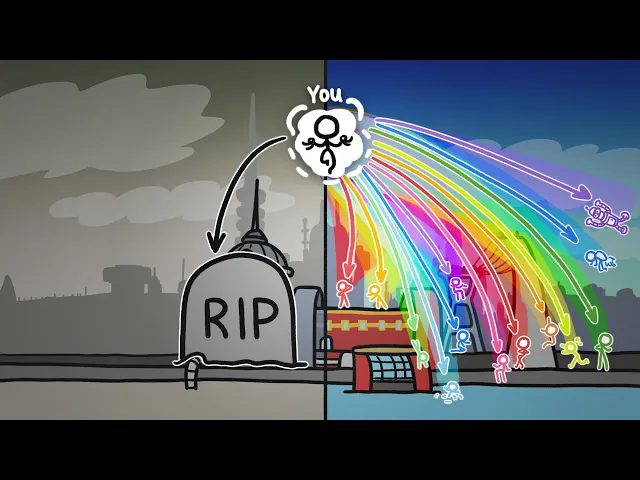
ish grandchildren, or your entire lineage will have died out completely. And this applies to every single person alive today! And if that sounds ridiculous, that's because it is – but it's also true.
Buckle up because I got another ancestry paradox for you! Hi, I’m Cameron, and this is MinuteEarth. Let's start with a simple version to show how the paradox is possible: imagine an island with a few ground rules: nobody moves to the island or leaves it, everybody pairs up randomly, every couple has two kids, and each generation has 10 people in it.
Let’s call the youngest generation “Gen 0” and work backward from there…so their parents’ generation is Gen -1, their grandparents are Gen -2, and on like that to infinity and beyond. Following the whole family tree can look daunting, but let’s start by focusing on this person down here, uh, let’s call them Alice. We can trace our way up the tree to see their parental lineage – that is, all the people she descends from.
If we do the same for, uh, Bob, we can see not only how their parental lineage overlaps with Alice’s, but also how soon it overlaps and, therefore, how closely related Alice and Bob are – in this case, since the overlap first happens in Gen -2, that would make them cousins. When we trace the parental lineages of everyone in Gen 0, we only have to go to about Gen -4 before we find a place where ALL the lineages touch – that is, someone who is related to everyone in Gen 0. And if we go further into the past – at around Gen -6 at most – all of the lineages end up overlapping everywhere: at this point in the past, everyone is an ancestor of everybody in Gen 0.
Now, let’s turn to Earth, which IS basically an island in the vast sea of space. Of course, we real-world humans pair up for all sorts of not-at-all random reasons like who we’re attracted to and where we live. Not everybody has exactly two kids with a single partner.
And there are a LOT of us. So things here on our Earth island are much messier than on our hypothetical island. But, using what we know about things like immigration and emigration, inbreeding, and population sizes, scientists can do a much, much more sophisticated version of our island simulation.
And here too, if you go far enough – somewhere between 70 and 170 generations – all of our parental lineages also end up touching, and you find one particular human who is the universal ancestor of everyone in the current youngest generation. Now, we don’t know who this person was, but they are the ancestor that makes even the two most distantly-related members of the current youngest generation related to each other. In terms of years, this person was alive between 2000 and 3500 years ago, which, for one, means it isn’t Ghenghis Khan, but still isn’t actually all that long ago.
And, like on our hypothetical island, as we keep going backward in time, our lineages overlap more and more, until eventually – somewhere between 5,000 and 15,000 years ago – they become identical: that is, they overlap everywhere. So look… if you were a human alive at this point in time, you were either here – in the shared lineage of everybody alive today – or here – in the group of people who maybe didn’t get to have kids, or whose kids didn’t get to have kids… basically, those people whose legacy died off, and are therefore in the lineage of nobody alive today. The same scenario will play out with those of us currently on Earth: there is a point in the future in which you'll be either an ancestor of everyone on Earth, or an ancestor of no-one.
It’s tough to say when this point will be, because – again – real-world humans are messy. But let’s assume the human population levels out at 15 billion people, that we are a very intermingly bunch, and average generation times about, um, 25 years. Given those assumptions, as soon as the year 3050, you'll know which group you fall into: either your lineage will be dead, or it will be universal.
But even now, there’s also two groups you can fall into: you’re either one of the proud owners of a MOVA globe, the sponsor of this video, or you’re not. Oh, hi, by the way, I’m Arcadi. I’m one of the people who illustrated this video.
Cameron is… uh… “unavailable”. And I might be biased because I’m a huge map nerd but, like, LOOK AT THIS. MOVA globes make these gorgeous globes which actually spin on their own, thanks to ambient light and the Earth’s magnetic field.
They come in 3 sizes and over 70 different designs. I personally love the outer space collection, with planets and moons and graphics from NASA and JPL. I mean, look at Pluto spinning around.
Look at that lil heart. What a rascal. And I’m gonna be real: MOVA globes are not cheap, but if I was stranded on an island with only 9 other people to randomly pair up with, I’d still want a MOVA globe with me: they’re hypnotic, they’re the perfect gift, and also you can do this!
Go check them out over at movaglobes. com because they are truly stunning. I don’t even need to get paid to say that.
Right now, you can use our promo code MINUTEEARTH15 to get 15% off. Thanks MOVA!