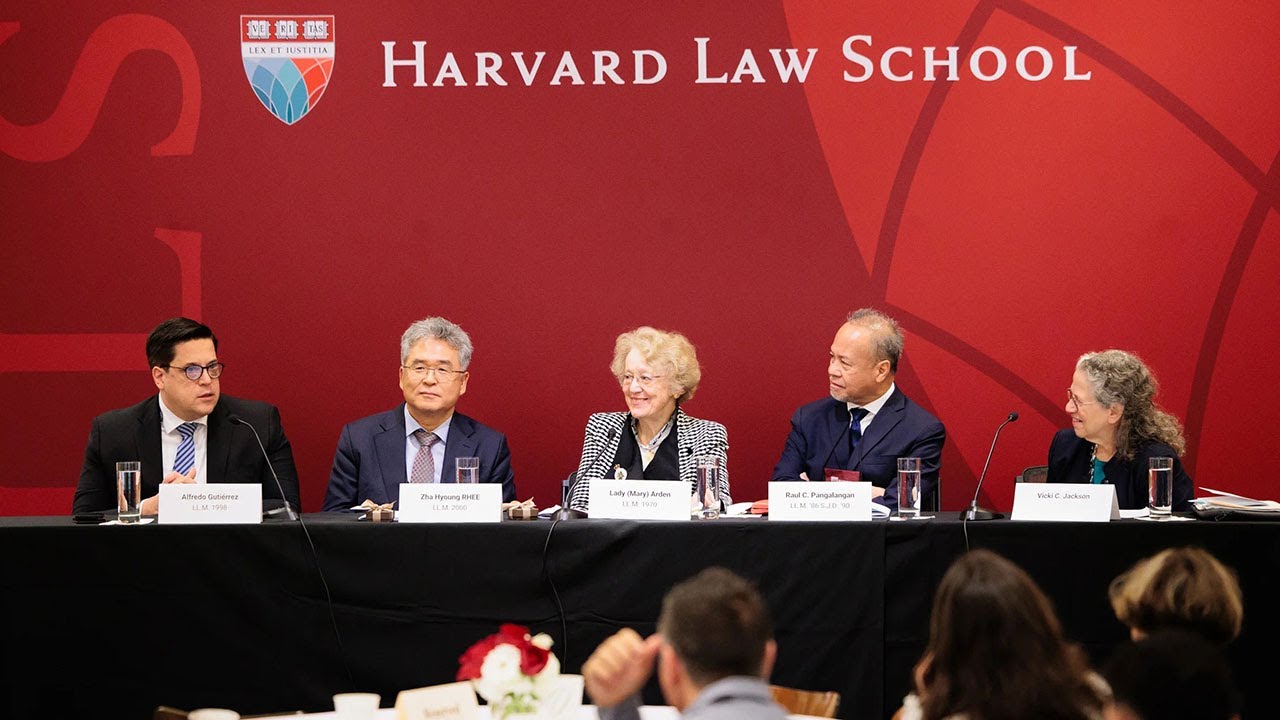
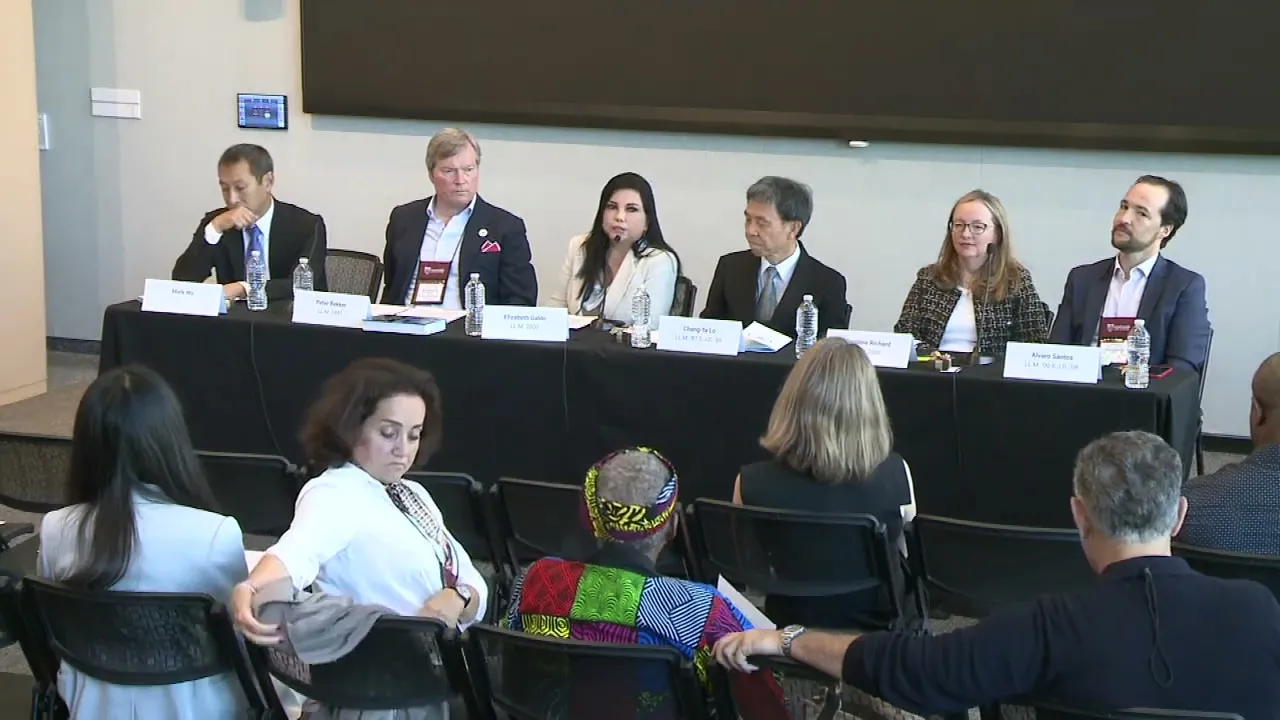
Oh you'll sit at the front and take a picture so nice to meet you nice to meet you too want to kick [Music] off I I can't say about other panels but I know in the train and investment World um it's a very prompt Community especially when hearings are taking place or events are taking place in Geneva uh which tends to run on Swiss Time so we're going to start exactly on time uh my name uh is Mark woo I'm the Henry Elson Professor uh here at Harvard Law um for a brief period I also
served as the vice team for the graduate program International legal studies so it's wonderful to see so many of you here welcome back and it's my pleasure today to kick off our panel on International Investment and trade um we have five panelists here I'm just going to introduce them briefly But you have their full CVS in your books um and I'm just going to go down the row here uh to my immediate left uh to your right uh is Peter Becker uh who's the arbitration Council and head of investment arbitration task force SC CMS uh
followed by uh Minister Elizabeth galdo who served served as the minister of foreign trade and tourism for Peru uh followed by Ambassador changfa La uh who currently serves as the permanent representative of Taiwan to the World Trade Organization and was formerly a Justice of the uh High Court the Supreme Court in Taiwan uh to his left to uh your right is carollyn Richard who's a partner of the fresh Fields um working on investment ortion based in Washington DC and last but not least is Professor Alvaro Santos uh who is based at Georgetown law and who
was intimately involved in the renegotiation of the US uh Mexico Canada uh agreement um so I'm going to kick off our discussion this Morning I think all of you are here because of your interest in uh either investment arbitration or trade uh but I'm sort of going to start by setting a big picture which is that we know over the past quarter Cy we've gone through this unprecedented period of globalization we've seen rapid growth of crossb trade uh immense flows of foreign capital investment and along with all this not surprisingly has been a proliferation of
disputes Um some of which uh many of you have been involved with personally uh and what we also know is that along with this proliferation of disputes um while we've seen millions or hundreds of millions of people lifted out of poverty because of these Trends in trade and investment um the distribution of gains from all this has been very uneven both within and across countries and this has sparked a tremendous populist backlash against the institutions they're driving Uh and overseeing uh the forces of globalization including those that oversee these disputes um so we've seen over
the last eight years in particular populists call for dismantling these treaties and we've actually seen countries withdraw uh from uh either treaty Arrangements the most notable of course being the United Kingdom uh but also uh calling for withdrawal from the institutions um that support these forces of globalization uh but yet Despite this backlash we continue to see um the number of investment arbitration and trade disputes increase um or at least remain steady uh with the exception of the WTO pellet body and we continue to see a negot ators Forge New treaties with robust dispute settlement
Provisions so I want to ask our panelists if they can help sort of shed some light on how we should try to make sense of these seeming contradictions um Peter is somebody who's been involved Intimately in these disputes and also responding to some of the criticisms which have come out including that from my former colleague uh Senator Warren and so forth um why don't you kick us off on how you see this from the investment world thank you Mark I had a real pleasure to be back here and I was telling Mark uh this was
my favorite room when I was here 34 years ago I spent a lot of time doing Research uh on what would become my PhD and dler V the late professor V serves on my PhD committee at lien University in the Netherland so brings back a lot of memories um I devoted my life to International Investment law and public international law in general uh ever since I graduated in ' 91 um first starting at the international court of justice where I spent three years so I think I can speak with some Authority about public International law
and maybe investment law in particular I actually was the first instructor to teach investment arbitration at Columbia law school and that was only in 2007 now that indicates there's a lot of Education to be done so the Ed educating part I think um ties into what uh I was going to say in my first comments and um Professor woo actually had a sentence in uh in his remarks that he shared with us uh to get us thinking about you know What we would discuss on this panel and uh one sentence was read as follows populists
who have called for dismantling these treaties and are withdrawing from these institutions have gained political power and funny enough I I immediately thought of a of an oped piece by U Senator Elizabeth Warren and she was a tax Professor when I was here and so she transformed herself into a politician uh unfortunately uh she was Ill advised to write a piece that has no Foundation in practice or indeed an international um investment law and arbitration and so uh it was really a sort of a a rally a call to arms and and the title was
the trans-pacific partnership Clause everyone should oppose so clearly a rallying call there uh and you know this trans-pacific agreement is a Free Trade Agreement 10 countries United States Japan Singapore um and she claims that investor State dispute settlement Um really would undermine us sovereignty now that kind of statement shocks the conscience of a public International lawyer because as arbitral tribunals have pointed out concluding treaties is an exerise of sovereignty it is not a limitation of sovereignty so I think right there she went off on the wrong foot there and then she says well with isds
the company could skip the US courts and go before an international panel of arbitrators if that seems Shocking buckle your seat belt isds could lead to gigantic fines but it wouldn't employ independent judges oh my God so arbitrators cannot be neutral as a matter of fact they are picked because they they are impartial and independent um she said that these are basically pseudo courts and then she she asked what's so wrong with the US Judicial System uh well if you have been in the US judicial system if you have been Before a state court judge
or a federal panel on an international law case uh you would question what she just said and I've been there um she also said that um this isds phenomenon uh independent arbitration bypassing the courts would offer a free taxpayer subsidy to countries with weak legal systems and the Only Winners will be multinational corporations those are her final words well she's got her facts wrong Because if you look at statistics and this is what we call empirical evidence would Scholars use right as part of their research methodology countries that defend these cases win more than the
corporations that bring the cases that's just a fact at least from the known cases in the uh World Bank arbitration institution isds protects investors a abroad overseas both us and non us and as a matter of fact the United States Has concluded more than 40 bilateral investment treaties um including with I think the latest with Rwanda a US investor wouldn't want to go into the courts of Rwanda um not because they're they're not independent but they may not be competent they may not know about you know a sophisticated investment so how would they be able
to provide Justice so I think I I will leave it there as my preliminary remarks Mr Galo um as somebody who's Been intimately involved in this uh as a minister but also as a politician uh any thoughts sure first of all it's an honor for me to be here thank you for the invitation when I joined the program the Harvard Law School LM in 1999 I was expecting I was eager to broaden my legal knowledge Beyond Peru but also something else happened I got pregnant during during that year so It's it's always um very nice
it's a joy to come to Boston because my daughter was born here and in my professional career it was a great year here because I grow academically it was also a a challenging because I have to to learn to manage time and I have the support of the community at Harvard Law School and I am very grateful for that and coming back to contradictions in Globalization um I agree with Professor Wu that contradictions in globalization stem from it multifaceted multifaceted impact while globalization has sped economic grad and lifted Millions out of poverty the benefits have
not even been evenly distributed these uneveness have not had not led to satisfaction and backlash against International institutions perceive as favoring certain groups of Nations however the aady number of investment arbitration and trade disputes along with new treaties being forged indicates that countries recognize the importance of a structur Frameworks to manage international relations they continue continue to engage in these mechanisms to protect their interests and resolve conflicts efficiently essentially despite criticisms the underlying need for cooperation and dispute resolution in a Connected World persists I was telling Professor wo that Peru this year is host of
The apic Forum so 21 Economist have been meeting I had a meeting with the the Ministers of trade in Peru I was a I was a chief and I have the chance to meet a Ambassador woo Who who is actually the representative of trade the main counselor and while we were talking we realized that we have something in common we were at Harvard Law School at the same time she was a JD and I was an LM candidate and she told me oh I was so jealous about you the LMS who also look so fun
and relaxed and I was so miserable studying all the time okay but but now you can see where she is so that is also something that I want to highlight about Harvard the netw workking that you can get and you can find very important people as I have heard before here in Harvard all of us are leaders And I cannot agree more on that that are my first thoughts great thank you and I think uh you know for those of you uh who know Ambassador Tai I think uh you can see um she's certainly that
studying has paid off and she's taken to Great Heights uh Ambassador La uh you've uh seen this from so many different angles uh as an academic as a arbitrator yourself and now as an ambassador uh and there somebody who's looked at this not just From trade but also International health and thinking about all of these impacts and globalizations how do you make sense of these contradictions thank you thank you Mark uh before that uh let me thank uh hu to invite me to this uh very warm event uh it brings me a lot of uh
memory uh Peter just mentioned before uh the start of this session this building was used to be this part was used to be library for international law um I remember each sjd student was assigned With a a desk at that time each each day uh I gave myself a Target at least to write something in order to to graduate uh so that was a very memorable uh days um I see this uh this whole question from three I pick up three three element one one is the Glo globalization and the um the uneven uh distribution
Rising uh from the uh from the result of globalization and the second is about dispute uh the proliferation of dispute And certainties about dismantling International treaties or International regimes uh the globalization the term has not been used has not been a favorite term uh in in the real world uh in Geneva we do not use this anymore uh sadly or or or or um there could be different uh perspective uh mainly uh because of uneven distribution of the of the benefit arising from Globalization we talked a lot more about about um the disadvantaged people we
talked a lot more about uh how disadvantaged countries uh between between WTO members or disadvantaged people within a WTO member how are we going to deal with that uh and therefore uh further liberalization has not been uh in the agenda for quite some time uh of course there are there are some Some results arising of from from this uh for instance if we are talking about uh how to address the inequality between countries uh there might not be uh consensus on the approach or on the real need of countries uh having uh uh been granted
uh to enjoy uh special and differential uh treat M uh sometimes we get uh we get uh progress but most other times we have difficulties of moving any topic forward in terms of Dispute uh I've seen dispute uh of course trade dispute within the WTO uh being composing different types uh some of the disputes genuinely arriving from uh the implementation of applications of WTO rules uh for instance if there is a breach of SPS uh commitment SPS uh rules and therefore there could be a genuine issue about whether uh the rules whether the scientific evidence
have been Shown uh but more and more uh this arise from uh things having lot to do with political tensions uh for instance uh in in in the last several years there are quite number of disput having to do with countries exercising its economic power economic coercion we call it this way uh to achieve certain political purposes um and and and of course there could be uh There could be other not necessarily having come to the stage of dispute but a lot of uh lot of differences for instance uh countries accus accusing each other uh
to uh to subsidize country accus accusing each other um not to uh to to to counter or to retaliate or to counter retaliate with with terrorists uh so so there are different uh types of uh of dispute emerging and these different types of disput are not actually are the ones which the WTO Dispute settlement is not capable of dealing with this is very uh very uh negative development uh to say to put this way uh in terms of dismantling uh International treaties uh basically uh I would say there are new development because of this new
development uh countries are not uh being satisfied with the the the the the sufficiency of the current rules to accommodate the domestic need for Instance whether the current uh rules are able to accommodate the So-Cal um National or essential security need uh if if not then then what then I just uh avoid following the rule for instance uh there are uh issues about the current system uh uh especially on the app body on the re re reinstallment or or or or to put it back of the operation of the app body uh and of course
there is a a strong sense uh in the United States about uh thear body not been not been uh In good operation uh and and that run against the interest of the US so these are the the development apparently uh having a lot to do with the overall operation of the International multilateral System so these three development I think they they occurred uh parall but they are related but not necessarily uh they uh are because of one or the other so that the other happens thank you thank you Carolyn um over to you Especially as
somebody who's been literally as you were just mentioning to me um literally in the jungle in the weights of all this um thoughts on these contradictions yeah let me let me give you my perspective so I've been practicing investment treaty arbitration focusing largely on Latin America for the last 20 years and ever since I started practicing people have been predicting the demise of my profession But I'm still here right and I so I graduated from Harvard Law School in 2006 um there was no investment treaty arbitration class I studied trade um and I joined uh
freshfields in Paris because um I actually joined the Latin American Investment arbitration uh Team we had 14 cases arising out of Argentina's 20012 2002 crisis this was really the first big um uh you know series of cases that were going to be that that effectively Developed investment treaty um law as we as we understand it now and you know I was so excited because I have some Latin American background I'm Canadian and I'm French Canadian anyhow so this is fantastic and just when that happened um uh Hugo Chavis uh stood up at a conference of
the Alba countries and encouraged everyone to exit the IID arbitration system exit is the international center for the settlement of investment disputes it's an arm of The World Bank and everyone said oh no right this is this is the end of it all um in the end after that speech in 2006 Bolivia denounced the uh exit convention 2007 Ecuador did it in 2009 uh Hugo Chavis eventually got around to it in January 2012 um Bolivia and Ecuador uh terminated um many of their invest effectively all of their investment treaties uh in uh the years following
that but that's that's pretty much where It ended uh right and and for Venezuela Ecuador and Bolivia um you know these denunciations and terminations happen in the context of a pretty extreme political and economic shift um in uh in those countries and you know the discourse um you know in those countries against uh investment treaty arbitration has been you know largely misinformed not always very logical um you know denounce for example For Venezuela denouncing the exit convention when effectively all of your treaties provide other arbitration rules and forums as an option is really a distinction
without a difference right exit is is not the boogeyman exit is just you know a building on Connecticut Avenue in Washington DC where there are people who forward emails and you know keep um uh hearing room stocked with coffee and and the like um exit does not make substantive decisions exit the exit Convention contains no substantive standards so it's it's sort of like Shadow Boxing to complain um about um and you know the the rhetoric tends to be simplistic um and I think Peter kind of referred to some of the criticisms that aren't really uh
borne out in the data but really you know although that sort of rhetoric against the system gets a lot of airtime um it's not really representative of what's happening in the world of investment Treaty arbitration um you know either globally or in Latin America right if you look at the two countries um that have the most cases actually the the country with the most cases is Argentina uh Argentina had 65 cases against it it hasn't denounced the exit convention it hasn't terminated um any treaties um Venezuela although it denounced the exit convention um has many
cases against it only denounced one treaty which I think it did um with a Rather um logical basis it said we're terminating the Netherlands Venezuela treaty because it is effectively being used as a conduit for American companies largely all the oil companies that Hugo Chavis um expropriated in the mid 2000s to bring claims against the state it's not really about Dutch uh investment per se which is you know again a you can agree disagree but it's a logical um it's a logical justification um then you have Peru for Example which is a champion uh of
of exit arbitration um and there was a few years ago um when President Castillo had uh made some disparaging comments about exit and investment treaty arbitration but that was I think a blip um in the otherwise you know consistent um you know Pro globalization Pro uh rule of law stance um of Peru and you know we've been seeing lots of new treaties being signed Ecuador just rejoined exit in 2021 um after uh exiting it in um in 209 So so yes there is that push and pull um but the pull away from the system I
think has at least in Latin America has really been in these extreme circumstances and otherwise I'm happy to tell you I still have a job and still have lots of work to do for those of you who have not followed it you'll be happy to know that we now teach multiple courses on investment arbitration each year here and we have a very robust student Organization focused exclusively on International arbitration uh Professor Santos uh over to you um you have a unique perspective in the sense that from an academic perch uh you highlighted some of these
uneven distributions and even some of the critiques but then you had a chance to actually put these into practice uh uh for your government so um how do you make sense of what we see going on today thank you Mark uh first let me say uh It's really a pleasure to be back here uh as Ambassador La I was reminising about this building uh where we had I think we had moved up a little bit so we had offices uh around uh with beautiful windows and we spend a lot of time talking to each other
the as doctoral students long nights and long days debating ideas and then also helping each other prepare for presentations oral exams and so forth so much so that a JD friend of ours said that sjd stood For sitting just down because that's a lot of what we did while we were here um so to answer your question mark I I don't see necessarily a contradiction um what I see is different Paces of change and so maybe one or another way to think about this is we can think about an ax that is an axis that
is basically the timing or at what speed the break with the traditional model of globalization takes place so it could be quick or it could be gradual And then at what level is the change uh happening it could be at the level of narrative or at the level of agreements and policies and so if we start with the level of narrative I think there's been a very quick change in the way we see the discursive practices now from coming from governments and also in scholarship away from efficiency and free trade leaves all boats and it's
a win-win scenario to concerns about workers and working Conditions uh first concern about National Security and so a clear effort to try to increased productivity at home of certain strategic Goods a concern about climate change and energy transition and a concern about uh the economic competition with China and so these are permeating all the new policies and focusing now more in the United States but also it's true in Europe policies and Agreements are now being basically uh taken on these Narrative concerns and are being reshaped by them um so they they matter at the level
of uh policies and agreements I think we see a different pace and that's where it might seem like a contradiction but there's just different speeds at w at which these changes are occurring uh so vo in the Trump and in the Biden Administration we saw changes in traditional policies like you know an increase in tariffs not just to China Which were kept by the B Administration but also to allies on good Goods that were deemed strategic like aluminum or steel or other Goods um and then we saw as you mentioned the renegotiation of NAFTA where
we have a new agreement that even though it has some continuities with NAFTA it also has important changes and one of them is a dramatic reduction of the investor rights and isds between the US and Mexico so the elimination for most sectors of indirect expropriation Fair aable treatment full protection and security Clauses that have been quite controversial in the adjudication of of these treaties and then no isds between the US and Canada so that's an important change on the other hand there's also a new mechanism for labor enforcement on freedom of Association we've seen more
than 20 cases this enforcement mechanism is facility specific it has real bite and sanctions on the companies that are violating those rights Uh it has problems it's for instance very asymmetrical so not reciprocal it's mostly about violations of Rights in Mexico um but so we see a lot of disputes there but it's a different kind of dispute that the ones we were seeing before uh of course the withdrawal of the US from cptpp which was the signature agreement of the Obama Administration so we we see clear changes in kind and then I think we also
see as Ambassador La mentioned trade Disputes that are arising from these new trade policies right so again some disputes between countries that are also of of a new interest because of what they're responding to and and finally we have the disputes of investment uh claims that my colleagues have referred to and and in that regard that probably is more of a continuation and some gradual change because they they are basically disputes brought by private parties against governments uh and so to The extent that the regime changes uh we will see you know some modifications there
I I I guess I want to take a moment to just respond to some of the comments of my colleagues I I really appreciate uh the work they've done and and and their perspective but I think it's important to recognize that you know there's a a re examination of how the investment regime has worked you know whether it's not a question of sovereignty I agree with with Peter on That it's a question of whether the regime is serving the purposes for which it was designed right whether it's actually uh creating more foreign investment in developing
countries and whether that investment is resulting in development and better economic outcomes and there's real concerns about the ways in which the regime has moved forward concerns that have to do with the amount the magnitude of the claims that you know states are facing claims that now Amount to not Millions but billions of dollars they can have a real impact in their fiscal budget there's also concerns about regulatory chill and about the interpretation of these agreements in a way that could undermine the policies of States uh for the public good whether it's in public health
or the environment uh so much so that the slogan to try to com combat this uh practice is the right to regulate so the Idea that states have to claim that they have a right to regulate tells you something of how they experience the the regime now this is not to say that all the complaints about the regime are well founded or supporting evidence but there's so much concern that countries now under unitral the United Nations commission for trade and uh investment uh are um are now making proposals that go from how to regulate the
practice of arbitrations you know arbitrators don't Have a general code of conduct that's uh sort of appealing to many countries there's concerns about the practice of double hatting where arbitrators are arbitrators one day but Council you know in other cases so things that could be really I think reform and would be good for the regime uh but then also concerns about what would be the policy autonomy of states to basically um be able to regulate in some areas without having to worry about what they conceived as on Due um constraints on datability right and so
I think this this is an area that's really there's valid perspectives on both sides there's a really good debate to be had we just a small advertisement the center that I direct at Georgetown called carola has a website on isds in L America with it's very user friendly all the data and statistics about the amount of cases the number of disputes how many have States won how many have uh companies one in What areas and all of that so you can also uh basically make up your mind about what you think but but all of
this to say I think there's enough ground to think about potential changes that could be POS positive that don't have to be about dismantling the regime or getting rid of it all together but I think that there are really important concerns that that need to be addressed great so I'm gonna pick up on that theme I'm gonna just toss an open Question out to the panel I think you've heard from this panel how um these regimes are in a state of flux and indeed globalization itself is in a state of flux now everyone on this
panel sits in multiple communities whether as a practitioner as an arbitrator as a diplomat as a negotiator as a academic and so forth um and you participate in these communities in different parts of the world uh Latin America has come up multiple times but also Geneva also uh Different parts in Asia which is really a driving force for much of this globalization and Africa where we've seen these Trends in terms of the afcfta and the col Free Trade Agreement really sort of Drive integration at those regions um what are the key issues that are surfacing
in the communities in which you participate and um are these communities actually working with each other to try to deal with these issues That surfaced in your responses and to think about how to reform these uh regimes or are they really talking past each other when it comes to dealing with these challenges and are we having the same conversation or different conversations across regions um so I'll toss this out as an open question to panel feel free anyone who wants to jump in here Peter so I do wear multiple hats but but not the double
hatting that is uh now criticized so I'm not sitting as An an advocate and an arbitrator um I'm a part-time professor and most of my students and certainly uh my PhD students are from Africa and uh some are studying overseas in my case uh at the Center for Energy petroleum mineral LA and policy at the University of Dundee in the United Kingdom um they are paid by um the oil companies that are the concessionaires for the for the states so there's an educational benefit um my students are Interested in things like Community Development agreements uh
which is something that is now uh part and parcel of new Investments by uh oil and gas companies uh where they basically earmark uh a certain amount per year to help develop schools um improve education um infrastructure so Community Development Agreements are uh a a thing that is popular among African students now the way they go about educating themselves and writing about it in their PHD thesis is by doing comparative studies so they they look at Australia you know how's the mining industry been there and with Community involvement Canada uh how are some of the
indigenous populations um benefiting from these uh foreign direct Investments so I I think you know that is a uh salatary development where uh these uh developing countries are looking to more developed systems so as to profit from uh some of the money that's earmarked I'm currently Advising the government of Uganda which is an emerging oil producing country it's not a coastal state it has it has Lakes right but Lakes um also have deposits uh in the form of of petroleum and the European Parliament has told uganda's concessionaire tole energies French um you you cannot invest
there because of course fossil fuels dirty oil and then there's going to be a pipeline to um through Tanzania and so farmers will be affected and they compensated Enough um and I think if total would withdraw uh the money also would be withdrawn uh that helps people like me advise uh the government and so I I do workshops I train some of the the people in the regulatory Authority in this case of Uganda some of the people in the National oil company and they profit from these kinds of Arrangements um so I think there's hope
but it's it's under pressure in the in the communities I Have been part of in the government as International Trade working also in digital education and also involving in women's entrepreneurship the some of the key issues that we are talking about is first digital inclusion ER Bridging the digital divide is crucial efforts are being made in my country to provide access to technology especially for education purposes to Underserve populations there is still no internet in a great part of the country you cannot believe it but it's like that I have work in digital educations at
the telephonic group where I have seen a lot and I know how valuable is digital education for the students and also of course for trade you know during the pandemia electronical trade was very important And now for everybody before it was not like that since the point of view of women's empowerment promoting gender equality in Commerce and Entrepreneurship remains a significant challenge we are discussing um the constraints that women have that don't have a m and we want to remove barriers such as Financial constraints and limited networking opportunities also women also have other task taking
care Of the family so including women in Commerce is also a task and we are discussing about that a lot and other key issue that we are discussing is about trade facilitation okay we have a lot of free trade agreements but let's let's make it work so it's very important to facilitate to simplif five trade processes to benefit all Market participants in it is a continuous goal requiring Collaboration across na Nations and sectors these communities are increasingly working together recognizing that that collaboration yields better better outcomes forums like Apec that I mentioned before facilitate this
dialogue and it's it's very interesting to listen to all the perspectives from different countries however differences in priorities can lead to Instance where parties talk past each other because of the difference so it's very important continuous communication and share objectives they are key or to overcoming this thank you uh I was very fortunate uh to have the opportunity uh serving the government serving uh in different positions uh before coming to to Harvard I was a practicing lawyer for several years um And earned some money to be able to come uh of course I got the
scholarship to uh to support my living here uh and I I taught after I graduated from from Harvard and I had the chance to work uh for the u fair tra commission which is in charge of antitrust La in Taiwan uh I happen to have the opportunity to serve as constitutional court judge and then uh being the panelist of the WTO dispute settlement uh panel and being The Negotiator so these all these issues I Think they are mutually supportive they need a lot of uh lot of creativity they need a lot of uh problem solution
orientation the the the the the uh the way that you deal with uh the issues basically the ultimate purpose is to find uh find a way to resolve the uh the issues no matter whether is it is constitutional or or or otherwise uh but of course sometimes you just have to uh to remind Yourself when you find solution you you need to compromise when you compromise to what extent uh you can compromise not to uh deviate uh from your basic uh Val talking about the uh very important point about the um the discussion or negotiation
with it they are really talking uh to each other or or talking past each other uh I find different uh situations sometimes you just cannot understand why is that uh the the point you make uh was not listened you In in international settings uh a lot of uh times you find uh people sitting there the first reaction is to oppose to to find problems to be very suspicious about anything that you you raise I give an example uh there was a discussion uh during the uh first stage uh Fisheries subsidies negotiation we call it fish
one uh I propose a a cross concerning dispute settlement procedure you know in In in the WTO there are violation complaint non-violation complaint even if you don't you do not violate any commitment or any WT obligation you can still be uh sued by any other country because of their Interest being being uh impaired um I said this is not applicable to the fish discipline because everything that you commit has been put into the into the cross very specifically very clearly so there shouldn't be any room for Non-violation complaint and some developing country this is supposed
to be good for developing countries and some developing countries will very strongly oppose my my suggestion my proposal so they just didn't reason they start by by being very suspicious about why is that you you propose this uh this this cross uh another example is more positive uh also during the uh the fish one uh Negotiations uh there were when when I went to uh to Geneva in the first year uh there was a very important issue about how if there there were at that time the uh the fate of the negotiation was not uncertain
if there were a document an instrument being concluded at toward the end of the negotiations then whether the instrument should be a standal along agreement or should be an agreement attached to the Existing WTO subsidies agreement because we are talking about fishy subsidy seems to be this has to do with subsidies agreement um I I wrote two discussion papers circulated among countries uh and trying to to to to explain this is not right to be attached to the subsidies agreement because the nature are the nature the respective Natures are very different totally different subsidies Agreements
are about preventing Distortion of production and trade this Is prevention of distortion of environment this is not about competition nothing to do of course there has something to do with economic activities but nothing to do with the competition and and and I Prevail so so that that is you know something sometimes you you find a satisfactory results arising from genuine uh genuine uh discussions uh of course uh we still have problems uh we do not have trust uh In in the uh in Geneva uh so building the trust is of course the most important and
most difficult one uh for us to uh to do anything thank you well on my side as an investment treaty lawyer um as a wannabe academic because I'm a ajun professor in my in my spare time um I mean I'm seeing developments that I think have been touched upon by um uh other uh panelists here as well um and what I'm seeing a lot of these days is ESG issues that are You know surfacing and leading to um international disputes and when I say ESG my corporate colleagues at the firm kind of roll their eyes
because ESG has sort of fallen out of fashion um at least in the um in investor world but in the investor State World um you know it's it's alive and well um you know the the E has been around for a long time ever since I've been practicing uh investment treaty arbitration there's been a lot of environmental issues that Crop up in in those cases same thing with the G governance right um you know World dutyfree V Kenya which is one of the the poster cases for you know um corruption in in International uh investment
came up a long time ago and there was a period where it it was a very um sort of trendy defense it was it was coming up in in a lot of cases I think the newer development now is the is the S especially in Latin America um there's been um a a big development in Terms of um you know concern over um social license indigenous people's rights um in my case in my cases at the moment almost all of them deal with social uh issues um Community consultations um illegal mining social license um Etc
and all of this kind of comes back I think to an issue that ad was mentioning which is the issue of you know our investment treaties creating regulatory chill and impeding uh developments in um the ESG uh space and You know as a as a practitioner and you know admittedly as a practitioner who mostly represents um investors I um I don't always find the argument um about regulatory chill to be very compelling right and I'm going to be provocative because otherwise this won't be fun um you know to me in investment treaties um contain all
sorts of fancy international law lingo but ultimately they're about the rule of law that's all It's about at a very high level it's about respecting commitments that governments have made to investors through contracts it's about complying with the laws on the books um and um you know often the examples that are given of cases that are creating regulatory chill are you know it's not about regulatory chill at all it's just about rule of law and to just mention one case to be specific and not just speak theoretically one of my uh cases um uh EO
versus uh Columbia which I'm I'm sure you're aware of you know um the uh you know is is pretty illustrative of the issue you have a mining company signed a concession agreement with the state um for 20 years was required to invest right it's not just you don't just get the right to mine you have the obligation to mine when you get a mining concession um you spent $300 million over a period all approved and In fact required by the government and then um you know the government ultimately um mix of government and courts Etc
decided to ban mining um uh in in the area where where the mine is you know does does the state have a sovereign right to do that absolutely um but you know does is the investor entitled to compensation in those circumstances um you know the answer under investment treaties would be uh Yes um but that would also be the answer under domestic law right where you know if you have a a contract and that contract is then taken away even if it's taken away for for you know laudable reasons change of policy we actually don't
want to do mining in this area the country we want to do ecotourism fine right but it it comes down to to the rule of and I think that's where we're seeing um tensions uh in frankly across um the international Law Gambit this this tension between all these transitions that that are uh taking place and you know the need to respect the rule of law thank you and I I really appreciate Caroline's uh perspective because otherwise it wouldn't be fun and also because you've so wonderfully represented the the perspective of of the um investors and
the law firms who who support this regime just on the other side of the equation just so that You have the complete picture too I would say there's been you know good scholarship actually showing how um you know the Philip Morris case against uru on the regulation of uh Tobacco For example advertising did did have some impact on what other countries were you know willing or not willing to do the same case with Australia you know there there's ways in which and there's been you know interviews to public officials that have Basically um sort of
convey you know how they're thinking about these issues so the extent to which you know some countries stop doing things that they think would be desirable but are concerned about the potential implications that would have uh with investor claims and just going back to the question of regul autonomy it's not just regulatory chill it's also the way in which for instance indirect expropriation has been Interpreted right so what are the bounds or the boundaries of ATT taking and how tribunals are interpreting this so it's not just about the rule of law in the sense that
you know these standards change and also it's been not very consistent there's no appet corrent investment regime so tribunals can come out with different standards this is you know the motivation for an effort to try to create in the position of the EU a Multilateral investment court or to basically give a little bit more coherence to the regime and provide more consistency you know on the rule of law again there's been voices of practitioners and Scholars who actually claim this really this regime looks nothing like the rule of law like George kahal from from um
ctis Curtis wrote this article called you know ISD as the Wild Wild West you know of uh of international arbitration and he Basically uh alludes to you know the rules of evidence the way that damages are calculated and so forth and so there's there's I think a really good debate to be had about whether this is in fact a regime that we that that exhibits the features of the rule of law and in what way is it helping countries achieve the goals that they thought they were going to achieve when they sign up to this
regime but so happy to keep talking about this but just to to be More directly to your question uh Mark I mean so I've been an academic and I've also have the privilege to participate in in the usmca and have been in touch with public officials in Mexico and other ltin American countries one issue that I see one concern is how to make sense of the changing uh nature and architecture of the global economy in a way that could be beneficial for developing countries right so the changes we're seeing in in the US and Europe
are the new industrial policies that these countries are taking that are changing the rules are promoted as good for everyone who joins right um and I think there are important distributional concerns for developing countries you know if you think about um critical minerals digital trade you know labor enforcement uh these by the way is a project that uh I've launched in uh um at Jan on under the sponsorship of the huet foundation called Latin American Political economy and globalization lapeg U with a colleague from the University of valaro in Chile Al so we're looking at
these issues because we we basically think there are important opportunities for developing countries but are often these concerns are not really taken care or addressed when we're discussing in the north how should the global economy look like and we run the risk of creating some of the same problems uh and living Unattended this you know this potentially negative consequences for developing countries right so if you think about critical minerals there's a real risk of a new extractivism if you think about digital trade well there's really clear concerns about who these new rules are going to
benefit and what are be what will be the opportunity of developing countries to take advantage of the of the digital economy and so forth so basically The the slogan that I would say is we need to prevent a regime that is post neoliberalism at home but neoliberalism abroad how can we think about a new Global architecture that really takes into account the concerns of you know workers but not just in the US climate change you know common problems and the aspiration to better living conditions uh in devel in the developing world so I hope the
last hour is giving you a sense of just how much this world is in flux Points of actual discourse that are happening but also points of disagreement so let's throw it open to all of you let's capture a round of questions um and then we'll let each panelist address whichever question they might like so if you have a question please raise your hand and please wait for the microphone um and then if you could also just state your name and uh thank you very much for the privilege Of asking the first question there are two
quite specific questions they're not connected first uh the oecd has proposed the a revision of the tax jurisdictions across the world so that instead of residence as being the basis for tax it would be Digital Services the proposals are pillar one pillar two pillar two is global minimum tax which is due to come into Force next year and the year in subsequently may it is likely to lead or May lead to a reassessment of uh jurisdiction so that uh in relation to Digital Services taxes the basis of jurisdiction would be more likely to be Market
jurisdiction than residents now this obviously uh invokes the position of investors because investors obviously uh often choose to uh be resident for tax purposes in a low tax jurisdiction and may find themselves in future faced with uh the new a new Global minimum tax or a tax Under the reallocation of tax boundaries jurisdiction and what I wanted to ask is whether I any of you thought that engaged what you've been talking about under investment treaty arbitrations because these are investors who may well have an ax to grind as it were and whether you saw any
scope for that that was question one question two is one which has engaged us in London which is uh what whether there should be any special responsibility by arbitrators Whom as Peter has said should be of high equality and thoroughly independent should there be any obligation on them uh to look for signs that the process is being compromised by of arbitration is being compromised by corruption and can I ask you to identify yourself so Mary all right okay a question up front here we're just going to capture all the questions before we up front thank
you good Morning let me I I have um couple of questions what I just going to highlight the first two I'm sorry I took notes I'm a professor of law myself and I'm a judge so I have questions about corruption and couple of things but what I'm finding is that I'm from one of those um countries that are labeled as LDC such as Liberia West Africa so I'm finding that arbitration it's it's sort of a soft landing and a wiggle room for many Multilaterals who want um resources of from countries such like mine but of
her the leag of system then you find also in terms of uphor the legal system they rush to arbitration but because law is particularly jurisdictional um countries such as M are not represented by their own lawyers but then again are represented by lawyers from those countries who you're already having an issue about the extractive industries and they kind of They they they're the ones who are representing you in these um kind of multilateral forum the other thing I wanted to um talk about and maybe modify that comment by um Professor Becker he says something about
Community Development and I'm and for my notes I'm like okay it's like AKA corporate responsibility in foreign direct investment so it's not that I don't think it's that one wants to profit from the money that's estimated But rather you want to profit from your own natural resources that have been extracted and the corporate responsibility part is not being fulfilled so for example I have Firestone in my country and it's been there for quite a long time a and sometimes you think that the uh indigenous people want to expropriate I think I heard uh Professor Santos
talk about that but at the same time they're there and when you look around in terms Of Community Development there's not much that's going on so it seems to me that everyone is involved in this corruption that she spoke about so you're corrupting um government officials who are supposed to be um uh um protector of these natural resources and then because you're corrupting them or they've being corrupted so then they close their eyes and then the corporate responsibility or the Community Development piece is not being fulfilled so I just I just want us to um
I just want your thoughts on that because often times it is said that we are not respecting the rule of law or sometimes these these countries want just want to expropriate but I don't find rule of law exclusive to Community Development or corporate corporate responsibility on part of the um multinationals thank you right thank you one last qu uh two there's two questions if you could again Um identify yourself and then State your question succinctly I just want to make sure we try to keep it within time thank you so much good afternoon uh thank
you to the panel for this very interesting discussion my name is Tana poova I'm an Alam of 2018 also former student of uh Professor maku um I have one question um to the panel uh it's a more general question so we have discussed that we are now living or experiencing interesting times uh for international Trade and isds legal regimes and there has been essentially a questioning of the existing uh tenets of both international trade and isds typically interesting such interesting times or times of flux are challenging but they might also offer opportunities and the word
opportunities has been mentioned by several panelists today so I would like to ask the panel to reflect on what specific opportunities do this interesting times offer thank you and And one last question and back firstly thank you so much for such an interesting panel and such interesting discussions in general my name is karolina Monroy Roso I'm a current student of law um and I have two questions so one is more General firstly observing your vast International experience in so many different Realms of the law as well as different countries um I wanted to ask in
general what you would all say have been the Primary ways um that have been seen seen to work to promote and increase foreign direct investment international trade and commerce and just transnational Commerce in general to promote the economic development especially that developing nations wish to have while still maintaining um Sovereign interests and national state interests so how does this get balanced in the best way in your perspective and my second question is more regarding um arbitration in General how would you say the principle of competence comp competence has been evolving and um how has this
like unal model law been respected both in National courts as well as the tribunals themselves thank you okay thank you everyone I'm just going to quickly recap what I captured as seven questions question on tax question on corruption question on representation a question on corporate responsibility on what types of Opportunities balancing development and sovereignty and then competence competence so I'll leave it to our panelist as we wrap up to take any uh hopefully not all seven of those questions but any of those you wish to reflect upon if I can just respond very quickly um
first to uh lady Arden um we actually were in a conference earlier this year we were in the same movement of Peace Palace recogniz we we are fellow members Of the permanent Court of arbitration which is the oldest standing arbitration institution um so on on tax I I don't have a substantive answer for you but I think it's very important that you raise the tax issue because we're talking about investment here right and criticisms of investment regimes and investment arbitration um but tax is more important for investors than having investor State dispute settlement how do
we know that studies have been done I Remember one it was done by the uh The Economist intelligence unit and Columbia University and they they quizzed um ped uh maybe 200 Executives or so and he said how important is having an investment protection treaty with arbitral Provisions only 23% said that is of interest that they they think about this in their risk assessment so I think uh tax and accounting uh are probably more important than the things that that we are discussing here so Let's not forget about tax um then about the arbitral uh the
arbitrator code of conduct um an Austrian llm graduate um Michael wble uh couldn't make it today um and he did a very interesting study at the University of Cambridge where uh he and a fellow scholar looked at the background of arbitrators and I think maybe Council in general and investment arbitrations now these arbitrations are governed by public international law in most cases right It's treaties international law lo and behold only 27% of the people that they looked at uh having been involved in these cases have a background in in public international law so so States
corporations they put people on panels to deci side cases where less than 30% have a background in public international law that is they studied it they have a PhD in it or maybe you know they have a a real practice in it uh I find that shocking I Think that's an element of competence um as a matter of fact rule one of the model rules here in the United States uh it's about competence you cannot represent a client unless you're competent and that I think is a relevant question to ask are these people really competent
and I think more arbitrators should ask themselves that question am I competent to decide this bet the country uh case uh on CDA is very quickly they are a payment so they come on top of the Investment that is made by an investor so so it is is extra money if you will that goes you know from the The Profit base uh and in that sense I think it's a good development in that it is money in the hands of locals to improve their schools their their roads their Bridges um and and lift them in
that sense out of poverty by enabling them so it's about cap capacity building um on the opportunities uh from the 2018 graduate as I grow older wiser I often ask myself the question when I challenge something uh or you know find some problem with it I I ask myself the question well what if it wasn't there what was what if it wasn't there so Dr low would not be an ambassador to the WTO because when I graduated in 91 there was no WTO we had Gat there was a general agreement that was not a full-fledged
intergovernmental organization so I think we first need to take a step back before we look at Opportunities and and really uh look at what we have and try to improve that and that may be an opportunity thank you maybe I can I can go next and I'll do a PO of an answer to a bunch of questions and I think I'll I'll use the question about you know how do you increase investment as my jum jumping off point and ultimately investment is about risk and opportunity right where there are huge Markets and huge opportunities say
Brazil is an investment treaty really going to move the needle on on a question of of on the investment threshold probably not if you're a smaller country competing to attract investment let's say you're Paraguay or Liberia um the availability of basic investment protections and the availability of a neutral forum um you know can move the needle when it comes to establishing the the threshold um for For an investment and that leads me to the questions of well you know why do investors uh abore domestic legal systems I think was a comment that was made and
I don't I don't see that in my practice right um when there's a when there's a problem domestically domestic courts will always be the best path for redress why right you have a decree that effectively um annihilates your your business in that country what do you what do you as an investor want to do You want to walk away and you know start an arbitration claim and maybe eight years down the road uh see some money uh coming out of it unfortunate for unfortunately for me the answer to that question by most of my clients
is no right we want to go to the domestic courts because that's where we have the possibility of seeking annulment of the measure or trying to um you know save our ability to to continue um with with our business right so so why why do you Have that regime well you know again the regime I think is about the rule of law and it's about the materialization of political risk and when political risk arises um you know having to H having as the only option to fight that fight in the jurisdiction where the political risk
uh arose um you know can be um you know can be daunting um we've seen for example in Mexico the courts have been um the the first portol for uh political risk uh over the course of the the the Amlo regime and is held up um has held up um super well but having that neutral Forum available is um I think a source of great comfort and I always tell my students you know that was in fact you know the whole reason behind diversity jurisdiction in the US right was the concern about um you know
disputes uh involving people from from different states having a neutral place to go for for those disputes um to be resolved um you know was the the whole Impetus behind that but I I will stop there and let others um respond to the other five or so questions that we posed go very briefly uh my first uh observation is not about the questions but about what have been uh discussed on the uh on the on the iscs um people talking uh about uh States right to regulate mostly from developing countries uh perspective but it does
not happen all the time uh with respect to developing Country developing countries uh for instance uh there was the Philip Morris uh against Australia uh that was because Australia adopted a plan packaging requirement on uh on tobacco products uh uh and very interestingly uh it happens in three different channels domestic Channel up to the high court of Australia and the arbitration Channel being uh procedurally rejected and also the WTO Channel being substantively rejected and Their respective issues are very different and very interesting um so first point different um International dispute settlement procedures can get involved
in one single uh package of issue and secondly uh there could be uh developed countries being the the target of uh of the uh litigation and thirdly in the WTO dispute settlement procedure that there was four cases all four cases were brought by developing countries against Australia that was was Very interesting uh mainly because of uh Philip Morris was behind these these four countries so this is first point U and second point about the very important and very difficult questions that you you ask how to promote International Investment or trade and at the same time
to maintain sovereignty and and and and domestic uh uh autonomous in in in doing uh in promoting their policies very difficult question to be answered how to balance If you do it so strictly then you scale away investment um and and this also has to do with uh another difficult question about we are in the very challenging uh an interesting time uh how are we going to address this uh one thing that perhaps we need to be aware of is that even in your mind if has been a a firm rules in the international uh
Norms uh in the future there could be a very drastic change of those rules so do not always believe that the the rules that You are believing in in uh nowadays will be the rule in the future there could be a lot of new ideas new disciplines be introduced into the whole regime thank you so so let me respond to the questions of Tatiana and karolina trying to connect them the question of so what are the opportunities in this backlash uh and then also what might be ways of fostering Economic Development and so one interesting
opportunity here is that Some of the concerns of developing countries that had been basically raised as challenges to the you know NE neoliberal economic model and those institutions have now taken up and Advance with full force by Rich countries right by the US and Europe and that's creating space for thinking about new kinds of policies so if you think about the industrial policies of the Biden Administration you know the chips sack the inflation reduction act and of Europe uh that opens up possibilities for developing countries to devise their own strategies as well um now that
requires a lot of capacity as well so it's not going to be easy and resources right so it used to be that there was a taboo to talk about industrial policy the slogan was the best industrial policy is no industrial policy and now we're like where we're seeing is what's your industrial policy it's becoming the question right but developing countries Dismantled their capacity you know many developing development Banks went extinct they they really have stopped for many years uh thinking about this because they were negotiating treaties and defense ing themselves against you know uh complaints
from investors and other tr trade disputes and so the question is how can you build that capacity and also can we think of polic industrial policies that are not just National but could be Regional for Instance and I think one good opportunity to model that would be strategies to combat climate change that are clearly of interest to you know all countries and so how can we think of Shar respons ability uh and policies that have to do with how you uh transfer technology how you um invest according to your possibilities in other words how can
we model a response to a common problem with a regional you know industrial Policy and and so that could help to think you know more broadly and further but just to conclude what I would say is that the current moment we're seeing today this backlash in my mind is also an indictment of the failure of uh liberal democracy to create broad share Prosperity right and and the huis as well uh and so I think that what we're seeing is the rise of uh autocratic regimes around the world that are obviously very concerning so here's an
Opportunity to try to design a global architecture that could have effects on how that Prosperity is shared uh that could basically prevent the or or make more appealing uh liberal democracy uh around the world regarding taxation in my experience when you want to sign a new Free Trade Agreement one of the first questions is about double tribut it's very important so you have to negotiate first that Agreement even before the Free Trade Agreement it's also important H protection for Investments to be sure that you're are going to invest in a country and it's going to
be profitable because you want to do business and you also uh ask about opportunities what opportunities do I see well I see a lot of opport of opportunities International trade and because um at at the beginning when we Signed the US Free Trade Agreement Peru and United States it took five years between the negotiations you know because people in Peru were afraid about the balance at the end at the end no but nowadays it's not like that anymore we are negotiating treaties with India China and other big countries and it is much faster and as
I see it since a perspective of a developing country there are a lot of opportunities that Open international trade and there are a lot of challenges also because our countries H mainly export H minerals so the challenge is H to export Manu manufacture products to export services and and and also if we can do that there is also going to be a growth in employment and GDP and economic development that's why it's so important for a developing Country and at the end the balance is so it's amazing we do not have to be afraid R
of signing agreements with other countries that are that are my final thoughts thank you so um many thanks to all of you for your insightful questions uh please join me in thanking our panelists for a very rich conversation today uh I I have one logistical announcement which is the next session is at 1:00 back at milstein East it's lunch talk by Professor Cass sunstein on Nudging past present and future but you do need to pick up your lunch on the way to that to that as well okay so U if you care about what lunch
you want to grab make your way up there quickly uh but thank you all




![Visual Calculations in Power BI - DAX Made Easy! [Full Course]](https://img.youtube.com/vi/JITM2iW2uLQ/maxresdefault.jpg)