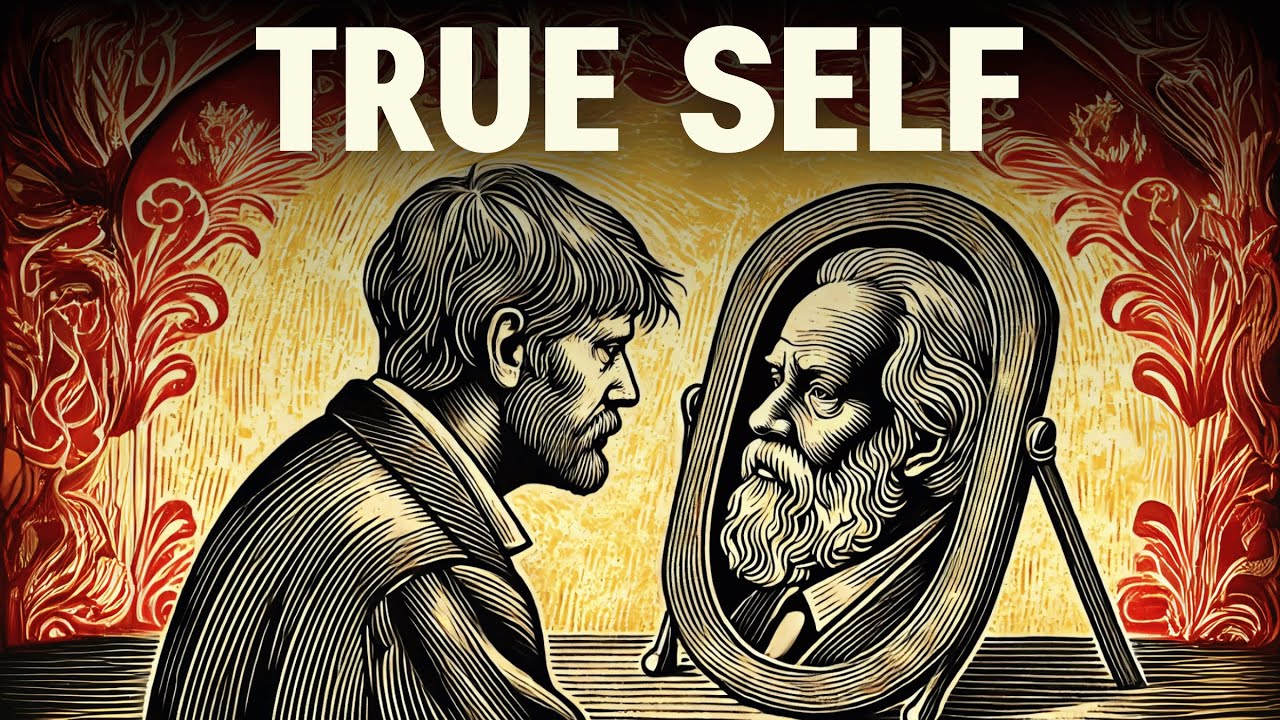
The story of the self begins with wholeness. We are born as unified beings, existing in a state of original completeness. However, as we grow and develop a sense of "I," this wholeness fragments.
Carl Jung describes this journey as the ego. The first half of life is a movement away from the self, and the second half is a return to it. This is the process of separation and reunion, a dynamic that shapes the entire arc of our lives.
Jung wrote, "The self is not only the center but also the whole circumference which embraces both conscious and unconscious. " It is the center of this totality, just as the ego is the center of consciousness. The self is the whole, but the ego, our sense of individuality, is merely a fragment.
Problems arise when the ego dominates, acting as the sole source of our identity. In doing so, we disregard the vast, mysterious depths of the unconscious. This creates a lopsided psyche, leading to what Jung called psychic dissociation.
The task, then, is to bridge this divide and recover the unity we once had—the original wholeness that lies dormant within. Paradoxically, to move forward, we must look back. Wholeness is not a regression into childishness, but a recovery of childlike unity.
Yet this recovery has pitfalls; for instance, the desire to remain in the protective circle of the mother, a state of dependency, results in stagnation. This is the archetype of the man-child—an adult who has failed to grow up. True maturity requires integrating the archetypal inner child while embracing responsibility.
Friedrich Nietzsche provides profound insight into this process in "Thus Spoke Zarathustra. " He saw the child as the ultimate metamorphosis. He wrote, "The child is innocence and forgetfulness; a new beginning; a game; a self-propelling wheel; a first motion; a sacred yes.
" The metaphor of the child represents a return to life's essential creativity and play. The child signifies a break from the weight of past burdens and societal expectations—a rebirth into spontaneity and imagination. However, this transformation is far from simple.
As adults, we suppress the qualities of play and wonder in favor of seriousness and responsibility. Our inner child comes buried beneath the roles we assume, the expectations we strive to meet, and the masks we wear to navigate social life. Yet this child remains within us, yearning for expression.
In the absence of integration, we may unconsciously long for this state of being. We see this longing in our nostalgia for the past or our attraction to stories and myths that rekindle our sense of wonder. Children live in a world of animism—a state where everything is alive with meaning.
Objects become companions in their games, imbued with stories and personalities. This creative projection is not mere escapism, but an essential part of their connection to the world. Jung recognized the profound importance of this imaginative state, writing, "The dynamic principle of fantasy is play, a characteristic also of the child; and as such, it appears inconsistent with the principle of serious work.
But without playing with fantasy, no creative work has ever yet come to birth. The debt we owe to the play of imagination is incalculable. " To reconnect with the inner child is to rediscover this imaginative vitality.
It is not about reverting to childishness, but rather embracing the capacity for creativity, joy, and wonder in our adult lives. By integrating this part of ourselves, we open the door to a heightened state of consciousness—a state that allows us to engage more deeply with life's complexities and mysteries. Jung often spoke of the process of disintegration and reintegration as the essence of human development.
We are born whole; we break apart; and we must piece ourselves back together. This journey is the path to self-realization, where we not only rediscover our original wholeness, but also transform it into something more profound. This transformation is not immediate; it requires effort, patience, and what Jung referred to as inner work.
Ancient wisdom too emphasizes the importance of discipline in this process. In "The Secret of the Golden Flower," a Taoist text, it is written, "Only after 100 days of consistent work is the light genuine; only then can one begin to work with the spirit fire. " The light in this context represents an acute state of awareness—one that allows us to illuminate the darker unconscious parts of ourselves.
Jung echoed this idea, stating, "It is high time we realize that it is pointless to praise the light and preach it if nobody can see it. It is much more needful to teach people the art of seeing. " The journey to wholeness is not linear.
Jung described it as circumambulation—a spiraling journey around the self. Each experience, each emotion, and each challenge we face is a step closer to the center. Jung himself found solace in this realization, writing, "I began to understand that the goal of psychic development is the self.
There's no linear evolution; there's only a circumambulation of the self. " This insight gave me stability, and gradually my inner peace returned. To align with the center is to find relief from life's chaos, anxiety, suffering, and the relentless pursuit of external goals.
Money, fame, and power belong to the rim of the wheel; the center offers stability, peace, and transcendence. In medieval symbolism, this concept was often illustrated through the image of a wheel. At the rim is a king, endlessly cycling through states of power and loss: "I am reigning, I have reigned, I have lost my kingdom, and I shall reign.
" At the center of the wheel stands Christ—a symbol of the self. The message is clear: to live at the rim is to be at the mercy of life's unpredictability; to dwell at the center is to find true freedom. The ancient Greeks had a term for the state of inner balance: apatheia.
It is not. . .
Apathy, but a profound state of tranquility where one remains undisturbed by external events. The Stoics too valued this ideal, teaching the dichotomy of control: to focus on what is within one's power and let go of what is not. By observing events as they are, rather than through the lens of our desires or fears, we can find a measure of peace amidst life's turbulence.
Yet, as with all states of alignment, apathy is temporary. It is not a permanent state, but a fleeting harmony; a moment when the ego aligns with the self. This alignment nourishes the soul and offers a glimpse of what it means to be whole.
Those who fail to achieve this alignment remain trapped at the rim of the wheel, caught in cycles of anxiety and suffering.