Hello everyone today we will start with the most basic epidemiological study design called case reports or case study. The case reports or study falls under the category of observational and descriptive research design to present patients in their natural clinical settings. So case study is basically what all clinicians do in their clinic every day when they see patients.
So case reports and study are the same kind of research where case reports typically consist of a couple of cases and case study involves multiple patients. So as a formal research design case study is a detailed description of the symptoms, signs, diagnosis, treatment, and/or follow-up of an individual or small group of patients and by nature almost all case studies are anecdotal and experiential. So it is descriptive or exploratory in nature and therefore this is considered as the least conclusive type of scientific information.
However, if you want to publish a case report in a journal, you still have to go through a formal peer-review process where two or more anonymous reviewers assigned by a publisher to read your case report and decide if your case is worth publication. So for more experienced healthcare professionals, case study can provide a clue of previously unrecognised symptoms or syndromes whereas the same case study can serve as a teaching tool and the model for inexperienced clinicians or students. So topics that are typically included in case study are such as unique or rare features of a disease or unexpected findings in the course of observing or treating a patient and so on.
Here are some interesting sample case studies found from the New England journal of medicine. So in the picture, we have a young Iranian man who knew that from birth he had a benign tumour on his eye which just below his pupil but by the time he was 19, the tumour had grown to about a quarter-inch thick and started sprouting hair. His visual acuity was 6/6 in the normal eye and 6/18 in the right eye with tumour the intraocular pressure was normal although this type of the tumour isn't typically harmful and cancerous, it can grow cartilage, hair, and sometimes even sweat glands.
So (even though) not everyone with these tumours wants to remove the tumour, but doctors did remove the hairy tumour from the man's eye and as expected there was a little improvement in visual acuity after surgery because of the amblyopia and induced astigmatism. So this case report is actually a 10-year follow-up of a 42-year-old male electrician who came to the eye clinic with decreasing vision after a month he had an electrical burn of 14000 volts to his left shoulder. So at the time, his vision in both eyes were limited to the perception of hand motions and slit-lamp examination confirmed bilateral cataract unfortunately.
Four months after the injury the patient underwent cataract extraction and implantation of an intraocular lens, which was followed by the improvement in visual acuity to 6/20 in the right eye and 6/120 in the left eye. Two years after the injury, there was a retinal detachment in the left eye and the patient underwent repair. At a 10-year follow-up visit and the patient's visual acuity was 6/30 in the right eye but in the left eye he could only count fingers.
While it's not entirely clear why the cataracts have taken a stellar shape but the ultimate takeaway is quite clear be safe around electricity. So a 42-year-old woman from Dundee was referred to ophthalmology by her GP with complaints of in the left upper eyelid swelling and ptosis over six months as shown in the picture. and the ptosis was a bit mild but you can see that her left eye is it's a little bit droopy.
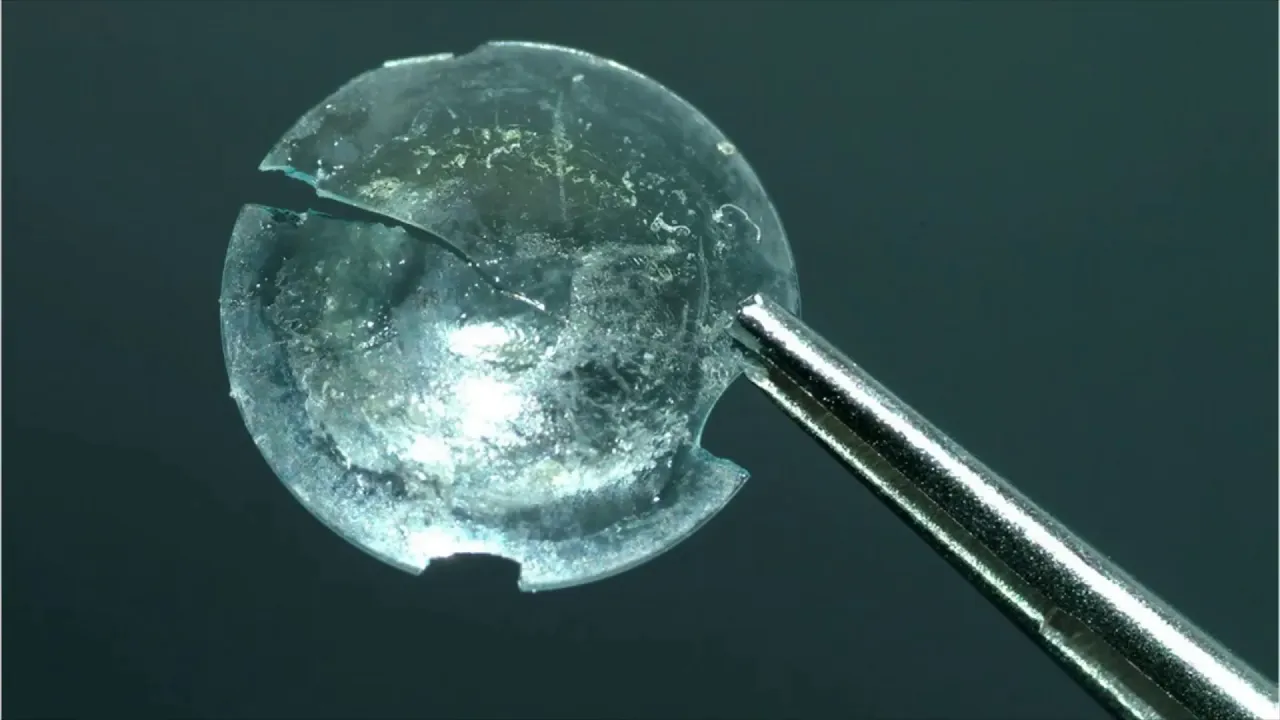
and then see the swelling up here and then and the clinic her vision was okay in fact it was good six over four and there was no sign of discharge from the eye whatsoever. So they ran the MRI scan of the orbit and it actually shows the nodular lesion and which was associated with the surrounding soft tissue swelling. So they decided to do a surgery and they found a cyst, a sac filled with fluid within the soft tissue superior to the superior fornix and in the middle of the year the surgery the cyst ruptured and this is what they found a hard contact lens and was later confirmed that this was actually the rigid gas permeable lens, RGP lens and upon the follow-up and the patient's mother recalled that her daughter had been struck in the eye by a shuttlecock when she was 14 playing badminton.
and according to her mother and she was wearing RGP lens at the time obviously and then which was never found. So they assumed that the lens had been knocked out by the impact. So what then actually happened was that the lens in fact migrated into the eyelid following the trauma and was dormant for 28 years, just sitting there for 28 years and then which is known to be the longest time between the traumatic RGP lens migration into the eyelid and the presentation of eyelid swelling.
So finally this is a French case report of the COVID patient showing the ocular symptoms. So the pictures are taken by the patient using the smartphone showing the sign of conjunctivitis in the left eye as the first presentation of COVID-19 during teleophthalmology consultation. The exact mechanism by which the virus ends up in tears is not fully understood but it has been proposed that the ocular surface can act as a gateway for infected droplets and aerosols to enter the body.
There have been multiple reports of the viral presence on the ocular surface and their potential cause of ocular complications. And by the way, this is one of the dissertation topics for the final year this year and it looks like it will continue to be so so. .
. when you become the fourth year, let me know if you are interested in this topic. So as a summary, here are some good things and bad things about the study design.
So in addition to the rich information and very detailed description of case provided by a case study or case reports this study design can be very useful for its invaluable educational value. So the practice of identifying and developing a case study promotes critical thinking and learning skills of student clinicians in turn, can be directly applicable to the practice in the clinic. And obviously running a case study is easy to do and it's fast and there's no heavy financial burden and better yet it only takes a single case to initiate a case study and case report or study can be very helpful to forewarn what's coming in the town in case of an epidemic.
If you see an unusual presentation of a disease then you know that something is going on and it only takes a single patient to spread infectious disease so it is important to be vigilant and attentive to the detailed aspect of disease. Another potential virtue of case study design is the possibility of quick publication as a way of rapid communication among clinicians but at the same time it is highly subject to publication bias where only novel rare and atypical results are much more likely to be published among all the available results to be published. For example those case reports with like a hairy hairy eyeball or the star-shaped cataract will be much more likely published than a case report of myopic patient.
So in general, typical, unremarkable cases are less likely reported and other typical limitations includes the lack of generalisability.