Translator: Vanessa Soneghet Reviewer: Leonardo Silva Hi, it's a pleasure to be here. I want to share with you some of my passion. I've been crazy about magic since I was a littlle boy, and it's such a passion that it has become my job.
This was my academic degree. And I want to share some magic principles with you, because magic manipulates our perception of reality, the reality we learn to see. I will show you what I mean.
Music. (Classical music) (Laughter) (Laughter) (Music ends) (Applause) (Cheers) Magic works with several techniques: theater techniques, manual techniques, expression techniques, psychology techniques. There are some techniques to manipulate the audience's perception.
I'll show you one. For example, I want you to look at "TED", the logo, there on the floor. Look, it won't disappear, it'll stay there.
(Laughter) But look straight at the logo. Now, look at me. Hi?
Now, look at TED. When I say "three, you look at me. Three!
Me, TED, me, TED, me, TED. I'm stil here. What do I mean to show you with this?
During this ludic exercise, the question is: did you see the datashow here in the middle? Maybe you did, but has you brain registered that? No, and that's one of the principles of magic, because you were focusing on this, this point that I've established.
And the big screen, the datashow, was like the secret. That's how several magic tricks work, by eliminating information. The illusionist shows what he wants you to see and hides what he doesn't want you to see.
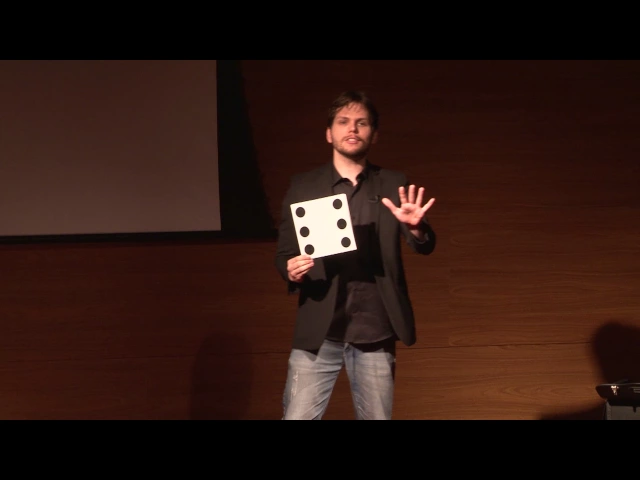
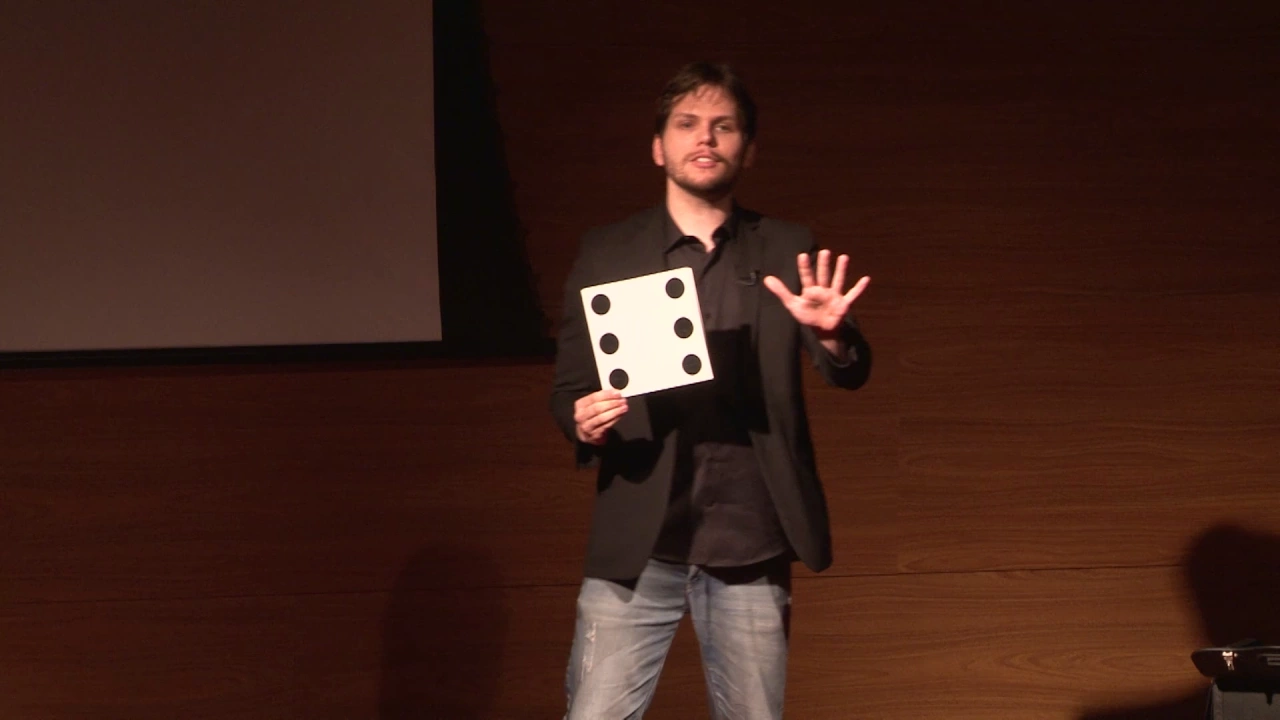
I'll show you one more example to make it more fun. Look: all you need is a white cardboard. You take a white cardboard, cut out a black circle, glue it on one side.
On the other side you glue two, three on the other, and four. (Laughter) I'll show it again, look. Fast: one side has one; the other two; the other three, four.
Tarah. . .
"OK, maybe there was something suspicious, maybe the speed. " But the thing is I am giving you too much information at once. In magic, there is a technique called "misdirection.
" What is misdirection? When I look at my hand, you look at my hand. You thought something was going to happen.
(Laughter) When I look at my hand, you look at my hand. When I don't want you to look at my hand, I don't look at it. I am directing your attention to my eyes.
That's an example. Here, I am giving you a lot of information at once, and you see a guy with a card with a black dot on it, and I say "one. " So it's visual and oral information.
But here I don't have one dot; I have two. I hide a piece of visual information. Then I put my hand here, I omit some information and say "one," and you have the impression it's really one dot.
When I put my hand on this space and I say "three," there is the illusion of three dots. And some people say: "I saw it! " (Laughter) But it's just an illusion, it's not real.
On the other side too, it seems there are two dots, right? But there is a third one, a-ha. When I put my hand here, I omit and add verbal information, "two", and with timing and the effect, you judge: "Oh, there are two.
" And when I put my hand on this white space and I say "four," our minds tend to complete the information, and some people see it. (Laughter) You may say: "Ah, but you can only do this cause you're fast". OK, I'll do it slowly, and if you look right at this side, you'll see there's a third dot.
(Laughter) (Applause) Do you want me to read it better? On the other side, I may click my fingers and you'll see I have four dots, and on the other I have five dots, and on the other, six dots. (Laughter) Don't worry if you didn't understand.
You can go to the eye doctor and he'll fix everything. (Laughter) (Applause) Why have I shown you this? Because the beauty of magic is this exact moment when you escape your reality.
"A lot of dots appeared. . .
why? There was nothing there. His hand was empty!
" That's the moment we work for. So, magicians, illusionists deceive the audience of course. You'll be really tricked today.
(Laughter) But the purpose of deceiving is entertaining, is fun, and it's charming because art has this property, it takes you to other worlds, to other places, and magic isn't different. When you see a movie. .
. For example, to me, Steven Spielberg is an illusionist. You know the movie E.
T. ? "E.
T. , phone home. " Steven Spielberg, along with the cast and the production team, makes you believe that rubber toy that sometimes is a robot, or a poorly costumed midget, (laughter) and sometimes is a 3D animation in the latest version, he makes you believe that is real, that it has real life, that it has feelings, and it touches you.
So, it is a set of techniques they create to manipulate your perception. You'll never see, in Jurassik Park, some flaw, or little robot, or some cable showing. No.
And when the actor is in the scene, in most of scenes, he doesn't see the object, he doesn't see the dinosaur. He is looking at a crepe tape mark, because the dinosaur is often added at the post-production phase, as a 3D animation. So the actor is there, using all his energy to communicate the idea that he is scared and to pass this to the audience.
And it's not just: "Let's take it from outside. Let's take fear from outside. I go like this and scream: ahhhh.
" No. The actor has a whole internal process to create this illusion, and magic isn't different. I know a lot of people who know art and work with culture, who think magic "is cool.
. . for kids.
. . ," or that magic "is from circus, right?
," or that magic is pulling a rabbit out of a hat. But saying that magic is that is the same as saying that dance is what people do at discos, or that music is what people sing in the shower. (Laughter) Because magic is an art, much bigger than that.
I am sharing this with you because here in Brazil we don't have a tradition of illusionism shows as in Europe, or in the USA, where for ages, this tradition of illusionism, or magic, has been appreciated. I'll show you one more technique. You'll like this one.
This is my first magic. The handkerchief is red to honor TED. My first magic, all I used: two hands and a handkerchief, two hands and a handkerchief.
I'd squeeze the handkerchief like this. Tac, tac, tac. .
. There we go. It would turn into an egg.
And I would take the same handkerchief out of the pocket. Everyone clapped. (Laughter) (Applause) But that is the perception you have of fiction.
The handkerchief was here and it went there, but if I bring you to reality. . .
it's a bit disappointing. (Laughter) It's an egg. .
. with a hole. It's an egg with a hole, a hollow egg.
And why am I sharing this secret with you? Because it's a trick you can do at home with your friends. All you need is a wooden egg with a small hole, got it?
A wooden egg with a hole to deceive people, and two handkerchiefs. Very importante: the handkerchiefs must be the same color. (Laughter) It's true.
(Laughter) Put one of them in your pocket, the one that will show. And the wooden egg too, leave them there. Start with one handkerchief, clean hands, and distract the attention: "Look at that girl with the photo!
" (Laughter) Hi. . .
thanks. Take the wooden egg, hide it in your hand. That means to hide it in your hand as the natural position of your hand.
So you give the illusion that your hand is empty. Slowly put the handkerchief in the egg, very slowly, creating the illusion that the handkerchief is in your hand, not in the egg. Done.
Click your fingers. For no reason, but that's your call. (Laughter) Show the egg, right.
Go into your pocket, take out the handkerchief and you've got a small miracle to show your freinds. That's the illusion. When you know the "modus operandi," it's kind of dull.
You just have to be careful if there's someone behind you, because then they'll see the reality, a handkerchief coming out of the egg. But otherwise, don't worry. Do what I do.
. . remove the hole from the egg.
(Laughter) Because many times, in art, fiction is much more interesting than reality. (Audience) Oh! (Applause) Thank you, guys!
(Applause) Bye.