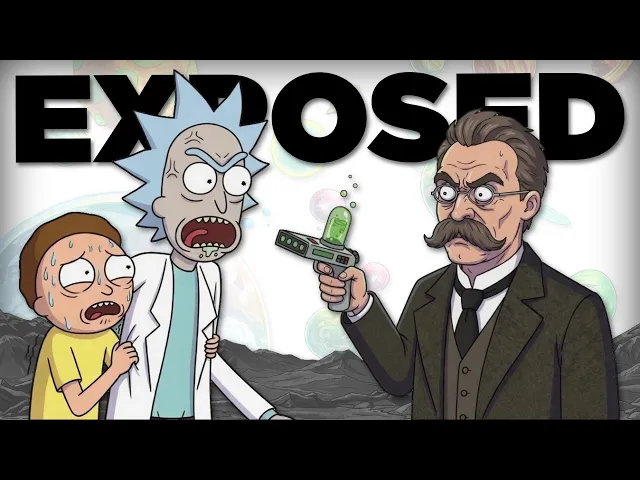
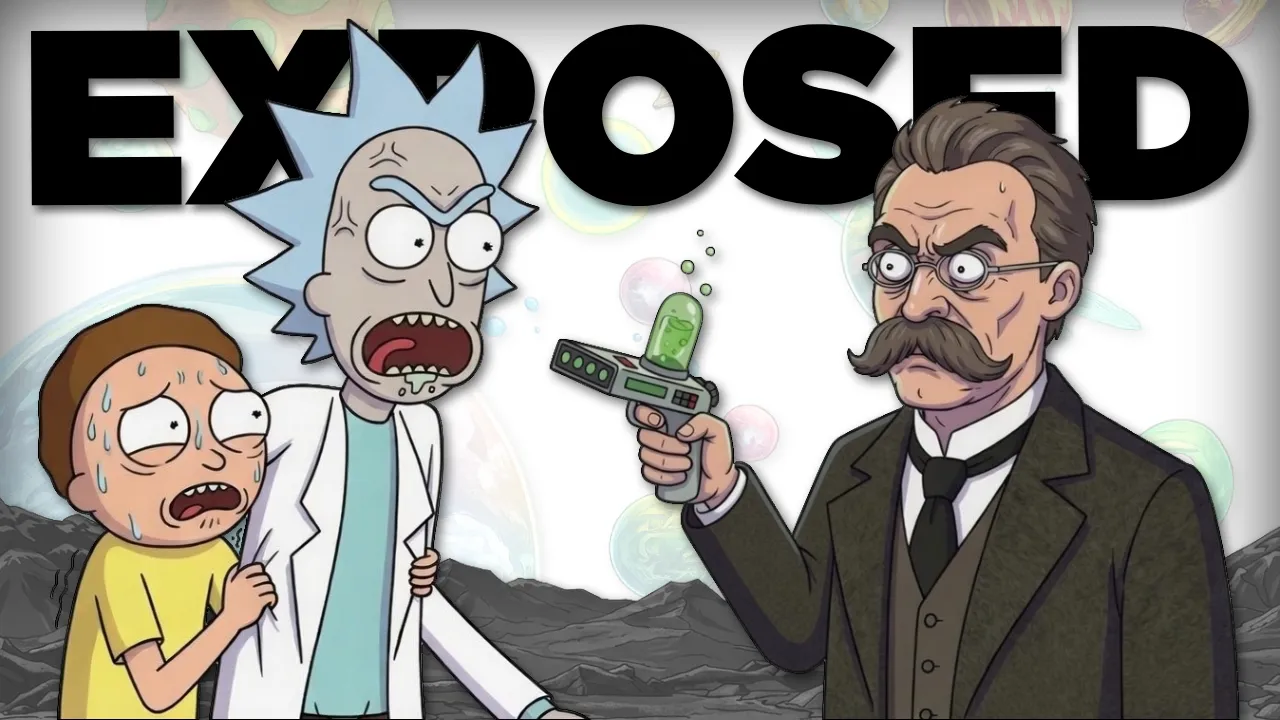
There is a 40-second scene in the second season of Rick and Morty where Rick Sanchez sits alone in his garage, builds a death ray, points it at his own head, and passes out before he can pull the trigger. The show plays a sweet pop song over it. The camera holds on his unconscious body for a full day and night. Nobody comes to find him. The next episode, he is back to making jokes. Most analysis of Rick and Morty Calls Rick a nihilist hero, a man who has seen through the lies, a genius too smart for
the small comforts the rest of us cling to. That reading is wrong. The German philosopher Friedrich Nichze spent his life warning the future about a very specific kind of person. And Rick Sanchez is scene for scene, line for line that exact person. The show knows it. The show has been telling us for over a decade. Welcome to Ricttopus. Let's get started. The misdiagnosis. Why Calling Rick a nihilist misses what Nietze actually meant. Rick Sanchez has been called a nihilist so many times by so many people in so many videos and articles and Reddit threads that
the label has stopped meaning anything specific. It has become a sticker. You put it on him and you move on. Rick is a nihilist. The show is a nihilist show. The smartest man in the universe has seen through the lies and his clarity is the joke and the tragedy and the appeal All at once. Almost everyone who watches the show understands him this way. The pilot episode hands the audience the manifesto on a silver tray. Nobody exists on purpose. Nobody belongs anywhere. Everybody's going to die. Come watch TV. That speech gets quoted constantly, almost always
with the assumption that it is the show's own thesis statement. The grandfather telling the grandson the truth at last. The smartest character giving us the Unvarnished facts. There is one small problem with all of it. The man who first wrote about nihilism in the way the modern world still uses the word, a German philosopher named Friedrich Nichze would have looked at Rick and said very clearly and very fast that this is not what he meant. Nze spent his entire life writing about nihilism. And one of the first things he did before getting into anything else
was draw a hard line down the middle of it. He Split nihilism into two halves. Two completely different things wearing the same name. The half Rick belongs to is the one NZ thought was the most dangerous. Nze called the two halves active and passive nihilism. The difference between them sounds small at first. It is not. It is the difference between two completely different kinds of life. Active nihilism is what happens when a person realizes that the old answers don't work anymore. The myths They were handed about why life matters, why their work matters, why the
universe cares about them in any way, those myths fall apart. And instead of lying down inside the rubble, the active nihilist picks up a hammer, they start building. They make their own meaning. They write their own values onto a blank page. The realization that nothing was ever handed down from above becomes the engine for creating something new from below. The void becomes a workshop. Passive Nihilism is what happens when the same realization arrives and the person decides they would rather not get up. The old myths are gone. Nothing replaces them. And so the passive nihilist
sinks into the empty space and treats it as a destination. They stop trying. They stop building. They mistake their exhaustion for wisdom. They tell themselves that giving up is the same thing as seeing clearly. They learn to confuse their inability to act with a kind of higher Knowledge that lets them mock everyone who can. NZ was very specific about which one of these he was warning the world about. He didn't think active nihilism was easy or fun, but he thought of it as a passing storm, something a person walks through on their way to becoming
somebody. Passive nihilism, by contrast, was the long sickness, the slow rock, the kind of giving up that disguises itself as understanding so well that the person doing it never Realizes they have given up at all. Rick Sanchez, from the pilot to the most recent season, is a textbook passive nihilist. The show has been showing us this for over a decade, and most of the audience has been calling him an active one because he has good comebacks. Look at what he actually does with his time. He has a portal gun. He can travel to any reality,
any planet, any version of any place that has ever existed or could exist. He has the closest thing to Godlike power a fictional character has ever been given. And the things he uses it for repeatedly across every season are these. Getting drunk, watching television, picking up a specific kind of soda from a specific Mexican grocery store in another universe, hiding from his daughter, hiding from his memories, hiding from his ex- best friend, hiding from himself. This is not the resume of a man who has stared into the void and risen above it. This is the
resume of a Man who has stared into the void and used it as a place to lie down. An active nihilist faced with infinite universes and the destruction of all inherited meaning would build something. They would create. They would forge a new system of values that worked for them in their actual life given everything they had seen. Rick, given the same situation, builds a death ray and a beer fridge. The show notices this. The show has been pointing at it From the beginning. There is a moment in the second season in an episode where Rick
is trapped at a party and is finally about to be forced to admit something true about himself where his friend Bird Person quietly translates the catchphrase Rick has been shouting all season. Wubba Luba dubdub. Rick's signature nonsense phrase. The thing he yells when he's pretending to be having a great time. The thing the audience has been laughing at and putting on T-shirts. Bird person tells the family what it actually means in his native language. It means, "I am in great pain. Please help me." That is not a punchline. That is the show in plain language
telling the audience that everything Rick performs as confidence is a layer of paint over something Nichza would have recognized immediately. The exhaustion, the collapse, the condition of the man who has decided that the universe is empty And has used that decision as permission to stop participating in his own life. The show even gives us the symptom that Nichz specifically identified with this state, the constant need for a kind of escape from the self. Nze wrote more than once that the passive nihilist is recognizable by his hunger for anything that will let him stop being who
he is for a while. Drink, drugs, distractions, mass movements, anything that turns down the volume on the inner voice. Rick Drinks in nearly every scene he appears in. This is not background detail. This is the show's primary visual indicator of what is wrong with him. The flask is not a cool accessory. It is the medication for a disease the show is asking us to recognize. And the fact that so much of the audience reads the flask as cool, reads the drinking as edge, reads the constant intoxication as part of the package of being smart enough
to see through everything is Itself part of what the show is examining. The audience is being shown a man drowning and a portion of the audience is asking where they can get the same swimsuit. Even the famous monologue Rick delivers about Sichuan sauce, the one that became a cultural phenomenon in its own right, sits inside the same diagnosis once you look at it without the noise. Rick describes a sauce from a fast food promotion, a thing that existed for a brief moment in His childhood, and announces that retrieving it is now his entire reason for
living. "That's my one-armed man," he says, naming the obsessive goal that gives an otherwise empty life its shape. He is being mostly serious. He is mostly joking. The exact ratio is never specified, which is the point. A man with infinite worlds and a working time spaceship has selected as the meaningful goal of his existence a discontinued condiment. If you read this through the Standard nihilist as cool lens, it sounds like a hilarious piece of contrarian comedy. If you read it through the Nietian lens the show is actually building, it is one of the saddest character
beats ever animated. It is a man whose reasons for living have collapsed so completely that he has had to install a fake one in their place. The sauce is not a bit. The sauce is what you reach for when the actual answer to why am I doing any of this has Gone missing and you need something, anything to hold the day together. This is the misdiagnosis the show keeps trying to correct and the audience keeps refusing to accept the correction. Calling Rick a nihilist is technically true the way calling someone in a hospital bed a
person with a fever is technically true. It misses the entire situation. The fever is a symptom. The collapse of belief is a symptom. The drinking, the avoidance, the catchphrase That secretly means please help me. The fast food sauce as life goal, the suicide attempts the show has shown us more than once and the audience has somehow trained itself not to count. All of these are symptoms of the same underlying condition. The condition is the one NZ named and warned about. The slow motion giving up that mistakes itself for clarity. The exhaustion that is put on
a lab coat and started lecturing. There is a quiet detail in The way the show has constructed Rick that points at this even more directly. Almost nothing he believes ever changes his behavior toward the people he loves. He says nothing matters, then risks his life to save Morty again and again. He says family is a meaningless construct, then rebuilds his entire reality after losing them. He says love is a chemical reaction, then falls apart when a hive mind named unity sends him a goodbye letter. The actions and the words are at War in every episode
of every season. An active nihilist would not have this problem. An active nihilist, having decided meaning is made and not found, would simply choose to make Morty matter, choose to make Beth matter, choose to make his work matter, and then go and do those things without contradiction. The fact that Rick keeps acting as if these people are precious to him while telling everyone, including himself, that nothing is precious to Anything is the central engine of his suffering. He cannot square the two. He has chosen the philosophy of giving up and his actual heart will not
cooperate. Nze had a name for this exact predicament. He called it the condition where the highest values devalue themselves. And the answer is missing to the question why. It is not a worldview. It is a wound that keeps trying to heal and cannot. This is also why so much of Rick's intelligence in the show is shown As essentially defensive. He is not building anything. He is dismantling. He spends his powers on tearing down whatever might catch him caring. He uses his genius mostly to keep the world at a safe distance. The smartest man in the
universe has organized his entire life around making sure no one and nothing ever gets close enough to require something from him. That is not the resume of a hero. That is the resume of someone who has been hurt and has Decided with all the resources at his disposal that he will never be hurt again. A child does this with a blanket. Rick does it with science. Once you accept that Rick is a passive nihilist and not an active one, the rest of the show begins to look very different. The cleverness stops being the point. The
catchphrases start to look like patches over a wound. The drinking stops being a quirk. Even the voice, the sloppy, slurred, half-finish sentences that the Show is so well known for starts to read less like genius mumbling and more like a man who cannot quite finish a thought. Because finishing thoughts is dangerous. And the show has been pointing at all of this in plain sight for years. Most analysis of Rick and Morty has gotten the diagnosis wrong because the audience walked in with a definition of nihilism that lumped both halves together. And the louder, cooler half
is the one that Rick performs the surface of. He sounds Like an active nihilist. He talks like one. He has the voice and the posture and the speed. Underneath the voice and the posture and the speed. Every single thing he does is the opposite. Withdrawal, avoidance, numbing, refusal to build. The man Nichze warned the future about was not the one who burned down old beliefs to plant new ones in the ash. That man, Nze thought, was rare and necessary. The man Nze feared was the one who would burn down old beliefs And then move into
the ash and live there, eat there, drink there, forget there, mock anyone who tried to plant anything new. That man, Nze wrote, would be the most contemptable figure of the future. He was so worried about him that he gave him a specific name and a specific description and built one of his most famous books around the warning. He called this future creature the last man. And once you understand who the last man was and what Nichza Feared he would do with the modern world, the picture of Rick that comes into focus is not flattering. It
is not cool. It is not even a worldview anymore. Before we move on, if you're enjoying this analysis, please consider subscribing. It helps the channel tremendously. It is a portrait, a very specific, very complete portrait of someone Nichzche begged us in the clearest words he could find, never to become. Section two, the last man with a Portal gun. Friedrich Nichze wrote a book called Thus Spoke Zerahustra. And inside that book, he put a warning that has haunted philosophers and writers and worried people for almost 150 years. He gave the warning a face. He gave the
warning a name. He called the figure he was warning about the last man. The last man is one of the strangest creations in all of philosophy because he does not look like a villain. He does not wear a black cape. He does not march at the Head of an army. He does not threaten the world or destroy it. He is on the surface a person living a perfectly ordinary life. He has small comforts. He has small pleasures. He has a warm home and a steady routine and a low number of problems. He laughs sometimes. He
says he is happy. By every measure modern people normally use, he is fine. That is exactly why Nichze feared him. The last man in Nichzche's description is what humans become when they stop reaching For anything bigger than their own comfort. He has given up on greatness. He has given up on ambition that risks pain. He has given up on creating anything new, on loving anything dangerous, on building anything that might cost him something. He has traded all of that for a soft chair, a warm drink, a screen to look at, and the right to mock
anyone who still bothers to try. Nichza described him in a single chilling phrase. "The last man," Mecha Wrote, has invented happiness, and he blinks while he says it. That blinking is the whole point. It is the body language of someone who knows somewhere underneath the comfort that the happiness is a lie. He blinks because the words taste wrong in his mouth. He blinks because the universe he has built for himself is a cage that he keeps insisting is a paradise. He blinks because deep down he can still feel the size of what he has given
up and the Feeling is uncomfortable. And so he makes a small motion with his eyes and changes the subject. Nze thought the last man would be the dominant human of the future. Not because the future would be evil but because the future would be comfortable and most people when handed comfort would stop reaching for anything else. The last man would build a society of small pleasures. He would turn down every chance at greatness because greatness involves suffering. He would Settle. He would stop dreaming. He would shrink the world around him until the world fit inside
his own small life. And then he would call the shrinking wisdom. Now picture Rick Sanchez. He has a portal gun. The device on his belt can open a doorway to any reality, any planet, any version of any place. He can step from his garage to the surface of a star to a parallel Earth where birds rule to a planet made entirely of cake to the inside of a space station to a Different point in his own life. There has never been a fictional character given more access to existence. Whatever the word possibility means, Rick has
more of it than anyone who has ever held a remote control. Watch what he does with it. He uses it to get a six-pack. He uses it to grab a salt shaker from a different timeline because his current one is empty. He uses it to dodge family dinner. He uses it to find a cantina where the bartender knows him so he can Drink in peace. He uses it to escape conversations with his daughter. He uses it to retrieve a fast food sauce that was discontinued before most of the show's audience was born. He uses it
again and again in ways so small that they would be funny if they were not so consistent. Almost none of his portal use across the entire show is in service of building anything. He is not with this miraculous tool founding new civilizations. He is not solving the Great problems of existence. He is not lifting struggling worlds out of suffering. He is not creating art. He is not raising children. He is not even on most days doing science that benefits anyone but himself. He is using the most powerful object in fiction the same way Nichzche described
the last man using his life to stay comfortable to stay numb to shrink the universe around him until it fits inside his own small wants. Look at the episode the show Calls Ricky Minutes. Rick installs a piece of equipment that picks up television signals from every reality at once. The family suddenly has access to the entertainment of every possible Earth. They can watch anything ever made by anyone anywhere. The first thing Rick does, the very first thing is sit down on the couch and stare. He does not move. He does not investigate. He does not
ask what could be learned from this. He watches commercials. Long stretches Of bad improvised commercials from other dimensions. He laughs. He drinks. He stays on the couch. This is the scene NZ wrote about 130 years before the show was made. The last man given the keys to infinity picks the channel with the funniest jingle and stops looking. And the show plays this for laughs because it is funny. But underneath the laugh, there is the whole portrait. The most powerful man in the universe has used his power to find a slightly better Version of doing nothing.
The Sichuan sauce monologue from the season 3 premiere belongs in the same picture. Rick stands in his kitchen and tells Morty in a long unbroken speech that retrieving a discontinued fast food sauce from his childhood is now the meaningful goal of his life. He calls it his one-armed man. The phrase comes from an old movie, the one where a falsely accused man chases a single villain across his entire existence. Rick is Comparing his own life to that quest. The thing he is chasing, the thing his entire existence now points toward is a flavor of dipping
sauce that came out for a few weeks in 1998 to promote a Disney movie about a Chinese warrior. That is not a small joke. That is the show writing The Last Man's Resume in plain handwriting. The Last Man does not have great quests. He has tiny obsessions. He cannot reach for the stars, so he reaches for a coupon. He Cannot build a temple, so he hunts for a flavor. The smaller the goal, the safer the goal, the less it asks of him. Nichi wrote that the last man would invent happiness out of things this small,
and he would do it with a straight face, and he would blink while he said the word happiness because some part of him would know. Rick gets the blinking, too. The entire monologue about Sichuan sauce is performed in his usual rapidfire rhythm, but the camera holds on him a second too Long at the end. There is a flicker, a break in the surface. The bit lands as comedy, but it leaves behind a feeling that does not quite leave with the laugh. The character has just told you in his own words that a fast food condiment
is the structural beam holding up his sense of purpose. Whatever else that is, it is not the speech of a man who has overcome the death of meaning. It is the speech of a man who has agreed to stop looking for any meaning bigger Than something he can put on chicken nuggets. The episode called Total Rickall from the second season sits inside the same diagnosis. The family is invaded by alien parasites that survive by inserting themselves into people's memories. The parasites can only hide inside happy memories. Sad memories, painful memories, embarrassing memories. Those scare them
off. So, the only way for the family to figure out who is real and who is a parasite is to remember the Worst things about each other. Rick is the one who solves it. He is the one who realizes the rule. And the way he proves who is real is by reaching instantly for memories of pain, of failure, of disappointment, of the times the family hurt each other. The episode is built like a comedy, and on the surface it works as one, but the philosophical shape of it is not funny at all. The show is
saying that comfort is the disguise the parasite wears. That a life Made entirely of pleasant memories is a life that has been infested. That the only way to know what is real in a household of people is to remember how much you have hurt each other and how much you have been hurt back. The Last Man wants the warm memories and only the warm memories. He wants the household full of friendly aliens who all think he is wonderful. The show is saying in the loudest possible voice that this kind of comfort is a sickness, that
a real life Requires a willingness to remember the bad parts, that happiness without struggle is a parasite. Rick understands the rule of the parasites. Rick saves the family by following it. And then Rick, the moment the episode ends, goes back to organizing his entire existence around the kind of comfort the parasites were imitating. He goes back to drinking. He goes back to running from his memories. He goes back to using his portal gun to dodge anything that might Cost him something. He has just proved the show's thesis. And then he turns around and lives in
defiance of it. That is the last man pattern in its purest form. He can see the truth. He can name the truth. And the truth does not change a single thing about how he lives. He nods and he goes back to the couch. Compare him for a moment to his son-in-law. Jerry Smith across the entire show is treated as a joke. He is incompetent. He is needy. He is Constantly the punchline of the family's conversations, and Rick despises him. The show often invites the audience to despise him, too. But watch what Jerry actually does with
his life. He loves his wife. He loves his kids. He goes to work. He is bad at most things, and he keeps trying anyway. He has small dreams that he keeps reaching for even though he keeps falling short. He gets up every morning and tries to be a person inside a family. That is not the last man. That Is something closer to a normal human being who has not given up. Jerry suffers. Jerry feels. Jerry takes risks that embarrass him. He is bad at all of it. And the badness is what makes him tragic. But
the trying is what makes him the opposite of what Nze feared. Jerry has not invented happiness and started blinking. Jerry has stayed messy and hopeful and stupid and alive. Rick despises Jerry and the show has slowly across seasons made it clearer and clear That Rick despises Jerry because Jerry is doing the thing Rick refuses to do. Jerry is participating. Jerry is reaching. Jerry is in his own pathetic way still in the game. Rick has stepped out of the game and decided to mock the players. Mocking the players is the last man's main hobby. In the
chapter of Zerahustra where Nze introduces the last man, he describes the last man's relationship to anyone who still tries. The last man, Nze writes, looks at Greatness, looks at struggle, looks at people reaching for something dangerous, and his response is to laugh, to roll his eyes, to shrink them down with a joke. The last man cannot stand the sight of someone trying because the trying reminds him of what he gave up. So, he develops a defense. He becomes funny. He becomes clever. He becomes the smartest person in every room. And he uses all of that
smartness to make sure no one in the room is allowed to be Sincere about anything. That is Rick at almost every family dinner. That is Rick at every moment Morty tries to feel something. That is Rick at every moment Beth tries to bond with him. That is Rick at every moment Jerry tries to be a husband. The intelligence is real. The wit is real. The speed is real. And underneath all of it, the work the intelligence is doing is the same work the last man's mockery does. It keeps the dangerous thing, the thing that asks
Something of him at a safe distance. Add it all up, the portal gun used for liquor, the infinity of channels collapsed into a couch, the fast food sauce as life goal, the episode about parasites that live inside comfort solved and then ignored. The contempt for the one family member still trying to live a life. The blinking under the catchphrase, the constant low hum of a man who has invented his own version of happiness and has never once looked Happy. This is not the smartest man in the universe. This is the most contemptable figure in 19th
century philosophy. Given a science fiction toy and a catchphrase and a voice the audience finds funny, Nze believed the last man would be impossible to argue with. He believed the last man would be too comfortable to listen to anyone telling him to want more. He believed the last man would simply laugh at the philosopher and ask for another drink And turn the channel. Rick laughs. Rick asks for another drink. Rick turns the channel. The portal gun in his hands has become the most expensive remote control ever built. There is one detail left in the picture
though. One piece that does not quite fit the last man template and that piece matters. The last man in Nichzche's writing is supposed to be content. Empty but content. Small but at peace with his smallalness. He invents happiness. And even if the happiness is Fake, he is supposed to actually feel it. Rick does not feel it. Rick is openly, visibly, constantly miserable. He drinks because he cannot bear his own thoughts. He sleeps for entire days after a heartbreak. He has tried to take his own life on screen. That is the part of the picture the
simple last man label does not finish. Rick has the lifestyle of the last man. He has the comforts, the mockery, the small pleasures, the shrunken world, but he does not have the Contentment that is supposed to come with all of it. Something has gone wrong inside the formula. The comforts are not working. The blinking is not enough. Nichze somewhere else in his writing described what happens to a person who lives like the last man for too long without the peace the last man is supposed to feel. He said that a person who tries to fight
against the darkness of the world by turning into something hollow will eventually find that the Hollowess has filled with something else. The thing they were running from finds its way inside. The void stared at long enough starts to stare back. Rick has been staring for a very long time. Before we move on, if you're enjoying this analysis, please consider subscribing. It helps the channel tremendously and the show has been showing us in its quietest and most devastating moments what has been staring back. Section three, auto erotic Assimilation when the mask slips. There is one minute
of television in Rick and Morty that the rest of the show keeps quietly pointing back to. It comes at the end of an episode in the second season called Autoerotic Assimilation. The episode runs about 22 minutes. It is funny for most of those minutes. There are sex jokes. There are alien race riots. There is a hive mind named Unity who can take over entire planets and who used to date Rick. The pacing is quick. The dialogue is sharp. The audience laughs. And then in the last minute, the show stops being funny. The shift is so
sudden, and the shift is so complete that a lot of viewers say they remember exactly where they were the first time they saw it. The episode goes from an outrageous comedy about an interdimensional ex-girlfriend to one of the saddest sequences ever animated on a cable network and the show does not warn anyone it is coming. The cut just Happens. The music changes and the viewer is suddenly watching something that does not belong in any other half hour of television. That last minute is the moment Rick's mask slips. It is the moment the show decides to
stop pretending and tell the audience in plain pictures what is actually wrong with him. And what is actually wrong with him is exactly what NZ said would be wrong with anyone who tried to live the way Rick has been living. Setting The scene matters because the contrast is the entire point. Rick, Morty, and Summer pick up a distress signal from a damaged spaceship at the start of the episode. They board the ship looking for things to steal. Instead, they find a hive mind. The hive mind is a creature that takes over the bodies and brains
of every living being on a planet until the entire population is one connected consciousness. The hive mind, when it sees Rick, becomes excited. It turns out The hive mind has a name. The hive mind is called unity. Rick used to date her. The reunion that follows is played for comedy. Rick and Unity start partying. They take drugs. They have sex. They throw a party that grows until it covers the entire planet she has assimilated. Unity controls every body on her world, which means Rick is basically having a relationship with a planet. The episode minds this
idea for jokes for most of its running time, and the jokes work. Underneath the jokes, the writers are setting up a question. The question is, what kind of person Rick becomes when he is around someone who matches him when his usual gravity, the way he pulls everyone around him into his own collapse, finally meets another mind big enough to push back. Unity is not Morty. Unity is not Beth. Unity is not Jerry. Unity is a pier. The only pier Rick has been shown to have. And Rick around a pier is supposed to look like Rick
at His best. Rick around a pier turns out to look exactly like Rick at his worst. The two of them get worse together, faster, louder, more dangerous. Unity, who had been carefully assimilating planets and creating peaceful unified societies, starts losing control of her population because Rick is pulling her attention away from the work of holding minds together. Pieces of her assimilated planet start breaking off. The people inside her hive mind start Regaining their own consciousness and they immediately start fighting each other in horrible ways. Race wars break out. Kidnappings happen. The assimilated world she had
spent who knows how long building falls apart in a few hours because Rick walked back into her life and she forgot to keep doing her job. Morty and Summer notice. Morty and Summer pull her aside and tell her in plain words that Rick is bad for her, that he ruins the people who love him, That she should walk away. She listens. She agrees. She breaks up with Rick. The breakup is not delivered as a scene. It is delivered as a letter. Rick goes to use the bathroom, and when he comes out, every body Unity used
to inhabit is empty. The planet is silent. There are notes everywhere. He picks one up and reads it, and the audience hears Unity's voice through the words. The letter is one of the most precise pieces of writing the show has ever produced. Unity tells Rick that being with him made her into the worst version of herself. She tells him that around him she could never stop, never slow down, never be the version of herself she wanted to be. And then she writes one sentence that is the diagnostic line of the entire show. She says that
around Rick she lost who she was and became part of him. She says that in a strange way he is better at what she does without even trying. What unity does is Assimilation. She absorbs minds. She erases individuality. She makes everyone around her into a copy of herself. And what she is telling Rick in a goodbye letter is that he does the same thing. That his presence in a room flattens everyone in the room into a smaller version of themselves. That his influence is a kind of eraser. that he turns every person who loves him
into a shadow that has to think about him first, second, and third with no room Left over for anything they were before he arrived. This is one of the most damning things one fictional character has ever said to another. And Rick reads it alone on an empty planet surrounded by the silence of a million people who used to be a single mind that wanted him. The episode could have ended there and it would have already been one of the best episodes the show ever made. The episode does not end there. Rick comes home. The family
is in the middle Of an argument about an alien Rick has been hiding in the basement. A creature that is barely alive, twisted and warped from some experiment that went wrong. Beth is yelling. Jerry is yelling. The household is loud. Rick walks in and the family expects the usual, the defense, the mockery, the redirection. the Rick who turns every accusation into a joke and walks away with the moral high ground because he is faster than everyone in the room. He does not do any Of that. He goes to the basement. He looks at the deformed
creature he has been keeping there. The creature is screaming. It is in pain, cannot be saved. Rick has been keeping it alive for some reason that the show never fully explains. And now Rick has decided that this is over. He builds a death ray. The audience watches him build it. The build takes a few seconds of screen time and the seconds are quiet. There is no music. There is no dialogue. There's Just an old man in a garage assembling a device. He turns to the creature and he kills it. The killing is gentle. The creature
stops screaming. The expression on its face in the last second looks something like relief. And then Rick turns the same device on himself. The audience realizes somewhere during this sequence that the death ray was not built for the creature. The creature was a test. The creature was a rehearsal. The thing in the basement was being kept Alive so Rick would have something to practice on. He kills the creature. And then he sits down at his workbench and he aims the device at his own head and he sets it to fire. The song that plays during
this sequence is by a band called Chaos Chaos. The song is called Do You Feel It? The song is sweet. The song is gentle. The song is the kind of song you might hear in the background of a romantic moment in a different show. The show plays this song over the suicide Attempt of its main character. And the choice is deliberate because the song is what Rick was trying to feel and could not. The device begins to charge. It needs a few seconds to fully prepare before it fires. And during those few seconds, Rick passes
out. He has been drinking all day. He has been doing drugs all day. The body that was supposed to be the agent of his decision gives up before the decision can be carried out. He falls forward onto his Workbench. The death ray sits on the table next to him, harmless now, never quite ready in time. The camera pulls back. The audience watches him from a distance. The night passes. The sun comes up. The sun moves across the sky. The day passes. The sun goes down again. Rick has not moved. The shot lasts long enough for
the viewer to feel the time. No one comes to find him. The garage door is closed. The family is upstairs going about their normal lives. The dog Somewhere offcreen has not noticed. There is no music anymore. The episode just sits with the shape of his unconscious body on a workbench while a full day moves around him. Then the credits roll. That is the scene the rest of the show is built on top of. That is the scene that makes every joke that comes after it carry a weight the joke did not have to carry. That
is the moment, the mask, the catchphrase, the rapid fire intelligence, the burping Smartest man in the universe routine. All of it falls completely off and the audience sees what was underneath the whole time. Underneath was a man who has run out of reasons to live. This is the precise condition Nichzche spent his life writing about. He called it the moment when the highest values devalue themselves. He meant the point in a person's life where the things they used to live for have stopped working as reasons. The work is not enough. The Cleverness is not enough.
The next adventure is not enough. The drink is not enough. None of the small comforts have weight anymore because the deep belief that should have been holding them up has collapsed. Nichze said that when this collapse happens and the person has not built anything new to replace what fell, the result is a specific kind of crisis. The person is left with the answer missing to the question why. They wake up and they Cannot remember why waking up was the plan. They make breakfast and they cannot remember why breakfast is the next thing. They look at
the people they love and they cannot find the thread that connects loving them to getting through the day. That is the state Rick is in during that final minute. Unity, the one peer big enough to almost match him, has just told him in writing that he turns the people who love him into copies of his own collapse. She has Named the disease. She has named it accurately. And Rick has gone home and reached immediately for the only thing that felt like an answer. The choice to die is not portrayed as brave in this scene. It
is not portrayed as smart. It is not portrayed as the logical conclusion of seeing the universe clearly. The show does not let the audience read it that way. The choice is shown as drunk, sad, fumbling, half-hearted. He cannot even finish it. He passes out. The death ray, the most sophisticated suicide tool ever animated on television, is built by a man too drunk to use it correctly. The show is making a specific point with this. The point is that this is not a philosophy. This is a man at the end of his ability to keep performing.
Everything Rick has been telling the audience for two seasons. The speeches about meaninglessness, the catchphrases, the comedy, the swagger, all of it has been A wall built around this exact room. And unity by leaving has knocked the wall down. There is no philosophy left. There is no clever line left. There is no portal to take. There is just a workbench and a device and a man too far gone to operate it. This is what Nze was warning about when he wrote about the long sickness of giving up. Not the loud crisis, not the dramatic moment
where someone screams that nothing matters. The quiet end point where a person who Has spent years calling their exhaustion wisdom finally arrives at the place that exhaustion was always going to take them. The garage, the empty workbench, the body that gives out before the mind can finish the job. The full day passing while no one comes to check. The next morning, the show resumes its normal style. The episode after this one is funny. The episode after that one is funny. Rick keeps drinking. Rick keeps making jokes. Rick keeps using the Portal gun. Nothing about his
life changes in any visible way. The garage suicide is never directly mentioned again by him, but the audience cannot unsee it, and the show knows the audience cannot unsee it. From this episode forward, every catchphrase has a shadow under it. Every burp has a question behind it. Every adventure carries the memory of that workbench. The show has shown its hand. It has told the viewer in the clearest pictures it Knows how to draw, that the man at the center of this story is not a hero of a worldview. He is a casualty of one. He
has been hollowed out by the same disease Nichze warned the future about and the cleverness everyone loves is a wall around an empty room. This is also the moment a different question begins to get harder to ignore. If Rick has been emptied out by his own beliefs, if the cleverness is a wall, if the catchphrase secretly means, please help Me. Then the question becomes, what filled the empty space? Because something always does. Nze himself wrote about this. He wrote that a person who spends long enough fighting the darkness ends up carrying some of it inside
them. that a person who stares too long into nothing finds that the nothing eventually grows eyes. And the show across the seasons that follow autoerotic assimilation has been showing the audience exactly what those eyes Look like. They look like Rick. They look like every Rick. They look like a citadel full of him, an enemy version of him, a literal toxic split of him, a child version of him, a robot version of him, all moving around in the background of the same story. All of them telling the same truth in different voices. Before we move on,
if you're enjoying this analysis, please consider subscribing. It helps the channel tremendously. The thing that filled the Empty space in Rick is Rick and the show has been quietly building for years the case that this is the worst thing that could have happened to him. Section four, The Abyss Gazes Back: How Rick Became what he was trying to escape. In a book published in 1886 called Beyond Good and Evil, Friedrich Nichze wrote a single sentence that has outlived almost everything else in 19th century philosophy. The sentence is short. The sentence is famous. The sentence has
Been quoted on book covers and in movies and on the kind of inspirational posters that hang in dentist offices and most of the people who quote it have forgotten that it is a warning. Nze wrote that whoever fights with monsters should be careful not to become a monster himself. And he added that when a person stares for a long time into an emptiness, the emptiness eventually starts staring back. The sentence has two halves and the two halves describe the same fate From two different angles. The first half is about the people around you. The second
half is about you alone. The first half says that if you spend your life fighting something terrible, you will pick up the habits of the terrible thing without noticing. The second half says that if you spend your life looking into a darkness and refusing to fill it, the darkness will fill itself with something, and the something it fills with will be a copy of you. This Sentence, more than any other thing NZ ever wrote, is the architecture of Rick Sanchez's character across seven seasons of television. Rick set out in his backstory to fight monsters. The
show has filled in the picture of his early life slowly across many episodes, but the basic shape is clear. Rick lost something he loved. Rick decided the universe was responsible. Rick committed his life to making sure no force in the universe, no government, no rule, no Person, no feeling would ever have the power to take something from him again. He built the portal gun to escape the reach of any system that might have a claim on him. He built the rest of his abilities around the same idea. The whole project of being Rick was an
attempt to rise above every monster the universe could throw at him. The show has also been showing the audience episode after episode what that project has cost. The cost is the second half of Nichch's sentence. Rick has stared into the emptiness for so long that the emptiness has filled with copies of him. He has fought the monsters of an indifferent universe so consistently that he has become the monster of every life he touches. The clearest place the show makes this point is in an episode from the third season called the Ricklantis Mixup. The episode is
also sometimes called Tales from the Citadel. The Citadel of Ricks is a place that Exists inside the show as a kind of background fact. It is a giant space station built by a thousand different versions of Rick from a thousand different timelines. Every Rick in the multiverse the show has established eventually finds the others. They form a society. They live together. They run their own government. They have their own jobs. They have their own police force. The Citadel is what happens when the smartest man in the universe meets a Thousand other smartest men in the
universe and decides to build a city. What that city looks like when the show finally takes the audience inside it is one of the most damning images Rick and Morty has ever produced. The Citadel is broken. The Citadel is corrupt. The Citadel is run by Ricks who exploit other Ricks. There are rich Ricks who live in towers. There are poor Ricks who work assembly lines making portal guns for other Ricks. There are Ricks in Factories who never get to invent anything. There are Ricks who have been turned into wage workers in coffee shops serving cups
of mediocre coffee to other Ricks who have given up on being scientists and are now just cogs in a machine. There are Ricks who beat up other Ricks for breaking small laws. There are politicians made of Rick. There are soldiers made of Rick. There are children made of Morty owned and abused by Ricks who do not see them as Children. This is what the show is telling the audience that Rick produces given infinite time and infinite resources and no one to stop him. He produces a world that exploits itself. He produces a society that treats
its own children as labor. He produces a corrupt government, a corrupt police force, a corrupt economy. all of it filled with versions of him doing terrible things to versions of him. The Citadel is not a triumph. The Citadel is A portrait of what happens when a man's worldview is given the chance to scale up. Every version of Rick, given his own life and his own choices, eventually arrives at the same kind of broken place, just with different jobs and different wallpaper. The episode also introduces a young Morty who runs for president of the Citadel and
wins. He gives speeches about hope. He gives speeches about change. He sounds for most of the episode like the only Character with any moral clarity left. The episode ends with him revealing that he is a different Morty than anyone realized. He is a Morty who has been planning for a long time to take over the entire citadel and use it to escape the multiverse. He is a Morty who has spent his life around Ricks and he has learned the lessons. He is colder than any Rick. He is more ruthless than any Rick. He is willing
to do worse things than any Rick has ever done in front of The camera. This is the abyss staring back. This is what Nichzche meant. Evil Morty is not a separate character invented to give the show a villain. Evil Morty is what Morty's become when they spend long enough around Rick's. He is the natural product. He is the abyss in the second half of the sentence. The emptiness given long enough fills with a copy of the thing that was staring at it. Rick stared at his Morty, stared at his disposable, replaceable, easily Damaged sidekick, stared
at the boy he was using as cover, and the universe eventually produced a Morty who had stared back, who had absorbed the lessons, who had decided to apply them. The show has spent multiple seasons treating evil Morty as one of its central long- form story lines. And the meaning of that story line has been from the beginning this exact warning. If Rick is a man who has spent his life refusing to build anything because he Believes nothing matters, then the people around him will eventually arrive at the same conclusion, and at least one of them
will go further than he ever did. Evil Morty has the courage of his beliefs that Rick does not have. Evil Morty actually acts on the worldview Rick only talks about. He is what Rick would be if Rick were still active enough to be dangerous instead of just sad enough to be ironic. There is a smaller, more specific version of this Same idea in an episode from the third season called Rest and Relaxation. The premise of the episode is that Rick and Morty have been doing too many adventures and need a vacation. They go to a
resort planet that has a machine designed to remove all the bad parts of a person and store them in a tank. The machine takes everything the person dislikes about themselves, all the impatience, all the cruelty, all the bitterness, all the meanness and pulls It out of them and keeps it separate. Rick goes through the machine. The machine pulls out his toxic parts. What is left of Rick after the procedure is calm, gentle, polite, kind. He smiles. He listens. He is patient with Morty. He is not interested in being mean. He is not interested in drinking.
He is not interested in mockery. He is a version of Rick the audience has never met. And then the show very deliberately shows the audience what happens to the toxic Parts. The toxic parts of Rick in the tank congeal into their own physical body. They form a separate Rick. A Rick made entirely of the cruelty, the meanness, the bitterness, the rage, all the things the procedure pulled out. This toxic Rick is just as smart as the regular Rick. He has the same abilities. He has the same voice. He has the same laugh. He just has
none of the warmth, none of the vulnerability, none of the parts of Rick that ever loved anyone. Toxic Rick escapes the tank. Toxic Rick comes after the gentle version. The episode becomes a fight between the two halves of the same person. In the final act, the gentle Rick is forced to merge with the toxic Rick to survive. He has to take all the cruelty back inside himself. The show frames this as a defeat. The gentle Rick fights it. The gentle Rick does not want to be cruel again. The gentle Rick has, in the few minutes
he has been gentle, started to Enjoy being a person who is kind to his grandson. He does not want to lose that. He has to lose it anyway. The toxic Rick wins. The two halves merge. The Rick that walks out of the resort is the Rick the audience knows. The kind one is gone. What this episode is saying in plain pictures is that the version of Rick who is cruel is not separate from the version of Rick who is smart. The cruelty is loadbearing. The meanness is structural. The toxicity is not Something Rick has. It
is something Rick is. He cannot be separated from it without becoming a different person. And the show makes that different person look better, kinder, calmer, more pleasant to be around and then takes him away. This is the second half of Nichch's warning written in cartoon. The abyss has filled. The emptiness has filled with Rick. There is no Rick left without the abyss inside him. The two are now the same thing. There's a third Example, smaller, that drives the point home in a way that hurts more than the others. The show has more than once shown
other Ricks who chose differently. Most of them are dead. Most of them died because they tried. The Citadel is full of Ricks who broke the pattern. Ricks who tried to be parents. Ricks who tried to do real work. Ricks who tried to keep families together. Ricks who tried to believe in something. They get killed off. They get crushed. They end up Assembling portal guns on a factory floor. The system the Ricks have built together does not allow any version of Rick to do anything other than what Rick already does. Trying is a crime. Caring is
a sign of weakness. The Ricks who try get punished by the Ricks who do not. Each of these dead Ricks in their own way is a piece of evidence for the same point. The pattern is not just Rick. The pattern is what Rick produces. Anywhere a version of him exists for long enough, The abyss spreads. Other Ricks become the abyss. Morties become the abyss. Cities become the abyss. Friends become the abyss. The infection has a shape and the shape is recognizable across timelines, across decades, across whole civilizations of him. Nichze believed this would happen to
a person. He did not have a name for it on the scale of an entire society. The show by inventing the citadel has invented the missing word. The citadel is what the abyss Looks like when it gets to grow. The hardest part of the warning in Nichzche's sentence is that the person it is happening to does not notice it happening. The person who fights monsters does not realize while they are fighting that they have become one. The person staring into the emptiness does not realize the emptiness has started staring back. The change happens slowly. The
change happens through small choices. The change happens in tiny Moments where the person picks the meaner option, the colder option, the more isolated option because all the smaller options seem reasonable on their own. By the time anyone could call them a monster, they have stopped being able to hear the word. Rick cannot hear the word. The show has shown the audience this many times. Beth has tried to tell him. Morty has tried to tell him. Bird person has tried to tell him. Unity wrote it in a letter. The therapist Dr. Wong said it directly to
his face in a famous scene that the next section of this essay is going to look at closely. Every important person in his life given the chance to speak honestly has told him in some version of the same words that he has become the thing he was running from. He listens politely. He laughs. He makes a joke. He pours another drink. He does not change. And the universe around him keeps producing the evidence. The citadel keeps Existing. Evil Morty keeps planning. Toxic Rick keeps emerging from any procedure that tries to remove him. Each new version
is a piece of mail from the abyss, reminding him that the abyss is not something separate. It is the room he lives in. He built the room. He keeps building more rooms like it in every reality, in every timeline, in every life he touches. This is what NZ was trying to prevent when he wrote that sentence in 1886. He was trying to warn The future not to do exactly what Rick has done. Not to spend a life fighting darkness with darkness, not to look at the emptiness for so long that the emptiness becomes the only
thing that knows how to look back. He wrote the sentence as a sentence of advice. The show has spent over a decade animating in detail what happens when the advice is not taken. There is one more thing the show has done with all of this though, and it is the thing that turns Rick from a tragedy into a philosophical case study. The show has not only shown the audience that Rick has become the abyss, it has also shown the audience more than once what it looks like when someone tells him so out loud. When someone
names the disease, when the diagnosis is delivered to his face by a person who can see him clearly. It has happened a few times. The cleanest, most complete, most uninterrupted version of it happens in an episode that the entire Internet remembers for the wrong reason. an episode the fan base turned into a meme so loud that the meme drowned out the actual content of the episode underneath it. An episode where the show stops the action for 2 minutes and lets a therapist explain in plain words exactly who Rick is and exactly why he lives the
way he lives. Before we move on, if you're enjoying this analysis, please consider subscribing. It helps the channel tremendously. The show told The audience the answer. The audience put a costume on the episode and started a fan club for the costume. Section five, the pickle Rick misreading. How the audience failed the test the show was giving them. In the third season of Rick and Morty, the show aired an episode that became almost overnight the single most recognizable thing it had ever produced. People who had never seen the show learned the name of the episode. People
who had never seen the Show could quote the title back. The phrase printed itself onto t-shirts, mugs, posters, costumes, and a thousand variations of the same internet joke. For a while, in the late part of 2017, you could not walk through a comic convention or scroll through a feed without running into some piece of merchandise referencing it. The episode is called Pickle Rick. The phrase the audience took away from it was the title character's own catchphrase, shouted in His usual rapid voice, the words he says when he announces himself in his new form. He says
he is Pickle Rick. He says it loud. He says it often. and the audience in numbers no one at the show could have predicted took those two words and made them their own. The strange thing is almost none of the people repeating the phrase seemed to remember what the rest of the episode was actually about. The plot of the episode on its surface is exactly as Ridiculous as the title makes it sound. Rick has turned himself into a pickle. He has done this on purpose using a piece of equipment in his garage. He has done
it the morning of a family therapy session that Beth has scheduled for the whole family. He has done it specifically so he will not be able to attend. That is the setup. That is the joke. Rick has invented an entire elaborate piece of science and used it for the sole purpose of getting out of Going to therapy. Beth, when she discovers what he has done, is furious. She removes the antidote from the room before leaving the house so he cannot turn himself back. She loads the rest of the family into the car. She drives to
the appointment without him. Rick, stuck in the garage as a pickle with no arms, no legs, and no easy way to move, is left alone. What follows is a long action sequence. The pickle rolls into the yard. The pickle gets caught in Rainwater. The pickle gets washed into a sewer. In the sewer, the pickle is attacked by rats. The pickle kills the rats. The pickle uses the bodies of the rats, their bones, and their tendons and their teeth to build itself a kind of skeleton. The pickle, now equipped with rat parts as limbs and weapons,
climbs out of the sewer. The pickle ends up inside an enormous embassy building run by a foreign government. The pickle fights its way through dozens of armed Guards. The pickle, by the end of the sequence, is covered in blood and oil and machine parts, having killed more people than most action movie villains kill in a full film. This is the part of the episode that became famous. This is the part the merchandise was based on. This is the part the audience celebrated. Rick, against impossible odds, using nothing but his own intelligence and an inhuman level
of violence, survives. He gets back to his Family. He arrives at the therapist's office covered in mess. And in the episode does something most of the audience did not seem to register. The episode stops. The action stops. The chase stops. The rolling and the killing and the engineering all stop. Rick in his pickle body equipped with rat skeleton is sitting in a chair across from the family therapist. The therapist is a woman named Dr. Wong. She is voiced by the actress Susan Sandon. She is Calm. She is intelligent. She is unbothered by the fact that
her client today is a vegetable. What follows is one of the most direct, most unhurrieded, most uncomfortable monologues the show has ever produced. The therapist, given a chance to speak, delivers a diagnosis of Rick that is so accurate, so quietly delivered, and so impossible to argue with that the show essentially stops being a comedy for two full minutes while she talks. She tells Rick that she does not have an issue with him being a pickle. She does not have an issue with the violence. She does not have an issue with the technology. She has an
issue with the choice. She has an issue with the fact that a man with the intelligence Rick has, given the option of attending a 1-hour conversation about feelings, chose instead to engineer an entire elaborate transformation, fight through a sewer, kill dozens of people, and Arrive at the same building soaked in blood in order to avoid the conversation. She points out in plain words that Rick spends his life this way. She says that he is the kind of person who can do anything. And what he has chosen to do with that ability is build elaborate ways
to avoid being known. She points out that the smarter the option, the more impressive the option, the more the option lets him stay exactly the same kind of person he Has always been, the more he likes the option. She points out that he prefers any version of himself that is in motion to any version of himself that is sitting still in a chair. And then she delivers the line. She tells Rick that she has no doubt he would be the last man standing after the end of the world. And she adds that he would probably
also be the loneliest. The therapist's office goes quiet. Beth is there. Summer is there. Morty is there. Rick has no Comeback. The man whose entire personality is built on having a comeback for everything has no answer for this. He sits in his chair in his pickle body with his rat skeleton and the therapist's words sit in the air and the camera does not move. This is the moment the show looked directly at its main character and named the disease. Not in code, not in metaphor, not in jokes, in plain, slow, unflinching words from a person
trained to recognize what Was wrong with him. She tells him that he uses his ability to do anything as a weapon against the simple work of being a person. She tells him that the elaborate adventures, the impressive escapes, the constant motion are all the same thing. They are the structure he has built around the empty room. The therapist in the language Nichze would have used was diagnosing him as a passive nihilist who had given up on the work of self-nowledge and dressed the Giving up as something more interesting. The pickle was not the joke. The
pickle was the symptom. A man so committed to avoiding a conversation about himself that he would rather fight rats with his teeth than sit in a chair and answer a question. Nichze believed that a person trapped in this state would do anything to stay trapped. He believed they would invent obstacles. He believed they would create problems for themselves so they would have something to solve. He Believed they would prefer any kind of struggle, no matter how dangerous or violent, to the quieter, more painful struggle of looking at themselves honestly. He wrote in a few different
places that people in this state can be recognized by their love of unnecessary difficulty. They are the people who would rather climb a mountain than have a feeling. They are the people who would rather build a machine than apologize. They are the people who would rather Kill rats than answer a question. The therapist's monologue is the show's full and direct version of this idea. She has watched him do this. She has watched a man with a portal gun, a flying car, a working time machine, and the keys to most of reality decide that the most
dangerous thing in the universe is 60 minutes in a small room with a person who would like to ask him how he feels. And she has decided to point that out. What happened after the episode aired is The part of the story the rest of the show could not have predicted and the part that proves the show's point about the audience as accurately as the therapist monologue proved it about Rick. The audience took the loud part. The audience took Pickle Rick. The character design of Pickle Rick, the rat skeleton, the action sequence, the catchphrase, the
rolling pickle screaming his own name, all of it got loved, repeated, copied, and sold. Pickle Rick became one of the most recognizable images in modern animation. Halloween costumes were made. Action figures were made. The president of the United States network that aired the show in interviews admitted he had been surprised by how big the merchandise got. The image of a screaming pickle covered in machine parts became a kind of unofficial mascot for the show and through the show for the kind of fan who wanted to be associated with it. What Got dropped almost entirely was
the therapist monologue, the diagnosis, the two minutes that the show had built the entire episode in order to deliver. The audience had been handed a piece of writing that was openly trying to tell them something about the character they love. And the audience on the whole decided it preferred the pickle. This is the cleanest example in the entire history of the show of what the show is doing and what the audience is doing Being two different things. The show was trying to make the same point about Rick that NZ tried to make about the passive
nihilist 130 years earlier. The point is that the surface of this kind of person, the cleverness, the speed, the elaborate avoidance, the impressive feats of intelligence used against the simple work of living, all of it is a costume. The costume is not the person. The costume is the wall around the empty room. And the more impressive the Costume gets, the more dangerous the person inside it has become. Because the costume is now strong enough to keep anyone from getting close. A pickle with a rat skeleton fighting through a sewer is the perfect visual version of
this idea. It is the most extreme costume the character has ever worn. It is the most impressive, the most elaborate, the most violently competent disguise the show could possibly put him in. And the show, having dressed him in it, then sits him In front of a therapist and has the therapist tell him in his absurd outfit that this is what he does with every day of his life. He builds a costume. He fights his way through some danger. He arrives somewhere covered in blood and oil and he uses the impressiveness of the journey to avoid
the small conversation that was the only thing he was ever asked to have. The audience given this episode made the costume into a meme. There is a way of reading this That is too cruel toward the audience and that reading should be set aside. The fans who loved Pickle Rick are not stupid. The episode is genuinely funny. The action is genuinely entertaining. The visual is genuinely memorable. There are reasons people responded to it. Loving the surface of a piece of art is not a moral failure. But there is a quieter version of the reading that
is harder to dismiss. The show in this episode ran a kind of test. The test was Whether the audience would notice when the show stopped being an action comedy and started being a piece of writing about the character they were laughing at. The test was whether anyone would feel the shift when the camera held still and the therapist spoke. The test was whether the audience would carry the diagnosis out of the episode the way they carried the catchphrase. For the most part, the catchphrase won. This is by itself a piece of evidence for the Thesis
of this entire essay. The man Nichze warned the future about does not survive in a culture that knows how to recognize him. He survives in a culture that loves the surface of him. He survives in a culture that puts his face on a t-shirt and forgets to read the rest of the page. The Last Man does not need to defend himself. His audience does it for him. Every time someone laughs at the costume and skips the diagnosis, the costume gets reinforced. Every time the meme of Pickle Rick travels further than the words of Dr. Wong,
the wall around the empty room gets 1 inch thicker. The show seemed to know this would happen. The therapist monologue is structured almost as a direct address. She is talking to Rick, but she is also talking to the camera. She is naming what Rick does in the language a viewer would recognize from their own life. the unnecessary difficulty, the impressive avoidance, The preference for any kind of motion over any kind of stillness. She is not just diagnosing the character. She is offering the audience the same diagnosis if they want to take it. Most of the
audience did not want to take it. Most of the audience took the pickle. In Nichzche's writing, this moment, this exact gap between the diagnosis and the response is the precise reason he believed the future he was warning about would arrive. He believed the warning Would not work. He believed the people who most needed to hear it would be the ones most committed to laughing at it. He believed that a culture in love with cleverness, with speed, with surface, would mistake every diagnosis it heard for another joke and would put the joke on a shirt and
walk away. Pickle Rick is the fan culture version of that prediction coming true. It is also, in some ways, the show's quietest moment of giving up on its own audience. Rick and Morty has continued since this episode to deliver direct diagnoses of its main character through different mouths through Bird Person, through Beth, through Morty, through other versions of Rick himself. The diagnosis have continued to land episode after episode. The merchandise has continued to ignore them. The character continues to live behind the wall the audience built for him. There is however one piece of the warning
the show keeps coming back to That none of the diagnosis, none of the therapy sessions, none of the bird person speeches ever quite reach. It is a deeper test than the one the therapist gave. It is the oldest test in the philosophy Nichzche left behind. It is a question so simple it almost sounds like a riddle and so heavy that almost no one in any of Rick's lives can answer it without flinching. The question is whether a person given the chance would choose to live their own life over again Exactly as it is with nothing
changed. Before we move on, if you're enjoying this analysis, please consider subscribing. It helps the channel tremendously. Rick has been asked this question in a few different ways in a few different episodes, and the show has shown the audience every single time what his answer turns out to be. Section six, Eternal Recurrence and the Roy Cabinet, the test Rick cannot pass. In a book called the gay science published in 1882, Friedrich Nichze proposed a thought experiment that has been keeping people up at night for almost 150 years. He framed it as a small story, almost
a parable, almost a ghost story. He described a moment when a person is alone late at night in their loneliest hour and a creature enters the room. The creature speaks to the person. The creature offers them a piece of news. The news is this. The life this person has lived exactly as they have lived it. With every joy and every sorrow and every small disappointment and every quiet mourning and every embarrassing moment will repeat itself. Not once, not twice, forever. The same life, the same choices, the same regrets, played on a loop with no edits,
no improvements, no corrections for all of eternity. The creature finishes speaking. Nze then asks the reader a single question. How would you respond? Would you fall to your knees and curse the creature for Delivering the worst news imaginable? Or would you fall to your knees and thank the creature for confirming that your life was something worth doing again? Nze called this idea the eternal recurrence. He did not necessarily believe it would actually happen. He used it as a kind of measuring stick for a single thing. He used it to measure whether a person had built
a life they could love, not just tolerate, not just survive, love. He believed that the Person who could hear the creature's news and say yes had figured something out about how to be alive that almost no one else had figured out. He believed that the person who heard the news and crumbled had been living wrong and the news had simply made the wrongness visible. He gave the second part of this idea its own name. He called it amore fati. The phrase comes from Latin and it translates roughly as the love of one's fate. Nze meant
something very specific By it. He meant the willingness to want your life. exactly as it was, including the worst parts. Not because the worst parts were good, because the worst parts were yours. Because the suffering and the joy were tied together in a way that could not be untangled. And removing any part of the bad would mean removing some part of the good. The person who has reached a morati does not just accept their life. They want it. They would choose it. They would choose it again And again with no edits forever. Rick Sanchez across
seven seasons of Rick and Morty has been asked this question in different forms by different episodes in different ways. And every single time the question has come for him, the show has shown the audience the same answer. He cannot pass the test. He has never passed the test. The structure of his entire life is a long and creative attempt to never have to take the test in the first place. The clearest single Image of this is in an episode from the second season called Morty Night Run. Most of the episode is about Rick and Morty
trying to free a strange floating gas creature named Fart, who has been captured by the Galactic Federation. The plot has its own moral problems and its own jokes. The piece that matters here happens at the start of the episode before the main story really begins in a place called Blips and Chits. Blips and Chits is an arcade, a multi-level alien Arcade designed for adults. It is loud. It is bright. It is full of strange machines making strange noises. Rick takes Morty there, parks Morty in front of one specific game, and walks away to do his
actual errand for the day, which involves something violent and possibly illegal. The game he parks Morty at is called Roy. Morty puts on a virtual reality helmet. The helmet covers his entire head. The screen on the front of the helmet plays a single scene. A Delivery room in a hospital, a woman screaming, a doctor cutting an umbilical cord, a baby in a blanket. The baby is named Roy. Morty is the baby. The game does not just simulate Royy's life. The game is Royy's life. The player lives the entire life of a man named Roy from
the moment he is born to the moment he dies. The game does not skip ahead. The game does not summarize. The game does not let the player choose a difficulty level. The player is born. The player Has a childhood. The player has parents. The player has a first kiss. The player gets a job. The player marries a woman. The player has a son. The player loses his son. The player gets cancer. The player goes into remission. The player works at a carpet store. The player gets older. The player dies. When Morty takes the helmet off,
he has just lived a full human life. Decades of memories, loves, failures, grief. He stares at the screen, breathing hard. The screen Displays his final score. Roy, a life well-lived. The episode plays this for comedy. The arcade attendant in the next moment drops the helmet on a counter and says, "You can do better than that, Roy." in a bored voice. The bit lands, the audience laughs, and then the show moves on to the rest of the episode, and the moment is technically never returned to. But the moment is one of the most quietly devastating pieces
of writing about Rick the show has ever produced. And it is devastating because of one simple fact. Rick goes back to that game. Later in the same episode, after the violence and the chase, Rick comes to find Morty. Morty has by this point already lived another full life inside the game. Morty has settled into Royy's existence so completely that he has forgotten for stretches at a time that he is Morty at all. Rick has to drag him out. Rick mocks him for getting addicted to a game that simulates an ordinary Human life when the real
boy has access to actual interdimensional adventures. And then later in a different episode entirely, the show shows Rick playing the game himself. Rick, the man with the portal gun, the man with infinite universes, the man who can do absolutely anything in real life, has chosen to spend his free time inside a virtual reality machine that simulates the life of a carpet salesman named Roy. He plays it more than once. He scores high on it. He gets good at it. The show is making a point that almost nothing else in any other animated series ever made
would dare to make. Rick, given a choice between his own life and a fake life that belongs to a stranger, prefers the fake life. He prefers being Roy. He prefers the small, ordinary, tragic, ordinary little human existence of a man who has never invented anything and never traveled anywhere and never solved any of the great problems of the Universe. He prefers being someone whose biggest worry is a tumor. He prefers being someone whose biggest joy is a son. If Nze had wanted to write a single image to demonstrate the failure of the eternal recurrence test,
he could not have written a better one. Rick has been asked by his own behavior the question Nietz put in the mouth of the creature. Would you live your life again exactly as it is forever? And Rick has answered by his own free choice, no. He would Rather live a different life. He would rather be Roy. The Roy game is not a small detail. The Roy game is the entire diagnosis. Every time Rick puts on that helmet, he is failing the test. He is choosing a stranger's small, sad, ordinary life over his own enormous one.
He is telling the audience without saying a word that all the cleverness, all the technology, all the freedom, all the universes are not enough to make his actual life something he wants to live. The carpet store is enough. The cancer is enough. The dead son is enough. Anything that is not him is enough. This is the answer to the eternal recurrence question. He has answered it. The show has shown him answering it. and almost no one in the audience has noticed because the answer was hidden inside a punchline. The same answer in a much larger
version sits at the end of the sixth episode of the first season. The episode is called Rick Potion number Nine. In that episode, Rick attempts to help Morty by inventing a love potion to make a girl named Jessica fall in love with him. The potion gets out of control. It infects everyone on Earth. It turns the entire population into slowly mutating monster creatures locked in their love for Morty, unable to function as a society. Rick, instead of fixing the situation, gives up. He decides the planet is unsalvageable. He tells Morty there is one option left.
He Pulls out the portal gun. He opens a portal to a different version of Earth. A version where the disaster never happened, a version where the events of the episode were narrowly avoided. He tells Morty to pick up a shovel. In that other Earth, the version of Rick who lived there and the version of Morty who lived there have just died. They died in a freak accident minutes ago in the garage. Their bodies are still warm. The new Rick and the new Morty, the ones From the broken timeline, walk into the dead family's lives. They
bury the corpses in the backyard. They sit down at the dinner table. They pretend to be the people who used to live there. This is one of the most quietly, horrifying scenes the show ever animated, and the show knew it. The episode ends on Morty sitting at the dinner table, staring forward, unable to move, unable to speak, having just helped his grandfather bury his own dead body. The Image is not just dark for the sake of being dark. The image is the most brutal demonstration of the failure of a morati that the show has ever
produced. Rick was offered his own life. The life where he had ruined the planet. The life where he was responsible. The life he had built with all its consequences. He was offered the chance to stay inside that life and try to fix it or live with what he had done. He chose to leave. He chose to throw the entire life away. He chose To walk into a different version of his own existence and bury the body of the man he was supposed to be. That is the opposite of a morati. That is the opposite of
loving one's fate. That is a man who given a single test of whether he could accept his own life as his own chose instead to swap it for a different one. The portal gun in this scene becomes the most precise visual symbol of his core problem. It is the device that lets him refuse the eternal Recurrence question forever. Every time the question comes for him, he opens a portal and walks into a different answer. The show keeps doing this to him. The show keeps offering him the test in different costumes, and he keeps refusing it
because he has built his entire life out of the ability to refuse it. Even the way the show treats his backstory is shaped by this refusal. The show has hinted across seasons that the original Rick, the first one, had a wife And a daughter that he loved, that he lost them in some way that involved another version of himself. that the loss is the foundation of who he became. The show has danced around this story carefully. It has shown pieces of it. It has shown a memory in one episode. It has shown a flashback in
another. It has built the picture slowly. What the show has never done in any of those pieces is allow Rick to sit inside the memory and accept it. Every time the memory comes Close to him, he runs. He runs into a different timeline. He runs into a different scheme. He runs into a different episode. The thing that is supposed to be the foundation of his character is the one thing he has never been able to look at long enough to accept. A man with a portal gun does not have to accept anything. That is the
point. The portal gun is a refusal machine. The portal gun is the practical physical technological denial of the Eternal recurrence question. Every time life presents Rick with a moment that asks him to want his own existence, he leaves. He leaves the timeline. He leaves the conversation. He leaves the room. Nichze believed that the failure to pass the eternal recurrence test was not just a personal problem. He believed it was the central illness of his time and that the illness would only get worse as the modern world gave people more and more ways to escape their
own Lives. He believed people would invent technologies, distractions, escapes, fantasies. He believed people would find more and more ways to live as someone else somewhere else in some imagined version of an existence that was not theirs. He believed that every advance in human comfort would make the eternal recurrence question harder to face because every advance would offer a new place to hide from it. Rick Sanchez is what happens when this illness is given Infinite resources. The portal gun lets him hide from his own life inside other lives. The Roy machine lets him hide from his
own life inside a stranger's life. The interdimensional cable lets him hide from his own life inside a thousand strangers lives at once. The drinking lets him hide from his own life inside a fog. The catchphrase lets him hide from his own life inside a sound. He has built so many ways to refuse the question that the question has, in some Sense stopped being able to find him. The few moments where it does find him, the moments where the question slips through and reaches him directly are the moments the show has built its most devastating sequences
around the garage in autoerotic assimilation where the question reached him through Unity's letter and he tried to die rather than answer it. The therapist office in Pickle Rick where the question reached him through Dr. Wong and he sat in Silence with no comeback. The graveyard in Rick potion number nine where the question reached him through his own dead body and he picked up a shovel. Each time his answer has been the same. He cannot will the eternal recurrence of his own life. He cannot say yes to it. He cannot love his fate. He can only
invent another way out. Nze believed there was one cure for this condition and one cure only. The cure was not a thought. The cure was not an argument. The cure was not a portal. The cure was a relationship. The cure was the willingness of one person to sit close enough to another person for long enough to make a life that included both of them feel like a life worth living again. He believed that the test of the eternal recurrence could only be passed by someone who had let another human being matter to them so much
that the entire shape of their existence reorganized itself around that Mattering. Before we move on, if you're enjoying this analysis, please consider subscribing. It helps the channel tremendously. Rick has had exactly one chance at this kind of relationship in the entire show. It has not been with Beth. It has not been with Morty. It has not been with Unity. It has been with someone else. And the show has spent seven seasons very slowly, very carefully, very devastatingly destroying that relationship in front of the Audience, piece by piece, until almost nothing is left. Section seven, Morty
as counterargument. Why the show refuses to give Rick the last word. There is a small detail in the pilot episode of Rick and Morty that almost no one talks about because the line that comes right after it is so famous that it overshadows everything else. The famous line is the speech about how nobody exists on purpose and nobody belongs anywhere. The detail nobody mentions is Who the speech is delivered to. The speech is delivered to Morty, a 14-year-old boy sitting in a flying car, listening to his grandfather explain to him that nothing he does matters
and nothing he is matters and nothing in his life will ever amount to anything because the universe is empty and he is going to die. The speech ends with Rick telling Morty that the only sane response to all of this is to come watch TV. This is the worldview Rick is Selling. This is the philosophy the show's main character has built his life on top of. And Rick, when given the chance to share it with anyone, picks the youngest, most impressionable person in his life and pours it directly into him. If Rick were the show's
hero, the rest of the show would be the story of Morty learning the lesson, slowly accepting that his grandfather was right, slowly hardening, slowly giving up. By the end of seven seasons, Morty Would be a smaller version of Rick, a junior partner in nihilism, a boy who had finally grown up enough to see the universe the way the smartest man in it had been telling him to see it from day one. That is not what the show has done. The show has done the opposite. The show has spent every single season making Morty a stronger
argument against Rick, a clearer voice, a more confident moral position, a harder line. The boy who was in the pilot terrified and confused and Willing to be told what reality was has become, by the most recent seasons the only character in the show capable of looking Rick in the face and saying he is wrong. Morty is the show's counterargument. Morty is the show's quiet but constant insistence that Rick does not get the last word. Look at the speech the audience always quotes. The one about nobody existing on purpose. The full version of that speech does
not actually come from Rick. It comes from Morty. In an episode from the first season called Ricky Minutes, the family is falling apart. Beth and Jerry are talking about getting a divorce. Summer is upset about something Rick said about her. Summer is preparing to run away from home. She is sitting on her bed with a packed bag. Morty walks in. He sits down next to her. He tells her not to leave. And then Morty gives the speech. He tells Summer that he comes from a different timeline. That the Original Morty, the one who was born
in this house, is actually buried in the backyard. That he himself watched his own dead body be put in the ground. He tells her in his own quiet voice that nobody exists on purpose. Nobody belongs anywhere. Everybody is going to die. And then he says one sentence that almost everyone misses because the famous part of the speech ends one sentence too early in most quotes. He tells Summer to come watch TV. The line is exactly the Same line Rick used in the pilot. The exact same wording, the exact same conclusion, but the meaning in Mort's
mouth is completely different. Rick used the line as a surrender. Come watch TV because nothing matters and trying is for fools. Morty uses the line as an invitation. Come watch TV with me. Come sit with me. Come be with your family in the living room. Come stay. Even though nothing means anything, even though we are all going to die, even though there Is no purpose written into any of us, come and sit with me anyway. Because the sitting together is what we have. The show has flipped the meaning of its own most famous quote without
changing a single word of it. Rick said it as a man closing a door. Morty says it as a boy holding one open. This is the entire shape of Mort's role in the show compressed into a single moment. Morty has heard everything Rick has said. Morty has seen everything Rick has shown Him. Morty has buried his own body. Morty has watched planets die. Morty has been kidnapped, hurt, lied to, used as bait, used as cover. Traumatized in more specific ways than most adult characters in television. He has every reason to arrive at exactly the place
Rick is. empty, mocking, drinking, refusing. And the show has chosen deliberately season after season to have Morty arrive somewhere else. There is an episode from the third season called the Vat of Acid Episode that demonstrates this more clearly than any other. Rick gives Morty a piece of technology. The technology is a kind of save point. Morty can live a moment and if he does not like how the moment goes, he can rewind it and live it again with the knowledge of what happened the first time. He can edit his life. He can try again. He
can take any moment back. Morty uses the device. He uses it for a long sequence the show plays as a montage. He uses it to flirt With girls. He uses it to win small bets. He uses it to test out things he is afraid to do. And then the show very slowly lets the audience see what is happening underneath the comedy. Morty uses the device to start a relationship with a young woman. He uses it because the first time he tries to talk to her, he embarrasses himself. He rewinds. He tries again. He tries again.
He gets it right. He gets her phone number. He goes on a date. He makes her laugh. He falls In love. She falls in love. They build a life together over weeks and months. The relationship is real to him. Then the show reveals what Rick built into the device that he never told Morty about. The device, every time Morty rewinds, deletes the timeline he was in, erases everyone in it. the girl Morty fell in love with. Every conversation he had with her, every laugh, every moment, every part of the relationship he built was happening inside
a timeline that Ended the second Morty hit the rewind button. The girl is dead. The relationship is dead. Everyone Morty interacted with on every rewind is dead. Morty figures it out. Morty confronts Rick. Morty is destroyed. What this episode is showing the audience is the philosophical difference between Rick and Morty as people. Rick has a tool that lets him erase consequences. Rick uses it as a normal feature of his existence. Rick treats consequences as An optional inconvenience. Morty, given the same tool, uses it once, falls in love, and the moment he understands what the tool
actually does, he refuses it forever. He cannot live with the knowledge that he was treating other people's lives as drafts. The tool that was for Rick a basic part of everyday life was for Morty a horror so complete that he never wanted to touch it again. Morty wants consequences. Morty wants the choice he made to be the choice that Stays. Morty wants the girl he fell in love with to actually exist. Morty wants the life he is living to be the life he is living with no takebacks. This is in plain words the answer to
the eternal recurrence question. Morty would choose his life. Morty would want it again. Morty wants the version of himself who has to live with what he has done instead of the version who can erase what he has done with a button. The show is making Morty say yes to the question Rick keeps saying no to. This is the central pattern of the entire show, hidden in plain sight under the comedy. And once it becomes visible, it does not stop being visible. Almost every important episode the show is produced has somewhere inside it a moment where
Morty answers a question that Rick has been refusing to answer. In the episode where Rick turns himself into a pickle to avoid therapy, Morty is the one who actually attends the therapy. Morty sits In the chair. Morty answers the questions. Morty takes the diagnosis seriously. Morty walks out of that office having done the work Rick refused to do. In the episode where Rick chooses to bury his own body and switch timelines, Morty is the one who is broken by the choice. Morty is the one who carries the memory. Morty is the one who in later
episodes refers back to that moment as the worst thing that ever happened to him. Morty has refused to Forget the consequence. Rick refused to live with it. Morty has carried it for him. In the episode about the love potion that ends in genocide, Morty is the one who pulls the antidote out of his pocket in a later season and saves a city with it. Morty learned the lesson. Rick never did. This is what makes Morty the show's counterargument. He is not just a sidekick who occasionally pushes back on his grandfather. He is the show's philosophical
answer to its own Main character. He is the demonstration written into the structure of every episode that the world view Rick is selling does not have to be bought. that a person can see exactly what Rick has seen, hear exactly what Rick has said, suffer exactly the kinds of things Rick has suffered, and arrive somewhere else, somewhere kinder, somewhere more honest, somewhere closer to what NZ would have called the active answer to avoid. Morty is the active nihilist Rick refuses to Be. He has accepted that nobody exists on purpose. He has accepted that nobody belongs
anywhere. He has accepted that everybody is going to die. and he has decided with full knowledge of all of those facts to love his sister, to protect his family, to want his life, to refuse the device that erases his choices, to attend the therapy, to take the lesson, to keep showing up. The show is telling the audience through Morty that all of the things Rick uses as Excuses, the meaninglessness, the death, the size of the universe, are not actually arguments for anything. They are facts. They are conditions. They are the weather. A person who knows
all of them can still build a life. A person who knows all of them can still love. A person who knows all of them can still answer the eternal recurrence question with a yes. A person can do all of this at 14 while their grandfather, almost five times their age, is still hiding in A virtual reality machine and getting drunk in the garage. The show has never said this out loud. The show does not need to. The show puts Morty in the frame next to Rick season after season and lets the contrast do the work.
Every time Rick refuses something, Morty is shown accepting it. Every time Rick runs, Morty is shown staying. Every time Rick mocks, Morty is shown caring. The picture is built quietly. The picture is built consistently. The picture is the Show's most important argument and the show's most patient one. And the picture is, in the end, the answer to a question this essay has been circling around since the first section. The question of whether the show is endorsing what Rick is or examining it. The question of whether Rick and Morty is in any way on Rick's side,
it is not. The show is on Mort's side. The show has been on Mort's side since the pilot. The show has been very quietly, very steadily building the Case against its own main character through the eyes of the boy he keeps trying to teach his collapse to. Before we move on, if you're enjoying this analysis, please consider subscribing. It helps the channel tremendously. Rick has one peer in the entire show. Morty is not that peier. Morty is the counterargument. The pier is somebody else, somebody Rick chose, somebody Rick respected, somebody who could speak to him
as an equal. And the show across Multiple seasons has done something to that relationship that has made it the most painful thing in the entire series. The pier has been broken. The pier has been programmed. The pier has come back as something he was never supposed to be. and what the show did to him slowly, deliberately across years of episodes is the most direct argument the show has ever made for what Rick's worldview actually does to the people who get close enough to be loved by him. Section 8, bird person, bird person, Phoenix person, the
friend who knew Friedrich Nichze, wrote in more than one place that the deepest test of a person was not how they handled their enemies, but how they handled their friends. He believed that real friendship, the kind he thought worth wanting, was not a comfort. He thought of it as a challenge. A friend, in the way he meant it, was someone close enough to see who you actually were, brave enough to tell You, and steady enough to keep showing up afterward. He used a phrase about this once that has stayed in philosophy for over a century.
He said that in your friend, you should possess your best enemy. He meant the kind of person who loves you enough to fight you, who refuses to let you settle, who keeps insisting on a better version of you, even when you would rather they let it go. This kind of friend is rare, even in real life. Inside a fictional show where Most relationships exist to serve a plot, this kind of friend is almost never written. Rick Sanchez has had exactly one of these friends across the entire show. The show has spent seven seasons very slowly,
very carefully, very devastatingly destroying that friendship in front of the audience. And the way it has destroyed it is one of the most pointed pieces of writing the show has ever done about who Rick is and what his worldview does to the people Who love him. The friend's name is Bird Person. He first appears in the first season. He is what he sounds like, a humanoid alien with a bird's head, a bird's wings, and a calm, deep, unhurrieded voice. He lives on a different planet. He speaks slowly. He is older. He is wise in a
quiet way. He treats Rick the way no one else in the show treats Rick with patience, with seriousness, with the kind of attention that does not require Rick to be funny. Bird person, when he appears, is the only character on screen who can sit in silence with Rick. Everyone else in Rick's life has to perform around him. Morty has to be the sidekick. Beth has to be the daughter. Jerry has to be the punching bag. Summer has to be the foil. Bird person does not have to be anything. He is a peer. He is a
person who knew Rick before any of the family did. He is, the show implies, through small flashbacks and small references. Someone who fought wars with Rick, drank with Rick, lived with Rick in a time before Rick had built all the walls that are around him now. The show treats this friendship as sacred. It is the only relationship Rick has where the show does not allow the camera to linger on his cleverness. When Rick is around Bird Person, he gets quieter. The catchphrases stop. The drinking continues, but it is different, less performed. The man under the
act becomes Briefly visible. In the episode at the end of the second season called the wedding squanchers, bird person does the single most important thing any character has ever done for Rick on screen. He translates the catchphrase. The setting is a wedding. bird person is getting married. The bride is a young human woman named Tammy. Rick has been drunk for most of the episode, performing at the family, shouting his usual nonsense phrase, the words wuba Dubdub. The catchphrase that the audience by this point has heard him say maybe a hundred times. The catchphrase is a
joke. The catchphrase is a meme. The catchphrase has been printed on t-shirts. bird person mid-con conversation mid celebration mentions calmly almost in passing that the words mean something specific in his native language. He translates them. He says in plain English that what Rick has been shouting all this time is a phrase that Means I am in great pain. Please help me. The information lands like a stone dropping into still water. The family hears it. The audience hears it. The show does not underline the moment with music. The show does not cut to a close-up of
Rick reacting. The translation simply exists now in the air of the scene and the rest of the episode has to be watched with that information inside it. This is what the show is establishing about Bird Person before Anything bad happens to him. Birdperson is the one person in Rick's life who knows what Rick is actually saying when Rick is saying nothing. Birdperson is the one person who can hear the secret message inside the joke. Bird person is the one person who has been close enough for long enough to translate Rick to himself. This is the
friendship Mecha described, the best enemy, the person who can name what is wrong without flinching and who stays anyway. The Show, having established this, then proceeds to dismantle it across multiple seasons in a sequence of increasingly painful events that follow a recognizable shape. The shape is the shape of what Rick's life does to the people who get close enough to be loved by him. The shape is the warning NZ wrote about. The abyss filling itself with copies of the thing that stared at it. the friend transformed into something he was never meant to be by
The gravity of the man he chose to love. The first thing that happens in the same wedding episode is that Tammy, the bride, turns out to be a deep cover agent for the Galactic Federation. She has spent years, possibly decades, infiltrating Bird Person's life, specifically to get close to Rick. The wedding is a trap. In the middle of the ceremony, she pulls out a weapon and shoots Bird Person at point blank range. He falls. The show ends the second Season on this image. This is the first cost. The friend who could see Rick clearly was
made into a target precisely because he was close to Rick. The Federation went after him because he was the way to get to the most dangerous criminal in the universe. Loving Rick made him a mark. The friendship itself became the weapon used against him. Nze wrote about this exact pattern. He wrote that the kind of person who fights monsters tends to draw monsters toward The people they love. That is part of the danger of becoming what Rick has become. The dangers do not stop at his own door. The dangers spread outward into the lives of
everyone who has decided he is worth standing next to. The second cost arrives when the show reveals much later that bird person did not die at the wedding. The Federation took his body. The Federation rebuilt him. They turned what was left of him into a cyborg. a machine wearing his Face, programmed, weaponized, sent back out into the world with a new name. The show calls this version of him Phoenix Person. Phoenix Person is one of the most haunting images the show has ever produced. And the haunting works because of who he used to be. The
same calm voice is gone. The same patience is gone. The same wisdom is gone. What is left is metal wires, eyes that have been replaced with cameras, a body that obeys orders. A person who used to be the only One who could translate Rick has been turned into a thing that does not even know its own old name. The friendship has been physically erased. The man who once said, "I am in great pain. Please help me." on Rick's behalf, has been emptied out and refilled with weapons. This is the warning made literal. Nze said the
abyss would fill with something. In the case of bird person, the abyss filled with a federal weapon designed to hunt the man he used to Love. The closeness became the cause of the corruption. Rick's gravity, the gravity of his life and his choices pulled his closest friend into a state where the friend was no longer himself. The show keeps making Rick face this. Across the fifth and sixth seasons, Rick keeps trying to bring Bird Person back. He attempts to override the programming. He attempts to find pieces of the original mind inside the cyborg body. He
fights for the friendship. He spends Episodes, real episodes, trying to undo what his life did to his friend. He partially succeeds in places. There are moments where the original voice comes through. There are moments where the eyes recognize him. There are moments where the show almost cruy lets the audience hope that the friendship can be saved. The most important of these moments comes in an episode in the sixth season. In a sequence inside bird person's mind, Rick goes inside Bird Person's consciousness. He moves through memories. He sees their old life together. He sees the wars
they fought. He sees the bar they used to drink in. He sees the person Bird person was before any of this happened. And then inside that memory landscape, Bird Person himself, the original mind, speaks to him quietly, without anger, with the same patience he always had. Bird person tells Rick something the show has been building to for almost the Entire series. He tells Rick that he has a beautiful family. He tells Rick that he has a daughter and a grandson and a granddaughter who all want to know him. He tells Rick that everything he is
running from is actually right there in his own house waiting for him to come home and be present with it. He asks Rick in plain words why Rick is so afraid of them. The question is the diagnosis. The question is the same diagnosis Unity gave in her letter. The Same diagnosis Dr. Wong gave in her office, but delivered by the one person whose voice Rick is most likely to actually hear. Bird person. The only peer Rick has. The only friend who has ever translated him. The man who is currently a cyborg because of his connection
to Rick. Looks at Rick from inside a memory and asks him why he is hiding from a family that loves him. Rick does not have an answer. He has never had an answer. The show has been Asking him this question in different mouths for over a decade and he has never once been able to answer it. This is what makes the bird person story line so devastating. The show has built with enormous patience a single relationship that could plausibly have been the one to save Rick. Birdperson was the friend who could see him. Birdperson was
the friend who could name his pain in plain language. Birdperson was the friend who, even from inside a programmed cyborg Body, was still trying to drag Rick toward the kind of life Rick was capable of having, if he could ever stop running. And the show has shown the audience slowly what happened to that friendship. Tammy infiltrated it. The Federation broke it. The cyborg body replaced it. The original voice, the one that could translate the catchphrase, only comes through in flashes now. The pier is gone. The best enemy is gone. The friend who knew is gone
because the Gravity of being loved by Rick was strong enough eventually to pull him apart. Nichze believed that a person who failed to handle friendship the way friendship needed to be handled would eventually lose the capacity for it altogether. He believed the failure was a kind of slow erasure. The person stops being able to be a real friend and so they stop attracting real friends and so they end up surrounded only by people who reflect their own collapse back at Them. The pier dies and there is no other pier. Rick has no other pier. The
show has not introduced one. The show is not going to introduce one. Bird person was the only one. Bird person in the form he originally was no longer exists. What exists in his place is a body Rick keeps trying to rebuild. A voice Rick keeps trying to coax back through the wires. A friendship Rick is performing maintenance on instead of having. The show in handing Rick this slow loss is Making its clearest argument yet. Loving Rick is dangerous. Loving Rick is corrosive. Loving Rick changes the shape of a person slowly over years until the person
who loved him is no longer the same person they were when they started. The abyss spreads. It does not just fill the room Rick lives in. It fills the rooms next door. This is the part of Nichzche's warning that hurts the most because it is the part that has nothing to do with the man himself anymore. It Is the part about the cost. The bill that comes due in the lives of everyone who decided he was worth standing close to. The friend who knew programmed into a weapon. The hive mind sending a goodbye letter from
an empty planet. The therapist predicting his loneliness in a quiet voice. The grandson carrying the consequence of every choice Rick refused to live with. The daughter still hoping. the whole family. All of them shaped by his gravity. All of them paying small Portions of what he refuses to pay himself. There is one more cost the show has shown the audience though, and this one is the strangest of all. This cost did not happen inside the show. It happened to the show itself. The man who created Rick, the man who voiced Rick for seven full years.
The man whose own life had begun in some unsettling ways to mirror the life of the character he was performing was removed. The voice changed. the show continued without him. Before we move on, if you're enjoying this analysis, please consider subscribing. It helps the channel tremendously. And the question of what Rick is when the man who built him is no longer the one playing him is the question the show has been quietly answering in real time in the seasons that came afterward. Section N. The show knows it's building a cage. Royland's departure and the question
of the author. There is a strange thing that Happens to a long-running television show when the person who built it stops being part of it. Most of the time, the audience does not notice. A writer leaves, a producer leaves, a new showrunner comes in. The credits change in ways most viewers never read. The show keeps going. The world keeps watching. Sometimes though, the person who leaves is not just on the credits. Sometimes the person who leaves is the voice, the actual sound. The person Whose breath was the breath of the main character. When that person
leaves, the show has a problem no other show has ever quite figured out how to solve. The audience has spent years listening to one specific human being become a fictional one. The two have fused. Pulling them apart is not just a casting choice. It is an open question about who the character actually was the whole time. In the year 2023, the studio that produces Rick and Morty, announced that Justin Royland, the co-creator of the show and the voice of Rick from the pilot onward, had been removed from the production. The show continued. A new voice
actor named Ian Cardone took over the role. The seventh season aired with him in the part and the show on the surface kept moving. What this meant for the character of Rick is the most interesting question the show has had to face since its first episode. Rick had been for 7 years voiced by the same Person who created him. The voice was improvised. The voice was a specific texture, a specific rhythm, a specific way of slurring and burping and racing through sentences. The character and the performance were one piece. When the performance changed, the character
had to change too because the character had never really existed apart from the sound. This kind of separation is rare in fiction. And Nietze, although he was not writing about cartoons, wrote about Something philosophically very close to it. He wrote about what happens when the figure who was supposed to give a story its meaning is no longer there. He used a different example. He used the example of the figure most of his society had built their idea of meaning on top of. He said that figure was gone. He called it the death of God. He
meant that the world had been organized for centuries around the assumption that a certain kind of meaning came from above. And Once that assumption was no longer believable, the world had to figure out what it was without it. He believed this was both a crisis and an opportunity. a crisis because the old structure, the old story, the old voice was no longer holding things together. An opportunity because the absence created room for something new to be built. He believed most people would handle this badly. He believed they would either pretend nothing had changed or they
would Collapse into despair or they would try desperately to find a replacement for the missing figure and pretend the replacement was the same. Rick and Morty as a show has had to face a small version of this exact problem. The figure who built the character has been removed. The voice that defined him is gone. The question is what the show does with the empty space. The show in the seventh season made a deliberate choice. It did not pretend nothing had changed. It did not collapse. It did not pretend the new voice was an exact replacement
for the old one. Instead, it leaned into the stranges. It used the seventh season to ask inside the actual story what Rick is now. Whether he is the same person, whether the cleverness was the man or whether the cleverness was just a costume one specific performer happened to wear. The most striking piece of writing in the seventh season is the conclusion of a long-running plot Involving a character called Rick Prime. Rick Prime is the original villain of the show's deepest backstory. He is the version of Rick from another timeline who killed the wife and daughter
of the Rick the audience has been following. He is the reason this Rick became the way he is. He is the inciting injury. He is the source of the long sickness. The show in the seventh season finally lets the main Rick catch up to him. The catch is structured carefully. Rick has been Hunting Rick Prime for 7 years of showtime. The hunt has been the closest thing to a goal Rick has ever admitted to. Killing Rick Prime is the one project the show has consistently treated as something Rick actually wants. When the moment comes when
Rick finally has Rick Rime cornered, the audience expects a triumph, a release. The thing the character has been working toward finally accomplished. The episode does not give the audience that the Killing happens. It is brutal. It is not satisfying. The show does not let it feel like a win. The camera lingers on Rick afterward, and his face is not the face of a man who has finally arrived at the answer to his life. It is the face of a man who has just spent his last reason for living and has nothing to do tomorrow. The
thing he was chasing, the thing that organized his entire existence is dead and he is still alive and he still has to figure out what Comes next. This is the show with a new voice in the role asking the same question NZ asked. What does a person do when the figure that gave their life its shape is gone? The show does not give Rick an easy answer. The show simply lets him sit with the question in a body that is now slightly different than the one the audience knew with a voice that is now slightly
different than the voice he was built around. And the answer the show seems to be saying is that there is No easy answer. The man who has spent his entire life as a passive nihilist, as a last man, as a person who has gazed into the abyss until the abyss gazed back has just used up the one piece of his life that pretended to be an active goal. The revenge is over. The hunt is finished. What is left is the man underneath the hunt. And the man underneath the hunt has the same problem he has
always had. He still does not know how to want his own life. This is In its own way the show telling the audience the truth about itself. Rick was not held together by Rick Prime. Rick was not held together by the voice of the man who created him. Rick was held together by an act of avoidance so consistent that as long as he was running from something, he could pretend he was alive. Take the voice away. Take the villain away. Take the hunt away. The man underneath is the same man Nze described over a hundred
years ago. The Last man in a body that no longer matches the voice that used to come out of it, sitting in a kitchen with no fight left to pick. The show in handling this transition the way it has, has done something almost no other show has ever done. It has used the loss of its own creator as a piece of its own writing. It has let the change in the voice, the change in the texture, the slight wrongness the audience can hear when Rick speaks now become part of the Story. The man we are
watching is not quite the man we used to watch. The cage that was built around him is showing the seams and the show instead of pretending the seams are not there has decided to make them part of the picture. This is a very nichian thing to do. He believed that the right response to the death of the figure that gave a story its meaning was not to replace the figure with a new one and pretend nothing had changed. He believed the right response was to Acknowledge the absence, sit inside it, and ask what the story
was actually about all along. Rick and Morty in its seventh season has done a small version of exactly that. It has acknowledged that the original voice is gone. It has not pretended otherwise. And it has used the strangeness of the new voice as a way of asking with the audience what kind of person Rick was the whole time when the performance is stripped away. The answer the show seems to be settling On is the answer Nichze feared without the cleverness, without the swagger, without the specific rhythm of the original voice. What is left is a
tired old man in a kitchen who has spent his life refusing to live it. The performance was the disguise. The disguise has slipped and the man underneath is in the most precise way possible the figure Nichza begged the future not to become. There is one piece of the warning left though. One piece The show has not fully closed yet. Nichze believed even at his most pessimistic that the man he was warning about could still in the right moment with the right person near him make a different choice. could still against everything learn to want his
own life. Could still find his way to the answer NZ believed was the only one that mattered. The yes, the acceptance, the love of fate. Before we move on, if you're enjoying this analysis, please Consider subscribing. It helps the channel tremendously. Whether the show is going to give Rick that chance or whether it is going to let him die exactly as he has lived is the question the final stretch of the series is going to have to answer. And the answer when it comes will decide whether Rick and Morty is a tragedy or something stranger.
Something closer to a warning that the writers and the audience finally took seriously. Section 10. Amore fati or why the show keeps almost letting him off the hook. Friedrich Nichze near the end of his writing life started using a small phrase more and more often. He used it in his letters. He used it in his books. He used it in the journal entries that were published after he died. The phrase was two words long. The two words were Latin. The two words were amore fati. The translation in plain English is the love of one's fate.
Nze meant something very specific By this phrase. He did not mean putting up with your life. He did not mean accepting your life. He did not mean being okay with your life because you had no other options. He meant something stranger and harder. He meant choosing it. He meant looking at every single thing that had ever happened to you, the joys and the failures and the embarrassments and the deaths and the small daily tiredness and saying yes to all of it. Wanting it not as a Punishment, as a gift. He believed this was the highest
thing a person could do, higher than being smart, higher than being strong, higher than seeing the universe clearly. He believed that a person who could reach a morati had solved the riddle the rest of philosophy had only been circling around. the riddle of what to do with the fact that you are alive, that you did not ask to be alive, that the universe does not particularly care that you are alive, And that you have to figure out how to live anyway. His answer was the love of fate. Choose it. Want it. Let it be yours
exactly as it is with no edits. Rick Sanchez has been across the entire show a man who cannot do this. The show has spent every season making this clearer. He cannot want his own life. He cannot love his own fate. The portal gun, the drinking, the catchphrase, the Roy machine, the buried bodies, the suicide attempts, the avoidance of Therapy. All of it is the structure of a person whose answer to the question Nietze asks is no. What is strange about the show and what makes the show so quietly powerful is that it keeps almost letting
him off the hook. There are moments scattered across the seasons where Rick comes within inches of the answer, where the show puts him in a position so close to Amorati that the audience can feel the door open. The moments are short. The moments are Quiet. The moments are usually buried inside episodes that are about something else. So the audience does not always notice them, but they are there. They have been there from the first season. They are the reason the show is not in the end just a tragedy. Look at the scene at the end
of the wedding squanchers. After Bird person has been shot, after the Federation has invaded, after the family has been forced to flee Earth. Rick is sitting on a ridiculous Purple planet with the family and Beth is holding herself together. And Morty is holding himself together. And Jerry is panicking and Summer is silent. They are homeless. They have nothing left. The life Rick built, the life he organized around making sure he never had to need anyone has collapsed because he chose the family over himself. He sits on the ridge with them. He does not make a
joke. He does not pour a drink. He looks out at the strange sky. He says In a quiet voice that this is fine, that they will be okay, that they will figure it out. That is the closest Rick has ever come on screen to the love of fate. He has just lost everything. He has just paid the price for staying and he does not run. For about 90 seconds, he sits inside his own life and does not try to escape from it. The show in the very next scene has him invent a way out. He
turns himself into the Federation in exchange for the family being able to go Home. The escape happens. The peace ends. But the 90 seconds were real and they are the proof that he is capable of the answer. He has been there. He has been inside it. He just cannot stay. The same kind of moment happens at the end of an episode in the third season called the ABCs of Beth. Beth, his daughter, has spent the whole episode wondering whether she should leave her family, whether she should go off into a created universe Rick made for
her as a child And stay there forever as a kind of god. At the end of the episode, the show implies that the Beth who returns to the kitchen may or may not be the same Beth who walked away. The question is left deliberately unanswered, but the very last shot of the episode is Rick in the kitchen alone with Jerry. Jerry has been brought back into the family. Beth has chosen in some sense to stay. The household is rebuilding and Rick is crying quietly without performance, Without commentary. The smartest man in the universe is sitting
in a kitchen with the son-in-law he despises and tears are running down his face because his daughter has decided to stay home. He does not run. He does not joke. He does not change the subject. He just sits there and cries and lets the moment exist. That is Amore Fati flickering through him for a few seconds. That is a man against everything in his nature excepting his own life. The daughter is Here. The grandson is here. The granddaughter is here. The wife of the daughter is back. The kitchen is full. The fate is his fate.
And for a moment, a very small moment, he is allowing it to be his fate. The credits roll. The next episode begins. The drinking resumes. But the moment was real. It was on screen. The audience saw it. The moment that hurts the most, the moment that makes the show feel less like a comedy and more like a long careful Argument comes in the sixth season, inside the dream sequence in Bird Person's mind, the one already mentioned in the previous section where the original Bird person, the version of him before the cyborg programming, asks Rick why
he is afraid of his own family. The question is the question. The question is Nichzche's question in a different costume. Why are you running? What is so terrible about staying? What are you trying to escape from when the thing you Are escaping from is your own house, your own table, your own people? Rick does not answer. He cannot answer. The question is too direct. And the man who has spent his life building elaborate ways to avoid direct questions has finally run out of distractions. He is inside someone else's mind. There is no flask. There is
no portal. There is no joke fast enough. The question sits on him. The show lets the silence happen. The show does not write a comeback for Him. The show, for the first time in the entire series, stops protecting him from a question with humor. He just looks at his old friend, and the old friend has asked him the only question that has ever really mattered, and he has nothing. The not answering is the closest the show has ever come to telling the audience what Rick's actual answer would be if he could speak it. The not
answering is the grief he cannot put into words. The not answering is the Fact that he knows. He knows the family is right there. He knows they love him. He knows he is afraid of them. He knows the running is the disease. He just cannot do anything else because the running is the only thing he has ever known how to do. This is Nichch's warning at its most painful. The man who has spent his life refusing to love his fate has eventually lost even the language to choose it. He can see the answer. He can
hear the answer. The Answer is in his ear, in his oldest friend's voice, and he cannot reach for it. The reaching is what was supposed to be possible and the reaching has been what he refused for so long that the muscle for it has atrophied. Nichze feared this. He wrote more than once that the worst part of the long sickness was not the suffering. The worst part was that the longer a person stayed inside it, the harder it became to ever leave. The portal gun gets heavier the Longer you carry it. The catchphrase gets louder
the longer you shout it. The wall around the empty room gets thicker every year you let it stand. By the end, the man inside the wall can hear the people on the other side, and he can recognize their voices, and he still cannot find the door. This is who Rick is. This is who he has always been. This is the man NZ begged the future not to become. The smartest character in modern animated television is, by every Measurement, Nichze cared about, the most contemptable figure in 19th century philosophy, given a portal gun and a flask
and a grandson. The show has been telling the audience this for over a decade. The show has been telling it gently. The show has been telling it through Unity's letter and Dr. Wong's monologue and Bird Person's question and Mort's quiet refusal of the rewind device and the long slow shot of an old man unconscious on a workbench while a Full day passes around him. The show has never been on Rick's side. The show has been telling the audience the whole time that the man at the center of this story is what happens when the warning
is not taken seriously. The show is the warning. What remains is the question of whether the warning after seven seasons and over a 100red episodes and a thousand jokes and a thousand small devastations has finally been heard. Whether the audience that turned Pickle Rick into a costume can looking back at all of it see what the show was actually doing. Whether the man Nze described given a face and a voice and a flying car and a grandson has finally become recognizable as a warning instead of a hero. The answer to that question can only be
answered by watching how the show progresses over time. If you enjoyed this video essay, make sure to subscribe.