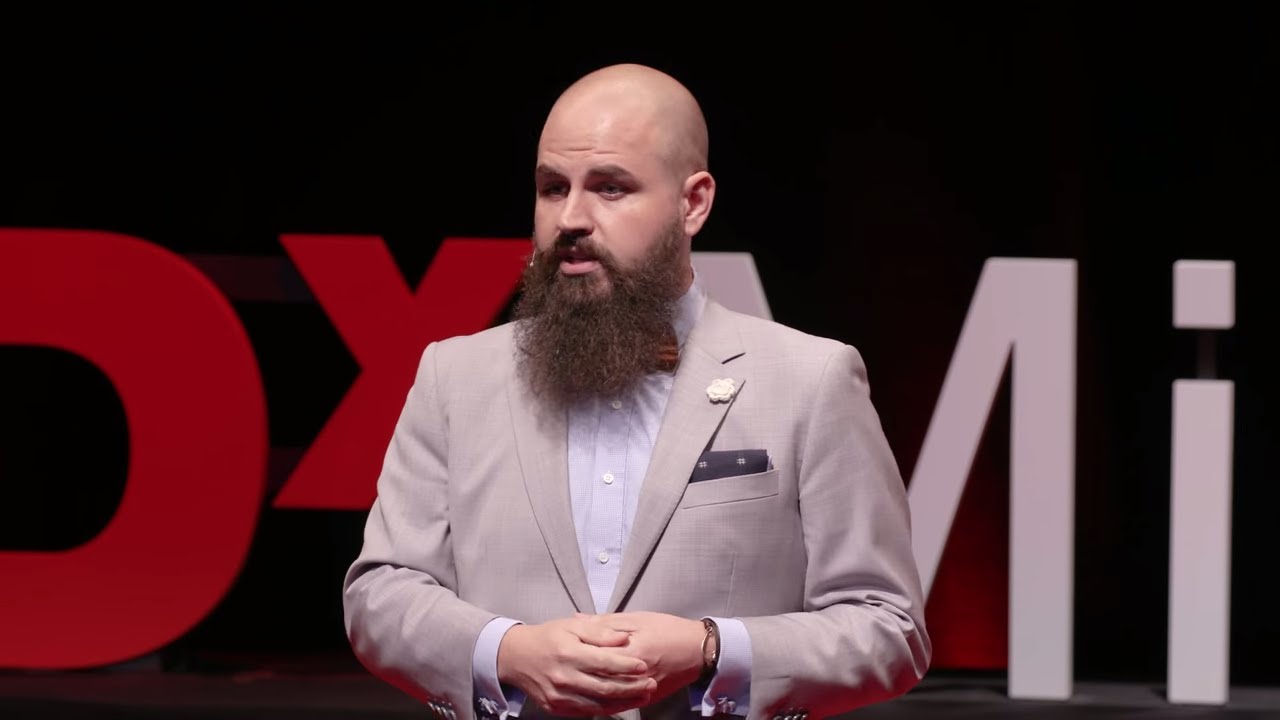
while I was a film student at BYU we received a visit from a filmmaker named Michael rabiger and he taught me one of the most influential concepts of my life and my career he said your life has marked you in unique ways and these marks whether you know it or not will determine how you live your life what quests you will pursue and what you are equipped to say with passion and Authority now Raber's intent was for us to look within ourselves to find the themes that would inform us and make us better filmmakers and
these marks that he talks about are actually unresolved personal tensions and they're the backbone of your personal narrative my reason for being here tonight is to help you understand that when you discover your personal narrative it will not only guide you to find your life's Mission but it will also serve as a lifelong source of strength and motivation to help you accomplish that mission now as a documentary filmmaker I'm in the business of unearthing and constructing narratives from the lives of real people and so for the next 12 minutes I'd like to share with you
three building blocks that will help you find and construct your own personal narrative and the first of these building blocks is find your marks and own them now the good news is you don't need a psychiatrist to do this but you're going to have to dig deep so if you have journals read them or do a self-inventory look back over your life and think about all the times write it down think about all the times where you were moved to Great emotion emotions like fear or Joy anger anticipation these are going to be Clues and
they're going to help you find the marks in your life was there ever a time as a child where you experienced trauma perhaps at some point you felt like you were caught between irreconcilable ideologies or maybe you've done something pH was so terrible that it still haunts you these are going to be Clues and they're going to help you find the underlying tensions of your life find your marks and own them now tensions are really really important and they're very powerful because we as human beings were hardwired to want to resolve tension in fact it's
tension that propels us us forward in a movie it's this desire this hope that the tension will be resolved and a desire to know how that tension will be resolved that causes us to keep watching so I'd like to share with you the first of three clips from my recent film white Earth it takes place in the oil boom region of North Dakota my dad works in an oil company my mom cooks for other people cleans the bathrooms she cleans other people's RVs but in California she just took care of us my family my husband
and my three kids they are everything for me for me there it was my idea to come with my husband to norak I'm talk with my kids and I explain the decision and they are so excited just like attention in a movie propels us forward with the desire to see what will happen next a desire to resolve the tensions in our own lives will Propel us to do really remarkable things the next building block is that we need to tell personal and family stories now in the mid90s there was a researcher named Marshall Duke and
he was doing research into why it was that certain families stayed together in an environment where many other families were becoming more and more fractured and he came upon this really interesting Discovery he found that children who knew more stories about their family history stories about their childhood and about challenges that their families had faced were more likely to have a stronger sense of control over their lives they had higher self-esteem they felt that their families worked more successfully it turned out to be the best single predictor of emotional health and happiness and it was
also the biggest factor in making them resilient to stress the stories that we tell about ourselves and our families Will Keep Us centered and they're going to help us mitigate the stresses of our lives and careers now when I was 4 years old I spent a summer with my grandparents and my grandpa who was a teacher his his true passion was this Garden that he had in his backyard and so I would follow him around for hours just peppering him with one question after another Grandpa why does the birdie stick its head in the ground
why does it want the worm why do birds like worms why don't people eat worms and on and on and on and on one day my grandpa was pulling up weeds pulling them out of the ground and throwing them in this wheelbarrow and I watched him for a really long time and then I turned to him and I said Grandpa how can a weed save itself now I'm pretty sure that my grandpa didn't wake up that morning preparing himself to have an existential conversation with a four-year-old and to be honest I have no idea what
he said in response but I do know that he wrote that experience down and that story was told to me over and over again as a child and it was really really important because every time that I heard that story I was reminded that I was a questioner and that my life's Mission would be to ask questions sometimes in unusual places and even of unlikely people smoke fire I don't get out much and whenever I do get out I don't even get near the stupid oil fields cuz I know if I did I'll probably just
smell the gas and pass out burn the methane into the air this say it's so efficient but I thought methane was supposed to be Pig farts I mean what I've heard from a lot of people is that the first natural gas comes from a pig's butt the third building block find your mentors now you are the hero of your personal narrative and like any good hero you've been helped along your way along this hero's journey by mentors now for some reason in the popular culture mentors are always portrayed as like these weird bearded old white
guys right so basically like older versions of myself and I know some of you are thinking well wait a second what about Yoda right Yoda is is green you are correct so I suppose we could say that Yoda is a mentor of color but in your personal narrative your mentors can be any person of any color or object that is a source of reflection or perhaps has been a catalyst for insight perhaps teachers religious leaders a poem when I was in elementary school there was a boy we'll call him Tim and he faced really serious
Social Challenges he acted out in school he said and did odd things he was a misfit and people made fun of him one day my mother pulled me aside and she said Christian the hardest thing that you will have to do in your life is to decide what you are going to do because you can do anything the hardest thing that Tim may have to do in his life is to wake up every single day to go to a place where he feels inadequate struggling to do things that you take for granted while other people
pile stones in his already heavy pack in her very special way this Mentor was teaching me about inequality she was teaching me about a world where the deck is stacked so strongly in favor of a few that they hardly perceive It While others have inherited a world where the deck is stacked strongly against them and despite this so many of them persist and accomplish remarkable things for I want to be a pilot and a chef maybe sometimes I could cook really good meals and sell them to people for like $200 a piece I don't really
care about the oil because it's not like I'm 18 yet whenever I'm 18 I might actually have to take an oil job and you know old enough to worry about how much money I have in my pocket if I have to take a job in the oil fields and then I'm going to have to say oh yeah I do care about the oil but if I don't have to then I'm just going to say I don't care about it every time that I am faced with an idea for a new film I ask myself the
following question is there something at the core of this idea some theme or tension that connects with the themes and tensions of my personal narrative if the answer is yes then I'm confident that I can tell that story in a way that no one else can how are you going to use the power of your personal narrative to accomplish things that no one else can true to my mission as a documentary filmmaker I've asked the question and I'll leave it to you to work out the answer for yourself thank you