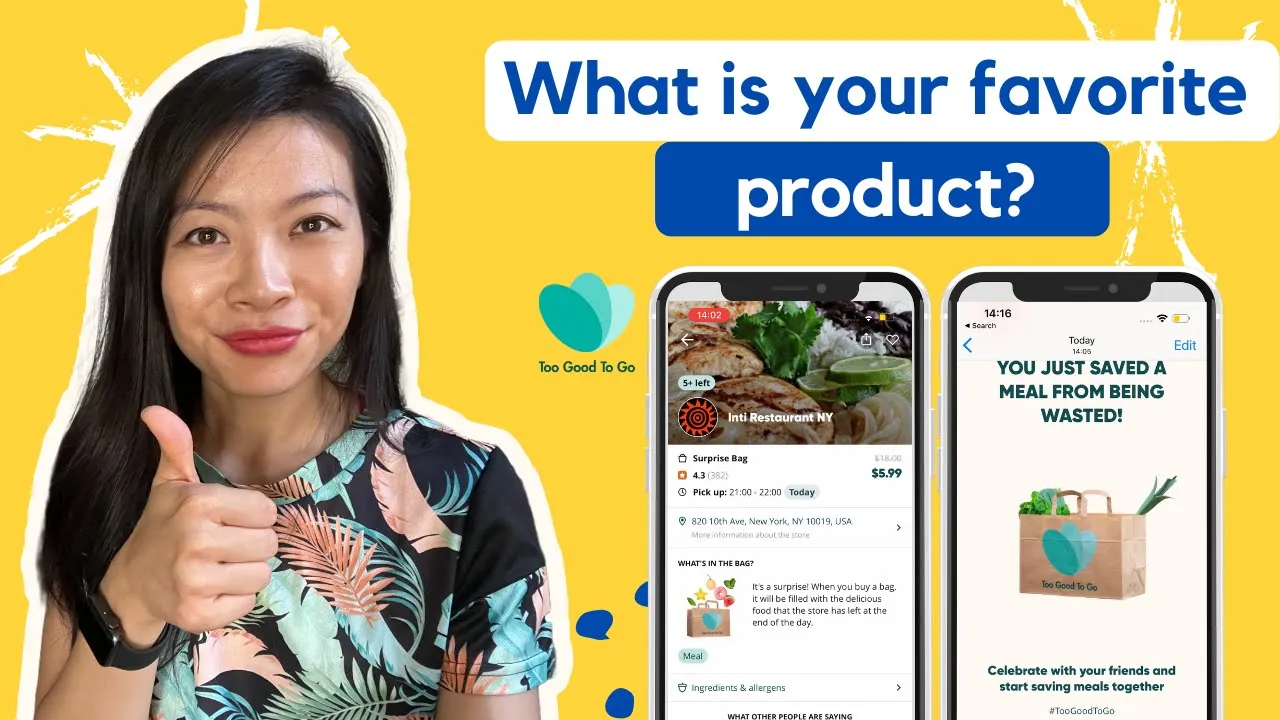
the most common product interview question is what is your favorite product and why and how would you improve it so in this video we're going to show you a framework to tackle this question so you can Ace this question and get the job hey guys I'm Diana and I'm a senior product leader in big Tech so I'm going to share with you guys my actual favorite product that I only discovered a couple months ago it's called too good to go and simply put it's a food app that basically sells you surplus food from restaurants at
a very steep discount and this product I love because of the social impact product at its foundation because it's tackling the problem of food waste and how does it work basically me as a customer I'll go into too good to go and start my first journey by searching for restaurants based on filters like near me based on when it's available to pick up the order then next I'll go to the company's profile page and take a look on what types of food they're selling the ratings and at the bottom I can choose to claim a
surprise bag what is a surprise bag a surprise bag basically means you'll get whatever Surplus foods that the restaurant has and you don't really know what it is and some of you might be thinking oh am I getting rotten food am I getting fish bones I've been on this app since April and all of the the meals that I've gotten were fresh cooked that day and not bad leftovers and once I've claimed my surprise bag I will go to the restaurant to pick it up within a certain window of time so now that I've talked
to you about what it does and with that let me dive into our framework to tackle this question so the first part of the framework is the motivation basically what problem is this product solving and I mentioned the first problem this product is solving is tackling food waste I did a quick Google and in the us alone 30 to 40 of our food is wasted that is astonishing and this was reported by the usda's economic research team so you can imagine how much food wastage there is another problem that this app is tackling is food
affordability especially in recent times where inflation especially for food has just soared in the U.S food affordability is a problem and hence this app allows you to buy the Surplus from restaurants that have thrown it away anyways for anywhere from three dollars to seven dollars second we're going to talk about the users and the value that they get from too good to go so for this product you have the businesses and the consumers on one side first the businesses find Value because they're able to resell the surplus food that they would have thrown away and
lost money on and it also helps them set up brand of being environmentally conscious on the consumer side the value they get is access to more affordable food because these restaurants that are signed up on too good to go are everywhere so I live in New York City and literally restaurants that I would normally go to that are quite nice are offering these surplus food bags so it's allowing consumers to access more affordable food while also helping the planet and what is the company too good to go get from this well I haven't looked into
their business model but I think that the businesses pay too good to go to be on the platform and it might be some really affordable rate and businesses are willing to pay that because they're going to make money off of selling on too good to go our third part is diving into the meat of it so why is it my favorite product well let me tell you and before I do let me share from the interviewer's point of view what they are trying to assess in your answer they want to see two things first strategic
thinking that you have a strategic point of you on why this product is good and when I talk about strategy what does that mean strategic thinking is that you understand the business model you understand how supply and demand Dynamics work you can talk about strategic engagement and retention tactics and that you can connect things to the businesses goals a second thing they're evaluating is that you have product sense that you understand what is good design that helps the company drive up their business goals so let's talk through some of that three reasons why this is
one of my favorite products the first is that it's a sustainable social good business model so I mentioned businesses are incentivized to sell their food surplus because they make extra money off of something they would have thrown out and you might be thinking well doesn't this cannibalize your food business no why because they are basically selling these food at odd hours that might not be the most convenient for customers so for example I've had to pick up too good to go bags at 9 00 PM or at middle of the day 4 P.M so that's
how they protect businesses from cannibalizing what customers would have paid for say a dinner so for businesses these two revenue streams are separate on the consumer front it's sustainable because the food is Affordable so customers will continue buying there's also a plethora of restaurants if you're in New York like I am so hence a lot of choices based on where people are and this is again good for businesses because this is almost like a trial for customers they get access to cheaper surplus food they taste it they like it and they go back to the
restaurant for to pay for a full meal and this model seems to be working pretty well given how many restaurants are on the to go to go platform lining up the streets of Manhattan and the other boroughs so every time I feel like eating out I will go check too good to go because it helps me reduce food waste and contribute towards a positive Mission and at the same time get access to Affordable food the second reason why I love too good to go they make searching and discovering food easy usually when I'm looking to
buy food it is a process I tell you I'm on Google Maps looking at ratings and review and it takes forever to the point where I have analysis paralysis that I just give up and cook at home but too good to go has simplified it and given me enough information to make a decision so things that they've combined to help me make the decision the first is showing me a visual map of food places so that gives me an idea of location based on where I am and it allows me to add filters based on
the time of pickup or whether it's a grocery store or a restaurant and they also have ratings but not reviews so again that simplifies it a bit because I can just quickly look at ratings rather than having to read lengthy reviews and another part on your home page they show shortcuts such as recommendations for you I don't find this to be the most useful and they could definitely do better on their algorithm there because a lot of the places they show me quite far away and lastly they have notifications telling me about new restaurants that
I might be interested in again I'm not sure what the algorithm that goes into predicting that because some of the recommendations that come up are not very relevant the third reason why I love this product is because it makes me feel good when I use it how often can you say that about a product most products you use you'll feel like oh I'm spending way too much time and wasting time here or other products I'm spending way too much money on this and I shouldn't most products usually touch a vise unless you're talking about fitness
apps apps but too good to go every time I order they give me a confirmation page telling me that I contributed to tackling food waste by buying one of their surprise bags and in my profile they show me how much co2e that I've helped save and also how much money that I helped saved this makes me feel like I'm contributing towards a larger Mission and hence it keeps me loyal to the brand so I mentioned every time I feel like eating out I will check too good to go and it's also a great way to
meal prep just buy a bunch of stuff in the beginning of the week and you can eat it throughout the week our fourth part is tackling the how would you improve this by talking about pain points and solutions so let me share what the interviewer is trying to assess here they are trying to gauge that you have empathy that you can understand what is painful for the users that you identified and things that are still going unsolved because one of the key skills for product managers in building great products is user empathy another thing they're
trying to gauge is that you can think of problem-led solutions instead of solutions looking for a problem because we know a lot of people fall into that trap and the last is prioritization can you from a whole host a whole list of things that sound interesting prioritize the one that's going to be the most important for your business's goals so how would I improve this product two things that I identified the first a pain point that users have is what am I even getting I remember the first few times that I ordered I had no
idea what to expect whether what I was going to get was of value I mentioned the surprise bags don't come with any information on what's in them because some businesses don't even know until they package it because they're basically picking the things that they have a surplus of and they won't know what that is until they look at what's available so this ambiguity might make people not want to take the risk of ordering food especially for early customers and this has a huge impact on probably one of the main metrics for good too good to
go which is the number of orders the number of times people click that claim surprise bag button so what could be some solutions to solve this problem well I'll start with the easiest one first well businesses can maybe import their menus to give people an idea what to expect business is no best what they're offering so they can just write these are the general things that I'm selling at my restaurant so what you're getting could be a whole host of some of these things a second easiest solution that we can make more complex is that
people who have bought and before can share their photos of what they received so others can see what the food looks like and they can see whether it's fresh or not I like the solution because it also keeps businesses accountable that they need to be giving customers not rotten food and if we were to make the solution more complex we could layer AI on top and get a system that sees and labels the food from the photos and then write that into text to tell customers what the restaurant is offering but also allow people to
search for keywords of what they want to eat and show restaurants that are offering those things the next solution could be breaking out the ratings into more granular pieces so today I'm too good to go there's a rating system where you can choose from one star to Five Star but a general of all rating is kind of ambiguous what people are rating it based on so maybe breaking it out into other factors like what would people rate this restaurant on freshness or the amount of food given and that way people have more confidence in what
to expect and especially those that are worried about food safety can check the rating on freshness the second big pain point is actually getting the food I mentioned the food is really offered at really odd hours so usually when a restaurant closes so around 9 pm or for bakeries in the middle of the day when the cafe closes so hence this makes it really inconvenient for customers to get the food and this could lead to less orders which is the main metric that too good to go cares about so some solutions maybe the first one
the restaurants can offer early pricing it means the food that they're selling to is a bit more expensive but still discounted but offered at a more convenient time and this could be for restaurants who let's say they close at nine and they offer the food at eight and they know at eight o'clock they have so much surplus food that they're okay selling the food at an earlier time because they know between eight or nine they're not going to get a ton more customers to eat all of the food the second solution could be either building
out or partnering with a delivery partner and here because the food price isn't too expensive people might be willing to Shell out money to have the food delivered and because it's off busy hours the cost for delivery should be cheaper and this could be a good way for too good to go to earn more Revenue so if I was to prioritize based on my key business goal which is a number of orders what pain point would I prioritize if I think about it not knowing what I'm getting that might be an initial pain point if
I'm an early customer but if I had more and more experiences and developed trust for the platform it shouldn't really impact the number of orders of course if you can't get a person past the first order then they're not going to order consecutive orders so it's still a pain but as too good to go becomes more popular people might be more willing to trust if they know a friend had a good experience or if they see that the app is downloaded a gazillion times but what continues to be a sticking problem that'll limit the number
of orders is people getting the food at these inconvenient times so for example I am a pretty loyal customer but if I have to go pick up food at 9pm by that time I've already eaten or I'm too lazy to go so by helping people get the food in easier ways too good to go can increase their orders tremendously and hence businesses can increase their revenue from selling too good to go surprise bags and between the two options of solutions we have either early pricing or the delivery partner I feel like the delivery partner one
has way too much Logistics than possible costs even if the company could earn Revenue so hence I might in my MVP test out the early pricing model by making the food a bit more expensive so companies can earn more profit which is good for them but customers can also get the food at more convenient times so it's a better win-win for all versus the delivery option you're still getting the delivery at 9 00 PM after you finish your dinner so let's review the four key steps we went through the first is the motivation what problem
is this company tackling the second is figuring out who the users and what is the value they're getting from the product third answers the question why is this a favorite product of mine and you want to talk about strategic and design reasons and lastly number four answers how would you improve this product by looking at pain points and solutions and prioritizing so this one example isn't enough to help you digest how to answer this question here is another answer to the what is my favorite product and how would I improve it question on Yelp so
if you love the Yelp product too you'll want to watch this and I will see you guys in the next video