foreign we defined earlier Innovation as a risky social process and so one of the core activities in managing Innovation is really to put the risk out of the process and this has been achieved in many companies by a so-called stage gate process what's the idea first let's start with the so-called Innovation funnel another famous concept from the old days of innovation management and the idea here is that really your Innovation activities should be like a funnel starting very broadly evaluating large sets of ideas broadly finalizing a concept and then precisely executing it and launching it
into the market so along this funnel we start really with the activities we talked about earlier ideal generation concept development realization and launch so along these funnels we start with ideas which we transfer into Innovative Concepts which after realization are the invention which I mentioned thing about our earlier definition when successfully placed in the market we really have an innovation in form of product services or processes or in some instances we find that we really don't have an external market for our product so we sell the Innovation inform the invention form of knowledge and by
out licensing or similar activities along this picture at the beginning we have a stage what we call the so-called front end of innovation the front end are the first activities and the front end is of also sometimes called a fuzzy front end it's here we have many the sources of uncertainty we really search broadly and some of these sources of uncertainty are beyond our company border some are within our company so here in India it's a begin is really to start to search broadly and reduce the uncertainty but really don't reduce it too much and
then we would perhaps search to narrow and be not Innovative enough while we then proceed over this Innovation funnel and along the process however we want to strongly reduce the Innovation risk and just execute what we really are certain about is also the more we move to the right on this picture the more expensive it's going sets idea generation actually is pretty cheap as the market research is pretty cheap compared to realization or then the ramp up of a protection process so the idea is the more we move to the right the more we proceed
along the stages of the Innovation process the less risk we would like to have I give you a few numbers on this this is a typical Innovation funnel from a consumer good company and they said in general in LA in the last year we started with 1919 ideas which we described and explored out of these we for about 25 of these in the original ideas we created a small project to really follow up on the idea perhaps develop a concept out of this project we generated 369 so-called board projects projects presented to our top management
for decision on further execution in the end we launched 167 new products this number already indicates most of these products probably were incremental Innovation and now it gets interesting despite all that screening and the selection and the board decisions out of these 167 problems 124 were flops they did not find any market demand 24 of these products were successful but actually not profitable 17 were doing okay but just 11. out of 167 and in the end out of 1919 only 11 were really successful products that really had a much higher average return what does this
mean this first means that really Innovation needs a system that is able to finance all the risk and all the trial and error um solving taking place these 11 products in the end have to finance all the rest and the wrong attempts we also could now say well perhaps we should really reduce it when all these flops so we really should screen stronger at a much earlier time but perhaps this is also not correct and then again we would look to an arrow and perhaps then in the end end up with no successful product at
all but because of these numbers which are really typical for many companies the main idea and the core requirement for a successful Innovation project is just think about is really a process that helps us to de-risk The Innovation process over the different stages more expensive it gets but that at the same time give us some room for creativity and explorator of sync and perhaps one of the largest success factors in managing Innovation is really addressing this point and it comes from Robert Cooper a consultant and management Professor who defines a so-called stage gate process and
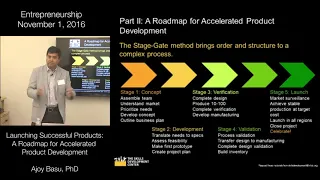
Cooper probably is from a practitioner's perspective one of the most important persons in managing Innovation what is his basic idea he says that structured Innovation process in a set of activities of different stages a stage is defined as a set of activities we execute in this stage and the stage are divided by so-called Gates a gate is a decision point that allows us to make a decision should we proceed to the next stage so often it looks like this this is original illustration of the stage gate process so Cooper says and you see it's similar
to our three-point differentiation I had earlier he says it starts with a discovery stage idea generation then I have to pass the first gate and this idea that pass the first Gates they come into stage one what he calls coping we would call it concept developing then some of the concepts pass into stage two we do more mainly economic activities of building a business case really doing an investment plan calculating is there a market for it can we earn money if this is successful the process will proceed across Gate 3 enter development actually looks like
a small stage here but it's often a very long activity with a lot of substages of developing the product then we have a functional prototype which we go into testing and validation so both technical testing um with regard to legal requirements and quality and so on but also Market validation by concept testing and Market testing is a really a market if this is positively ticked we pass gate 5 and go into the launch activities and after we launch Cooper reminds us we also should do a post-launch review to really on the long term learn from
this process and see did we pick the right products and projects so the idea on the one hand side is that each company should have this kind of structures processes and in each let's go one step back in each of the stages a clearly defined set of activities methods tools you execute in this stage then let's now look again a little bit more into the gates it's these These are really responsible for the dearest King to putting the uncertainty out the gates you have to think about as a meeting this is a meeting where people
from the management and the project team come together and they talk about the achievements and they evaluate the project process and so it's a kind of a quality control but it's mainly a go or kill decision Point sounds very hard but it really is as it engage the decision is made should be proceed with this project go into the next stage should we invest into it more or perhaps it's better to terminate the project at this point as it's not meeting the gate criteria so gaping criteria it's here at the beginning is something that we
talk about idea screening and really mainly looking in the fit to Market does it Meet customer requirements but also does it mean meet the Strategic priorities of our company the second screen is more or less the same but in a more elaborated form then we build a business case and so the idea of the screening of stagegate is really very Financial we'll see can we earn money with it but we also at this time have already a better understanding on on the solution information we will need in the technical concept behind so in this case
we we also talk about do we really trust us that we technically can achieve this outcome the development stage then is finished by gate four when it's about really should we invest now in testing of not such a good um not not such as tweaked M gate but it's mainly also to revised at this point here is this what we defined here what we achieved are the open problems we identified in Gate 1 and 2 are those really met by the product if we take this we go to stage four and really here's the criteria
then at the gate Fiverr does it need our minimum validation criteria does it meet all the quality tests and so on then we go into launch and then it's too late if something as long as then at this stage we are out in the market and so the idea is really and this was one of the main achievements of Cooper that he says we should really make this systematic and for all the Innovation projects in our companies we should have more or less the same criteria so it's not that someone who has a great idea
and is a good promoter and talker has a higher likelihood as someone who also has a great idea but it's a little bit more nerdy someone who's not so prolific and that both ideas have the same chance and the projects are equally competing on budget and scare resources in their execution stage so the main activity really here to summarize this that in each stage you have a set of activities you do mainly together information you do some analysis and you create clear deliverables clear outcomes or concept an idea description early prototype or functional prototype are
really ready to launch product which are then evaluated in the gate decision by the different set of people normally management members that do this go kill decision point and so this is why it became a course successful for Innovation it's really this continuous need to evaluate and make a decision and this stage gate process is forcing a team to really make this evaluation at all points and not just run into a contingency and say oh we totally are sure that the customer wants it and then spends a lot of time time by going through the
entire process without having these in between evaluations and also clear gate criteria allow us to compare projects and provide management with an aggregated overview of our project um portfolio where are projects in which stage of it um or how much are we forward when do we expect a next Market launch however while this idea has been very appealing and think it's very intuitive also the stage gate process has been subject to plenty of critique some companies found that it's too determined it's too slow just for minor improvements it adds a lot of administrative burden some
say it's not suited for radical Innovation as what would be the gate criteria some say because of this clear gate criteria some really radical projects are not passing the gate criteria which are set based on the experience with old products also it really is a very sequential thinking we do this activity we pass a gate we go to the next however we know from Innovation it's often a trial and error process it happens in many iterations we should be allowed to go back as only in a later stage we really get certainly new information about
the customers so perhaps we go back to concept generation and the original stageco process of other more sequential once we pass this activity we just execute the next one also it's not so much a critique but more a question of focus what really happens before gate one as obviously the entire process is only as good as what we feed into this process and while in many companies strong emphasis has been placed on executing these Gates and these stages and passing the gates actually we now know that probably we should have something like a gate zero
eating gate minus one of all the front end activities to creating opportunities it's the first place and this is why many companies nowadays use what is called a third generation stage gate process which is a little bit more flexible which has more overlapping phases more fuzzy gates to allow for different contingencies of an innovation project and this is also what Cooper lately um introduced so he says now in a modern Next Generation State gate we have the traditional full stage gay poses for normal projects with a so-called light process for minor improvements projects just variants
where we have not much uncertainty so we just can execute it have one or two decision Gates and that's it and then a so-called stage get Express this is a process for projects with a medium degree of innovativeness that somehow are important for the market and therefore has to be a little bit faster so also here you see you really have to consider the consent contingencies of an innovation process what you want to achieve to set up perhaps a different kind of projects how to manage it so we nowadays know that executing a stage gate
processes clear activities and performance measures is often really one of the main success factors but sadly it's often regarded as sufficient for successful Innovation and I would say it's not it's just the beginning it sometimes even is a reason for failure and so stay tuned as this is what I talk about in the next module