1138 Giga-Analysis Alright, let's cut the bullshit, Oda literally dropped what may be the biggest lore drop in One Piece history, extensively detailing not just the Void Century, but even the world that came before it, but the issue is, all of this is described in incredibly poetic and cryptic Japanese that gets so easily lost in translation. Every single line here matters, every term is essential, and because of that, it is my utmost honor as someone who has been studying and translating One Piece for the past decade to guide you through the Harley, the history of the
One Piece world! On the cover, we see that the- Okay look, I know, we're all dying to get to that final spread, but let's take a moment to talk about the other things in this chapter very quickly since they're pretty interesting as well, be patient as it'll all be worth it, I promise. So as I was saying, on the cover, we see that the hideout belonged to none other than… surprise, Surprise, Who's-Who. Who could've guessed who this was. Even the cover story's title very cheekily jokes around saying "It was the hideout of Who's-Who all along!!".
He is surrounded by the other members of the Who's-Who Pirates, his own squad within the Beasts Pirates, which include several cat-related SMILE users that we saw by his side during the events of Onigashima. Above him is the kanji for "neko", translating of course to "cat", which was also seen in his chamber within Kaidou Manor known as the Cat Kafé. This seems to pretty much explain the events thus far. Who's-Who seemingly kidnapped several girls to work as his servants, by making the likes of Holed'em do the dirty work, which is why we see several girls here
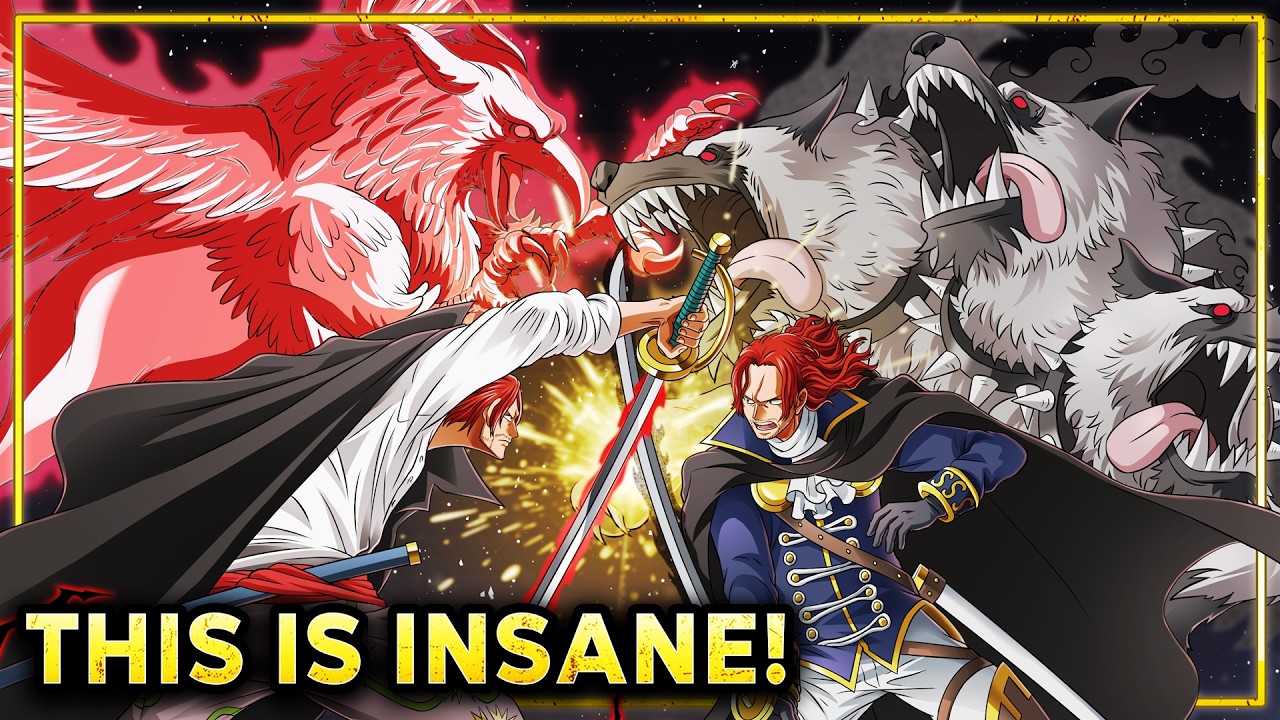
serving him. At the same time, he likely kidnapped the master carpenter Minatomo to help him build this hideout, since he is so talented at building castles. Though I wonder if he really has some grander plan to retake Wano or is just happily lazing around after Kaidou's defeat. In the First World, the Underworld, Loki questions Shamrock about why he has the same face as the "Great Pirate" Red-Hair. Though we could infer, Shamrock gives us better details about his relationship, stating that Shanks is his younger twin brother. He also states that Shanks once came back to the
Holy Land, but prefers to continue living in what Shamrock calls the "lower world" (下界, gekai), what he also describes as being "filthy". Shamrock in general speaks quite differently than Shanks, sounding pompous and conceited though without the same bratty attitude that Gunko has, being a bit more composed. Unlike Shanks, who uses the crass and informal first person pronoun "ore", Shamrock uses the gender neutral "watashi", which is more polite and sophisticated. Gunko also refers to him by the title of "Danchou", or "Knight Commander" (as a reminder, a lower position than Garling being the Supreme Commander) rather than
by his name, and he does appear to be her superior as he gives her orders. Fundamentally, it seems that while Garling is the big guy in charge, Shamrock is more like the man on the field who commands orders. Shamrock's claim about Shanks having visited the Holy Land is interesting though, as it could have been some point in the distant past when Shanks came to Mary Geoise but decided to return to the lower world. But what if… this wasn't the case? What if this was actually referring… to the events of the Levely. What if the person
that spoke to the Gorosei… was actually Shanks? I know it sounds surreal at this point given what we know about Shamrock and especially given the cape, but this is Oda, I wouldn't put it past him to do a double twist. We don't fully see the edge of his scar in that image, but again, this could just be a matter of perspective. And more importantly, there is one key detail that doesn't add up. You see, if we focus on Shamrock's face, there is one more detail that distinguishes him from Shanks beyond the lack of scar and
his hair. It's the beard. You see, Shanks has a beard that covers his mouth, but it's clean and shaven on the sides. Whereas Shamrock's beard extends to the sides of his Cheeks. And the man who spoke to the Gorosei… doesn't have a beard extending to his cheeks. He is clean and shaven… unlike Shamrock, but just like Shanks. Could it really be that Shanks was in fact the rat all along? Or was Shamrock just feeling like shaving that day? At the very least… we can't fully rule out the allegations quite yet. We get another insane revelation
as it's shown that Shamrock has a power… or rather, his sword does. We don't know if on top of this Shamrock himself has an ability, but his blade has the power of what seems to be a mythical devil that turns it into the legendary creature of the Cerberus, the three-headed dog that guards the gates of Hell. This isn't the first time we've heard of the cerberus myth in the One Piece world, as there was the cerberus guarding the entrance to Thriller Bark which the Straw Hats identified as such, so it shows this myth has long
since existed in the One Piece world as well. Even Usopp back during Syrup Village lied about the myth of the cerberus with the Usopp Pirates. In this case, It kind of makes sense that Shamrock has this power, as the Cerberus is the guardian to the gates of Hell, and we've kind of established that Mary Geoise is basically Hell, with Sabo stating that he didn't imagine Hell would be located at the top of the world. So in that regard, Shamrock might be like the gatekeeper to Mary Geoise, he who keeps potential intruders away. In this case
however, at first glance it seems that Shamrock's blade "ate" this mythical fruit. We were already told of the technology that Vegapunk helped develop which allows inanimate objects to eat Zoan fruits. This is because, as it was pretty much stated even as far back as Alabasta when this concept was first introduced with Lassoo, Zoan fruits have a will of their own, and as such the will of the animal within can bring the inanimate object to life. We saw this with Mr. 4's gun Lassoo, Spandam's sword Funkfreed, and more obscurely Sukiyaki's tea kettle Bunbuku. Yet here there
is something peculiar about this power. For one, it appears to be awakened with a dark cloud scarf, but it's also surrounded by The same flames that Imu and the Gorosei could generate, as well as Gunko. We know that Gunko has an actual named devil fruit, but given the flames it really seems like it's something that Imu has granted her as a special power rather than just an average fruit like any other. Whereas here the Cerberus is introduced as a demonic creature rather than its own whole fruit, just like the Gorosei were. So it could perhaps
be possible that the distinction is that Imu can grant actual mythical devils that don't classify as fruits, but can also grant Paramecia powers that instead have a name but still qualify as devil powers. It's all a bit tricky, but I'm sure it'll be explained eventually. If there is one thing to say about this power though, is that this finally brings the "Blackbeard has a Cerberus fruit" theory to an end after all these decades. The blade appears to have some sort of hybrid form as well by being able to sprout blades out of each of the
Cerberus's three mouths, though even more bizarre is the fact that the heads are able to pop out of the body that fly out on their own like rockets, while Shamrock then Retreats the main body back into his blade. He refers to this attack with the phonetic reading of "Sukuranburu", or "Scramble", though the kanji reading is "kinkyuu hasshin" (緊急発進), or "Emergency Takeoff", literally shooting out like rockets. These heavily pierce Loki as Shamrock and Gunko leave in an incredibly cool arrow bird, but they're likely underestimating his tenacity. It's also worth noting that the Cerberus has ringed eyes
like Imu's, though whether this is an effect of the powers he confers or just for dramatic effect is hard to say for sure. As the two leave, Shamrock says that they need one more person on the island, and Gunko asks who this should be, but the scene cuts away… Seems like we'll have to deal with yet another God Knight soon enough, likely to spawn into the island with the same summoning circle given the speed they're expecting them to come. As we imagined, Luffy now has to reckon with the fact that Shanks seemingly attacked these giants
out of nowhere, refusing to believe it's Shanks. When Nami acknowledges his passion for Shanks, Luffy says it's the same way she feels for Molley-mere, which is in reality referring to Belle-mere. This is a nice detail, as it shows that the Straw Hats tell each other about their pasts, much like we saw with Luffy knowing about Robin and Saul. If you remember, during Arlong Park, Luffy refused to listen to Nami's backstory from Nojiko, but here he clearly knows about Belle-mere, meaning that Nami still told Luffy the whole story afterwards. As Luffy continues to talk about Shanks,
he mentions his time being in the Roger Pirates, and as he says that, the mysterious man walks up towards the castle. This is likely to be Collon's father, and at the very least he is undoubtedly the silhouette we saw on the cover of Chapter 631. We see the same striped cape as well as the same blonde hair. The fact that he is mentioned in the same breath as Luffy's statement about the Roger Pirates could be Oda's indication that this is in fact a former member of the Roger Pirates. Many will hop to the idea of
Scopper Gaban, though I'm still not sure how I'd explain the blonde hair given how Gaban had black hair. The Only blonde members of the Roger Pirates were Taro and Petermoo, but I really doubt it's any of them. Hey, who knows, maybe Gaban just dyed his hair or something? Or is it someone else entirely? Back at the Elbaph village, everyone is celebrating to the rhythm of Nika, as we see Hajrudin and Stansen doing the Nika pose. What seems to be Usopp is dancing atop Brogy's helmet, while what seems to be Brook can be seen leaping, seemingly
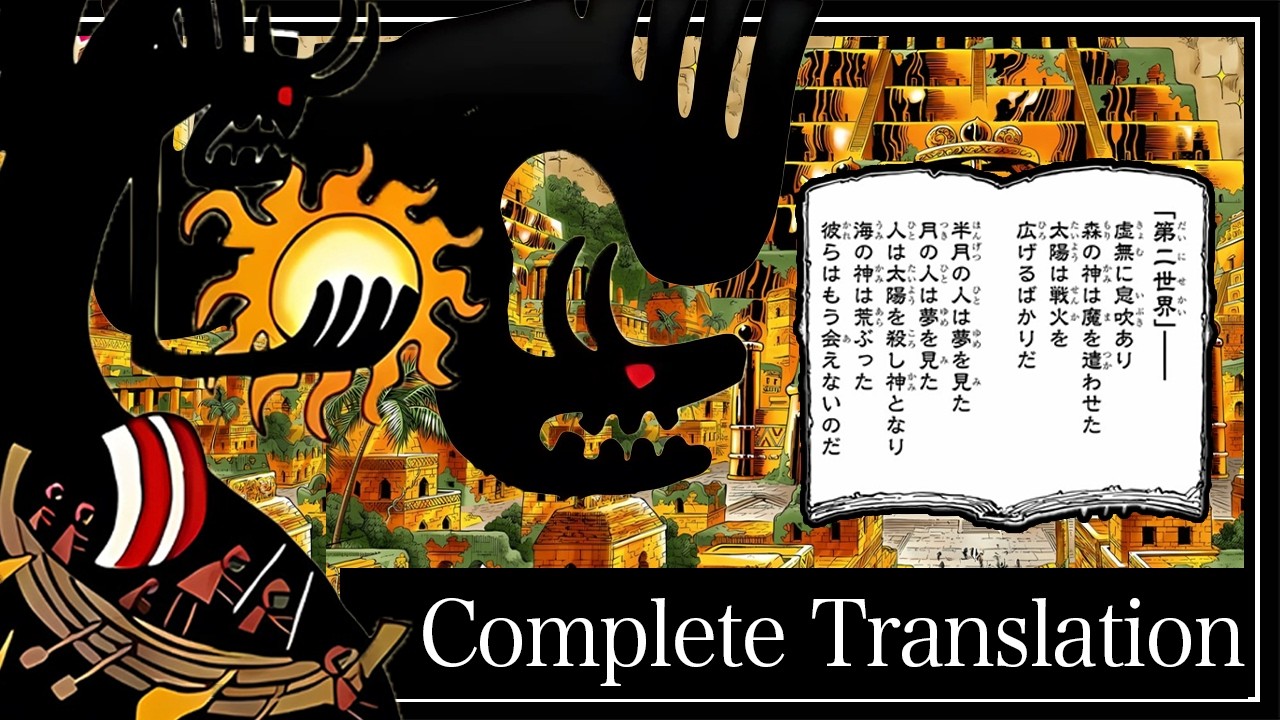
playing the violin. At the same time, at the Owl Library, Saul shows us the one and only Harley, the holy text of the history of the giants!! Though it's so old and dusty that it makes Chopper cough. Also interestingly, it's formatted more like a western book, read from left to right, rather than a Japanese-style book. The contents of it are tantalizing, but let's first focus on the cover of the book, which is, of course, the symbol of the ancient kingdom, the sun with the eight spheres. But shockingly, this is no normal sun, for the center
isn't an empty circle, but rather some Sort of detailed drawing. Unfortunately, it's way to small to really make out, but it's pretty clear that something is drawn within that circle itself. At the same time, as Ripley shows Franky around the Adam Tree, she brings him to an ancient mural, believed to have been drawn by kids 900 to 800 years ago, during the period of the Void Century, which represents the story told in the Harley. As Saul explains, the book is divided into three chapters detailing each of the three worlds. These represent the three worlds of
history, the first one before the first great calamity, the one from the first calamity up until the Void Century, and that of the present. Interestingly, this also matches with Elbaph having three worlds, which are named in just the same way as those of the Harley. So perhaps the people of Elbaph named their realms after the worlds from ancient history. And so, without further ado, let's dive into the story of the Harley!! [The First World:] Upon the Earth, there is flame. People succumbed to desire. As they seized the forbidden sun. The slaves wished and prayed. The
Sun God appeared. The Earth God grew furious. Along with the Hellflame Serpent, it enveloped the world in death and darkness. Those men would be unable to meet again. The first verse of the "First World" chapter says "Upon the earth, there is flame". In this case, the terminology of "earth" is the kanji "chi" (地), which is a kanji that translates to "earth", or "land". Generally this kanji refers to earth as in the land that stands beneath us as a whole. This kanji can be combined with other words such as "seichi" or "Holy Land", the title of
Mary Geoise. But the distinctive thing about this kanji is that it was also historically used to refer to Earth, the planet, the realm that we stand upon. And in this context that seems definitely the way it's being referred to, as this "Earth" is evidently being used to refer to the planet as a whole. This potentially opens up to an insane possibility, that the world of One Piece… Could potentially be our Earth itself. Now, to be clear, it's not that this is confirmed in any way. After all, while the word was historically used to refer to
the realm of the Earth and it does appear to be the context it is used in here as well, but it could just be the word that Oda is using to historically refer to the realm that is this planet. And maybe it's just a copy paste version of our Earth made purely as a distinct fictional setting. But… what follows seems to suggest the truth might be otherwise. At the very least, given how some details are slightly different, I think that this world may be unique but is meant to pretty much be a one to one
parallel of ours. And this whole story could be taken as a cautionary tale. On the other hand, the "flame" this verse speaks of is most likely the Mother Flame. As we know, the Mother Flame is essentially Oda's version of nuclear power, what we also call "artificial suns", generating endless energy. Even the Power Plant where the Mother Flame is made is referred to in its kanji reading as a "Nuclear Fusion Plant", meaning the Mother Flame is just a more advanced stage of nuclear power, an artificial sun. So fundamentally, this first verse is essentially stating that upon
the Earth, the Mother Flame was discovered as a revolutionary energy source. But as the next verse says, "People succumbed to desire. As they seized the forbidden sun". Fundamentally, people's greed gets the better of them and they begin to exploit the power of the Mother Flame. And this is something that we see in the drawings of the mural. We see people upon a boat building gigantic skyscrapers. These skyscrapers billow smoke out of their chimneys. We see that under the city, giant cogs and machinery turn, powering its technology. There even seems to be some sort of rocket-shaped
item, what could perhaps be something similar to Vegapunk's vacuum rocket, as well as televisions, monitors, and other technology. Fundamentally, it is showing that this was an incredibly advanced civilization. So in the not too far future from our present year 2000, a future where eternal energy has been achieved but the greed of people caused them to overtake the world and cover it in their buildings and technology. In fact, if you look at the boat that these two men are using to build this skyscraper, it appears to be floating in mid-air. Now, it's hatf to really say
given the flatness of this mural, but I do think it makes a lot of sense for this boat to be flying. Because fundamentally, this could be a flying ship, or rather an aircraft. Keep in mind these murals are drawn from the perspective of people of the Void Century, so to them accounts of a plane are nothing more than tales of a floating boat. And in fact, we see several slaves feeding what seem to be charges of the Mother Flame into another boat higher up the mural. I feel this is likely representing the slave workforce helping
build some sort of ship. But in reality, these ships may actually even potentially be the Ancient Weapons. As we've established, each of the ancient weapons compose one colossal ship: Pluton has the massive battleship under Wano, Poseidon has the Noa, and Uranus seems to likely be some sort of flying ship that casts down blasts at those under it, what Imu used to destroy Lulusia. And all three of these boats are drawn and accounted for in this mural. Now, we'll get to the drawings of Poseidon and Uranus later as they are drawn in the Second World section,
but this one here drawn within the city is most likely the battleship Pluton, originally designed by a shipwright of ancient times from a land that would eventually become Shipbuilding Island, where the City of Water Seven would develop one day. But I think that the suggestion this mural is implying is that all three Ancient Weapons were developed during this original ancient period. That may be why even in the Void Century they were already considered to be "Ancient" Weapons. We also see what appears to be an elevator going up to some high land, but it is subdivided
into two sides that clearly differ from each other. On one side there are slaves, carrying the Mother Flames produced in factories and bringing them to some platform in the sky where they are using them to build the ship that we believed to be Pluton, as we mentioned. But on the other side of the elevator are people who aren't bound by any specific duty, and instead Gain a halo on their heads as they ascend up the elevator. As they reach the top of this high land, these people are welcomed by those living in the skyscrapers above.
This halo might represent an ascent to godhood, fundamentally a very similar concept of those moving to live on the Holy Land. And this might be because this high land they are standing on is most likely the Red Line, which must've come into creation during this time. The Grand Line may have been created during this period too, perhaps relating to the sea kings of Poseidon always being around the Calm Belt, but there's no real mention of it here, so let's put that aside for now. This might even suggest that the Red Line is manmade and that
it was created as some sort of higher land of living for the upper class that could live in all those skyscrapers. And this is further suggested by the fact that the Red Line here appears to turn into some sort of snake, but we'll get to that in just a moment. Something I think is worth noting about this first world however, is that the people here… are all humans. No other races are depicted within the image of The First World (though it's hard to say where exactly it cuts off), so could this be suggesting this was
at a time where only humans existed? As such, it could be a way to make it even more similar to our current world, with other races either having evolved later, or… much more grimly, perhaps being nothing more than the result of human experiments with the bloodline elements to enhance themselves to become stronger and more powerful. After all, we see this later with angels, who were implied to have augmented themselves into the biologically superior lunaria race, so could perhaps all of the races have arisen during this period or sometime after as a result of these types
of bloodline element experiments? Then again, this is the more speculative side of this, so let's go back to what we know more for certain. Particularly, there's something I'd like to talk about in this mural, which is the Moon. We see what is very clearly the Moon, and if you look above it you can even see the other planets, which actually quite resemble the other planets seen in the orrery at the Library of Ohara. However, The Moon is also surrounded by Mother Flames, which likely refers to the colonization of angels of the Moon. This is the
event that was depicted in the murals of Enel's cover story, showing how the angels colonized the Moon in ancient times and developed a very highly advanced civilization on the Moon. There they developed the automata robots but eventually were forced to return to the planet below due to a scarcity of resources. We know that this event preceded the Void Century because the descendants of the Moon People, the Shandia, would go on to found the city of Shandora several centuries before the Void Century even began, so this whole colonization of the Moon was several centuries before. However,
we don't know exactly if this was before or after this first calamity, but the way it is framed here with this advanced technology seems to suggest it most likely was during this ancient period prior to the calamity, as technology only really seemed to resurface again later around the Void Century itself. Eitherway, this all ties into our next verses: "The slaves wished and prayed. The Sun God Appeared.", which of course refers to the desire of slaves to be freed bringing into existence the presence of Nika, just as Vegapunk once explained to us. This is the first
Nika that Jarul mentioned a couple chapters back, but of course, we are still torn on the dilemma of who this Nika really was. Was he the first user of the fruit, was he just a regular person that later became the myth of the fruit, or was he entirely fictional during this period but was conflated with reality later on? After all, he isn't even drawn in this mural here, but ultimately, once again, we still don't know. Nika's presence in this first period is also more mysterious than in the Void Century. We don't know if he was
an agent of good or an agent of evil, and even the Harley doesn't much elaborate on what Nika did during this period, save for the fact that the slaves prayed for him, likely to free them from their suffering. However, "The Earth God grew furious. Along with the Hellflame Serpent, it enveloped the world in death and darkness."… in this case, beyond the "Sun God", or "Taiyou no Kami" (太陽の神) we Are introduced to the "Earth God", or "Chi no Kami" (地の神), which uses that same "chi" kanji we mentioned earlier standing for Earth. As such, this God represents
the land and the Earth itself. And later on, we are also told of the Forest God and the Sea God. Which may sound familiar to hardcore One Piece theorists because some of these Gods were mentioned by the Shandia people during Noland's flashback. In fact, when Mousse was meant to be sacrificed to kashigami, the great snake the Shandia beleived to be a deity, she claimed she was happy that in death she would go to meet the "Sun God". But during the ritual, not only is the Sun God named, but so is the Rain God, the Forest
God, and the Earth God. Now in this case, the Forest God matches one to one, but the other two not quite exactly. The Earth God in this case uses a slightly different kanji, using "daichi" (大地) rather than just "chi", which is fundamentally the same word, just a different synonym of it, but it's worth noting that the kanji are slightly different. The Rain God on the other hand is completely different from the Sea God, but it's possible that it might just be another name for It or that the name changed slightly between cultures. After all, it
makes sense that these four gods the Shandia mentioned are the exact same four gods detailed here in the Harley. Furthermore, however, there is a pattern that is established by all these different Gods. Because you see, the Earth, the Forest, and the Sea can all be considered part of the five elements of Eastern belief. Water (which would be the Sea), Fire (which would be the Sun), Forest, Earth, and Metal. Which are also serve to give the Japanese names of the Five Elder Planets that the Gorosei are named after. So perhaps the Gorosei may have all been
named after this ancient belief of there being several different Gods, though it's hard to say for sure. However, these Gods, combined with the Gods of Pluton, Poseidon, and Uranus, would complete the pantheon of planetary names. Eitherway though, this "Earth God" was said to grow furious, likely due to how humanity was using the Mother Flame for its own interest and covering the Earth in cityscapes rather than respecting its nature. So this Earth God seemingly represents nature itself, but I don't think it's the figure Of the "Mother of Nature, the Sea Umi" that we were told of
by Vegapunk, since we do after all have a Sea God here already, but it's hard to tell. It's possible this Earth God was an actual individual, but who they are exactly we can't really say, we don't have enough information. However, they were joined by the "Hellflame Serpent". Now this is a complicated word, the "serpent" part is pretty easy obviously, but "Hellflame" is derived from the word "gouka" (業火), which refers to the fires of hell, this term being used in Buddhism and religion particularly to refer to the fires of hell that consume evildoers who have sinned.
However, in this case Oda specifically has the kanji for "fire" replaced with that of "flame" to form this more unique word, "Hellflame", likely to connect it to the Mother Flame. So could this suggest that this serpent is in some way artificially powered by the Mother Flame? Or does the serpent represent the Mother Flame that was so abused by humans fighting back, engulfing the world in its hellish flames? We can't say for sure, But what we can likely assume is what this snake is. Because it's most likely… the Red Line itself. During Little Garden, Dorry and
Brogy claimed that the one thing the giants couldn't destroy was the "blood-stained snake". In that case, they seemed to be referring to the Red Line, as the blood-stained snake in Norse mythology is referring to the Jörmungandr, the snake of red color that envelops the entire world just like the Red Line does. And so, they likely viewed the Red Line as this giant snake… but what if this is actually the case? This Hellflame Serpent is most likely the Red Line itself, and even in this drawing we see it arising from the very Red Line upon which
the privileged upper class is welcoming the new gods to their realm, coiling from a city into this colossal creature, breathing fire upon the world. So fundamentally, this is the story of the First World: in a world of Earth much like ours of the present, humanity has advanced technologically. However, having discovered the Mother Flame, an advanced form of nuclear power, humans are able to attain endless energy. With it, humanity Expands its industrialization, covering the entire Earth in factories, buildings, and skyscrapers. Most ambitious of them all is the creation of what would be called the Red Line,
a colossal continent where only the chosen privileged can live, while slaves have to toil away to provide the Mother Flames that power the civilization of the privileged. Some colonized the Moon, founding the city of Birka, though later were forced to abandon it due to a lack of resources. Even further, it seems this may be the time when the three Ancient Weapons of mass destruction were crafted, consisting in part of three colossal ships. The wealth gap furthers more than it ever has before and suffering in desperation, the slaves pray for the Sun God to appear. Eventually
however, the Earth God grows enraged by this abuse of the Mother Flame, and unleashes the Red Line, the Hellflame Serpent, to engulf the world in a nuclear war, scorching the entire land. All that remains is the final verse: "Those men would be unable to meet again". Thus ends the First World. [The Second World:] Within the nothingness, there is breath. The Forest God sent forth devils. The sun only aggravated the fires of war. The people of the half-Moon saw a dream. The people of the Moon saw a dream. People killed the sun and became Gods. The
Sea God rampaged. Those men would be unable to meet again. So the Second World is one we are slightly more familiar with, the story of the Void Century. For reference, we don't know how far back the original first calamity took place. I suggested it may have been the year 0 of the Kaienreki Sea Circle Calendar, with Nika's appearance being like the birth of Jesus, and I still stand by that, but it's either something like that, or maybe even the complete other extreme of potentially thousands of years ago, we don't know for sure. But at some
point, we know that said technology was regained during the Void Century. The ancient kingdom Joyboy was Born into was said to be very technologically advanced, most likely because it began to rediscover the technology of the ancient past, and began trying to reapply the Mother Flame again. And this resulted in a very particular event: the creation of Devil Fruits. "Upon the nothingness, there is breath. The Forest God sent forth devils."… The first verse is fairly cryptic in how it's described, but the concept of "nothingness" likely refers to the state of the world after it was wiped
in the nuclear war. While it is a term synonymously similar to "void", it's important to note that this nothingness (kyomu, 虚無) is written differently from the one in Void Century (kuuhaku, 空白) despite similar meanings. What "breath" means is even more cryptic, but it could perhaps represent life being breathed into the world once again, so I think the meaning of life and humanity arising again from the void left behind by the nuclear war makes more sense. However, "The Forest God sent forth devils." is pretty evidently referring to the creation of Devil Fruits. This likely refers to
what in the mural we see to be the colossal world tree at the Center, what is most likely the Sun Tree Eve, what we've believed for a long time to be the source of all devil fruits, which makes sense that the one who created it came to be known as the "Forest God" for being able to grow such a colossal tree. From this tree the devil fruits were created, containing bloodline elements that help people advance into potential futures as Vegapunk explained, what is described here as "sending forth devils". What's interesting here is that we've often
assumed that Imu was the one that is the Sea Devil and created the devil fruits, but in this case again Imu is most likely the Sea God, not the Forest God. However, I had already proposed before that Imu isn't the one that created the devil fruits but perhaps the one who appropriated them and took control of them during their process of creation. Perhaps in this case the "Forest God" is the one who first created the devil fruits, developing the technology to make dreams come true, while the Sea God is the one who later became the
Sea Devil and took control of the power of some fruits. This would explain why A fruit of the Sun God exists despite the fact that Imu would despise its existence, likely because they were never fully under Imu's control, it's just a power he may have appropriated in some form. But again, we don't know enough about the Forest God to say. The next verses say "The sun only aggravated the fires of war."… In this case, the "sun" here once again likely refers to the Mother Flame, and it's fundamentally saying that its rediscovery only led to more
war and conflict. This is likely particularly referring to the use of the Mother Flame during the Void Century when Imu used a Mother Flame-powered Uranus to eradicate entire islands. And in fact, this is something that we see depicted in the Mural as well. The flying ship here is likely to be Uranus. You may notice it looks a lot like Enel's Ark Maxim, and this is likely because many fans have speculated the Ark Maxim was serving as a narrative parallel of what would become the role of Uranus, with Enel sort of playing at being a little
Imu within his belief of being a God. In fact, according to One Piece Odyssey, it's implied the people of Birka got acccess to some Void Century technology by reverse-engineering it, so it's possible that the Maxim may have been a way of trying to reverse engineer Uranus through Enel's knowledge of Birkan technology. Speaking of the sky, we also see an angel attempting to escape the flood, which in this case could symbolize the angels trying to escape from the flood by creating the sky islands of Skypiea and Birka, through the technology of Cloud Crafters that Vegpaunk introduced
during Egghead, as it would make sense that those islands were made artificially during this period as a result of the flood. Even Vegapunk remarked how the Cloud Craft technology is essential for the survival against the flood. In this case, Uranus shoots down a lightning bolt going down past a crowned king, striking the land below by the tree. This crowned figure is most likely King Nerona Imu, representing someone who is overlooking others as Uranus destroys them from above. In fact, there is this dark texture Standing beneath Imu that may seem confusing at first, but while it's
hard to judge, particularly as it bleeds together with the mural of the First World, I believe this to be water. I think this substance represents the water that Imu sank the world with, and the people and animals attempting to climb the tree could be symbolizing all the people and animals of the world that drowned underwater and were desperately trying to seek higher places to survive. Imu instead stands above the flood, as the water itself turns into the shape of a ship with oars. This could be symbolism for Imu always floating above others or perhaps could
be an actual boat of sorts, who knows. More noticeable however is the depiction of what is almost surely the Ark Noa. It attempts to float up towards the surface but the strike from Uranus seems to jolt it and stop it from reaching its destination. It's been implied the Noa's purpose was to assist the emigration of the people of Fish-Man Island, but as we know that promise couldn't be fulfilled, and this might be representing just that, the Noa being stopped from completing its objective. The pairs of people and Animals drowning below it may even suggest the
idea that the Noa may have been used as a sort of Noah's Ark, helping people survive the flood by riding upon it, just as it does in the tale of Noah's great flood in the Bible. But perhaps that may be where Joyboy failed, he couldn't save enough people with the Noa and failed to fulfill its purpose as they drowned beneath the waves, and at the same time, the people of Fish-Man Island were unable to emigrate to the surface. What is most bizarre on this side of the mural however is the large dragon, as we don't
really know of any particular dragons in the Void Century… or do we? Because I've argued for quite a few years now that despite there not being that much evidence, there are signs there may have been the important presence of a dragon present during the Void Century. Fundamentally, the Tenryuubito are known as the "Celestial Dragons", and they seem to have a fascination for dragons as we saw in Punk Hazard, desiring Kaidou's fruit to be cloned and asking Vegapunk to create artificial dragons. So This fascination must've come from somewhere. Their mark is known as the "Hoof of
the Dragon that runs on the Sky" and even the kanji for "Tenryuubito" uses the same kanji as "Tennousei", or the Japanese name for "Uranus" the God of the Sky. So I've always thought that perhaps there was some dragon associated with Uranus, in the same way Zunesha is associated with Pluton and the Sea Kings with Poseidon (though oddly enough Zunesha seemingly doesn't appear in this drawing). Regardless we don't really seem to get many details about this dragon in the Harley, we see it clashing with the Hellflame Serpent but this is most likely just an artistic choice
to blend the two periods rather than an actual clash. But who actually is this dragon? Well, when you think about it, it looks very similar to the being on the left, what is most likely to be Imu himself. So in that regard, could this dragon be a form that Imu took during the Void Century? Perhaps similar to the jawed creature that he attacked Sabo as? The next verses state: "The people of the half-Moon saw a dream. The people of the Moon saw a dream."… In this case, the people of the "half-Moon" seems like an odd
statement as it doesn't connect to anyone specific. We later have a reference to the people of the Moon, obviously the angels and lunaria, and then in a later chapter the half-broken Moon, likely referring to the symbol of the Kouzuki clan. But what does half-Moon mean? Well, why not take a Moon and cut it in half? What do you get? You get… a D…. So the people of the half-Moon are the D. clan, the people of the ancient kingdom. The D. itself likely has a more unique distinctive meaning, but "the people of the half-Moon" could be
a way that they referred to them. While the people of the Moon, as we mentioned, are in this case the lunaria, literally meaning the Moon people in Latin, who were a major ally of the ancient kingdom due to the technology they seemed to have developed in their Godland atop the Red Line. And their shared dream, of course, the Dawn of the World. It then continues "People killed the sun and became Gods."… This "killing of the Sun" could be referring to the loss of the Mother Flame technology, but I feel like it more likely refers to
the killing of the Sun God, the death of Joyboy. Following it, people became Gods, as the Celestial Dragons ascended to heaven to become the new Gods of the new world they had created. And as a result "The Sea God rampaged.", which likely refers to Imu flooding the world. The figure of the Sea God is most likely Imu, who I've said many times we believe to be the Sea Devil, the same figure as the Mother of Nature, the Sea Umi, who in this case rampaged by drowning the world in water. So fundamentally, this is recanting the
story of the Void Century that we are mostly familiar with. From the devastation of the previous calamity, life and civilization were reborn again. The Forest God created the devil fruits through a great tree, but as the Mother Flame became rediscovered, it was only used to further stoke the flames of war, with Imu reawakening the Ancient Weapon Uranus to smite the world. The people of the D. Clan, With the help of the lunaria, dreamed of one day bringing the Dawn, but Joyboy was killed, and the Celestial Dragons became gods. Imu continued to rampage, drowning the world
in 200 meters of sea level, and despite its best efforts, the Ark Noa was not able to fulfill its promise. All that remains is the final verse: "Those men would be unable to meet again". Thus ends the Second World. [The Third World:] Upon the chaos, there is Void. The inconvenienced lingering shadows shall remember the Day of Promise. They shall listen to the voices of the half-broken Moon. The Sun God dances, he laughs. He leads towards world's end. The Sun will return. A new morning will arrive. Those men will surely be able to meet again. We
skip to the period after the Void Century, starting from the year 700, Or 822 years ago. "Upon the chaos, there is Void." obviously refers to the Void Century remaining after the chaos of that period, with the Government censoring its existence. "The inconvenient lingering shadows shall remember the Day of Promise" likely refers to those left behind to inherit the will of the ancient kingdom (similar to the concept of Oden's vassals become the "shadows" of his wish), remembering the "Day of Promise". This term is identical to the same day that has been mentioned by several characters, such
as the Fish-Men believing the Ark Noa will be used on the Day of Promise, the decisive day when the world will be changed. "They shall listen to the voices of the half-broken Moon" could likely be referring to reading the Poneglyphs. The "half-broken Moon" may be referring to the D. people again, but it also might be more directly referring to the Kouzuki clan, as they bear the symbol of a half-broken Moon, or a crescent Moon, with Kouzuki literally meaning "moonlight", so their voices refer to the writings left behind in the poneglyphs. "The Sun God dances, he
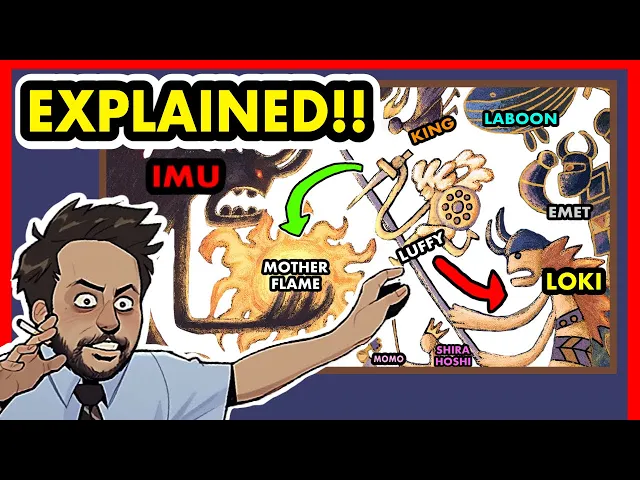
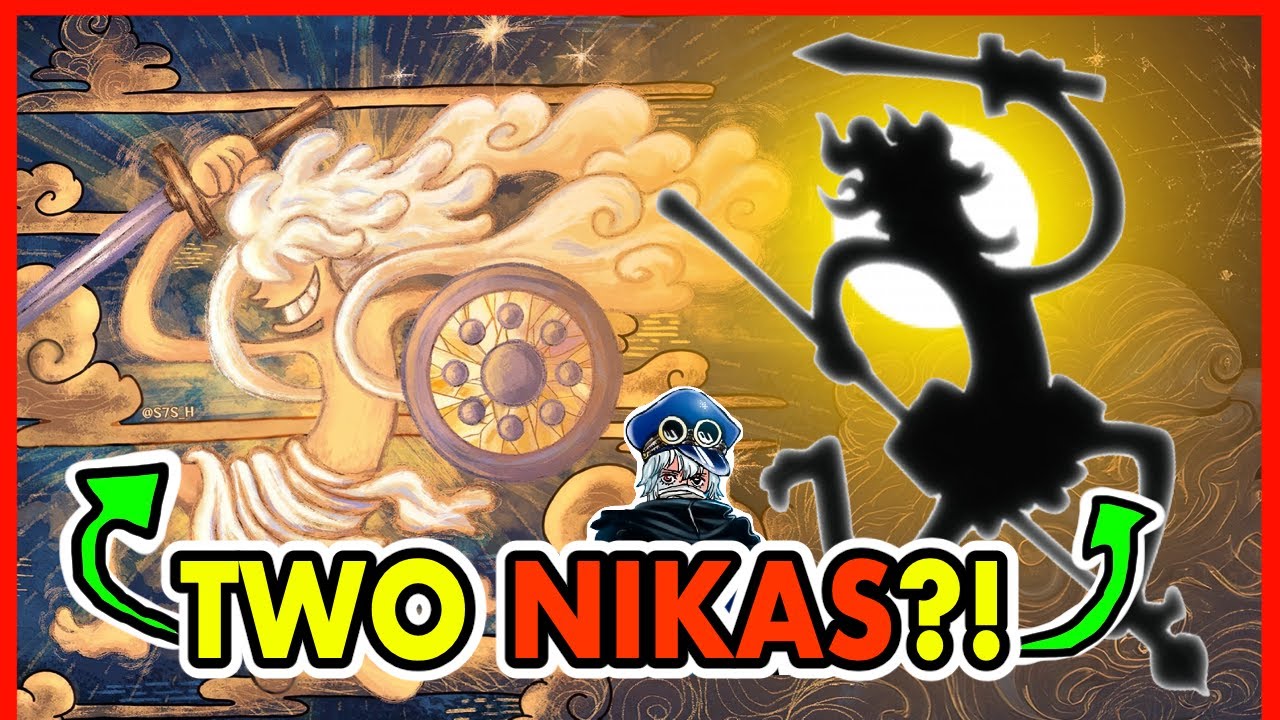
laughs." obviously refers to the appearance of Gear 5th, while "He leads towards world's end." is a fairly ambiguous line, for good reason, as it furthers that idea of duality within Nika. One could interpret it as Nika being the one that brings the world to its end, but you might also interpret it as Nika leading the people of the world in the face of the end being brought by Imu, helping save the world, leading to the final conflict. The final part of the mural envisions what is likely a hypothetical idea of this final conflict, though you
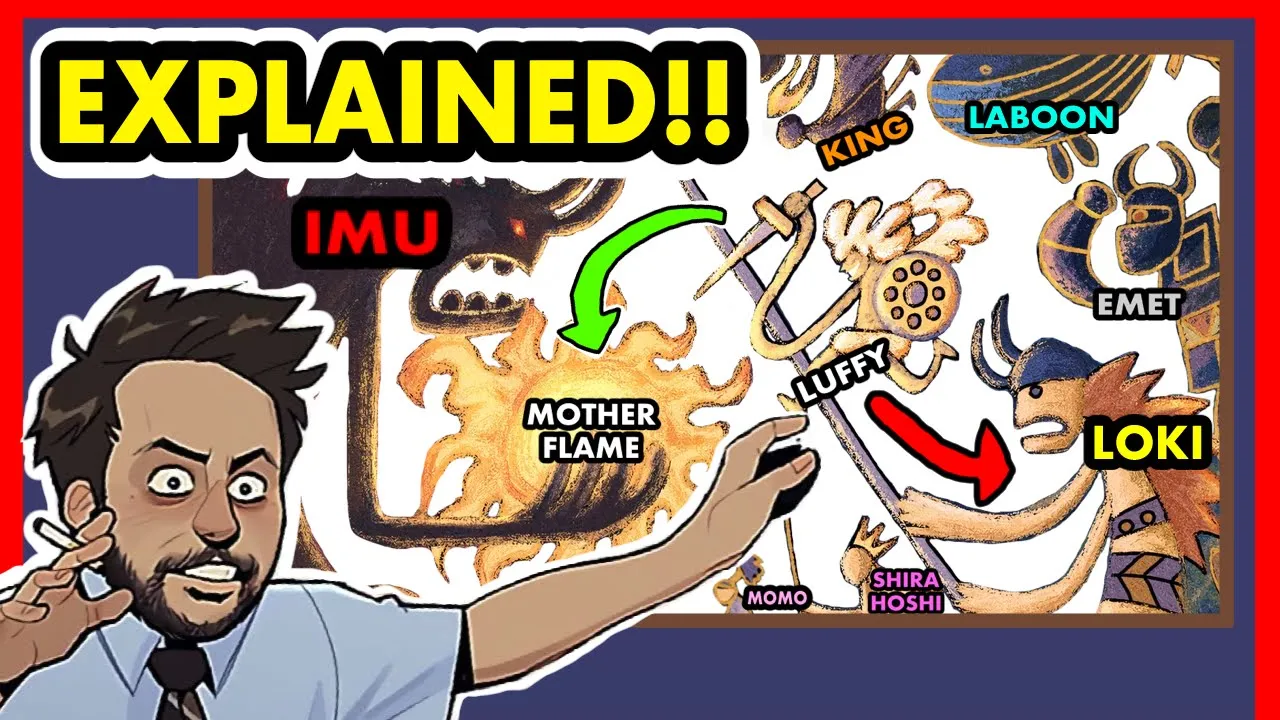
could also argue it's basically also a representation of the Void Century since fundamentally the two would be depicted as one and the same, especially since this was drawn from the perspective of those of the Void Century. But I feel it makes more sense if the three sides of the mural represent the Three Worlds. Eitherway, at its center we see of course Nika, either Joyboy or Luffy, carrying the same cloud scarf, sword, and shield from the depiction seen before, with the shield having the symbol of the ancient kingdom. We even see here that Nika stretches like
rubber. Next to him are all his allies from all the different races: above him there is an angel, though this is likely to be a lunaria, given the dark color of the body and wings as well as the flame atop its head. In the present, this could represent either Arber, or King, deciding to ally himself with Joyboy after Kaidou's defeat, or maybe even just simply the Seraphim fighting on our side. Next to it is a whale, which might seem weird, but remember, it was stated the whales were allies of Joyboy. The sea kings mentioned in
Chapter 968 that the whales wished for the return of Joyboy and we've seen them wishing the destruction of the Red Line too, and so it makes sense they will fight by Joyboy's side, helping ride others atop them into battle. In this case, this whale could even represent Laboon. Next to it is a mink, with its hair turning white, likely representing a sulong transformation and could mostly apply to most kings we've met so far, though if you want some real copium you could even consider this Carrot. Beneath them is of course best boy Emet, with both
of his horns intact, Who was expected to fight alongside the new Joyboy at some point in the future, and so could be taken here as Emet returning in Egghead to fight against the Gorosei and Imu. Lower still is an ancient giant, larger than the Elbaph giant seen lower on the left (as distinguished by the viking helmet), which is our first proper confirmation that the ancient giants were allies of Joyboy. But in this case of the future, this ancient giant could in fact represent Loki, as he does bear ancient giant blood through his father, and the
helmet and general appearance in this drawing matches that of Loki quite closely. Next to it is a tontatta as indicated by the fluffy tail, and next to it is a mermaid bearing a trident. Given the crown on top of her, this is likely the mermaid princess Poseidon, or what in the present would be Shirahoshi. Beneath the mermaid princess is a fish, which I wonder if it's meant to be a sea king or is the poor representation by the kids of the fish-man race. And next to it is some weird bear-like creature with a tail, Which
is odd since we already saw a mink elsewhere in the picture, so what could this be? Is it like a Zoan user, or some other race entirely? At the same time, we see what are likely different groups of humans aboard many boats. We see what looks like a woman due to the long hair aboard a boat with the symbol of the ancient kingdom, what could perhaps be Nefertari Lily of Alabasta, though it's hard to say. Behind the ship is a Mother Flame, perhaps to symbol the ancient kingdom using the Mother Flame to power its technology.
Aboard another boat is what is very clearly a samurai, bearing a katana and a topknot, and next to it is a ninja, as clear by the shuriken. Beneath it is a boat with someone with with very long arms, perhaps a member of the longarm tribe, and under it one of a larger body with what looks to be hair or some odd shape on its head. Perhaps the size indicates a Buccaneer, or perhaps it's meant to be something else entirely. Next to it are people with seemingly pretty long legs, likely the longleg race, So it's nice
to see the longarms and longlegs put their thousand year war that was introduced in Ideo's cover story to a brief stop during the Void Century. And finally there's a boat with a bow, likely to be the kuja race as they are known for their bowmanship. This pretty much encompasses all the major races of the world, which all came united to fight against Imu, and likely will do so again. Ripley mentioned it's odd to see so many people of different races united, a line particularly important for her given how she married a human, to the point
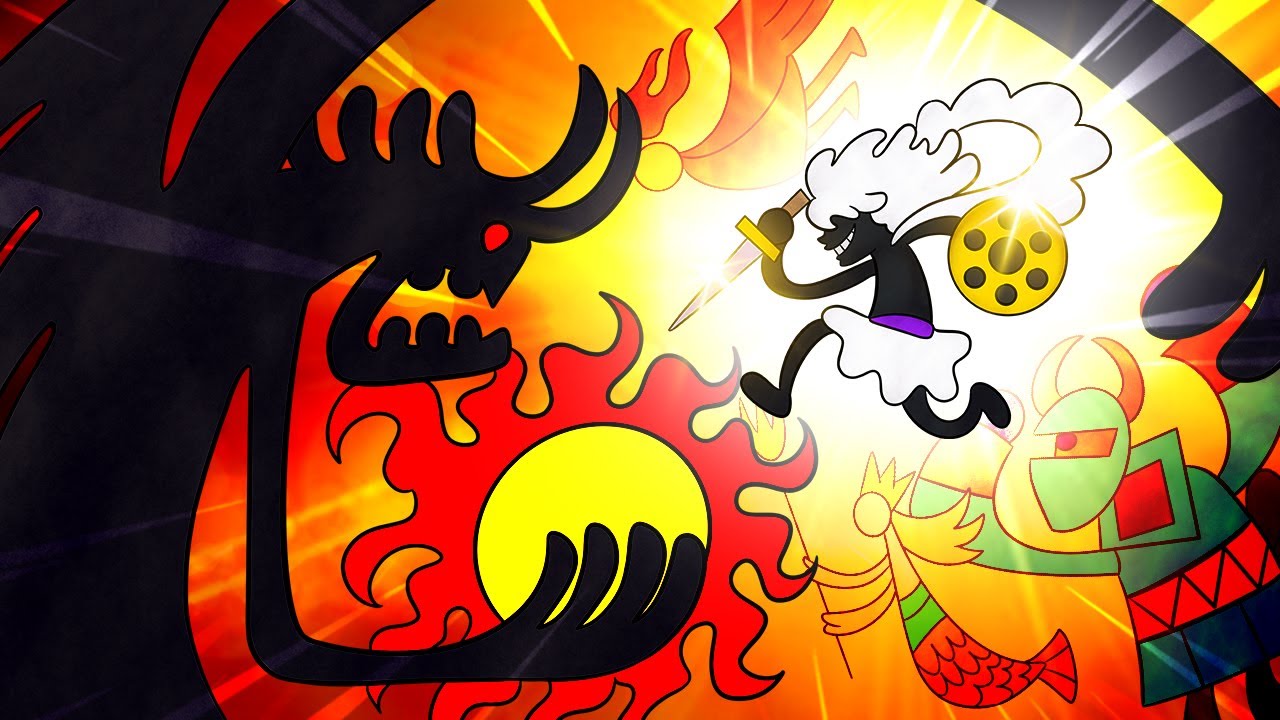
this drawing seems like a dream, but we know this was the case during the Void Century and that people are capable of fighting together against evil. In this case, the evil is the being depicted on the left, the Devil itself, no doubt King Imu. Beneath it among the flames of Hell are its followers, the God Knights and the Celestial Dragons. From above, it casts its hand down, from which descend drops of rain, likely symbolizing the flood it intends to bring, as well as several Mother Flames, representing The attacks with Uranus that it intends to continue.
And at the center, it hoards the Sun, wishing to keep it to itself, with everyone else seeking to liberate it from its clutches. So fundamentally, here's a quick condensed summary of the Harley and the mural: In the First World, prior to the Void Century, humanity was similar to that of our current planet Earth. They discovered the Mother Flame, an endless source of renewable nuclear energy, but the greed of humans led them to monopolize it and create a bigger wealth gap in humanity, allowing a few privileged elite to live at the top while the slaves suffered
below. Through the slave workforce they seemingly built the Red Line (and potentially the Grand Line too) as well as the three ancient weapons bearing the names of Gods: Pluton, Poseidon, and Uranus. During this time, angels had also colonized the Moon, establishing a technologically advanced city as seen in Enel's cover story, before returning to the planet below. The slaves prayed for liberation, and to answer their wishes the first Nika appeared. We don't know if this Nika was indeed a real person, or if it may have Been a fictional character like Kuma and Saturn suggested, but at
the very least we know it wasn't a fruit user. However, an entity called the "Earth God" unleashed the Red Line upon the world in the form of the "Hellflame Serpent", though we don't know if this is metaphorical symbolism for something like a nuclear attack from atop the Red Line, or if the whole thing really is alive. Its destruction basically reset this technologically advanced world, but eventually humanity recovered and rebuilt. Eventually people would re-discover the mother flame and likely traces of the old world, and particularly the lunaria seemingly developed great technology and became able to augment
themselves to the point of having biologically superior bodies and portable mother flames on their backs they could naturally generate. The people of the half-Moon of the D. allied with them and shared a dream of one day using this flame for good, just like Vegapunk currently does. However, slaves had carried into this Second World as humans once again vied for greed and power as they oppressed others during the Age of Slaves. Some of these Humans stole this technology, which resulted on one hand the entity of the "Forest God" creating the devil fruits, and on the other
King Nerona Imu reviving the ancient weapon Uranus to destroy his enemies. These attacks led to a great flood, causing most of the people of the world to drown. The angels likely used the cloud crafting technology to create sky islands and escape, while the ark Noa attempted to save people but likely failed, causing Joyboy to not be able to maintain his promise. Also, a literal celestial dragon of sorts was involved, in one way or another. Imu and the other kings killed Joyboy and became Gods, and Imu, called here the Sea God, rampaged and sunk the world
by 200 meters. Now that more years have passed, as the ancient weapons return again, some wish to use the mother flame to sink the world once more. However others wish it to provide endless energy for all, and so a battle for the sun will certainly come. Those who have lingered will decode the poneglyphs and follow the Sun God as he dances, laughs, and guides the world in the Face of its end. The mural of the third world depicts this battle as Luffy will be joined by allies of all races, such as Shirahoshi, Momonosuke, Loki, Emet,
Laboon, the lunaria, minks, and so many more, leading them against the Sea Devil Imu trying to sink the world. And once that conflict ends, "The Sun will return. A new morning will arrive", indicating that the Dawn of the World will come. And at last, "Those men will surely be able to meet again.". It is unclear who these "men" is referring to, as it just uses the male third person pronoun in the plural (while English doesn't have male third person plural, Japanese does), so it's just referring to a group of men, though keep in mind it
could also be generalizing to men as a large group if it also includes women. Perhaps these could refer to the "two kings" that the sea kings spoke of, what we assumed originally to be Joyboy and Poseidon, but this appears to suggest otherwise. Who "those men" are particularly we can't say, but during the first calamity, they could not meet again. After the Void Century, They could not meet again either. But in the future, at last… they will surely be able to meet again. And at that point they'll finally be as one again, as they become… One
Piece. As a final note, I just want to say… thank you. For letting me be a part of this for so long, and allowing me to be a One Piece historian unraveling the truth little by little. To be part of this adventure alongside all of you is nothing short of an incredible honor, and to have made it this far after all these years of studying to the point we are discovering the Void Century… makes me so happy to be alive. Thank you.