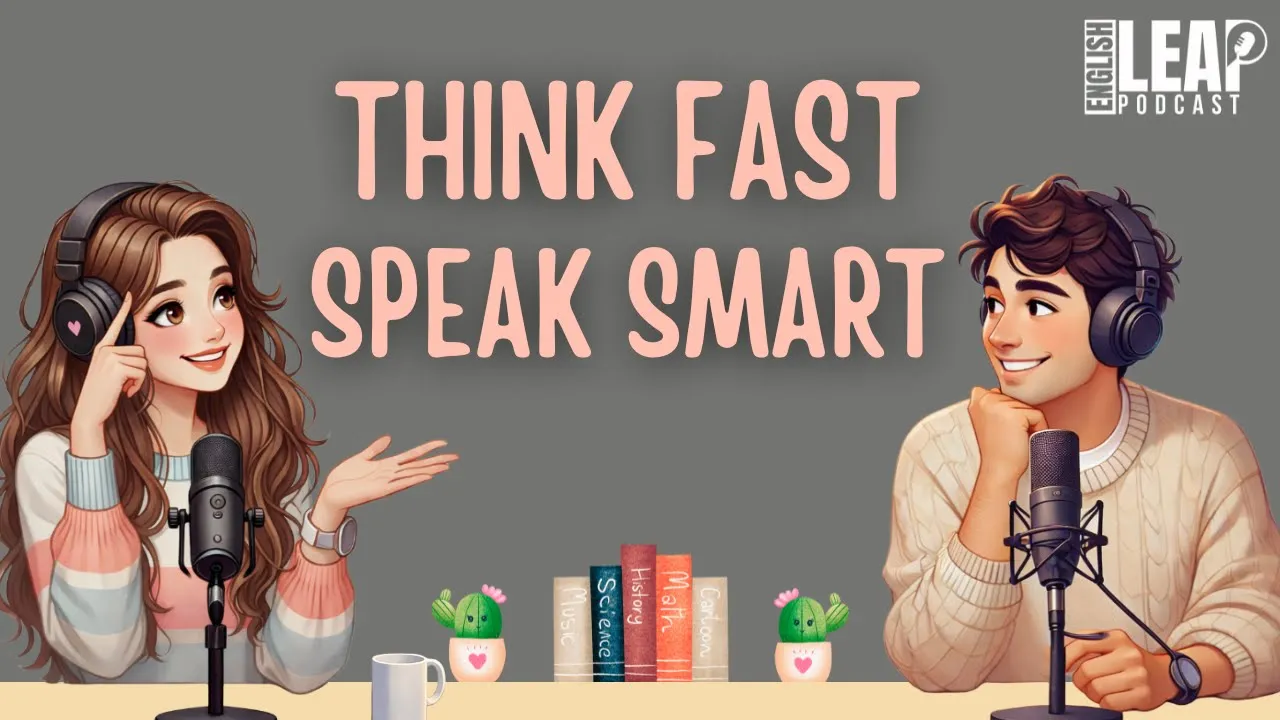
English Leap Podcast >> from Speak English with Claus. Hey English learners, welcome back to the English Leap Podcast, your cozy place to learn easy English through real daily life conversations. I'm Anna >> and I'm Jake.
We're really happy you're here with us in 2026. >> Okay, Jake, quick question. Be honest.
Is your brain online today? >> Online? Yes.
Fast, not guaranteed. >> Same. My brain is like a phone on 5% battery.
Still working, but very dramatic. >> And it overheats if someone asks, "So, what do you do? " >> Stop.
That question is a trap. >> A trap. Because you know the answer, but your mouth suddenly forgets English >> and then you start doing this face like uh Yes, that face.
Your brain is like loading, loading, and then oops, page not found. >> And the other person is like, are you okay? >> Honestly, that moment is painful.
>> It's like your thoughts are running, but your words are stuck in traffic. >> Ooh, stuck in traffic. Perfect.
>> Wow. And later, 2 hours later, you suddenly think of the perfect reply and you're like, "Where were these words when I needed them? " >> Seriously, that's so relatable.
I can feel it in my chest. >> And honestly, so many listeners can feel that, too. >> Hey, if you felt that, too, raise your hand in the comments like, "Yep, that's me.
" >> Because it's frustrating. It can make you feel slow or nervous or even a little embarrassed. But hey, if that happens to you, don't worry.
You're not weird. >> Not weird at all. You're human.
>> And also, English is sometimes spicy. >> Spicy like your brain is fine until English says, "Surprise. Choose the right word in 0.
2 seconds. " >> And if you choose wrong, your brain goes, "Shut it down. " >> Exactly.
>> So today, just let yourself relax. You don't have to be perfect here. You can just listen and let the English come to you.
>> Take a breath. Let your shoulders drop. >> And if your brain starts shouting, understand everything, tell it, "Shh, we're just learning.
" >> Yes. Oh, and just so you know, this episode is around B1 level, so the English is simple, slow, and natural. >> Right.
If you're an intermediate learner, you can relax. this one is made for you. >> And if you're a strong beginner, don't worry.
You can still catch a lot. >> Yeah. Just grab what you understand, borrow the lines you like, and don't stress about every single word, >> right?
You don't have to catch everything to learn something. >> And because this is easy daily life English, we'll use phrases you can actually say in real conversations, >> right? Our rule is simple.
real conversation first and the vocabulary is hidden inside. >> So, no pausing every 5 seconds to open a dictionary. >> Yeah, no dictionary battles today.
>> Just listen, enjoy the conversation, and let your English grow in the background. >> Hm. Then at the end, we'll do a calm word tour so the best words and phrases stay in your head.
And hey, if you enjoy learning English like this, please like this video and subscribe to the English Leap podcast. It really helps more learners find us. >> And we'd love to hear from you.
After you listen, write one sentence in the comments. One moment when my brain freezes in English is >> even a simple line is perfect. >> All right, let's jump in.
>> Yeah. So, let's start with the why. Why does thinking fast matter so much?
>> Because conversations move like a river. If you pause too long, the moment floats past you. >> Right.
And then you're standing there like, "Wait, come back. " >> Exactly. And here's the real thing.
People often perceive quick answers as confidence. >> Yes. Perceive means how someone sees you or what they understand about you.
>> Yeah. So, even if you're smart, if you freeze, it can look like you're unsure. >> Totally.
Like your brain is full of ideas, but your mouth is buffering. >> Buffering like the Wi-Fi goes off at the worst time. >> Yes.
And then later your English comes back like, "Hey, I'm here now. " >> And one more thing, there's a big misconception here. >> Yes.
Tell them. >> The misconception is thinking fast means speaking fast. It doesn't.
Right. Fast speech without clarity is just noise. >> Exactly.
It's like driving super fast with no map. You're moving but you're not arriving. >> H.
And clarity is the map. >> Right. And when you're clear, you can get your point across even with simple words.
>> Yes. Get your point across means your message lands. People understand you.
>> And honestly, that's what most of us want. Not perfect English, just understood English. >> Exactly.
Understood English. That's the dream. >> So, if you want to think faster and speak clearer, I think we're on the same page.
>> Yep. Same page, same team. Okay.
So, now the next question. If we want this so badly, why do we freeze? What blocks us?
>> Ooh, scary part. But yeah, let's talk about the real life reasons because they're very human. >> Yeah.
And we'll go slowly. No pressure. Just oh that's me moments.
Okay. First challenge, the perfect sentence trap. Overthinking.
>> Mhm. Your brain wants a five-star sentence with perfect grammar and perfect accent and perfect timing. >> Oh yes.
The brain that wants five drafts before speaking. Like when you text your friend, "Hey, are you free? " Then you delete it.
Then you write, "Hi, hope you're well. " Then delete again. >> And meanwhile, the friend is already asleep.
>> Exactly. And in real conversation, you don't get a delete button. >> Right.
So overthinking creates hesitation. That visible pause where you're building a perfect sentence in your head. >> And the funny thing is, once you start hesitating, another challenge sneaks in right behind it.
Mhm. Fear, right? >> Yep.
Challenge two, fear of mistakes. >> Yeah. Because when you hesitate, your brain goes, "Uh-oh, don't say the wrong thing.
" >> Exactly. When I was learning Spanish, I'd stop mids sentence because I was scared I'd sound silly. >> And that fear makes your words smaller.
You play safe. You say less. >> And then when fear gets bigger, it can push you into the next one, the full freeze.
Yes, the brain freeze moments. >> Challenge three, mental blocks. You get asked something simple like, "What's your favorite movie?
" >> And suddenly you've never watched a movie in your life. >> Exactly. Your brain is like, "Movies?
Never heard of them. " >> It's like someone shines a spotlight on you and your thoughts hide behind the curtain. >> Yeah.
The spotlight effect is real. >> And here's what makes it even more annoying. Sometimes it's not fear or spotlight.
Sometimes it's just the word. >> Yes. Challenge four, the language barrier.
The word delay problem. >> Right? You know the idea, you feel it, but the English word doesn't arrive on time.
>> Oof. You try to come up with the word and it's like your brain is searching a messy drawer. >> Or like the word is a shy cat under the sofa.
You call it come here and it refuses. >> Perfect. And you're sitting there like, "Please, just one word.
" >> So, yeah, these challenges are connected. One can lead to the next. >> Exactly.
But here's the good news. If they connect, the solutions connect, too. >> So, now let's move from why we freeze to what helps.
We just need a second to gather our thoughts and then we'll start with the first strategy. >> Mhm. And the first one is simple but powerful.
>> Oh, yes. This one is huge. Stay calm.
under pressure. >> Yep. Because when you get nervous, your brain goes into fight or flight mode, like you're being chased.
>> And the danger is a simple question >> and your brain becomes a security guard. No speaking, too risky. >> It's like a quiz show.
The contestant knows the answer, but pressure makes them say something totally random. >> Like the host asks, "What's your name? " And the contestant goes, "Coffee.
" >> Stop. That's so real. It happened to me in a presentation once.
I was so worried about messing up that my mind went blank. I could hear my heartbeat in my ears and all the great points I had prepared just vanished. >> Your brain said, "Good luck, bestie, and left.
" >> Yeah. So, I did one thing. I took a deep breath.
Seriously, just pausing for a second and reminding myself that I wasn't in any danger helped my brain reset. And instead of panicking, I started speaking slowly and focused on my key points. >> Wow, that breath is like pressing restart.
>> Yes, it breaks the panic cycle. When we calm ourselves down, our brains can function normally again. So, the trick is to take a slow breath before responding.
>> I get that. Calm first, then English. >> Exactly.
And once you're calm, the next skill becomes much easier. >> Mhm. What's next?
>> Anticipating responses. It's like you prepare a little path for your brain to walk on. >> Oh, yes.
That already sounds comforting, >> right? You anticipate the common questions before they happen so you don't get shocked in the moment. >> Mhm.
Like you're putting your shoes near the door the night before. Small prep, big piece. >> Exactly.
Or like checking the weather before you go out so you're not surprised by the rain. >> Yes. Because surprise questions feel like someone throws a ball at your face and says, "Catch.
" >> And you're like, "I didn't even see the ball. " >> I do this when I meet new people. I keep two simple answers ready.
Where are you from? And what do you do? >> That's perfect.
Your brain relaxes because it already has a starting point. >> Right. And then I can be more natural.
>> Exactly. Same for interviews. Think of the usual questions and prepare small, simple answers.
And if you don't prepare and the question still surprises you, we still have a rescue tool. >> Yes, time fillers. The little pause pillow.
>> A pause pillow. I like that. >> Yeah, because fillers help you buy time.
Just a few seconds without making the conversation awkward, >> right? Buy time means you create a little space to think. >> Like, that's a great question.
Or, hm, let me think for a second. >> Yes. It's like your brain is opening the right drawer.
You're not empty. You're just searching. >> Exactly.
And here's a big one. Don't bully yourself with that inner voice that says, "Hurry up. Spit it out.
" >> Oh, that voice is so rude. >> Right. Be kind to yourself.
Give your brain two seconds. >> Yeah. Keep the flow.
Stay calm. And let the words arrive. >> Exactly.
And if you want to sound even smoother than fillers, there's a trick that feels like magic. >> Ooh, tell me. >> Paraphrasing.
>> Ah, yes. I love this one. >> Yeah, because paraphrasing is like echoing the question back in your own words, >> right?
Like you're catching the question gently and handing it back slowly. >> Exactly. Someone asks, "What do you think about the new project?
" And you say, "Hm, the new project? " Yeah, it's an interesting one. >> Oh, and while you're saying that, your brain is quietly waking up.
>> Yes. Your brain is like, "Oh, we have a second. Thank you.
" >> I use this when someone asks me something big. If I answer too fast, I get messy, so I repeat it calmly first. >> Exactly.
And it also shows you're listening. It makes the other person feel heard. >> And once you paraphrase, the next step becomes easier, too, because now you need a simple way to build the answer.
Yes. Simple structures. Because when people freeze, it's often because they're trying to build a perfect long sentence in their head.
>> Mhm. It's like trying to carry 10 shopping bags at once. Something will fall.
>> Exactly. So, we carry one bag. >> Right.
And the great thing is people appreciate clarity. If you keep your sentences short and structured like I think this because or my opinion is, it makes your ideas easier to follow >> and it takes the pressure off. The funny thing is simple doesn't sound childish.
Simple sounds confident. >> Yes, calm and clear is actually attractive English. >> And when your structure is simple, you can focus on something even more powerful than speaking.
Listening. >> Yes. Because listening makes replying feel lighter.
>> Exactly. Active listening is like giving your brain better ingredients. >> Better ingredients.
>> Yeah. If you really listen, you don't have to invent a response from zero. You just respond to what's already there.
>> Mhm. It's like cooking. If someone gives you good ingredients, you can make something simple and tasty.
If they give you nothing, you're just staring at an empty pan. >> Exactly. Empty pan conversations are stressful >> and sometimes we're not listening because we're busy preparing our answer in our head.
>> Yes. And that's the trap. When you listen less, you panic more.
>> So listen for keywords, listen for the feeling, and then answer the feeling first. >> Right? Like if someone sounds tired, you can say, "Oh no, long day.
" Even before the perfect words arrive. >> That's such a nice tip. You stay human >> and once you listen well, you're ready for the final skill, the fun training one.
>> Ooh, yes. Fun time. >> Exactly.
This is where improvisation helps. >> Right. Improvisation or improv means speaking without planning, responding in the moment without overthinking.
>> Yes. And it trains you to be more spontaneous. Not perfect, just real.
>> Mhm. Spontaneous means natural and unplanned. >> Yes, like your mouth moves before your fear can stop it.
>> Wow, that's the dream. >> Hey, your dream isn't far. You can reach it by playing little speaking games.
No pause button, no overthinking. You just go with the flow. >> Oh, speaking games.
That's fun. >> And the best way to practice is through small exercises. One fun method is word association.
If I say apple, you say >> juice. >> Nice. And if I say ocean, you say >> waves.
>> See, no time to think, just respond. This helps train your brain to react faster in conversations. >> And another great exercise is storytelling.
Give yourself 30 seconds to tell a quick story based on a random word. The goal is to keep going without stopping. >> I love that.
And the best part, the more you practice, the better you get. >> Exactly. Quick thinking isn't about being born with a special skill.
It's about training your brain. >> Wow, we covered so much today. From staying calm and using time fillers to thinking in simple structures and practicing improv, these strategies can really help anyone improve their quick thinking skills.
>> Mhm. And now, let's do something calming. Let's collect the key words from today so they stay in your English.
>> Yes. Welcome to our word tour. Short, clear, and super useful.
>> First one, perceive. >> Perceive means notice or understand something. How you see it.
>> Yes, like how people see your confidence in a conversation. >> It's about your view or impression. For example, people perceive quick answers as confidence >> or I perceived that she was nervous even though she smiled.
>> Next one, misconception. >> Misconception means a wrong idea or belief. >> Yes, something many people think is true, but it's not.
>> It's like a misunderstanding that lives in your head. For example, a common misconception is that thinking fast means speaking fast. >> Or he had a misconception about grammar, so he felt scared to speak.
>> Next one. Get your point across. >> Get your point across means explain your idea clearly so people understand you.
>> Yes, not fancy, just clear. >> It's like your message lands successfully. For example, I spoke slowly so I could get my point across.
>> Or she used simple words, but she still got her point across. >> Next one. On the same page.
>> On the same page means we agree or understand each other in the same way. >> Yes. It's like you and the other person are thinking together.
>> Same idea, same direction. >> For example, I think we're on the same page about practicing daily. or let's check if we're on the same page before we decide.
>> Next one. Hesitation. >> Hesitation means a pause before speaking because you feel unsure or you're thinking.
>> Yes, that little uh moment. >> It's normal, especially in a second language. >> For example, my hesitation made me sound less confident.
>> Or there was a brief hesitation, then he answered calmly. >> Next one. Put on the spot.
>> Put on the spot means someone asks you suddenly and you feel pressure to answer right away. >> Yes. No warning, no preparation.
>> Like a surprise question under a spotlight. >> For example, I was put on the spot in the meeting. >> Or don't put me on the spot.
I need a second. >> Next one. Come up with.
>> Come up with means find or think of something like an idea or a word. >> Yes. You're searching in your brain.
>> It often means you're creating or finding an answer. >> For example, I couldn't come up with the right word. >> Or she came up with a great answer quickly.
>> Next one. Gather your thoughts. >> Gather your thoughts means take a short moment to organize what you want to say.
>> Yes. Like putting your ideas into a neat line. >> It's a calm, polite pause, not panic.
>> For example, give me a second to gather my thoughts. or he paused to gather his thoughts then spoke clearly. >> Next one.
Anticipate. >> Anticipate means expect something before it happens. >> Yes, you prepare your brain in advance.
>> Like predicting the next question. >> For example, I anticipated the interview questions and felt calmer >> or he anticipated a followup so he was ready. >> Next one.
By time. By time means create a few seconds to think without stopping the conversation. >> Yes, you keep the flow while your brain catches up.
>> Like giving your brain a tiny buffer. >> For example, I said that's a great question to buy time. >> Or she repeated the question to buy time.
>> Next one. Spit it out. >> Spit it out is a casual phrase that means say it quickly.
Yes, but it can sound a bit rude if you say it to someone. >> So, it's better as a joke, not as pressure. >> For example, my brain was yelling, "Spit it out.
" >> Or, "He laughed and said, "Okay, okay, I'll spit it out. " >> Next one, improvisation. >> Improvisation means speaking or acting without preparation.
>> Yes, you respond in the moment. >> It's like training your brain to stay flexible. For example, improvisation helps you speak more freely.
>> Or we practiced improvisation with short speaking games. >> Next one. Spontaneous.
>> Spontaneous means natural and unplanned. >> Yes, it just happens in the moment. >> Not perfect, just real.
>> For example, her spontaneous answer sounded confident. or we had a spontaneous conversation in English today. >> Last one, think on your feet.
>> Think on your feet means respond quickly in the moment without preparation. >> Yes, your brain moves fast right now. >> It's a skill you can train little by little.
>> For example, in meetings, I need to think on my feet. or these games help you think on your feet in English. >> And that's our word tour for today.
>> Yes. Try to use just one of these in a sentence this week and you'll feel the difference. >> Mhm.
Just one is enough. Small practice, big confidence. >> So, here's a tiny homework this week.
Pick one moment you usually freeze and practice one move, one slow breath or one filler or one simple sentence frame. >> And if you want, tell us in the comments which word from today will you use first. Even one sentence is perfect.
>> We really love reading your comments. >> This is Anna >> and this is Jake >> and you've been listening to the English Leap podcast. Bye.
Your progress doesn't end here. To continue advancing your English skills, click on the next video or explore the additional videos we've thoughtfully selected for you.