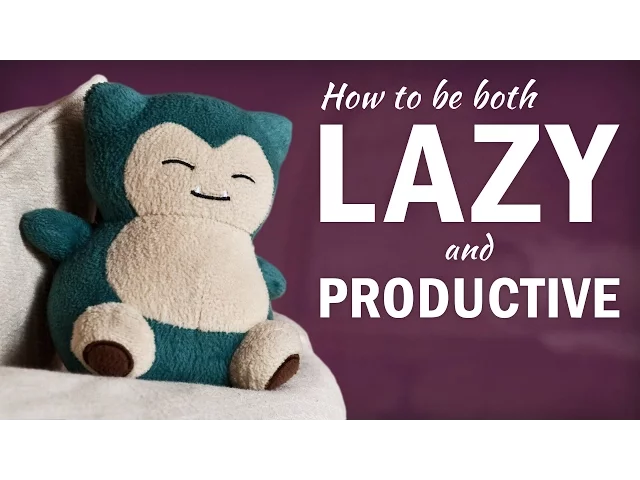
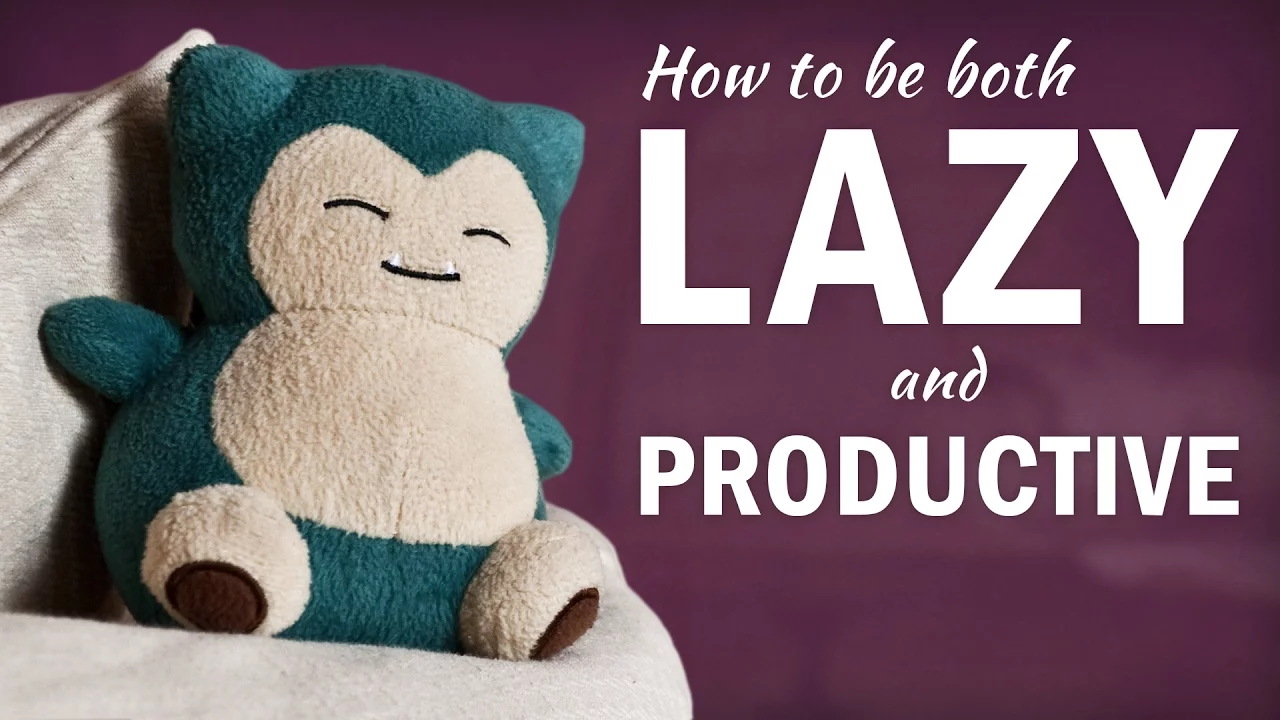
We live in a culture where it's basically the norm to be constantly busy, to have a million things going on. It's basically the mark of an ambitious person. So how in the heck can you get a ton of work done while also being lazy?
Seems like a paradox, right? Well, it's actually not a paradox, because being lazy is something you can do strategically and you do that by taking regular breaks throughout your day. Taking breaks is an absolutely vital part of keeping your brain healthy and able to produce great work.
(swooshing) They're like the yang to hard work's yin, like the necessary white space that enables great prose to be read on a printed page. By being a little bit lazy at regular intervals throughout your day, you enable yourself to work far more intensely and effectively during your actual work hours. As the writer Cal Newport put it in his excellent book, Deep Work, productivity really breaks down to a simple formula.
High-quality work produced is the product of time spent and intensity of focus. But when you don't use a little bit of this time for these pockets of laziness, you rob yourself of the ability to focus intensely at all. We often like to think of our brains as similar to computers, but this is one area where the two are vastly different.
See, computers are designed from the ground up to be able to run on a steady supply of power, of electricity. And in return, they can work pretty much ceaselessly and tirelessly. Aside from the occasional update or crash, a computer can work like a certain battery-powered bunny for hours and hours and keep on going without a break.
And we can't. You and I are both products of millions of years of evolution that is always dependent on a cycle of work and rest. Stressful exertion and relaxation, and this applies just as much to our brains as it does to our muscles and all the other parts of our bodies.
As the writer Joe Robinson put it, "The brain is usually seen as an ethereal realm that "exists apart from the body and the laws of physiology. "Yet gray matter tires well before the body does. "Since almost all of us are doing mental work these days, "managing cognitive resources is not "a nice thing to be able to do; it's essential.
" And to make sure you're managing those cognitive resources well, you need to build two types of breaks into your work schedule, tiny breaks and long breaks. Now, tiny breaks (swooshing sound) are those little five to ten minute breather sessions that just give you a chance to step back from your work for a little bit and get mentally refreshed. Whereas long breaks, (swooshing sound) just like they sound, are much longer periods of time, maybe thirty minutes or an hour, where you can completely disengage from your work and do basically whatever you want.
And like I said, if you wanna work with the utmost intensity when you're actually working, both these types of breaks deserve slots in your work schedule. And the following five tips will help you get the most out of both. (swooshing sound) My first tip has to do with your long breaks and it's to predetermine when (swooshing) they're gonna happen at the outset of your day when you're planning out everything you have to do.
And this has a lot of benefits that comes with it. Number one, when you're pre-planning your breaks, there's no ambiguity or guilt about when you should be working. You know exactly when you should be working and you know exactly when you should be on a break.
And you and I both know we've had these times where we're on YouTube maybe, or we're on Reddit or Twitter or just doing something that we know isn't work, and in the back of our minds, we're thinking, I should probably be working right now, right? Or you had this guilty feeling. Well, when you pre-plan your breaks, you basically know what you should be doing at all times and this guilt becomes erased.
And in addition to that, you're also gonna be more motivated and work more intensely during your actual work hours because the existence of a pre-planned break coming up in your near future is gonna create a little bit of time pressure. You know that your current work session is going to end according to your plan, so you're probably gonna work a little bit harder to try to finish whatever you're doing up before it actually does end. (swooshing sound) My second tip for you guys is to consider your tiny breaks to be breathers, little mental respites away from your work and in fact, away from all work.
And in fact, I think you should actually physically get up and get away from your workspace, all your books, your computers, your notebooks, and walk around. Go get a drink of water, go get a healthy snack if you're hungry, do some stretches. Basically, move about, amble about a little bit, talk to a friend and get some mental clarity.
Just basically disengage from all the work that you're doing. And that leads right into my third tip, which is what you should not do during your tiny breaks. I really, truly believe that you should not go on social media, should not go on distracting websites, and you should not check email or engage in other lower value work during your tiny breaks.
And there are a couple of different reasons to not do these things. The first one is to avoid accruing what a 2009 paper at the University of Minnesota (swooshing sound) coined attentional residue. And this concept describes what happens when people switch from one big task to another and then try to switch back to that main task.
Basically, by switching to another task, like your email or some other kind of work, you bring new ideas and new problems that weigh on your tension and take up working memory. And when you try to switch back to that main task, the really important one, those new ideas and new problems don't really go away. They kind of gunk up your working memory and they create this attentional residue and that can really lower your productivity and impede your ability to get back into the flow state.
(swooshing sound) Secondly, and this is something I probably don't have to tell you because you know just as well as I do from personal experience, social media and distracting websites can turn a five minute break into a 30 minute break. These sites are absolutely engineered, designed, honed, and tested to suck up as much of your attention and time as possible. That's what the entire YouTube algorithm is designed to do.
So if you expose your attention to these kind of sites during a five minute break, it's probably not gonna be five minutes. (swooshing sound) Okay, I'm gonna stop telling you what not to do and we're gonna get into the fourth tip now, which is to go for walks outside. And this is something that helps me more than almost anything else.
When I'm feeling mentally drained or when I'm feeling very unmotivated and I just can't get into the flow of my work, without fail, going outside and going for a walk always lifts my mood and helps me get back into the flow of work like nothing else can. The fact of the matter is our bodies and our brains are built from the ground up to move a lot and we're not adapted to sitting in chairs for eight hours and looking at squiggly lines on sheets of paper all day. So, when you need a break, get up and go outside and take a walk.
And I am far from the first person to advocate this. In fact, almost 2,000 years ago, the Roman philosopher Seneca (swooshing sound) once said, "It does good also to take walks outdoors, "that our spirits may be raised and refreshed "by the open air and fresh breeze. .
. " And he didn't know this at the time, but also you get Vitamin D. Furthermore, as Barbara Oakley points out in her book, A Mind for Numbers, taking walks is a great way to get your brain out of that focused mode of thinking and into the just as important diffused mode of thinking, where you can enlist a lot more of your subconscious resources to solve problems in ways that the focused mode can't.
Lots of great scientists and thinkers and adventurers over the years are famous for using this technique to make their breakthroughs. In fact, (swooshing sound) Charles Darwin would use a huge chunk of his workday to walk all around (swooshing sound) his property to mull over large problems that he couldn't solve while he was at his desk. So to sum up this particular tip and to put a bow on it, I think at least one of your breaks, every single day, should involve a walk (swooshing sound) that takes at a minimum 10 minutes to do.
If it's outside, that's awesome, but even if it's not, it's really cold, like it is for me, doing it inside has a lot of benefits. (swooshing sound) And that brings me to my final tip for you guys, which is to experiment with the time intervals between your work sessions and your tiny breaks. Cause there are a lot of systems out there that try to suggest the quote unquote best ones.
There's the Pomodoro Technique, which says you should work (swooshing sound) for 25 minutes and then take a break for five minutes. There's the Beeminder Tocks system, which is a 45 minute (swooshing sound) work session and a 15 minute break. And then there's the research done by the DeskTime time tracking app, which says that (swooshing sound) 52 minutes and then a 17 minute break is the optimal solution.
But, I really think that it's variable. Your ability to concentrate and focus on your work is like a muscle, it's like something that must be trained, like a skill. So, if you find yourself easily bored or easily distracted, start with something small, like the Pomodoro Technique.
But, if you are a productivity master, then maybe you could work for a full hour, and then take a 15 minute break, it's totally variable. So, if you found this video helpful, I would love it if you gave it a like to support this channel. And if you have additional suggestions or other ideas for taking effective breaks that I didn't cover here, I would love to hear about them down in the comments and I'm sure a lot of other people would as well.
(swooshing sound) Beyond that, if you're not already a subscriber to this channel and you wanna get new videos every single week on being a more effective student, you can click right there to subscribe and you can also click right there if you wanna get a free copy of my book on earning better grades. You can also click your mouse button right around there if you wanna watch another video. And other than that, I'm going on break.
See ya next week.