foreign have you ever been in a situation where you have received goods from A supplier but some of the goods were not up to scratch or have you ever sent an invoice to a customer but because you accidentally undercharged them you need to ask for more money situations like this happen sometimes in business and when they do customers and suppliers can use debit notes to sort things out so in this video we're going to take a look at a few situations in which debit notes are used to fix problems that happen between suppliers and their
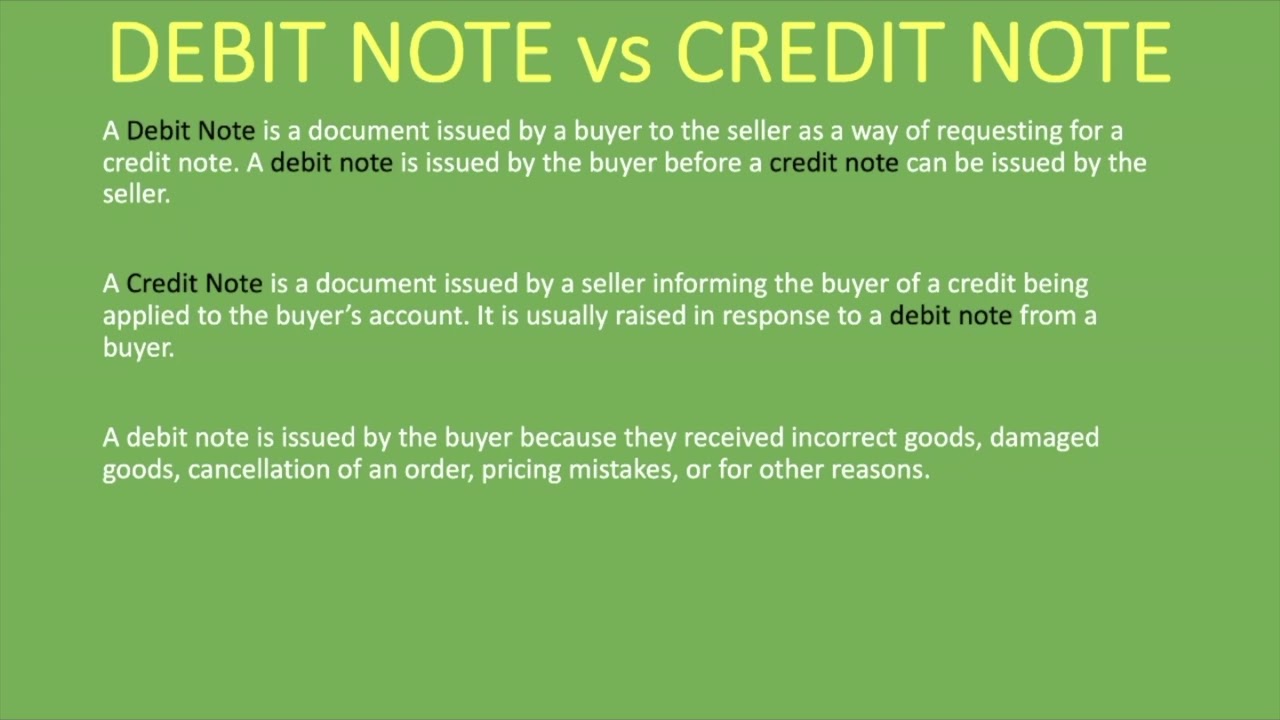
customers but before we do that let's take a quick look at what a debit note actually is a debit note is a document that is part of the purchasing process along with other documents such as quotes and invoices they are issued by either the supplier or the customer when one of the parties needs to make a debit entry into their accounts because something has gone wrong during the purchasing process with that in mind let's take a look at the two most common scenarios in which debit notes are issued in the first scenario the customer will
issue the debit note and in the second scenario the supplier will issue the debit note okay so in the first scenario a customer has purchased some goods from A supplier an invoice will be sent from the supplier to the customer at a later date after the customer receives and checks the goods upon checking the goods the customer notices that some of the items are faulty and need to be returned to the supplier because some of the goods are being returned the customer needs to request an amendment to the invoice equal to the value of the
goods being returned to do this the customer will create a debit note on their accounting system and send it to the supplier the supplier will then create a credit note in their accounting system and apply it to the invoice they're going to send to the customer this will effectively reduce the total amount payable on the invoice so the customer only pays for the goods that are not faulty for example if one thousand dollars of goods was delivered but two hundred dollars of these goods were faulty the customer would send the faulty Goods back to the
supplier along with a debit note of two hundred dollars the supplier would then create a two hundred dollar credit note on their accounting system and apply it to the invoice for this sale the supplier will send an invoice to the customer with a total amount payable of 800 which is the original one thousand dollars minus the two hundred dollar credit note it's worth noting that if the credit note could not be applied to the invoice for the current sale for some reason the customer and supplier could agree to apply it to a future invoice instead
if that was done in this example the supplier would send an invoice of one thousand dollars to the customer for this sale and reduce a future invoice by two hundred dollars so that's one of the two main scenarios in which debit notes are used and it involves a debit note being issued by a customer and sent to a supplier in the second scenario we're going to look at the supplier will issue the debit note and send it to the customer this usually happens when the supplier under charges their customer by accidentally sending them an invoice
for a lower amount than they should have in this case the supply will create a debit on their accounting system and send it to the customer as a debit note the customer will then either add the debit note to the incorrect invoice and pay the total amount or they will make separate payments for the debit note and the invoice for example if a supplier was supposed to send an invoice of 500 to a customer but they accidentally sent an invoice for only 450 the supplier could then create a debit note of fifty dollars and send
it to the customer the customer would then add the debit note to the outstanding invoice and pay the supplier five hundred dollars which is made up of the 450 invoice plus the 50 debit note it's worth noting that if the debit note could not be applied to the invoice for their current sale for some reason the supplier could agree that the customer can pay for the 50 debit note separately or add it to a future invoice so there you have it that's the two main reasons why debit notes are used in the purchasing process number
one to adjust an invoice when faulty Goods need to be returned to A supplier and number two to ask for more money when a supplier under charges a customer at this point you may be wondering why you would use debit notes at all instead of just deleting any incorrect invoices and sending out amended ones well this is because businesses are usually required to keep an accurate audit trail of their transactions if you receive faulty goods from A supplier and you delete the invoice they send you because you aren't going to pay the full amount that
may leave you with no evidence on record that you receive the faulty goods and you may need that evidence if there is a dispute a better idea is to keep the original invoice send a debit note and then keep both documents together in your system that way you have a proper audit Trail of the events that happened during the transaction and one last thing about debit notes and that is to make sure they contain lots of information about the supplier the customer and the transaction A good rule of thumb is to include similar information on
your debit notes that you include on your invoices such as business names address and contact details descriptions quantities and prices of goods and services and relevant tax amounts such as GST or vat the more information you include the better your audit Trail will be so that's it for debit notes and as you can see they can be created for a variety of reasons they can be for any amount and there is flexibility with how they are applied to current and future invoices if you would like to learn more about the purchasing process check out our
videos on credit notes invoices quotes and other related topics