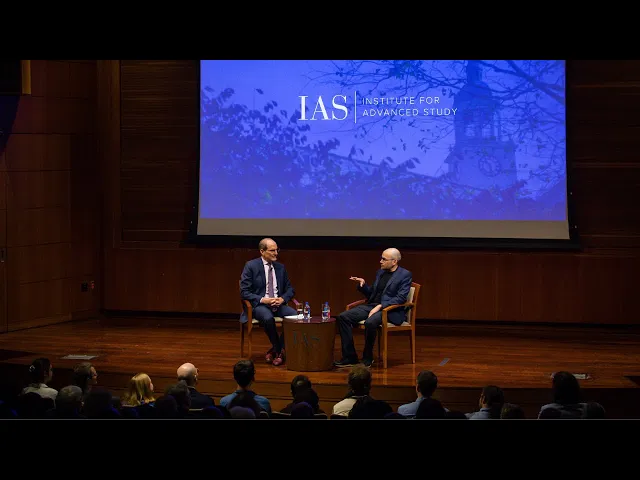
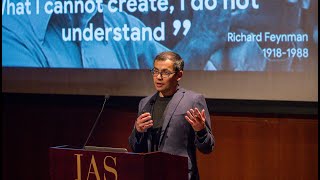
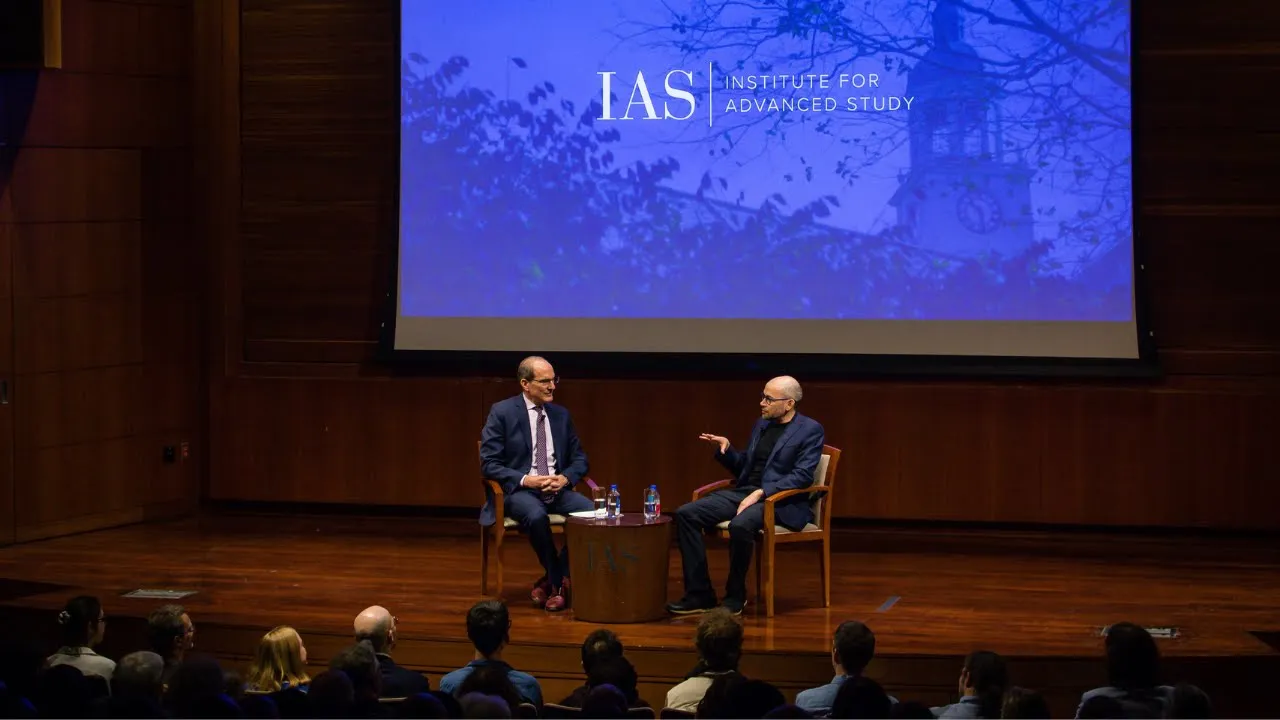
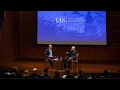
I'm David Nermberg, the Leon Levy Professor and Director of the Institute for Advanced Study, and it's my pleasure to invite you to this latest installment of our director's conversations on the place and practice of the arts and sciences in the past, present, and future of humanity. Now, so far in this series, we've discussed biography, universities, opera, museums, dance, and Philosophy. In those conversations, we've focused on how important forms of human discovery emerge, persist, and change. In part, we've done this to better understand the institute's own distinctive forms of discovery and what it can offer the
future. So today's conversation is about what is still for the moment a human form of discovery. That's a laugh line. Though its very names, artificial intelligence, machine learning, convey That it threatens to break the category. Our questions, what are the powers of computation? How do they work? What opportunities and perils do they offer? How will they transform human knowledge and indeed humanity? Those are some of the questions, the easy ones that we're counting on our distinguished guest, Sir Deis Hassabis to answer for us. Now, the institute and its faculty have been thinking about these questions
for almost a century. the pioneering Programmable computer that John Fonoyman built here and established Fonoyman architecture as the standard for computing operations well into the 21st century seemed to him just as transformative as the atomic and hydrogen bombs he also contributed to what we are creating now he said to his wife Clary after returning home from some bomb work at Los Alamos this is a quote you can usually tell the difference between Fonoyman's voice and Mine or Oenheimer's voice in mind is a monster whose influence is going to change history provided there is any history
left. He then changed the subject to the computing machine he was conceiving at the time and became even more agitated according to Clary in her biography foreseeing disaster if quote people could not keep pace with what they create. She had to give him a handful of sleeping pills and two whisies to calm him down. As you all know from Christopher Nolan, Robert Oppenheimer, the institute's director from 1947 to 1966, shared Fonoyman's agitation and also his um affection for drink. He believed, although he favored Martineis, he believed that quote, "The safety of a nation or the
world cannot lie wholly or even primarily in scientific or technical prowess, but also requires attention to ethics, values, forms of political and social Organization, feelings, emotions. He sought to make the institute a place where these many forms of discovery and thought could come into contact with the goal of preserving humanity much as we do today. The list of people he brought as part of his efforts is astounding across all disciplines, physics of course, but also poetry and politics and psychology. And that's just the P's. Now, not all of those disciplines are present at the institute
today. I don't Think we have any full-time poets, for example, but our current faculty is just as dedicated to the task of bringing its different methodologies to bear in its exploration of the possibilities of thought and of humanity. All this is to say that Oppenheimer Fenoyman and all of their institute colleagues would very much wish that they could be present this evening to hear from Sir Dennis Hassabis the CEO and co-founder of Google DeepMind 2024 Nobel Prize laurate In chemistry and a scholar who is not only a leader of what may prove to be one
of the most significant technological transformations in the history of human knowledge but also an eloquent herald of the need to attend to the consequences es of those transformations for humanity. I hesitate to plunge into Sir Demis' list of accomplishments. From his prodigious achievements as a child in chess to his co-creation as a teenager of one of the Most popular and influential computer simulation games of the 1990s theme park to his influential doctoral work in the neuroscience of memory and imagination to his founding of deep mind in 2010 to solve the quote problem of intelligence with
the intent upon solving it of using it to quote solve everything else. Deep Mind's breakthroughs in artificial intelligence are justly famous. Among them, Alph Go, the first program to beat the world champion at the game of Go, And Alpha Fold, which cracked the 50-year grand challenge of protein structure prediction, and has inspired his recent launch of a sister company, Isomorphic Labs, to propel drug discovery. But I'm not going to go further. Not only because a list of achievements is so long and for a still too brief glimpse you can look in your programs but also
because Sir Demis's biography is so astounding that you might mistake it for fiction and me for A fabulist if I continued. In fact the writer Benjamin Labatut has already produced such a fiction. His recent novel, The Maniac, is a fictional biography of John Fonoyman and his ideas, exploring how those ideas have unmurreded the world. The Maniac concludes with a biography, fictional, I don't know. We can ask Sir Demis. Uh, and an account, a biography of Sir Demis entitled Brainchild and an account of Alph Go that depicts the powers of that Program as a terrifying game
over for humanity. So without further ado, please join me in welcoming Sir Deis Hassavves to the institute stage. If I might start with the most human of topics, your biography. I've I've read in several places that your move into uh into intelligence uh into artificial intelligence began with an epiphany you had as a 13year-old when you ran out of the European chess championships thinking zero sum games are too simple. I want to work on intelligence. Um is this is this uh true? Well and actually why don't you just tell us your entire biographical arc? You
have you have uh well look first of all thank you David for that wonderful introduction and um it's it's amazing to be here it's one of my favorite places in the world to spend time at uh I think it's a unique place for many reasons maybe we'll discuss that later on but I love the Multi-disiplinary nature of IAS and I think it's a very important plays important part in the world and of course the history of it is so inspiring and you feel that just walking around the ground so it's it's wonderful to be back
here um as to, you know, how I got started in AI. Um, I I really it really began with games for me actually. Um, as with a lot of the the the the legends here like vonoman of course and so on. Um, started with chess. Uh, and really I Started playing when I was four years old and very seriously and I was going to become a professional chess player. Um, but really it got me thinking about the the about the process of thinking. So, as when you're a kid and you're trying, you know, playing for
the England junior teams and so on, you're trying to improve your own thought processes, your own decision-m. So, you really end up, or at least I did, examining um what goes into those Thought processes and then becoming fascinated by that. Um and then very shortly later around about 8 n years old, um the first chess computers started arriving and when we would go to training camps, uh with the England team, they would pull the these chess computers out. And if you remember, this is sort of in the 80s now. They were physical chessboards, right? They
they were where you press down the the the key the LED squares and that's how you Move the pieces. And of course, we were supposed to be me and the other the rest of the team, we were supposed to be training on chess openings and other things. But I remember distinctly being much more fascinated by the idea that this lump of inanimate plastic, someone had programmed this to play chess at this very high level. And I actually found that more intriguing than I guess the chess I was supposed to be studying. And um and and
I found that fascinating. And then, you know, with some early winnings from some chess tournaments, I bought my first home computer in in the UK. There was a big uh home computer hobby boom. It was ZedX Spectrum and then a Commodore Amigga. And that's when I started um programming. And then really my love of computers and games came together. uh uh as you say my first professional career designing computer games and programming them but all the games I made like theme park they had AI As the core gameplay component. So they were simulation games usually
with intelligent characters that had to react to um the way the player played and that's why the the games I some of the games I worked on became very successful because every player had an individual experience different experience with the game because the game adapted to how you played it with it. Now, obviously, this is the '9s, so it's very rudimentary AI, but it already convinced me how powerful AI would be if we could um uh uh uh you know, scale it up and get it to the point where we see today um how incredible
a tool and a technology it would be. It was obvious to me already when you know I was sort of um in my early teens. You just presented games as flowing out of your biography. It began as a child etc. and and you pointed to the fact that people like John Fonoyman put games at the very center of their thinking About thinking too not only in his early essay theory of parlor games but also in the famous um uh theory of games and economic behavior which he wrote here with Oscar Morgan Stern. Uh so using
certain approach to games to model human behavior. What is it about these kinds of games the zero sum games that you abandoned at age 13 according to the uh epiphany that makes them so good such good test cases for well look I I think if you actually the history of AI and Games has been intertwined from the very beginning right as you say with the sort of founding fathers of it like like vonoman Claude Shannon um Turing many of the people that have come through this place they all actually tried their hand at writing chess
computers uh obviously very rudimentary ones very famously chewing wrote a program but there was no computer available at the time that could run his program so he had to run it with his mind and uh I think it took Like two days or something to to to play the game um and I think the reason is is because uh it's you know games are kind of microcosms of interesting parts of life that's why we as human designers have designed those games that's why we're fascinated by things like chess and go and poker they encapsulate some
aspect of life in a very um convenient form one would say. So convenient and fun and challenging. So we've designed these games and we play these games Because of all those reasons. Um but that's also why they're really well suited I think to to AI development because um uh they are these microcosms of human thought uh which do represent something about our culture. you know, one of my favorite books is Homoludans. Uh, and that really argues about, you know, the idea that, um, in some sense we're games playing, uh, animals, right? That's what we do.
I mean, we're tool making and games playing are two of the Kind of traits that that that, um, society and humans have. And so, it's pretty fundamental, I think. Uh, and I love all games. I started with chess. I ended up playing many, many games. Um, because actually, I think it's another way, just like language, to get to the heart of a culture. So, you know, in terms of go, it's what they play in Japan and China and Korea. In Asia, it sort of occupies the echelon. Chess does in the west. And you can really
um get Deep into uh uh what a culture really thinks about things. It's sort of embodied into their games. Um including the way they think about strategy, warfare, all of these things are embodied in some of the rules of these games. So, it's a fascinating thing for AI then to try and uh uh uh for us to try and build. And then the other reason that it's convenient, why we used it at the start of DeepMind is that you can generate um as much data as you want Because you can have the system play against
itself and generate effectively uh a lot of synthetic data which you can then learn from. Uh and it also has very clear metrics, wind conditions, maximizing the score. So that's also very useful from an AI perspective to kind of um optimize against. I never thought I am a medieval historian. His Singinga the author of Homoludin medievalist and here in a conversation on AI you get a a medieval book about The middle ages. Um Homoludin points out though there there are many different kinds of games. There are zero sum games, competitive games, winner take all. There
are also games that are just um imagination games, charades. Mhm. Uh I imagine that there's a reason why it's the zero sum games and the more rule governed creativity games that have been so useful for the early successes of AI. Is charades a harder challenge? And if that's the case, what Does it tell us about human thinking and about the relationship between computer thought, human thought? Yeah, I mean look, the only reason that I think zero sum games are are were more useful in the early stages of AI development is um the metrics are clearer
than an open-ended game necessarily, right? or a cooperative game, it's usually easier to specify, you know, there's the win condition or you know the these kinds of things are normally easier to specify in Zero sum games. The other thing is the other big distinction is things like perfect information games like chess versus hidden information like poker which is harder. Of course, the real world is more like poker. that's hidden information and I think um uh so we ended have to generalize to those you know the wide set of games and I think at this point
we're able to play certainly any two-player um perfect information game but actually wider than That um towards you know poke there's there's good programs now for poker and and these and these sorts of other more challenging games now when you say sherads and other things then of course then the system has to understand uh uh the physics of the world and visuals and um become multimodal and actually the sorts of systems we build today so you know our latest foundation models you know called Gemini they were built to be multimodal from the beginning so what
That means is they don't just deal with text or mathematics or code but also video images and they can understand uh things like intuitive physics about uh you know something going on in a video so actually I think with our latest systems some of our prototype systems we call them project Astra would be able to be reasonably good at something like charades So I was I'm going to ask you a series of questions about how you pick the Problems you work on because this is quite striking. You've chosen very different problems and had such tremendous
success across different kinds of problems and you just I think gave part of the answer which is benchmarks clear benchmarks matter um but so you almost immediately like the day AlphaGo defeated Lee Sedol and soul you started hiring biologists uh for Alpha Fold. So can you tell us what what was it what characteristics made that The problem you had decided to focus on? So so games was never an end in itself right it was a it was it was a sort of means to an end. So we wanted to build as you read out our
original mission statement from deep mind you know these general learning systems that could generalize and then help solve really challenging real world problems that matter. So games were the kind of on-ramp to develop those types of general algorithms. But we were only Interested in developing algorithms that not just were good at the game, but actually we thought could generalize. So there was no point building like an expert system like deep blue to just win at chess because it would it was not generalizable to anything else. And the anything else part what I had in mind
was science specifically science, medicine, mathematics, advancing human knowledge with these AI systems. Um going back to my childhood you know Other than apart from um my you know obsession and professional training in games and then also uh loving computers the other thing I was fascinated about was all the biggest questions. So I I'd voraciously read you know both sci-fi but also biographies of of the great scientists and books on them. Richard Feman was one of my all-time heroes and um trying I'm just sort of was fascinated by perhaps you could say obsessed by the biggest
questions you Know and obviously like you know things like the nature of reality nature of consciousness um uh unified theory of physics so physics was my favorite subject but when I at school but when I was reading some of the grades like you know Fman or Steven Weinberg dreams of a final theory I sort of maybe took the opposite inspiration from some of those books which was that tremendous progress had been made um many of the people here from who you know affiliated with the Institute in the maybe the 40s the the 50s60s and so
on but actually if you look later in the 80s and '9s had we made much progress towards uh this unified theory and maybe the people would disagree with me in the audience but but I I I actually felt from reading Steven Weinberg's book that that we sort of hadn't it was a little bit disappointing relative to the the the amazing work that we done in the early part of the century and then I was Thinking through why that is And um I was thinking even if you were very lucky and you studied hard and um
you know maybe one could could could uh do the sorts of things that you know you know one could only dream about being someone like Richard Feman or with his genius. And even yet there was still so much we didn't know or we wouldn't be able to know even with th those kinds of minds working on it. So I sort of thought well maybe a better option would be to build A tool that could help us um and help the best scientists in the world including myself make those discoveries. And for me it was obvious
when I started thinking through this you know I must have been I don't know 13 14 that um it that that that uh that would be maybe the best way to make the fastest progress towards all these big questions that the the great physicists and and mathematicians had been thinking about for for centuries. Um and then Additionally to that it's a fascinating topic in itself a fascinating intellectual pursuit in itself the building of an intelligent artifact. Uh the distillation of intelligence into a machine then comparing it to another great mystery which is the workings of
the human mind and the nature of consciousness. And it also felt to me and I did obviously I did a degree in neuroscience and computer science is that um I always felt that trying to Build an intelligent artifact and then being able to deconstruct that with the scientific method and comparing it to the human brain will tell us a lot about what's special or not about the the the human mind. I'm going to ask a question that's um maybe a little political but uh Alphafold used as its training set about a 100,000 known structures in
the protein structure datab bank and those known structures were were determined by Basically protein one protein per dissertation by many many many many graduate students and then uh scientists u mostly funded by large public investments Think National Science Foundation. Think National Institute u for Health. Alphafold has since done approximately the equivalent of 1 billion graduate student years uh of of protein structure determination in what two three years but its initial training set was the product of that Human capital investment. And I wonder as we go up the biological complexity ladder where we don't have good
training sets um beyond the genome beyond proteins are you worried that uh that the kind of public investment in science necessary to create those kinds of training sets won't be in place or do you think that AI will be able to simulate its way to that kind of training set? Look, it was incredibly important that that that we built on 50 Years worth of um structural biologist painstaking experimental work to create those 150,000 roughly structures in the PDB. Um it actually was actually we were only just about had enough uh data because turned out that
wasn't enough on its own. the 150,000 we actually had to create an earlier version of Alphafold that predicted you know nearly a million structures and then we had to triage that for the you know the most accurate 300,000 or so and put that back into the Into the training set. So we actually added some synthetic data into the training um and I do worry about that and there aren't many problems where that of that sort of uh importance that have that cleaner data set to work from and that was one of the reasons we I
picked protein folding and had that in mind. And I think you asked that question actually earlier of um I because I knew I was going to work on AI my whole career no matter what from an Early age and then I wanted to apply it to the sciences. I've been collecting over my sort of career like in when I bump into and I love multi-disiplinary environments like the IAS and I've and our deep mind is one of those environments and I've always tried to work in those kind of environments and not just with technologists but
also artists and designers and those things and that's one of the great trainings computer game design does because you Work with artists, engineers, u musicians and so on all together. It's a really amazing creative endeavor at the highest level and with um the problems you know you want three things that if you step back at what what our systems all our alpha x systems do alpha go alpha forward and so on the way you can generally think of them is you have some data hopefully a lot of data um maybe you supplement it with some
simulated data some synthetic data but you usually Need some real data in order to create the simulation in the first place and to also make sure that your simulation or your synthetic data the distribution coming out of that is matching to the real distribution. So otherwise, you know, you're you're potentially compounding some bias or some error in your data set. So you usually need some some real world data. You also need um uh to have a clear metric. Going back to metrics and games have clear ones, but a Lot of things in science do too
if you think about it in the right way. Minimizing the free energy in the system. Um uh uh you know there's all sorts of ways of thinking about uh uh metrics that you can hill climb against with a lot of natural problems. Um and then finally you you know we really like uh problems which can be described as massive combinatorial spaces. So generally speaking too many options too many possibilities to do. So brute force Methods brute force search for example would not work in those uh in those uh kinds of problem spaces. And then that
makes it if all those things hold true um that makes it really interesting for the sorts of techniques that we have which you can think of as building a model and your network model of um the problem space based on the data um whether that's go or protein structures uh and then using that model to guide an intelligent search process you know Whether that's Monte Carlo true search or you know reinforcement learning all these things in order to um tractably find the needle in the haystack solution. that optimizes your metric. So that's basically it. That's
what all of these systems do at their heart. And it but it's actually extremely turns out if it's quite a general solution to a lot of problems that can be couched in that way even for math. So that's u you've You've you've turned your attention and Google and DeepMind has turned its attention to to AI for math and in fact much of the Google AI for math team is here. Welcome. they've been coh collaborating with the institute and with the the local community of mathematics for the week and we're very happy we're here. I guess
my question is what what makes this area you've just described the three three things that make a problem interesting to you and I'm wondering um how math fits in what makes that an interesting area and then I then I might ask later how is it different from yeah so if you look at some of our math our math programs like alpha proof you know they they basically it's the way I think of it at least and and and different people on the team think of it in different ways but a lot of the team actually
had did work on things like alpha go and alpha zero as well. And if you think about um trying To solve a maths conjecture or something like that, um you know, one way you can think about it is that you have some equation or some formula you're trying to um you know, trying to optimize or reduce down um and find a solution to some problem and you can adjust that formula in some way as the next step. And you can almost think about that as the next move in a game. and you're trying you have
some metric you're trying to reach uh or you're trying to Optimize about the elegance of that or what it can describe as your sort of guiding goal for where it's going to go to. Um and it feels like it's it's quite sort of um isomorphic to the kind of things that we're able to do. And you the other advantage on things like maths and coding is you can generate a lot of synthetic data because one can verify the the answer. So you can actually you know so that's quite useful in areas of synthetic data is
checking whether that Data uh really is accurate uh that you've generated. So um and that's also very similar to games and also coding where you can verify the end position you know who's won the game uh or the value of the pos you know the different sides in the game uh who's winning. Um these are pretty precise things that you can accurately compare your predictions against the outcome. Um and so math has uh some of those properties too, at least some of the equations and and so You know I think we are building systems now
that are capable of solving pretty hard problems. Uh we're using formal uh logic uh languages like lean. So there's a sort of translation process. Can you convert a you know a math problem that's maybe described in in natural language into a formal uh formalized version of that problem and then you can uh use the rules of that formalized logic to try to make progress. I think many of our colleagues are in in In in mathematics are thinking what what will the powers of AI be in math and also will there be areas of mathematics that
remain more human and areas that are more susceptible to AI approaches and I think that's a burning question uh for mathematicians but also for all of us and that was the a year ago you told me that if you ever got a sbatical again likelihood probably not that likely but we'll see you said after you done? Yeah. If you Ever got a sabbatical, you'd like to spend it at the institute working on the P equal NP or P versus NP problem. Now, I'm not going to ask you why the institute because the answer to that
is obvious. And uh and I won't name check all the colleagues we have here who make it a good place uh for such a thing, but I did want to ask you why P versus NP. What could you explain that problem to us and why you find it? So, well, look, it's I think it's, you know, it's one of The Millennium Prize problems. It's always been the most fascinating problem to me in in sort of you know computer science uh and applied mathematics let's say. So I think gets to the heart of of of um
computation what is possible on classical machines right sort of the P of that P equals MP right so the P the things that are you know problems that you can categorize in P what that means is stands a polomial means it can actually be solved in some sort of Tractable amount of time and then the ones in NP you can think of as they're sort of not possible not tractable to solve in some reasonable amount of time at least on a classical computer and um it's always fascinating to me and it's increasingly become fascinating to
me. So I I you know I've loved it since my undergrad. Uh and I think it's a fundamental core foundational question actually. Um and I think we've been investigating in our own way because one Of the things you can think of what we've done with deep mind and I would say my whole career is I sort of think of ourselves as Alan Turing's champion. So you know cheuring and and Alonzo Church and many others uh also affiliated here you know they came up with these ideas of cheuring machines uh the church thesis you know all
of these things that are important about what you computation is um you know foundations of computer science and what is possible To compute. uh and of course Turing famously uh invented the Turing machines and he showed that they could compute anything that was computable and therefore anything that was uh could mimic a Turing machine or approximate cheering machine was also cheuring powerful and um and I think what we've shown in the last um you know 15 20 years as a field and also the work that we through the work we've done is that classical uh
methods and classical Comput running on classical computers can go a lot further than perhaps we previously thought, you know, and do things like beat the world champion a go or um fold, you know, every protein known to science uh within a year. And so these are kind of pretty amazing things that would have surprised very very smart people. You know, I remember I'm struck with I I've had quite a few conversations with people like Roger Penrose about this. Um you know, Obviously he was a big advocate of something something quantum going on in the brain
and quantum consciousness and things like this. And um and he told me he was surprised by Alph Go as a result, right? He he would not have predicted that we could create systems that um could, you know, beat the best humans at Go. Classical systems. Yeah. Classical systems, you know, maybe you need a quantum system or something like that. And so I think when someone like that Says that to you, he's thought about this for a long time, you know, one has to really think through like when you step back again like what does these
systems mean having these systems? And we've had some interesting lunchtime discussions today. And that's the thing I would work on if I was here and I had the the luxury of, you know, a summer in this amazing inspiring place to to think about things is try to make progress with what what what is it that we've Done and how does it affect uh this fundamental question about P equals NP. Well, I uh I have to uh plug the institute. So I I I meant I gave Dennis this morning a copy of the letter that Good
wrote to Fonoyman in 1956 when Fonoyman was dying. And good begins the letter by saying I hear you're getting better. I'm so happy to hear. And then he plunges right into in a typical institute way a mathematical question or a sign a question about knowledge and he Proposes it's the first the first proposal of P uh equal or or not equal NP. Um, unfortunately, Fenoyman never wrote a response. If he had, it would be like Ferba's last theorem. But so we we won't welcome you when your sobatical comes. Yes. In your Nobel lecture, you proposed
a conjecture yourself. Um, I think we we we could have it up here. Yeah. Um, any pattern that can be generated or found in nature can be efficiently Discovered and modeled by a classical learning algorithm which grows what out of what you were just saying. So what what's prompted you to think about this particular conjecture and what are its potential implications? Yeah, I would say it's still it's still in the formative stage. This is an early version of it may change but but but it's it's my first sort of um I guess attempt at trying
to categorize um uh what these class of systems are able to Do and and going back to my description of how I pick problems and why protein folding then became sort of top of the pile for me you know um so I I I came across protein folding actually as an undergrad uh in Cambridge in the 90s and one of my biologist friends was obsessed with protein folding, still works on structural biology today in Cambridge. And um he was always going on about it in the in the bars, you know, playing table football or pool
or something and He'd be going on about how revolution this would be and it should be possible. And I just listened to him quite carefully as as I tried to do and I sort of realized first of all it would be really foundational and it would unlock so many new branches of research like drug discovery and so on. So it' be a really impactful breakthrough as well as to fundamental research. But it also struck me as the type of problem even though we didn't I didn't we didn't have The type of AI we have today
wasn't even invented then that one day it felt like this incredible like ultimate jigsaw puzzle or something right like to figure out of all the possible configurations a protein shapes a protein could take you know some people estimated 10 to the^ 300 for an average protein is the number of different shapes it could take and that somehow in nature spontaneously in in in milliseconds in your body, it folds up into this intricate 3D shape That determines its function. So, it seemed like a fascinating problem, but also one maybe suited to, you know, a future sort
of AI approach. So, I carried that around with me for, I guess, nearly 20 years until we did Alph Go. And then, as you said, the day after Alph Go, I felt we'd reached the pinnacle of games AI. That was always the holy grail is like can you build a system that's learning that's general to to to win at go the most complex game We've ever invented. Uh and not only did it win it also invented new strategies uh new go strategies that had never seen before even though we played go for hundreds of years.
And then that to me was the signal that we now have enough interesting algorithms we can apply it to science which was always the real goal right and then and then protein folding as the first big problem we tackled. Um so going back to this conjecture then and taking again Together the the description I gave you about the the model uh you have some massive combinatorial problem you can't brute force it it's too big um uh on a classical system so one has to learn a model of it and then the model if it's accurate
will guide your search okay so that's the basics of what we I it's the most basic way I can describe what we've done and so then why is this this important then is my I guess what this behind this conject ure is um my sort of Proposal is that most interesting things in nature most natural systems have gone through some kind of process of evolution and I mean that very generally I don't mean just life but I mean it could be geological weathering could be even cosmological you know the shapes of planets and what the
orbits and things like that they they've they've become stable over time right um they've survived sort of spatial temporal stability otherwise they wouldn't exist As entities um and that means means there is some structure there that um is you know not random that is uh not uniform that one can perhaps learn given enough examples. So this should probably have a caveat of given given sufficient data and to a certain level of resolution um then that might it might be possible to build a model of that natural system in which case um if you're trying to
find a particular state that it's in or particular solution to Some problem within that natural system you know the classic needle in the haystack uh type of um uh uh uh solution that you need then uh these kinds of systems that I'm describing uh may be suitable to do that. Um and you know some of the other things that we're working on and I think could be possible are for example finding uh room temperature superconductor material assuming that exists in physics. One of these types of processes might be able To do that. Another example is
what we're doing in drug discovery. Now we know the structure of the protein. Can you design a compound uh that binds to the right part of the protein but to nothing else in the body? because if it binds into anything else then that's like toxicity. So you don't want that. So we're building you know in in in our spin our sister company isomorphic we're building uh more alphafold like technologies to do these other parts of Drug discovery. And so all of those things I think you can frame in terms of this um smart guided search
through an enormous space. Um, and you know, I think this we'll we'll see. I want to work on on this conjecture, refining it and and making it uh perhaps making it more mathematically precise over the next few years. Oh, so even before a sobatical. Yeah. Well, ideally a sbatical would help, but uh maybe in my spare time at, you know, 3:00 a.m. I mean, one of the things that makes the conjecture so plausible is the astounding success of neural networks in addressing problems that were thought to be from a point of computational complexity point of
view very difficult. Yes. Did that success surprise you? And if not, or either way, how do you account for it? And just asking for a friend, what's a neural network? Well, yeah, we'll come back to it when you run out in a second. But I think the The the what's surprising is um so in some ways I'm not surprised because this was the whole point of the attempt of what we were trying to do to build these general learning systems. Why would there why would you even have hope that this could be possible? Okay, so
well that's where my neuroscience background comes in because um and again with Turing machines. So Turing proved the his his proofs about Turing machines. As far as we know through neuroscience, Although people like Penrose would disagree, there is nothing non-class going on in the brain, right? No, at least no one's found anything. You know, Stuart Hammeroff and other big biologists have looked for quantum effects in the brain. They don't appear to be there. So my our best guess and my best guess is that we're we're also classical systems and um and yet we're seem extremely
general. uh I mean cheuring with his mind came up with Chewing machines and the whole theory of that. So, you know, it's it's a type of, you know, one can think of as a type of chewing machine. And yet, we're able to do amazing things, including science, mathematics, chess, go, invent all of these things, the modern world, which is pretty astounding with our huntergatherer brains. I don't think we stop to think about how amazing that is enough times. I do that every time I come over on a se, you know, Transatlantic flight. How have we
built these 747 planes with our monkey brains? It's it's astounding. And then you fly over Manhattan and it's like you think back to 20,000 years ago what that would have been. And then you tell the hunter gatherer, you know, person going to be Manhattan here in 10,000 years. And the same brain is going to produce and the same brain is basically the same brain is going to deal with it. Brain plus culture extremely adaptable. Yeah. But that's but culture is the is the is the is the output of collective our collective brains, right? It's not
it's not magic. So it's pretty astounding and it also I think speaks to the extreme generality of our minds our human minds and um and so you know it's a really interesting uh problem that so the brain does this so and the tr we know about chewing machines so if we can mimic that uh I don't know necessarily What the limit is of what they may what is the limit I think it's a very interesting question of what a chewing machine can actually find out and I think we're going to that's what I'd like to
find out well if it's a conjecture then maybe no limit there. Well, there may be no no natural limit but of course there could be um there could be human created abstractions. So this doesn't mean it could describe uh everything in mathematics or random Noise or things like that because or you know maybe not even factoriize large numbers because um there has to be a pattern or that that a model can efficiently learn otherwise you can't guide the search. If it's truly uniform or random, then you would then then you have no alternative but to
brute force it and then a classical system can't work. You need a quantum system, right? Yes. But it's also what the what our quantum computing colleagues they're Working on because then you would need a quantum computer. Um you've been uh talking so far about systems you've built that are really modal. They're for AI for science. for a specific problem of specific uh uh approach but the media seem more focused on large language models and artificial general intelligence and you're leading work on on that sort of model as well. Can you talk about the differences and
the challenges and opportunities you see Between the modal and multimodal? So, so deep mind started with the idea and we and still continues now as Google deep mind with we we want to build AGI right that's the aim these this general system that can exhibit all the capabilities cognitive capabilities humans uh can and that's important because of all the things we've just discussed that's the only way obviously would have m massive economic value but actually that's not the interesting thing about it from my Perspective it's more from a theoretical standpoint that's when we would know
we would have a fully general system right at least an approximation to it if it can do things the human mind can do because as far as we know you know we're this generalized intelligence. Um so you know that's that's that's the main um uh aim of of deep mind has always been and language and general knowledge about the world is incredibly important. So we talk about it as building a world model. So we've talked about lots of model building. We started with building models of computer games like Atari games. Then we built models of
go and then we're now building models of scientific uh environments. Um but ultimately you want a world model. So a model that can simulate things in the world um and intuitive physics, how uh vis you know the the the the spatial context that you're in and break that down uh and and other you know things That you know object recognition all of these things that we do effortlessly as humans. And um traditionally that's been really hard for machines to do right to build these kind of predictive world models. And actually that's what I studied for
my PhD was the imagination part. So I studied memory and imagination and and showed the imagination dependent on the hippocampus just like memory and because I thought that you know was thinking of memory as A reconstructive process. You know it's not a videotape memory. It's it's it's reconstructed from its components. And then I thought if that's true then then it should rely on the same brain process imagination which is constructing things as well from components that you've learned but in a novel way versus a way that you recognize which is the purpose of memory um
should use the same processes. So we have all sorts of mental simulations and mental models in Our mind and very complicated ones including theory of mind and theory of other people and what they're going to do in in a situation right and that's what we do to plan all the time. Imagine you have a important business meeting or interview you know next week you know you're going to have a lunch with someone important you rehearse it in your mind like what am I going to say what am I going to talk about how might it
go you you can plan ahead use the Mental simulation to plan ahead and probably that's why evolutionary it it it came about because it's useful for survival and planning and um and I think in the same way we would like machines our AI systems to have that capability to truly be able to to now guided planning in the real world, right? And and that's what you're going to need if you want something like robotics to work or um uh uh uh what we sometimes call universal digital assistant. So you Imagine an assistant that's extremely useful
in your everyday life and helps you with admin and enriches your life with recommendations. Yeah. So then then you know you could imagine it's on your phone or on glasses that and it needs to understand to really be a good assistant. it would need to understand the context that you're in and understand the world around you and we're very very close to doing that uh with our project Astra program and um Even very recently we've we created models our main set of models is called Gemini most powerful models in the world now but we also
have side projects uh where like VO there's a sort of chewing test of videos which is a funny one that you'll you'll find amusing if you're not in the field which is like can you uh generate a video 10-second video of a person chopping a tomato on a chopping board Okay. And and I'm proud to say VO does it really well, but the thing that Happens if the early video ones, you know, the kn the tomato would spontaneously come back together or the, you know, the knife would sort of disconnect from the handle or, you
know, go through the fingers or something and then match back in. But now our one does it perfectly. But if you actually think about that, you're generating that at pixel level and somehow you're keeping the consistency of slices and they don't reform tom, you know, round tomatoes, Little little water drops on the tomato. what a knife is. I mean, it's it just kind of astounds me that it can actually understand something about the intuitive physics of the world. Um, actually just by observation. I I would have said 10 years ago it needs to act in
the world. Maybe you need a robot to actually feel physics and do physics like like we do, you know, like the Well, yes. The the the weight of this, what will happen when it when I if I if I push it over Here, it will smash. Actually, our systems can predict that now. And very soon they'll be able to generate the image of that. It's just pretty it's pretty amazing if you think about what's going on. So now I'm gonna ask a question out of concern for all this uh progress. Uh you speak with real
fondness. You you've done it already today about your experience at Cambridge a university and touring in Babage. I think you um you Associated touring with Cambridge but forgot Princeton. I'm claiming it for Cambridge. Yeah. uh today people like you working in AI are not primarily working at Cambridge or places like the institute you're working at uh Google deep mind or should I mention competitors open AI anthropic meta etc etc um so what are the reasons for that shift and does it have consequences for the nature of the knowledge being produced So I think the reason
there's been the shift in that is because of um well several things. One reason I started DeepMind and I didn't do that in academia was because I knew um from my games background and working in games companies and starting my own games company when when I was younger that the the speed at which one could get resources and also therefore make progress um you could do that faster in a company. You know I used to say to my My one of my co-founders Shane leg we were both at the at UCL as postocs at the
time you know he wanted to do it in academia but I said that it's going to you know we'll be like 50 actually sadly the age I'm sort of out now before they give us any resources to you know to actually pursue this right when this is when we were in our late 20s and early 30s and I thought like we can accelerate it 10x so one is speed you know not having to deal with bureaucracy and Other things when you're a startup um obviously big companies also have their own bureaucracy. So um so there's
you have to overcome that. But the main reason is it's turned out the way AI has gone is it needs a lot of resources. Um mostly compute. It's not really data actually because we're mostly using the open web which everyone can access. But it's just compute power for the way that the scaling has gone and it's become quite engineering heavy. Um having said That what what I would what I suggest to my colleagues in academia and we talked about this earlier is there are many things that academia should be doing orthogonal to that. So don't
try and build, you know, places like us, we're spending billions of dollars to build the machines to then with amazing engineers, world-class engineers and research to build these Gemini foundation, you know, top foundation models, but they're available for Pennies on the dollar, you know, for anyone to run. There's actually very good open- source models. So you could do a lot of experiments very cheaply with the models to but to go further in terms of like understanding what they do, interpreting what they do, maybe building benchmarks to constrain the behavior of it. We're in desperate need
as a field and I think as the world for better understanding these models now of course companies are doing this too. We Have we have very smart divisions and groups working on this but uh we're also building the models and that that is the main track of of of what industry is doing. So I think academia, civil society should be um figuring out what happens next in a way, not chasing after what the company's already doing. Just utilize all those billions of dollars of basically R&D. take advantage of it and then move into the these
other domains and including and I think this is Perfect for the IAS areas of philosophy economics sort of multiddisciplinary what's going to happen to the future of the of you know the human condition you know purpose the the the economic benefits how do we um um spread that um you know fairly um and then the risk inherent in the technology itself you know how do we test for traits that we don't want for example like deception be pretty terrible if our AI systems had that capability. How do we test for it? How do we how
do we get rid of it? Um and how do we try to teach them to play poker? Well, sure. I mean, exactly. So, poker, you know, and maybe that's a good test case for seeing, you know, what what does this look like? You know, I always keep telling my some of my neuroscience colleagues, you should be doing all the amazing things we've invented the last 20, 30 years in neuroscience and cognitive neuroscience and systems neuroscience. we should Bring to bear on these artificial minds. You know, what's the equivalent of single cell recording or fMRI uh
on an artificial mind, right? So, in theory, we should be able to understand even more than we do about the human mind uh with these artificial minds because not only can you ask them things and they can they can answer back in natural language like each other, we can do, but you could do that at the same time as looking at every neuron in its in its Artificial mind. So I think there's a lot of revolutionary work to be done there. Um probably cross-disciplinary and I think that would be very well suited to the academic
environment. In some ways it'd be better if academia did that because if industry did it say benchmarking and we are doing it. It's a bit like marking your own homework. I think it'd be better for society if it's if it's academia or or or you know safety institutes or something Independent um that's actually uh looking and analyzing at what the what industry is building. Yeah, I I bet you theory of computing and complexity theory has a lot to offer too from academia. I we had here Shafi Goldbuster the other day speaking about how the adversarial
models of cryptography can be applied to do validity testing for AI and these kinds of things. So it's I I see lots of possibilities even for the small the Non-engineering disciplines. Um, you recently received the Nobel Prize. Jennifer Dudna, who had won the Nobel Prize earlier for her breakthroughs in gene editing, said that you were building tools that don't just help us understand life, but help us shape it wisely. And I want to focus on on the wisely part. as you create these technologies with the power to reshape life, how do you think about the
risks and the dangers and how do you protect Against them? Maybe if you want to offer an example of a tool and and how you think about it as Yeah. So um we thought about this for a very very long time because when you know even when we were starting Deep Mind even before that we we had this very ambitious mission in mind and we actually planned for success even though if you wind your mind back to 2010 nobody in industry was there was no there was no we could barely get any money for this
you know uh starting the Company no one in academia was very small pockets of academia were working on this people like Jeff Hinton um so it was really nent and no one really thought it would be successful uccessful. I remember a lot of discussions I had at MIT with um I I actually did my posttock at MIT but I I spent it with Tomaso Podio in the neuroscience building partly because I knew I would not be welcome in the AI building which is which is pretty funny If you think about it because seesale is the
most famous AI lab probably in academia but it was really the bastion of it may still be but of of traditional sort of logical approaches to AI right with with Chsky and and and and Patrick Winston and so on and and um Chsky was here too, by the way. And there were a lot of people, you know, a lot of people were were objecting there to the the idea of learning systems and general systems. You know, it's really kind of like the opposite way to think about it than than the expert system approach. Um but
we've been thinking planning for success from then like what we what if we're right and what if we're successful and it really is as influential and as impactful as we hope. you know, you really could apply it to many areas of science and medicine. So that's all the positive use cases. You know, maybe one day we'll be able to cure almost all Diseases with the help of AI. I think that might be possible and incredible things help with climate um find new energy sources. We work on fusion with with collaborators on fusion to try and
uh use AI systems to contain the plasma in a tokamac. Um material design, all of these amazing things we're working on. Uh climate prediction, weather models. Um, so those all the that's all the all of the amazing things I think that AI is going to bring to society, but it come Something that transformative and general purpose. Uh, obviously comes with attendant risks. It's a dualpurpose technology at its heart. And um, and there's two big things I've always worried about and I still worry about. One is bad actors, whether it's individuals or rogue nations, um, repurposing
these general purpose technologies that were meant for good, medicine. and so on but for harmful ends right that is possible and then secondly Uh the second big worry I have is uh inherent risk in the AI itself as it becomes more autonomous more agentic so the next era is going to be agents which are able to accomplish things more autonomously a bit more like our games programs but they were they were agents like Alph Go but more generalized right not just playing a game but with world models and so on and then as we get
towards AGI itself, you know, how can we um uh control those systems, put the Right guard rails around those systems, understand them well, what should we deploy them for? Um and and how can we keep control of of of that technology? And so those are two really big challenges. Um uh and uh one one set of challenges, the technical challenges. I'm actually pretty optimistic about those if we um give ourselves enough time as humanity as a society to carefully approach that that that tipping point of AGI. Um I would Advocate doing it in a sort
of collaborative scientific way something a model a little bit like CERN. Um but I don't it's not the current way the world's going. So um so that's going to be tricky in itself. But I actually think the bad actor uh issue and um and you know what you want to do is give access to these systems to to to good actors to use for science and all of those things but how at the same time do you restrict that what's inherently a Digital technology to the bad actors and I think that's going to be difficult
without international cooperation which um may end up being the harder challenge in today's uh in today's geopolitical world. Well, my last question was going to be uh I was going to draw I can't now he just answered it. an analogy with Robert Oenheimer whose first act was was Los Alamos and whose second act spent here was trying to create the conditions of Possibility for what he humanity to survive technology and and really the question is and I think I in my introduction I mentioned that that's not a question just for science and technology and I
was going to ask you what are the most important non-technological steps our so you think our societies should be taking as as we develop this technology well I You know, I've read a lot about Oppenheimr and the Manhattan Project and you know, um, so Many great books written about that and try to learn we got to try to learn the lessons from that as those of us coming later with, you know, equally transformative technology. And it's so present of vonoman to say that that your intro in your introduction, right? It's amazing that he thought of
that back then that that computation could be even bigger than nuclear. And I think he's probably right. And um, I think we need new institutions. Mhm. So, um I was Actually discussing it with uh some of the other Nobel winners in the in the ceremony in Sweden. Um the economists that won it this year uh are all in, you know, experts in in institutions and the power of institutions if you build them right. And I sort of said to them, maybe you should spend some time on thinking through what we need for AI. You know,
I can um we already mentioned international CERN type thing. CERN's not exactly the right model, but but it Would need to be a new thing. Um, but you also maybe need uh the equivalent of the IAEA, you know, atomic agency to sort of monitor uh rogue projects, dangerous projects that are, you know, with designs that are unsafe. Um, and then on top of that, ideally, you would have some kind of governance body that's a wise council that represents the world. Um, some sort of technical UN, uh, is how I describe it. But, you know, the
UN itself doesn't seem that Functional at the moment. So, you know, it's it's going to be a tricky one. But, but on this they got it right because they recruited our own Alandre Nelson to help advise them on their tech on their AI policy. Yes. And so, on that last plug for the institute, we're working on this problem too. Thank you. Thanks very much. Thank you.