oh thank you for the lovely lovely introduction and I can't tell you how excited I am to be here because thinking about oligonucleotides is a therapeutic is something that one always sort of has hoped for and seeing it materialize is just so incredibly satisfying so I'm looking forward very much to some of the talks that are coming up my lab as you've just heard has for decades basically worked on non-coding RNAs and as the title here implies these can be encoded not only by cellular genomes but also by viral genomes and in both cases the
question is the same what are they doing with respect to cellular non-coding RNAs I think they could be doing virtually anything and regulating it that a cell does in the case of viral non-coding RNAs I think the scope is a little bit more restricted because viral genomes are small and if it's going to devote precious space to making a non-coding RNA that RNA ought to be doing something important for the virus so you could think that maybe it's contributing in some important way to the viral life cycle or that it's assisting the virus in the
counter-offensive of the defense's that the host organism is raising against the viral infection another thing to remember is that viruses and cells are constantly exchanging genetic information and so what this is meant is that some non-coding RNA is made by viruses look very similar to ones made by host cells on the other hand that doesn't mean they're carrying out the same function because viruses are very clever they acquire these pieces and then they do further things with them in order to satisfy their own needs so the story that I've decided I want to tell you
today actually has to do with RNA triple helix and that started with our investigations of a viral non-coding RNA so what I want to do is give you a little bit more introduction to non-coding RNA as you all probably know this but it's I always feel sort of ties to talk together and then I'm gonna go back to when we ran into RNA triple helix E's and so to follow the storyline and then tell you about some very very I think revealing studies that have just been published that have I think understanding of evolution impact
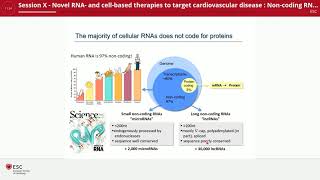
and again that's something that looking at both viral and host encoded non-coding RNAs has a potential to do so I always love to start with what I think is a wonderful slide from John Maddock who's the Australian bioinformatics and what is done here is to compare plot over here the amount of non-coding DNA in various genomes the fraction versus a whole bunch of organisms that you can of course read and with the result that with the conclusion that the ratio of non-coding RNA Rises as a function of developmental complexity which is sort of a mystical
term but everybody here knows what what I'm talking about so what you see here all the blue guys down here are single-celled bacteria either you bacteria or archaea bacteria and you see that they have at most about 15% non-coding DNA the organisms here are single-celled eukaryotes like yeasts more non-coding DNA in this range we have invertebrates and plants yet more non-coding DNA and finally as you know once we get up to animals mammals and humans we have a whopping 98 percent or so non-coding DNA but I think an even more striking realization that's really been
occurred in the last ten years is that virtually all of this non-coding out DNA at some time in the life of the organism is probably made into RNA but just because these molecules can be perhaps very short-lived or very low in abundance doesn't mean they can't be doing important things in terms of cell signaling regulation of various processes and that's of course what we want to know about with respect to function and over the years and you heard some of this in this lovely introduction we have identified the role of many non-coding RNAs and what
they do in gene regulation you heard mention of the snrnas in the snoops that are the building blocks of the spliceosome using base pairing to recognize the ends of introns and build a spliceosome that then splices out introns but they're also non-coding rnas involved in the regulation of transcription like the 7sk RNA in the nucleolus there are two major kinds of so-called sports no rnas small nucleolar rnas that again use base pairing to identify certain locations in ribosomal RNA and insert very specific modifications that we're now learning are more and more important for regulating translation
by ribosomes in germ cells we have pi rnas that keep transposon in part keep transposons from moving around and racking havoc with genomes and you all know that you know every journal if you open has at least one new paper on some long non-coding RNA that associates with a protein complex and associates with chromatin to either turn it on or turn it off in the in the general region where it binds once we go out to the cytoplasm there of course the classical non-coding RNA is the ribosomal RNA and the T RNAs that make translation
happen and there's also si RNA the experimentalists tool but also the tool we're talking about here because of its potential for therapeutics and finally micro rna's and you know that there perhaps as many as a thousand of these tiny little 22 nucleotide RNAs itself and what they do is associate with specific proteins and then use partial complementarity with messenger RNAs usually in the 3-prime utr to both modulate a translational efficiency and to affect the stability of the mRNAs and thus they're very important and development differentiation disease and so on so let me just make a
couple of additional comments here first in virtually all these cases the non-coding RNA is associated with tightly bound proteins and very often perhaps always those proteins play a really important role in the function of non-coding RNAs and secondly I've already mentioned that in several cases we know that base pairing between the non-coding RNA and its target is very important for its function but this is of course just the tip of the iceberg and as I mentioned you know all sorts of new non-coding RNAs are popping out on a daily basis primarily because of advances in
sequencing technology so finally I want to introduce because as I mentioned the story I want to tell you today starts with the viral non-coding RNA I want to introduce you to the viral non-coding RNAs we've been studying in my lab actually since 1981 they come from the gamma herpes viruses and their names are listed here gamma herpes viruses have long double stranded DNA genomes they encode about a hundred different proteins on average they are lymph atrophic meaning they infect T cells or B cells they're all oncogenic and they all have both latent States and lytic
States so in the latent state the the viral DNA sort of disappears into the cell a few genes are transcribed and the virus waits for conditions to change we don't know that much about that until they come out and start producing virus during the lytic phase so what you notice from this slide so the names of the non-coding RNA or RMP are shown over here along with the dates of their discovery and by comparing these days with the number of question marks that remain over here you can deduce that finding functions for non-coding RNAs is
quite a challenge it's very difficult and it takes a long time to get anywhere but just recently I think the last five years has been a real uptick in our rate of being able to assign functions and that's because technology has finally caught up and nowadays we can find associations between non-coding rnas and their bound proteins and other RNAs chromatin etc much much more easily and that really sends us off in the right direction okay so the story I'm going to tell you today has to do starts with this pan RNA that polyadenylated nuclear RNA
and maybe i KS hv and actually i'm not going to be telling you about its function because you don't really yet know its function i think we're closing in on that but what i am going to be telling you about is an RNA element that was found in that RNA that has now sort of expanded into the far corners of biology and that is an RNA triple helix so let me go back and start with a little bit more introduction to kshv and the pan RNA the polyadenylated nuclear RNA you probably know that kshv causes
cancers on the little peripheral disorders in immunocompromised individuals like those are who are already suffering from HIV and it causes these ugly sarcomas in the lytic phase this virus produces this RNA pol a tenth elated nuclear RNA discovered in the mid-90s both in my colleague George Miller's lab at Yale and in Don Ganon's lab at ucsf pan RNA resembles a messenger RNA it's about a kilobase long it's transcribed by Paul - it's capped and polyadenylated just like message pre-messenger rnas but as far as we know although there's a little bit of controversy about this recently
the vast majority of it is never exported to cite the cytoplasm there no conserved open reading frames so it's a nuclear RNA and what's remarkable is that accumulates to about half a million copies per infected cell and therefore is this little diagram shows that accounts for up to eighty percent of the polyadenylated rnas in the lytic ly infected cells so there's huge amounts of this so it's got to be doing something important but what I'm going to tell you about is an element called the E&E for element for nuclear expression that's near the three prime
end that's necessary for it to accumulate to this very high amount and that element was first worked on by nick conrad who was a postdoc in my lab he now is his own lab at UT Southwestern and by the time Nick finished in the lab we knew that this was the structure of the element that was necessary for this high accumulation of the pan RNA and based on both biochemical experiments and and in vitro experiments Nick had come up with a model for how he thought the E&E would in fact stabilize the pan RNA of
which it's apart and the idea was very simple we know that normally the first step in decay is to chew off the poly a tail and then chew chew up the rest of the RNA so the idea was that this element with its you rich internal loop here would bind would base pair with poly a RNA the poly a tail and therefore stabilized the RNA against aggradation and we were very excited when to realize that the structure here looks exactly like the interaction of one of the snow rnas the box h AC ace no RNA
with its ribosomal RNA substrates and therefore we thought this has to be what's really going on here this has to be the way it looks now of course that turned out not to be true which we found out several years later when Rachel Minton Frey who is an ex post doc to take up this problem came to the lab and was successful in getting crystal structure of the core en e bound to a LIGO a nine that's my allah go contribution in my lecture so so watch what her structure revealed was that it didn't look
like a Snowe RNA interaction at all but that this E&E is really forming a triple helix and that's what's important for clamping the poly a tail and stabilizing the pan RNA and she did this with a lot of crystallographic help from Tom States's lab so I'm just summarizing here so the model certainly is not that what happens instead is that there are five major group triple helical interactions that are formed by the oligo a9 with those use that were in this internal loop and then there's extension by a minor interactions into the lower stem of
the E and E so this is what it looks like in 3d for those of you who have an easier time looking at 2d pictures like me the a LIGO a nine forms standard watson-crick base pairs with the use over here they're extended by hoops teen interactions with use on the other side of the loop and then further extended by these a minor interactions so let's take a slightly closer look at this major groove triple helix this is what it looks like so you see you you you a you you a you etcetera looking down
on it just to remind you here's the standard watson-crick interaction extended by the hoops teen interaction and I want to call your attention because this is going to become important later in my talk to the fact that the two prime hydroxyl of the hoops teen strand in this triple helical stack is within hydrogen bonding distance of a phosphate on the the a rich strand and as I said remember that because that's going to become important later on it turns out that these these five triples that are stacked on top of one another are almost perfectly
identical and what as you see here in the overlay and what's particularly satisfying about that is that back in 1957 Garry felsenfeld David Davies and Alex rich predicted exactly this structure for the uau triple and that was based on their studies of poly two strands of poly u binding - Astraea - poly a and using helical diffraction to study the structure but what that makes even more curious is that at the time that Rachel's structure was was was found and she published it it was a longest stretch of triple helix as triple helical interactions that
had yet been identified in any naturally-occurring RNA and yet it was discovered way back in 1957 so there must be others where are they and that's basically what the rest of my talk is going to be about what do they look like let me just quickly say that the a minor interactions that extend the triple helix of the E&E with the poly a tail those are very common tertiary structures in RNA quarter of the A's and the ribosomal large subunit engaged in them there are three different types we have examples of all three types here
so Rachel had a structure but was it really important in terms of stabilizing RNA and what she realized was Nick previously had made mutations in those you rich that you rich internal loop and found that changing used used to cease were debilitating in terms of the stabilization conferred by the element those are the positions there and because she knew that CGC based ripple was Isis Tarek with the UA you triple the obvious experiment was to try to introduced into the poly a tail a single G residue and see whether that could suppress the effect of
the two u mutations and the next slide I want to show you turns out that you can just pop RNA into a nuclear extract and do an in vitro assessment of the survival of the RNA and what I'm showing here is that if you have an Ian e in in a short RNA pictured here that you get some survival of the RNA all the way up to sixty minutes whereas if it's deleted or if you have this double C mutation there's pretty much no full-length remaining after 60 minutes on the other hand when Rachel put
a single G residue into the poly a tail of sixty nucleotides either very close to the far end or sort of in the middle then she saw incredible stabilization of the poly a tail of a certain length meaning that the Ian he was sort of scanning along this whole poly a tail and picking out of that sea of A's the single G residue and clamping in in making the cgc triple there and therefore giving you both more and a more defined product in the nuclear extract which of course has all sorts of nucleases in it
which is the basis of this assay so what I've told you about this earlier work then is that the ena is an RNA element that protects Payan RNA in the crystal structure it interacts with the illegal a to form these major groove triples and the three additional a minor interactions and it appears to be functionally important for stabilizing the RNA because of this experiment that I just told you about so that raised the question do other viruses there must be other viruses that make pan RNAs that have e'en ease in them to stabilize them and
also where did the virus get this structure presumably there would be in some cellular RNA so you learn on coding RNAs E&E like structures that would also protect those RNAs in the nucleus from nuclear decay pathways so let me tell you quickly about this and then I'm going to go on and spend a bit more time about cellular eni's before I come to the the final part of my talk which is the sort of interesting evolutionary part so we of course been looking for triple helix ease in RNAs but we didn't really know how to
search until the triple helix was actually found and at that point cause you to Kowski research scientist in the lab was able to take the programs and build in the right descriptors so that we could actually begin to find additional Yanni's and those of course included that there would be an internal loop that there would C be some G C's as receptors for the a minor interactions that there would be a stem loop on top etcetera etc and he also realized that the structure could also exist upside-down and just have the watson-crick base pairing occur
with this brand and that'd be the hosting strand and that would work just fine and doing this then he searched the viral database and he found lots of other yeah not lots but some other leonie's and most of them are shown here what you notice is that the ones that are from DNA viruses are all just upstream of a poly ASIC so they're close to the poly a tail so they can grab it and interact and stabilize it one of these though was actually in an RNA virus which in no place during its replication cycle
actually enters nucleus so this was one of our first indications that that cytoplasmic RNAs can also be protected from degradation by this any element and two of these are our V rhesus rad no virus and equine herpes virus two are very closely related viruses to kshv and I just want to show you in the next slide because it's a sort of fun that at the time we found the ents in in these genome structures nope an RNA had been identified from either our RV or eh v2 but the fact that there's an A&E there and
these are where they're in sin Teaneck locations relative to the surrounding genes predicts the existence of pan RNAs and these other viruses and in the case of reasons for adenovirus i won't show you any data but we went in and we found that there was indeed a pen RNA about a KB long with an e to stabilize it so the conclusions then of this this short part of the work are that they're relatively rare but they do occur in evolutionary divergence viruses many gamma herpes viruses appear to express RNA pen homologs and Teaneck positions almost
no sequence homology for the KB length of the RNA it's all structural homology in this ene element just upstream of the poly a tail so what that suggests is that if we had good programs that could predict the presence of these structurally conserved elements we would have a good way of looking for homologs but we're still groping with how to actually search for them and I'll come back to that so what about cellular you so it turns out that meanwhile would have been going on was characterization of to now very famous long non-coding RNA in
map very highly conserved in vertebrates a one called mallet one for metastasis associated lung adenocarcinoma transcript one and the other called men beta which is also the same as the need RNA that's a component of para speckles and I know that you'll be hearing a bit more about Mel at one from David Specter so be sure to come to his talk what these RNAs have in common with the pan RNA of kshv non-coding intron was made by Paul - highly abundant or can be highly abundant their nuclear and their exact functions are still unknown what
had been discovered by Jeremy Willits when he was a graduate student and David's Spector's lab at Cold Spring Harbor was that the three prime end of these two rnase although it's made originally with a poly a tail like all Paul - transcripts these get cleaved because there's a tRNA like structure which then services a target for rnase p creating a 3 prime end which has an a rich stretch at its terminus and what was realized by both us and by jeremy Willits who then later on went to fill sharps lab was that that enabled the
possibility of folding back this a rich tract onto the eat what looked like an any type structure and forming what would be longer stacks of triple helix YZ but with this funny interruption in the middle in other words a CGC which i've already told you about is a triplet and a CG base pair and what happened first was that both just brown and new postdoc in my lab and jeremy Willits did various mutational studies that were consistent with these structures forming and just an addition did thermal melting and got data again consistent with these longer
triple helix EES forming just however wanted real proof in terms of the structure and so she went on to get crystals and solve a 3.1 engsub structure of the mallet one took this bipartite so-called triple helical structure again with help from the state's lab David Buckley was a graduate student and so the Jess Brown and max valence ting and undergraduate in the lab okay so what just saw the structure of then was a somewhat truncated mallet one E&E so here's the terminal a rich track coming up and pairing very nicely here and here's a tetra
loop that she's stuck in and a little module for binding heavy metals to cell help solve the phase problem and what I just want to point out is that if one looks at the accumulation of a fragment from the three prime end of mallet one RNA that this core that she saw the structure of as virtually as stabilizing as the wild-type E&E but if you make this just one you to see mutation which just would destroy this upper part of the triple helix it has a devastating effect both on the wild-type E&E and on this
piece that she forms she solved the structure of okay so what does the structure look like well it looks like it was predicted to look except now that we we know that on top of this stack of you a use in the bottom triple helix there is a CGC that stacks on top and then there's a CG doublet and then we continue on and up above is a stem and below are two a minor interactions and then more of a stem and I just want to show you here if I can get this to work
rotate this thing around and the only point of rotating it around is if you squint your eyes this just looks like you know a nice helical regular helical structure you don't see the fact that there's this interruption in the middle where you have the CGC and the CG doublet so so what what is really going on and how is this contributing to the structure and the stabilization ability of the structure one thing that the CG sees and that and the double are probably doing is increasing the base stacking because it just turns out that Jesus
sees stacked better than using A's another thing that happens at this point is that the direction of the local axis of the helix is changed so it sort of straightens it out and that may be important for its for its biological function but the really important thing comes back to that putative hydrogen bond that I mentioned to you earlier namely the fact that you can potentially form a hydrogen bond between the two prime hydroxyl of the of the cooling strand and the backbone phosphate of the a red strand and what you notice here is that
those distances turned out to be slightly different at two different points in the crystal structure of the mantle at one E&E and what just noticed as she started at the bottom and looked at the putative length of that hydrogen bond was it started out quite big and as you proceed up the triple helix it gets smaller and smaller and smaller and then when you get to the interruption all of a sudden there's a reset it gets bigger again and then gets smaller and what this prompted her to do was some model building so the question
was could she take this pack of six triples and elongated by one and what happen so basically what she did was to put another CGC up there and ask in this model building exercise what would actually happen and what she discovered is that you can't do that because this hydrogen bun potential gets too short so there's just a steric collision there and that's what we think is interfering with the ability to make a triple helix that's longer than six six triples and I should also mention that the longest one that's been identified in any RNA
so far and Julie faggins lab from a telomerase from kuvira my C's or something like that is five UA use and a CGC on top so what this says is that the reason you need that interruption is that structurally you just can't extend the triple helix any further without steroid crash and therefore you need to have some sort of an interruption and this is the way this particular structure has solved this problem I want to just mention a little bit about how we assess the stabilization activity of triple helix ease it turns out that we
have a reporter which is basically a beta globin gene from which the introns have been removed and it's been known since the 1980s and Paul Berg's lab that if you remove the introns from beta globin the transcript just disappears in the nucleus and you can see this here here's lacking the two introns of beta globin but if you put an Ian E in you can restore that you can rescue it which is what's shown here so that's our reporter assay for missioning the ability of viennese to restore stability and what's been done here is to
make all sorts of mutations in this critical juncture of place and you can see that almost none of them are able to give stability to this reporter some interesting ones here are adding nucleotides onto the three prime and which are destabilizing but you still get some RNA and the really interesting one I we think that's happening just because that gives nucleases a chance to grab on and start degrading but one that we really don't understand is if you just remove that terminal a residue then it's very very destabilizing we don't understand that at all why
that why that's happening so this is then you know in vivo in transfected cells cells transfected with this reporter so in conclusion then about this part of the talk you can have up to nine base triples in in the element but in the middle you have the interruption making it a part bipartite element of the CGC and the CG doublet there the role of these is to lock the register of the triplets to form a blunt end and I've just shown you how important it is to have a blunt end up against the upper double-stranded
bit and there are other things they do but the real reason for having that interruption is to reset the triple helix so that you can start over and make more base triples in the structure and the stabilization of the reporter depends on all these same things that the CG nucleotides do okay so at this point we were of course searching and searching we didn't believe that there were only two triple helical elements in all of vertebrates namely the mallet one and the men beta non-coding RNAs and we of course were searching for more and at
that point co-ceo Tokarski began searching the entire eukaryotic genome for these elements and he did find something this was rewarding he found thousands of these any elements but almost all of them in plant and fungal genomes turns out they're thousands because they are actually in trance poseable elements and you know they're multi copies of transpose ax Bilal so lots of them are identical although they're about 200 different sequences and they're all of the type where they bind the poly a tail like the pani Andy that can sort of slide along and get get clamped so
the question at this point is why are they prevalent in these particular organisms in plants and fungi and it turns out that the answer to that we think and this is what I want to tell you about in this last part of my talk is that they compensate for in from loss over evolutionary time in these transpose ax Balilla manure Covey oh and my super main technician and lab Mady shoe okay so first of all what do these thousands of iya knees that are now we now know are in plant and fungal transpose ax balilla
meant Slyke well they look like we expected them to look there's an internal loop with use in it and the possibility for making a minor interactions with GC base pairs lots of these have a sort of curious destabilized portion there some of them are right-side up some of them are upside down but we also found lots of double domain Ian's ease so not just one potential ones with not just one place where you could potentially form a triple helix with the poly a tail but also others another region and sometimes those are in the same
orientation sometimes they're in opposite orientations and sometimes it's sort of ambiguous about what the orientation really is because this one looks like it could go either this way or this way if you line up a lot of these and this is just you know part of the sort of incredible database that cashew is now compiled it turns out that this lower E&E so the red are the conserved nucleotides this lower Ian Ian E domain is more served and longer than the upper E&E domain but the important thing here is you never have more than four
or potential for four or five uau base pairs or uau triples so I mean that fits with their earlier conclusions that you certainly can't do more than six because it's just structurally unacceptable and finally here if you think about how these these double domain ents interact with the poly a tail the ones that are in the same orientation could do this but this sort of weird class could do the poly a could be coming down here and then continuing on or it could switch over and then be be engaged in the opposite direction by the
lower lower part of the domain okay so do are these really stabilizing we pop them into our beta-globin report or a number of them and indeed you see an increase in beta-globin this is just a nonspecific band up here if they were inserted in the forward but not the reverse orientation and the aspects of them that we noted to be conserved like the internal you ridge stretches and the potential for making a minor interactions then if you mutate those you see that you lose the stabilizing ability but to get back to the question of why
are they in trance poseable elements of why are they in these particular species of organism let me remind you of what we know about transpose ax balem owns so there are three major classes of transpose ax balilla Munir DNA transposon x' that move by having the transpose a x' cut the double-stranded DNA at both ends and basically pick it up and put it into a foreign site and then as you know they're also ones that move via RNA they make a copy of the RNA which is then transcribed a reverse transcribed into DNA and about
those divided into two classes the non LTR and the ones that have long terminal repeats like the RNA retroviruses and where we're finding these iya needs was in the DNA transposons and in the LTR retrotransposons so and here's here's a pie chart illustrating the distribution so here are the retrotransposons like gypsy and copia few in the DNA and almost none in the nan LGR retrotransposons so where are the ents in the LTR and nan LTR retrotransposon it turns out that they are very close to what would be the three prime and in these cases since
the poly a signal isn't very highly conserved and plants and fungi it's difficult to tell where that what really is the poly a signal and where the poly a really would start but these are about in the right place okay so why are they prevalent in transcripts from transpose ax balem owns but not so much in other cellular mRNAs or long non-coding rnas and we think that that has to do with the fact that these transpose ax balilla montz are undergoing horizontal transfer and it turns out that horizontal transfer you know the putting of nucleic
acid from one cell into another cell occurs much more frequently with the DNA transposons and with the LTR retro transposon stand with the non ltr' retro transposon so that fits but then it still doesn't inform us about why in plants and fungi and we think the answer here isn't the last little bit I just want to give you a little bit of evidence is that these particular organisms have a mechanism for transposon silencing via an SI RNA mediated pathway and here we were inspired by a beautiful paper that came from hitting my honey's lab at
ucsf a couple years ago we're in Cryptococcus they discovered that if spliceosomes stall or don't get made so they can't carry out splicing what happens is that multi protein complex called scanner and the branching enzyme take over and enable the production of double-stranded RNA that then gets diced to si RNAs and those go back and destroy the message on which you have the stalled spliceosomes okay so what I've just told you in a little bit more is in this slide so if you think about it after horizontal transfer a transposon might find itself in an
environment where all the splicing components don't quite fit with its particular introns and therefore it's likely that splicing would go awry and you might create these stalls spliceosomes and then you get this si RNA directed silencing so the evolutionary pressure here would be for these transposons to lose their introns but once they lose their introns as I've already shown you if transcripts don't have introns in the hostile environment of the nucleus they get degraded so one way that they could prevent getting degraded would be then to pick up an en en element if they've lost
their introns and this is all you know evolutionary hokey-pokey but we think this is what's going on so what you'd like to do at this point is to look at all these transpose ax balilla moans and ask do they have introns do they have en es and what you would predict is that all the ones that had lost their introns might have eaten YZ or all the ones that picked up in YZ had lost their introns now unfortunately the annotation of all these trans poseable elements is not such that you can do it with all
of them but the one class of them that you can do it with are the DNA transposons because they're basically they're messenger RNAs encode a single Orff for the transpose a is itself that has conserved elements in it and here this is well enough defined so you can tell whether or not it has introns and so if you look at the phylogeny over here of these transpose ax balilla manie's DNA sorry of the introns and these transpose elements it turns out that if they don't have an intron they all have anis if they do have
introns they never have ents and sometimes they have en es with with wait there's one example here that's sort of an outlier let's see if they have introns they don't have any s they don't have introns they do have viennese if they have introns dated okay anyhow so certainly all of these fit the rule that if you've lost your intron you've gotten ena to pick up to protect yourself against nuclear decay so what you might say looking at this chart is well all of these organisms are related it could be that this happened once and
that was just propagated during evolution to all these other species but there is one other example down here of organism that has lost its intron but that has an en a in in these transpose days mRNAs so we think that's pretty good evidence that probably this this story that I've been painting for you probably is why we find Ian YZ and the transpose ax balilla Minh syn these particular species because they have this mechanism for getting rid of stalled spliceosomes which is likely to happen after horizontal transfer of these elements so the final conclusion then
is Enys can be found in mRNAs here they're in transpose n transpose a's genes as well as in non-coding rnas everything we know so far in these these new transpose on TNT's it's never longer than five but we do have examples of being six but never longer than six and we think that the reason that they are where they are is that Ian E's are counteracting the negative effects of intron loss in these transposon rnas so meanwhile we still don't believe that in all of vertebrates and actually there are some examples in stickleback fish in
the transpose ax Balilla montaine likea knees but beyond that we haven't found any so what we think is going on and what we're trying to do now and this is my very last real slide is that there may be triple helix e's that have non canonical triples in them and of course that makes them very very difficult to predict by any sort of algorithm and we have to find out what these non canonical triples are and the reason we think they exist is that people who've been doing structures of ribose witches telomerase etc have found
very good triples that aren't either uau or CGC and we need to know what those are so we've done two things one is to take one position in the mallet one E&E and substitute into it all possible triple combinations and ask which are acceptable and which are destabilizing and from that we can build build that into our local search algorithms and also say a Torabi a postdoc in the lab is doing seal acts on the mallet one structure trying to select stabilizing elements and seeing whether some of those that we pick up have non-canonical based
ripples in them because we really expect there will be more so stay tuned so in the very end I just want to thank you think the people whose work I've told you about Rachel Minton fry who started all of this in terms of the triple helix is now teaching at Denison College in Ohio Cascio luckily is still in the lab as is Mady just brown just moved to an assistant professor position at Notre Dame in the Department of Chemistry and biochemistry and Max Valentine is a MD PhD student at Harvard and I want to thank
all of our funding sources and particularly my biology friends at Yale without whom we wouldn't have been able to work on viral non-coding rnas at all and I want to thank you all for your attention and hope that there will be lots of questions thank you hi that's spectacular talk I have two questions one is how does having an ESC affect the protein output of the mRNAs and then secondly it almost seems as though the introns and esus are mutually exclusive as though if you have an intron it would be not be beneficial to also
have an e se C do you any thoughts on that okay so the person who's really looked into the effect on translation if he any is is Jeremy Willits who I'm sure you know who is now at the University of Pennsylvania and what he found was that having an Ian E in a reporter construct making GFP in fact up to the translation we have not seriously looked at that what the role is in the cytoplasm although it's clear that for these transposon mRNAs that have ents there must be some benefit to having them no your
other question was mutual exclusivity oh yeah yeah I think there was anyhow there was an anomaly in that chart maybe should go back to it and see if we can find it there's one zero or zero zero so I couldn't find it earlier okay that has an either an intron or and Ian E and I would argue it just hasn't gotten it see yeah you know we've captured it mid evolution but your question was well why don't you don't see any cases where they have both an intron and an ESC we haven't seen any of
those and so you have any thoughts on why that might feel okay Nick Conrad way back did do experiments where he had both an Ian E and an intron in beta globin and it turned out that the intron was dominant in terms it's ability to export the RNA and get it out to the cytoplasm and in his experiments then that made no difference to the translation the ene made no difference to the translation of the beta-globin from those particular messages so I think we don't really have an answer to your question yeah thanks likewise great
talk a couple of questions so one is does the E&E actually interfere with nuclear export of an RNA as far as we know it doesn't we thought at the beginning that it did but the experiment that I just told you about saying that having an intron is dominant says that at least the ena can't interfere with export if there's an intron they're coupling to the export machinery the way we believe it happens with the vast majority of eukaryotic messenger RNAs okay and I think you mentioned also that the ena does stabilize RNAs in the cytoplasm
as well as the nucleus well that's according to Jeremy Willits because he just saw more GFP now whether there any direct effects on translation or whether it's just that because it's more stable and the nucleus you get more of it out into the cytoplasm and therefore you get more product I don't know okay okay and I guess like Melissa probably I'm thinking about the potential therapeutic applications if you wanted to deliver an mRNA and you didn't want to have introns and it to what degree sticking and E&E in there might help and I guess that
go for us to be go for it try it I mean we know it works in the nucleus because we put Ian's ease into pre micro rna's and we're sorry pry micro rna's and see that you get much much more of the micro RNA but that's all a nuclear process but we haven't gone so far as it is producing proteins but therapeutically it certainly has lots of potential okay beautiful talk John so on this slide again there's actually two places where there's a zero and zero ones right thank you thank you I knew that there
were so the question is it seems that if you are without an intron and without an e as you're with your hypothesis that there might be some effect on the prevalence of these particular transposons and have you looked at that well I think you'll realize that these species are not ones that are highly studied we barely have annotated DNA genomes from them and so certainly in terms of gene expression they have not been explored and that's if somebody wants to do it fine and then the other question the the length of the any it seems
a bit long for the what you're hypothesizing that maybe that it could be truncated down if one made an effort dude I mean we've made lots of mutations in this those stacks of five right and seeing that any mutation decreases its ability to stabilize now there are many that only have four in these double domain E's and also also some of the some of the singles so we don't know whether those are just less efficacious whether you could go to three we that we haven't really tested that I was thinking more in terms of the
stems above and below it seems like a lot of stem for holding that structure together yeah the mallet one E&E is is more stabilizing than the kshv one with the with the A's sliding along and all sorts of different orientations it's clear that the mallet one is more stabilizing but we haven't actually that's a really good question we haven't actually measured what the quantitative difference is between the two okay thank you hi Bruce beautiful talk it was really interesting to see you found so many in the trans possible elements particularly ones that may have an
RNA intermediate so I no if you had looked at reverse transcription to those things you know change anything with copying reverse transcribing does it pause process involvement but there are all sorts of fantastic things that could be deciphered if one were to do those experiments but no we haven't we can talk about it more later what is known about adenosine deaminase in such structures can this be deaminated such structures or when they age whether it isn't the happening in the nucleus Wow great question I have no idea whether formation of a triple helix would mediate
against deamination I would suspect it would but only the region that's in contact which is pretty short I have a another question kind of going back to the KSHB and the situation where you have this half million rnas in each cell what is that doing to the normal RNA transport and processing and do we know what proteins in the nucleus may be binding to the okay this isn't our work this is mostly the work of brick Glen singer at Berkeley and what she's investigated in kshv is the nuclear shutoff phenomenon or I'm sorry the host
shutoff phenomenon which which basically just means that host messenger rna's aren't translated and expressed as well as viral mRNA s in kshv infected cell this has to do with a particular protein made by the virus called the SoCs protein and what's what's come out from her work is that what the SoCs protein does and it's not known exactly how is to relocate the cytoplasmic polyadenylation largely to the nucleus and when it when that happens and you have this half million copies of the pan RNA what it does is to code all those poly a tails
with what is normally a cytoplasmic protein and my favorite hypothesis and I think we're getting evidence it's getting us there is that what this high amount of pan RNA does is to capture and sequester this cytoplasmic poly a tail at Arius to I don't know what processes but some processes in the nucleus and that by doing this the virus then is able to effectively or more effectively discriminate against host messages in favor of viral messages but this is all this is all hypothesis we're working on exactly what the mechanism is okay and a related question
is there a mutant virus that doesn't have the E&E and what does that do to pathogenicity again that that answer will come very soon because we finally have those viruses okay great well I'd like to ask everyone to join me in thanking professor Stites