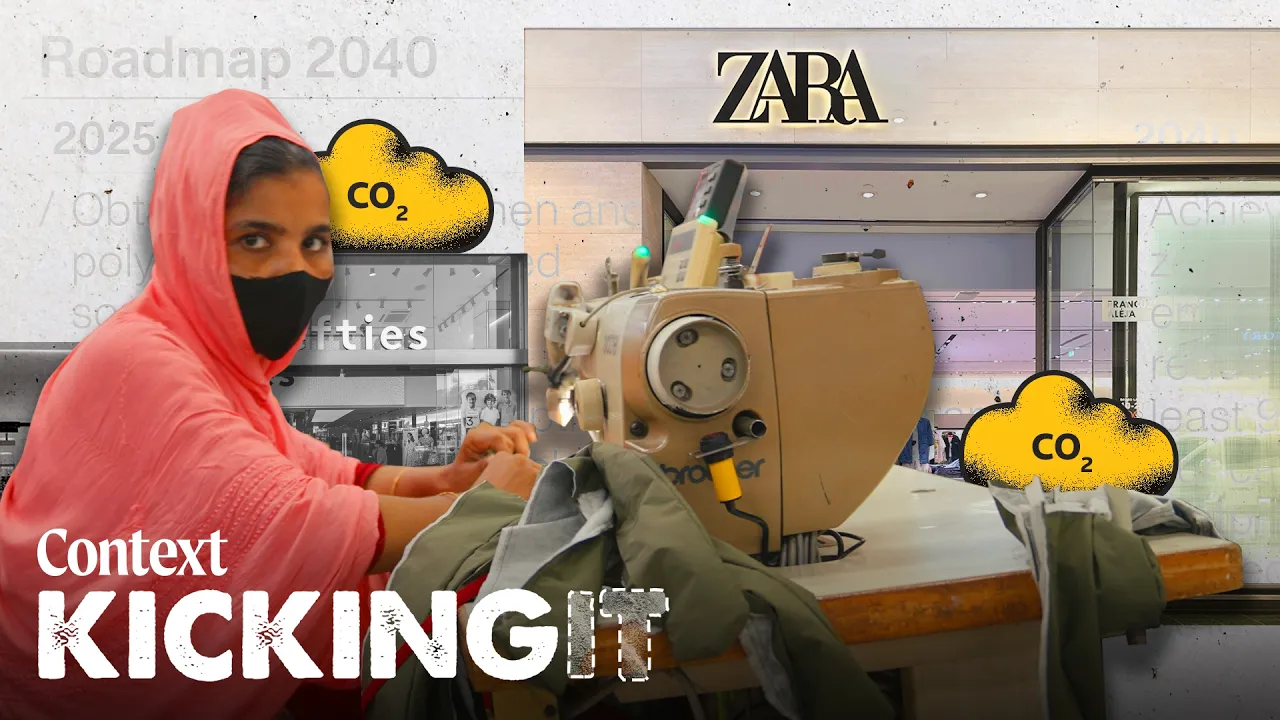
You can't talk about fast fashion without talking about Zara. The world's most successful clothing brand pioneered the mass producing, quick turnaround production model that's brought in $136 billion last year and turned its founder into one of the world's richest men. Lately, Zara's parent company, Inditex, has been talking a lot about making fast fashion not faster, but better.
For workers and the planet. You read it in earnings reports. Whether it's creating a marketplace for pre-owned clothes or cutting down on water consumption in the supply chain, you hear it from the chairwoman herself too.
But our reporting found that their business tactics paint a different picture. We've spent the last six months sifting through thousands of pages of supply chain data. It shows a major shift towards shipping by air in the last few years, A dirtier and more expensive alternative to sea shipping.
Air shipping isn't just bad for the environment. Through dozens of interviews with factory owners and workers, and current and former Inditex employees, we found that air shipping adds huge costs to the production process. Costs that are sometimes placed on factory owners if they don't meet strict deadlines, Costs that compound what's already a pressure cooker environment for garment workers.
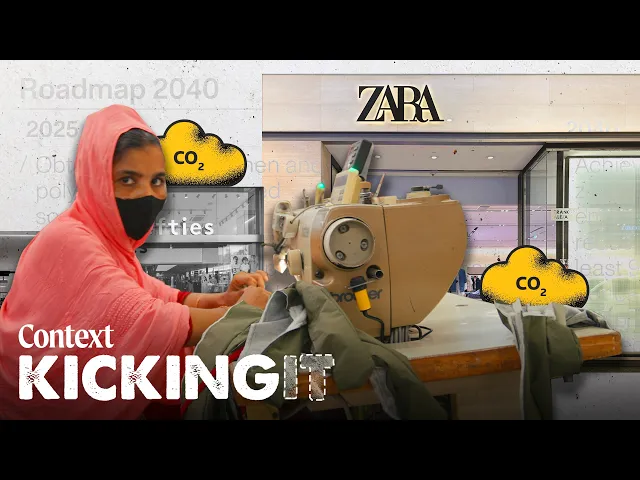
It means faster fashion and higher profits, and there's no signs of this slowing down any time soon. When you go into a Zara store like this one, you'll find clothes that have traveled thousands of miles get here, Some of them were designed as little as few weeks ago. It starts at Inditex HQ, Zara's parent company based here in Spain, where employees monitor the latest fashion trends and sales figures, create designs and put in orders.
Those orders are distributed to factories in about a dozen countries, like this one in Bangladesh, where clothes are produced as quickly as possible. This worker, for example, will be sewing one piece of a Zara puffer jacket every minute. In a month, this factory will have produced 22,000 pieces.
To hit these targets and keep clothing racks around the world full, s ome garment workers are pushed to their limits. Okay, so it's 8 p. m.
We've been waiting for about two hours now, We're supposed to be meeting with Poli, a garment worker on the outskirts of Dhaka. But she's running late. Without notice, she was told to work overtime tonight.
Poli is afraid she'll lose her job if she spoke to us, so we concealed her identity. Today, she's worked a total of 11 hours, but will only get paid for eight. It happens a lot.
Sometimes she's told to come in on her only day off of the week. Poli earns around $125 per month as a seamstress for a company called Nipa Group. A single mother of three, she also takes side jobs to keep the family afloat.
Poli is one of around 4 million garment workers in Bangladesh, producing clothes for some of the world's biggest brands. Zara, H&M, Uniqlo. Her employer takes regular contracts for several brands owned by Zara's parent company, Inditex.
While the experience of workers at Nipa Group like Poli are unusually abusive, most of the dozens of garment workers we spoke to described stressful working conditions. Lots of unpaid overtime work when orders need to be quickly finished, sometimes up to 19 hour workdays. They told us wages are often late and barely enough to cover their expenses.
Polli's colleague Mili is seven months pregnant, but she can't afford rent or even a bed, let alone checkups during her pregnancy. Mili, Poli and other colleagues told us that supervisors at Nipa Group abused workers and threatened them to produce clothes quickly. In 50 years, Bangladesh has built its garment industry into the backbone of the global clothing business.
It's attracted the attention of largely European and American brands, while growing its own economy in the process. Bangladesh is now the world's second biggest clothing exporter after China, making up 10% of the country's GDP. Over half of garment workers are women, many who move to cities from poor rural parts of the country.
They definitely had a dream before coming to these jobs. They thought that it will give them economic freedom. But that's not the reality.
The workers in here are getting rock bottom wages. Over the years, they've tried to unionize, form walkouts and stage protests, which sometimes turned deadly. Still, take home pay has only risen by less than 1% in the last four years, while inflation has gone up by 9% and workers continue to struggle.
Meanwhile, companies like Inditex are continuing to find ways to make all of this faster. They built a business model and a logistic model that is really addicted to speed. This is David Hachfeld, a researcher at Public Eye, a Swiss NGO focused on sustainability issues.
With his help, we spent months tracing Inditex's supply chain, and we noticed a shift towards air shipping in multiple countries including Bangladesh, India and Turkey, a method that can increase carbon emissions by as much as 35 times. So far in 2024, Inditex transported a quarter of its clothes produced in Bangladesh by air, a 26% increase compared to 2023 in terms of value of shipments. That's not all of it.
When there's a bottleneck in Dhaka's airport, multiple sources told us they put clothes on trucks to India and air ship them from there. Look at this chart. About 14 million kilos of Inditex cargo worth around $212 million have been sent by truck to India from Bangladesh so far in 2024, up from 103,000 kilos in 2022.
Most of what's airshipped from Bangladesh, India and other countries end up in a centralized sorting facility in Zaragoza, Spain, before getting shipped again on planes to stores around the world. To give you an idea of the climate impact, air shipping just from Bangladesh to Spain in 2024 so far would've emitted around 160,321 metric tonnes of CO2 equivalents, according to one conservative calculation, around the same as the Falkland Islands' emissions for 2023. This doesn't include the climate impact of aircraft emissions beyond CO2, which, when we consulted two other experts, said it would be as high as 417,875 metric tonnes of CO2 equivalents.
All of this is just a portion of Inditex's total transport emissions. We asked Inditex about this increase in air shipping and the amount of resulting emissions. The company declined to respond specifically to this query.
we might need flying, but in a time of climate emergency, we need to prioritize, and prioritizing fast fashion is just weird because it's not a product that gets bad if it's too long on a ship. Inditex isn't the only one leaning into air transport. Some smaller brands actually rely on it more, but the sheer scale of Inditex's production means its carbon emissions are industry-leading.
While there are other companies who do efforts to reduce flying, Inditex seems not to care at all. When you compare them to brands of similar size, they blow away the competition. One exception is Shein, which has disrupted the fast fashion industry and overtaken Inditex as the world's biggest fashion retailer.
They send most of their clothes directly from manufacturers in China, by air, to customers around the world. The company reported 6. 3 million tonnes of CO2-equivalents in transportation related emissions, nearly double that of 2022.
We asked Inditex if their increase in air shipments is a response to competitors like Shein. The company declined to comment. In an emailed response, a spokesperson said, sea and road transport are by far the most significant methods used to ship garments, and they use additional modes of transport in exceptional circumstances.
The statement also said, Inditex is working to reduce emissions in several ways, such as using alternative, more sustainable fuels. However, our reporting found that it's a very small percentage of their total air cargo fuel. And the factory owners we spoke to said the decision for air shipping often comes down to profits.
To buy everything in the air, I think that create a lot of cost, and that really hurt the environment. It's not just about the carbon emissions. There's a human toll here too.
I want to bring you back to the factory floors, a pressure cooker that's optimized, down to the stitch, for high speeds and low costs. Now imagine cranking up the dial on that pressure. According to multiple sources, that's what the high costs of air shipping does.
Sometimes the costs are picked up by Inditex, but other times they're passed down to factories if they can't deliver orders on time. We asked Inditex how often factories pay for air shipping and whether those costs affect working conditions or pay. They said they work with suppliers to find solutions.
in the infrequent case of delays. They did not elaborate on what those solutions are. When asked about Nipa Group specifically, Inditex told us they were aware of problems there and are taking steps to address wage and labor issues.
They said that orders could continue from noncompliant factories like Nipa Group, if the factory agrees to an improvement plan. But when we were in Bangladesh at the end of September, the issues remained. Workers at Nipa Group told us the factory often use low profits as an excuse for not paying them overtime.
We decided to show up at Nipa Group's offices. It's quite important for somebody in management to speak to us. And spoke with their director, Syed Mahmudul Islam.
He refused to speak on camera and denied allegations that workers at Nipa Group were not being paid overtime, or that they suffered physical abuse. Islam us that Inditex is a demanding client when it comes to the speed of delivery. He also talked about a little known Inditex brand called lefties.
If you haven't heard of Lefties, you're not alone. What started as an outlet for unsold Zara clothes has grown into a low cost competitor to brands like Primark and Shein. These days, Lefties is found in 19 countries, most of them in southern Europe and the Middle East.
The brand isn't mentioned in Inditex's earnings reports, nor is there much written about it elsewhere. So we reached out to dozens of current and former Lefties employees. One of them, who worked in senior management at Lefties and Inditex for over a decade in Spain, answered.
Hello. How are you? He agreed to speak to us on the condition that we do not reveal his identity.
So we're calling him Jonathan, and we're using an AI-generated voice from the transcript of our conversation. They [Inditex] have never been, how to say it, proud of Lefties. In order for Lefties to offer rock bottom prices like 3 euro t-shirts, Jonathan said the brand sources the majority of its clothes from Bangladesh, one of the cheapest countries to produce in.
Even then, multiple sources, including Jonathan, said that Lefties is particularly cut-throat when it comes to how much they pay for their orders. Lefties earns about 22% less per item of clothing compared to Zara. That means Lefties, when sourcing from factories, would always be looking for the cheapest offers.
This was confirmed when we visited Nipa Group. Their director Syed Mahmudul Islam told us Lefties pays around 10 to 20% less than other clothing brands. Jonathan claims a factory might even take on a Leftie's order at a loss, hoping they can work with one of the world's biggest fashion brands.
What they do, they use Lefties because they know perfectly that, 'okay, I could do some orders under my cost, but they will open the doors of Inditex to me. ' We asked Inditex and Nipa Group about factories taking orders at a loss. Neither provided a comment.
Our data shows that Lefties was Nipa Group's biggest air shipping client in 2024. Nipa Group did not comment on the terms of these air shipments, and if they had to pay for any of it, While Lefties isn't the biggest air-shipper among Inditex brands, Jonathan said in his experience, the fact they paid so little to begin with only exacerbated the pressures factories already faced. The whole fast fashion industry is like that.
Lefties maybe is one of the worst companies because of the highest pressure they have. We asked Inditex about Lefties' low-margins and whether or not air-shipping creates added pressure for their clients. Again, we did not get an official comment on these questions.
The top of Inditex is the CEO's sales obsession, and the buyers in the middle. and the buyer is pushing the suppliers, and the suppliers are pushing the factories. And the only reason that everybody needs to be much more conscious about fast fashion is the position of the workers.
This is the only thing that deserves to be explained, you know? And that's why I'm collaborating with you. The brands need to be more focused on being responsible when they talk about profit, whether in terms of pricing, they're also giving enough space to take care [of] people and the planet.
It's Friday, Poli's only day off in the week, but she's getting ready to go to work this morning. Many factories here shut down for days this past summer because of heavy flooding, as well as massive protests that shut down the country earlier this year and overthrew the previous government. Now, workers like Poli are being asked to catch up.
For millions of workers like Poli, the fast fashion industry is a shot at a better life, just not at the pace that brands and consumers want it, and at the price they're willing to pay for it.