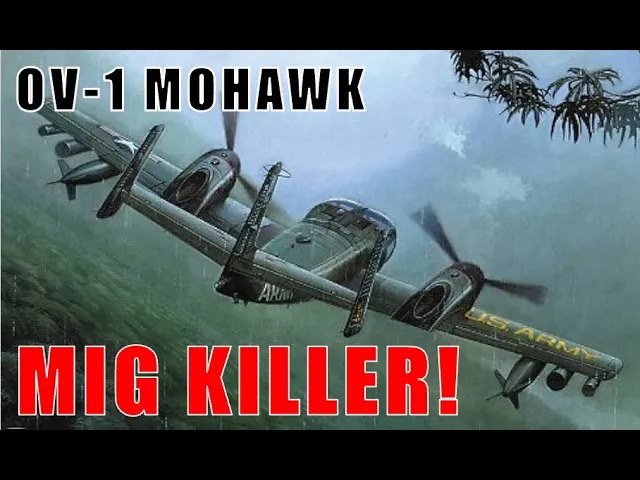
Ken Lee and his wingman were flying their ov1 Mohawks at 2000 ft over thick jungle just south of the DMZ suddenly Lee felt a series of thumps on the rear of his aircraft having been hit by ground fire and injured in this area only weeks before Lee had no intention of hanging about he told his wingman to break South and started a right turn to put some distance between himself and the triple batteries in the valley heavily loaded he only had 170 knots of air speed as he looked out the right side of the Mohawk
to clear his turn a snub-nosed fighter flew right by him overshooting the slow flying Mohawks and turning to re-engage for a moment Lee thought he was looking at one of the Australian ca27 Sabers that were deployed to ubon but then he saw the red star on its tail and heard his wingman shouting that he had a MIG on him in a matter of moments Ken Lee was going to become one of the Vietnam War's unlikeliest and least heralded Mig Killers the ov1 Mohawk development Journey was remarkably complicated and political for what was ultimately rather a
modest and utilitarian aircraft in late 1954 the US Army issued a requirement for a high performance aircraft to be used for observation artillery spot spotting and general utility use even in these early days the specification called for multi-service aircraft as the Marines needed to replace the cessar oe1 and it seemed prudent to kill two birds with one stone six companies proposed designs against this requirement having processed them the Army submitted a formal specification for approval by the Department of Defense in March 1956 and they immediately encountered politics and Inter service rivalry the Air Force was
still a relatively new service at this point but it was already a jealous guardian of its territory they had pushed the dod to aine on the subject of army ownership of fixed wi aircraft ostensibly to prevent duplication of procurement between the two services this process was ongoing when the Army specification was pushed up the chain based on the dod's study Secretary of Defense Charles Wilson decided to place a 5,000 weight limit on Army aircraft that's a pretty small airplane the last US Army Air Force combat aircraft to come in under that limit was the Boeing
p26 which first flew in 1932 and entered service in 1933 for this reason the Army requested two exceptions to the weight limit the first was the DHC 4 Caribou the second was the proposed observation aircraft DOD approved both exceptions during June 1956 the Army issued their specification to Industry it was for a 2 seat twin engine turboprop aircraft able to operate from unprepared fields in all weather conditions the Navy operating on behalf of the Marines wanted the aircraft to be able to operate from escort carriers so this requirement was also included in March 1957 Grumman
was declared the prime contractor for the program the resulting aircraft from which was then known as g134 a different form of inter service tension now erupted the Navy reasonably wanted to have its say in the g134 specification it was also essentially grumman's only customer and therefore able to exert powerful influence over the company unfortunately the Army and the Navy wanted different things out of the aircraft the Marines really wanted a basic extremely rugged observation aircraft that could also provide close support the Army had loftier Ambitions they wanted something equipped with sophisticated radar and infrared sensors
and Powerful radios that could spot for heavy long ranged and potentially nuclear tipped artillery and short- range missile batteries Armament wasn't essential as a 203 mm shell with a nuclear warhead sends its own message g134 therefore featured weapons pylons the Air Force absolutely hated this and because in this period they tended to act like spoiled kids they whin to the dod they even demanded that grummond stop Publishing Company brochures advertising the aircraft's attack potential all four Services were now involved in developing the aircraft which was hardly a recipe for leanness and speed of decision making
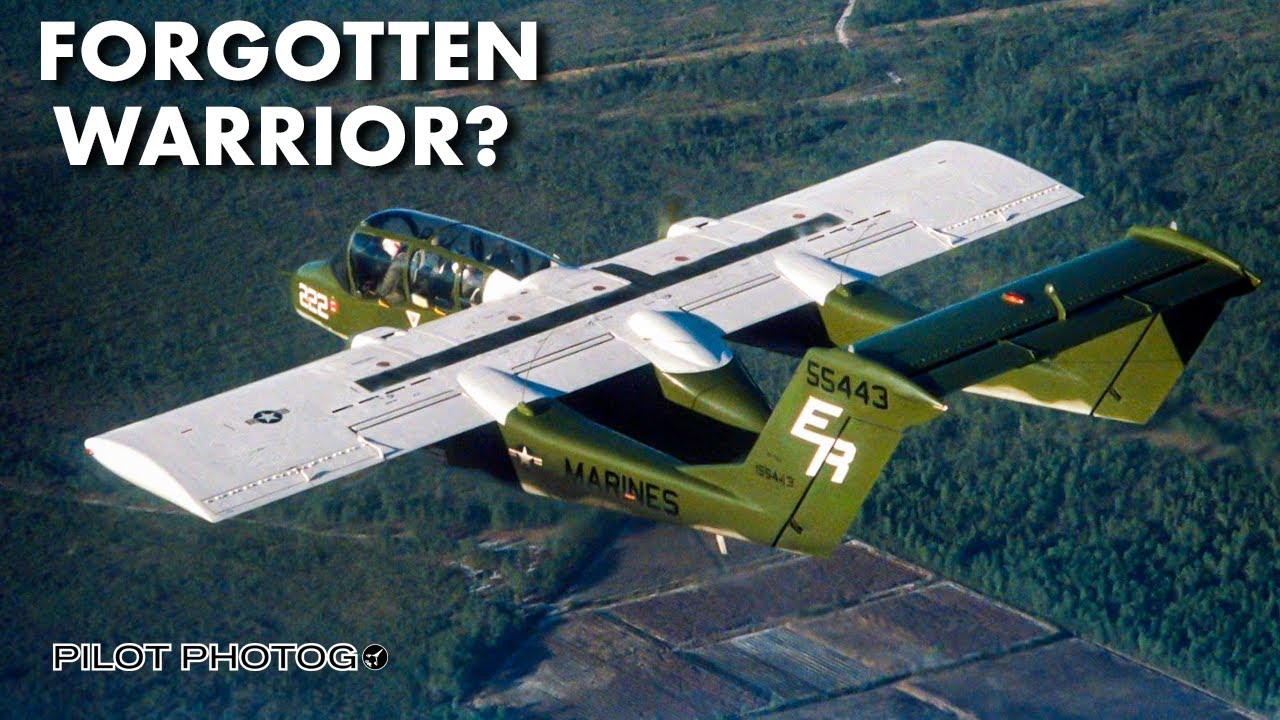
in September 1957 the Marines announced that they were dropping g134 because the Navy wanted to spend the money on tanker aircraft to equip their Fleet carriers the Marines would have to find some other mechanism for close Port like a bayonet or perhaps a juny and slightly offensive song The Marine's loss was the Army's gain as the procurement was now considerably simplified the eventual test article for g134 became known as y1f it was a small midwing monoplane with two 960 shaft horsepower loming t53 turbo props driving Hamilton standard three bladed propellers its most distinctive feature though
was the buggeyed cockpit required to furnish the pilot and observer an unobstructed view of the world below them front cockpit windows were made of flat plates of inch thick bulletproof glass and had one windshield wiper per side the side windows hinged upwards to allow the crew to take their seats side by side in Martin Baker ejection seats a Deployable ladder made entry and exit simple the ejection sequence caused a bit of a problem in early service as the Navigator went out first unbalancing the plane and leading to the pilot being shot out at a less
than ideal angle modifications to the sequence eventually fixed this problem you'll notice that at this stage the mockup had a high te tail wind tunnel testing revealed that trimming the aircraft with one engine out would be impossible in this configuration unless powered controls were fitted since this would increase weight complexity and cost the g134 was redesigned with the characteristic triple vertical tail in order to become the Yao 1X this process was sufficiently complicated that it took nearly 2 years to build the first flying prototype curiously this feature also substantially reduced the aircraft's frontal radar cross-section
making it one of the earliest low observables aircraft well sort of anyway the Prototype flew in April 1959 and immediately demonstrated excellent flying characteristics besides rather heavy control surfaces an issue that was easily fixed it was fully aerobatic particularly in roll had a very short takeoff and Landing run and good Endurance on internal fuel 227 gallons of fuel was carried giving about 2 and 1/2 hours of mission time 150 gallon underwing drop tanks could and typically would be carried to extend that range to 4 and 1/2 hours instinctively you might imagine the Mohawk to be
quite a small aircraft but it was actually not roughly the same size as an A4 Skyhawk the OV 1A was 42 ft long with a wingspan just over 41 1 ft empty it weighed about £1,000 and it could operate at up to £ 15,000 at maximum load maximum speed in the production aircraft was limited to 297 mph and service ceiling was 25,000 ft performance wise it was a slower but faster climbing p40e Warhawk flight testing was generally relatively uneventful until during a high-speed run to 460 mph the center fin abruptly detached the aircraft was safely
landed and although the service limitation on speed was 297 mph reinforcement was added fixing the problem the Army Aviation board was very happy with y1f and recommended it for production each example cost about $435,000 in 1960 it was initially to be called montalk after a Native American tribe that lived near grumman's base in Long Island the Army decided that the peace mon talks were neither wellknown enough or aggressive enough for a military aircraft they therefore decided to name the ov1 the Mohawk when it arrived in service in the middle of 1961 the Mohawk was the
first turbo prop aircraft in the Army's inventory and it replaced relatively sedate observation aircraft dating back to the second world war unsurprisingly it immediately established a reputation as a hot aircraft that offered the pilot a great deal of entertainment with a high degree of of safety it had actually be the fastest climbing and highest climbing turbo prop aircraft in the world for a good decade after its service entry usually the Mohawks would deploy with a pair of wing pylons to carry external tanks on however even though the Air Force said they couldn't Mohawks did have
the wing structure to carry up to six pylons on which could be hung iron bombs seven or 19 Shot 2 and 3/4 in rocket pods and 50 caliber machine gun pods the big 5-in Zoom rocket could also be carried the Army had 54 of its initial production run of OV 1A sent back to grummond to have the pylons installed and a mark 20 Gun Site fitted for the pilot these aircraft were briefly known as j1a to distinguish them from the unarmed Mohawks the Mohawk was an excellent close air support platform because of its tight turning
Circle great visibility and the fact that it was a relatively slow stable gun platform that could place ordinance very precise nicely being as it was by definition orbiting near the forward edge of the battle area most of the time the Mohawk's reaction time was also much better than tactical Jets which couldn't loiter as long either it was also tough with self-sealing fuel tanks and substantial armor for the crew the Army loved all of this it was exactly what they wanted and the troops on the ground needed the Air Force hated it and they kept pushing
the dod to tell the Army to stop which they eventually agreed to do after sucess successful use of the type in Vietnam had further irritated its sister service the exception to this rule was when weapons were needed for self-defense it seems like self-defense might be a regular need for a Ford air controller in Vietnam but there we are and self-defense was in fact very much the order of the day in February 1968 Ken ley's Mohawk was armed with 250 caliber machine gun pods and two rocket pods the Mig pilot made a fatal error and in
his hurry to re engage he pulled up right across the OV one's path Kenley let him have it with everything pumping 50 caliber bullets into the Fresco from Point Blank Range he also fired his 38 rockets in two salvos largely by Kentucky windage as the Mohawk's Gun Site had no airto air mode many 50 cal rounds and by Le's estimation four 2 and 3/4 in Rockets hit the Mig in the fuselage and Wing the mig's engine flame disappeared as the two aircraft at a low Cloud Bank Lee lost track of the Mig for 5 seconds
reacquiring it as both aircraft exited the clouds its right wing was low and the nose was pitched over with orange Flames lapping the rear fuselage the Mig went around one of the mountains ringing the ashow turning into what Lee knew was a blind Valley he was so low though that he knew he couldn't get out of the valley without impacting the Hillside and so he didn't see the Mig crashing the Army had always intended the Mohawk to be fitted with Advanced sensors that enabled it to detect enemy formations in all weathers and from standoff range
the first major variant of the aircraft was therefore fitted with an advanced Motorola aaps 94 side looking Airborne radar mounted asymmetrically in an 18 ft fiberglass pod under the starboard side of the forward fuselage to restore climbing performance because of the aerodynamic and weight compromises of the Pod the mo Hawk's wingspan was extended 5 ft to 47t 10 1/2 in data from the radar was recorded on a roll of film and processed in the cockpit that processing took between 10 and 90 seconds depending on the size of the plot that plot could then be viewed
via a CRT display or sent back to a ground station for assessment flying at 3,000 ft the Mohawk could cover an area of 50 Mi on each side of the flight path on a typical Mission it could map about 30,000 Square kilm the first OV 1B models were deployed to South Korea in 1963 to monitor the demilitarized zone the B was successful in Vietnam and was used extensively to monitor the hoimin trail the other basic model of the Mohawk was the ov1 C which had infrared rather than radar sensors this was the most common variant
of the mohawk with 169 built it cost about 20% more to buy than the be early ov1 C aircraft were simply modified a model airframes that carried the uas 4 red Haze infrared sensor and a data Communications link later examples move the sensor Suite into a pod underneath the fuselage just behind the wing known as the AAS 14 this also included panoramic cameras for reconnaissance and slightly unusually a rotating anti-collision Beacon just in case the crew wanted to attract the attention of everyone in a 10m radius most seem models had the extended Wing from the
B some also had a Ka 60 panoramic camera in the nose this was retrofitted to some ov1 a in Vietnam as well this photo shows the observer's cockpit in a later ov1 C you can see the multiple hooded screens that allowed him to view the feeds from the various cameras in the dark the red Haze IR system was used to detect heat sources at night it didn't have much utility during daylight the OV On's initially operating in Vietnam had the early uas 4 but was soon upgraded to the more advanced versions as the need to
Monitor and interdict the hoim Min Trail at night became a significant strategic need A14 was significantly more sensitive allowing the aircraft to operate at higher altitudes and to cover a larger area the aircraft's low noise signature and data link was a powerful combination in this effort as the crew could identify a Target and relay images and position within seconds in 19 1967 Grumman modified 2 ov1 BS and 2 o1 C's under the southeast Asia Mohawk requirement a program otherwise known as Seymour this was a highly classified effort that was intended to accelerate the development of
two technologies forward looking infrared or flare sensors and image intensification night vision goggles the seore aircraft had other systems like a radar warning receiver to protect themselves but the principal purpose was test in of night fighting Optics project cost was in the region of $6 million or 1.2 million per aircraft but I think that cost includes underlying development so it isn't necessarily all Hardware the original idea was also to integrate the SL on the B models with the Flur to create a true multi-sensor aircraft but this was never done the last Mohawk version to enter
production was the ov1d featuring a more powerful t53 l71 engine improved avionics and interchangeable Mission pallets that made it possible to switch the aircraft from infrared to radar configuration in about an hour it also had a number of additional cameras in addition to the nose mounted panoramic unit the D has a slightly different cockpit Arrangement than the earlier models with the Central Bank of gauges for the pilot replaced with the creatively named vertical instrument display system the first four ov1 DS were prototypes converted from earlier production uction airframes and the first of those flew in
1969 they were followed by 37 new build aircraft the last of which was delivered in December 1970 the ov1d was a nearly $2 million aircraft far more expensive than its predecessors the first Mohawk unit deployed in a Trang in September 1962 to provide air support to Republic of Vietnam forces in a sign of things to come Rules of Engagement were very strict the aircraft could only carry machine gun pods which could only be used in self-defense and the Observer had to be Vietnamese even so their deployment was highly successful particularly as a result of the
intelligent on troop movements and dispositions they were able to collect even the machine gun pods caused a storm of protest from the Air Force the Army wanted to go a step further and have the Mohawks carry Rockets bombs and nap Pals so they could break up enemy formations that they located deep behind the lines and eventually Rockets were routinely carried by the summer of 1965 there were 30 Mohawks in the theater covering all of the major variants at the Battle of ladrang they provided essential visual reconnaissance and directed artillery in August the slar equipped aircraft
spotted Ingress points for the Marines during operation Starlight and in December they began to participate in operation Tiger hand the intrduction of the hoian trail B and C models were particularly in demand for this Mission locating targets for C130 flar ships to illuminate iron missions were especially dangerous exposing the Mohawk to ground fire if they were detected the pilots flew at500 ft or lower getting as close to the ground as they could to fly their searches at low altitude the IR in the belly of the aircraft could cover a strip about 500 M wide flying
in the early hours of the morning they worked with Air Force b57 canra light bombers loitering off the coast once they detected targets they would give the b57 is the coordinates via a special tactical frequency and they would come in and drop ordinance blind the pilot of the Mohawk operated the plane's full range of radios during these missions F mhf VHF and UHF while the Observer kept tabs on the targets below quiet fast and rugged compared to a helicopter at least the Mohawk Crews proved their aircrafts worth time and time again the North Vietnamese called
them Whispering Death because their approach was often too quiet to detect and their attacks were as precise as they were unexpected SL was a real game changer as well the aircraft could Cruise along the DMZ and spot targets well inside North Vietnam North Vietnamese sa2 guideline batteries would often Engage The Mohawks from across the DMZ to attempt to stop them fortunately even though the Mohawks lacked a radar warning receiver the missile guidance radar betrayed its Presence by painting lines of interference across the SL display only one Mohawk was lost to a guideline in 1966 although
details on this shootdown are pretty sparse radar Warning Systems were installed on the aircraft in 1969 other sources have a mohawk being lost to a MiG 17 that came over the Border in 1969 I found no details at all about this vpaf didn't claim an ov1 airto a kill in 1969 US Army fix wi Aviation losses are also hard to come by in general in all 27 Mohawks were lost to enemy action 25 of those to ground fire 38 more were destroyed in operational accidents even so the Mohawk had the highest availability rate of any
us fix wi aircraft deployed to Southeast Asia they were in constant demand and constant use the Mohawk was also cheap to run costing only about $200 per flight hour that's about 30% that of a phantom and comparable to the very efficient Northrop freedom fighter and the mohawk was significantly more advanced from an avionics perspective than the f5a or C it was a specialized but highly effective aircraft that fit a mission need the Air Force had rejected in its Quest For Speed and nuclear attack if War had broken out in Europe then the likelihood is that
Mohawks would have been an important Force multiplier in Germany orbe it the intensity of the threat from schulkers and manpads might have made its life expectancy that bit shorter when the two Mohawks returned to FU by Airbase Lee found numerous 23mm Cannon holes in his aircraft he had shot through all his rockets and most of the 50 cal ammunition although they couldn't be completely sure there was little doubt that he'd down the Mig but because the Army wanted to avoid any issues the Air Force might have with a mohawk or in fact any other Army
aircraft shooting down an enemy Lee and his wingman were ordered to keep his victory quiet confirmation would come some months later Ken Lee had previously flown to uban Airbase in Thailand several times to meet with Robin SS and chappie James who were interested in any Le ocean targets identified by Lee and his fellow Mohawk Pilots the next time he made that trip the two Colonels pulled him aside olds and James informed Ken that the mid Killers confirmed but they wouldn't say how they knew all Ken Lee got from the Army was don't talk about it
even if asked it certainly is one of the more unusual Mig kills that occurred during the Vietnam war although not in fact unique a similar incident had occurred about 9 months earlier on the 1st of May 1967 a flight of A4 Skyhawks launched from us bonom Richard to attack cap Airfield north of Hanoi part of their Crusader escort had to divert leaving the Skyhawks underrot Lieutenant Commander Theodore Schwartz was leading the flax suppression fight and was about to make his attack when his wingman alerted him to a pair of MiG 17s moving into attack from
his 6:00 Swartz former Crusader pilot aborted his Target run and pulled his aircraft into a high barrel roll to defend himself the unexpected maneuver caused the attacking migs to overshoot and Swartz slid into their 6:00 position without time to switch to guns he fired a salvo of Zuni Rockets one of the 5-in zonis hit the Mig which disintegrated in a ball of flame although an aircraft like the Mohawk initially looks like quite an easy target it's low and slow and in this case it's unawares attacking something like this in a MiG 17 is actually a
little more challenging than you might think the Mig 17's radar lead Computing Gun Site was unlikely to be able to track the Mohawk against ground clutter so the pilot would have been forced to make his attack without it my understanding is that the best way to execute that attack would have been to maintain air speed and break off early to prevent an overshoot that leads to a 200 knot or so closure speed if the Pilot's intention was to engage with this full battery of 223 mm and a 37 mm Cannon then effective range is about
800 M the Mohawk is a small Target and probably quite difficult to see against the terrain so maybe you can start firing at 500 in reality with 100 m/ second of closure you're looking at 2 seconds of firing time before you need to break off and climb to start again given the slow fire rate of the mix cannons that isn't actually a great opportunity to hit the target unless you're an exceptionally good shot you you would need to be very disciplined in order to execute an attack in that window and not get over excited and
overshoot most vpaf Pilots were inexperienced they weren't good shots as a rule and they were often either excessively aggressive or excessively timid in this case the pilot made an obvious mistake and pressed his attack too close in having overshot he then appears to have attempted to climb to re-engage rather than going to Full Throttle and separating this gave Ken Lee the opportunity to unload everything which he did if he had just been carrying 50 cal machine guns then the effects would have likely been less spectacular given the Mig 17's ability to absorb machine gun fire
but of course he had the Rockets Each of which hit with the force of 80 20 mm Cannon rounds from the common us M39 and that was all she wrote The Mohawk continued in service into the early 1990s some aircraft went out to the Middle East for Desert Storm before the type was retired in 1992 no Iraqi migs were DED