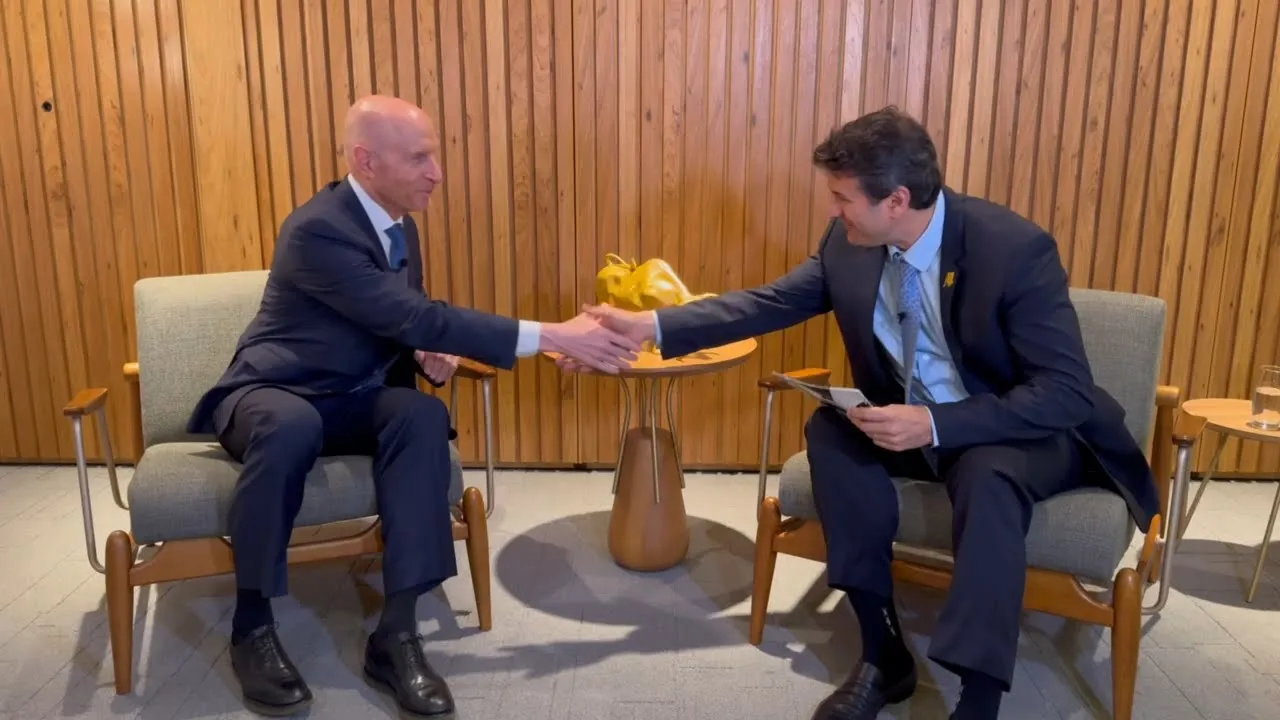
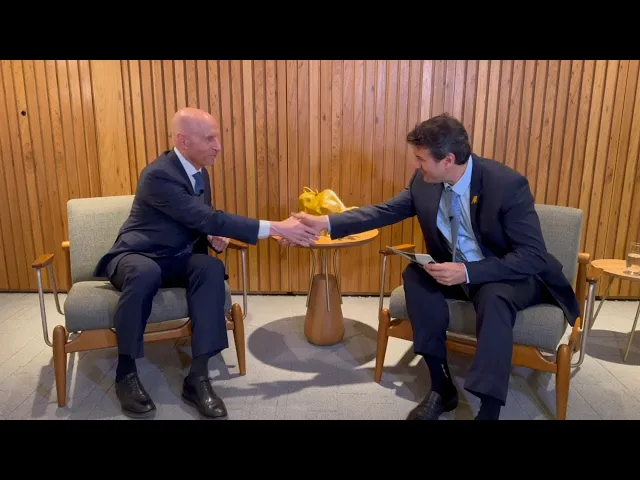
[Music] Hello, welcome to Face to Face with the BU with Mr Mayor Smith, executive chairman of Brazil potach. Today it's going to be an interview in English. Mr Mayor Schmidt is a seasoned executive with over 30 years in leadership in global agriculture, energy, and supply chain management.
He most recently served as chairman of Versa code, Canada's largest temperature sensitive supply chain company from 2013 to 2021. He held key roles on nutrient company including chairman and intering CEO where he chaired the merger of Agrium and Potach Corporation. as CEO of Idro 1.
From 2015 to 2018, he oversaw one of Canada's largest IPO and achieved significant cost savings. From 2000 to 2012, he transformed Vera Inc. into a 7.
3 billion global agri business through major acquisitions and international expansions. Early in his career, he held senior roles at General Muse and K Ara. Thank you very much for being here, Mr Mayo.
It's a pleasure to be with you today. All right. Okay.
We're here at B3 for an important event that the launch of the PTR of Brazil potach in B3. So now Brazilians will be able to invest in this company that's listed overseas through here. Right.
Yes. So, okay. So, Mr Mayor, please tell us what Brazil potach or Brazu potach in English, what it is and what's the goal of Alaz's project.
Well, the important thing is it's a critical mineral that exists here in Brazil that will support food security for the world and it secures Brazil's position in terms of supply chain management for the potach to produce agriculture crops. All right. All right.
Well, the company is Canadian but operates in Brazil. What's the strategic logic behind that? Well, certainly it is that with the growing population in the world today and the discovery of this important mineral that we can produce this mineral to secure the production and increasing production of Brazil crops for supply to the world.
And today in an era of supply chain disruption, it becomes important that you have your own supply to secure that production that will be exported to many countries around the world. Yeah, you're mentioning the mineral and what's the importance of potach for the Brazilian agriculture? Well, it it sustains the plant growth and it secures plant growth and it's responsible for probably 50% of the production of plants around the world.
So, it is a critical mineral that uh allows not only the the plant growth but the volume of production that a plant produces for of crops and also protects uh the the crops. How does potach helps to protect crops against heat, floods and also how does it ensure higher land productivity? Well, it it creates a resilience in the plant and it creates that critical mineral that supports the plant growth and plant life and uh when you're producing on soil that is depleted through multiple crop productions, uh it replenishes the nutrients in the soil.
Okay. Uh you mentioned once uh in the past to us that uh Brazil has the potential for up to three harvests per year but relies on the proper use of fertilizers. Can you explain that relationship a little further?
Yes. When when you of course are growing crops and the nutrients go into the plant, you harvest the plant, you have to replenish the nutrients in the soil. And so what this does with potach, it is a replenishment of that nutrient.
And we're working with Brazil's farmers and have contract contractually worked with the farmers to make sure that they have these critical nutritions for their crops. Well, today Brazil imports 94% of the fertilizer that we use, right? You you mentioned to me uh what are what are the risks of depending on countries like Russia or Bellarus and Canada?
Well, when you think about the supply chain, first of all, it's 110 days away from, you know, halfway around the world to get product here. So, timing really is critical. Uh secondly is uh in the supply chain, we have issues in geopolitical conflicts, we have port strikes, we have uh rail strikes, uh we have a changing uh event here with the Panama Canal in terms of how that's going to work out in terms of supply chain.
So this is a product that is two days away by barge from the major production area the Migraso in Brazil as compared to over a 100 days of supply chain and of course uh the the carbon that's required between rail and and oceangoing vessels to get that product in market. So we bring it halfway around the world. We go through uh multiple storage situations onto the ship and then we wait at ports that are congested because of other supply chain and then we unload into storage and then reload it back into halfway across the country to get it in market as compared to this product is under the ground in market uh in the agriculture sector.
Okay. You mentioned the geopolitical risks crisis. How did the how does the the war in Ukraine affect this market, specifically the war in Ukraine?
Well, it's it's been you've seen the volatility in pricing. We've gone from a product that would generally trade at $350 a ton in market to over $1,200 a ton because of the supply chain issues. And it's a disruption in terms of shipping availability of ships, the insurance of ships to be able to at Origin to load these ships and then sail them halfway around the world in market.
And then of course there's also the sanctions that are changing daily that also have to be considered. So it's not security of supply for a critical mineral for plant life in market for Brazil to be able to to support three crops a year. Yeah.
So I I understand as a pressure of prices up also. So what's the talking about cost? What's the cost difference between importing potach for example from Canada or Russia and producing it locally through your project?
Well, it's over $130 a ton. And just to give a perspective, we can produce in country and transport at less than the cost of transportation alone. Wow.
From a foreign country. Mhm. Okay.
So, it's a big difference. It's a huge difference. So, the second large potach reserve in the world is in Otazis.
It's here in Brazil just two hours from Manow. Man is important hub here in Brazil. What was the process?
How was the process like to obtain the environmental license needed to explore Otasis? Well, it was it was a period of seven years where we had we had undertaken considerable work uh and had secured all of the permits 21 permits necessary and appropriate for producing the pod ash in market to secure the supply to sure the environment and also in this uh process we've also been able to secure uh uh access to hydroelectric. So this project will be 80% carbon neutral.
So from hydroelectric production, it'll be the cleanest pot ash produced in the world today. Impressive. Impressive.
And how are your forecasts? For example, can the project supply up to 20% of the Brazilian demand for for fertilizer for potach? What and and if so, what's the timeline to get there to get to 20% for example?
Yes. Yes. So, so to your good point, uh we will produce up to 20% of the demand in Brazil in the first phase and there of course development after that can occur.
Uh today with as you mentioned Brazil importing 95% of this critical mineral in a supply chain era where we've got disruptions at at home. It gives us the opportunity to be certain that we can be there every day in just in time delivery and to support the production of uh critical uh crops that are grown here in Brazil. Yeah.
So the agriculture market here in Brazil is very important super important for our GDP. So I have a a questions related to that. What's your estimation?
the estimated annual production volume and what would be its impact in the agriculture GDP of Brazil? Well, first of all, it'll be a 6% increase in the GDP. Secondly, when you think about the production, it'll be 2.
5 million tons in the first phase of production that will supply 20% of the market here in Brazil with an opportunity to expand that. So, it's a 24 year supply that can grow to over a hundred years if the company chooses to continue to develop and and secure uh additional uh minerals. Oh, impressive.
Impressive, Mr Mayo. So, Mr Mayo, how exactly I'm curious, how is the the potach extracted? Is it like for example like oil extraction?
How does it work? Well, that's a really important point. The interesting thing is the extraction with really the plant sits on as much as 34 acres or 13 hectare.
So it's a very very small footprint for what it can do. So it's a shaft that goes 800 meters under the ground and then the potach is in seams. So it's ancient seabeds from millions of years ago, hundreds of millions of years ago.
And then the pod ash is extracted with a combination of salt. It's brought to the surface using no chemicals at all. The hot water alone.
The pod ash is separated from the salt. The salt ultimately goes back underground into the chambers where it was extracted from and the mineral of pot ash goes onto a barge in two days it's immediately into production areas for crops. Wow.
And and how does the separation of the salt and the potach help happens down deep in the the earth? Well, in fact, it doesn't. So, the the the the minerals extracted and brought up to the surface.
the plant that sits on 34 acres or 13 hectare. It's used hot water to separate the two products. And the salt is just table salt.
It's a natural mineral that's under the earth. Okay. And then the pesh stays above and is loaded into in barges and the salt goes back into the chambers of which it was extracted.
So you the salt back again. Yes. Yes.
Leaving no footprint on the on the earth ultimately and it's all natural products. Oh, awesome. Unbelievable.
Very impressive. Awesome. So your transportation logistic also be to be seems to be a key differentiation differentiator.
Can you explain how you manage to reduce costs compared to international competitors? Well, and the competitors of course are using rail and storage and ships to bring product for over a 100 days away from halfway around the world. It's just so also there's a time lord.
Oh, which is also in the time is affected by port congestion where ships sit and pay to merge or cost sitting offshore waiting to unload. And in our case, we're able to bring the product to the surface, separate it, use just in time delivery. We're literally 7 kilometers from the river.
We load a barge. 2 days we're in market and distributing into the farm and agriculture communities. So when you think about two days versus over a hundred and all of the carbon that it takes to get in market between trains and ships versus our hydroelect electric supported project in market next to the Modaso which raises over 45% of the production in Brazil which is critical for the world's food supply.
So uh also recently Brazil potachio raised $30 million for the company. How are these funds being used? Well, they're being used to prepare this the the land for the 34 acres or 13 hectar for the plant site.
Uh it'll be used for the the road improvement to get to the river and then of course we've got a relationship with the farming community for barges which we'll discuss which is rather important to us. Okay. Well, it was the first it was in the end of last year, right?
It was the first IPO of a Brazilian operating company since 2000 I guess 2021. How how did the market receive it? How did how did you feel the Brazilian people?
Well, one is it's very very positive for the market and particularly for food security. Unfortunately, a time of disruption in the markets, a change in geopolitical leadership, a change in global conflict. It's created a real uh pressure on any entrepreneurial opportunity that's occurring today and we've experienced that as well.
But it hasn't changed the value proposition of this product that is going to be necessary to grow crops for the growing uh food production needs in the world. Okay. So well today we are here in B3 the Brazilian stock exchange to launch the BDR of GRO which is the listed asset of Brazil potach in uh New York right.
Uh can you please explain a little bit about the BDRs? Well, yes. In fact, this is a really strategic and critical opportunity for people here in Brazil to participate in agriculture, which is the largest GDP producer in the country, in a critical mineral that is entering the market to support food production, which is one of the, you know, food energy and water for human life is critically important.
So, we're bringing that here to Brazil and making it available to the Brazilian uh population to participate with us and support not only the financial returns for them individually but also do something that for humanitarian effects to support food production. Exactly. To be partner with Brazil potach.
Absolutely. And also Amaji is your partner, right? Uh how important is this partnership?
Yes. The it's it's been a wonderful partnership with Amaji. Not only do they uh buy the pot ash from us for their plant production, but they also provide the barges and those barges are taking grain production to the coast for export.
They're coming back empty and we can fill those with fertilizer to support their crop production. So they've demonstrated incredible leadership in in tying our production to the farm economy. Oh, so yeah, they're the agriculture guys.
How does the Well, there was a national fertilizer plan launched on 2022. How did the plan influence influenced your project? Well, first of all, it was demonstrating market leading by declaring early prior to any other country doing so that potachsh is a critical mineral and and the government of Brazil taking the leadership to recognize the importance of food production here in Brazil for the world where we have probably 900 million people on the planet that are facing starvation today and growing populations to take that leadership, declare this product a critical mineral and assist us and support us in the development of this important project.
So what are the next major milestones for 2025 2026? Well, it's it's one is we're preparing the surface. Secondly, we'll uh engage in uh bidding for the shaft development and then a building of 100 miles and 160 km of power lines that will come from the hydroelectric support for the plant.
The important thing about that is not only the hydroelect electric will support our plant, but it will take 200,000 residents in our communities local to the podash production off of diesel generation and put them on hydroelectric power and the government is just thrilled about that opportunity. Great news, great news for Brazil for us. So in three years you will be full operational, right?
So how do you see Brazil potachio in 2028 for example? Well, what my view would be that with the development of the mine and the production and the relationship that we have with our farmers and we've already covered contracts for 15 years in the future. So, it's not a case where we have produced it and then go find buyers.
We've already committed to the buyers. Emagi has bought 15 years of supply. So, the vertical integration of this and the production is all seamless and is all complete.
So, it's really just a matter of getting the shaft in, building the plant on the surface with a small footprint, and then getting the product into the barges going into the farm community. Okay. Good.
Great news. Good, good news. So, what legacy do you plan to leave for Brazil with this project?
Well, I think it's a great opportunity to recognize as government has in a critical mineral the importance of food production and their leadership role in this world today and with the growing population and the disruption between tariffs and other supply chain. This is an internal unaffected by outside events that can secure that supply and grow grow production for uh for our human population and deal with food insecurity in the world today. Okay.
So, well, if everything goes as planned, can Brazil finally stop being dependent on fertilizer importation? Well, and you look at first phase, we're 20%, second phase and growing up to even a 100redyear supply absolutely can. that needs the support of the Brazilian population to get behind this.
It needs government support to be successful and we'll carry out our duty to deliver this product into the critical areas it needs for producing plants. Okay, great. Thank you.
I thank you for Brazil for helping us to to stop to being dependent on this fertilizer from this place so far away and thank you very much for the interview. Thank you. Thank you.
Okay, so you that watched the face to face with the with Mr Mayor Schmidt from Brazil potach. Thank you very much for your audience. Now we're going to keep on bringing more informations of Brazil potach.
This is the beginning of a partnership between us. Thank you very much and see you next.



![Harvard Professor reveals the Science of Happiness in 15 minutes | Arthur Brooks [ARC 2025]](https://img.youtube.com/vi/w8a0T5XLrXc/maxresdefault.jpg)