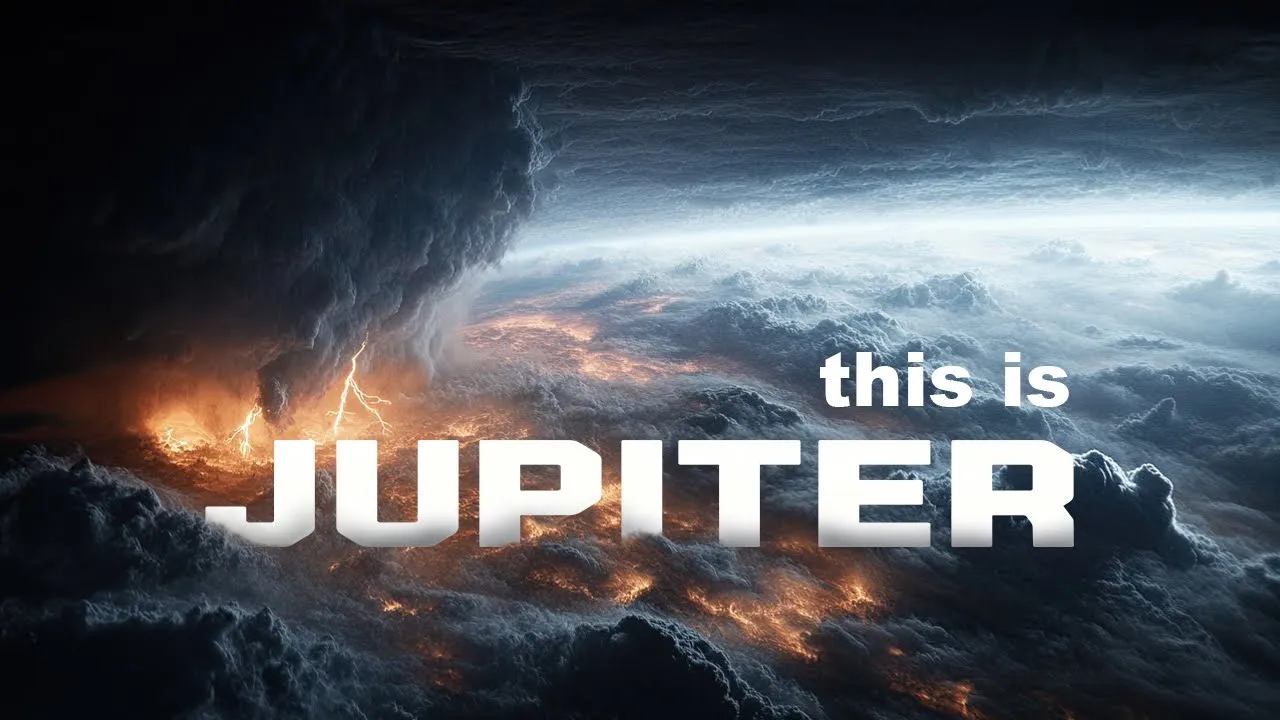
Jupiter floats in the darkness like a colossal beacon. From afar, it looks like a striped sphere, a gas giant so massive that it outweighs all the other planets in our system combined. What kinds of forces create those alternating shades of orange and white?
Today's journey is not just about a planet, but a dynamic laboratory where atmospheric physics and planetary evolution converge. This giant composed mostly of hydrogen and helium, the very ingredient stars are made of, never ignited into a star. Instead, it radiates an internal globe, a quiet testimony to its turbulent origins.
What drives this internal heat? How do the powerful winds carved across its surface maintain the continuous motion we observe? Today, we'll take a closer look at its faint halo of rings and distant moons lost in the glare of the giant.
What stirs in the depths of this planet? Where have the obvious surface elements gone? What illogical phenomena are hidden at its poles?
Our journey, accompanied by original imagery from NASA probes and enriched with meticulous animation, invites exploration of these mysteries. [Music] Up close, Jupiter's face breaks into bright bands of clouds, okra, brown belts, and pearly white zones running parallel to its equator. These atmospheric stripes are not static markings, but visible manifestations of powerful jet streams racing around the planet at immense speeds.
Jupiter's atmosphere is organized into east-west flows that alternate as they encircle the globe, intensifying multiple times from the equator to the poles. In the lighter zones, clouds of ammonia ice rise from below, reflecting sunlight and white and pale gold. In the darker belts, we see deeper layers of the atmosphere where clouds tinted by compounds like ammonium hydro sulfide give off rusty and amber hues.
Each adjacent band moves in the opposite direction of its neighbor. A giant planetary pattern etched by ferocious winds. The speed of these jet streams can reach hundreds of miles hour, far exceeding any hurricane on Earth.
Some winds in Jupiter's upper cloud layers exceed 400 mph and at certain altitudes even more. The corololis effect on this rapidly spinning sphere fractures the atmosphere into dozens of east and west moving jets between which lie the bright zones and dark belts. The planet's atmosphere is divided into zonal flows.
Essentially, a system of cyclonic and anti-cyclonic jet streams. Deep below. Jupiter's internal heat left over from its formation drives convection that continuously fuels these flows, sustaining eternal winds.
The jetreams form sharply defined bands that remain astonishingly stable over time. Yet their boundaries are turbulent and chaotic. We observe fine waves and curls where fast winds whip past each other.
A sign of intense wind shear shaping the cloud tops. Ammonia and water vapor rising upward condense into bands of high white clouds. While in other areas, descending air clears the sky to reveal the dark layers beneath.
The result is a marbled pattern encircling the entire planet. Amid Jupiter's bands, there is a storm raging like no other. The Great Red Spot.
This salmon colored oval cyclone has been raging in the planet's southern hemisphere for centuries, and it's large enough to engulf Earth entirely. More precisely, the Great Red Spot is an antiscyclone, a high-pressure vortex spinning counterclockwise opposite to a typical cyclone and towering above the surrounding cloudscape. In this closeup, the spot's clouds swirl into a dense oval ring the color of a faded brick.
A high alitude haze gives the spot its reddish tint, though its exact chemical makeup remains somewhat mysterious. It may be colored by complex organic molecules or phosphorusbearing compounds dredged up from the depths. Inside, bands and swirls spiral like a giant eye.
Around its edge, winds rage at speeds of up to 268 mph, sculpting cloud matter into a form that has fascinated astronomers since it was first observed over 150 years ago. White ammonia clouds swirl around the spot's perimeter, stretching and being pulled into the vortex. From time to time, smaller storms collide with the Great Red Spot, either bouncing off or being absorbed.
It acts as a ruler of Jupiter's atmosphere, influencing weather far beyond its immediate borders. In recent decades, observers have noted that the spot is gradually shrinking and changing shape. It was once twice its current size.
Nevertheless, it remains the largest storm in the solar system. The Great Red Spot completes a rotation roughly once every six Earth days. At its center lies a relatively calm area compared to the fierce surrounding jets.
High above the storm hovers a dome of reddish haze, setting it apart from the brighter zones nearby. Within this giant, lightning has occasionally been observed, briefly illuminating the clouds from within. Far beneath the cloud tops, the storm likely extends for many miles.
Though instruments aboard the Juno spacecraft suggest it may be relatively shallow compared to the planet's radius. Still, it stands significantly taller than the surrounding cloud layers. The Great Red Spot is essentially a massive long-lived high-pressure system.
Something akin to a hurricane's inverse with wind spiraling at its top. It's persisted so long that it may have even changed form over time, merging with several major storms from centuries past. Beyond the Great Red Spot, Jupiter's entire atmosphere is filled with smaller storms and vortices.
Planet is a canvas of everchanging [Music] turbulence. Along the belts, we find elongated white ovals, small anti-cyclones similar in nature to the Great Red Spot, but much smaller in size. Some last for decades, while others form and dissipate within a few weeks.
At one latitude, a chain of such storms curved around the planet's southern hemisphere like a string of pearls. These white ovals can merge over time. In 2000, three small ovals combine into a larger storm called Oval BA.
Oval BA, nicknamed Red Spot Jr. , later turned red and reached a size roughly half that of the Great Red Spot. Between the major spots, Jupiter's clouds are full of turbulent flows.
At the boundaries of the fast jet streams, the windshare creates twisting filament-like patterns. We observe swirls where dark belts meet light zones, and likely these are Kelvin Helmholtz waves formed when two air layers slide past each other, creating a wavelike cloud. In some regions within the belts, small dark barges drift by while bright popup clouds resembling popcorn mark powerful convective thunderstorms rising upward.
Jupiter's atmosphere has no solid surface to interrupt the winds. Storms can dive deep and last longer than any earthly equivalent. Following the curve of the planet, we see countless small rotating structures from compact vortices just a few hundred miles across to vast chaotic regions where multiple vortices interact.
These collisions and mergers regularly disrupt the rest of the strike pattern. For example, a turbulent region often trails behind the Great Red Spot, where the spot's flow disrupts the neighboring belt and creates clumps of vortices and pale clouds. This turbulence acts as a storm nursery.
New vortices can be born in these chaotic shears. Yet, amid this apparent chaos, there is a kind of order. Each storm tends to stay within its latitude band, held in place by powerful zonal jetreams.
Despite the striped and chaotic look of Jupiter's equatorial and mid latitude regions, surprising order emerges at the poles. Flying over the poles, Juno discovered polar cyclones arranged in geometric symmetry. At Jupiter's north pole, eight massive cyclones are evenly distributed around the central one, forming a nearperfect octagon of storms.
Each of these polar cyclones is enormous, about 1,500 to,800 m across, but they sit tightly next to each other without merging. all spin counterclockwise, their spiral arms nearly touching, yet balance is maintained as if something repels them from each other so no one crowds too [Music] closely. The pattern is truly striking.
A polygon of synchronized cyclones, bizarre yet stable. The South Pole displays a similar scene. It originally had five cyclones surrounding a central one and was later joined by a sixth forming a hexagon.
These polar clusters have remained stable for years of observation barely shifting. The symmetry suggest hidden physics. Perhaps a fine balance of vortex flows and jetream boundaries locking the storms into place.
Suddenly, a bright flash lights up the planet's clouds. There's lightning on Jupiter. For a moment, the tops of the clouds just glow intensely.
Then darkness returns. Jupiter's thunderstorms produce lightning that rivals and even surpasses that of Earth. Since Voyager first spotted them in 1979 as fleeting flashes at top the clouds, we've known that lightning on Jupiter occurs deep in the layers of water clouds where temperatures and conditions are similar to Earth's storms.
But NASA's Juno mission found a new twist. The planet also has shallow lightning as electrical discharges high in the atmosphere within clouds made not just of water but of an ammonia water mixture. In these cold upper layers where temperatures drop to about -126° F, normal liquid water can exist.
But Jupiter's abundant ammonia acts as antifreeze. During powerful storms, icy hailstones are hurled upward some 15 miles above the usual cloud decks into regions rich in gaseous ammonia. Ammonia melts the ice, forming droplets of ammonia water slush.
In this strange alien thundercloud, collisions between rising ice crystals and falling hailstones saturated with ammonia, which earned the nickname mushballs, generates static electricity. The result, lightning crackling through Jupiter's upper atmosphere, far higher than we thought lightning could form. These shallow lightning bolts flash through ammonia clouds, briefly illuminating towering storm structures with eerie blue and gold light.
Juno detected these flashes on the planet's night side, each lasting just milliseconds, yet glowing nearly as brightly as Earth's familiar lightning strikes. Deeper down in more conventional thunderstorm regions 30 to 40 miles below the cloud tops, lightning strikes are just as fierce. Here, water exists in all three phases, ice, liquid, vapor.
Just like in Earth's cumulo nimbus clouds, promoting energetic charge separation. Some lightning bolts are colossal, releasing several orders of magnitude more energy than typical lightning on Earth. Juno detected thousands of lightning flashes, hearing their radio crackle, so-called whistlers as it flew over the cloud tops.
Interestingly, it was Juno's discovery of shallow lightning that solved the mystery of why ammonia seemed to be missing from Jupiter's air. Mushball hailstones were carrying the ammonia deep down, removing it from the upper atmosphere. Once more, we witness a flash piercing a distant cloud bank.
Lightning illuminates billowing cloud towers rising above the surrounding haze. These convective towers can reach heights of 30 m driven by the planet's internal heat. In the brief glow, we glimpse the outline of a colossal thunderhead, possibly the source of ammoniarich hail falling downward after the strike.
Now, let's go beyond the clouds and storms. High above the poles of Jupiter, there are shimmering auroras of staggering power dancing in the sky. Each pole is surrounded by the constant halo of glowing auroral radiation, crowning the planet's darkness with an otherworldly blue violet light.
Jupiter's auroras are the most intense in the solar system. Hundreds of times more energetic than Earth's northern lights. Unlike the fleeting auroras on Earth that appear only during solar storms, here the auroras never cease.
They're driven not only by the solar wind, but also by the planet's immense magnetic environment. Jupiter has a magnetic field estimated to be between 16 and 54 times stronger than Earth's, generated by metallic hydrogen rotating deep within the planet. This magnetic field captures charged particles and channels them toward the poles.
When these high energy particles collide with Jupiter's upper atmosphere, they excite hydrogen molecules, causing them to fluores in ultraviolet and infrared light. The result, gigantic oval rings of auroral light encircling each pole. In the image, the northern aurora glows with an electric blue light spiraling under the influence of magnetic forces.
The auroras are partly powered by the rotation of the planet and its moons. Volcanoes on Io, Jupiter's innermost major moon, spew tons of ionized sulfur and oxygen, which get trapped in Jupiter's magnetic field. As Jupiter rotates, taking less than 10 hours, it drags the magnetosphere with it, flinging ions toward the poles.
Io's contribution is so significant it creates footprints in the aurora, bright spots corresponding to magnetic connection points between Io and the planet's atmosphere. Similar footprints come from Europa and Ganymede. One of these can be seen as an especially bright pulsating auroral spot at the edge of the northern oval.
In addition, burst of solar particles, the solar wind can intensify the glow, causing it to flare even brighter and more dramatically. Observations from Hubble have shown auroral curtains reaching thousands of miles above the cloud tops, far surpassing anything we've ever seen on Earth. However, even an observer standing within Jupiter's atmosphere would not be able to see these massive glowing rings overhead.
That's because they glow in wavelengths that our eyes can't perceive. Primarily ultraviolet. On top of that, they also emit X-rays.
essentially Jupiter's aurora shimmer emitting high energy X-rays, a phenomenon still being studied to determine how these particles are being accelerated. Let's pull back even farther from the planet's surface. Against the blackness of space, Jupiter is surrounded by something unexpected.
A faint set of rings encircling the gas giant. Shimmering like strands of spider silk. Jupiter's rings are nothing like Saturn's bright sweeping arcs.
These are thin, almost transparent bands of dust, so tenuous they weren't discovered until 1979. In this image, we see the main ring as a slender bright line wrapping around the planet's equator, a dim halo within it, and a wide diffused gossamer ring extending outward. These rings sparkle in sunlight, appearing as a faint white line crossing Jupiter's night side.
They are a million times fainter than the planet itself and are composed of tiny dust grains, not brilliant chunks of ice. So what maintains such structures around a colossal planet? The answer lies right in orbit.
Jupiter's small inner moons. Two of these, Amla and Adrastia, appear as faint points of light within or near the rings. In this image, Amthea is visible on the left edge of the ring system.
a tiny white dot with a barely noticeable defraction spike, confirming its presence in JWST's infrared view. The even smaller adia appears as a speck of light on the very edge of Jupiter's main ring. These rings exist because the moons are constantly replenishing them.
Unlike Saturn's icy rings, which may be remnants of a shattered moon, Jupiter's rings are formed from dust created by micrometeoroid impacts. When space debris strikes the surface of tiny moons like Adraia or Metis, it kicks up particles that drift into orbit around the planet. And over time, countless impacts form a dust ring.
Adraia, only about 12 miles across, orbits right at the edge of the main ring and is its primary material source. The slightly larger Metis, though not shown here, contributes as well. Farther out, the moon's ama, about 155 mi wide, and Phoebe emit dust that forms the faint outer braids of the ring.
Data from the Galileo spacecraft confirm this mechanism. Jupiter's rings are indeed composed of dust blown off its small moons. The vertical thickness of the main ring is just a few miles.
Up close, the particles are microscopic bits of silicut rock, likely dark in color, which is why they reflect so little sunlight. They're virtually invisible unless seen in infrared or angled and with backlighting as we're doing now. There it is.
Jupiter, a dynamic system in its own right. Atmosphere, magnetosphere, rings, and moons all bound in a complex gravitational and electromagnetic embrace. We observe atmospheric bands stretching across its latitudes, holding storms and channeling energy from within.
We feel its internal heat still radiating from a primordial furnace, fueling convection that gives rise to thunderstorms and towering clouds. Invisible lines of magnetic force reach from its depths, linking to the auroras at the poles and courarssing through Io, driving electric currents that make the polar skies glow. Jupiter's rotation ties all these elements together.
Its rapid spin shapes the bands, aligns the cyclones, shifts the magnetic field, and even helps maintain the rings in a flattened disc. From this perspective, the planet is a symphony of motion and forces, fluid dynamics, electricity, magnetism, gravity, all playing out on a grand scale. Now, all these elements come together in a single portrait.
Jupiter is a world of eternal change and immense power. There's no need for a conclusion because whatever we say, Jupiter remains what it has always been. A majestic, mysterious, and forever dynamic gas giant, holding with it echoes of creation and the ongoing drama of the cosmos.


![Collisions of the Early Solar System [4K]](https://img.youtube.com/vi/5cw0dO5RF-8/maxresdefault.jpg)