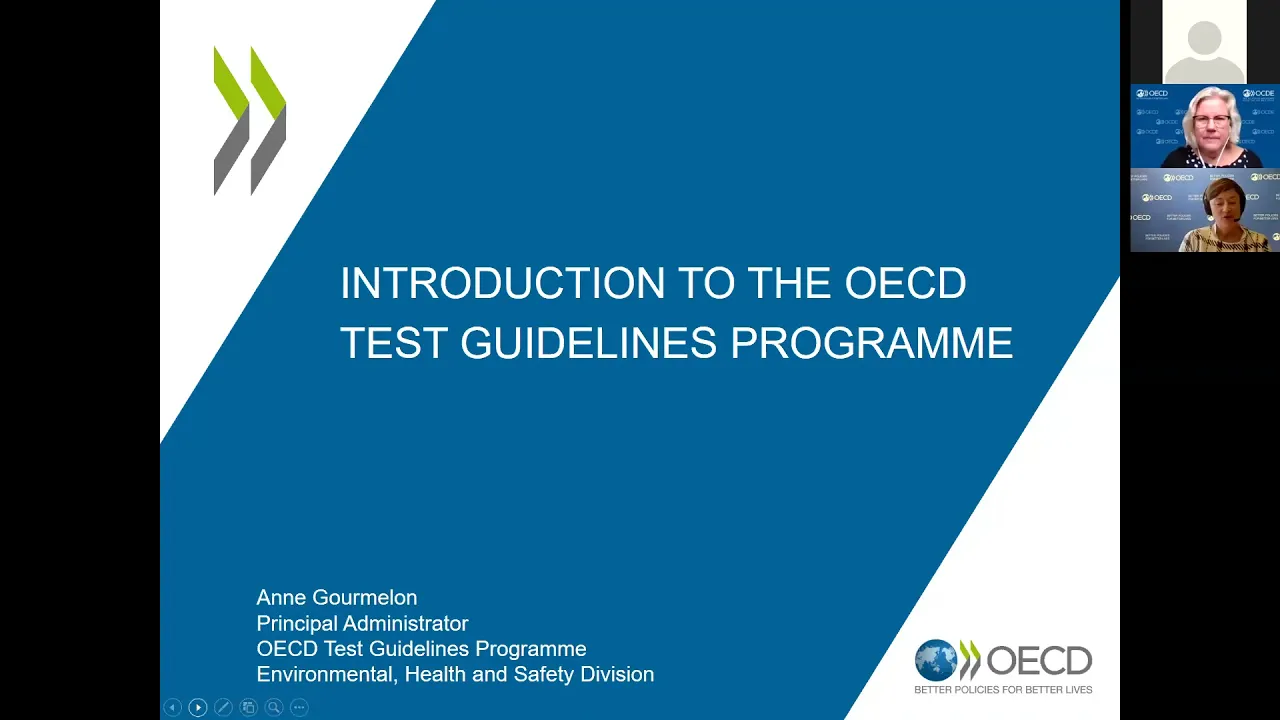
good good morning good afternoon and good evening to uh to you all i'm anne gomez and i'm principal administrator of the oecd test guidelines program my presentation today i will provide you with some basic information about the the functioning of the oecd test guidelines program and everything you ever wanted to know without daring to ask so the foundation of the oc test guidelines program are in the the system of mutual acceptance of data we're a study following an oecd test guideline in accordance with a good laboratory practice generate data that are accepted in all countries
that have the same data requirements this is further elaborated in details in an oecd council decision dating from 1981 so tested once accepted everywhere is the model uh the working party of the national coordinators of the test guidelines program oversees the work in the program uh members and uh adhering uh countries uh nominate uh one or more national coordinators um uh the european commission uh industry non-governmental organizations such as animal welfare groups also have their national coordinators the list is public as you can see and the secretarian secretariat team supports the program [Music] the wnt
which is the acronym for this working party meets uh once a year in april for about four days um documents are submitted for approval on this occasion only decisions are made on project proposals proposals that are made by the member countries the meeting is of course uh an occasion to review ongoing projects and discuss any issues encountered and also general program related issues regular observers are the people's republic of china and the russian federation two advisory groups um uh are affiliated uh to the program the endocrine disruptor uh testing and assessment advisory group and the
group on molecular screening and toxicogenomics that also oversees the adverse outcome pathway program at the uncg and deliverables from this program um eggmaster are both relevant to the wnt and to another working party which is the working party on the hazard assessment so projects in the test guideline program are led by member countries as i already mentioned contributions to the program represent voluntary work by experts in member countries uh the projects uh respond uh to specific regulatory needs in several countries a template format for making proposals is available to national coordinators for describing new project
proposals and every year in november proposals are invited and there is a review cycle that stands looking a little bit more into the details of the template for making project proposals information is expected on the regulatory needs and the validation status of a proposed method an endpoint or an approach the presence of protected elements has also become an important information indicative of the future accessibility the transparency and distribution of new technologies uh covered in new approaches so uh the review of uh proposals for new projects takes place between november and mid january of the year
after so a couple of weeks a few weeks to organize some iterations of review and responses and revisions to project proposals until the annual meeting of the wnt takes a decision on a new project on this slide it shows you a snapshot of the different projects on the web plan in each area of chemical safety testing and of course you immediately see that half of the resources in the program are devoted to methodologies for human health safety testing and assessment the program is really a rich of a vast network of experts nominated by their national
coordinators in expert groups some scientists from academia regulatory agencies national institutes industry contract research organizations animal welfare groups and other ngos interact together to develop review and harmonize test guidelines guidance documents and review papers here on this slide i indicated the expert groups that are currently in active discussions on the projects so although the main objective of the program is to deliver the harmonized testing tools that can be used to meet the regulatory needs in member countries the program also generates a number of companion documents and material to support test guidelines use and review papers
that are exploratory for new areas of testing and assessment in the course of the development of harmonized test guidelines there are uh several important steps um that are uh ultimately uh leading uh to uh the acceptance of uh test guidelines um typically a test method that is candidate for test guideline development comes with a package of supporting information and data on its validation status um to a test of its reproducibility and relevance guidance uh has been developed over the years to orient test method developers um in the different steps that can be organized in modular
approaches towards the development and validation of test methods and later in this webinar you will have presentation from valerie zugan from the john research center at the european commission who will further elaborate um in the next um [Music] talk on the the validation in particular so obviously once a method is considered valid uh by the wnt and approved as a test guideline subsequent demonstrations of its validity are not needed each time the test method is used of course this diagram summarizes the processes the workflow and the timelines for the test guideline development so once a
draft test guideline is ready um the draft test guidelines is typically made available on the oc public website and commenting grounds are organized with the national coordinators to collect feedback and consolidate the test guideline and obviously the the expert groups are playing a very important role at that stage to help the lead country now for the project addressing the comments received and the wnt then looks for a consensus on the final document one once it is ready for approval then on this last slide um [Music] you have an overview of the test guidelines team at
the oecd secretariat and their respective areas of coverage for projects that are active at the moment so uh with that i thank you very much uh for your attention um i hope um it was useful and i will now hand over uh to [Music] the chair of the test guidelines the working party of the national coordinators of the test guidelines program tim singer from canada to say a few words and from his perspective and his experience as chair tim over to you thank you so much anne and welcome everyone and thank you for joining certainly
my my pleasure today to share a few of my own personal reflections on the test guidelines program before going any further i'll just pause quickly if and you could just advise that you can hear me yes we can thank you so as i said some personal reflections from me and my experience in the test guidelines program it's actually been about 20 years as hard as that is to believe that i've had some involvement with the test guidelines program be it as a user of test guidelines someone who's authored some test guidelines and revised test guidelines
and then as a national coordinator for canada and then subsequently as the chair for the last number of years so if we move forward in the first slide the as an indicated the the working party is in fact the governance body and as all or most of the entities within the oecd operates on a consensus basis says an indicated with decisions made following an extensive consultative process and so the diagram that i show here that's essentially from from ann's presentation indicates the extent to which these consultations occur and uh decisions are extremely well considered before
they're made the downside of course is that this is a process that does take some time and so you'll see that following innovations in methodologies that have applicability in the regulatory space they're not immediately incorporated into the program there is a process by which due diligence is done and experts are engaged before we see these approaches move into the test guidelines themselves the role of national coordinators is actually a some somewhat of a challenging job at times for for most of us as the focal points for the test guidelines program in our respective countries because
not only do we have the responsibilities to organize within our countries the the efforts and support of the program and to engage with the program which often means engaging with a fairly wide and large expert group community to organize the sharing of comments and perspectives on the work but also we as indicated meet once a year for a meeting at which we represent our countries the important thing to note about the body itself is that there are remains from year to year a fairly consistent core group of national coordinators with the turnover being relatively small
and so that means as a as a body corporate we actually have a quick considerable corporate memory and so as a result we tend to to make decisions with a degree of internal consistency that's quite high and that means that decisions that are made are well considered and they reflect the past precedence while incorporating changes that reflect advances in the science and the technology that uh that warrants uh consideration if we move forward and i'll give i'll just start here with a few uh reflections on the past and then i'll move forward and uh in
a moment to talk about where i think things might go for the future but of course over the last i think it's been 40 years since the council decision obviously these tools have been well used amongst all member countries so there's an enormous amount of experience that's been gained to date with test guidelines and the associated guidance documents that are developed to support them and really the mutual acceptance of data concept or principle has become really indispensable to regulate organizations and industry worldwide and not only avoiding duplication but also being able to establish scientifically sound
methods with the aim of protecting human health and the environment and so these methods having been extremely well essentially developed in the scientific capacity then support regulation worldwide and including in countries that are adherent not necessarily members of the oecd but use the test guidelines to support their own national regulatory regimes i couldn't uh reflect on the past without noting the extent to which animal welfare considerations have really become fundamental to the program over the last 10 plus years although the program is really focused on addressing regulatory needs it's not doing that without a strong
focus on moving away from animal-based methods wherever possible and to accept and embrace alternative methods it's also worth noting uh and you can see that actually if you put uh physically a test guideline written 20 years ago against the test guideline written today just on on a on a table you can see definitely it's thicker it's much more complicated and obviously much more lengthy with the aim i think of trying to reduce ambiguities and to provide more clarity there's a lot more content within test guidelines today than there's a bid in the past and so
from the perspective of those users of the test guidelines the intention of course is to be more supportive but of course it comes with the cost of complexity at times and then there's been some and it's been more recent i think in my experience uh efforts made to address issues associated with intellectual property and to avoid i guess what we call inadvertent monopolies and so performance-based test guidelines so these are test guidelines where there's uh standards essentially embedded within the test lineup to allow others to develop similar methods uh than those that incorporate some proprietary
elements and as a result of that there's been in some some areas for some end points an explosion of what we call me too or very similar methodologies so you'll see some endpoints some areas in which the tesla events cover being fairly well subscribed by various test guidelines where there's in some cases last subscription of other methodologies and then moving forward talking about where i see things might go in the future obviously and indicated what the work program looks like it gets bigger and bigger every year with new projects taken on board every project has
a generally three to five year life cycle depending on how complex it is so at some point in time there might be a need for the program to think about making decisions around resource allocation and priority setting just to ensure that uh we're in a position to put our uh our efforts where the most benefit could be derived not sure we're we're at that point just yet but certainly as every year progresses it becomes more evident that there are finite resources amongst all the oecd member countries to move some of these projects forward and we
see that manifest from time to time in projects for example switching lead countries or some projects being placed in the annex because their resources that were apparent at the beginning of a project unfortunately for a variety of reasons may not have followed through we also have uh an ongoing challenge associated with the balance between making sure that the methods that are incorporated into test guidelines are supported by transparency so there's obviously need to understand how they work at a fairly granular level because they support decision making by countries that are making regulatory decisions on the
basis of these methodologies at the same time incentivizing innovation so if the program goes too far in one direction it may de-incentivize those from developing methods because they may not be able to see a return on their investment so this is a struggle and a constant balancing act that the program is uh is going to uh or has been and continues to to work through and mentioned briefly the defined approach based test guidelines essentially without describing what those are in depth just essentially methods that will allow the the use of multiple methods uh together uh
to address a particular endpoint or area where no single alternative method in vitro method and silicon method may ultimately replace an animal test guideline and these define base defined approach based test guidelines use fixed state interpretation procedures to to allow the grouping of multiple methods such that it ultimately could replace an animal method and therefore be covered under the mutual acceptance of data principle and so these so we were successful in april of this past year in approving the first defined approach-based test guideline for skin sensitization and we would expect this approach will continue uh
in the future to cover other endpoints that uh that are in this situation we uh as time has progressed have developed a large number of test guidelines there's a fairly significant library and as time progresses like in any uh area you need to curate your your library to make sure it's most relevant and current and so as methods become more obsolete or just advance in age and need revisions or where there might be animal methods that are used that may not be um or incorporated that may not necessarily be widely used we do have uh
the need to start to consider how we can address those and there's been some work recently dedicated to addressing the curation of the program and some work by countries to help to set priorities for how that could come together and then lastly preserving mutual acceptance of data in light of different requirements in different jurisdictions obviously where requirements are unique to a particular country or region it's always tempting to go off on your own but the value of the multilateral approaches has been well established and so the efforts that various member countries play in coming to
the table and ensuring that we're able to to set test guidelines together that broad applicability is going to become and continue to be very important and so then in conclusion in my last slide here just to uh to indicate that my view of course is that the program is really well positioned to translate advances in science about the development to uh to test guidelines uh as it always has been and it will continue to be over the foreseeable future and it's supported as well by an enormous community of experts as an indicated that contribute to
the program development and uh that provides a really solid foundation for uh for the future and then of course the uh the support and advanced metrics substance of data couldn't happen without uh extensive collaboration with the working party on glp and so we would definitely welcome that going forward so thank you for your your time today now we are going to move to our next speaker valerie zuwanga from the european union reference laboratory yeah url eckvam european center for the validation of alternative methods who is going to [Music] give us the perspective of a validation
body uh who does a lot of work uh who contributes a lot for uh the program like also many member countries of course but validation is certainly a central element of test guidelines development so thank you valerie for your presentation morning good afternoon or good evening to everybody depending on where you are in the world my name is valritsuwan and as an already and eva already introduced me i'm the national coordinator for the european union and i'm working at the european commission more precisely in the joint research center of the european commission which i will
introduce in in a moment my presentation will focus on validation in a regulatory context and here's an overview of my presentation first i will briefly introduce the jrc and ulac firm then we will go through the definition and principles of validation novel concepts in the validation of alternative methods and finally to the lessons learned during validation studies with regard to scientific and non-scientific issues the joint research center is the science and knowledge service of the european commission it supports eu policies with scientific and technical evidence that is independent from any national or sectoral interests it
has about 3000 staff almost 70 percent of whom are scientists the headquarters are located in brussels and the research facilities are spread over five eu member states which you see here on this map namely israel in italy carls who are in germany gail in belgium patton in the netherlands and sevilla in spain the largest site is at isra and that's also where our unit is located our unit is part of directorate f which is on health consumers and reference materials and is called chemical safety and alternative methods unit the unit hosts ul egg farm the
european union reference laboratory for alternatives to animal testing that has been established under directive 2063 on the protection of animals used for scientific purposes with the following broad tasks and tasks and duties guide research on alternative methods coordinate validation within the eu disseminate information on the triage promote stakeholder dialogue and promote international we have been working on method validation for a long time in fact we celebrate our 30th birthday this year and over those years we estimate that we have dealt with well over 100 methods with a view to their validation and regulatory use we
are always looking forward to share our knowledge and experience and to discuss ways of evolving validation principles and practice to keep pace with scientific and regulatory developments and to be as efficient and effective in what we do we work on test methods or approaches throughout their whole life cycle from research and development over validation to international adoption regulatory acceptance and finally implementation we don't do this in isolation but we have set up various networks that provide input to our process for example parere our network of regulators from eu member states relevant commission policy dgs eu
agencies such as ekka efsa and ema they provide the preliminary assessment of regulatory relevance of a proposed test method or approach whereas our ekfam stakeholder forum called estaf composed of industry academia and civil society provides advice on the relevance of a method or an approach from a user perspective the international perspective is provided by iketem the international corporation on alternative test methods involving nice item ik farm in the u.s jack van in japan health canada coke farm in south korea breakfam in brazil and occasionally governmental institutions from china singapore and taiwan we have also set
up and coordinate a network of 35 validation laboratories called eu network which provides support for prospective validation studies our ekfam scientific advisory committee called izak is carrying out independent scientific peer reviews of validation studies and issues opinions on the scientific validity of a test method or an approach in certain cases this opinion is followed up by the publication of a you a lag farm recommendation that has undergone prior consultation by pariri estaf iketem public and the test submitter in case the recommendation is based on the test method that has been submitted to exam for evaluation
validation and or peer review finally international adoption and regulatory use is achieved through uptake of the scientifically valid method into the eu test method regulation or in an oecd test guideline or as an iso standard or for medicinal products in ich bich guidelines or at the level of the pharmacopeia depending on the sector now we go to the definition and principles of validation validation principles of toxicity test procedures were first discussed at an cat air gut a workshop in 1990 um card stands for center for alternatives to animal testing which is still existing and it's
located at the john hopkins university in the u.s and ergat stands for european research group for alternatives in toxicity testing then these principles were then taken up later in oecd guides document 34 that was in 2005 and validation has been defined as the process by which the reliability and relevance of a particular approach method process or assessment is established for a defined purpose reliability is the extent that the test method can be performed reproducibly but sorry reproducibly yes within and between laboratories and over time when using the same protocol whereas relevance is the extent to
which the test correctly measures or predicts the biological effect of interest the defined purpose can be various and range from addressing a specific regulatory information requirement for example for classifying a chemical as a skin returned to the generation of relevant mechanistic information i will come to this in a minute a test method is never valid in an absolute sense but only in relation to a defined purpose if you are interested in the historical perspective on the development validation and use of alternative methods in toxicology this book here is a good reference another useful reference is
the book on validating alternative methods for toxicity testing this book provides information on best practices and new thinking regarding the validation of alternative methods for toxicity testing an in vitro test method is usually composed of a test system and points or biomarkers and a prediction model or data interpretation procedure and is accompanied by a protocol that describes how you should perform the test the test system could be cells or t tissues such as for example a reconstructed human epidermis model the endpoints could be for example mtt reduction for measuring cell viability and the biomarker could
be for example ldh release or a certain an expression of certain genes the prediction model is a formula or an algorithm used to convert the results generated by a test method into a prediction of an effect of interest and the data interpretation procedure is used to determine how well the results from the test predict or model the biological effect of interest both test system and endpoint need to be reproducible and have a relevant scientific basis with the prediction model and data interpretation procedure need to have a predictive capacity regarding the purpose as i said before
you could use the test methods for various applications in regulatory decision making for example to obtain mechanistic information to investigate how a chemical interacts with a human protein or for priority setting of chemicals of concern that need to be further tested for hazard identification uh for classification labeling purposes or for hazardous characterization with a dose response assessment and the establishment of a threshold dose below which the toxic effects are no longer observed considering what was just said validation can just be seen as the ultimate means to build confidence and reach acceptance but also to ensure
that solid science-based decisions are made to protect human health and the environment validation as we have heard before as well facilitates development of globally harmonized standard methods and as such it should not be perceived as an impediment or constraint acceptance cannot simply be imposed but needs a process of trust building amongst various actors in 2004 ekfam proposed to break down the information required for peer review of a test method into seven modules that do not necessarily need to be assessed in a sequential order and this provides a certain flexibility however test definition would normally always
come first but could still be refined at a later stage in the process the seven modules that you see here on this slide are test definition within laboratory reproducibility transferability between laboratory reproducibility predictive capacity applicability domain and if appropriate are necessarily necessary performance standards within laboratory reproducibility transferability and between laboratory reproducibility relate to the reliability of a test method whereas predictive capacity and applicability domain relate to its relevance at the level of the first module namely the test definition you normally already have an idea and at least some preliminary data on the reproducibility and relevance
of a method now this slide is just to show that there is not always a need to carry out a full prospective multi-laboratory validation study but that you could also validate a method on the basis of existing data in a retrospective validation study or for similar methods on the basis of performance standards if these are available and on the right hand side you can see several examples of methods in oecd test guidelines that underwent different types of validation processes now to the novel concepts in the validation of alternative methods now nowadays we are faced with
a plethora of new technologies such as chem informatics and computational models organ on a chip devices high content imaging omix technology 3d tissues exposure modeling all the data generated is then integrated to predict safety the biological complexity of in vitro test systems is increasing we are speaking of cultures of multiple cell types grown together furthermore we are experiencing a convergence of different scientific disciplines such as biology and engineering physics electronics and so on so validating or standardizing an approach starts to have a broader meaning depending on what it refers to thus the principles of validation
that say that a method or approach should be relevant and reliable are universal and valid the validation process is adaptable and depends on the purpose one size does not fit all the process needs to be fit for purpose i now come to the lessons learned from carrying out validation studies several workshops on validation had been organized in 2017 and 2018. in 2017 ivm and bfr so the netherlands and germany organized a joint workshop where the drivers and barriers concerning implementation of innovative 3rs approaches in regulatory toxicology were discussed this was followed up by a second
workshop in 2018 aiming to develop feasible solutions and recommendations to move innovation forward in this area in 2018 we organized the workshop with our academ partners and invited also some additional governmental institutes and authorities the oecd participated as well at the icatem workshop we discussed the lessons learned by iketum partners in the conduct of validation studies then we discussed four challenging topics in particular how to establish relevance without animal data how to evaluate reliability without ring trials how to evolve validation practices and how to develop the concept of standards for the lessons learned here are
some scientific issues we came across how should the relevance of single methods be assessed if you know that a method needs to be integrated with several others several sorry relevance assessment should be made within that integration context and one should not emphasize on the relevance of the individual method single methods validation is also time consuming and costly in particular if methods are not meant to be used individually another issue that has been occur encountered is the poor on unknown quality of the reference data which are often in vivo animal data against which you validate your
in vitro data and related to this too high focus is given to the animal test as the gold standard and the derived data which are used to assess the predictive capacity of your test whereas animal data are not always human relevant another issue is poor chemical selection introducing bias for example when the same chemicals are used for the development and validation of the test method and sometimes the same chemicals are even used for transferability and training purposes further guidance on chemical selection is needed to better explain how this should be properly done lab specific sops
that hinder transferability for example the sops are too specific to one laboratory too detailed with regard to the material that should be used and this is hindering transferability regarding non-scientific issues the current regulatory requirements are based on animal studies whereas the new non-animal methods provide a different type of information that does not fit these requirements international harmonization is critical but having guidelines does not guarantee use by regulators and industry if they do not fit the regulatory requirement in the jurisdiction engagement with stakeholders at every step is important a review and evaluation of uses and needs
of data across end users is key to define fit for purpose and context of use we heard about intellectual proper property tackling intellectual property ensuring commercial availability and avoiding abuse of a monopolies this is a topic that was discussed considerably over the recent years at the oecd with the development of the guiding principles on good practices for the availability distribution of protected elements in oecd test guidelines and the implementation of fair reasonable and non-discriminatory which we call friend licensing terms and conditions lack of transparency of protected elements for example when a test method includes confidential
business information and the prediction model is not explicitly described glp implementation of protected elements and cloud-based computerized system that's also a topic that has been discussed more recently in the oecd a working party on glp so some final thoughts from my site validation will remain one of the cornerstones of a successful toxicological evolution or revolution validation needs to keep pace with rapid scientific progress for example the defined approaches computational models organ on a chip it is important to keep scientific integrity credibility and usefulness while making the process more efficient and validation should be framed as
a process to characterize and reduce uncertainty rather than a ring trial to demonstrate toxicological equivalence that's all for me thank you very much