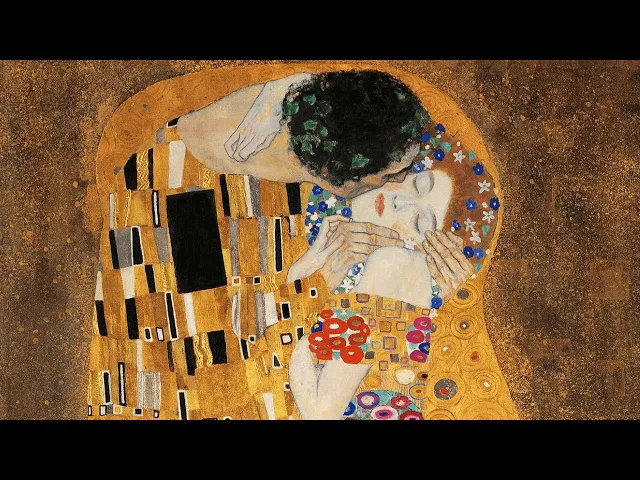
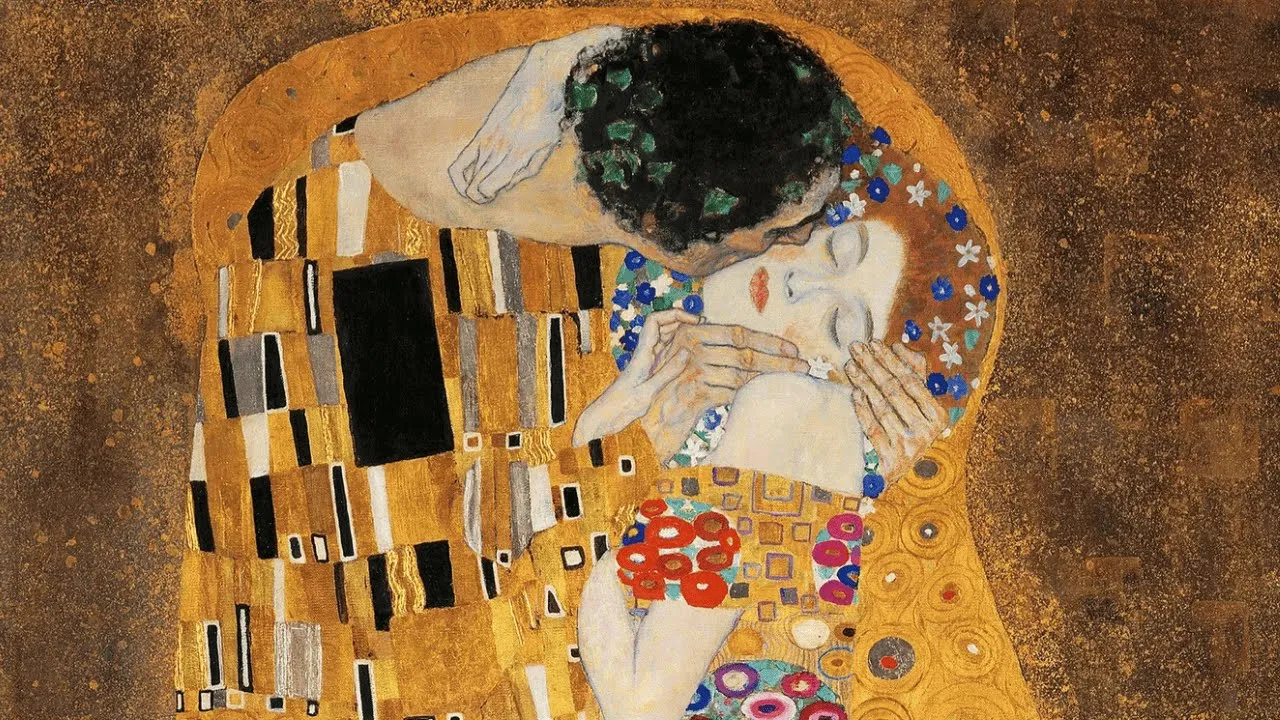
Very few paintings have reached a level of admiration as great as this one. It is one of those images that feels instantly familiar even to people who do not usually take an interest in art. The kiss was painted by the Austrian artist Gustaf Climpmpt around 1908.
And even today, more than a century later, art historians remain fascinated by this work. If we look at the painting and let its title guide us, it is easy to assume that it is simply an image about love and romance. two figures embracing wrapped in gold suspended in a moment of absolute intimacy.
And yet there is a theory that completely changes the way we see this painting. An interpretation that suggests this kiss is not only an act of love, but something far more tragic. When we begin to pay attention to the details, the image stops being as simple as it first appears and reveals a meaning that is far more complex.
The first element that deserves close attention in the kiss is the position of the woman's feet. If we look carefully, we see that her feet are placed right at the edge of what appears to be a cliff, as if she were clinging to the very limit of the world. Beyond this point, there is no clear information, only a vast golden hazy expanse that occupies much of the background of the canvas.
This could be interpreted as a night sky, a cosmic light suspended in space, or even the deep void that opens at the edge of a precipice. Her toes are tense, tightly curled, while her heels point toward this unseen part of the painting. This small detail is crucial because it seems to concentrate the emotional tone of the entire scene.
The image conveys a passion that exists at the edge, an intense closeness between two people embracing at a moment where pleasure and fear coexist. It is a powerful love, but also a fragile one, suspended at a point from which there is no return. The lovers appear kneeling on a ground covered with wild flowers surrounded by lush vegetation.
Their body language leaves no doubt that there is mutual surrender and consent between them. Their figures visually merge, wrapped in a kind of golden aura that separates them from the rest of the world. She encircles him with her arms while he gently holds her face as he leans in to kiss her.
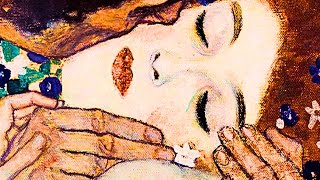
The scene communicates trust and desire at the same time. Moreover, the fact that we cannot see their eyes, hers closed and his hidden, reinforces the sense of an inviable intimacy. It is a moment we are allowed to witness as spectators, but one in which we can never truly intervene.
Now the male figure appears crowned with leaves while his golden cloak is covered with rectangular shapes in black and gray tones. These rigid blocks stand in contrast to the circular and colorful motifs on the woman's garment. She, by contrast, has a luminous face, flush cheeks, reddish lips, and small summer flowers woven into her brown hair.
Gold dominates the entire composition. Climp often applied gold leaf directly onto the canvas, combining it with oil paint to achieve the intense, luxurious glow that defines many of his most celebrated works. Climp's fascination with gold and ornamental patterns did not emerge by chance.
If we look more closely at the artist's life, there are two key experiences that help explain this aesthetic choice. The first relates to his childhood. His father was a vianese jeweler who specialized in working with precious metals and gold engravings.
So, it is hard to imagine that the young climp was not deeply influenced by the materials, textures, and brilliance he saw every day in that workshop. The second influence came years later in 1903 during a trip to Italy. In Ravena, Climpmpt was profoundly moved by his visit to the Basilica of San Vital and by the 6th century Byzantine mosaics that cover its walls.
These golden surfaces have a unique quality because they appear flat yet come alive when light passes over them. Many of Climp's paintings attempt to recreate this effect using repeated geometries that completely transform the work once it is seen under illumination. Even so, as difficult as it may seem to believe, the decorative richness of the kiss is not merely an aesthetic device.
The circles and rectangles do more than distinguish the masculine from the feminine. They introduce a visual tension between the two bodies. These basic shapes can be read as primal, even instinctive symbols associated with the masculine and the feminine.
Climpmp seemed to be searching for a visual language capable of expressing something essential and deeply human about the act of loving. Much of the paintings appeal lies in the way figurative elements such as hands, arms, and faces blend naturally into this abstract universe. One only needs to observe how the woman's left arm merges with the surrounding patterns, gradually losing the boundary that defines it.
All of this results in a composition that works as a constant interplay between what feels close and what feels distant. The eye lingers on the most delicate details, then pulls back to take in the whole, and then dives once again into the forms. It is a visual back and forth that keeps the image alive and turns the act of contemplating this painting into an almost hypnotic experience.
Now over time art historians have tried to identify the lovers represented in the painting proposing different possibilities. For me, however, the most compelling interpretation is the one that connects them to Orpheus and Uritysy, the mythical couple tragically separated at the very limits of the underworld in Greek mythology. But before going deeper into this theory, I would like to remind you that if you would like to have this work in your own home, it is available in our catalog where you can purchase a reproduction that is as faithful as possible to the original painting and collect it for a lifetime.
Shipping is completely free and just like in the video you are watching with our reproductions you can begin your own art collection and turn your home into a personal museum. By purchasing from the store you are also supporting me in a very meaningful way so I can continue creating videos like this one. You will find the link in the description of this video.
Now let us continue. According to the Roman poet Virgil Orpheus and Uritysy had just been married when tragedy struck. Shortly after the wedding, Uritysy was bitten on the ankle by a snake and died.
Perhaps this is why Climpmp chose to depict her barefoot with her feet exposed on the grass as if an invisible threat still lingered beneath her steps. Devastated by her loss, Orpheus descended into the underworld, determined to bring her back. Thanks to his extraordinary talent as a musician, he managed to move the rulers of that dark realm by playing his liar.
He was then allowed to lead Uritysy back, but under one condition. He was not to turn around and look at her until they had both fully reached the light. According to the myth, Orpheus walked on, but doubt and longing proved stronger, and he looked back.
In that instant, Uritysy vanished forever. This myth has been widely represented in art, so it is possible that Climpmp was retelling this story through the kiss. Could this painting represent the exact moment when the lovers reunite?
just emerging from the underworld, kneeling beneath a golden light that illuminates their final seconds together. Perhaps the artist transformed the fatal glance into a kiss, replacing loss with a gesture of absolute love. This reading is reinforced by the crown of leaves that surrounds the man's head.
Since Orpheus was often depicted wearing a laurel wreath, a symbol of recognition granted for the beauty of his music. Other experts, however, suggest that what he wears is ivy, a plant associated with eternity and with love that does not fade. This stands in contrast to the summer flowers in the woman's hair, which are beautiful but fleeting.
Going even further, it is easy to imagine Orpheus's liar hidden among the flowers of the meadow. Moreover, Uritysy was a nymph closely linked to nature, which could explain the delicate golden patterns that run along her legs and ankles, like roots binding her to the earth. In Climp's vision, Orpheus and Uritysy remain suspended in a motionless embrace, set against a golden background that feels infinite.
They stand on the edge of their tragedy, yet frozen in time, neither moving forward nor turning back. held in that single moment, preventing themselves from being lost. Once again, I would love for you to let me know in the comments whether you share this interpretation of the painting or if you believe there is another reading that might be more convincing.
Thank you for watching the video until the end and I will see you in the next one.