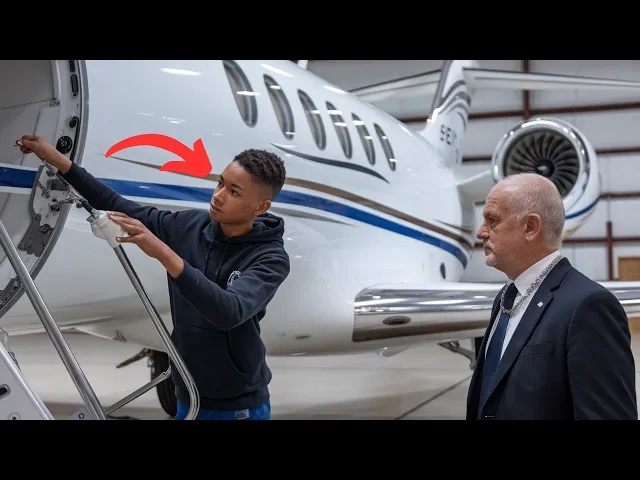
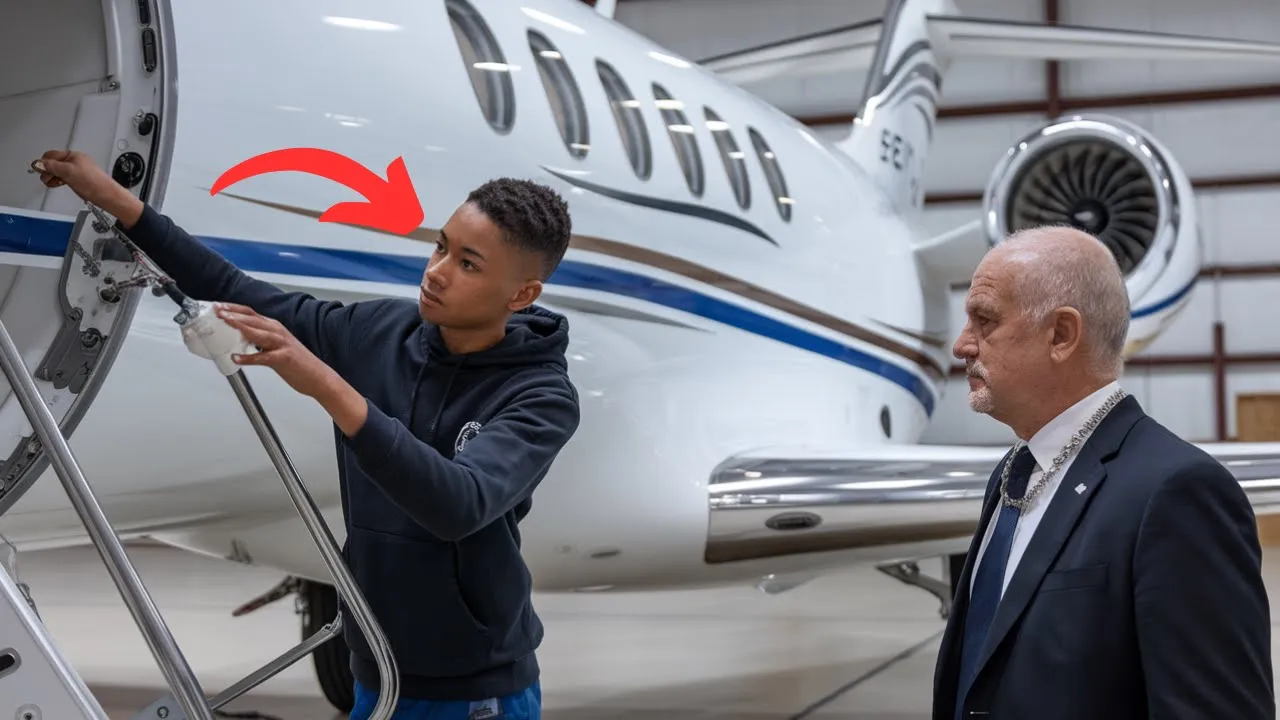
Black teen fixes private jet. CEO stops cold at his pilot wing necklace. The silver wings on Jamal Wilson's necklace caught the hanger's fluorescent light as he tightened the final bolt on the Gulfream G650's thrust reverser. The 17-year-old's hands moved with practiced precision. Despite the exhaustion pulling at his eyelids, 20 hours of emergency repair work had culminated in this moment, fixing a $38 million Aircraft that every senior mechanic at Atlantic Executive Aviation had deemed grounded until parts arrived from Switzerland. But Jamal knew better. He'd recognized the cascading failure pattern from the thousands of hours he'd spent
studying aircraft systems while his peers played video games. The solution wasn't replacing the damaged component. It was recalibrating the entire system using a procedure he discovered in an obscure maintenance manual from 1994. The hanger door slid open, letting in a blast of early morning air along with Harrison Reed, CEO of Pinnacle Investments and owner of the gleaming Gulfream. The executives tailored Italian suit and commanding presence seemed at odds with the 500 a.m. hour, but his expression made one thing clear. He'd been awake all night, too, awaiting news about his aircraft. "Well," Reed's voice echoed against
the hanger walls. "Davidson told me someone was still Working on it. Please tell me it's fixed. I have eight people flying in from Tokyo in 3 hours who need to be in Manhattan by noon." Jamal carefully replaced the access panel before turning to face the CEO. "Yes, sir. The thrust reverser system is fully operational. I've also recalibrated the auxiliary power unit to prevent similar failures. You're good to fly. Reed's momentary relief vanished as he fully registered who was speaking. A black teenager in Work coveralls too large for his lanky frame. Standing confidently beside a multi-million
dollar aircraft that Reed had been told was unfixable without parts that wouldn't arrive for days. You Reed's skepticism was poorly concealed. You fixed my plane. Where's Davidson or Merrick? They went home, sir, Jamal replied, maintaining his professional tone despite the familiar sting of doubt. Davidson authorized me to continue troubleshooting through the Night since I had identified a potential solution. Reed stepped closer, his eyes narrowing. And you are? Jamal Wilson, apprentice mechanic. I've been with Atlantic Executive for 8 months, but I've been studying aircraft systems since. Reed's gaze had dropped to the silver wings hanging from
the chain around Jamal's neck. His words died mid-sentence as the CEO's face transformed, color draining so rapidly that Jamal feared the man might faint. That necklace, Reed whispered, all thoughts of the repaired jet seemingly forgotten. "Where did you get it?" Jamal's hand instinctively moved to the silver pilot wings, his most treasured possession and good luck charm. The gesture seemed to intensify Reed's strange reaction. It was my grandfather's, sir. He was a Tuskegee airman. Reed's eyes widened. What was his name? Lieutenant Joseph Wilson, Jamal said, a note of pride entering his Voice. He flew P-51 Mustangs
with the 332nd Fighter Group. Harrison Reed, a man renowned for his composure in billion-dollar negotiations, visibly trembled. Joseph Wilson, he repeated, the name familiar on his lips in a way that sent a chill down Jamal's spine. Red Tail Squadron flew cover for bombers over Germany in 1944. Now it was Jamal's turn to be shocked. How could you possibly know that? Reed stared at the necklace a Moment longer before meeting Jamal's eyes with an intensity that made the young mechanic take a step back. Because Reed said, his voice thick with emotion. Your grandfather saved my father's
life. If you're enjoying this story so far, please take a moment to hit the subscribe button so you don't miss our future videos. Now, let's continue with this powerful story. 12 hours earlier, Atlantic Executive Aviation. Jamal Wilson trudged across The rain slick tarmac, his work boots heavy with exhaustion after a 14-hour shift. The evening storm had grounded three flights and sent the maintenance crew scrambling to secure aircraft and equipment. Now at 700 p.m. he was finally heading home to study for tomorrow's FAA certification exam, the next step in his journey toward becoming a licensed aircraft
mechanic. Wilson the sharp call cut through the drum of raindrops on metal hanger roofs. Jamal Turned to see Frank Davidson, Atlantic executives head of maintenance, waving from the doorway of Hangar 3. At 58, Davidson was a legend in private aviation circles, a former military aircraft engineer whose approval was nearly impossible to earn. In the 8 months since Jamal had joined Atlantic's apprentice program, Davidson had acknowledged his existence exactly twice. "This would make three." "Yes, sir." Jamal jogged over rain soaking Through his coveralls. Got an emergency. Reed's G650 came in with thrust reverser malfunction. Pilots reported
metal-on-metal grinding during landing. Davidson ran a hand through his thinning gray hair. Need all hands for diagnosis before Merrick can order parts. Calvin Merik was Atlantic's senior mechanic, a man whose 20 years of experience was matched only by his disdain for the apprentice program that had brought Jamal into what Merik called A precision professional environment, not a community outreach project. "I was heading out, sir," Jamal said carefully. "I have the certification exam tomorrow morning." Davidson's eyes narrowed. "You want to be a real mechanic or not, Wilson? This is a $38 million aircraft and Reed is
our biggest client. Everyone stays until we figure it out. The everyone in question, Jamal soon discovered, consisted of himself, Davidson, Merrick, and two other Apprentices, both white, both with family connections to Atlantic's upper management. The five of them stood in hangar 3, surrounding the imposing Gulfream G650 with its sleek white fuselage and the Pinnacle Investments logo emlazed on the tail. Thrust reverser failed during landing at Lagardia, Davidson explained, pointing to the massive engine. Pilot managed to compensate, then flew it here empty for repair. Reed has meetings in Manhattan Tomorrow afternoon. Critical timeline. Merik snorted. Timelines
irrelevant. That's a customcalibrated titanium actuator assembly. Can't source those overnight. Reed won't accept that. Davidson muttered. Physics doesn't care what Reed accepts, Merik replied. But we'll do the diagnostic and write up the order. Reed's company can send their private helicopter to ferry him to Manhattan if Necessary. For the next 3 hours, the team methodically inspected the engine and thrust reverser assembly. Merrick took particular pleasure in narrating each step with excessive technical detail, glancing at Jamal as if daring him to reveal his ignorance by asking questions. But Jamal stayed silent, absorbing everything, forming his own mental
model of the problem. By 1000 p.m., Merrick had reached his verdict. Catastrophic failure of the primary Actuator assembly. Corrosion damage to the secondary assembly. Complete replacement required. He closed his tablet with a decisive snap. Parts from Switzerland. 5 days minimum. Davidson winced. Reed's going to explode. Not our problem, Merrick said. Physics is physics. But something didn't add up for Jamal. The pattern of where he'd observed, the specific vibration signature reported by the pilots, the subtle discoloration around the Secondary assembly, it all pointed to a different diagnosis. The problem wasn't the actuator itself, but the calibration
system that controlled it. Mr. Davidson, Jamal said quietly. I think there might be another explanation. The sudden silence was deafening. Merrick's expression darkened while the other apprentices exchanged uneasy glances. "Excuse me," Merrick's voice dripped with disdain. "The wear pattern doesn't match actuator failure," Jamal continued, forcing himself to meet Merik's gaze. "It's more consistent with calibration drift causing system conflict. If that's the case, we could potentially reccalibrate rather than replace." Merrick laughed. A sharp dismissive sound. Calibration drift in a G650 kid. That system self-calibrates every flight cycle. Unless the software parameters were corrupted, Jamal countered. There's
a procedure in the 1994 maintenance Manual for the original system this one evolved from. The architecture is similar enough that we might be able to enough. Merrick cut him off. Davidson, control your diversity higher. I'm not risking a $38 million aircraft on some teenager's science project. The words stung, but Jamal had heard worse. Far worse. He'd grown up in East Atlantic City, raised by his grandmother after losing both parents in a car accident at age 8. His path to Atlantic executive Aviation had been paved with similar dismissals, similar assumptions about his capabilities based solely on
his appearance. I'm just suggesting we try something that might save Mr. Reed's timeline," Jamal said, struggling to keep his voice even. "If it doesn't work, nothing lost." Davidson rubbed his temples, clearly weighing the political implications of the moment. "Merrick, what's the harm in checking the kids theory? Reed's going to demand we try Everything anyway. The harm is wasting time on nonsense when we should be ordering parts," Merrick snapped. "But fine. You want to humor him? Go ahead. I'm filing my report and going home." The actuator needs replacement. Period. After Merrick stormed out, Davidson turned to
Jamal. You really think you can fix this? I think it's worth trying, sir. Davidson checked his watch. I've got to call Reed, then head home. My wife's having surgery tomorrow morning. He hesitated. Look, I can authorize you to keep working, but I can't pay overtime for an experiment. Jamal understood the subtext immediately. If he was right, Davidson would take credit for authorizing the unorthodox approach. If he was wrong, Jamal would be the overeager apprentice who wasted time on a feudal effort. I don't need overtime, sir. I just need access to the manuals and tools. Davidson
studied him for a long Moment. This isn't about the exam tomorrow, is it? You're actually convinced you can fix this? Yes, sir. Why? What do you see that Merrick doesn't? Jamal considered his answer carefully. When I was 14, my grandmother got me an old flight simulator program. It kept crashing every time I tried to land a specific aircraft model. Turned out the program had a calibration conflict in the thrust reverser system. The simulator was trying to execute Commands that contradicted each other. The patterns here are similar. Davidson's expression softened slightly. So, you taught yourself aircraft
systems through simulator glitches. that and every manual and textbook I could find at the library. Jamal hesitated. My grandfather was a pilot. I've always wanted to understand how aircraft work. Something in Davidson's eyes shifted. Not quite approval, but perhaps reassessment. All right, Wilson. You've Got until 5 a.m. I'll let security know you're authorized, but if you damage anything, I won't, sir. After Davidson and the other apprentices left, Jamal found himself alone in the cavernous hanger with the Gulfream G650, a machine worth more than he would likely earn in his lifetime. The responsibility should have terrified
him. Instead, he felt a strange calm as he began gathering the tools and manuals he would need. His fingers reached for the silver wings That hung from his neck, a ritual he performed whenever facing a challenge. The pilot wings had belonged to his grandfather, Lieutenant Joseph Wilson, one of the famed Tuskegee airmen who had fought fascism abroad while facing discrimination at home. Jamal had never met him. Joseph Wilson had died years before Jamal was born. But through his grandmother's stories, the pilot had become Jamal's guiding star. "All right, Grandpa," Jamal whispered to the empty Hanger.
"Help me figure this out." For the next 7 hours, Jamal methodically dismantled, inspected, and tested the thrust reverser system. He accessed the onboard computer, analyzed error logs, and compared current readings to manufacturer specifications. Around 2:00 a.m., he found what he was looking for, a software parameter that had become corrupted, causing the calibration system to send conflicting commands to The mechanical components. The fix required rewriting specific code blocks, manually calibrating the mechanical interface, and then running a complete system diagnostic. It was delicate, exacting work that demanded both intellectual precision and physical dexterity. By 4:30 a.m., redeyed
but triumphant, Jamal completed the final system check. The thrust reverser deployed and retracted smoothly, all sensors reporting normal operation. the Aircraft could fly safely. No expensive parts or extended downtime required. He was cleaning up his tools when the hanger door slid open, admitting both the cool dawn air and Harrison Reed himself impeccably dressed and visibly tense. Their conversation and Reed's shock at the necklace had led to a revelation that Jamal could never have anticipated. Now standing in the early morning light of the hanger, Jamal struggled to process the CEO's words. My grandfather saved your father's
life. Harrison Reed nodded, his eyes never leaving the silver wings. William Reed was a bomber pilot with the 3003rd bomb group. February 1944 mission over Gotha, Germany. His B7 was hit by anti-aircraft fire falling behind the formation. Two Messids moved in for the kill. Reed's voice took on a distant quality as if reciting a story he'd heard countless times. A single P-51 Mustang from the Red Tales Appeared out of nowhere, shot down one German fighter, and drove off the other. Jamal's heart pounded. His grandmother had told him stories of his grandfather's missions, but never this
specific incident. My father always said the pilot waggled his wings before escorting them back to the formation, Reed continued. When they landed, he sought out the Red Tail Squadron to thank the pilot personally. It was Lieutenant Joseph Wilson. "How can you be sure it was my grandfather?" Jamal asked, still struggling to believe this connection. Reed reached inside his suit jacket and withdrew a leather wallet. From it, he carefully removed a worn black and white photograph. He handed it to Jamal. The photo showed two young men in military uniforms standing beside an aircraft. One was clearly
white, tall, and thin with a serious expression. The other was black, shorter, but powerfully Built with a smile that Jamal instantly recognized from family albums. My father and yours, Reed said quietly. After the mission, Dad kept this photo his entire life, carried it through 30 more missions over Germany. Said it reminded him that courage knows no color. Jamal stared at the photograph, emotions churning. His grandfather stood proudly in his flight suit, a set of pilot wings identical to the ones around Jamal's neck gleaming on His chest. "My father made it home because of yours," Reed
said. "Started his investment firm with the GI Bill. Everything Pinnacle Investments became. Everything I inherited exists because Lieutenant Wilson protected that bomber. And now, almost 80 years later, his grandson saves my aircraft when everyone else said it couldn't be done." Reed shook his head in disbelief. Some might call that coincidence. I don't. The hangar door opened again, admitting Frank Davidson and Calvin Merik. Both men stopped short at the sight of Harrison Reed standing with Jamal, examining a photograph together as if they were old friends. Mr. Reed, Davidson said, recovering quickly. I see you've met Jamal.
I was just coming to check on his progress with the experimental procedure we discussed. Reed turned, his expression hardening as he faced the senior mechanics. Yes, I've Met Mr. Wilson. He successfully repaired my aircraft using an innovative approach when your senior mechanic was ready to ground it for 5 days. He gestured toward Jamal. He also happens to be the grandson of the man who saved my father's life in World War II II, though I suspect that information wasn't in the personnel file you bothered to read. Davidson palded while Merrick's expression cycled through confusion, disbelief, and
dismay. "The aircraft is Ready to fly," Davidson asked. "Completely," Jamal confirmed, unable to keep a note of pride from his voice. "All systems functioning within specifications. I've documented the procedure for future reference." Merik stepped forward, his face flushed. "With all due respect, Mr. read. I'd like to verify this repair before clearing the aircraft. What Wilson has attempted is highly unorthodox and Potentially. By all means, verify away, Reed interrupted coldly. But do it quickly. My pilots will be here in 30 minutes for pre-flight checks. As Merrick grudgingly began inspecting Jamal's work, Reed turned back to the
young mechanic. You said you have an FAA certification exam this morning. Yes, sir. in about 3 hours. Actually, Jamal glanced at his watch, realizing with a sinking feeling that he'd had no sleep and no time to study. Consider it Canled, Reed said. When Jamal's expression fell, he quickly clarified. I mean, postponed at my expense. You've been up all night saving my aircraft. I'll speak with the FAA myself about rescheduling. That's very kind, sir, but not kind practical, Reed's tone, brooked. No argument. Now, I'd like to continue our conversation, but I have Tokyo executives landing soon.
Can you meet me this afternoon? I believe we have much more to discuss. He glanced Meaningfully at the silver wings around Jamal's neck. Yes, sir. After I get some sleep, I'd like that. Reed nodded, then turned to Davidson. I want Mr. Wilson assigned to my aircraft exclusively going forward. Whatever certification or training he needs, Pinnacle will cover the costs. his voice dropped to a steely whisper. And if I ever hear the phrase diversity hire in reference to him again, Atlantic executive will lose Pinnacle's business permanently. Are we Clear? Davidson's yes, sir was immediate and emphatic.
As Reed strode out of the hanger to take a call, Davidson approached Jamal, his expression unreadable. You actually fixed it. Yes, sir. And Reed's father knew your grandfather during the war. Jamal nodded. Apparently, my grandfather saved his father's plane from being shot down. Davidson shook his head slowly. Jesus, kid. Talk about having angels watching over you. He hesitated, then extended His hand. Good work, Wilson. Really good work. The gesture was so unexpected that Jamal momentarily froze before shaking Davidson's hand. It wasn't an apology for months of invisibility, but it was something, a beginning, perhaps. As
he finally left the hanger, exhaustion catching up with him, Jamal's fingers found the silver wings around his neck once more. For the first time, he felt a connection to his grandfather that transcended family stories and Photographs. Today, in this hanger, he had continued Joseph Wilson's legacy, not by flying planes, but by understanding them deeply enough to fix what others couldn't. And somehow impossibly that legacy had intertwined with the Reed families once again. Jamal couldn't know that this unexpected connection was about to transform not just his career, but his understanding of his family's past, uncovering secrets,
sacrifices, and triumphs that Had been buried for generations. The silver wings around his neck weren't just a momento. They were a key about to unlock a door to a history he'd never fully known. Same day, Manhattan Reed Tower. 100 p.m. The Manhattan skyline stretched out below the 54th floor conference room of Reed Tower like a steel and glass ocean. Harrison Reed stood at the window watching his Gulfream G650 approached the downtown helport. The aircraft that According to all expert opinion should have been grounded for days was now delivering his Tokyo executives precisely on schedule. All
thanks to a 17-year-old apprentice mechanic wearing a set of pilot wings that had triggered memories Reed hadn't revisited in decades. "Sir," his assistant's voice interrupted his thoughts. "The Tokyo team has landed. Their helicopter will arrive in 15 minutes, and that mechanic you mentioned, he's here." Reed turned Surprised already. I told him afternoon, but I assumed he'd need more rest. He said he couldn't sleep. Too much on his mind. Security brought him up when you authorized it. Reed nodded. Send him in, please, and hold my calls until the Tokyo team arrives. When Jamal Wilson entered the
conference room, he looked both aruck and uncomfortable. He had exchanged his oversized coveralls for clean jeans and a button-down shirt, but his expression betrayed his discomfort In the rarified environment of Manhattan's financial district. "Mr. Wilson," Reed greeted him warmly. Thank you for coming. Please sit down. Jamal took a seat at the massive conference table, his fingers instinctively reaching for the silver wings around his neck. Thank you for inviting me, sir, though I'm not entirely sure why I'm here. Reed smiled slightly. Direct. I appreciate that. He sat across from Jamal. First, I wanted to properly thank
You for saving my aircraft. You prevented a major disruption to Pinnacle's operations and demonstrated exceptional skill in the process. I was just doing my job, sir. No, you weren't. You were doing far more than your job. You were solving a problem that your superiors had deemed unsolvable. Reed leaned forward. That kind of initiative and ingenuity is rare, Mr. Wilson, particularly in someone so young. Jamal shifted in his seat. Praise from Authority figures was an unfamiliar terrain. Thank you, sir. But that's not the only reason I asked you here. Reed's expression grew more serious. This morning's
revelation about your grandfather and my father feels significant. Too significant to be coincidence. I was thinking the same thing, Jamal admitted. What are the odds that I'd end up working on your specific aircraft? Exactly. Reed stood and walked to a sideboard, returning with a Leatherbound portfolio. After our meeting, I called my father. He's 99 now, living in a care facility in Connecticut. His mind drifts sometimes, but when I mentioned Joseph Wilson, he opened the portfolio, revealing more black and white photographs. He became more lucid than I've seen in years. Jamal leaned forward, staring at images
of young men in military uniforms, aircraft on airfields, ground crews working on massive bombers. Among them Were several showing his grandfather. Sometimes alone, sometimes with William Reed, sometimes with other pilots from the 332nd Fighter Group, their redtailed P-51 Mustangs visible in the background. My father kept everything, Reed explained. Letters, photographs, mission reports. He and your grandfather maintained contact after the war. This came as a shock to Jamal. They did. My grandmother never mentioned that. How much has she told you about your Grandfather's life after the war? Not much, Jamal admitted. I know he struggled to
find work as a pilot despite his war record. Commercial airlines wouldn't hire black pilots then. He eventually became a mechanic for a small regional airline. Died before I was born. Reed nodded slowly. That align with what I knew, but there's more to the story, Mr. Wilson. Much more. He pulled out a yellowed envelope. This is a letter your grandfather wrote To my father in 1963. I'd like you to read it. Jamal carefully opened the envelope, conscious of its fragility. The paper inside was covered with neat, precise handwriting. A man accustomed to filing flight plans and
mission reports. Dear Bill asterisk, I've considered your offer carefully. The investment opportunity is generous beyond words, and your faith in my abilities means more than I can express. But I must decline. The Aviation school you propose funding would indeed create opportunities for colored pilots who, like myself, find their wings clipped by prejudice rather than lack of skill. But the timing is wrong. My family faces enough challenges in Atlantic City without becoming the focus of those who would resent such an enterprise. Margaret is expecting our second child in August. Nathan is only three and already asking
questions about why strangers look at his father with Suspicion. I cannot in good conscience bring additional scrutiny to them, even for a cause I believe in so deeply. Perhaps in the future, when the country has moved beyond its current turmoil, such a venture would be possible. For now, I will continue my mechanics work and teach Nathan everything I know about aircraft. There is dignity in understanding the machines that others merely operate. Your friendship has been a rarity in my Life. A connection that transcends the boundaries others would impose. For that, I remain eternally grateful. Yours
truly asterisk. Joe Wilson asterisk. Jamal looked up from the letter, struggling to process its implications. My grandfather turned down an investment to start an aviation school. Reed nodded solemnly. My father wanted to fund a flight school specifically for black pilots who had been denied opportunities despite their Qualifications. Your grandfather was to be the chief instructor and partner, he sighed. Dad believed it was the least he could do for the man who saved his life. But grandpa said no because he was worried about bringing scrutiny to his family. Jamal's mind was racing. This was during the
civil rights movement 1963. Indeed, Atlantic City wasn't the deep south, but integration was still meeting fierce resistance. A white businessman And black pilot opening a flight school together would have drawn attention, some of it potentially dangerous. Jamal studied the letter again, focusing on the names. Nathan was my father and the second child on the way. He looked up. That would have been my uncle James. Your father and uncle? Did either of them pursue aviation? No. Jamal shook his head. Dad worked construction until he and mom died in a Car accident when I was eight. Uncle
James is an accountant in Philadelphia. Neither of them ever showed interest in flying, as far as I know. He touched the silver wings around his neck. Grandma gave me these after dad died. Said flying was in my blood, even if I didn't know it yet. Reed was quiet for a moment, his expression contemplative. When I saw those wings this morning, it was like seeing a ghost. I recognized them immediately because my father kept A photograph of your grandfather on his desk my entire childhood. Those wings were visible in the image. A reminder dad always said
that courage comes in all colors. Jamal struggled to reconcile this new information with what he'd always known about his family. His grandfather had been offered an opportunity that could have changed the trajectory of their family, but had declined out of concern for their Safety. There's more," Reed said, sensing Jamal's internal conflict. "My father didn't give up easily. He continued to correspond with your grandfather for years, modifying the proposal, seeking ways to make it work. By 1968, they had developed a new plan, a scholarship program for minorities in aviation, administered quietly through an industry foundation." "Did
that happen?" "It did, though not with your grandfather's Direct involvement." Reed pulled out another document, a newspaper clipping from 1970, the William Reed Foundation for Aviation Excellence. It operated from 1970 to 1989, providing scholarships to over 300 students from underrepresented backgrounds. The clipping showed a much younger Harrison Reed standing beside his father at what appeared to be a scholarship ceremony. Several young black men and women in aviation uniforms Stood in a line receiving certificates. "My father created it, but your grandfather inspired it," Reed said quietly. "Dad always insisted that the foundation existed because of Lieutenant
Wilson's courage, both in the skies over Germany and in his commitment to protecting his family in uncertain times." Jamal sat back, overwhelmed. "I had no idea Grandma never mentioned any of this. Perhaps she didn't know the full story. Or perhaps she felt it Better left in the past. Reed gathered the documents, returning them carefully to the portfolio. When the foundation ended after my father's retirement, Pinnacle continued supporting diversity in aviation through other channels, but I've always felt we could do more. There was something in Reed's tone, a leading quality that suggested he was building towards
something significant. Mr. Reed, why are you sharing all this with me today? Reed smiled slightly. Perceptive, another quality I admire. He closed the portfolio. I'm sharing this because when I saw you with those wings this morning fixing an aircraft my senior mechanics had deemed unfixable, it felt like the universe was sending a message. A circle completing itself. What kind of circle? The kind that presents an opportunity to honor both our grandfather's legacies properly. Reed leaned forward. Mr. for Wilson. How would you like to become Pinnacle Aviation's first advanced mechanical engineering scholar, full college tuition, guaranteed
internships during breaks, and a position waiting after graduation? Jamal stared at him, certain he'd misheard. Excuse me. I'm offering to fund your education, aerospace engineering, mechanical engineering, avionics, whatever path you choose. Based on what I saw this morning, you have extraordinary potential. potential That shouldn't be limited to an apprenticeship program where you're clearly undervalued. The offer was so unexpected, so overwhelming that Jamal found himself momentarily speechless. College had always been a distant dream, financially impossible for a kid raised by his grandmother on her teacher's pension. Why? He finally managed to ask. Is this because my
grandfather saved your father? Because you feel you owe my Family something? Reed considered the question carefully. Partly, yes, I believe in honoring debts, even those incurred before my time, but it's more than that. He pointed to the thrust reverser diagram Jamal had sketched to document his repair procedure, which lay open on the table. This solution required not just technical knowledge, but innovative thinking, the ability to see patterns others miss. That's the kind of talent Pinnacle needs. The kind Of talent that should be developed, not sidelined because of outdated attitudes or systemic barriers. I don't know
what to say. Say yes, Reed replied simply. Allow me to revive my father's vision in a way that directly benefits Joseph Wilson's grandson, a new scholarship program with you as its first recipient. Jamal's mind raced through the implications. College engineering, a future he'd barely allowed himself to Imagine. What about Atlantic Executive, my apprenticeship? You can continue working there part-time if you wish, or transfer to Pinnacle's Aviation Division. Either way, your education comes first. Reed checked his watch. The Tokyo team will be here shortly. Take some time to think about it. Discuss it with your grandmother,
but know that this offer comes with no strings attached. It's an investment in potential I recognized This morning. Potential my father would have recognized in an instant. Before Jamal could respond, Reed's assistant opened the door. "Sir, the helicopter has landed. The Tokyo executives are on their way up." "Thank you," Reed stood, extending his hand to Jamal. "Think about it, Mr. Wilson. This could be the beginning of something extraordinary." As they shook hands, Jamal felt the weight of the silver wings against his chest. a physical Connection to the grandfather he'd never met, but whose legacy had
somehow led him to this moment. Whatever he decided, he knew his life had irrevocably changed the instant Harrison Reed had recognized those wings. What neither man could possibly know was how much more complex their family's intertwined history truly was, or how their chance meeting would soon uncover secrets that had remained buried for over half a century. Atlantic City Wilson residence. That evening, Elena Wilson's modest two-bedroom home sat on a quiet street in Atlantic City's Chelsea Heights neighborhood. Its neat appearance masking the financial struggles that had followed her husband's early death and her decision to raise
her orphaned grandson. At 73, she maintained both the house and her substitute teaching schedule with meticulous care, determined to provide stability for Jamal despite limited resources. When Jamal entered the living room that evening, she was grading papers at the dining table, reading glasses perched on her nose, red pen moving efficiently across student essays. She looked up with the immediate concern of a woman who had raised a black boy in America. Jamal Wilson, where have you been all day? Her tone was sharp, but underlined with worry. You didn't come home last night. You missed your exam
and you haven't been answering my texts. I'm Sorry, Grandma. My phone died and things got complicated. He set his bag down trying to decide where to begin. I was at work all night fixing a private jet when the owner came in and recognized Grandpa's wings. Elenor's hand froze midmark on the essay she was grading. What did you just say? Harrison Reed. He owns Pinnacle Investments. His father was a bomber pilot in World War III and grandpa saved his life during a mission over Germany. Elener set down her pen With deliberate slowness. Harrison Reed came to
your workplace. Yes, this morning he saw Grandpa's wings and nearly passed out. Then he showed me a photograph of Grandpa and his father together during the war. Jamal studied his grandmother's face, noting the careful neutrality of her expression. You knew about this, didn't you? About grandpa saving William Reed. Elina removed her reading glasses, folding them precisely. Your grandfather Didn't talk much about the war. Said most of those memories were best left there. But you knew about the Reeds, she sighed. Joseph mentioned a bomber pilot he protected once. Said the man had tried to thank him
after, which was unusual. Most white pilots didn't acknowledge the Red Tales, even when they provided escort protection. She shook her head slightly, but that's all I knew. Joseph never stayed in contact with anyone from those days. Jamal reached into his pocket and withdrew a folded copy of the 1963 letter Reed had shown him. Then how do you explain this? Elena took the paper with visible reluctance. As she read, her expression shifted from guarded to troubled. When she finished, she carefully refolded the letter and placed it on the table between them. Where did you get this?
Harrison Reed had it along with other letters photographs. He said his father and grandpa corresponded for Years after the war. That William Reed wanted to fund an aviation school with grandpa as a partner. Elina was silent for a long moment, her eyes fixed on the folded letter. Your grandfather made his choices for good reasons. Jamal, the 60s were a dangerous time for a black man with ambitions that crossed certain lines. So, it's true. He turned down a chance to start a flight school, to become a pilot again instead of just a mechanic. Joseph was a
practical man. He Understood the world as it was, not as it should have been. Elener's voice took on a defensive edge. He had a family to protect, a wife, two young sons. But he could have changed things, made a difference, created opportunities for other black pilots. At what cost? Elenor's calm finally broke. You think we didn't receive threats just for moving into this neighborhood in 1961? You think your father didn't come home with bloody noses for being the only Colored child in his class? She shook her head fiercely. Joseph didn't abandon his dreams out of
cowardice. He set them aside out of love. Jamal looked down at his hands, abashed by his grandmother's vehements. I'm sorry. I didn't mean to suggest he was wrong. It's just hearing about all this today. Seeing the letters, the photos, it made me wonder what might have been. Elener's expression softened. That's natural, but don't judge the past by Present standards. Your grandfather made peace with his choices. Did he really? Jamal couldn't help pressing. Reed said they kept corresponding for years, kept trying to find ways to work together. That doesn't sound like someone who'd made peace with
giving up on flying. Elina stood abruptly, walking to the living room bookshelf. From behind a row of photo albums, she withdrew a small wooden box Jamal had never seen before. She brought It to the table and opened it, revealing dozens of carefully preserved letters. Joseph kept these. I found them after he died. Her voice was quiet now. He never showed them to me while he was alive, never talked about them, but he couldn't bring himself to throw them away either. Jamal stared at the collection, evidence of a correspondence, a connection his grandfather had maintained in
secret for decades. Why wouldn't he tell you? Because he knew I worried. Because every Time something related to aviation came into his life, I feared it would take him away from us. Elener gently touched one of the yellowed envelopes. When he couldn't fly commercially after the war, something in him changed, dimmed. The mechanic's work was a compromise that kept him close to aircraft without reopening the wound of what he'd lost. And William Reed's offer threatened to reopen that wound. Yes, but also to create new ones For all of us. She looked directly at Jamal. You
can't understand what it was like then. The backlash against integration was fierce. A high-profile partnership between a white investor and black pilot would have made us targets. Jamal considered this, trying to imagine his grandfather's impossible position, caught between his passion for flight and his duty to protect his family. Reed mentioned something else, he said finally. A scholarship foundation his Father started, the William Reed Foundation for Aviation Excellence. He said it was inspired by Grandpa, even though Grandpa wasn't directly involved. Elena nodded slowly. Joseph mentioned it once years later. said it was Bill's way of doing
what they couldn't do together. He seemed proud in his way, but also sad. Did dad or Uncle James ever know about any of this, about the connection to the Reeds. No, your father was too young When it all began. And later, she hesitated. Later, Joseph decided some stories were better left untold, especially after what happened with the scholarship. Jamal frowned. What scholarship? Elena looked surprised. Reed didn't mention it. In 1973, the foundation offered your father a full scholarship to train as a pilot. Joseph turned it down on Nathan's behalf. What? Why would he do that?
Because your father was 17 and had no interest in Aviation. Because accepting would have meant acknowledging a connection Joseph had kept private for decades. And because Elener sighed heavily because by then William Reed's son had joined the business, Harrison Reed. Joseph didn't trust him the way he trusted the father. This new information landed like a blow. Grandpa didn't trust Harrison Reed. Why? What happened? I don't know the details. Joseph only said the son didn't share the father's sense of obligation, that He was too much a businessman, not enough a human being. Elener's gaze was steady,
which makes me wonder why he's suddenly taking such an interest in you. Jamal hesitated, then explained Reed's scholarship offer, "Full college tuition, internships, a guaranteed position after graduation." Elena listened without interruption, her expression growing increasingly troubled. When he finished, she asked simply, "What did you tell Him?" "That I needed time to think, to talk to you," Jamal leaned forward. "Grandma, this is the opportunity of a lifetime. College, engineering, everything I've dreamed about. Dreams can be dangerous, Jamal, especially when they come wrapped in old debts and family histories you don't fully understand. She began returning the
letters to the wooden box. Harrison Reed is not his father. Whatever connection existed between William Reed and Joseph Wilson doesn't mean his son's intentions are pure. You think he has some kind of agenda beyond repaying what he sees as a family debt? I think 70 plus years is a long time for a debt to suddenly become pressing. Elina closed the box with finality. I won't tell you not to accept. You're 17, but you've been making adult decisions since you were 10. All I ask is that you proceed carefully, ask questions, understand what you're agreeing to,
and remember That nothing in this world comes without strings, especially when it comes from people with power. Jamal nodded slowly, recognizing the wisdom in his grandmother's caution. Yet even as he acknowledged the potential complications, another part of him burned with excitement at the possibilities Reed's offer represented. "I need to know more," he said finally, about Grandpa, about what really happened between him and the Reeds. "If I'm going to make this decision, I need the full story." Elina studied him for a long moment, recognizing the determination that had always reminded her of Joseph. Some parts of
that story died with your grandfather Jamal. But she hesitated. There's someone who might know more. Someone who was there during those years. Who? Calvin Wilson. Your grandfather's younger brother. Jamal stared at her in shock. Grandpa had a Brother. You never mentioned him. Not once in all these years. Because they had a falling out in 1969. Never spoke again. Elenor's expression was pained. Calvin took a different path than Joseph. Made different choices about how to respond to the injustices they both faced. The break between them was absolute. And he's still alive. Where is he? Last I
heard Philadelphia, he'd be in his 90s now if he's still with us. Elena rose, moving to a small secretary Desk in the corner. From a drawer, she withdrew an address book so old its cover was cracking. This was Joseph's. His last known address is in here. Jamal took the address book, a tangible link to the grandfather whose legacy had suddenly become so much more complex than the heroic wartime stories he'd grown up hearing. Tomorrow, he decided, I'll go to Philadelphia tomorrow. I need to hear his side of things before I meet with Reed again. Elena
nodded, Resignation mingling with pride in her expression. Joseph always said you had his stubborn streak once you set your mind to something. I see it through, Jamal finished, touching the silver wings that hung from his neck, the talisman that had unexpectedly connected him to a past more complicated and consequential than he'd ever imagined. As Elena returned to her grading, Jamal slipped the address book into his pocket, his mind racing with questions About the grandfather he'd thought he knew, and the great tunle whose existence had been erased from family history until tonight. Whatever choice he made
about Reed's offer would now be informed by a more complete understanding of the complex legacy he carried. A legacy symbolized by the silver wings that had caught Harrison Reed's eye and set these revelations in motion. If you're still with us in this powerful story, we'd love to hear where You're watching from. Take a moment to leave a comment below and don't forget to subscribe to catch our future videos. Now, let's continue with this remarkable journey. Philadelphia the next morning. The address in Joseph Wilson's book led Jamal to a brick apartment building in North Philadelphia's Germantown
neighborhood. The structure had the dignified weariness of a place that had witnessed decades of history. Some glorious, some painful, all etched into Its weathered facade. Finding Calvin Wilson's name still listed on the building directory had been surprising. Finding the elderly man himself at home and willing to see a grand nephew he'd never met was even more unexpected. "So you're Joseph's grandson," Calvin Wilson said, studying Jamal from a worn armchair by the window. At 91, he retained a straightbacked dignity and penetrating Gaze that reminded Jamal instantly of family photographs of his grandfather. "You have his eyes
and his jaw." I wouldn't know, Jamal admitted, perched on the edge of a sofa cluttered with books and newspapers. He died before I was born. H Calvin's expression gave nothing away, and now you're here asking about him, about the Reeds, why Jamal explained the events of the past two days, fixing Harrison Reed's aircraft, the recognition of the silver wings, the Scholarship offer, and the discovery of his grandfather's long hidden correspondence with William Reed. Calvin listened without interruption, his gnarled hands resting on the arms of his chair, his eyes never leaving Jamal's face. When the young
man finished, Calvin was silent for a long moment. "So Joseph never told Elener about Calvin," he finally said. "Not surprising. My brother was good at compartmentalizing his life, keeping the messy parts Separated from the respectable facade." "Grandma said you had a falling out in 1969. Is that what she called it? Calvin's laugh was short and without humor. A falling out suggests a disagreement between equals. What happened between Joseph and me was a fundamental divergence in how we believed black men should navigate a world designed to diminish them. Can you tell me what happened? Calvin studied
Jamal Carefully. Why do you want to know? How will it help you decide about Reed's offer? Because I feel like I'm missing pieces of my own history. Because Grandpa's relationship with the Reeds seems complicated in ways no one has fully explained. And because Jamal hesitated, because I'm wearing his wings, carrying his name, trying to honor a legacy I'm not sure I fully understand. Something in Calvin's expression softened. Fair enough, he Adjusted himself in the chair. The story doesn't start in 1969. It starts earlier when Joseph came back from the war when he couldn't get hired
as a commercial pilot despite his experience. Exactly. My brother had flown 64 combat missions, shot down German fighters, protected American bombers, earned the distinguished flying cross. Calvin's voice took on an edge, and not a single American airline would hire him. Not because he wasn't Qualified, but because he was black. Because passengers wouldn't be comfortable with a colored pilot. Jamal nodded. This part of his grandfather's story he knew. What you probably don't know, Calvin continued, is how that rejection changed him. Before the war, Joseph was idealistic, believed excellence would overcome prejudice. That if he just flew
better, worked harder, proved himself more thoroughly than any white man, the Barriers would fall. But they didn't. No, they didn't. And that realization broke something in him. Calvin leaned forward. Joseph became careful, strategic. He decided that surviving in America meant accepting certain limitations, finding ways to work within a broken system rather than challenging it directly. Is that why he turned down William Reed's offer to start a flight school? Calvin's eyebrows rose. So Reed told you about that? Interesting. He Settled back. Yes, that's part of it. Joseph believed the flight school would draw too much attention,
create too much backlash, but there was more to it than that. What do you mean? Joseph didn't fully trust William Reed's motives. Calvin's tone was measured. He was grateful that Reed acknowledged his role in saving that bomber, appreciated that Reed saw his skill as a pilot, but he always questioned whether Reed's interest was Genuine respect or a form of absolution. Absolution. White guilt, if you want to be direct about it. Reed had survived the war, built a successful business, achieved the American dream. Meanwhile, the man who saved his life couldn't even get a job flying
commercial aircraft. Calvin shrugged. Joseph suspected Reed's persistent offers were motivated more by a desire to ease his own conscience than by true belief in Equality. Jamal considered this perspective so different from Harrison Reed's portrayal of a genuine friendship between the two men, but they corresponded for years. he pointed out. Grandpa kept all the letters. Yes, they maintained contact. And yes, Joseph kept hoping Reed's influence might eventually open doors. But as the years passed and nothing concrete materialized, Joseph's skepticism grew. Calvin's expression darkened. Then came 1968, King's Assassination, riots across the country, and William Reed's son
joining the business. Harrison Reed. Harrison Reed. Calvin confirmed. Young, ambitious, with none of his father's sentimentality about the war or sense of personal debt to Joseph. He saw the proposed flight school as a liability, the relationship with Joseph as an unnecessary complication. How do you know that? Because I was there when he said it. Calvin's voice had grown harder. August 1968, William Reed invited Joseph to New York to discuss a new proposal. Joseph asked me to come along. He wanted another perspective. Someone who wouldn't be overroed by Reed Tower and million-dollar views. And that's when
you met Harrison. That's when we both met him. 30 years old, Harvard Business School, already positioned as the company's future. He joined the meeting late, listened to his father outline a new proposal for a scaledown flight Training program, then systematically dismantled it. Calvin's eyes had taken on a distant look, as if seeing the scene replay. used phrases like current social unrest and potential damage to the Pinnacle brand and fiduciary responsibility to shareholders. He was against the partnership. He was against any visible connection between Pinnacle and what he called racial activism. Said if his father wanted
to help Joseph, he should Do it quietly through anonymous donations or arms length foundations. Calvin's fist clenched slowly on the armrest. Joseph just sat there taking it, nodding as if the young man in the expensive suit wasn't dismantling his last best hope for returning to the sky. What did William Reed do? It was his company, wasn't it? It was, and he overruled his son that day, saying he'd proceed with the program regardless of Harrison's concerns, Calvin sighed. But The damage was done. Joseph could see which way the wind was blowing. Harrison represented the future of
Pinnacle, and that future had no place for Joseph Wilson's dreams. But the foundation still happened, the William Reed Foundation for Aviation Excellence. Yes, the foundation happened. A compromise that allowed William to feel he'd honored his debt while keeping the actual recipients at a safe distance from Pinnacle's corporate Image. Calvin laughed bitterly. And who do you think was tasked with reviewing the scholarship applications when the foundation launched in 1970? Harrison Reed Jamal guest got it in one. The same man who'd argued against any association with racial activism was now deciding which minority applicants deserved Pinnacle's benevolence.
Calvin shook his head. That's why Joseph rejected the scholarship for your father in 1973. He Wouldn't have Nathan beholden to Harrison Reed's approval. This aligned with what Alener had told him. But Calvin's account added layers of context that made his grandfather's decision more understandable. So that's why you and grandpa had your falling out because he wouldn't stand up to the reads. Calvin studied Jamal for a long moment. You're simplifying a complex situation, but yes, that's part of it. By 1969, we Represented two different approaches to navigating American racism. Joseph believed in quiet persistence, strategic compromises,
focusing on family security above all else. I believed in direct confrontation, in demanding that America live up to its stated ideals, even at personal cost. You were more radical. I was more honest, Calvin corrected. Joseph spent his life accommodating a system that had already proven it would never fully accept him, no matter how Exceptional he proved himself to be. I refused to play that game. His expression softened slightly. Neither approach was entirely right or wrong. We were both responding to the same wounds in different ways. Jamal's fingers found the silver wings around his neck. And
now Harrison Reed wants to offer me what he helped deny my father and grandfather. Ironic, isn't it? Calvin said, "The question is why now? What Does Harrison Reed get from this arrangement?" He said it was about honoring both our grandfather's legacies, completing a circle. Calvin snorted, "Read men and their circles." William was always talking about debts and obligations, cosmic justice, things coming full circle. Seems his son has inherited that tendency, if not his actual sense of personal responsibility. You don't think his offer is genuine. I think Harrison Reed Is a businessman first and foremost. Everything,
even apparent generosity, serves some purpose in his larger strategy. Calvin leaned forward. That doesn't mean you shouldn't accept his offer. Education is education, no matter who pays for it. But go in with your eyes open, Jamal. Understand that your value to him may not be solely about your mechanical aptitude or your grandfather's wings. What do you mean? Think about it. What's changed in American business since 1968? Companies now tout their diversity initiatives, highlight minority employees in recruitment materials, establish scholarships and programs specifically targeting underrepresented groups. Calvin's gaze was piercing. What better story for Pinnacle's corporate
image than rediscovering the grandson of the black pilot who saved the founders's life, now himself a talented aviation prodigy. The suggestion made Jamal Deeply uncomfortable. You think he sees me as a PR opportunity? I think Harrison Reed doesn't make purely sentimental decisions. Whatever he's offering you serves Pinnacle's interests somehow, Calvin shrugged. That doesn't make it worthless. It just means you should negotiate from a position of strength, not gratitude. Jamal sat back, trying to process everything he'd learned. His grandfather's relationship with the Reeds was far more complicated than Harrison had portrayed. The tension between accommodation and
resistance, between practical compromise and principled stand, had literally divided his family, creating a rift so deep that Joseph had excised his own brother from family history. I don't know what to do, he admitted finally. Part of me wants to grab this opportunity with both hands, but another part wonders if accepting means betraying Joseph's principles. Calvin finished for him. Let me offer a perspective your grandfather might not appreciate. Joseph made his choices based on his time, his circumstances, his responsibilities. You're not obligated to make the same choices. The world has changed, not enough, but some. So,
you think I should accept? I think you should do what serves your future best without feeling constrained by choices Joseph made in a different era. Calvin's expression softened. Joseph was A good man who wanted security and dignity for his family. If he was uncomfortable with William Reed's help, it wasn't out of pride, but protection. He understood the costs that came with certain kinds of visibility. And what about you? What would you do in my position? Calvin chuckled. I'd negotiate. Make sure any agreement protects your interests, not just reads. Ensure your acceptance doesn't make you a
silent mascot for Pinnacle's diversity initiatives. Maintain your independence. He pointed to the silver wings around Jamal's neck. Those wings represent something powerful, Jamal. The excellence and courage of black airmen who served a country that didn't serve them equally. Don't let that symbol be co-opted for corporate image making. As Jamal prepared to leave, Calvin walked him to the door with surprising agility for his age. "One last thing," Calvin said, Resting a hand on Jamal's shoulder. Whatever happened between Joseph and me, whatever paths we chose, we both wanted the same thing. A world where the next generation
of Wilsons wouldn't face the same barriers, where talent and dedication would be enough. Maybe in some small way, that world is finally emerging. The old man's eyes moved to the silver wings around Jamal's neck. Joseph would be proud of you, Jamal. Not just for your technical abilities, but For asking questions, for seeking the complete story before making your decision. Thank you for telling me the truth, Jamal said. Even the complicated parts. Especially the complicated parts, Calvin corrected. Those are the ones that matter most. As Jamal left the building, his mind was churning with new perspectives
and deeper questions. The scholarship offer that had seemed like miraculous good fortune now appeared more complex. Neither a simple act of Generosity nor a cynical manipulation, but something with elements of both. Whatever decision he made would need to honor his grandfather's legacy while creating his own path forward, a path that neither ignored history nor was imprisoned by it. Reed Tower, Manhattan. 2 days later, Harrison Reed's private office on the 55th floor of Reed Tower offered a panoramic view of Manhattan. The vast cityscape, a testament to the power and influence of Pinnacle Investments. Jamal sat across
from Reed at a sleek conference table, a formal agreement between them, waiting for signatures. "I appreciate you taking time to consider my offer carefully," Reed said, his tone professional but warm. "Have you reached a decision?" I have, Jamal replied. But before I give it, I want to make sure we understand each other completely. Something in his tone made Reed sit back slightly, reassessing the Young man before him. Go on. I visited my great uncle Calvin Wilson in Philadelphia, my grandfather's brother. Jamal watched Reed's expression carefully. He told me about the 1968 meeting, about your opposition
to the flight school, about why my grandfather ultimately rejected the scholarship for my father. Reed's face remained composed, but a muscle tightened in his jaw. That was a long time ago. I was young, concerned primarily with Pinnacle's corporate interests during a volatile period. I understand that, Jamal said evenly. But it changes the context of your offer to me. This isn't just about honoring your father's relationship with my grandfather. It's also about reconciliation, perhaps a second chance to make right what went wrong 50 years ago. Reed considered his response carefully. That's an astute observation, Mr. Wilson.
Yes, there is an element of personal reconciliation in My offer. The older I get, the more I recognize the short-sightedness of some of my early business decisions. The way I handled the flight school proposal is one I've particularly regretted. Why? Because it was wrong or because it damaged Pinnacle's relationship with a man who had saved your grandfather's life. Reed's eyebrows rose slightly at the directness of the question. Both, if I'm being honest, by 1968, America was changing. I was Focused on protecting Pinnacle from what I perceived as political risk. But in doing so, I undermined
something my father valued deeply. His connection to your grandfather and his commitment to creating opportunities in aviation for those who had been systematically excluded. Jamal nodded, appreciating the cander. My great uncle suggested this offer might serve Pinnacle's corporate image as much as my educational needs. To his credit, Reed didn't deny it. Pinnacle, like most major corporations, has diversity initiatives. We're actively seeking to address historical imbalances in our industry. Would your success story be something we'd highlight? Potentially, yes. But that doesn't diminish the genuine opportunity being offered. I agree. But it does mean we should be
clear about expectations and limitations. Jamal pulled out a document of his own, a carefully prepared addendum to Reed's scholarship Agreement. I've made some modifications to your proposal. Reed took the document with undisguised surprise, quickly scanning its contents. You're requesting control over how your story and image are used in Pinnacle's corporate materials, the right to decline participation in PR events, and his eyebrows rose further. A commitment from Pinnacle to fund five additional scholarships for minority students interested in aviation with you Participating in the selection committee. Yes, Jamal Met Reed's gaze steadily. If this is truly about
honoring both our grandfather's legacies, then it should extend beyond just me. My grandfather believed in creating opportunities for others like him, this would fulfill that vision in a way the foundation never fully did. For a long moment, Reed studied Jamal with newfound respect. Then unexpectedly, he smiled. You've been busy since our last Meeting. I needed to understand the complete context before making my decision. and Calvin Wilson provided that context, I presume, including his rather unflattering assessment of my motives both then and now. He offered his perspective, Jamal acknowledged, but my decision is my own. Reed
tapped the addendum thoughtfully. These terms are unusual for a scholarship recipient to request. So is the circumstance that brought us together, Jamal countered. if You're not comfortable with the modifications. I didn't say that. Reed leaned back, studying Jamal with interest. Actually, I find your approach refreshing. Most people in your position would simply accept whatever was offered, grateful for the opportunity. You're negotiating, protecting your interests, expanding the impact beyond yourself. He nodded slowly. Your grandfather would be proud. So would my father for that matter. Then you accept The modifications. I do. Reed picked up a pen
and signed both the original agreement and Jamal's addendum. Congratulations, Mr. Wilson. You're officially Pinnacle Aviation's first advanced mechanical engineering scholar and apparently also the newest member of our scholarship selection committee. Jamal signed as well, feeling a weight lift from his shoulders. Thank you, Mr. Reed, for the opportunity and for Understanding why these modifications matter to me. Understanding is the least I owe your family. given our history. Reed gathered the papers, passing them to his assistant for processing. Now, there's someone I'd like you to meet. Someone who can help guide your education and career development. He
pressed a button on his desk intercom. Send Dr. Carter in, please. Moments later, the office door opened to admit a black woman in her Early 50s, impeccably dressed in a tailored suit, her natural hair styled in a short professional cut. She carried herself with the confident ease of someone accustomed to navigating corporate environments. Jamal Wilson. Meet Dr. Michelle Carter, Pinnacle's Director of Aviation Technology and Innovation. She'll be overseeing your scholarship and serving as your mentor throughout your Education. Dr. Carter extended her hand. Mr. Wilson, I've heard a great deal about your innovative repair of Mr.
Reed's aircraft. I'm looking forward to working with you. Jamal shook her hand, momentarily speechless. He hadn't expected his mentor to be a black woman, especially one in such a senior position. Dr. Carter is one of the original recipients of the William Reed Foundation scholarship, Reed explained. Class of 1985, MIT aerospace engineering, followed by a doctorate in aviation systems at Georgia Tech. She's been with Pinnacle for 15 years and has revolutionized our approach to aircraft maintenance and design. Dr. Carter smiled slightly. What Mr. Reed isn't saying is that I was the foundation's first female recipient and
that getting the scholarship was just the beginning of a very long journey in an industry that wasn't particularly welcoming to People who looked like me. She glanced at the silver wings around Jamal's neck. Those have historical significance, I understand. They belong to my grandfather. He was a Tuskegee airman. Her expression softened with recognition. Then you come from a proud tradition. One I hope we can help you build upon at Pinnacle. She turned to read. Harrison, we should discuss the logistics of Jamal's education and work schedule. I've prepared some options Based on different university programs. As
the two professionals began discussing his future, course sequences, internship rotations, potential research projects, Jamal felt a surreal sense of his life transforming before his eyes. Just days ago, he had been an overlooked apprentice mechanic, struggling to be taken seriously while studying for certification exams. Now he was signing scholarship agreements, negotiating terms with the CEO of a major Corporation, and meeting accomplished mentors who would guide his education. All because of a chance encounter triggered by the silver wings around his neck. When the meeting concluded, Dr. Carter offered to show Jamal Pinnacle's aviation division located in a
separate building near the East River. As they rode the elevator down, she studied him thoughtfully. "You know there's more to this story than Harrison is sharing," she said finally about why he's taking Such a personal interest in your education. Jamal looked at her in surprise. What do you mean? Harrison Reed has funded numerous scholarships over the years, but I've never seen him personally negotiate terms or introduce a recipient to their mentor. She shook her head slightly. There's something personal at stake for him in your success. Something beyond corporate image or historical reconciliation. Do you know
what it Might be? I have theories. The elevator reached the ground floor and she gestured him forward. But I suspect you'll discover it yourself as you become more integrated into Pinnacle's world. Just remember that knowledge is power, Jamal. The more you understand about why people act as they do, the better positioned you are to make choices that serve your own goals. As they exited Reed Tower into the bright Manhattan afternoon, Jamal touched the Silver wings around his neck, the talisman that had unexpectedly changed the trajectory of his life. Whatever Dr. Carter's cryptic warning might mean,
whatever Harrison Reed's deeper motives might be, Jamal had taken a crucial step toward claiming his own place in the sky his grandfather had once commanded. Not as a pilot, but as an engineer who understood aircraft deeply enough to fix what others deemed unfixable. The legacy of Joseph Wilson Would continue, transformed, but unbroken through the grandson who carried both his name and his silver wings. Three years later, Massachusetts Institute of Technology. Snow fell gently outside the windows of MIT's aerospace engineering lab as Jamal adjusted the parameters on his thesis project, a revolutionary recalibration system for commercial
aircraft thrust reversers that promised To reduce maintenance costs by 40% while improving reliability and fuel efficiency. At 20, he had already distinguished himself as one of the department's most promising students. His innovative approaches drawing attention from aviation industry leaders beyond Pinnacle. Looking good, Wilson. Professor Abernathy, the department chair, paused behind him to study the simulation results. The predictive Algorithm is particularly impressive. Have you patented this yet? Working on it, Jamal replied. Pinnacle's legal team is handling the paperwork. Abernathy nodded approvingly. Smart. Too many students underestimate the importance of protecting their intellectual property. He tapped the
screen, highlighting a specific sequence. This adaptation for regional jets is especially clever. You've accounted for the higher cycle frequency Without compromising system integrity. That was actually inspired by something my grandfather mentioned in his maintenance logs from the 1950s. Different technology but similar principle. Your grandfather was a mechanic, right? After flying in World War I II. Yes, sir. For Eastern Airlines. His insights are still relevant seven decades later. That says something about true innovation. Abernathy checked his watch. Your mentor Is coming today, isn't she? Dr. Carter from Pinnacle. Yes, for my quarterly review. She's also bringing
someone from their board who's interested in my research. Well, I won't keep you then. Impressive work as always. The professor moved on to check other students projects, leaving Jamal to make final adjustments to his presentation. 3 years into the pinnacle scholarship program, Jamal's life had Transformed dramatically. The skeptical, overlooked apprentice had become a confident engineering student whose work was already influencing industry practices. His relationship with Harrison Reed had evolved from formal benefactor recipient interactions to something more complex. Not quite mentorship, not quite friendship, but a connection characterized by mutual respect and occasional weariness. Dr. Michelle
Carter had Proven an invaluable guide, helping Jamal navigate both academic challenges and the corporate culture of Pinnacle. Her practical advice, drawn from her own experience as a black woman in aviation technology, had prepared him for obstacles he might otherwise have found insurmountable. The silver wings that had started this journey remained around his neck, a constant reminder of the legacy he carried and the responsibility that came with it. Jamal was preparing His presentation materials when Dr. Carter entered the lab, accompanied by an elderly man Jamal had never seen before. The stranger walked slowly, leaning on a
cane, but his eyes were sharp and evaluating as they took in the advanced equipment and student projects. Jamal, Dr. Carter, greeted him warmly. Sorry we're running late. Weather delayed our flight from New York. She gestured to her companion. This is William Reed, Harrison's father And Pinnacle's founder. He specifically requested to meet you and see your work. Jamal stared in shock. William Reed, the bomber pilot his grandfather had saved, the man whose letters Joseph Wilson had preserved for decades, stood before him. At 99, Reed was remarkably present, his gaze direct and intelligent despite his physical frailty.
"Mr. Reed," Jamal finally managed. "This is unexpected an honor to meet you." William Reed studied him intently. "So you're Joseph's Grandson. The resemblance is remarkable around the eyes especially." He gestured to the silver wings around Jamal's neck. And you wear his wings. Good. Symbols matter. Yes, sir. They were his from his time with the Tuskegee Airmen. I know. I was there when he earned them. Reed moved closer, examining Jamal's project display. My son tells me you're revolutionizing thrust reverser systems, creating something that will make air travel safer and more efficient. That's The goal, sir. Reed
nodded slowly. Joseph would be proud not just of what you're building, but of how you've approached this opportunity. Harrison told me about your negotiation, the additional scholarships you insisted on, your refusal to be merely a corporate success story. Jamal exchanged a quick glance with Dr. Carter, who gave him a slight nod of encouragement. I wanted to honor my grandfather's values, Jamal said Carefully. to ensure others would have similar opportunities. As it should be, Reed straightened slightly, his voice strengthening. I've come today for two reasons, Mr. Wilson. First, to meet the young man who has so
impressed my son. No small feat, I assure you. But second, and perhaps more importantly, to give you something that rightfully belongs to your family. From inside his coat, Reed withdrew an envelope. Not a modern Business envelope, but something older, yellowed with age. The address written in a neat, precise hand that Jamal recognized from the letters his grandmother had shown him. "My last letter to your grandfather," Reed explained. "Written in 1974 after he rejected the scholarship for your father." He returned it unopened. The old man's hands trembled slightly as he held it out. "I've kept it
all these years, thinking someday it might find Its way to the right Wilson." Jamal accepted the envelope with a mixture of curiosity and reverence. Thank you, sir, but why now after all this time? William Reed smiled slightly. Because at 99, one becomes acutely aware of unfinished business. And because seeing you succeed, seeing Joseph's legacy extended through your work, brings a circle to completion that I'd nearly abandoned hope of witnessing. Dr. Carter stepped forward. We should proceed with the quarterly review. The conference room is reserved, and several department faculty are waiting. As they walked through MIT's
corridors, William Reed moved alongside Jamal, speaking quietly. "There's something you should know about Harrison's interest in your career," he said, confirming Dr. Carter's cryptic warning from 3 years earlier. "Something beyond the obvious historical connection between our families." "What is it, Sir?" Harrison never told you why he recognized your grandfather's wings so quickly that morning in the hangar, did he? why the site affected him so deeply. No, sir. I assumed it was because of the stories you had told him. The photograph on your desk. Reed shook his head slightly. It was more personal than that. You
see, in 1992, Harrison's son, my grandson, was a young Air Force pilot, Lieutenant Thomas Reed. During a training exercise over the Nevada Desert, his F-16 suffered catastrophic engine failure. Another pilot came to his assistance, helping him navigate an emergency landing that saved his life. "That pilot was wearing wings like my grandfather's," Jamal guessed, beginning to understand. "Not just similar wings, the same wings. It was James Wilson, your uncle." Jamal stopped walking, stunned by this revelation. "Uncle James, but he's an accountant in Philadelphia. He never served in the Military, never flew planes." Reed's expression was gentle
but firm. James Wilson graduated from the Air Force Academy in 1987, flew F-16s until 1995 when he left the service and returned to civilian life. The official records show he received an honorable discharge, but the truth is more complicated. I don't understand. Why would Uncle James hide his military service? Why would my family never mention it? That's a question better Directed to James himself. All I know is that after saving Thomas's life, your uncle faced certain challenges within the Air Force. Challenges that ultimately led to his decision to leave. Reed's expression grew troubled. Harrison tried
to intervene to use Pinnacle's influence to address the situation, but James refused any assistance. Said the Wilson family had enough complicated history with the Reeds without adding another chapter. Jamal's mind was reeling. His quiet, reserved uncle James, who came to holiday dinners with accounting anecdotes and always seemed slightly uncomfortable when aviation was discussed, had been a fighter pilot, had saved Harrison Reed's son, had worn the same wings Jamal now wore around his neck. Why tell me this now? He finally asked. Because you deserve to understand the full context of Harrison's interest in your career. It's
not just about your Grandfather and me. It's about a debt that has passed through generations, creating a connection neither family has fully acknowledged or resolved. Reed's eyes moved to the silver wings around Jamal's neck. Those wings have now saved three generations of Reeds. My father believed such patterns weren't coincidental, but meaningful. I've come to share that belief. As they reached the conference room, Dr. Carter held the door, clearly aware they were concluding A significant conversation. Consider speaking with your uncle, Reed said quietly. There's more to your family's aviation legacy than you've been told. More to
the connection between Wilson's and Reeds than appears in any official record. Jamal nodded, tucking the unopened letter inside his jacket. I will, sir. Thank you for trusting me with this. Thank you for continuing a legacy that matters deeply to both our families, Reed replied, even If neither fully understood its importance until now. As Jamal entered the conference room, prepared to present his thesis research to Pinnacle executives and MIT faculty, he felt the weight of the letter against his chest, alongside the silver wings that had now become even more significant. Not just his grandfather's legacy, but
apparently his uncles as well. A family history of flight more complex and continuing than he had ever Imagined. Whatever revelations the unopened letter might contain, whatever truth lay behind James Wilson's hidden military career, Jamal knew that his path forward had just become more meaningful and more challenging than even his scholarship negotiation had suggested. The silver wings around his neck represented not just the past, but a continuing tradition of excellence, courage, and connection that transcended individual lives. A legacy he was now Consciously extending through his own innovation and determination. Philadelphia Wilson family home Thanksgiving. The modest
dining room of a leaner Wilson's Atlantic City home hummed with conversation as three generations of the Wilson family gathered for Thanksgiving dinner. Jamal, home from MIT for the holiday, found himself watching his uncle James with new awareness, searching for signs of the fighter pilot Beneath the accountant's reserved exterior. The revelation from William Reed had transformed Jamal's understanding of his family. After careful consideration, he had decided not to confront James directly. Not yet. First, he needed to understand more about why his uncle's military service had been kept secret. Why the family narrative had been so carefully
edited to exclude this chapter. Elina brought out the turkey, her face glowing with Pride as she surveyed her family around the table. Her two sons, James and Nathan, named for his late father, their wives, and Jamal, the grandson she had raised after Nathan's death. At 76, she moved more slowly than in years past, but maintained the dignified energy that had sustained her through decades of challenge. "Before we eat," she announced, "I want to acknowledge how grateful I am to have everyone here, especially Jamal, who's making us all Proud at MIT." She smiled warmly at her
grandson. "Joseph would be amazed to see what you've accomplished." As serving dishes circulated, Jamal engaged James in careful conversation, looking for openings to explore what he had learned. How's the accounting firm, Uncle James? Busy tax preparation season is approaching, so we're gearing up. James passed the mashed potatoes. How's the engineering program? Still on track to graduate early. Yes, just one more Semester, then I'll start full-time with Pinnacle's Aviation Division. Jamal hesitated, then added, "I met William Reed recently, Harrison's father." Something flickered across James's face, too quick to identify, but definite. "Did you? He must be
quite elderly now." 99. Still sharp, though. We talked about family history, connections between the Wilsons and Reeds over the years. James's fork paused halfway to his mouth. What connections Specifically? Grandpa saving William Reed's bomber during the war, obviously. The scholarship foundation, a few other things. Jamal watched his uncle carefully. He mentioned, "You might have your own history with the Reed family." The silence that fell over the table was sudden and complete. Elena's hand froze in the act of lifting her glass. Nathan looked between his brother and son with confusion. James's expression became carefully neutral. Did
he? James said Flatly. Not a question. Elina set down her glass with deliberate care. Jamal, perhaps this isn't the best time to. It's all right, Mom. James interrupted. He studied Jamal for a long moment. What exactly did William Reed tell you? That you were in the Air Force? That you flew F-16s? That you saved his grandson Thomas Reed during a training exercise in 1992? Jamal met his uncle's gaze steadily. that you wore grandpa's wings Just like I do now." Nathan looked at his brother in shock. "James, is this true?" James sighed, setting down his fork.
"Yes, I served from 1987 to 1995, fighter pilot stationed primarily at Nelly's Air Force Base in Nevada." "But why didn't we know this?" Nathan asked, bewildered. "Why would you hide your military service?" "Because it ended badly," James said simply. because I made choices that affected our family's relationship with the Reeds because I Wanted to start fresh without carrying that history forward. Elina reached over to place her hand on James's arm. You don't have to explain, James. You never did. Maybe it's time, Mom. James turned to Jamal. Did Reed tell you why I left the Air
Force? No, just that there were challenges that Harrison tried to help with, but you refused. James nodded slowly. The official record shows an honorable Discharge. The truth is more complicated. He took a deep breath. After I saved Thomas Reed in 1992, there was an investigation into the incident. Standard procedure. But during that process, certain relationships in my personal life came under scrutiny. Understanding dawned on Jamal. This was during don't ask don't tell. before that policy was even formalized. But yes, the military wasn't friendly to those they suspected of being gay. James's voice remained steady. I
wasn't out, wasn't planning to come out, but the investigation created enough suspicion that my career advancement essentially ended. I was gradually sidelined, assigned to less critical missions, passed over for promotion. Nathan stared at his brother. You never told me any of this. Not about being in the Air Force, not about being gay. You were just starting your family. Nathan had a new baby. James's smile was Sad. I didn't want to complicate your life with my problems, especially after how dad had protected all of us by keeping his own aviation dreams contained. Jamal thought of the
correspondence between his grandfather and William Reed, the flight school that never materialized, the scholarship his father had never known about. But what about the reads? He asked, "How did Harrison find out about what was happening?" Thomas told him," James Explained. After I helped talk him through the emergency landing procedure, we became friends. When the investigation started affecting my career, Thomas realized what was happening and went to his father. Harrison Reed offered to use Pinnacle's military contracts as leverage to intervene. But you refused. I did. The Wilson family had already sacrificed enough to maintain a connection
with the Reeds. Dad turning Down the flight school, rejecting the scholarship for Nathan. I wasn't going to create another complicated entanglement. James shook his head. So, I left the Air Force, got my accounting degree, and started a new life in Philadelphia. A life that didn't involve cockpits or the constant pressure of hiding who I was. Elener squeezed her son's arm. You never have to hide who you are with family, James. Never. I'm only sorry you felt you needed to for so Long. Nathan nodded emphatically. Seriously, bro, fighter pilot, that's amazing. And being gay, that's just
you. Why would you think you needed to hide either? James smiled slightly. Because our family had a tradition of keeping complicated things private. Dad never talked about the reads, about the flight school, about any of it. I assumed there was wisdom in that approach. There was for his time, Elener said firmly. But times change. What protected us then Might limit us now. Jamal touched the silver wings around his neck, feeling their weight differently in light of this new understanding. So you wore these wings when you were flying. I did. James's expression softened at the memory.
Dad gave them to me when I graduated from the academy. Said they had brought him through 64 combat missions without a scratch. Thought they might do the same for me. And when did grandma give them to me? Jamal asked, Turning to Elener. After your parents' accident, you were so lost, so in need of connection. Elener's eyes grew misty. James brought them to me, said you should have them, that they belonged with someone who would carry the Wilson aviation legacy forward. James nodded. I knew from the way you were always fixing things, always asking about how
planes worked that you had inherited Dad's mechanical intuition. The wings belonged with you. The revelation created a moment of profound connection around the table. A family reclaiming parts of its history that had been carefully partitioned away, acknowledging truths that had shaped their paths without ever being directly discussed. So now, James said, looking at Jamal, you understand why Harrison Reed takes such a personal interest in your career. It's not just about dad saving William Reed. It's about me Saving Thomas Reed. It's about a connection between our families that keeps recurring generation after generation whether we acknowledge
it or not. Three generations of Wilsons saving three generations of Reeds, Jamal said quietly. William called it a circle completing itself. Maybe it is, James studied his nephew thoughtfully. But circles can become traps if we're not careful. Each generation of our family has had to make Choices about how to engage with the Reed family's power and privilege. Dad chose protective distance. I chose complete separation. You've chosen active engagement negotiation on your own terms. Is that wrong? Jamal asked suddenly uncertain. Not wrong, just different. Appropriate for your time, your circumstances, James smiled. I'm proud of how
you've handled this opportunity, Jamal. Proud of the additional scholarships you secured, the boundaries you established. You found a way to honor dad's legacy while creating your own path. As the conversation gradually returned to more typical Thanksgiving topics, Jamal felt a profound sense of completion, as if pieces of a puzzle he hadn't known he was solving had suddenly fallen into place. His grandfather, his uncle, himself, three generations of Wilson men connected to aviation, each Navigating the complex intersection of race, opportunity, and identity in their respective eras. The silver wings around his neck represented not just his
grandfather's service as a Tuskegee airman, but a continuing family legacy of excellence and courage. A legacy that included his uncle's hidden military career and his own emerging contributions to aviation technology. Later, as guests departed and Elener began clearing the table, Jamal found himself alone with James in the living room. There's something else you should know," Jamal said, removing William Reed's unopened letter from his pocket. "Reed gave me this. It's his last letter to Grandpa from 1974. Grandpa returned it unopened." James stared at the yellowed envelope. "Have you read it?" "No, it felt wrong to open
it without understanding more context. Now I'm not sure what to do with it." James Considered the letter. It was addressed to Dad, but he chose not to read it. Maybe the choice now belongs to you as the one carrying his wings, extending his legacy. "What would you do?" "I'd read it," James said without hesitation. "The time for protective silence in our family is passed. Whatever William Reed wrote in 1974, it's now part of a much larger story, one that includes your scholarship, your innovations, your future in aviation. Knowledge is never The enemy, Jamal. Only what
we do with it matters. Jamal nodded carefully opening the envelope. The letter inside was written on pinnacle letter head. The paper now delicate with age. Dear Joseph asterisk your decision regarding Nathan's education is of course your right as his father. I respect your wish to keep him separate from the foundation and whatever complicated history exists between our families. However, I feel compelled to clarify one Matter. Harrison's opposition to our flight school venture in 1968 did not reflect my values or intentions. His concerns were purely business related, lacking the personal context that has always informed my
actions toward you and your family. The debt I owe you can never be fully repaid. not only for saving my life over Gotha, but for showing me through your excellence and dignity how limited my understanding of race had been. You expanded my world, Joseph. Whatever opportunities I've attempted to create for minority pilots flow from the lessons you taught me through both your extraordinary skill and your persistent grace in the face of injustice. My hope remains that someday a Wilson will again take to the skies with the same passion and precision you demonstrated during those crucial
months in 1944. Should that day come, whether in This generation or the next, please know that whatever resources Pinnacle can provide will be available without reservation or condition. The wings you wore so proudly over Germany represented not just your qualifications as a pilot, but your courage in fighting for a country that failed to recognize your full humanity. That symbol and all it represents deserves to be carried forward by future generations who will hopefully encounter Fewer barriers than you have faced. with enduring respect and gratitude. Asterisk William reads. When Jamal looked up from the letter, he
found his uncle watching him with quiet intensity. Well, James asked. He wanted a Wilson to fly again, Jamal said softly. And you did without even knowing about this letter. And now you're creating technology that will make flying safer for everyone. James smiled. Different manifestations of the same Legacy. Jamal carefully folded the letter, returning it to its envelope. I think I finally understand what these wings truly represent, he said, touching the silver symbol around his neck. Not just grandpa's service, not just aviation heritage, but a family tradition of breaking barriers. Each in our own way, in
our own time. That's exactly right, James agreed. Dad couldn't become a commercial pilot, but he became one of the best Mechanics Eastern Airlines ever had. I couldn't continue as a military pilot, but I found another path that allowed me to live authentically. And you, you're redesigning the very systems dad once maintained, creating innovations that will influence aviation for decades. All while wearing the same wings. All while wearing the same wings, James echoed, his expression reflective. Some symbols transcend their original meaning, Jamal. Those wings were first Given to mark a specific achievement, completion of pilot training.
But over time, they've come to represent something more profound. The Wilson family's enduring connection to the sky despite all obstacles. As Jamal prepared to return to MIT the following day, he carried with him not just the physical weight of his grandfather's wings, but a deeper understanding of their significance. The silver symbol around his neck connected Him to a heritage more complex and inspiring than he had previously known. A lineage of men who had found different ways to claim their place in aviation despite the barriers of their respective eras. His innovative thrust reverser system nearing completion
at MIT wasn't just a technical achievement or career advancement. It was his unique contribution to a family legacy that had been quietly unfolding for generations. The wings that had caught Harrison Reed's attention that morning in the hangar had set in motion not just a personal opportunity, but a reconciliation between families whose histories had been intertwined through war, discrimination, sacrifice, and now finally collaboration. As William Reed had said, a circle completing itself not through cosmic coincidence, but through the conscious choices of individuals committed to moving beyond the Limitations of the past while honoring its hard one
wisdom. Thank you for joining us for this powerful story about legacy, connection, and breaking barriers across generations. If you enjoyed it, please take a moment to subscribe to our channel and share your thoughts in the comments below. Your support helps us continue bringing meaningful stories like this one to our community.