Peace be upon you. We may read the Quran and sometimes feel we are reading historical stories unrelated to us, events that ended, and nations that passed away. Why can't we link all that to our reality? What makes the Quran close to our feelings but far from our reality? Is the problem in the Quran or how we read it? Are there keys we lack to see ourselves in it? What rules help us see our reality in God's book and correct it, leading to An active, living understanding, not just recitation or passing emotion? But wait, isn't this
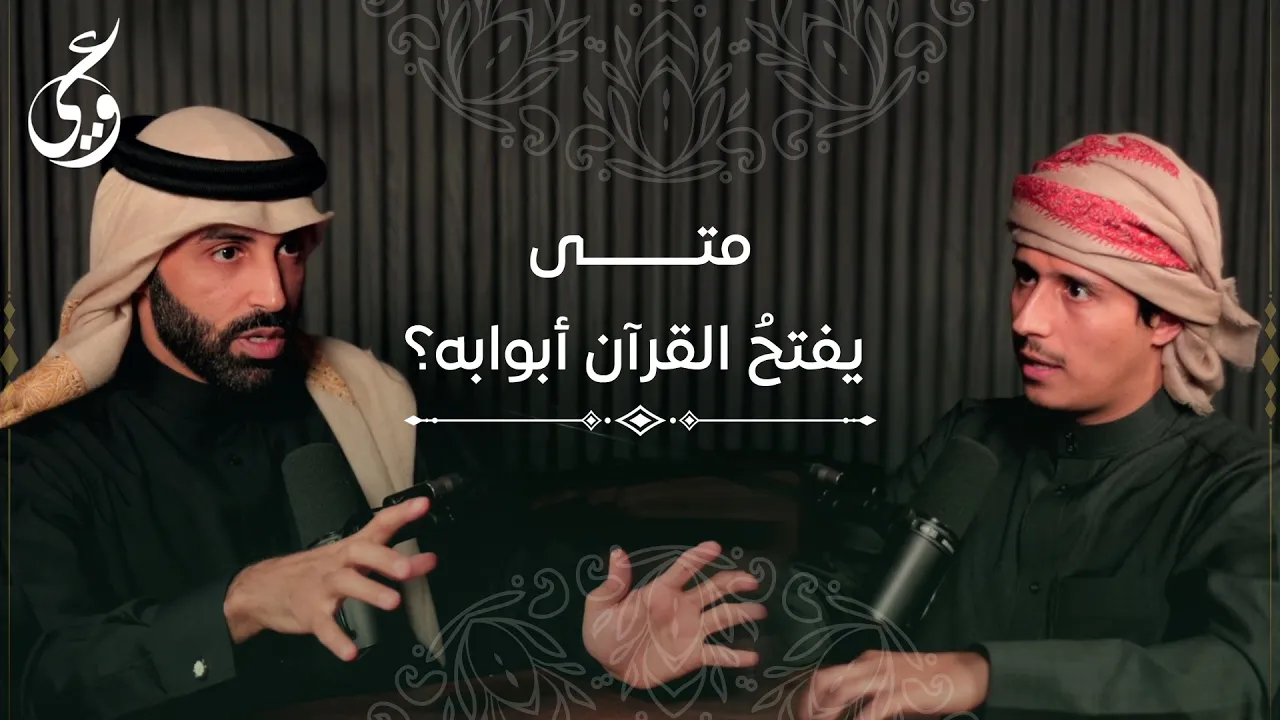
the task of scholars? Or is each of us meant to reflect and understand? If the door is open, is there no fear of those who twist verses to fit their whims, as seen in modern examples? And with talk of the Quran's centrality, does that mean marginalizing our Prophet's Sunnah? Or is the bond deeper than we imagine? With Ramadan near, how can it not be just another repetitive month with the Quran? How can it be a different month where we do more than just count completions? Discussion topics with Dr. Nayef bin Nahar in this meeting, where
we try to approach one big question: When and how does the Quran open to us? Welcome, Dr. Nayef. Greetings to you. Mr. Fida, welcome. Greetings. You honored us. I am happy. May God save you. How are you? Fine, God bless you. Again with the Quran, but from different angles. We start with a question many people have: We hear the Quran is for all times and places, but when we open and read it, we don't feel it is actually linked to our reality or that it addresses contemporary issues. How can we activate the Quran in our
lives? Activating the Quran is a necessary duty, as God revealed it for our guidance in our reality, not just a specific one. The Companions and their followers were the ones guided by the Quran, and we are not? No, in every time and place we must be guided by it. But as you said, Sometimes we read it and feel it is hard to apply to our reality. Some people might see a gap with current issues. And the Quran, because he sees different issues, prophets' peoples, and others, he says our issues are different from those in the
Quran. This is inaccurate. The problem lies in our perceptions of it. Major problems always have roots in perceptions; wrong perceptions prevent proper awareness. For example, in our dealings with the Quran, we have wrong Perceptions that prevent its application to our reality. What I see as very important in dealing with the Quran, to guide your interaction and give you the ability to apply it to your reality, is to see it as a book of methodology, not information. Great. If you see it as a methodology that shapes your thinking and awareness, not a book of information, no,
it aims to shape the recipient's awareness. If you approach the Quran seeking information, you might not find What satisfies you. But if you seek to build sound, mature awareness, you will certainly find what you need. What do you mean by information? It's not... For example, when you read about events covered in the Quran, you find few details. You don't find info about people, or places, or times. For example, Pharaoh is mentioned over 60 times, but it doesn't say when he lived. Right? It doesn't name his father or even him. Pharaoh is a title. It didn't
name him. It didn't say how big his army was, where he lived, his age, or where or when he was born. All this information that historians usually care about, the Quran ignores. Why? Because it doesn't help build your awareness. It focuses on issues that build awareness. It only mentions enough information to build the reader's awareness. Look at the Battle of the Trench. It was a serious, decisive battle. The Muslim nation was nearly destroyed. The last base, Medina, was besieged from all directions. There was a plan to annihilate it. So you'd expect the Quran to give
details about this pivotal battle. And indeed... If you look at history books, you'll find they are full of details. When the Battle of the Trench occurred, who participated, the names and number of the tribes, the number of Muslims, the leaders' names on both sides, even the number of horses and camels. The Quran did not mention This information. Why? It is not vital to your awareness. What is important then? When the Quran spoke of this battle it only dedicated about two pages to it. An event that takes historians hundreds of pages took only two in the
Quran. Why? Because these two pages are enough to build your awareness. The Quran says: "And when the hypocrites and those in whose hearts is disease said, 'Allah and His Messenger only promised us delusion.'" This is the first group. When the hypocrites saw the Confederates, they began to doubt the principles. "We discovered that this religion is not true, as we are now besieged and about to lose, so our principles are incorrect." This recurs in reality. Today, it repeats. Who are the hypocrites? He didn't say. Who are the sick-hearted? He didn't say. So what does He want?
He wants you to understand their logic, as they repeat in every time and place. Then He starts with another group: "People of Yathrib, you cannot stay." This group wants to discourage. Why? Because the other side is stronger. We cannot resist them. Let's surrender. "You cannot stay, so go back." Right? This group discourages. A third group: "A group of them asks the Prophet." Why use a different word for "group"? To show they have a different logic. To build your awareness of these groups that repeat in every time and place. "They say: Our houses are exposed." Meaning:
we have women to protect. "They are not exposed." Why did they lie? The Quran exposes their excuse as a lie. "They only intend to flee." A group that wants to withdraw. A group that wants to flee. How many? Three: the doubters and the discouragers. And a fleeing group. Right? No time or place is free of them. Amazing. He also mentioned the fourth group: the believers. Here it's different. "And when the believers saw the companies" It didn't say "saw the disbelievers." He wants to show you the large numbers. See the scene: companies surrounding them while they
see signs of defeat. Signs of being overcome. And even worse? The team they relied on began to withdraw. Another group fails them, and another doubts their principles. Only a few remain. They feel abandoned and disappointed. Usually, when one sees signs of defeat, they feel their hopes are disappointed. And the principles they adopt. People link truth with victory. But Allah may test you for other reasons. This group sees all signs of loss, yet: "And when the believers saw the companies," "they said, 'This is what Allah promised us.'" Even though they saw those signs, they had the
opposite belief. The same event, but different reactions. Why? Due to different awareness. They have a different awareness. "It only added to their faith and submission." Normally, when an ordinary person sees this siege And this gathering of factions, they start doubting their principles. But for them, the opposite happened: "It only added to their faith and submission." God wants to tell the believer that this event, this siege, and this shaking of principles might happen again, and you must remain firm and follow those before you. He shaped our awareness. Whoever reads Surat Al-Ahzab gains awareness. In every crisis
and every battle between truth and falsehood, these groups Will appear. Do not be surprised; prepare yourself to see these groups. But people today are surprised. In the Algerian war, we saw these four groups. In Afghanistan, we saw these four groups. In Gaza, we saw these four groups. In Syria, we saw these four groups. In every battle between truth and falsehood, you see them. Do not be surprised. When something happens... Gaza's genocide. Some doubt the resistance. They say it is useless. In the Algerian Revolution, they said France was a legal state. Sharia scholars used to say
this. So why are you surprised? Why did the Quran focus only on this info? To build your awareness. If you lack awareness, it means you did not read the Quran correctly. Such a person hasn't applied the Quran because they ignored the ideas the Quran wants you to notice to build awareness. To summarize this point or first rule: The Holy Quran is a book for building awareness, not just information. Yes, in every incident and event, even when dealing with people, it ignores numbers, names, times, and places. It cares about events that build awareness. It doesn't give
much info on events, but aims to build your awareness of them. If events repeat a thousand times, you'll have no problem because you have the awareness to handle these events. You have the awareness for a right stance. Like now, when someone wants to enter trade, At first, you teach him, shape his mindset, How the trader handles money, how he deals with deals, how he handles these matters, then After building his awareness, you let him trade. He has business sense now; you don't go with him to every transaction and explain everything, or have him return to
you for every sale and buy. You shaped his awareness once, that's enough. With that awareness, he'll handle everything. Got it? So, whoever turns to the Quran seeking info only without paying attention to the logic of thinking that the Quran wants to build, will not understand its purpose or be able to apply it. Let me give you another example in the same context. Look at this verse: Allah Almighty says, "And a man came from the farthest city, running," This man played a very important and dangerous role, He saved a prophet of Allah, yet his name wasn't
mentioned. Why? The Quran wants you to focus on his role. Because this role is required from you too. You must always act in such a role yourself. This man lives under an oppressive, frightening regime. A tyrannical system, Pharaoh's regime, yet he found a way to act and save this reformer. No matter how blocked the horizon is, Look for available spaces to move. Let me give you another common example. The owners of the garden in Surah Al-Qalam. The lesson is their logic and thinking. Look at the idea of the blind man. He frowned and turned away...
Why didn't it mention his name? It could have said Abdullah ibn Umm Maktum. But why say "the blind man"? The Quran wants to alert you to the trait for which he was turned away and ignored. He frowned because he was blind. How do people treat the blind? They don't see them as an added value. They don't think they will change much. So the Prophet focused on the leaders. He thought they would change the equation. The Quranic lesson here is that you cannot judge people by appearances. You don't know their inner potential. But what would make
you perceive... What do you know about him? Judge people by their openness to ideas and by their readiness. Because this is... The standard, and don't let formal criteria judge people. But if it said "Abdullah bin Umm Maktum," this meaning is lost. The story and the meaning would end. Some atheists ask: why call him blind? Is it an insult? No, it is not. He wants to warn us not to make this a standard for dealing with them. He may be better. So it is an advantage here, not a flaw. If we view it as building awareness,
not building information—and this is common— you will understand the Quran's method. In many Quranic issues, you will see it if you view the Quran as a book aiming to build awareness, not just to provide information like historians do. If you look at the battles in history books, you find every detail. But in the Quran, they are very brief. Information is rarely mentioned. Look at Joseph's story in the Quran and in the Torah, in the Book of Genesis. In Genesis, from Chapter 37 onwards, you read informational details: how old was he, His brothers' names, his age
at the palace. How old were Joseph's sons when he left and became a minister? All this info is not mentioned in the Quran. The Quran says: they sold him for a low price. How much? Not mentioned, because it only shows they undervalued this prophet. For example, the Torah says he was sold for twenty silver coins. With false blood. So what blood was that? Where did they get it? The Quran doesn't mention it, but the Torah says it was from a goat, etc. So these details, even if you compare, not just with history books, even if
you compare the Quran with other religions' books, You'll find the difference is clear. Why? Because the Quran wants the Muslim to build awareness to deal with life with sound awareness. But doctor, there are details mentioned in the Quran: numbers and names, like Abu Lahab, in the story of Noah: a thousand years minus fifty. People of the Cave: three, their dog is the fourth. These things, Yes, that's true. I'm not saying it gives no info. But I say it doesn't focus on info. It gives very little info. For example, Noah, what do you know about him?
Imagine, his son's name is unknown. What era did he live in? We don't know. Which country? We don't know. When did he die? How old was he at death? We don't know, you see? So, a lot of info considered basic by historians is not mentioned, but when it did This period is 950 years, why? Because this was in Surah Al-Ankabut. It came to comfort the Muslims who began complaining in Mecca at the end of an era. It has been over ten years and Meccans did not believe, and we are few. Frustration grew with the Meccan
state. It said: You complain about ten years without response? Look at Noah. Noah spent nearly a thousand years Calling them, yet they did not respond. Elsewhere it says he called them day, night, secretly and openly, yet they did not respond, but he did not despair. The number is vital to build awareness and a message for reformers: people might not respond to you. Your duty is to keep calling to God. If they respond, fine; if not, you did your job. Remind them. People's reactions are not your concern. Your responsibility is to remind. Even Abu Lahab is
the only name mentioned. Imagine, of all the disbelievers at that time, only Abu Lahab was named. Abu Jahl was not mentioned, but notice one of the amazing things: Surah Al-Masad, which mentions Abu Lahab, follows what? Surah Al-Nasr. Strange, isn't it? Al-Nasr was among the last revealed, yet they were placed together. Abu Lahab was one of the fiercest opponents, most concerned with aborting the dawah. Allah placed this Surah after Al-Nasr To say to everyone who opposes Islam: The final outcome is victory for Islam. Do you see? He took the one who led the enmity and linked
him to victory, so that anyone trying to undermine Islam who thinks their massive wealth and vast power will stop its spread or stop the light of Allah on this earth will know that victory belongs to Allah. When the victory of Allah has come and the conquest. The matter is settled. "We have given you a clear conquest." So these few names, numbers, and places always have a purpose behind them. The Quran wants to create awareness. May Allah bless you, Dr. Nayef. We conclude from the above one rule or one guide: the Quran is a book that
builds awareness, not just providing information. Yes, so when you approach the Quran, seek what builds awareness and corrects logic. Do not look for detailed information, etc. as many people do. Instead, focus on how each Surah builds awareness of an issue. For example, how Surah Al-Ahzab builds it regarding existential crises, or At-Takathur on material competition. In every Surah, the Quran builds awareness of an idea. And so on. Are there other guides or other rules to help apply the Quran to our reality? There are many rules, like this one, an extension of the previous: Do not view
Quranic figures as just specific individuals. You see? You must view them as models. How so? For example, the Quran mentioned Qarun, Pharaoh, Haman, and the people of prophets. These are not just historical figures. They are recurring models in every age. Sometimes you may have their traits. You might see yourself in the story. unconsciously, though you see it in others. So now, when we read the verses about Qarun, Pharaoh, Haman, and so on, or the verses about the Children of Israel and past nations, we feel they don't apply. It's as if we only wait for God
to say, "O you who believe," to pay attention. We think the rest doesn't concern us. This is wrong. The Quran did not mention these in vain, but to alert us to issues vital to shaping our awareness of reality. Qarun, for example, is a model with logic explained by specific characteristics. He said, "I was given this due to knowledge." When his people spoke of his vast wealth, he credited himself. How many of us think with this logic of self-entitlement? "I got this position through my smarts." Or when achieving academic excellence, Or when the world opens up
and wealth grows, one credits oneself for everything. This is a "Qarun-like" tendency. You must work to treat it, and therefore, you must reflect on these characteristics. The Prophet said in Musnad Ahmad... Jahl? This nation's Pharaoh. God did not view Pharaoh as a person who lived in Egypt and ended, but as a model recurring in every time and place. Abu Jahl was this nation's Pharaoh. Pharaoh's traits were present in him. So he applied it to him. Same thing regarding the Children of Israel, or even their scholars. The Quran speaks much of their scholars. This is not
in vain, for we will fall into what they fell into. "You will follow the ways of those before you, step by step." They asked: "Jews and Christians?" He said: "Who else?" We will closely follow the ways of previous nations, including Jews and Christians. We can see The Quran's talk of them in ourselves. Ibn Taymiyyah showed common traits between their scholars and some of ours. Some Muslim scholars fell into the same crisis they fell into. I'll give an example. This is serious. God said of the Children of Israel... "Sell my signs for a small price." How
many scholars sell God's signs for a small price? A Sharia specialist might come and write tweets or articles distorting Islamic issues, directing verses to serve Certain interests, whether partisan, govt, or international systems. How they played with verses of Jihad. This is all selling God's signs for a small price. Also, look at some sheikhs in Islamic banking, for example. This is a wide arena for trading religion. I don't say all, but many of them. In the end, he fears that if he rules against bank management, they will fire him. We have a very bad system in
banks, where the bank management can Remove the Sharia board. Either the board complies, or I dismiss it. Many sheikhs face worldly weakness, so they don't issue a fatwa that angers management. They flatter them. Doctor, you reminded me of the Israelites and the cow, making excuses to evade the Sharia ruling. Yes, this is recurring. Events recur; the Cow incident repeats in every time and place. If we ponder the Quran this way, we will see that it exists in everything before us. You will see a Quranic explanation for it, a model for human and social phenomena fully
and completely. But our problem is that we are attached to people and words, without penetrating what lies behind them and the ideas behind them. This is an important rule: modeling people. Treating people as models. How do we turn people into models? By extracting their characteristics. I read of Qarun and Pharaoh and extract their traits. How do they think? How are they presented? I read the Bedouins' story and extract their way of thinking. You see? Then I seek these traits in myself first. I see which of these I suffer from. I may have many of these
traits without knowing, so I start to fix them. The goal isn't just to ponder and extract, but to seek guidance. It is a means. Pondering extracts Quranic meanings. Extracting Quranic meanings is one task. Another is seeking guidance for reality. To fix it, as God revealed the Quran. Why? Ramadan is when it was revealed. A guidance for people, so we must use it. To deal with our reality. This stage. Comes after reflection. Indeed, Doctor. The point you made about searching traits. Of Quranic models, like hypocrites or. Bedouins, Israelites, Pharaoh, or others. Or Qarun, then I question
myself. Which traits apply to me? I should not start with others. So this search is not used for revenge. Labeling enemies as hypocrites or Jews. Seeking guidance is very important. To see which traits apply to me first. Before applying them to others. When you extract these meanings. The first thing is to look at yourself. If you extract traits of Pharaoh. Or Qarun, or the people of Shuaib. Or Aad, Thamud, and Noah. First. You must ask: where do I stand? What traits of theirs do I have? In me? You see? Before looking at others The goal
is fixing yourself, then others But it is vital to start. This point you mentioned is very important: some exploit these meanings to attack others. This is manipulating the Quran. Well said. So far, we can say there are two rules. First, the Quran is a book of awareness, a methodology, not just information. True. Second, the Quran focuses on modeling people. All the names you read in the Quran, the groups and sects, are models that recur in any time and place, not just specific people. Are there others To help apply the Quran to our reality? Before discussing
other guidelines, regarding these two rules, we must understand that since it is awareness, we must also embody these Quranic characteristics. How? If the Quran builds awareness more than information, I, as a researcher, must also focus on building awareness, not drowning people in data. Many researchers, especially historians, do that without a goal. See? For example, some historians have Historical data but lack awareness. See? He lacks historical awareness, so he drowns people in data. What is the gap? I will give you an example of the difference. Days ago, I heard a talk about a historical era. The
speaker drowned people in detailed information. You leave without a mature perception. How do you benefit from those events? God's laws in that era, the phenomena of that time—how did they react? How? These things regarding the listener's Methodology were ignored. He just gave endless data. This is a big problem, because information dazzles. You know? It has an appeal, and many intellectuals fall into this trap when sitting in a gathering, showering people with facts so they say, "Wow, he is so encyclopedic." But people gained no real benefit; their awareness is same. It is the same as before
meeting him. Right? This is a problem. Therefore, the intellectual should not be deceived. The audience, because people usually look for information. What happened? How tall was Adam? And so on. Detailed info that doesn't build awareness. He must redirect the audience's questions. They ask worthless questions. You must reshape their awareness to ask valuable ones to build a sound awareness for them. What is the difference between a merchant and a clever merchant? A regular merchant thinks about investing in people's needs. A clever merchant creates those needs. Amazing. So, a regular merchant thinks about what sells in the
market. He enters a country: "What sells here?" "This and that sells." So I will buy this merchandise and sell it. Right? A clever merchant thinks: "How do I sell my goods in the market?" For example, if you want to open a gym in a society with no sports culture, you would certainly lose because people do not care. But the clever merchant comes And creates a positive culture for sports. The public craves a sports arena here. The first to open wins, right? Sometimes, apply this to intellectuals. Sometimes, you sit in a gathering and they pelt you
with useless, pointless questions. Like Noah's Ark: how big? What era? And so on. Its size? Was it huge? Or whatever? Where was it? Was it in Iraq or the Hijaz? Where did the flood start and end? These questions build no awareness. So, What do you do? Redirect their questions. Say: Noah is important, but there is more. Noah preached to his people for 1,000 years yet they didn't respond. Let's explore the cognitive and psychological barriers that kept them from believing for nearly a thousand years. Then, let's see if these barriers exist in us. See? What did
you do here? You reframed it. Instead of questions about matters that build no awareness, you moved to enlightening issues. This is the Quran's Method: raising the listener's thinking above trivial, valueless information. Knowing it or not adds nothing to you. It adds nothing. Here you adopt the Quran. As a scholar, you focus on what builds people's awareness. If scholars accept this, the cultural production of the Ummah changes. I start to focus; I only write research if it plays a role in building awareness. I only write a book if it builds awareness. I only lecture if it
plays a role in building awareness. I don't aim to impress. Impressing people with my knowledge has no real benefit. What benefits people is not what they like. The second rule is a common saying: "I discuss ideas, not people." As an intellectual, this is a good rule for dealing with ideas. This is also the Quranic method; it looks past people to the ideas behind them. Any other guides to activating the Quran in our reality? Yes, there are many rules or guidelines. The Quran only interacts with the active. Take it as a rule: it only interacts with
the active. How so? Meaning, you cannot understand its objectives unless You adopt its causes; the Quran reforms. If you do not care to reform reality, you won't grasp the Quran's objectives. It came to establish justice. If you do not care to see justice in society, you will not understand its objectives. For example, it came to face hypocrites. It faced them clearly. This is a cause: to face hypocrites. If you do not, You cannot understand what it said about hypocrisy as a phenomenon. The arguments of hypocrites in every age were mentioned and refuted by the Quran.
The challenges of facing hypocrites are the same ones mentioned in the Quran. When you face them and return to the Quran, you will discover the massive model through which it treated hypocrisy, as seen in Surat Al-Fath, Al-Munafiqun, Al-Ahzab, and At-Tawbah. It discussed it deeply. But when do you start to recognize and understand the depth of its words? When you engage with hypocrites. This applies to any issue. For example: Family reform: if you are not concerned with family reform and don't care about it, you won't realize the depth of what the Quran says about family. But
bring someone interested in family reform and let them read what the Quran says. They'll say: "We often need this point, this and that." They will see that Quranic verses fit reality perfectly. This is logical. If you talk to someone without a background in a certain topic, they won't interact. If I had a project to reform banks and I brought people who have no relation to banks at all, they wouldn't understand a thing, right? But if you brought banking specialists and explained my reform project to them, they would understand and say: "Yes, we need this. We
have a big challenge. This reform will address this point, And this will solve that obstacle." They'll understand because they engaged with the issue. The rule here is: unless you adopt the Quran's causes, you won't understand its objectives. Sometimes some verses, some people may commit a certain sin, and when they encounter verses that discuss this sin, they are deeply moved Yes, and they understand it among all the worshipers Or, for example, another point: you may find researchers and scholars Non-Muslims interested in a certain aspect, so as soon as they come across information by chance in the
Quran They are greatly affected and enter Islam, and this There are many examples who entered Islam for this That's 100% true, and this leads us to the idea that we call the whole nation to reflect on the Quran. Why? Because minds are different, abilities are different, and the Quran is comprehensive; there is no field of life except it spoke about it. Glory be to Allah. So you cannot reflect on every verse of the Quran. For example, cosmic verses—how can someone like me, not specialized in cosmology or physics, reflect on them? Amazing But when a physicist
or a chemist comes you find they have amazing reflections, true I read a book by a chemist here in Qatar, a chemistry scholar, who explained the verses about the sky in an astonishing and wonderful way Honestly, I have never seen such an explanation He even detailed the issue of the sky's atmosphere, why he said "sky's atmosphere" and not "subjected in the sky's atmosphere" He didn't say sky; he spoke of the atmosphere in scientific detail. When you invite people to reflect on the Quran, each in their field, from the angle God has opened for them, you
will see the treasures of the Quran emerge. The whole society will see them, And this is what amazes people. Knowing its contents increases your trust. God says: A blessed Book We sent to you to reflect on its verses. For all people, Muslims and non-Muslims. Reflection is the true condition for seeing its consistency. Then do they not reflect upon the Qur’ān? If it had been from other than Allah, they would have found much contradiction. Without reflection, one sees contradictions. Reflection is the safety valve for harmony. The Quran interacts with those who engage. Only those who adopt
its causes understand it. This is one guide, but there are many others. An important rule for your relationship with the Quran and our ability to apply it to our reality is that the absence of terms doesn't mean the absence of modern ideas. Some people look into the Quran searching for Ideas enter through specific terms; if not found, one thinks the underlying ideas aren't in the Quran. This is the issue. It's a big problem. For example, ask him: Does the Quran discuss interest patterns? He'll say no. He didn't look for the idea, but is tied to
the word itself. Because the Quran didn't use "interest patterns," he thinks it didn't discuss them. Or, if you ask: Does it discuss power balance, balance of terror, or deterrence? No, the Quran didn't discuss these ideas. Why? Because he expects it to use these terms to realize it spoke of these ideas. No, these are modern terms; the Quran doesn't necessarily use them. For example, does it discuss wishful thinking? Yes, it does. Thinking patterns? Yes. Personality types? Yes. We think the Quran doesn't discuss many ideas because we expect it to use terms we know, and we think
it only expresses them this way. I recall the Iranian thinker Abdolkarim Soroush saying the Quran didn't discuss "authority." How? If you mean the term, yes, it didn't. Not using the term doesn't mean He didn't discuss the idea, right? When Allah says of David: "We strengthened his kingdom and gave him wisdom and discernment." This idea relates to authority, right? True. "Their affairs are by consultation" also relates to authority. All verses related to war and peace, the verses related to David, and "Pharaoh's command was not right." It speaks of his power and how he ruled. The Quran
discusses power in various terms. It sometimes discusses ideas using unfamiliar terms. For example, we are used to the word "despot," right? To express political tyranny. But when You search the Quran, it doesn't use it. One might think it didn't discuss despotism. It mentioned despotic figures like Pharaoh. But what term is equivalent to "despot"? One might search and not find the word, then say the Quran didn't address it. Yet it's a critical social concept, as many societies collapsed due to political despotism. How could the Quran, It addresses a grave social phenomenon: political tyranny, in a specific
term. The Quran uses a term equivalent To "tyrant", which is "Jabbar". "In it are tyrannical people." You see? "And you are not a tyrant over them. So remind with the Quran those who fear My threat." A tyrant forces people to obey him. This is equivalent to the term "tyrant". To extract Quranic knowledge... Sorry, but "Al-Jabbar" is one of God's names. Yes, because God is "Jabbar". Meaning? He binds all creation to His obedience. He directs all creation by His law. The sun moves according to God's law. The moon moves according to God's law. Air, water, and
all creatures move by God's law. Man does not die except by His will. When He wants you to die, you will die. When He wants you ill, you are. When He wants you to live, you live. Everything is by God's law. He is Jabbar as He binds all to obey Him. But He says: "There is no compulsion in religion." This is the only space He left for man. Free human will, to believe by conviction. Why? If one believes under compulsion, They won't fulfill religious obligations. God wanted us to believe because this religion has a message:
that people uphold justice. How can they do so if they are not convinced? It is impossible. Forced faith is useless, right? On the contrary, you increase hypocrisy. But God wants you to believe in this religion and be convinced, then start the project of upholding justice. We sent Our messengers with clear signs and sent the Book and the Balance with them So that people may uphold justice. One cannot contribute to this project unless they are convinced. Conviction is in the heart, so compulsion is useless. Thus, He said: There is no compulsion in religion. Right has become
clear from wrong. People now realize right from wrong. The choice is theirs. What did the Jinn say? We heard a wondrous Quran guiding to right, so we believed in it. Absence of modern ideas in the Quran, yes. Because people, as I mentioned, look at words sometimes like glasses; if you remove them, they can't see. This is a problem that deprives you of Quranic knowledge. You cannot see Quranic insights: political, economic, and cognitive, educational, social, and even managerial. You don't see all this knowledge in the Quran because you expect it to use specific terms, thinking it
only addresses ideas through them. If this rule is not rooted in your mind, the result is that you won't See Quranic knowledge. So far, the Quran is a book of awareness, not just information. It interacts with those who engage with it. It is understood by those who adopt its cause. The absence of modern terminology doesn't mean modern ideas are absent. Correct. These rules help us activate the Quran in our modern reality. But here, proper activation must be preceded by proper understanding. If it is not sound, activation will fail. How is proper understanding of the Quran
achieved? Through... Following rules for understanding Quran... Allah spoke of the "partitioning" method. Most of us fall into this method, whether we realize it or not. What is it? Just as We revealed to the separators who made Quran into portions. They treat it with fragmentation. One takes a verse and leaves another that doesn't fit, or takes a verse and leaves the context. For example: The word has come into effect upon most, so they do not believe. An atheist says: "It's settled then." "Why does Allah demand we believe?" "The word has come into effect." But you must
read it with another verse: I will turn away those who are arrogant. So, those whom the word came into effect are the ones arrogant toward the truth. The problem started with your arrogance, so Allah turned your heart from the truth. Or: O you who believe, upon you is yourselves. Those astray will not harm you. How often those who want no interference in their falsehood use this! "Leave people." "Don't speak out. Mind yourself." Common. But he ignores other verses that clarify the meaning, such as the verses: "You are the best nation produced for men" "enjoining what
is right," and those who deliver the messages. The Quran ordered us not only to forbid evil, but also warned against not doing so: They used not to prevent one another from wrongdoing. So: O you who have believed, upon you is yourselves. This means after your duty of calling to Allah, if they don't respond, You aren't responsible. You did your best. You are responsible for yourself. Or for example, someone cites: And warn your closest kindred to say Islam is only for Arabs specifically, or even just for Quraish. But he leaves out other verses showing its universality:
It is but a reminder to the worlds. He ignores all these as if he doesn't see them to exaggerate the role of Arabs. Sometimes one does this unintentionally, but the point is we often fall into the Trap of selective quoting. This is not the only type of selective quoting. Another form is sometimes related to context, where you take a verse and ignore the verses before and after it. Preceding and following context is vital. For example, "kill them wherever you find them." He takes it as an independent text, ignoring what precedes and follows it. Fight in
the way of Allah those who fight you He ignores this and only knows "kill them." To suggest the Quran calls for open war. They have misled many non-Muslims and Muslims through this selective quoting. "When the sacred months have passed, kill..." As if it were an open declaration. What is the verse before it? He doesn't know. What are the verses after it? He doesn't know. Later verses clarify: Would you not fight those who broke their oaths and intended to expel the Messenger and attacked you first? He ignores these, or does it intentionally. I have seen opponents
of Islam and some Westerners do this. Even in translation, they decontextualize verses to promote them, because out of context they do suggest a problematic meaning. Its context will be clear. This is one of the biggest pitfalls we fall into. Sometimes the extraction is not just from the context; they even extract from the verse itself. They don't finish the verse, like: "And the male is not like the female." They take only this part and view it as an explicit declaration of contempt for women. He doesn't even know who said this phrase. Is it attributed to God
Almighty or to Mary's mother? Why did she say it? What is the rest of the verse? Neither context nor anything else. Let me give another example of extracting from the verse itself without completing it. Taking part of the verse and leaving the rest. God's words: Recite in the name of your Lord who created The word "Recite" has been taken out of context in the modern era. They treated it as a verb related to contemporary reading that we see today. Therefore, the expression became common: "We are the nation of Recite." No, we are not. Other nations
also read. In fact, some nations might read more than us. But we are the nation of: "Recite in the name of your Lord who created." God is Great. We are the nation of divine reading. We are the nation of reading that links the creature to the Creator. It does not view matters in isolation from the Creator who initiated creation. You see? When we extracted the verse under modern pressure in the current era, and we became... We view Quranic concepts materialistically. We saw reading as a purely physical act. We glorified the subject of reading without finishing
the verse: Recite in the name of your Lord who created No, reading alone is not enough. It must be linked to "In the name of your Lord who created." So, when I read cosmic phenomena, or read human And social phenomena, my reading must be an extension of reading revelation. For example, I view the hypocrites based on revelation, not on common analyses and explanatory models. Or I read material competition in human society, not through the capitalist model, nor through the Marxist model of material competition, but through Surah At-Takathur, as it provides awareness. Returning to the awareness
mentioned at the start, it gives me the awareness To understand this phenomenon and its cure. By the way, Surah At-Takathur addressed material competition and solved it in this short section called At-Takathur. A complete model for the solution. The solution: I read correctly, but Recite in the name of your Lord who created. My reading is always linked to the Creator who guides, as Abraham said: Who created me, and He guides me. God created this universe, so He guides this universe. Wonderful. I look at everything through revelation. This reading, when we fragmented it in the current era
and made The matter only about "the nation of read" apart from the divine connection, we began to interpret it materialistically. This all brings us back to the problem of division. We divide the Quran and deal with it as fragmented parts. We do not link God's verses to each other, to the point that we divide the verse itself. We are not the nation of "read," but the nation of "read in the name of your Lord." May God bless you, Doctor. Are there other rules related to correct understanding? Well, I told you, Mr. Fida, that the rules
and guidelines on this subject are very many. Among them is noting the names of the Quranic Surahs, As they nourish your understanding. Also, noting the Quranic themes. Regarding these themes, people usually follow the verses, trying to understand each alone, but they do not look at the theme of the Surah. The Surah's theme is vital to understanding phenomena found within it. What do you mean by the Surah's theme? For example, Surat Al-Hujurat has a theme. Al-Baqarah and Al-Imran have themes. Each surah has a main theme to understand. Verses are understood through it. Example: Allah repeats many
stories often. You cannot understand the purpose Of repetition without the context in which the story appeared. For example, Allah repeated the story of Iblis. True. But it is not identical repetition. Each time, there is another angle linked to the surah's theme. A different awareness or angle He wants to highlight. This angle relates to the surah's theme. In Al-Baqarah, He didn't focus on Iblis. Only one verse. But He focused on angels. Their dialogue isn't repeated, but Iblis is. Why? Because Al-Baqarah is about mandate. And the main issue: submission to Allah. From the start, submission is a
core idea. When He said "guidance for the righteous," the first trait was "belief in the unseen." We don't often stop at this verse. Though it seems strange. One expects it to say "those who believe in Allah." See? "Those who believe in the unseen" is not repeated. No other verse mentions believing in the unseen as a specific trait of believers except here. Unseen is the unknown. That is so he knows I did not betray him In his absence, meaning where he cannot see. Sometimes God gives you a command and you don't know the purpose, but you
must submit. Surat Al-Baqarah addresses this issue: submission, using the example of the gnat. Those who believe know it is the truth. Who gave the example? God. So that's it. But those who disbelieve say, "What did Allah intend by this?" I'm not convinced. We need to be convinced. Here is the issue. Regarding: I will make upon the earth a caliph The angels submitted; Iblis did not. He discussed this from the angle of submission. In Surah Sad, he expanded on Satan's arguments. Because Surah Sad deals with the arguments of the disbelievers. That is its main theme. But
those who disbelieve are in pride and dissension. Stubbornness. They have false arguments. In this context, it was fitting to expand on Satan, unlike in Surat Al-Baqarah. Then the Children of Israel and submission Al-Baqarah's name is also related to submission; they didn't submit when ordered to slaughter a cow. Then everything Returns to the idea of submission. When Talut said: "God will test you with a river whoever drinks is not of me, and whoever..." See? "Except one who scoops a handful." Why? What's the wisdom? Learning to submit. He could have allowed three or four, but He wants
to train you to submit to duty, which is the theme of Surah Al-Baqarah. When you understand this theme, you know why Iblis's story was told this way, and why the Children of Israel's story, and why the cow was mentioned. Same thing for Surah Ar-Ra'd, for example. Its theme revolves around the idea: "Why is there no physical miracle?" The polytheists tried to harass the Prophet and repeat this idea: "If you want to convince us, be like previous prophets. Moses had a staff, Jesus raised the dead, etc. Where are your physical miracles?" It seems the Prophet was
longing for... Such physical miracles exist, but Allah said: For every term there is a decree. Some scholars said it should mean: For every book there is a term. The Torah had a term until the Gospel, then it ended. The Gospel until the Quran, then it ends. But Allah said: For every term there is a decree. Decree can mean a ruling or a law. A timed ruling. So, He says: If I brought a physical miracle, you'd be awed, but who would convince future generations? It must be a final miracle. And for it to last until the
Day of Resurrection, the sense of awe must continue. This only happens with an intellectual one. What is the Surah's name? Ar-Ra'd (Thunder). A loud sound that awes, but lasts seconds, then it ends. It leaves no trace. A physical miracle would awe you, its sound would be loud, but no trace. As for the Quran, we still live in unimaginable, accumulating wonders. There is no god but Allah. It's the same for Surah Al-Hujurat. Surat al-Hujurat has a whole theme. I mentioned it earlier, but briefly. The Surah is called Al-Hujurat, right? What are "Hujurat"? It means rooms. Land
enclosed by a wall. This wall aims to protect you in your room, right? Surat al-Hujurat discusses the rules that form a wall protecting society. First, respecting status: do not raise your voices above the Prophet's voice. Indeed, those who call you from behind the chambers - most of them do not use reason. If a wicked person brings you news, verify it. If two groups of believers fight, make peace. Do not leave any Problem without trying to fix it, even if small. You must take initiative to end the problem at its start. Believers are brothers, so make
peace. It corrects our perception. If we see ourselves as brothers, we will reconcile. It didn't say "don't disagree," because brothers do disagree, right? But brothers don't stay in disagreement. I may be upset with you today and tomorrow, but we will meet at a family occasion. In the end, we will reconcile, right? Our paths cross; we won't part, so... Brotherhood leads to reconciliation. Brotherhood doesn't deny disagreement... but denies persisting in it. Great. The Quranic expression was amazing: "Believers are brothers, so reconcile." Then it mentioned direct insults: Ridicule, defaming, and offensive names. Then it mentioned indirect insults:
Suspicion, backbiting, and spying. Then the rule protecting human society: Getting to know one another. For every problem, it gives a solution. Like: "Do not defame yourselves." Two words: the problem and the solution. Defaming is the problem, right? It says "yourselves" because it's abuse. It is an indirect way of insulting. What we call "taking jabs" today. It shows meanness. You cannot... confront people, so you use such words. It harms you before others. It corrected the act in two words. When you understand the Surah's theme... The story of the Bedouins is at the end. But if you
don't understand this topic, you can't frame the Bedouin issue. Focusing on the Surah's theme helps. I'll give another example. Tell me if I'm taking too long; I can move on. Look: Sometimes you find it strange that the Quran defines things differently than traditional logical methods. In logic, when defining a concept, they include all elements in a definition. The Quran doesn't list every element, But mentions elements related to the Surah's theme and the context. When defining "the believers," it doesn't list all elements of faith, but only those that fit the theme and context. Regarding the Bedouins
in Al-Hujurat: The believers are only those who believe in Allah and His Messenger and doubt not. Why start with "doubt not"? Because the Bedouins' problem is with certainty. The Bedouins say, "We have believed." Say, "You have not believed; say, 'We submit.'" Faith has not yet entered your hearts. The believers have succeeded: They who are humble in prayer Then what did He say? He spoke of turning away, those who... from ill speech: And they who turn away from ill speech. Now... Why did He mention turning away from ill speech as a second trait? Imagine, He mentioned
it second. If you... today brought anyone and asked them to list the first... ten traits of a believer, you likely would not find the trait... of turning away from ill speech among them, right? True. So why did He mention it here as number two? Because... it fits the theme of the Surah. Surat Al-Mu'minun talks about... the challenges a believer faces when belonging... To the faith. Turning away from ill speech... is one of the greatest tools that protects you from challenges. Because if you face every challenge, even a trivial one... and exhaust yourself with it, you
cannot continue. Therefore... turning away from ill speech is a safety valve for you in dealing... with the challenges you face in your life as a believer. So it was fitting to prioritize it. But how did we know... it was fitting here? Had we not known before... the theme of Surat Al-Mu'minun. Thus, knowing... the theme of the Surah helps us identify some... phenomena in the Quran. May Allah be pleased... with you, Doctor, and reward you, and put this in your... Scale of good deeds. Well, we have discussed the guidelines... and rules for activating the Quran in
our reality, then... We moved on to guidelines for correct understanding of the Quran and its rules. These ensure the Quran opens up to us, grasping its meanings and goals. True, but fundamentally, you may have these rules and others, yet not benefit from it. The Quran won't open its doors. Strange. It's not just knowledge; it's the heart. We have issues to fix in our approach To the Quran. We have a crisis of trust. Trust in dealing with the Quran. Do we really trust the Quran absolutely? We say the most beautiful things about it, but our reality
shows something else. Muslims rush to find knowledge and answers from outside the Quran. When a question arises—educational, cognitive, social— they seek answers outside the Quran. When we ask how to develop a model, they go to every book except the Quran. This is what I see in research fields. They always resort to outside the Quran, then speak beautifully of it. This is a contradiction. Imagine being an employee A minister says: You are the employee whose mind I trust and genius I admire. Yet, whenever an issue arises, he shows it to everyone but you. Or at least,
he comes to you last and says: I trust you completely. You'd see him as contradictory. This is us with the Quran. We say we trust it completely, then we develop our models and build our institutions on other values, Based on non-Quranic knowledge. Why? Sometimes an educational researcher asks: How do I develop a model for children? Where do I start? Give me books. You say: Look at Surah Luqman. It offers a great educational model for dealing with kids. Correcting perceptions, then practices, then linking them. He says: Okay, fine, but give me other books, other names. He
is not convinced. By the way, when you tell people the Quran has models, they feel you are exaggerating. Why? Their ceiling for the Quran is low. Their trust in the Quran is not high. They think it is only for law and stories of prophets and a few topics. But on the... Knowledge makers doubt the Quran's input. How do we restore our trust in it? First, you must trust the Source. Do you not have absolute trust in God? Is He not All-Wise and All-Willing? And All-Knowing? This book is from Him. He knows every detail of this
universe. He wants only good for us. He is Good. So we know that this book came... "To guide to that which is most upright." All life is set right by the Quran. To fix political life, use the Quran. To fix educational life, use the Quran. It must be based on the Quran. Social life must be based on the Quran. God says: "This Quran guides..." "...to that which is most upright." Do we trust and apply this verse? We must see it embodied. What is... ...the Quranic Centrality project? It aims to turn faith into reality. How do
we align all life with the Quran? The Quran spoke of all areas of life. Surahs At-Tawbah and Al-Anfal, for example, showed a model for international relations. Surat An-Nahl discusses a cognitive model. Al-Hujurat discusses a social model. Thus, the Quran covers all models, but many Muslims lack trust and give more time to philosophical and Western literature. When they come to the Quran, they do a quick reading and say they found nothing. How could you find nothing in the Quran? Did you give it time like other books? Some spend a year or two with certain writings and
figures. Even when dealing with famous thinkers or past scholars, they spend a year or two. Some specialize in them for a lifetime. Did you give such time to Surat Ar-Ra'd, Surat Hud, or Yusuf? Not even 10% of it. How are you convinced you won't understand Ibn Taymiyyah unless you spend ten years reading him, or Al-Ghazali, Abu Hamid, Ibn Rushd, or even Western philosophers? I myself spent six months with Baruch Spinoza, for example, because I felt his cognitive material was vast. I began deconstructing his views on religion, politics, etc. We give time to thinkers. But when
it comes to the Quran, read fast and then you make these major claims: "The Quran has no political theory or model of knowledge." Why? Because of hasty reading. Then, in the end, we judge the Quran based on this reading. Some say you can't Judge Al-Shatibi's Al-Muwafaqat unless you read it six or seven times. Al-Shatibi wrote massive volumes on heavy topics. When you read the first volumes, they are heavy, yet there is persistence. But when moving to the Quran, this persistence vanishes. We have a problem: we don't give the Quran its due research to extract its
treasures. This doesn't come by chance through hasty readings. It must be studied properly. Trust the Source when you know God, as Ibrahim said: Who created me, and He guides me. This Book is from my Creator, so it contains my guidance in this life. That is absolute trust in God's Book. Also, trust is built by knowing its content. When you learn the Quran's content, you are amazed and reach absolute certainty. You reach a level of certainty that this Book can only be from Allah. There is no god but Allah. The integration in handling issues is dazzling.
No human could have written it. Imagine Asking someone for a vision to regulate social relations. How much would they write? Volumes or hundreds of pages. In Surah Al-Hujurat, only two and a half pages regulate society from authority to practices. Glory to God. O you who have believed, do not put... ...yourselves before Allah and His Messenger The compass is authority. In Al-Hujurat, as we said, it mentions social rules. But what use are rules without authority? What is the standard for these rules? What is their reference? There must be wise authority. You cannot build a wise society
without wise authority. If authority is flawed, rules are flawed. We are holding a forum on the family. The title: A Wise Family via Wise Authority. You cannot create a wise family if we live with conflicting authorities. Other references will not be disciplined. He has the compass for making rules. The first step is setting the reference. This great method first set the compass. Then it moved to the following rules. An integrated method. Look, for example, at epistemology in Western literature. They expanded greatly on epistemology. Starting from Francis Bacon, David Hume, Descartes, and Baruch Spinoza—philosophers like Montesquieu
and others. But when you move from this field, even to former Islamic scholars like Al-Ghazali, Averroes, and others, if you read them, then move to Surat An-Nahl, you find a different logic and a different method. These writings on epistemology open many files and expand your mind and perspectives, but they do not give comfortable or satisfying answers. They are open horizons with no end. Surat An-Nahl clearly shows you the sources and nature of knowledge, the limits and obstacles of knowledge, and the means and goals of knowledge. The topic of obstacles to knowledge is not very important
to philosophers, but it is essential in the Quran. Knowledge is clear; the problem is obstacles. The Quran presents knowledge differently from philosophers. It says that knowledge is consistent with the soul. You cannot separate them. To understand how knowledge moves in the human mind, you must understand the soul's movement. It combines them, discussing knowledge and its psychological obstacles. Separating psychological knowledge from social and educational knowledge is an artificial split in universities. Psychology, sociology, and education cannot be separated; they must all start from understanding the human being. The unit of analysis is the human, and the human
is based on psychology. All human actions stem from the soul, whether in politics, economics, or society. These fields reflect human biases and psychological convictions. Even in politics, you see Trump today. His dealing with the world depends on the psychological side. The whole issue Is psychological. He uses high threats to see the other leader's reaction. Are they rattled? When he tells Europe: "I will impose 200% customs duties," he watches. Then he says, "Okay, 100%." Now it seems easier. He always gives high threats to rattle the decision-maker. Then he lowers it. But those with mental toughness are
not affected. Trump then gets along with them. He relies on this a lot. It is like merchants; when you enter, they give a high price. An item worth 20, they say 100. You say, "100? No." They say, "Okay, 70." You say 60, they agree. But it is worth only 20. They played with your mind. The Quran focuses on the psychological aspect. If it ensures your mental toughness, whether as a political decision-maker in international relations, or as an ordinary person buying and selling, your behavior will change. Even as a parent. It is all related to the
human soul. You will have a clear compass, plus When we say the Quran focuses on the psychological side, it doesn't mean it doesn't focus on cognitive awareness. It laid many rules for cognitive awareness. For example, what does the Quran say? "None will enter Paradise except one who is a Jew or a Christian." A big claim: none enters Paradise unless they are a Jew or a Christian. What did the Quran say? "That is their wishful thinking." These are desires, not facts. Why? "Say, 'Produce your proof, if you should be truthful.'" To turn desires into facts, meet
this Simple standard: "Produce your proof, if you should be truthful." This distinguishes wishful thinking from reality. The Quran taught me this: if your beliefs are based on desires, they are worthless wishful thinking. To move to real thinking, you must build it on real data, on evidence and proof—demonstrative thinking, in Quranic terms. This helps us, for example, most notably in political analysis. People say this state will collapse, this state will lose, or this one will win. You ask: do you have data or evidence? Do you follow the arms race between them? No, just their desires. This
state is... collapsed already. Common analyses spread among people match their desires and wishes. It's wishful analysis. It relies on human desires. But now, when you start from the Quran, you realize this is invalid; it's wishful thinking. The Quran wants you to build logic. "They denied what they did not encompass." This is a cognitive rule: humans deny what they are not used to. "I haven't Seen this before, so it's not true." Look at some people who denied Hadiths because they were unfamiliar to them. Al-Hasan al-Basri spoke of Heaven's gates. He said if you tell them "open,"
they do. Whoever reads this now says, "How?" "Impossible! How can a door just open?" Today you tell a device "write a book," and it does. As technology evolved, it's more than just opening a door. Often, verses on Heaven and Hell were denied as impossible. With technology, we see it's very easy. For example, they ask how the people of Hell can speak to the people of Paradise, when they're far apart. It turns out communication isn't an issue at all. You could be at one end of the world and I at the other, yet we can still
communicate, right? Visually too, not just by voice. Many things they denied simply because they didn't know them. Glory be to God, the Quran guides you to build awareness. Look, for example, at His saying: And those who disbelieve say to those who believe, "If it had been good, they would not have preceded us. And when they are not guided by it, they say, 'This is an ancient falsehood.'" Because they didn't believe, they went and criticized it. People tend to criticize what they can't do. This is widespread among people. Thomas Kuhn spoke about this idea in his
book "The Structure of Scientific Revolutions." For example, if you're a chemistry specialist and propose a new theory, your colleagues are the first to deny it since they haven't reached it yet, you see? They start denying you, but the point is the next generation. They don't feel this rivalry, so Now the Quran expresses this truth: don't let their denial deceive you, since they saw, for example, the poor and others preceded them in faith. When you follow the Quran's contents, you find amazing things. I challenge you to find a book that analyzes hypocrites like the Quran. I
know no book in history that analyzed and deconstructed material and psychological motives like it. When you hear the hypocrites' arguments, their actions and behaviors are the same as those mentioned in the Quran. When you learn this content and become Closer to it and enter its world, you will develop a very broad and absolute trust in the Great Quran. So, we restore trust first in the Sender, in God, and then in the content. True. But Doctor, there is another side related to trust. It might not be a crisis of trust as much as laziness. If you
tell someone who has a problem or wants an educational or economic model to look in the Quran, for example, they might find it easier to take a book That compiles it from several sources. It is not necessarily that they have a crisis of trust in the Quran's content. Yes, laziness is a valid excuse. But this excuse might only apply to the general public who are busy earning a living and have no time to acquire knowledge. It is natural for them to want a concise book. If we accept this excuse for them, we cannot accept it
for researchers. You are a researcher in this field. What is your excuse for not researching? You specialize in education, and the Quran has hundreds of verses on education. Why haven't you read these verses? Why haven't you utilized them to build educational knowledge? Don't tell me these are unrelated sciences. That is incorrect. These social and human sciences all contain values. Studies reflect objective social facts, but they also contain values. Max Weber said no science lacks values. Who creates these values? Usually, they are created by ideologies. The dominant ideology is liberalism. Why not accept other ideologies? But
you resent the presence of Islam. When you describe a phenomenon, you describe it based on certain values. This doesn't negate the objective side. For example, when you talk about the educational model in resolving family disputes, for instance, the Quran spoke of this extensively. Why didn't you refer back to it? Or when you talk about interests and treaties, the Quran spoke of these political issues. Every researcher focuses on their field, and the Quran addressed these topics. Not referring to it shows a crisis in their perception of the Quran. What stopped them? This is your field. That
is what I mean by this idea. Correct. So it is a crisis of trust and laziness. Some have a trust issue, others laziness. As I said, this is not everyone, But a segment of people. The more dangerous and bigger problem is the issue of sincerity with the Quran. Are you sincere when approaching it? We assume we are sincere when we start. The difference between honesty and trust. He is honest with the Quran, but lacks trust. Honesty is approaching Quran with biases. You have prior convictions and you search the Quran for what supports them. We do
this sometimes unconsciously. Strip away biases. We seek what we want, Not what the Quran wants. It's strange. For example, I have a political stance, and I search the Quran to support it. Or I am in sectarian or ideological strife, so I want the Quran to support me. I ignore other verses. It won't help you. It won't open doors for you. Or someone might have racial biases. He looks for verses supporting his views. His ideological direction. I see. Or someone who looks down on women. Or vice versa, looking down on men And their role. Everyone seeks
what they want in the Quran. No matter what you offer, in the end, you cannot benefit from it unless you approach it with a pure heart. Unless you are honest, seeking guidance. You are certain that you live in darkness. The only thing that leads you to light is this Book, so you cannot afford not to be sincere with it; you must be sincere to leave this darkness. This foundation, once established, allows us to discuss how to interact with and understand it. Without this foundation, it is like writing on water; it will have no effect. Or
like someone trying to plant seeds on a sidewalk; he places the seed on it and waters it. Even if he waters it forever, nothing will grow from it. Because the ground is wrong. Regardless of how vast your knowledge is, in the end, the Quran only benefits a sincere heart. The verse summarizes this sincerity. God says: "Had God known any good in them, He would have made them hear." If God knows there is good in you, He will open the Quran's doors for you. If you approach the Quran wanting to know what God wants from you,
you will find its doors open; otherwise, they are shut. Do they not reflect upon the Quran, or are there locks upon their hearts? In our hearts. Doctor, before I forget, we are approaching Ramadan, the month in which we all turn to the Quran. True. We want practical advice on how to engage with the Quran this month, So our engagement is different and better than before. Imam Malik said: "The end of this nation is only rectified by what rectified its beginning." We recall the words of Ibn Masud about the culture of the Companions: "When we learned
ten verses, we did not move on until we understood and applied them." They did not move on until they learned and applied. Today, we don't think of knowledge or action. We think of finishing or memorizing Without following the Companions' method in dealing with the Quran. We must not deviate from it, as it makes our bond with the Quran one of awareness, knowledge, embodiment, and application. You find a Muslim who has completed the Quran for 20 years. Ask him: "Did you learn the meaning of any word?" A surah you didn't know, did you learn it? 20
years of reading and you added nothing to your Quranic vocabulary? That's a problem. So next Ramadan must be different. It should be a turning point with the Quran. How? Keep in mind this coming Ramadan to learn at least 10 Quranic words. When you finish the Quran, you see words you may not fully grasp. Aim to learn 10. Say you pass the verse: "Indeed, al-Nasi'" "is an increase in disbelief." What is "al-Nasi'"? If unknown, learn it. Indeed, We granted you al-Kawthar. What is "al-Kawthar"? Learn it. Collect 10 this year, and 10 words next year. After 10
years, you will have 100 Quranic words. That's a huge wealth. After 20 years, 200 words. A huge wealth. Imagine if all Muslims did this. Their Quranic awareness would be high. Wonderful. Their Quranic culture would be high. Also, if they learned the themes of the surahs. This Ramadan, choose at least one surah, like Surat al-Ankabut. Say: "I want to know..." Try to identify the theme of this Surah. Give a title to each group of verses. Then try to see the link between these Titles. Your bond with Surah Al-Ankabut becomes organic, one of awareness. Choose from the
short Surahs in Juz Amma, for example, and extract lessons from it. The first lesson is this, the second is... Express these lessons in your own words. Force yourself to engage cognitively with the Surah. Some use the same words of the Surah; that is not beneficial. Use your own style to show understanding. Your own understanding. This year, you connect with Surah Al-Ankabut; next, Surah Al-Nur; then Surah Al-Ra'd, then Surah Hud. Thus, every year, you don't just finish the Quran, but you advance your knowledge of it. This Khatm will be different. Also, you can compile Quranic themes.
For example, the Quran spoke about the traits of a hypocrite. Make it your task this month to collect them. Go to Surah Al-Munafiqun and see. The Quran lists hypocrites' traits. Trait one, trait two, trait three... Go to Surat Al-Fath, you'll find traits. In Surat Al-Tawbah, from verse 42 on, it discusses traits of the hypocrite. Say you gathered 20 of these traits. What do you do next? Here is the recall. Think: which of these traits do you suffer from? Or your family, or your relatives, or your friends? Identify these hypocritical traits and work on yourself to
remove them. Or search for the traits of a believer. Surat Al-Mu'minun mentions some, As does the end of Surat Al-Furqan. Gather these traits, then see which ones you lack. If a believer's trait is missing, work until you acquire it. "When the ignorant address them, they say peace." But when they address you, you fight. You enter every door they open for you. So you have a problem with a trait not applied in you. Start working to gain this trait, so by next Ramadan you are sure you have these traits. If we do this, it will change
Our relationship with the Quran entirely. The Islamic nation will move from a formal relationship to one of knowledge and awareness. Not just finishing it without understanding. I am not asking for much; it is simple. Everyone can do it, the layman and scholar. All segments of society can connect with the Quran through this knowledge. Very beautiful, Doctor. May God bless you. May it be a different month and a start to how we engage with the Quran. This call to all people toward the Quran, Won't it also invite those who tamper with the Quran, like Shahrour and
others? What is the control for this? Look here. Opening or closing the door of reflection is not within anyone's authority. We live under the illusion that if we close the door, everyone will stop. No. Those who want to tamper with the Quran did not wait for a door to open or close. They entered, tampered, and left. But what contributed to their presence is that we scared people from reflection. Generally in the Ummah, and if there were Quranic awareness, these meddlers would not have remained, because they would be exposed. Even the least student of the Quran
could solve their doubts. They truly tamper with the Quran. One relies on incomplete induction; he takes a word in two specific verses and says, "Look, it means this," but ignores a third verse because it ruins his meaning. They use clear fallacies, but because the Ummah was scared off from the Quran—"do not approach or ponder the Quran, it is only for scholars"—these Falsifiers found a wide space to meddle with the Ummah. Otherwise, if we were engaged and had Quranic awareness, they could not have meddled. They did not emerge because of the call to ponder the Quran,
but because of warnings against it. Those people wronged the Ummah when they made them fear the Quran. Now, how many youth follow these liars? They have tens of thousands of followers. How did they follow them, despite their shallow fallacies? Because we impoverished The Ummah's awareness, they were able to... manipulate the Muslim nation's minds. We must realize that opening the door to reflection is the safety valve for the Muslim nation's awareness. Through it, the level of tampering with the Quran will decrease. Allah pointed out this tampering from the start of its revelation. The disbelievers say, "Do
not listen to this Quran and speak noisily during it." He sent down the Book with precise verses That are its foundation, and others not. Those with deviance follow the unspecific. So, if some want to tamper and follow the unspecific, what did the Quran do? Did it say, "Close the door to reflection"? No, it said: Do they not reflect upon the Quran, or are there locks upon their hearts? This was a call for polytheists to come and reflect; they would find it consistent. But they do not reflect. One might say this divine discourse was for them
because they had a level of Arabic That allowed them to reflect. This excuse is incorrect, because Arabs today also... They grasp the Quran, but at a lower level naturally. If you take any Arab, even if uneducated, and recite Surah Al-Asr to him, would he understand it? If you recited Surah Al-Nasr, Al-Hujurat, or even Al-Baqara, he would grasp much. Why? Because he is Arab. What is the gap between him and early Arabs? They knew more. But not reaching that level doesn't mean I don't understand the Quran, right? That is why people are moved today by the
Quran and weep behind the Imams, for example, during night prayers. Why? Because they understand it. How can we say only early Arabs understood the Quran? That is inaccurate. Secondly, Arabic alone is not enough for full understanding. True, the polytheists knew Arabic, but did they know the Quranic contexts? Did they know the paired verses? The clear and the ambiguous? The clues of wording and situation? No, they didn't. If you brought Abu Jahl and said to him: "Abu Jahl, I am saying to you, Indeed, We have granted you al-Kawthar. What is al-Kawthar?" He will be confused by
this Quranic term. Some Companions found certain verses problematic: "Those who believe and do not mix their belief with injustice". Some understood it in the general linguistic sense, so the Prophet corrected them. He said no, injustice here means shirk: "Indeed, shirk is a great injustice." They were Arabs, yet needed to understand Quranic usage. When it says: "Do they not reflect on the Quran?", this was for polytheists. They knew Arabic but not other conditions. Yet, he called them to reflect on it. Entering the world of the Quran and reflecting on it will increase your knowledge. Don't say
"I must learn first." Enter the Quran. Arabic is the first, essential condition to enter the Quran because without it, you won't understand. "In a clear Arabic language." Once you start, you will learn. Reflection is a condition For gaining Quranic knowledge, not just a result. It is a requirement. If you want to learn the Quran, you must reflect. Do not learn in isolation from reflection. Quran pillars: stirring and assessment. Stirring means exploring Quranic meanings. After extracting meanings, we assess them. Who assesses the meanings we reached? Quran scholars assess them. When we say... scholars in Sharia context,
Sharia scholars are those with Quranic knowledge and... other sciences. But one who lacks... Quranic knowledge is not a Sharia scholar, even if a scholar in other fields. Like a scholar of Usul, Fiqh, or... Maqasid or Hadith. He is a scholar... in these sciences, but not in Sharia, unless he adds Quranic knowledge. You cannot be a Sharia scholar while... ignorant of the Quran, Sharia's basis. Then We put you on a Sharia. Al-Shatibi said: The Quran is the source. If you ignore the source, how are you one? You remain a jurist or Hadith scholar, But to be
a Sharia scholar, you must add... Quranic knowledge. It is illogical... to ignore Quranic terms and contexts... and be called a Sharia scholar. So, these scholars who cared for the Quran... When researching Quran, we must refer to them To correct our understanding; this is a space For scholars; we must refer to scholars In areas needing explanation and tafsir Yes, when Ibn Abbas spoke About types of tafsir, he mentioned the first Which no one is excused for not knowing Everyone knows it, as I mentioned earlier When Allah's victory and conquest come, and you see people entering Allah's
religion in crowds, then glorify your Lord and ask His forgiveness He is ever Accepting of Repentance. An ordinary person without The requirements discussed for studying The Quran might say: this Surah teaches us Humility in victory. Now that we won, instead Of feeling pride and vanity, we learn modesty Thus, for any value or blessing in life I receive, I must remember my need for Allah If I get a position or achieve excellence Or anything like that, how do I show need To Allah? Any Muslim can do this reflection But "When Allah's victory and conquest come" What
is the difference between them here? People may not know; you must ask scholars To distinguish victory from conquest Because they use established tools of tafsir Look at Quranic usage, refer to lexicons, refer to others, refer to Arabic poetry to know this source. As Ibn Abbas said, there are levels of dealing with verses. Quranic verses are not all on one level. A clear level everyone understands, And a higher level requiring scholars. It is important to note here that interpretation is not of one type. There are several types or methods to interpret the Quran: by the Quran,
by the Sunnah, by the context of revelation, by the speech of the Arabs, and by the speech of the Companions, who witnessed the revelation and context. But what is the greatest of these ways, and the best by consensus? The Quran. By consensus. Al-Suyuti said scholars Said: whoever wants to interpret the Book must use the Quran. Yes, Ibn Taymiyyah in "Introduction to Principles of Tafsir" stated that the best way to interpret the Quran is by the Quran. He said: if it exhausts you—if you find no solution in the Quran—then use the Sunnah. What the Quran requires;
Allah says: This Quran guides to what is most upright. So if we ask: what is the most upright way to reach the Quran? It is the Quran. This is the prophetic methodology. Like the example I mentioned earlier, When the companions turned to the Prophet and said: Who among us has not sinned? Allah says: Those who believe and do not obscure their faith with wrongdoing. He explained the Quran with the Quran, referring back to: Shirk is a great wrongdoing. This is the prophetic methodology. But unfortunately, today we have an inferior view of this method. This interpretation
was the pillar for early scholars and the prophetic way. It is the methodology agreed upon by scholars, but abandoned. Now, once they hear you talk about Quran, they say: He denies the Sunnah, he has a negative stance. They developed a phobia of the Quran. We are tested by two groups: one wants to limit itself to the Quran and deny the Sunnah, and another group unintentionally wants to limit itself to the Sunnah and marginalize the Quran. So anyone who approaches the Quran, they call him a "Quranist." No, the best way to interpret the Quran is returning
to the Quran itself. But we ignore, for example, Sheikh Muhammad al-Amin al-Shinqiti, who wrote 60 years ago. His book, Adwa' al-Bayan, explains the Quran through the Quran. Does he deny the Sunnah? No, he doesn't. But he relied on the greatest method of Quranic exegesis. That is, explaining the Quran by the Quran. Exactly. Therefore, explaining The Quran by the Quran is the greatest way, but it is not the only way. We also have explaining the Quran by the Sunnah. This is of two types: explaining the Quran by the verbal Sunnah, and explaining the Quran by the
practical Sunnah. For example, the Prophet in the Sahihayn explained: "And We have certainly given you seven of the often repeated" What are the seven often repeated? He said in the Sahihayn: Al-Fatihah. Or, for example, in Sahih Ibn Hibban, the meaning of the Rope of Allah: "And hold firmly to the rope of Allah all together." What is the rope of Allah? The Prophet explained the rope of Allah as being the Quran. You see? And of course, there is the practical Sunnah which explains many things. The point is, these are different methods, and they have Their sources
and fields of study. But generally, the methods of Quranic exegesis are diverse. The greatest method is to explain the Quran by the Quran, and not to treat the Quran as just a source of questions. We read the Quran, and if a question or issue arises, we jump outside the Quran. No. We must give the Quran its due and search within the Quran for Quranic answers. Then, if we are unable, we move to other sources. You see? For example, Allah Almighty says: "And We rained upon them a rain. Then see how was the end of..." Criminals.
A question might occur to you. Allah sent rain upon them, and rain is water. Water is good; how was it a punishment? No. Some people look outside the Quran, but elsewhere it is clearer: "We rained stones of clay." It was stones, not water. Or consider: "Allah does not impose blame for your oaths, but for what you intended." What does "intended" mean? Wait for other verses to clarify. Another verse says: "Allah does not impose blame for your oaths but for what your hearts earned." See? It means what you meant. Thank you, Doctor. God bless you. This
was a rich episode. God willing, we will return For more episodes, God willing. May God enlighten you. God bless you and keep you safe.