SHATNER: Within this modern city stands the ruins of a citadel that was once the center of ancient Greece. The ancient Greek civilization lasted for more than three centuries. The Greeks developed a sophisticated culture, which had a profound impact on Western politics, science and philosophy.
One of the best known Greek philosophers was Plato, who wrote more than 20 important philosophical texts, known as "dialogues. " RIC RADER: Plato was doing his major writing in the fourth century BCE. And Plato's works are very serious, very sober philosophical reflections on major, major questions.
He is really the most important philosopher in the Western world. RICHARD FREUND: For most of Western civilization, Plato is the basis for our thinking and philosophy. But he's also partially historian.
And his work is still used in order to identify the way life was in antiquity. SHATNER: Of all the influential writings of Plato, the one that is perhaps the most fascinating and the most mysterious is his account of a lost civilization that existed centuries before the rise of ancient Greece. .
. Atlantis. Atlantis is a very important story in Western imagination.
In the year 359 before the Common Era, Plato, the great philosopher, told a story about a continent, a large island, out in the Atlantic Ocean, and it became a very powerful nation. It was home to a fabulous civilization that began as the byword for justice and compassion. It had a huge navy that it used to travel from place to place around the Mediterranean.
ANDREW COLLINS: Plato tells us in his dialogues that the information came from a famous statesman who visited Egypt by the name of Solon a few centuries before. SHATNER: Plato wrote that Solon traveled to northern Egypt and entered a sacred temple dedicated to the Egyptian goddess Neith. Within the temple was a column completely covered with hieroglyphics on which the history of Atlantis was recorded.
Egyptian priests told Solon the story of this lost civilization, which predated the Egyptians themselves. The Egyptians would recount the story of Atlantis as a major, major part of where their civilization came from, where they got a lot of their knowledge. This was a very advanced and technological civilization.
And Plato is reporting this as a very, very important story for the ancient Egyptians. Pretty much like the next day after Plato writes this, people start debating whether or not it was true. Did Plato mean this as a fictional story, or was Plato talking about a historical occurrence?
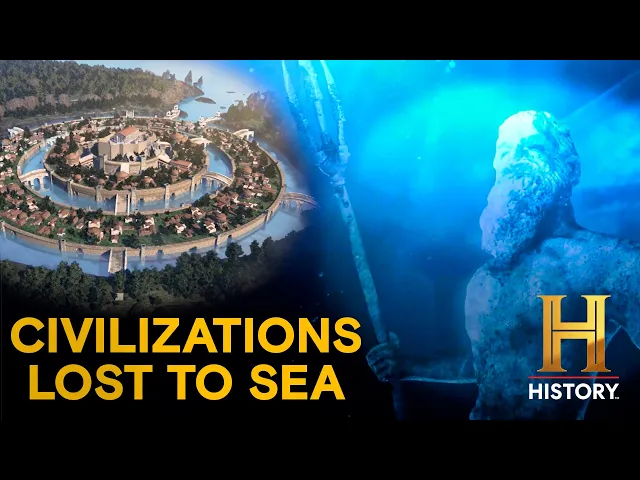
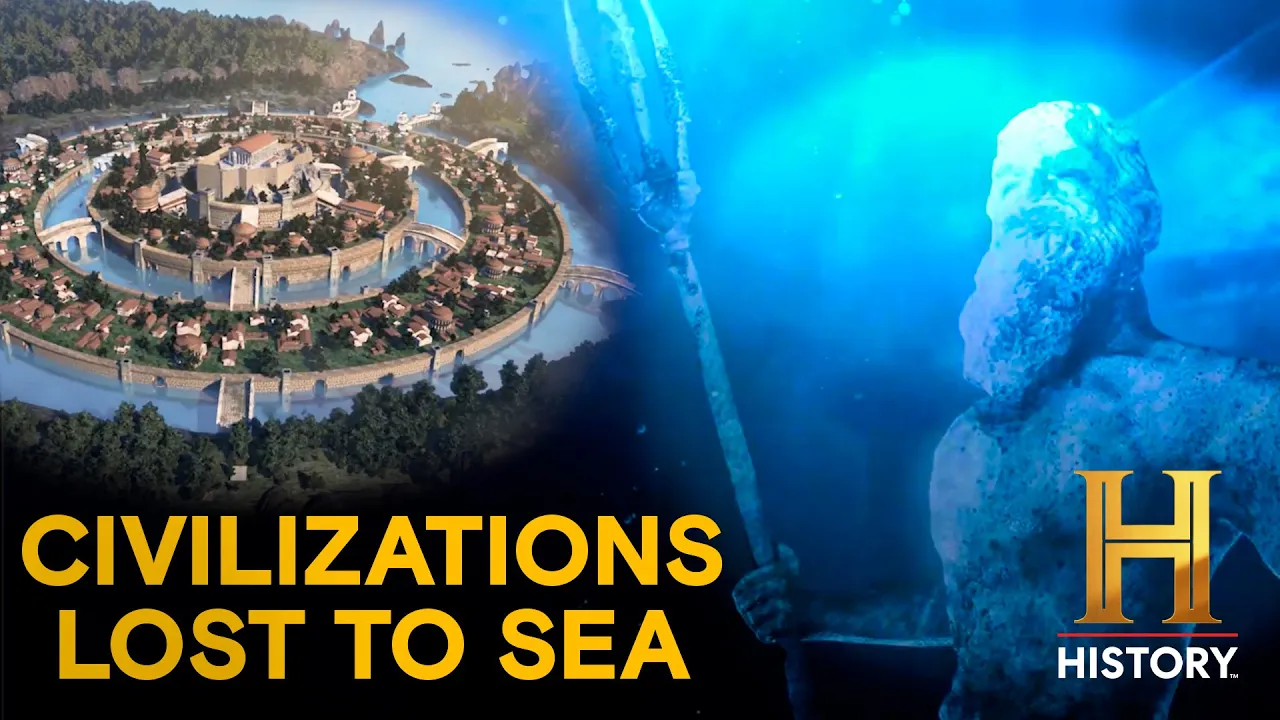
SHATNER: While it may sound like the stuff of fantasy, in his dialogues<i> Timaeus</i> and<i> Critias,</i> Plato provides a wealth of detail about what many believe was a very real island nation. HUGH NEWMAN: Plato described Atlantis as being a huge landmass, potentially in the Atlantic Ocean. One of the main design specs of Atlantis was this huge area at the center of the main city of Atlantis that had concentric circles of land and canals.
It had a canal coming out that went to the sea, and a great port was built there. YOUNG: The concentric circles of navigable canals suggest a well-planned early marina. It is strongly oriented to the sea.
In the temple on the acropolis at the center of Atlantis, there is a statue of Poseidon, the creator god of the place. And he's got winged horses; a chariot with horses that can fly. So there is also a transcendent dimension implied.
SHATNER: But if such a transcendent, awe-inspiring place actually existed, what happened to it? According to Plato, the Atlanteans angered the gods with their pride, what the Greeks called "hubris. " -(thunder crashes) -And you definitely don't want to do that.
YOUNG: Atlantis got more and more vain, more and more abusive in their hubris. A kind of arrogance that was saying, "We are gods. " That vanity of thinking that we are as important as the gods tends to upset the gods, and then the downfall comes.
The downfall that is in every Greek tragic play is the same thing. People of great privilege are brought down. (thunder crashing) PICKNETT: Atlantis disappeared in a day and a night due to some natural catastrophe, and ended up under the waves.
YOUNG: The gods came and destroyed the whole place. The people were killed, the navy was destroyed, all in a day. And Atlantis sinks into the sea.
FREUND: When Plato talks about this catastrophic destruction of Atlantis, I have to take him seriously. And the people would say, "Oh, it's just a metaphor, Atlantis. " Every metaphor has at its base a nucleus of historical information.
So even if he fictionalized it, even if he elaborated it, at its nucleus, it's a real historical place. SHATNER: A team of geologists at GNS Science announce a major discovery related to the Earth's continents, the vast landmasses that make up the planet's surface. The scientists found that, in addition to the seven continents that humans have known about for centuries, there's also an eighth continent located directly underneath New Zealand, which they named Zealandia.
Zealandia sank into the ocean approximately 50 million years ago, and its existence suggests that there may be even more lost continents that were swallowed up by the sea. The Earth has cycles of sea level rise and sea level fall. Over the last hundreds of millions of years, as climate has warmed we get sea level rise; cold periods, sea level fall.
There's a huge amount of land which is now covered by the sea. MICHIO KAKU: 10,000 years ago, with the end of the Ice Age, sea levels were dramatically lower than they are now. And because of the melting of the ice, sea levels have risen since then, and cities that may have existed thousands of years ago could be lost in history as a consequence.
SHATNER: For thousands of years, cultures from around the world have told stories about long-lost continents that were home to human civilizations and are now submerged beneath the waves. Perhaps the most famous is the legend of Atlantis, a massive island that was home to an advanced civilization before it supposedly sank into the ocean after an earthquake. HUGH NEWMAN: There's been more books written about Atlantis than any other lost continent in history.
There are many sunken cities, lost lands, destroyed continents all around the planet in legend and history. For example, we have the lost land of Hy-Brasil, which was thought to be 200 miles off the coast of Ireland, and it was even on maps until the 1800s. SHATNER: One of the most intriguing lost continents is a landmass that is believed to have once existed in the Pacific Ocean.
A mythical land that is known as Mu. The first person to write extensively about the lost continent of Mu was a Scottish writer by the name of James Churchward. In the 19th century, he was in India when he visited a monastery.
And the monks there had records, apparently, tablets that referred to this place called Mu that was this huge continent that supposedly existed from Hawaii in the north down to Easter Island in the southeast, right the way across to Micronesia in the west. And the people there were supposedly called the Naacal. The continent of Mu thrived perhaps 50,000 years ago and was sunk beneath the waves, possibly at the end of the last Ice Age.
My great-grandfather James Churchward, eventually he became friends with the rishi of the temple that he visited in India. And the rishi mentioned that he was a member of the Naacal brotherhood, the holders of wisdom and knowledge of the lost continent of Mu. They were mighty navigators and sailors and established civilization in other parts of the world.
SHATNER: According to James Churchward, the Naacal civilization had a population of more than 60 million people at its peak before a massive volcanic cataclysm caused Mu to vanish beneath the waters. SHATNER: Dayton, Ohio, November, 1923. Edgar Cayce, an American psychic and healer, famous in the early 20th century for his ability to see into the future, has a profound vision while in a self-induced trance.
-(babbling) -But on this particular occasion, Cayce's vision was not of the future -but of the distant past. -(mumbles): Atlantis. SHATNER: He saw Atlantis.
But the Atlantis that Cayce saw did not resemble an ancient city. Edgar Cayce talks about Atlantis in his psychic readings as being a place of high culture. Civilization beyond even what we have today.
They had everything from crystals that could affect your healing in the body to death rays, even airships. BADER: He described Atlantis as a place of a much greater and much more advanced technology than either Plato or Donnelly claimed. He claims that they were able to levitate and have psychic powers.
The downfall of Atlantis, according to Cayce, was that Atlantis had developed giant crystal death rays and there was an internal civil war on the island, that during that war, the crystal death rays were set off and sunk the island beneath the waves. SHATNER: Giant crystal death rays? As strange as it sounds, that is what Cayce said.
Researchers believe that one way to test his incredible claims is to look for the ruins of Atlantis where Edgar Cayce thought it was located. Cayce said that Atlantis wasn't centered near the Mediterranean, as most people believe, but rather, on the other side of the Atlantic Ocean. PICKNETT: Edgar Cayce described Atlantis as being just off the coast of Cuba, and there is some quite persuasive research about, um, Atlantis actually being off Cuba.
COLLINS: In September, 1998, I went to Cuba and I hired the help of a local archeologist who was able to take me out to these caves. We found a veritable Sistine Chapel of the ancient world. Seven chambers full of the most incredible rock art showing these weird concentric circles that were a complete mystery to the archeologists.
It was almost as if I had a eureka moment, and I realized that this could be the key to finding Atlantis. SHATNER: In addition to archaeological evidence linking Cuba to Atlantis, researchers argue that there is also historical evidence, in the form of accounts written by Spanish explorers in the 16th century. In 1552, a Spanish historian by the name of Francisco López de Gómara actually wrote that when the Spanish did arrive in Cuba, they found that the indigenous peoples had a tradition that once all of these islands were one huge continent.
. . .
. . that had been broken apart by the waters during a great cataclysm and split apart into the islands and the cays that we see today.
SHATNER: According to geologists, such a cataclysm did take place in the Atlantic Ocean, near Cuba, more than 10,000 years ago. During the last ice age, sea levels were about 400 feet lower. Many of today's islands were joined into large landmasses; island continents, you might say.
Then the ice began to melt, creating sudden surges in ocean levels called meltwater pulses. One particularly violent pulse wreaked havoc on coastlines and islands everywhere. Meltwater pulse 1B.
Some people think that meltwater pulse 1B took place precisely when Atlantis was supposed to fall. Now, of course, this is a theory, 'cause we're going back 10,000 years. Some people have claimed that perhaps it was the sudden meltwater being released that caused the flooding which destroyed Atlantis.
Plato tells us that Atlantis was somewhere out in the Atlantic Ocean. But where, exactly? Is it possible that Atlantis awaits discovery off the coast of Cuba?
I actually think the answer is yes. SHATNER: At the western end of the Pacific Ocean, 67 miles off the coast of Taiwan, is the Japanese island of Yonaguni. It is one of some 6,800 landforms in the Japanese archipelago, a chain of small islands located near the southern tip of Japan.
But just off the coast of Yonaguni lies a mysterious complex of underwater stone formations known as the Yonaguni Monument. SCHOCH: It's an absolutely incredible structure, and it looks like a giant staircase. Steps in the bedrock with terraces.
The symmetry and the regularity that people see on it just makes a astounding impression. NEWMAN: It looks like a huge, multifaceted pyramid platform that stretches over a huge area with all these details carved into it. There's areas where monoliths were said to have been standing.
There's even dolmens or large slabs like lintels covering areas and creating doorways and other features. HALLS: When you look at some of the rock structures, it looks undeniably man-made. But with that comes a whole series of questions.
How did it get here? How long has it been here? What is the structure you're looking at?
SHATNER: The Yonaguni Monument was discovered by divers in 1987, and since that time, experts have debated whether it's a natural formation caused by erosion or an artificial structure that was carved by man in the distant past. Researchers who believe that the monument is man-made claim that it is the ruins of a massive stepped pyramid complex that is nearly 500 feet long, 130 feet wide, and 90 feet tall. The Yonaguni Monument was originally above water, but at some point in the past, waters rose up and covered it and it's now beneath almost 100 feet of water.
You have not only these geometrical structures, these terraces, but also some strange monuments, including what appears to be this human head. It's 23 feet tall and it has these hollow sunken eyes. It almost looks like the moai statues of Easter Island.
It looks hauntingly like some kind of giant of the past. SHATNER: Underwater archaeologists who have visited Yonaguni have also noted that there appears to be a sculpture of a sea turtle. And some even claim there is a carved roadway circling the entire site.
NEWMAN: There's so many elements to it which suggest it's at least been manipulated by man, because it looks like it's been carved from solid rock. And one of the theories that has kind of caught many researchers' attention is that it could be evidence of a lost civilization many thousands of years old. SCHOCH: Some people have thought of Yonaguni being "Japan's Atlantis," in the sense that if Yonaguni is an artificial, human construction from very ancient times, it must represent the tip of the proverbial iceberg of an advanced civilization thousands of years ago that somehow disappeared into the ocean under the waves.
SHATNER: Is the Yonaguni Monument the remains of a lost civilization? And if so, how long ago did that civilization exist? HALLS: One of the really, really interesting, mystifying things about the Yonaguni Monument is the depth of water.
So, it's 25 meters. Now, if we were relying on the pulses of sea level rise from kind of the end of the Ice Age 10,000 years ago, that means that the Yonaguni Monument would be 12,000 to 14,000 years old. That's going to predate the earliest civilizations we know of by 7,000 years or so.
If the Yonaguni Monument was man-made, then it is a truly seismic discovery in terms of the history of our species because, potentially, the cradle of human civilization was Japan, was off the coast of Japan. SHATNER: Is it possible that the Yonaguni Monument is not only man-made but also much older than any other ruin that's ever been discovered? Many scientists believe that further research on this remarkable structure could rewrite history and offer tangible evidence in support of the theory that there are remnants of lost civilizations hidden in the world's oceans.
TUTTLE: Are there some foundational cities underneath the water? I wouldn't bet against it. If we want to unlock the secrets of ancient civilizations, we may very well have to look underwater.
HALLS: What we are beginning to learn is the huge potential of mysteries in the sea, as in what the sea can give us in terms of new discoveries, new glimpses into other worlds. And the Yonaguni Monument is a real manifestation of that.