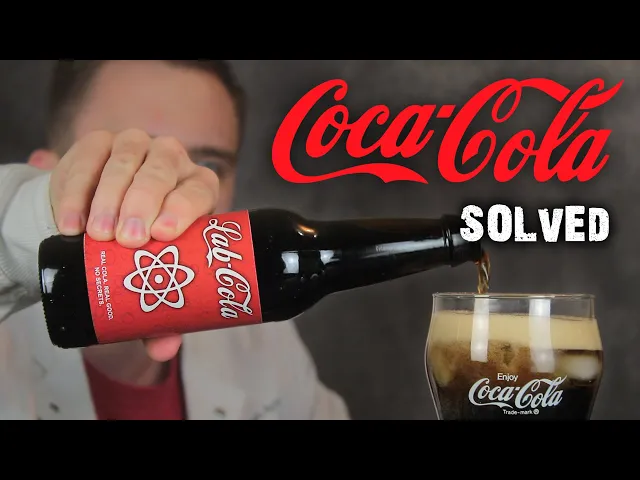
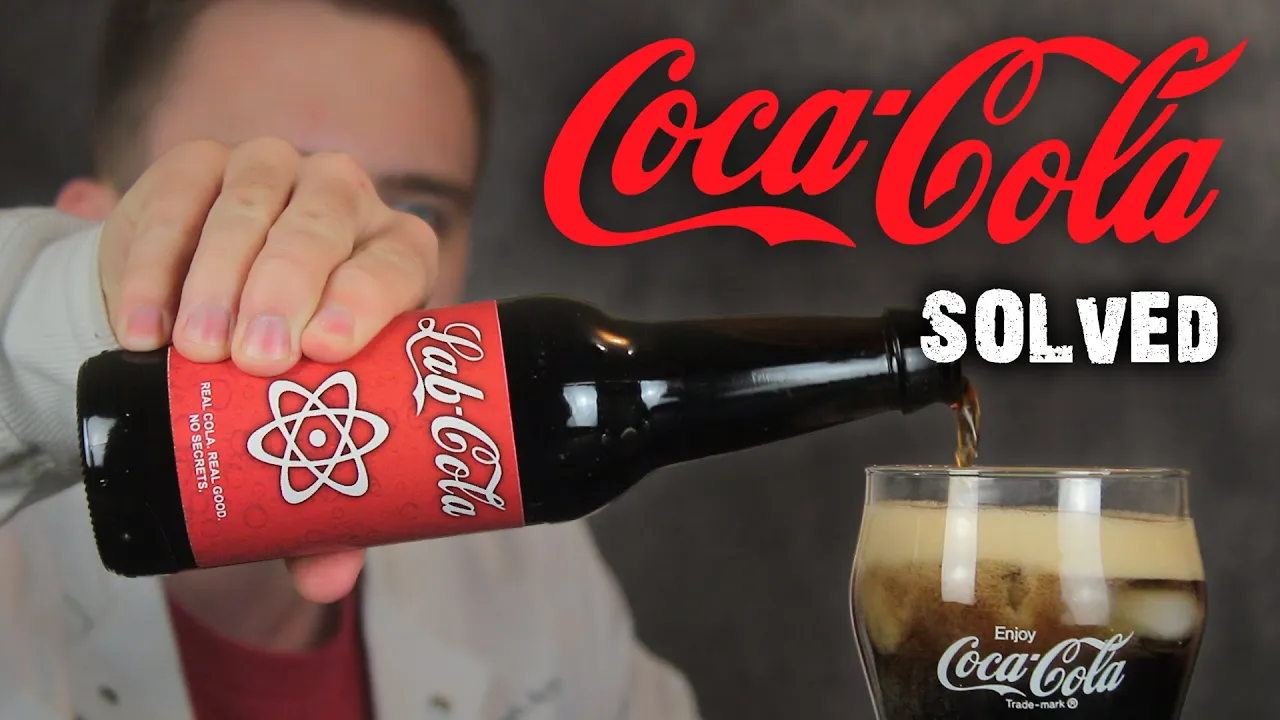
Hey everyone, welcome back to Lab Coats. Did you know Coca-Cola is the world's most popular non-alcoholic beverage? That's a little tidbit I picked up as I studied literally every aspect of this drink for almost a year at the cost of my own sanity.
But I digress. Point is, Coca-Cola is kind of a big deal. Practically every human being on the planet knows what it is.
And yet, despite existing for almost 140 years, only a handful of people actually know what it's made of. As a matter of fact, the Coca-Cola secret formula is one of the most tightly guarded trade secrets to ever exist with protective measures so extreme that they're almost laughable. Seriously, they have a giant steel vault that they show off on guided tours.
Does that not sound like something straight out of Spongebob? And if that wasn't enough, the ingredients are all shipped unlabeled and from entirely different facilities who are kept almost entirely in the dark about what they're making. So much effort, all for a soft drink that the company half-h hardly promotes with horribly out of touch AI commercials.
Wouldn't it be funny if somebody managed to steal the secret formula right from under their noses, piece together a chemically identical beverage with the exact same flavor, and then tell absolutely everyone on the internet how to make it themselves? To most sane people, this probably sounds like a fool's errand. After all, many have attempted the quest and invariably came up short.
Trust me, I tried all their formulations. None of them tasted like real Coke. So, is this even possible?
Well, in theory, yes. One article from 2016 theorized that the recipe could be deciphered with the help of mass spectrometry, although the author basically concluded that only a major group like Fizer would have the time and resources to actually do so. Guess this was before science YouTubers got serious cuz I actually have two YouTube friends with two different kinds of mass spectrometers.
And one even happens to be a college professor. Yeah, we're coming for you. Coca-Cola.
>> Oh, but Zach, Coca-Cola uses cocoa leaves. You can't possibly hope to replicate it without >> Have you heard of chemicals? I'm aware that whatever I make won't be absolutely identical down to the trace contaminants, but if I add all the major flavoring agents that are detected in real Coca-Cola, I should get something that tastes like Coke, regardless of if it came from a cocoa plant.
And spoiler alert, >> dude, I can't even tell, even though I know I can't even tell. [laughter] >> I wasn't expecting it to taste so much like Coke. Oh my god.
>> This approach actually works pretty freaking well. And in regards to legality, well, Coca-Cola hasn't actually patented their recipe. Seriously, doing so would require them to expose what they're actually patenting, and that's obviously not something they want to do.
Consequently, unless I try marketing my own product under the Coca-Cola name, there's really nothing they can do about it. So, what are we waiting for? Let's get cooking.
Now, believe it or not, we already know over 99% of Coca-Cola's makeup, at least by weight. A liter of Coke contains roughly 110 g of sugar, 96 millig of caffeine, and 0. 64 g of phosphoric acid based on pH measurements and other scientific analysis.
It also contains caramel color, which contributes important flavor compounds like furral in addition to the co's rich brown hue. What we don't know is what makes up the last ingredient, natural flavors. This is where the real battle begins.
As of 2025, only one of the natural flavors can be definitively verified. Decoonized cocoa leaf extract. The Steen Company in New Jersey is one of the only American companies licensed to work with cocoa leaves.
And guess who they sell the extract to once the cocaine is removed. Cola nut extract was also used at one point, but it was phased out in favor of refined caffeine. I tried finding my own source of cocaine-free cocoa extract, but companies like Power Leaves never returned my emails, and the package I bought from this definitely not sketchy Peruvian website got seized at the border.
So, basically, I was at square one like every other non-CA entity, which meant I had to work up the entire flavor profile from scratch. At first, I thought this might be fairly easy. I mean, several cola recipes are already published, including the original Peton Coca-Cola from 1886, so I figured it'd simply be a matter of tweaking these until I got something that fit.
Long story short, I was very, very wrong. As a starting point, most recipes call for the following set of flavors: orange, lemon, lime, coriander, nutmeg, cinnamon, vanilla, and naroli. A few other ingredients that get suggested include black pepper, lavender, clove, and kafir lime leaf.
So, I bought all these flavors as essential oils from reputable vendors. Using essential oils in food might sound a bit strange, but rest assured this is fairly standard practice in the food and beverage industry as it allows for very precise and repeatable combination of flavors. To run my early trials, I would measure precise volumes of each oil using a micro pipet and combine them in a small vial.
Once mixed, the required amount of flavor oil would be dissolved in roughly 1 milll of foodg gradede alcohol, which helps it disperse into the soda instead of clumping into droplets. This was an issue I faced when I made root beer from sass oil a few years ago. And the ethanol practically eliminates it without throwing off the flavor.
Finally, the flavor mixture will be measured and added to a predetermined volume of soda, which was made with the established proportions of acid, caffeine, caramel color, and sugar. Pretty straightforward. Initially, I attempted to use something called an orthogonal array to perform my analysis.
Nighthawk and Light has an excellent video explaining how these work, which I highly recommend you check out. But basically, an orthogonal or Taguchi array is a type of mathematical table that allows you to find meaningful correlations with a relatively small number of trials. In my case, I was hoping to determine which flavors contributed the most to the flavor of cola.
Unfortunately, the human mouth perceives flavor mixtures in really complicated ways. So, my results were highly inconclusive and often disgusting. That said, I did actually learn a lot by doing this.
In terms of flavors, nutmeg, cinnamon, and coriander seem to contribute the most to the iconic cola flavor, but not without a strong citrus base composed of lemon and lime. At the same time, flavors like naroli and lavender just didn't seem to work in the modern profile. They added a strong floral note that isn't found in today's Coke and also made it taste like artificial sweeteners were being used.
And despite showing up in most recipes, orange didn't really seem to fit either, at least not in the large amounts that are usually suggested. 1 to 2% ended up being the sweet spot. And while modestly important to the flavor, higher amounts would begin to throw off the citrus notes.
Of the other flavors I tested, kafur lime leaf was by far the most out of place since it basically tasted like citroronella. Clove was similarly overbearing and noticeably different from the spices found in Coke. While black pepper and vanilla contrastingly seem to do very little, I mean, if I really boosted the vanilla, it was detectable and the perceived sweetness would go up.
But black pepper mostly just seemed to accentuate the more earthy flavors already found in nutmeg. Now, while I did gather at least a rough idea of what's in Coca-Cola from these early trials, I still had no idea what the correct ratios were or what ingredients I was missing. So, to find out, I cracked out my secret weapons, scientific papers, and chemical analysis.
In terms of analysis, Vince from Neptunium and Ben from Aspect Everything agreed to analyze Coca-Cola, My Ingredients, and a few similar sodas like Pepsi using their mass spectrometers. These machines essentially take a tiny sample of whatever you want, split it into chemical fractions using either a liquid or gas chromatography column, and then analyze each fraction by ionizing and firing its components through magnetic field. Much like a prism splitting up light, the magnetic field splits up ions based on their mass, giving a sort of fingerprint that can be used to identify what chemical was ionized.
That's the explanation. And this is the exact chemical makeup of Coca-Cola. Let's dissect its secrets, shall we?
The dominant peak we found was something called alpha tarpine which mostly arises from the acid catalyze hydrarolysis of lmonine and pinine and it hints that citrus oils do in fact make up a large portion of coke's flavor. The next major peak is actually the remaining lmonine followed by forpine and fentrol. Cinemaldahhide, sabanine and kerine were also detected indicating the presence of cinnamon and nutmeg.
And finally we found eucalyptal, borneal, furral from the caramel color and ethylolinate. Levlinic acid and its esters form when sugars like fructose are heated under acidic conditions which suggests the Coca-Cola underos heating at some point during its production. Now, this is all well and good, but unfortunately, we couldn't pin down the exact concentration of each component using this data.
You see, a mass spectrometer's output is given as a plot of relative intensity, not concentration. If you want concentration, you usually have to do a lot of math and other testing to figure out how different chemicals interact with the machine. So, instead of relying purely on the mass spectrometry data we collected, I chose to also lean on the data from this article in the Journal of Agricultural and Food Chemistry.
This table in particular listed pretty much every flavor found in Coca-Cola and even gave their measured concentrations. There were a few flavors they left out such as Fentil, but I figured once the concentrations of other ingredients were determined, these secondary flavors would be easy to dial in with the help of mass spectrometry. I won't be going through every chemical on this list, but there are a few I'd like to point out that reveal important information about the secret formula.
Obviously, cinemaldahhide and vaneline can be directly correlated with cinnamon and vanilla. So we can check those off as part of Coke's recipe. Lmonine and alpha tarpine are also present along with aldahhides like octanel, noninanol and decanel which collectively signal the strong presence of citrus oils.
This is all stuff we mostly knew. Things get interesting though with linolul and the various forms of eugenol. Eugenol and its esters make up 80 to 90% of clove oil which is one of the suggested ingredients that people reference from time to time.
However, the concentrations found in Coke are only enough to account for the traces contributed by nutmeg and cinnamon oils, which are much more definitive ingredients. And since clove oil threw off the flavor in my early tests, I think it's fairly safe to rule it out as a potential flavor. Sticking with ingredients we already discussed, linolule also rules out a few potential flavors.
To explain how though, we need to talk about inantiomer. Basically for a molecule like linolul two mirrored versions exist R and S. You can flip them around all you want but no orientation will make them identical.
Interestingly the R antiimer of linolul makes up the majority of both lavender and naroli oils while the essentiimer makes up the majority of coriander oil. And according to the study Coca-Cola contains mostly esinol with the amount of arlin only being enough to cover what would come from the citrus oils. Some might argue that chemicals like nural and narol signify the presence of naroli, but this simply isn't the case.
These compounds are found in citrus oils just like linolul, meaning we can pretty definitively say naroli and lavender are not ingredients in Coke. The last chemical I'm going to bring up is acetic acid. To me, this one was kind of a shock, especially with it being the third most prominent flavor by mass.
My first thought was that it was simply arising from the acid catalyze breakdown of acetate esters in the cola. But after talking with Darcy over on the Art of Drnk channel and seeing it in an actual recipe from the 1950s, I'm almost certain that's being added deliberately. To be clear, the amounts being used are in the range of parts per million.
But I still find it kind of funny that vinegar is probably one of the secret ingredients. With the major flavoring compounds identified and correlated with existing ingredients, I set up an Excel spreadsheet to make iterating my recipes a bit easier. A mixing calculator would basically take the volume of each oil being added, determine how much of each component was present, and then compare that data with the Coca-Cola numbers.
Once everything was matching, I would take the recipe, log it on a separate tab with notes about the soda it made, and finally rank how close it was to real Coke. Unfortunately, while most of the flavor compounds could be easily connected to at least one of the essential oils, there were a few that just weren't showing up on the mass spectrum, specifically fentil and for pineal. Originally alpha tarpine was also on this list but after modifying my soda preparation to include heating there was more than enough of it to go around.
For the fential I simply resorted to buying the raw chemical but for forpine I started down a completely new rabbit hole. You see the taste of Coca-Cola can be divided into a few main groups. The two we've tackled so far and the two most people stop at are citrus and brown spices along with less pronounced subgroups like caramel and vanilla.
What most people tend to overlook are the more green fresh flavors that seem to come from the cocoa leaf. Without these flavors, you tend to end up with a more spice centered drink like Pepsi. So for my source of forpine, I decided to go with an essential oil that I felt would reintroduce those missing flavors.
Tea tree oil. By mass, this stuff is close to 50% for most of the other chemicals it contains match up with those found in Coca-Cola, so it doesn't really mess up the mass spectrum. When I began using it, I noticed an immediate improvement in the flavor, although it never fully replenished the missing freshness.
Overall, it was more like drinking Diet Coke than regular Coke, and no amount of tweaking or adding essential oils seemed to change that. I spent months adjusting the recipe, testing new ingredients, and forcing family members to taste my experiments. Eventually, my original Soda Stream gave out, and I had to buy a second one.
This is starting to become unreasonably expensive. I tested cassia cinnamon versus cinnon leaf, different versions of nutmeg and lime, heating and aging versus not, even adding trace flavors like isopugal. Heck, I even tested completely random flavors to see if they'd fill in what was lacking.
They never did. After a certain point, I was pretty close to throwing in the towel. Maybe people were right to say that Coca-Cola is impossible to replicate without cocoa leaves.
And then the answer finally hit me. Cocoa leaf extract is essentially a type of tea and teas contain tannins. These tannins possess a dry astringent taste that can help mask sweet flavors and since they're nonvolatile, they don't usually show up on gas-based mass spectrums, explaining how I missed them for so long.
Best of all, they're sold in a purified state for wine- making, meaning I could quickly get a hold of a sample and test out my theory. And it was all worth it. This is the mass spectrum of Coca-Cola.
And this is the mass spectrum of one of my replicas. They are nearly identical. And the flavor, well, what can I say?
It tastes like Coke. There are tiny differences, of course, but honestly, this stuff is closer to classic Coke than Coke's own glass bottle or Diet Colas are, and infinitely closer than any other replica. It definitely checks out as Coca-Cola, at least to me.
We'll get to other people's reactions and opinions here in a minute, and I'll even tell you how you can get some for yourself, but first, let me show you exactly how it's made. Brief spoiler, the startup cost for this recipe can be kind of high, unless you have a pre-existing stockpile of essential oils and accurate measuring equipment. Once you have everything, though, you can easily produce a bulk flavor solution that will last for years and allow you to create servings of Coke for mere pennies.
No more paying a company that won't even pay real animators. In terms of hardware, we'll need a mass scale, an adjustable micro pipet that can accurately dispense up to 1,000 microL, a 50ml graduated cylinder, some one L storage bottles, and some kind of heatresistant glassware for making the syrup. Resist the temptation to use metal cookware since phosphoric acid can attack it and dissolve less than healthy metals into the soda.
There is a reason soda cans have that plastic liner. Finally, you can also use a magnetic stir for mixing as well as a one L volumetric flask to make the dilution steps a bit easier. For ingredients, we have all the essential oils seen here.
Sugar, carbonated water, caffeine, caramel color, food grade alcohol, 85% phosphoric acid, glycerin, wine tannins, 5% vinegar, vanilla extract, and fenol. Quick note, fenchol melts just above room temperature, so you might need to warm it up in some hot water before beginning. I bought my sample on Amazon and after testing it, I can confirm its flavor is present in Coke.
So, use it if you can. For caramel color, I used Shanks brand, but other varieties like Derky should work just as well as long as they're composed of actual caramel color and not a mix of red and green food dyes. If you don't use Shanks, though, try playing with the amounts you add to get the right color.
Also, keep in mind that we are working with chemicals here, including a few that are mildly hazardous. So, for your own safety, wear gloves, measure accurately, and don't taste any of the unmixed ingredients. The first step is to prepare what most people call the 7X flavoring, which is the mixture of essential oils and alcohol that make up the Coca-Cola Secret formula.
To be clear, what I'm about to share is not the Coca-Cola secret formula since I failed to utilize deconized cocoa leaf extract. Chemically, though, it's about as close as you can get without it, and the real deal should be fairly similar. The recipe is 45.
8 ml lemon, 36. 5 ml lime, 1. 2 milll orange, 8 ml tea tree, 4.
5 milll casia cinnamon, 2. 7 milll nutmeg, 0. 7 milll coriander, and 0.
6 milll fenchol. And optimally, you'd let this mixture age for a day or two before continuing. Art of drink has an excellent video explaining why, and even the original Peton version of Coca-Cola includes this aging step.
In the end, you'll be rewarded with about 100 milll of flavor oil, which is enough for over 5,000 L of soda, or about as much as your mom drinks in a day. To make the 7X solution, simply dilute 20 ml of the flavor oil to a volume of 1 L using foodg gradede alcohol. And before anyone gets worried, the amount of alcohol being added to the final soda is five times less than what you get from a non-alcoholic beer and far too little to taste or make this drink intoxicating.
Other flavor extracts like vanilla or almond use ethanol as a solvent. This is no different. Still, if alcohol is an issue, you can emulsify the oil into water with the help of gum arabic.
Check out Glenn and Friends cooking to see how he does this with his cola. Anyway, next we'll need to make a secondary water-based solution containing the other ingredients aside from sugar and carbonated water. Into roughly 200 ml of hot water, measure out 10 ml of 5% vinegar, 9.
65 65 g of caffeine, 175 g of glycerin, 45 ml of 85% phosphoric acid, 8 g of wine tannins, 10 ml of vanilla extract, and 320 ml of Shanks caramel color. In case you're wondering, the glycerin is being added for texture and mouth feel. Without it, the drink tends to feel a bit thinner and more like diet soda.
Also, if using vanilla extract feels imprecise, you can alternatively mix up a solution containing 9. 5 g per liter of vaneline and use 1 milll of that. Given the fairly limited impact vanilla seems to have, though, you probably wouldn't notice a major difference.
Give each ingredient to fully incorporate before adding the next. And once everything is dissolved, dilute the mixture to a final volume of one liter using water. Now, let's make some Coca-Cola.
For this demo, I'll be making one liter. just so scaling up or down is a bit easier. Into a glass dish, add 104 g of sugar and just enough water to dissolve everything.
I know I said 110 g of sugar per liter of soda at the beginning of the video, but here's the deal. That's for a mixture of fructose and glucose like you'd find in corn syrup. If we add 110 g of sucrose or cane sugar, the phosphoric acid will cause it to react with the water and form nearly 116 g of those simpler sugars.
that would throw off the sweetness of the drink. So, we use less sugar to compensate. Anyway, next we add our flavor solutions to the syrup.
10 milliliters of the water-based solution and 1 milll of the alcohol-based 7X solution. You might need a few extra drops of the 7X solution. It really depends on your taste.
As soon as everything is combined, microwave or otherwise heat the mixture until nearly boiling and cover to prevent the more volatile flavors from escaping. Heating like this helps the phosphoric acid breakdown compounds like lmonine and citrol and it also accelerates that sugar hydraysis reaction we just talked about. So it's a fairly crucial step.
Once fully cooled, dilute the syrup to a volume of one liter with cold carbonated water. This can either be bought or made yourself using a soda stream. Just don't attempt to carbonate the fully mixed soda on the machine.
It tends to produce a lot of foam which can lead to bacterial growth if you're not careful. And this is our finished Coca-Cola. You can drink it directly, but if you want the most accurate version of the final flavor, allow the soda to rest for a day or so in the fridge.
And again, while the flavor is as close as I could get to Coke after a year of trying, and certainly closer than any other clone I've tasted, there is still room for perfection. So, if you have the ingredients, feel free to experiment. And for future reference, I'll have the most up-to-date version of the recipe in the video description.
Of course, I could go on and on about how I think my cola tastes, but what do other people think? Is this a convincing replica or just another Peton knockoff? Well, I set up several blind and non-blind taste tests, and people actually had trouble telling it apart from real Coke.
>> Yeah, this is regular Coke. See, I can't even tell. Even though I know already, I can't even tell.
5 out of 10. >> 9. 5 out of 10.
>> That's pretty good. >> That tastes pretty close. Like I may not be able to tell if these were side by side with the original taste.
>> I know that is definitely, you know, Coke or Coke product. You know, if you said it was vanilla Coke or something like that, I'd be like, "Yeah, maybe that's that's definitely Coke. " >> I think this is more like is more similar to this bottle than this is to that bottle, which is crazy to think about now that I said that out loud.
>> Yeah, [laughter] >> that's a Coke product. I wasn't expecting it to taste so much like Coke. Oh my gosh.
Hold I got to go again. >> I got to go again. >> Yeah, that's good.
I mean, like, if you sold this on the shelves, I'd buy it. >> Regular Coke drinkers were better picking mine out from the mix, but the general consensus was that LabCola could be mistaken for Coke and not other colas like Pepsi. When tasted on its own, without Coca-Cola as a direct reference, people overwhelmingly thought it was the real deal.
Unlike the Peton recipe, Open Cola, and other clones I had them try. >> Yeah, that's that's not Coke. Oh, >> no.
That's not Coke. No, that's not even like it's a cola, but like that's not Coke. That is just straight flour.
[laughter] >> It's very cinnamony to me. That's like almost pure cinnamon. >> Like you you know like those little those little candies.
>> Yeah. >> But it's definitely not co. >> All right, I think that's finally it.
2025 is coming to a close and it has been an insane year for this channel. Thanks to everyone's support, I was able to take on crazy projects like making florine gas at home, preparing oium piranha solution, and putting a 360 camera probe in front of a tornado. Stay tuned for that adventure.
2026 is shaping up to be another great year for lab coats, although there are a few changes on the way. If all goes well, I'll be graduating in May with my bachelor's degree in chemical engineering and moving to a new location where I'll be doing an internship and hopefully getting a full-time job. It's hard to say how many videos I'll be putting out at that time, but rest assure if there is like a little break in there, it's not going to be permanent and I will be coming back.
Regarding projects, I have several chemistry themed ones planned out, including making torine for my own energy drink. And finally finishing my work with super stenches by taking on. I also bought over $1,000 worth of capacitors to build a plasma gun.
And for stormchasing, I got this high-speed drone to film tornadoes up close and personal. Kind of like the Otis project, but cheaper. Now I just need a license.
If you'd like to help support me and my channel, feel free to donate, join my Patreon, or become a channel member or pick yourself up a sample of the Lab Cola flavor stuff. As always, a big thanks goes out to all the existing Lab Codes Patreon supporters and channel members. Without them, I would not be able to afford projects like this.
Remember to like, share, and subscribe, and I'll catch you next time. Lab Coats out.