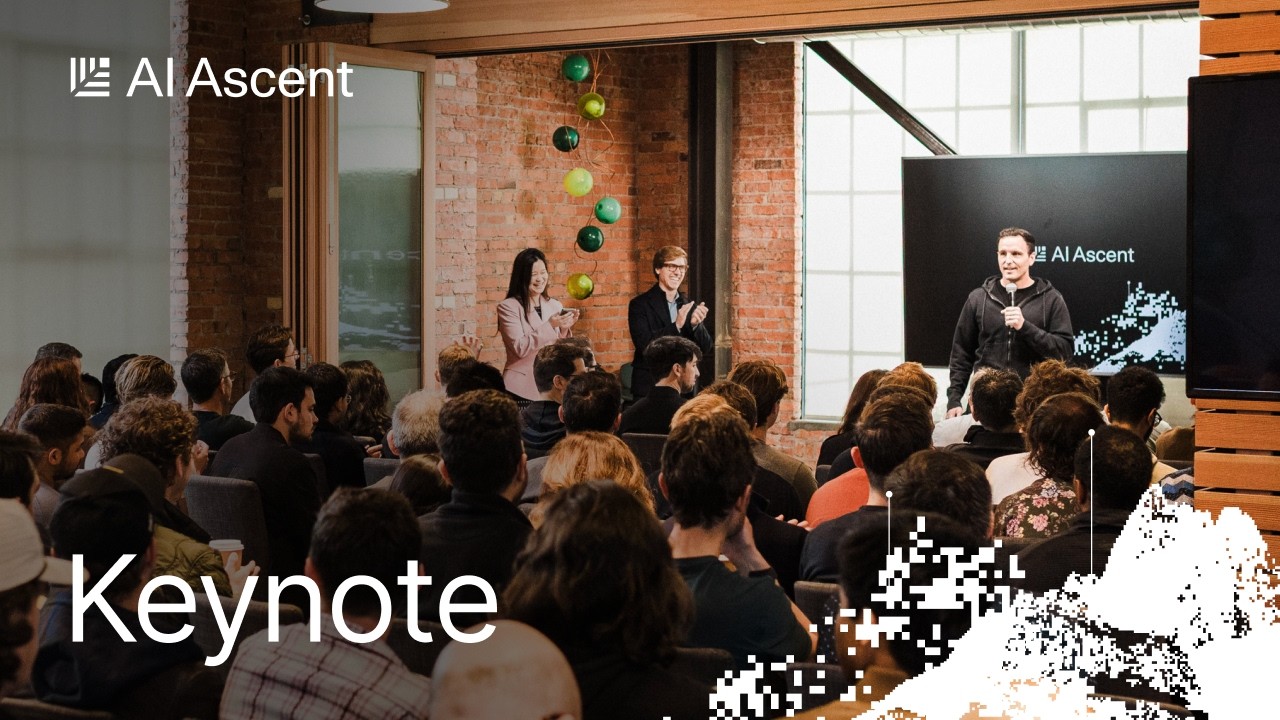
my name is pack Rady I'm one of the members of team seoa I'm here with my partners Sonia and Constantine who will be your MC's for the day and along with all of our partners at seoa we would like to welcome you to AI Ascent there's a lot going on in the world of AI we have an objective to learn a few things while we're here today we have an objective to meet a few people who can be helpful on our journey while we're here today and hopefully we'll have a little bit of fun so
just to frame the opportunity what is it well a year ago it felt like this magic box that could do wonderful amazing things I think over the last 12 months we've sort of been through this contracted form of the hype cycle we had the peak of inflated expectations we had the trough of disillusionment we're crawling back out into the plateau of productivity and I think we've realized that what what llms what AI really brings to us today are three distinct capabilities that can be woven into a wide variety of magical applications the first is the
ability to create hence the name generative AI you can create images you can create text you can create video you can create audio you can create all sorts of things not something software has been able to do before so that's pretty cool the second is the ability to reason could be one shot could be multi-step agentic type reasoning but again not something software's been able to do before because it can create because it can reason we've sort of got the right brain and the left bra covered which means that software can also for the first
time interact in a humanlike capacity and this is huge because this has profound business model implications that we're going to mention on the next slide so what a lot of times we try to Reason by analogy when we see something new and in this case the best analogy that we can come up with which is imperfect for a million reasons but still useful is the cloud transition over the last 20 years or so that was a major tectonic shift in the technology landscape that led to new business models new applications new ways for people to
interact with technology and if we go back to some of the early days of that cloud transition this is Circa about 2010 the entire Pi the entire Global Tam for software was about 350 billion of which this tiny slice just $6 billion doar is cloud software fast forward to last year the Tam has grown from about 350 to 650 but that slice has become 400 billion of Revenue that's a 40% ker over 15 years that's massive growth now if we're going to Reason by analogy Cloud was replacing software with software because of what I mentioned
about the ability to interact in a humanlike capability one of the big opportunities for AI is to replace services with software and if that's the T that we're going after the starting point is not hundreds of billions the starting point is possibly tens of trillions and so you can really dream about what this has a chance to become and we would posit and this is a hypothesis as everything we say today will be we would posit that we are standing at the precipice of the single greatest value creation opportunity mankind has ever known why now
one of the benefits of being part of SEO is that we have this long history and we've gotten to sort of study the different waves of technology and understand how they interact and understand how lead us to the present moment we're going to take a quick trip down memory lane so 1960s our partner Don Valentine who founded SEO was actually the guy who ran the goto market for Fairchild semiconductor which gave Silicon Valley its name with silicon based transistors we got to see that happen we got to see the 1970s when systems were built on
top of those chips we got to see the 1980s when they were connected up by by networks with PCS as the endpoint and the Advent of package software we got to see the 1990s when those Networks Works went public facing in the form of the internet change the way we communicate change the way we consume we got to see the 2000s when the internet matured to the point where it could support sophisticated applications which became known as the cloud and we got to see the 2010s where all those apps showed up in our pocket in
the form of mobile devices and change the way we work and so why do we bother going through this little build well the point here is that each one of these waves is additive with what came before and the idea of AI is nothing new it dates back to the 1940s I think neural Nets first became an idea in the 1940s but the ingredients required to take AI from idea from dream into production into reality to actually solve real world problems in a unique and compelling way that you can build a durable business around the
ingredients required to do that did not exist until the past couple of years we finally have compute that is cheap and plent we have networks that are fast and efficient and reliable seven of the 8 billion people on the planet have a supercomputer in their pockets and thanks in part to covid everything has been forced online and the data required to fuel all of these delightful experiences is readily available and so now is the moment for AI to become the theme of the next 10 probably 20 years and so we we we have as strong
conviction as you could possibly have in a hypothesis that is not yet proven that the next couple of decades are going to be the going to be the time of AI what shape would that opportunity take again we're going to analogize to the cloud transition and the mobile transition these logos on the left side of the page those are most of the companies born as a result of those transitions that got to a billion dollars plus of Revenue the list is not exhaustive but this is probably 80% or so of the companies formed in those
transitions that got to a billion plus of Revenue not valuation Revenue the most interesting thing about this slide is the right side and it's not what's there it's what isn't there the landscape is wide open the opportunity set is massive we think if we were standing here 10 or 15 years from today that right side is going to have 40 or 50 logos in it chances are it's going to be a bunch of the logos of companies that are in this room this is the opportunity this is why we're excited and with that I will
hand it off to Sonia [Applause] than wow what a year chat GPT came out a year and a half ago I think it's been a whirlwind for everybody here it probably feels like just about all of us have been going non-stop with the ground shifting under our feet constantly so let's take a pause zoom out and take stock on what's happened so far last year we were talking about how AI was going to revolutionize all these different fields and provide amazing productivity gains a year later it's starting to come into Focus who here has seen
this tweet from Sebastian at Clara show fans um it's pretty incredible Clara is now using open aai to handle two-thirds of customer service inquiries they've automated the equivalent of 700 full-time agents jobs we think you know there are tens of millions of call center agents globally and one of the most most exciting areas where we've already seen AI find product Market fit is in this customer support Market Legal Services a year ago the law was considered one of the least Tech forward Industries one of the least likely to take risks uh now we have companies
like Harvey that are automating away a lot of the work that lawyers do from day-to-day grunt work and drudgery all the way to more advanced analysis or software engineering I'm sure a bunch of people in this room have seen some of the demos floating around on Twitter recently it's remarkable that we've gone from a year ago AI theoretically writing our code uh to entirely self-contained AI software engineers and I think it's really exciting the future is going to have a lot more software and AI isn't all about revolutionizing work it's already increasing our quality of
life now the other day I was in a zoom with Pat and I noticed that he looked a little bit suspicious uh didn't speak the entire time and having reflected on it more I'm pretty sure that he actually sent in his virtual AI Avatar um was actually hitting the gym which would explain a lot hi this is Pat Grady this is definitely me I'm definitely here and not at the gym right now and it even gets the facial scrunches right this is courtesy of hen it's it's pretty amazing um this this is how far Technologies
come in a year it's it's just it's scary to think about um it's scary and exciting to think about how this all plays out in the coming decade um all getting a two years ago uh when we thought that generative AI might usher in the next great technology shift we didn't know what to expect would real companies come out of it would real Revenue materialize I think the sheer scale of user poll and revenue momentum has surprised just about everybody uh generative AI we think is now clocking in around $3 billion doll of revenues in
Aggregate and that's before you count all the incremental revenue generated by the Fang companies and the cloud providers in AI to put 3 billion in context it took the SAS Market nearly a decade to reach that level of Revenue generative AI got there it's first year out the gate so the rate and the magnitude of the C change make it very clear to us that generative AI is here to stay and the customer pull in AI isn't restricted to one or two apps it's everywhere I'm sure everyone's aware of how many users chat GPT has
but when you look at the revenue and the usage numbers for a lot of AI apps both consumer companies and Enterprise companies startups and incumbents uh many AI products are actually striking a cord with customers and starting to find product Market fit across Industries and so we find the diversity of use cases that are starting to hit really exciting the number one thing that has surprised me at least about the funding environment over the last year has been how uneven the share of funding has been if you think of generative AI as a layer cake
where you have Foundation models on the bottom uh you have developer tools and infro above and then you have applications on top a year ago we had expected that there would be a Cambrian explosion in the application layer due to the new enabling technology in the foundation layer instead we've actually found that new company formation in capital has formed in an inverse pattern more and more Foundation models are popping up and raising very large funding rounds while the application layer feels like it is just getting going our partner David is right here uh and posed
a thought-provoking question last year with his article ai's $200 billion question if you look at the amount that at the amount of money that companies are pouring into gpus right now we spent about $50 billion doar on Nvidia gpus just last year and everybody's assuming if you build it they will come AI is a field of dreams but so far remember on the previous slide we've identified about3 billion dollars or so of AI Revenue plus change from the cloud providers we've put 50 billion into the ground plus Energy Plus data center costs and more we've
gotten three out and to me that means the math isn't mathing yet uh the amount of money it takes to build this stuff has vastly exceeded the amount of money coming out so far so we got some very real problems to fix still and even though the usage and uh even though the revenue and the user numbers in AI look incredible the usage data says that we're still really early and so if you look at for example the ratio of daily to monthly active users or if you look at one month retention generative AI apps
are still falling far short of their mobile peers to me that is both a problem and an opportunity it's an opportunity because AI right now is a once a week once a month kind of tinkery phenomenon for the most part for people but we have the opportunity to use AI to create apps that people want to use every single day of their lives when we interview users one of the biggest reasons they don't stick on AI apps is the gap between expectations and reality so that magical Twitter demo becomes a disappointment when you see that
the model just isn't smart enough to reliably do the thing that you asked it to do the good thing is with that $50 billion plus of GPU spend last year we now have smarter and smarter base models to build on and just in the last month we've seen Sora we've seen Claud 3 we saw grock over the weekend and so as the level of intelligence of the Baseline Rises we should expect ai's product Market fit to accelerate so unlike in some markets where the future of the market is very unclear uh the good thing about
AI is you can draw a very clear line to how those apps will get predictably better and better let's remember that success takes time we said this at last year's aent and we'll say it again if you look at the iPhone some of the first uh some first apps in the V1 of the App Store were the beer drinking app or the light saer app or the flip cup app or the the flashlight kind of the fun lightweight demonstrations of new technology those eventually became either native apps uh aka the flashlight Etc or utilities and
gimmicks um the iPhone came out in 2007 the App Store came out in 2008 it wasn't until 2010 that you saw Instagram and door Dash uh 2013 so it took time for companies to discover and harness the net new capabilities of the iPhone in creative ways that we couldn't just imagine yet we think the same thing is playing out in AI we think we're already seeing a peak into what some of those next legendary companies might be here are a few of the ones that have captured our attention recently but I think it's much broer
than the the set of use cases on this page as I mentioned we think customer support is one of the first handful of use cases that's really hitting product Market fit in the Enterprise as I mentioned with the Clara story I don't think that's an exception it's the rule I think that is the rule AI friendship has been one of the most surprising applications for many of us I think took a few months of thinking for us to wrap our uh our heads around but I think the user and the usage metrics in this category
imply very strong user love um and then horizontal Enterprise knowledge we'll hear more from glean and dust later today we think that Enterprise knowledge is finally starting to be become unlocked so here are some predictions for what we'll see over the coming year prediction number one 2024 is the year that we see real applications take us from co-pilots that are kind of helpers on the side and suggest things to you and help you to agents that can actually take the human out of the loop entirely AI that feels more more like a coworker than a
tool we're seeing this start to work in domains like software engineering um customer service and we'll hear more about this topic today I think both Andrew in and Harrison Chase are playing this PE on it prediction number two one of the biggest knocks against llms is that they seem to be paring the statistical patterns in text and aren't actually taking the time to reason and plan through the tasks at hand that's starting to change with a lot of new research um like inference time compute and game gameplay style value iteration like what happens when you
give the model the time to actually think through what to do we think that this is the uh this is a major research thrust for many of the foundation model companies and we expect it to result in AI That's more capable of higher level cognitive tasks like cogn like uh planning and reasoning over the next year and we'll hear more about this later today from noan Brown of open AI prediction number three we are seeing an evolution from fun consumer apps or prosumer apps where we don't really care if the AI says something wrong or
crazy occasionally uh to real Enterprise applications where the stakes are really high like hospitals and defense the good thing is that there's different tools and techniques emerging to help bring these llms sometimes into the 59 reliability range from rhf to prompt chaining to Vector databases and I'm sure that's something that you guys can compare notes on later today I think a lot of folks in this room are doing really interesting things to make llms more reliable in production and finally 2024 is the year that we expect to see a lot of AI prototypes and experiments
go into production and what happens when you do that that means latency matters that means cost matters that means you care about model ownership you care about data ownership and it means we expect the balance of compute to begin shifting from pre-training over to inference so 2024 is a big year there's a lot of pressure and expectations built into some of these applications as they transition in production and it's really important that we get it right with that I'll transition to Constantine who will help us dream about AI over an even longer time Horizon thank
you Sonia and thank you everyone for being here today Pat just set up the so what why is this so important why are we all in the room and Sonia just walked us through the what now where are we in the state of AI this section is going to be about what's next we're going to take a step back and think through what this means in the broader concept of technology and Society at large so there are many types of Technology Revolution there are communication revolutions like telefony there are Transportation revolutions like the locomotive there
are productivity revolutions like the mechanization of food Harvest we believe that AI is primarily a productivity Revolution and these revolutions follow a pattern it starts with a human with a tool that transitions into a human with a machine assistant and eventually that moves into a human with a machine Network the two predictions that we're going to talk about in this section both relate to this concept of humans working with machine networks let's look at a historical example the sickle has been around as a tool for the human for over 10,000 years the mechanical reaper which
is a human and a machine assistant was invented in 1831 a single machine system uh being used by a human Today We Live in an era where we have a combined Harvester combined Harvester is tens of thousands of machine systems working together as a complex Network we're starting to use language in AI to describe this language like individual machine participants in the system might be called an agent we're talking about this quite a bit today uh the way the topology and the way that the information is transferred between these agents we're starting to talk about
as reasoning for example in essence we're creating very complicated layers of abstraction Above The Primitives of AI I'll talk about two examples today two examples that we're experiencing right in front of us in knowledge work the first is software so software started off as a very manual Pro process here's a love who wrote logical programming uh with pen and paper was able to do these computations but without the assistant of a machine we've been living in an era where we have significant machine assistance for computation uh not just the computer but the integrated development environment
and increasingly more and more Technologies to accelerate development of software we're entering a new era in which these systems are working together in a complex machine Network what you see is a series of processes that are working together in order to produce uh complex Engineering Systems and what you would see here is agents working together to produce codee not one at a time but actually in unison and Harmony the same pattern is being applied in writing very commonly writing was a human process human and a tool over time this has progressed to human and a
machine assistant and now we have a human that's actually leveraging not one but a network of assistants I'll tell you in my own personal workflow now anytime I call an AI assistant I'm not just calling gp4 I'm calling Mist large I'm calling Claud 3 I'm having them work together and also uh against each other to have better answers this is the future that we're we're seeing right in front of us so what what does this type of revolution mean for everyone in this room and frankly everyone outside of this room in cold hard economic terms
what this means is significant cost reduction so this chart is the number of workers needed at an S&P 500 company to generate 1 million of Revenue it's going down rapidly we're entering an era where this will continue to decline what does that mean faster and fewer the good news is it's not so that we can do less it's so that we can do more and we'll get to that in the next set of predictions also fortunate is all the areas where we've had this type of prog progress in the past have been deflationary I'll call
out computer software and accessories the process of computer software because we're constantly building on each other has actually gone down in cost over time uh televisions are also here but some of the most important things to our society education college tuition Medical Care housing they've gone up far faster than inflation and it's perhaps a very happy coincidence that artificial intelligence is poised to help drive down costs in these and many other crucial areas so that's the first conclusion about the long-term future of artificial intelligence as a massive cost driver a productivity Revolution that's going to
be able to help us do more with less in some of the most critical areas of our society the second is related to what is it really doing one year ago on the stage we had Jensen hang make a powerful prediction he said that in the future pixels are not going to be rendered they're going to be generated any given image even information will be generated what did he mean by this well as everyone in this room knows historically images have been stored as rope memory uh so let's think about the letter a asky character
number 97 okay that is stored as a matrix of pixels either the presence or absence if we use a very simple black and white presence or absence of those pixels well we're entering a period in which we already are representing Concepts like the letter A not as Road storage not as a presence or absence of pixels but as a concept a multi-dimensional point I mean the the image to think about here is the concept of an a which is generalizable to Any Given format for that letter A so many different type faces in this multi-dimensional
space we're sitting at the center and where do we go from here well the powerful thing is the computers are now starting to understand not just this multi-dimensional point not just how to take it and render it and generate that image like Jensen was talking about we are now at the point where we're going to be able to contextualize that understanding the computer's going to understand the a be able to render it understand it's an alphabet understand it's an English alphabet and understand what that means in the broader context of this rendering computer's going to
look at the word multi-dimensional and not even think about the a but rather understand the full context of why that's being brought up and amazingly this future is how we think how humans think no longer are we going to be storing uh the wrote pixels in a computer memory that's not how we think I wasn't taught about the letter A as the presence or absence of a of a pixel on a page instead we're going to be thinking about that as a concept powerfully this is how we' thought about it philosophically for thousands of years
here's my fellow Greek Plato 2,500 years ago who said this idea of a platonic form is what we all ascribe to or all striving for that you have this concept in this case of a letter A or this concept of software engineering that we actually are able to build a model around so what now we've talked about the second pattern this idea that we're going to have generalization in inside Computing itself what does that mean for each of us well it's going to mean a lot for company building uh today we're already integrating this into
specific processes and kpis Sonia just mentioned how Clara is using this in order to accelerate their kpis around customer support they know that they have certain kpis that they can drive towards and they can have a system that's actually retrieving information generating great customer experiences tomorrow and this is already happening alongside new user interfaces that might be a different interface for how the support is actually being communicated and this is what I'm personally incredibly excited about is because of this future in which concepts are rendered because of this future in which everything is generated eventually
the entire company might start working like a neural network let me break that down in a specific example this is a caricature as with everything in this presentation it's in reality everything is continuous these are all discreet this is a caricature of the customer support process you have customer service that has certain kpis these are driven by Text to Voice language generation customer personalization and the like this feeds into sub patterns sub trees that you're optimizing and eventually yourx going to have a fully connected graph here yourx going to have feedback from the language generation
to the end kpi for the servicing of the customers this is is going to be at some point a layer of abstraction where customer support is managed optimized and improved by the neural network now let's think about unique customers another part of the important job of building a business well again you have Primitives of artificial intelligence from language generation to a growth engine to add customization and optimization this will all feed into each other once again the powerful conclusion here is eventually these layers of abstraction will be become interoperable to the point where the entire
company is able to function like a neural network here comes the rise of the oneperson company the one person company is going to enable us not to do less but to do more more problems can be tackled by more people to create a better Society so what's next the reality is the people in the room here are going to decide what's next you are the ones who are building this future we personally are very excited about the future because we think that AI is positioned to help drive down costs and increase productivity in some of
the most crucial areas in our society better education healthier populations more productive populations and that's the purpose of convening this group today you all are going to be able to talk about how are we able to take our Technologies abstract away complexity mundane details and actually build something that's much more powerful for the future I'll hand it off to Sonia to introduce our first speaker thank you