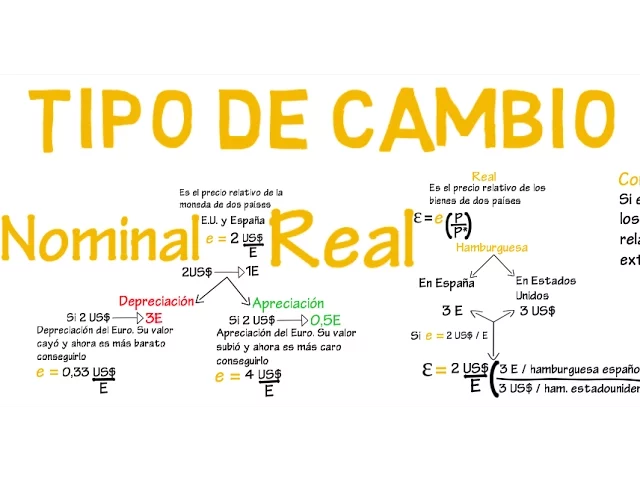
In this video we will learn how to differentiate between two exchange rates; the nominal and the real. The nominal exchange rate is the relative price of the currency of two countries, for example, the United States and Spain. Suppose the nominal exchange rate is 2, then a Spaniard needs 1 euro to get 2 dollars and an American needs 2 dollars to get 1 euro.
Let's see what the appreciation or depreciation of a currency means. We have that 2 dollars can be exchanged for 1 euro, but if for some reason now only 2 dollars are needed to have 3 euros, it means that there is a depreciation of the euro; its value fell and now it is cheaper to get it. That is why it is said that a depreciation of the local currency causes the nominal exchange rate to fall.
Now it takes only 0. 66 dollars to get 1 euro. If, on the other hand, there is an appreciation of the euro and now it takes two dollars to get 0.
5 euros, it means that the value of the euro increases and it is now more expensive to get it. The exchange rate also increases and holders of dollars need 4 dollars to get only 1 euro. On the other hand, the real exchange rate is the relative price of goods from two countries.
In other words, it shows us the purchasing power of one currency over the goods of another country. The real exchange rate is defined by the Greek letter Ɛ, which is equal to the nominal exchange rate multiplied by the prices of national goods; on the prices of international goods. Let us suppose that a hamburger with similar characteristics is produced both in Spain and in the United States.
The price of the hamburger in Spain is 3 euros and in the United States it is 3 dollars. To be able to compare we need the prices in the same currency. If 1 euro is worth 2 dollars, then Ɛ is equal; at the nominal exchange rate; multiplied by the domestic price on the foreign price.
Making the mathematical operation we have that the real exchange rate is 2, it means that in the market you can give 2 American hamburgers for a Spanish one. Suppose that the real exchange rate (Ɛ) goes up from 2 to 4. Now you need 4 US burgers to get one Spanish burger.
This means in relative terms that the Spanish one would be even more expensive than the American one. As a conclusion, if the real exchange rate (Ɛ), domestic goods will be relatively more expensive and foreign goods cheaper. On the contrary, if the real exchange rate (Ɛ) falls, domestic goods will be relatively cheaper and foreign goods more expensive.