I've spent the last 15 years pretty obsessed by a single question. Which is, what is it that holds capable driven people from breaking through to the next level. And the answer to that question to my great surprise is success.
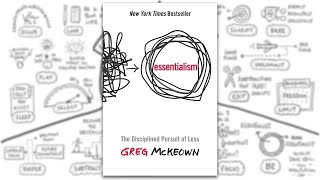
I first observed this working with executive teams in Silicon Valley where I noticed that when they were focused on a few things it led to success but success breaded so many opportunities and options that that diffused the very focus that led to success in the first place. And so exaggerating the point in order to make it I found that success becomes a catalyst for failure because it leads to what Jim Collins called the undisciplined pursuit of more. The antidote to that problem is the disciplined pursuit of less, but better.
That means exploring the very critical things you want to pursue and being willing to then, number two, eliminate the rest, and number three build a platform for effortless execution, so that doing what is essential becomes the default position, not just the rare occasion. [MUSIC]. My position is that when people really get a chance to think and have the space.
That they can quite easily discern between the things that are essential to them, important to them, and those things that are not. The problem is not our ability to discern, it's that we don't have the space to take the time to discern. Once we have that perspective, we can think through it.
So my position is that we need to develop a routine. That enables that space to think. In a world where we have so much information, we need more time to think and process it not less.
And so, yeah, one CEO I interviewed for the book has 2 hours on his calendar everyday. Broken up into half hour segments so that he has this spaced stop, to turn everything off, to think, to see the bigger picture. I think we can all do something similar to that.
[MUSIC] The idea for many people of saying no to a senior, leader, to even family members and so on is so unthinkable. They just don't even experiment with it. So they end up being a novice with no.
They just want to avoid this like the plague. But what I've found is that essentialists practice and learn and develop this skill. Kay Krill is the CEO of Loft and the Ann Taylor brand.
And she said that years ago she was really bad at saying no. And somebody came to her mentor and said look, you've got to learn to, to get rid of all of these people and commitments that don't mean anything to you. Because they'll rob you of the things that really do and she said that because she got that feedback she did learn over the years how to say no, how to push back gracefully, sensibly, but unapologetically.
And now she says she's very good at it, and it saved her so many you know, wasted hours, wasted days, wasted commitments because she actually learned to develop a repertoire for saying no. [MUSIC] One of the executives that I interviewed for the book, because he was trying to be a good citizen to his new company, ended up saying yes to almost everything. And his stress was going up and the quality of work was going down and so he started to, you know, with an experiment, saying no more often, being more selective.
And what he found was that the meaning of his work was going up, the value of his work to the company was going up, his stress was going down and he ended up with one of the best performance evaluations of his career and one of the largest bonuses of his career. In that little story there is the argument for essentialism. That by focusing on the few things that are really essential, we're actually able to make a more valuable contribution.
I think becoming an essentialist is not an easy thing. I certainly think it's a revolutionary thing. You find yourself saying no when other people are saying yes.
You're gonna be saying yes, when other people are saying no. But in the end, in the final analysis, anything less than the disciplined pursuit of the essential, will lead to the undisciplined pursuit of the non-essential. And that's a price I don't think many of us would deliberately choose.