okay now uh we are going to learn about the confidence interval for difference of two means okay maybe one minus mu 2 okay let's not look at this uh slide we go to the formula okay so um based on your formula okay chapter uh sorry page two satisfy table okay the first Formula the first part is the chapter two and then uh formula for five six and seven for single mean now we go to the difference of two means okay so as you can see here we have the formula uh number eight nine ten eleven and twelve so all together five formula that's mean we have five cases now okay just now for single mean only three cases okay one is when the sigma Square known Sigma Square known is the population variance is known okay the second case is when Sigma square is unknown okay but n is greater than or equals to 30 the third case is when Sigma Square unknown and is small less than 30. okay for difference of two mean we have additional additional R cases where in the second and the third case uh we have to divide it into two category okay one is when we assume that Sigma square one and sigma Square 2 is equal we have equal values of Sigma square one and sigma Square two another one is when it is not equal not equal okay so by default it is not equally if let's say the question didn't State whether uh we we assume that uh population variance is equal or not uh then you assume that it is unequal by default it is unequal okay not equal to Okay so so all together we have five so case one case two a uh we can say that this is a this is ba okay is 2 a case two B case three a case three B okay uh all right so we have all the formulas where you don't have to remember all of this formula just refer to but you have to know how to construct the confidence interval from this formula you need to know how to to build the formula okay to for constructing the confidence interval all right okay let's go to case one when Sigma square is known uh when Sigma Square known okay so when uh both the sigma Square known uh you have this formula right okay so based on this formula when I write in a lower level and upper limit term it is too long so I'll just put the plus minus 1A Okay so from this we are focusing on this mule right mu 1 and mu 2 okay so we have uh from this formula we have um from the Z right z alpha over 2 same z alpha over 2 and then you bring this to uh both sides so you have Sigma Square 1 over N1 plus Sigma squared 2 over N2 and then just put plus minus and then here have X1 and X2 okay uh so this is uh how to construct the confidence interval okay uh plus is for the upper limit minus is for the lower limit so X bar 1 minus X by 2 plus minus the alpha over 2 square root of Sigma square one over N1 plus Sigma Square 2 over N2 so this is your formula okay for case one or okay for case two or maybe you can refer to the table error okay for table um formula number nine okay formula number nine you have um X bar one minus x square two minus mu 1 minus mu 2 over s p ah you have you have a formula for SP okay this is when uh Sigma square one equals to Sigma squared 2 right so based on the formula in your statistical table please refer to your statistical table okay so your formula is z alpha over 2 must have Alpha over 2 because we have two side set a lower limit and upper limit and then times with SP square root of 1 over N1 plus 1 over N2 okay this is Formula number nine and then plus minus here you have X bar 1 minus X bar 2. uh okay so this is the formula all right now we go to case three case two B okay okay case 2B you refer to formula number 10 okay number 10 is this one all right so we go for Zack first z alpha over two and then this one you bring to this side s Square 1 over N1 plus s squared 2 over N2 then plus minus here x bar y minus X bar two okay so this is your formula for uh constructing constructing the confidence interval for difference of two mean when Sigma square one is n Sigma Square 2 unknown and is greater than or equals to 30 and we assume that the population variance is unequal we still use normal distribution why because our n is more than or equals to 30 okay okay case 3 is when n is less than 30 so you see the formula is using the D distribution table get the distribution and here is t uh t means the distribution that means normal distribution so T Alpha over 2 and the degree of freedom is N1 plus n 2 minus 2 okay and then for the denominator you have times s p square root of 1 over N1 plus 1 over N2 then plus minus here you have X by 1 minus X by 2.
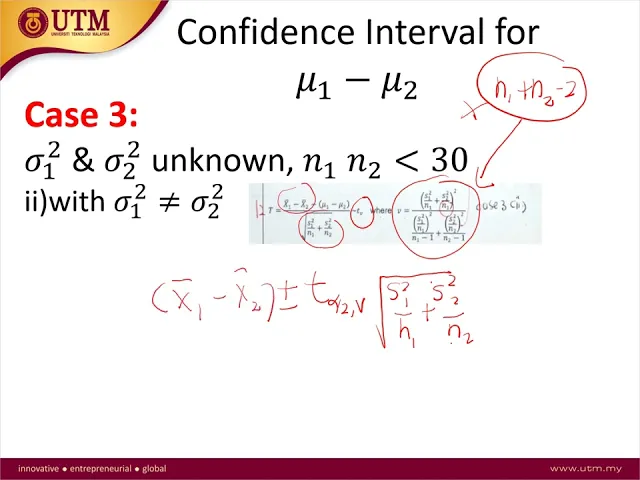
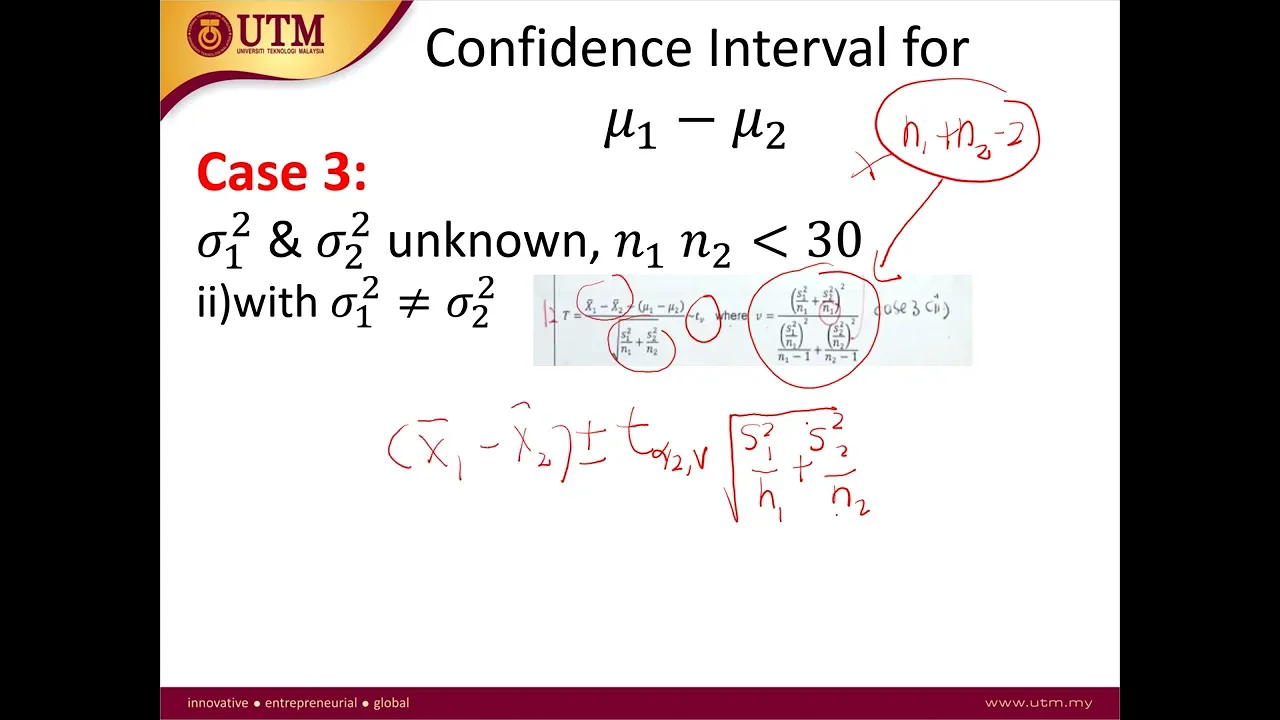
okay so this is the formula for case 3 a okay case three a is when we assume that population variance is equal okay and the last case is case 3B when population variance unequal so this is the formula from the table a bit complicated for the V you need to calculate the v v v is for this V uh for this V okay so T Alpha over 2 V again previously your V is N1 plus N2 minus 2 right the degree of Freedom so for the last case here the V is not not this one but it is this one okay and then times the denominator which is s Square 1 s squared to okay for the generator and then plus minus and then you take this one X Plus 1 x 1 okay so this is your formula okay for the last case right now let's look at example 3. 1 from your textbook okay example 3. 1 from your textbook suppose I'm not going to solve we just look at the question only okay suppose random sample of 49 cool tires and 36 mid lane uh tires were selected the sample mean mileage the tires need to be replaced for cool tires is 119 000 kilometers and the standard deviation is 7700 sample mean mileage for methylene tires is 118 000 kilometers standard deviation is six thousand kilometer compute a 90 confidence interval so Alpha is 0.
1 okay so for this question for this question we have um N1 equals to 49 and 2 equals to 36 X bar one hundred nineteen thousand X bar 2 hundred eighteen thousand S1 7700 S2 6000 okay Alpha is 0. 1 Alpha over 2 is 0. 05 okay so for this question the population variance is known or unknown it is unknown okay I know we don't have any information on the standard deviation for population so it is unknown so it's where the case is either case one or case two okay so now uh case one or case two okay so now you have to look at the end and it's large or small the end is large okay so n is large because n is more than 30 so it is case two right but case two A or B okay since the question didn't mention that assume the population variance is equal so we by default by default it is not equal so if not equal so in this case 2B okay case 2B so for case to B you need to follow formula number 10.
formula number 10 the formula is this one you use and Z normal distribution so z alpha over 2 okay why I cannot write anything here okay so for case b it is um formula number 10. okay um so you can trial you can try it okay next four okay task for a car magazine is comparing the total repair cost income during the first three years of two mid-sized car the ferry and xpy so 16 Paris and nine xpy are taken all 35 cars are three years old and have seamless mileage the mean of 16 very very fairy cars is 5000 standard deviation of hit 800 and for xpy cars the mean is 7700 standard deviation of 1000 assume that assume that the repair costs follow a normal distribution with same population variance this is important Point okay with same population variance construct 90 confidence interval for the difference between two population means okay so before we solved the question we need to know which case is that okay by no uh in order to identify which case is this question you need to take out whatever information that you have okay right so you have N1 equals to 16 and 2 equals to 9 and then X bar 1 5000 x bar 2 7 7 0 0 S 1 800 S2 1000 right the repair the repair cost polynomial with same population variance so here we are assuming that variance one is equals to variance 2. so Alpha is 0.
1 Alpha over 2 is 0. 05 okay now do we have the information on the population variance we don't have okay so in this case variance population variance and none okay so if unknown it is well either case one a case 2 or case three so guess 2 or case three so you look at the end and it's small or large and is small right so n is small so it is case three so K3 but we have Sigma square one equal to Sigma Square 2 so it is 3A k3a so 3 a uh from your table uh it is Formula number 11 formula number 11 you have that one okay so our formula will be our formula for confidence interval will be X bar 1 minus X by 2 plus minus t Alpha over 2 and then this is N1 plus n 2 minus 2 then you have SP you have to calculate for SPF 1 over N1 plus 1 over N2 okay so now X bar 1 is what x bar one is five thousand minus seven seven oh plus minus okay we don't have the value of 3 right okay so we have to switch okay so T 0. 05 0.
05 the N the degree of freedom is okay so T 0. 05 the degree of freedom is N1 plus N2 which is 25 minus 2 is 23. so 23 it is 1.
714 okay so 1. 714 1. 714 here and then SP uh we need to calculate for SP a speed of the formula is okay the formula for SP is NY N1 minus 1 which is uh 15 S1 squared 800 square plus n 2 minus 1 which is 8.
S 2 square which is 1000 square divided by N1 plus N2 minus 2 so N1 plus N2 is 25 minus 2 is 23. so you calculate K using your calculator you calculate you will get eight seven four point seven six seven oh okay so this is the value so you just put in the value 874. 7674 square of 1 over 16 plus 1 over 9.
okay so you will get an interval of minus three three to four point seven two nine four this one you calculate on your own try to calculate get the same value or not okay 2706 okay so I got this value for my interval so that's mean I'm 90 confidence that the difference between two population means is in between minus three three to four point seven two nine four n minus 2075. 2706 okay so that is the interpretation for the confidence interval all right now let's go to task five okay for task five a process engineer is comparing two different etching solutions for removing silicon from the back of waffles The Edge follows the edge rate for loose normal distribution and have equal population of variance uh have equal population variance of 0.