Ask anyone on the street to name the most frightening animal that ever lived, and you will get the same answer. What's the scariest animal that ever lived? Oh, the T-Rex.
Scariest animal in history. Tyrannosaurus Rex. Tyrannosaurus Rex.
And it is a reasonable answer. 12 m long, 9 tons. A skull a meter and a half in length, lined [music] with teeth the size of bananas, driven by the strongest bite ever measured in a land animal.
Roughly 35,000 newtons of force, enough to crush bone into powder and swallow the fragments. It is genuinely one of the most formidable predators the planet has ever produced. But here is the problem with that answer.
The T-Rex has had the best publicity campaign in the history of extinct animals. It was described in 1905. It got the best name anyone has ever given a fossil.
And it has been in every film, every museum hall, and every child's bedroom for over a century. Fame is not the same thing as terror. Because while the T-Rex was standing in North America at the very end of the dinosaur age, other animals had already come and gone.
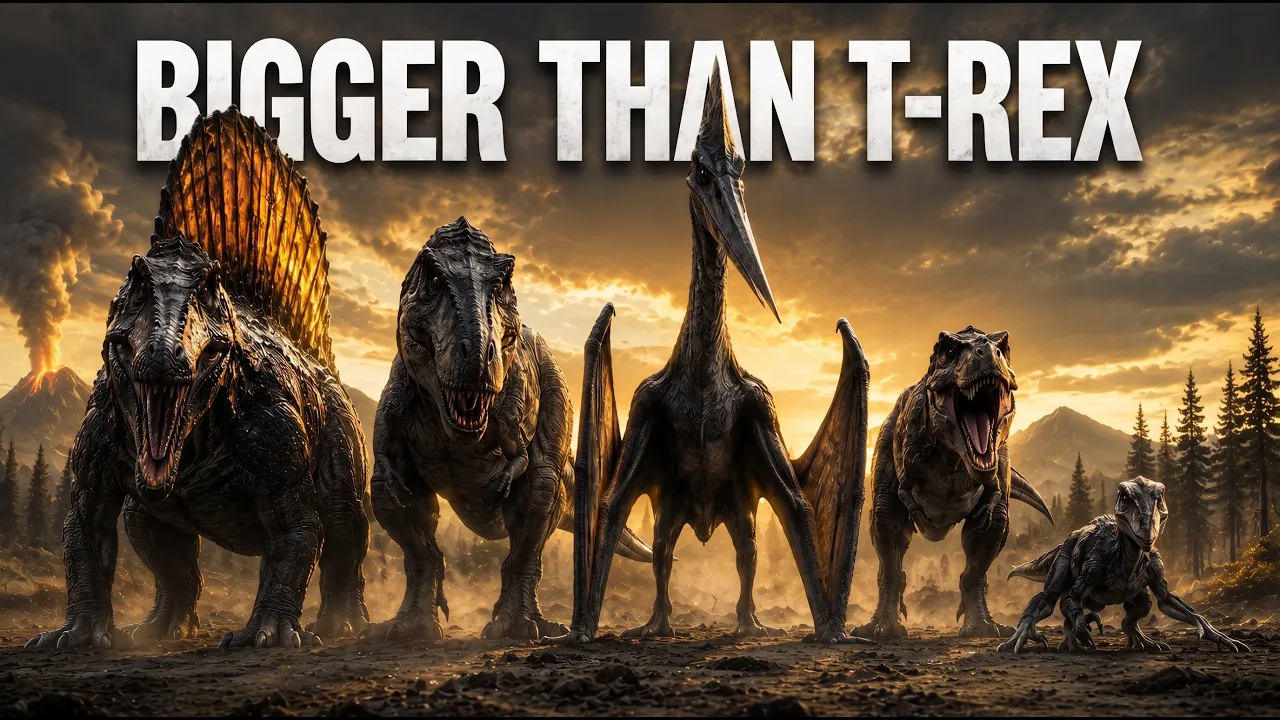
Animals that were longer, animals that hunted in packs, animals that could take prey out of the water or out of the sky, animals built to do things a tyrannosaur physically could not. Some of them would have been considerably worse to meet. Tonight, we are going to work through them.
Five contenders, each one terrifying in a different way. And by the end, you may find that the animal you have feared since childhood is not even in the top three. Let us start with the obvious challenger, the one that was simply bigger.
Before we take the crown away, we have to be fair about why the T-Rex earned it. This was not a dumb animal, and it was not slow. Start with the skull.
A Tyrannosaur skull is not built like most predators. Where an Allosaurus had a relatively narrow bladelike head designed for slashing, the T-Rex skull is deep, wide, and reinforced. The bones at the back are thickened.
The teeth are not flat blades, but [music] thick, conical, deeply rooted spikes, some of them over 15 cm of exposed crown with roots running much deeper into the jaw. Those are not cutting teeth. Those are crushing teeth.
We know [music] what they were for because we have found the evidence coming out the other end. Fossilized Tyrannosaur dung has been recovered [music] containing large volumes of crushed bone. This animal was not delicately stripping flesh off a carcass.
It was biting [music] through skeletons and swallowing the pieces. Then there is the brain and specifically [music] what surrounds it. CT scans of Tyrannosaur skulls reveal enormous olfactory bulbs, the region of the brain that processes smell.
Proportionally, [music] they are among the largest of any dinosaur measured. Its sense [music] of smell was likely exceptional. Its eyes faced forward.
Most large predatory dinosaurs had eyes set on the sides of the skull, giving wide vision but poor depth perception. [music] The tyrannosaur skull narrows toward the snout which swings both eyes forward into an overlapping field. Binocular vision, accurate [music] depth perception, the eyes of an animal that needs to judge exactly how far away something is [music] before it commits.
So, the picture is a 9-tonon animal that could smell you from a considerable distance, [music] see you in three dimensions, and bite hard enough to shatter your skeleton. That is the [music] standard. That is what the challengers have to beat.
And the first one starts by [music] simply being larger. 30 million years before the Tyrannosaur existed, on the other side of the world, something bigger was already hunting. Its name is Jiggonottosaurus, and it lived in what is now Argentina around 98 million years ago.
Length estimates put it at roughly 12 to 13 m, which places it at or slightly beyond the largest known Tyrannosaur specimens. Weight estimates generally land in the region [music] of 8 tons in the same class, possibly a little lighter, but the shape of the [music] animal is completely different. And the difference matters.
The Jiggonottosaurus skull is longer and narrower than a Tyrannosaurus. And the teeth are not thick crushing cones. They are flattened bladelike [music] with serrated edges front and back.
Steak knives rather than railway spikes. That tells [music] you the hunting strategy was different. A tyrannosaur closes its jaws and destroys [music] structure, bone included.
A jiggonottosaurus closes its jaws and opens a wound. Long, deep slicing [music] bites designed to cut through muscle and blood vessels. Against a heavily armored animal, the Tyrannosaur approach is better.
But against something enormous and soft, the slicing bite is devastating, and you do not need to hold on. You bite, you release, you follow. And what it was hunting is the part that should stop you.
Giggonottosaurus shared its landscape with some of the largest animals that have ever existed. Titanosaur soropods 30 m or more from nose to tail, weighing potentially 50 tons or beyond. Animals so large that no single predator should be able to touch them.
Here is where it gets genuinely unsettling. At a site in Argentina, paleontologists uncovered the remains of several individuals of Maposaurus, a very close relative of Giganottosaurus, together in the same bone bed. Multiple animals of different sizes preserved in one place.
That is not proof of pack hunting. Bone beds can form for many reasons, including animals dying at a dried up water hole over years. Researchers are careful about this, and so should we be.
But it raises a possibility that changes everything. If these animals were tolerating each other's presence around a kill, or worse, coordinating, then the largest herbivores on Earth had a real problem. A single predator cannot bring down a 50 ton soraod.
Several of them working the same animal over hours or days absolutely can. Picture that. Not one monster but four moving at the edges of a herd, cutting an animal that outweighs them all combined and simply waiting.
The T-Rex, as far as we know, hunted animals it could kill by itself. This is a predator that may have gone after things nothing should be able to kill. Now we go to North Africa 95 million years ago and to the animal that ends the debate about size entirely.
Spinosaurus. It is the longest predatory dinosaur ever found. Estimates for the largest individuals run to 14, possibly 15 m.
That is meaningfully longer than any tyrannosaur specimen we have. And it is without question the strangest large predator in the fossil [music] record. Start with the sail, a row of enormously elongated spines rising from the vertebrae in places well over a meter and a half tall, supporting a structure of skin and tissue along the animal's back.
Its exact function is still debated. [music] display, thermmore regulation, or something to do with movement through water. Then the skull, which does not look like a theropod skull at all.
It is long, narrow, and low with a slight downward curve at the tip and a rosette of interlocking conicle teeth at the front. Those teeth are not serrated. They are smooth and round in cross-section.
Serrated teeth cut flesh. Conical unserrated teeth grip something slippery and stop it escaping. That is a fish catching mouth.
And it is nearly identical in principle to the skull of a modern gariel, a crocodilian that eats almost nothing else. The nostrils sit further back on [music] the skull than usual, which would allow the animal to have most of its snout in the water and still breathe. Studies of the bone structure found the limb bones were dense and solid rather than hollow, similar to animals that spend significant time in water, [music] which reduces buoyancy.
And then there is the tail. In 2020, a team recovered a remarkably complete Spinosaurus tail. And it was not the stiff counterbalancing rod that most large therapods have.
It was tall, flexible, and paddle-shaped with enormously elongated spines running along it. Physical models of it in water suggested it generated far more thrust than the tail of a land-based [music] dinosaur. This is where the science gets genuinely contested, and I want to be [music] honest with you about it.
One camp argues Spinosaurus was a pursuit predator that actively swam and chased prey underwater. Another argues it was more like a heron or a giant wing [music] animal, standing in the shallows and striking at what came past since some biomechanical studies suggest [music] it would have been unstable and slow as a true swimmer. That argument is still running.
Papers go back and forth on it, but nobody disputes the core point. This was a 14 meter predator that spent much of its life in and around water, hunting animals in a place no other giant therapod could follow. And consider what lived in those rivers.
The chem beds of Morocco preserve sawfish several meters long. celeracantss far larger than the modern ones and enormous crocodilians. Spinosaurus was hunting in water full of things that could fight back.
Here is why it belongs on this list. Every [music] terrestrial predator gives you one thing, the water. Every land animal on Earth today knows that if something is chasing [music] you, deep water is often an escape.
Spinosaurus removes [music] that option. You cannot outrun a Tyrannosaur, but you can in principle reach a river. Against this animal, the river [music] is where it lives.
Everything so far has been about size. Now we stop measuring because the next contender is smaller than you are. Donicus, roughly 3 m long, including the tail, standing waist high to an adult human, weighing perhaps 60 to 75 kg.
This is the animal that the raptors in the films were actually based on, despite being given a different name on screen, and it changed paleontology permanently. [music] When John Astramm described it in 1969, dinosaurs were still widely pictured as slow, coldblooded, tail dragging reptiles. Dionicus did not fit.
It had a lightly built skeleton, long arms with three grasping fingers, a stiffened tail [music] held straight out for balance, and a body plan that only made sense for something fast and active. And on [music] the second toe of each foot, held permanently off the ground, a large sickle-shaped claw. That single animal is a major part of why we now understand dinosaurs as active, warm-blooded, bird related animals.
The modern picture of dinosaurs starts here. Now, what the claw was for is genuinely debated, [music] and the answer is more disturbing than the old one. For decades, the assumption was slashing, [music] that the claw opened prey like a blade.
Casting has largely undermined that. [music] The claw's shape and structure are not well suited to cutting. The current leading model based on comparison with modern birds of prey is that the claws were for gripping and holding.
Hawks and eagles use their talons to pin prey to the ground and keep it there while they begin eating. often before the animal is dead. [music] That model, sometimes called raptor prey restraint, suggests Dionicus leapt onto larger prey, sank both foot claws in, held on with its arms and its weight, [music] and started feeding while the animal was still alive and struggling.
Which brings us to the numbers. At one site, the remains of several Donicus individuals were found associated with a single much larger planteating dinosaur called Tenonttosaurus. This pattern turns up more than once.
The traditional interpretation was coordinated pack hunting, wolves in reptile form. More recent work has questioned that. Analysis of tooth isotopes suggests that juveniles and adults were eating different food, which is not what you would expect from a true cooperative pack [music] that shares kills.
The current thinking leans towards something more like modern Komodo dragons. Multiple individuals converging on the same prey opportunistically, competing rather than cooperating, and occasionally fatally. Take a moment with that because it is arguably worse.
A coordinated pack is at least [music] organized. What the evidence may be describing is several highly agile, sharp, clawed predators, all arriving at the same struggling animal at the same time. Each one determined to get its share.
None of them waiting. A tyrannosaur [music] kills you and it is over quickly. There is a certain mercy in 9 tons of bone crushing force.
Donicus does not have that. It cannot [music] kill you fast. It simply holds on.
We now break [music] the rules slightly because the next animal is not a dinosaur at all. It is a terasaur, a flying reptile [music] from a closely related branch. But it needs to be here because [music] it is the single most alien predator in this story.
Kettzel Katlas, late Cretaceous, [music] North America. The wingspan is estimated at around 10 to 11 m, comparable to a small aircraft. Standing on the ground on all fours with its neck raised, it stood roughly as tall as a giraffe.
Now understand how strange that is. something the height of a giraffe that could fly. It managed this by being extraordinarily light for its size.
Estimates [music] vary considerably, but many fall in the range of 200 to 250 kg achieved through a skeleton of thinwalled airfilled bones [music] threaded with the same airsack system that birds still use. And what it did with that body is the frightening part. For a long time, it was pictured [music] as a giant scavenging vulture circling and descending on carcasses.
The current leading model is very different. Studies of its limb proportions and neck structure [music] suggest it was well adapted to walking on all fours on solid ground. And researchers now generally [music] interpret it as a terrestrial stalker, something closer to a colossal stalk or ground hornbill, striding [music] across open landscapes and picking up whatever it could swallow.
Its jaws were long, pointed, and toothless, built for seizing and swallowing prey whole rather than dismembering it. So, the picture is this. An animal as tall as a giraffe walking across a flood plane on four limbs, eating baby dinosaurs and small animals whole.
And when it was finished, it could take off. That is what makes it belong on [music] this list. Every other predator here is bound to a place.
You can in principle escape a jiggonottosaurus [music] by leaving its territory. You can escape a Spinosaurus by staying out of the river. Ketzel Kawatlas could cross terrain no land [music] animal could follow.
There is no distance that helps you. No river, no ravine, no cliff. If it decides to relocate, it simply leaves the ground.
Now the last one, and it is not the largest or the fastest or the strangest. It is the young one. Because there is a serious body of research on Tyrannosaur growth and it describes [music] something the films never show you.
A juvenile tyrannosaur was not a small version of the adult. It was a different animal entirely doing a different job. Young tyrannosaurs were slender, longlegged.
Their skulls were narrow and shallow with [music] bladelike teeth rather than the thick bone crushing cones of the adult. They were built for speed and for cutting, not for crushing. There has been genuine [music] scientific debate about whether some of these slender specimens were juveniles at all or a separate, [music] smaller species.
The current weight of evidence based on bone microructure showing they were still [music] growing rapidly supports the juvenile interpretation, though the argument is [music] not fully closed. Either way, the ecological picture is the same, and it is remarkable. In this ecosystem, there is an odd gap.
Almost no medium-sized predators exist alongside the Tyrannosaurs. In most ecosystems, you would expect a spread of predator sizes filling different roles. The likely explanation is that the Tyrannosaurs filled those roles themselves at different ages.
The juveniles were the fast pursuit predators. The adults were the heavy bone crushers. One species occupying multiple [music] predatory niches across its own lifespan.
Which means [music] the landscape contained tyrannosaurs of every size at once. And the small ones were not less [music] dangerous. They were dangerous in a way the adults were not.
An adult tyrannosaur is enormous. And enormous animals [music] have limits. Turning circles, acceleration, energy costs.
A juvenile [music] has none of those limits. It is light, fast, agile, and it has slicing teeth. Here is the thought I want to leave you with.
If you were dropped into the late Cretaceous, the 9-tonon adult is the thing you would see coming. It is loud. It is huge.
It cannot hide. The one [music] that would actually catch you is the fast, lean, quiet one at roughly your own height that is faster than you over open ground and has [music] no interest whatsoever in a fair fight. The most terrifying Tyrannosaur was not [music] the adult.
It was the teenager. So, where does that leave the king? Still one of the most powerful [music] land predators the planet has produced.
Nothing here takes away [music] the bite force, the skull, the sense of smell, the binocular vision. All of that [music] is real. But terrifying is not the same as famous.
And it is [music] not the same as strongest. Jiggonottosaurus was longer and may not [music] have been hunting alone. Spinosaurus took the water away.
Dionicus [music] would not kill you quickly. Kettzel Kawatlas could follow you anywhere [music] on Earth. And a juvenile tyrannosaur could actually catch you.
The T-Rex [music] won the argument in our imaginations because it was named well and found early and because a single enormous predator is an easy story to tell. The real Mesazoic was more complicated [music] than one monster. It was an entire planet of animals solving the problem of eating each other in [music] wildly different ways for 165 million years.
And every single one of them was a real animal doing an ordinary thing on [music] a planet that used to be here. If you enjoyed this, subscribe and tell me in the comments which of these five you would least [music] want to meet. Next time we go back further to the predators that ruled [music] this planet before dinosaurs existed at all.