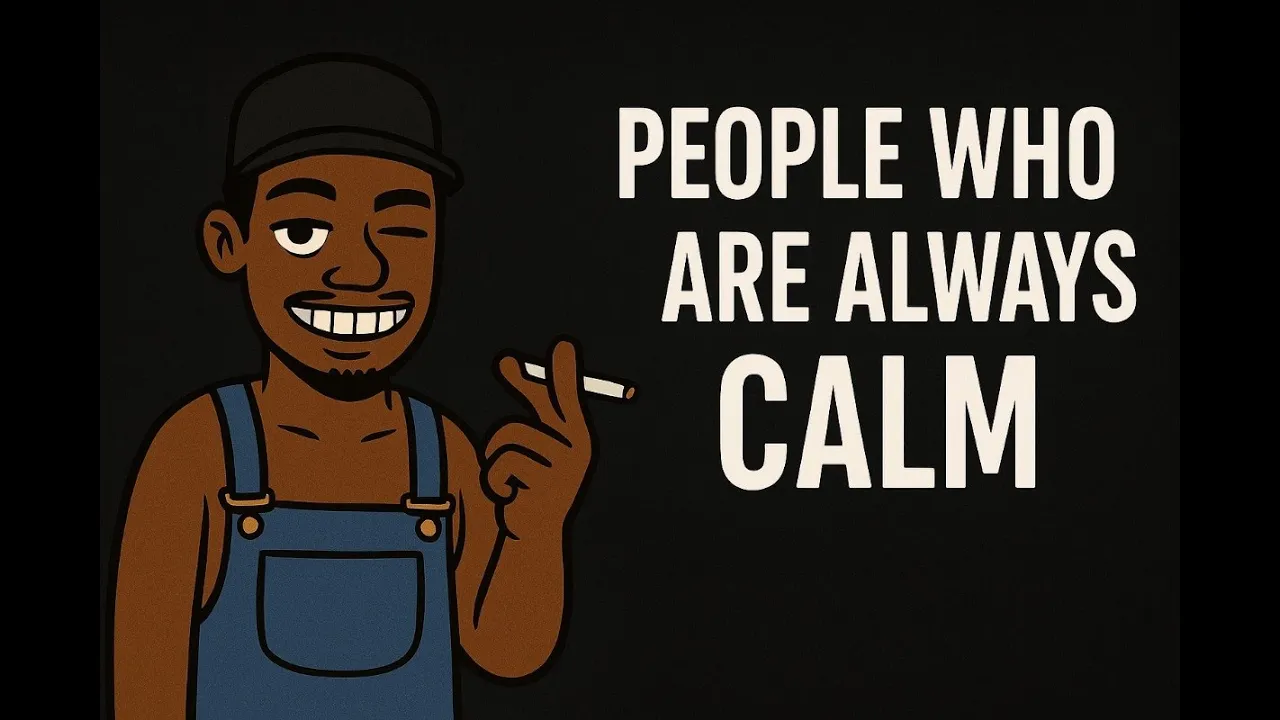
[music] There's a certain kind of person who doesn't raise their voice even when the world seems to be falling apart. They don't argue. They don't panic.
They don't rush to prove themselves right. They just breathe. And while everyone else is trying to make sense of the chaos, they quietly watch.
Like someone who's already been through this [music] storm before. You've probably met someone like that. The kind of person who feels like silence itself has wrapped around them.
No matter what happens, they remain composed, steady, grounded, untouchable. And if you've ever wondered why some people can stay so calm while others fall apart, [music] the answer is far deeper than you might think. Calmness, real calmness, isn't the absence of emotion.
It's what happens when emotion meets understanding. It's not that these people don't feel. They do.
They just don't react in the same way anymore. [music] [music] Once you've seen enough, once you've hurt enough, once you've realized that panic doesn't solve anything, you stop fighting storms that can't be controlled. You learn to stand still in the rain instead.
That's the psychology of calm people. They weren't born this way. They became this way.
See, people who are always calm usually went through phases where they weren't. [music] They were overthinkers once. They cared too much.
They tried to control everything, fix everything, [music] please everyone. And every time they tried, they learned the same lesson. [music] That life doesn't bend to your will, no matter how hard you push.
At some point, they stop trying to control the ocean. And instead, they learn to surf it. That's what calm really is.
Not indifference, but emotional wisdom. Psychologists often describe this as emotional regulation, but that term doesn't quite capture the soul of it. [music] It's not just about suppressing emotion or pretending everything's fine.
[music] It's about understanding emotion so deeply that it no longer has control over you. Calm people aren't emotionless. They're emotionally fluent.
They've learned the language of their mind. They can feel anger without exploding, sadness without drowning, and uncertainty without losing balance. Because inside their mind, there's a small voice that whispers, "This too will pass.
" And that voice isn't blind optimism. It's memory. They've lived through enough to know that even the worst moments fade, [music] that panic doesn't speed up healing, and that peace isn't found in control, but in acceptance.
Most people misunderstand calm people. They think calm means cold, but in truth it often means compassionate. Calm people are the ones who hold space for others when everyone else is panicking.
They're the ones who can say it's okay and mean it. Not because they don't care, but because they know chaos isn't permanent. There's a kind of quiet strength in that.
[music] It's the strength of restraint, of knowing that not every battle deserves your energy, not every insult deserves a reply, and not every storm deserves fear. It's [music] the strength of choosing peace even when your instincts want to fight. But let's go deeper.
Why do some people reach this state while others [music] constantly find themselves overwhelmed? The answer lies in a part of the brain called the amygdala, the center of fear and emotional response. In people who've practiced mindfulness or been through emotionally intense experiences, [music] the amygdala becomes more balanced.
It still signals danger, but it no longer hijacks their entire system. Their preffrontal cortex, the rational thinking part of the brain, learns to step in before the emotion takes over. In other words, calm people have trained their minds to pause between feeling and reacting.
That pause is their superpower. It's why in an argument, they can hear something hurtful and not immediately strike back. It's why they can sit in uncertainty without needing to fill the silence.
It's why when the world is loud, they can still hear themselves think. That pause, that moment of stillness is where wisdom lives. But here's what's fascinating.
Calm people often weren't taught to be this way through books or therapy. Many learned it the hard way. Through heartbreak, through disappointment, through realizing that reacting quickly often made things worse.
At some point, they got tired of their own chaos. They got tired of overreacting, regretting, apologizing, explaining. They reached a point where peace became more [music] important than being right.
So now when tension rises, they choose silence over shouting. They choose to breathe instead of blame. They choose to let go instead of hold grudges that burn from the inside.
And yet that calmness isn't always easy. Because sometimes calm people carry storms inside that no one can see. They look peaceful, but their calm is hard earned.
It's the kind that's forged in pain, not perfection. They've cried in private, questioned their worth, felt unseen, misunderstood, and through all that, they discovered that peace isn't a reward for having an easy life. It's a discipline you build when you realize that emotional chaos doesn't serve you anymore.
That's why people who are always calm tend to think differently. They're not driven by impulse. They're guided by perspective.
They don't chase validation. They chase meaning. They don't need to prove they're right.
They'd rather understand because deep down they've realized something most people don't. Reacting to everything makes you a prisoner of everything. The calmer you are, the freer you become.
In psychology, there's something called response flexibility. It's the ability to choose your response rather than let it choose you. That's what calm people master.
They don't suppress emotion. They channel it. They let the energy move through them without letting it destroy them.
[music] That's why they're often the ones who seem so composed during crisis, but break down quietly afterward. [music] Not because they're pretending, but because they understand timing. They know there's a time to feel and a time to act, a time to process and a time to release.
Their calmness isn't a mask. [music] It's an internal compass that keeps them aligned no matter how strong the winds get. And if you look closer, you'll notice another thing.
Calm people don't just react differently. They see differently. While most people see chaos, [music] they see patterns.
While most see problems, they see lessons. While most see endings, they see beginnings disguised as change. They've trained their perception to zoom out, to look at the bigger picture instead of getting lost in the moment.
That's what gives them balance. That's why they can lose something and still say, "Maybe this was meant to happen. " It's not denial.
It's perspective born from experience. The calm person you see sitting quietly in the corner, they've probably [music] lived through things that once broke them. They just learned not to live inside that break anymore.
They've realized that when you stop trying to control the uncontrollable, you create space. [music] And that space is where peace begins. Think about that the next time you see someone who never seems rattled.
[music] They're not detached from life. They're just anchored deeper in it. They've stopped being tossed around by every wave because they've become the ocean itself.
Their calmness is not apathy. It's [music] understanding. It's the understanding that not every emotion deserves expression.
[music] Not every thought deserves attention and not every situation deserves energy because energy to them is sacred. They spend it wisely [music] on things that build, not break. They've seen how easily chaos can drain a [music] person, how drama can destroy peace, how small reactions can grow into regrets.
So they choose differently now. When someone insults them, they pause. When someone misunderstands them, they explain if it's worth it [music] and walk away if it's not.
When life gets heavy, they don't [music] collapse. They lean on faith, on time, on perspective. And that's what makes calm people magnetic.
It's not that they have all the answers. [music] It's that they don't need to anymore. They've made peace with uncertainty.
And in a world obsessed with control, that peace is power. Because while most people are fighting battles in their minds, replaying, overthinking, [music] regretting, calm people know that silence can say more than words ever could. that not every emotion deserves a witness and that sometimes the greatest strength is simply not reacting.
But there's another layer to this psychology, [music] something few people talk about. Calmness can also be a kind of self-p protection. A defense mechanism, yes, but a [music] gentle one.
For many, calmness isn't something they chose. It's something they had to build to survive. They learned early that reacting loudly didn't change outcomes.
[music] That staying composed was safer. that keeping your emotions guarded kept you from being misunderstood or hurt. So calmness became their armor.
Their quiet became their shield. But here's the beauty. Even if it began as protection, it evolved into power.
[music] Because over time, that restraint turned into awareness. That emotional distance turned into depth. And that quiet strength became the foundation of their peace.
That's why calm people are often the most self-aware. They understand their triggers. They recognize their patterns.
They don't need constant noise to feel alive. They find comfort in stillness because stillness isn't emptiness. It's clarity.
It's the sound of someone who's finally stopped running from themselves. The calm ones, they often make the world feel a little slower, a little safer just by being in it. They don't walk into a room and demand attention.
They don't raise their energy to match the noise. Instead, they lower the noise by being themselves. You can almost feel it.
[music] that quiet confidence that doesn't need to be proven. There's something magnetic about people who stay calm in a world addicted to reaction. [music] It's not because they're emotionless.
It's because their emotions have matured. And maturity isn't about age. [music] It's about understanding what truly deserves your peace.
Calm people often know that arguing rarely changes anyone's mind. [music] That rushing rarely speeds anything up. That worrying rarely prevents anything from happening.
So, they let go of what doesn't serve them, not because they don't care, but because they finally learn the cost of caring about everything. The calm person has probably already lived through what you're panicking about. They've already faced the heartbreak, the loss, the rejection, [music] the fear.
They've seen that life continues even after the moments that once felt unbearable. And that realization becomes their peace. It's not that they expect life to be easy.
They've just stopped expecting it to be fair. And that shift alone removes half of life's chaos. When something bad happens, most people spiral into why me.
But the calm person thinks, why not me? Not out of defeat, but out of understanding that life happens to everyone. And resisting that truth only multiplies the suffering.
They've discovered a truth hidden deep in human psychology. That pain without resistance is just sensation, [music] but pain with resistance becomes suffering. So they stopped resisting what is.
They've accepted the flow of life not as passive observers but as active participants who know when to move and when to wait because calmness isn't pacivity. It's control in its highest form. The control of self.
They've learned to separate the external world from their internal one. [music] The world can be loud, unpredictable, cruel at times, but their inner space that's sacred. They don't allow every external event to dictate their internal state.
That's why calm people often feel like they live in a different dimension because they do. It's the space between stimulus and response that defines them. That tiny invisible pause where they decide whether to feed chaos or peace.
That pause is the mark of emotional intelligence. Because the truth is calmness isn't found, it's created. Every calm person you meet is building it moment by moment.
[music] They've built it in long nights when their mind wouldn't stop racing. In mornings where they wanted to quit, in conversations where they chose silence over reaction. It's not easy, but it's intentional.
They've trained themselves to be unshaken. [music] Not because life stopped testing them, but because they stopped failing the same emotional tests. If you ask a calm person what changed them, they'll probably tell you, "I just got tired.
Tired of overthinking. Tired of defending. Tired of being misunderstood, tired of giving energy to everything that didn't deserve it.
So, they started valuing peace like oxygen. It's a strange thing. [music] The world celebrates loud success, but rarely honors quiet strength.
Yet, it's the calm ones who carry the most wisdom. They're the ones who can sit in stillness long enough to actually hear what life is trying to say. They notice more than they speak.
They see through the noise because silence sharpens perception. In that silence, they observe without judgment. And that's what allows them to understand people so deeply.
If you think about it, calm people are emotional translators. They don't just hear words, they hear intention. [music] They don't just see behavior.
They see the wound behind it. They don't just react to energy. They absorb, decode, and release it.
[music] That's why talking to them feels like therapy. You feel seen, not analyzed, [music] understood, not judged, because they're not listening to respond, [music] they're listening to understand. That kind of listening requires stillness.
And stillness requires strength. [music] Because it's hard to stay centered when others are spinning. It's hard to remain soft when the world keeps trying to harden you.
[music] But calm people do it anyway. Not because it's easy, but because they know it's necessary. [music] They've realized that peace is not the absence of problems.
It's the ability to face problems without losing yourself, and that's what sets them apart. Most people look for peace in perfect conditions. Calm people create peace within imperfect ones.
They don't wait for the storm to pass. They learn to find stillness inside it. You'll often find them with simple routines because simplicity stabilizes the mind.
A morning ritual, a quiet walk, a cup of tea, a few minutes of silence before sleep. These little habits aren't random. >> [music] >> They're anchors.
Psychologically, repetition builds a sense of control and predictability. [music] And calm people protect that pattern because it keeps them grounded. They know that without small doses of stillness, the mind starts to spin stories.
[music] And the calmer the mind, the clearer those stories become. There's also something beautifully paradoxical about them. Calm people tend to be some of the most emotional souls.
Yet, they're the least reactive because they've learned that expression doesn't always require eruption. [music] Sometimes you express emotion by holding it gently until it dissolves. And this doesn't mean they don't feel intensity.
They just express it differently. [music] Their sadness turns into reflection. Their anger turns into clarity.
[music] Their fear turns into faith. That alchemy, the ability to transform [music] emotion into awareness, is the core of calmness. It's what separates emotional maturity from emotional chaos.
But here's something even deeper. [music] Calmness doesn't only change how you feel. It changes how people treat you.
When you stay calm, you become harder to manipulate. You become unpredictable to those who rely on emotional reactions. And that in turn protects your energy [music] because nothing confuses chaos more than someone who doesn't join it.
It's a quiet rebellion. When everyone else is racing to respond, the calm person waits. And in that weight, they gain perspective that others miss.
They see motives, patterns, dynamics that only reveal themselves in stillness. They don't rush to conclusions because they've learned that truth always unfolds. It doesn't need to be forced.
That's why calm people rarely regret their decisions. [music] They give life enough time to show them what's real. And maybe that's the most profound part.
Calm people don't just manage emotion. They respect [music] time. They understand that time reveals what emotion hides.
That patience is not in action, [music] it's wisdom disguised as delay. So while others chase quick closure, calm people allow things to breathe. [music] Because they know that rushing understanding is the fastest way to misunderstand.
If you ask them how they stay so calm, [music] they'll smile and say something like, "I just stopped fighting everything. " But what they really mean is [music] they stopped fighting life. They stopped trying to win every argument, control every outcome, [music] rewrite every past, and predict every future.
They started trusting themselves enough to let things unfold. Trust. [music] That's the secret ingredient in calmness.
It's not about knowing what will happen. It's about believing that whatever happens, you'll handle it. And that belief doesn't come from ego.
It comes from experience. From surviving enough storms to know you will survive the next one, too. That's why calm people often radiate quiet confidence.
Not loud, showy confidence, but the kind that feels like gravity. [music] It's not in their words, it's in their presence. You just feel safe around them because their energy tells you it's [music] okay.
We don't have to rush. We don't have to fight. We can just be.
And maybe that's what the world needs more of. [music] People who don't add to the noise. people who can pause before reacting, breathe before speaking, [music] and listen before judging.
Imagine if everyone learned to do that just for a day. The world would sound a lot quieter. And [music] maybe, just maybe, that silence would heal more than words ever could.
But let's be real, staying calm isn't easy. Even the calmst people lose [music] their balance. Sometimes they get angry, they break down, they feel [music] doubt.
But the difference is they know how to return to stillness. They don't stay lost in emotion. [music] They observe it, understand it, and let it pass.
That's the cycle. Awareness, [music] acceptance, release. Because true calm isn't about never being shaken.
[music] It's about always finding your way back. The calm ones know that emotions are waves, not walls. You [music] can't stop them from coming, but you can choose how to surf them.
So they ride the rise and fall of life with grace, [music] never letting one wave define the entire ocean. They've learned that happiness and pain are temporary visitors, both welcome, both fleeting. And in that acceptance, they find peace that doesn't depend on what happens next.
That's why calm people often feel timeless, as if they've stepped outside the race everyone else is running. Because in a way, they have. They're not chasing peace anymore.
They've become it. [music] And maybe you felt that pull, too. That quiet voice inside that says, "I [music] just want peace.
" Maybe you've reached the point where chaos no longer excites you. Where silence feels like safety and where you'd rather understand than argue. That's not weakness.
That's growth. Because calmness isn't something you're born with. It's something you grow into.
And once you do, the world changes color. [music] You stop needing noise to feel alive. You start valuing quiet moments, gentle [music] people, slower days.
You begin to measure success not by how much you achieve, but by how peacefully you live. And the [music] best part, the calmer you become, the more clearly you see. People, patterns, purpose.
You start noticing how much of life is noise pretending to be important. And once you see that, it's hard to unsee it. So you begin simplifying.
You declutter your thoughts, your space, your relationships. You choose less and somehow it feels like more. Because calm people know that the goal isn't to have a perfect life.
It's to have a peaceful mind. And [music] peace doesn't come from fixing everything outside of you. It comes from learning to rest within yourself.
Even when nothing outside makes sense. [music] That's what makes calm people rare. Not their lack of emotion, but their understanding of it.
They don't escape the storm. [music] They become the stillness inside it. They don't control the wind.
They learn to move with it. They don't fear uncertainty. They see [music] it as part of the dance.
And maybe that's the message we all need. That calmness isn't found at the end of the journey. It's found when you stop running, and decide to be fully here right now.
[music] Because life will always test you. It will shake you, challenge you, break your rhythm. But every time it does, you have a choice [music] to react or to return.
And every time you choose to return to calm, you become a little stronger, [music] a little wiser, a little freer. So if you've ever been told you're too calm, take it as a compliment. It means you've mastered the art of emotional balance in a world that thrives on reaction.
[music] It means you've learned to see the storm without becoming it. And it means you found the kind of strength that doesn't shout. It simply is.
Because calmness is not emptiness. It's [music] fullness without noise. It's power without aggression.
It's emotion without chaos.