Thanksgiving day was already cold, but nothing prepared me for the chill I felt when my sister pointed to the garage and said she's used to scraps. She didn't whisper it. She didn't flinch.
She just handed me a paper plate, turned her back, and walked inside to her perfect dining room, where the rest of the family was already seated under golden lights and polished chandeliers. I stood there for a second, holding that flimsy plate, my kids behind me, Micah and Ila, 12 and nine. Neither of them said a word.
They just looked at me, waiting for what came next. And I I couldn't cry. Not in front of them.
Not after everything we've already been through. So, I smiled. I led them through the side door and into the garage.
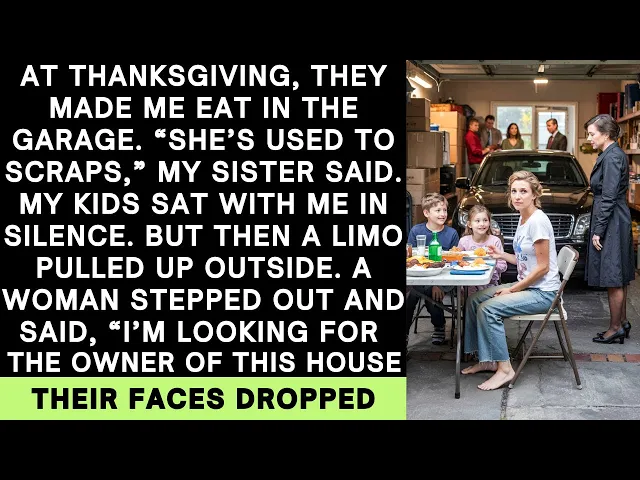
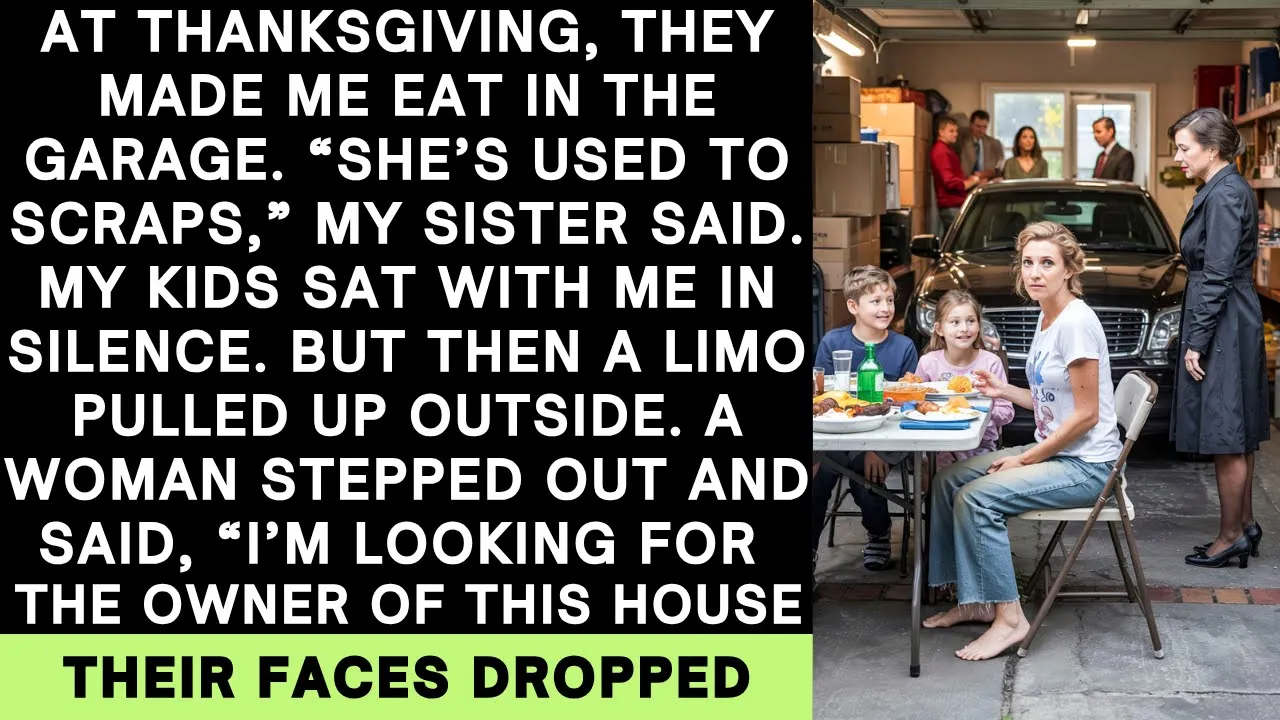
It smelled like gasoline and dust. A single folding table was pushed against the wall with two metal chairs and a cardboard box to sit on. No decorations, no warmth, just silence and the sound of forks scraping plastic.
That's where we ate our Thanksgiving dinner. My kids didn't complain. They sat with their back straight, their eyes fixed on their food.
Ila nudged her sweet potato pie around with her fork. Micah clenched his jaw like he does when he's trying not to cry. That was the moment I felt something shift.
I wasn't angry. I wasn't even hurt anymore. I just looked at them and I knew.
I was done begging to belong. And then it happened. A black limousine rolled up outside the house.
Not a car, a limousine. Everyone inside paused. I saw their silhouettes through the window curtains, curious, confused, crowding toward the front of the house, but the car didn't stop at the front door.
The driver circled to the garage entrance. The engine cut off, and a woman stepped out, tall, elegant, wearing a navy blue coat that looked expensive even from a distance. She looked around and asked, "Clear as day.
I'm looking for the owner of this house. " And when I stood up, their faces dropped. I hadn't planned on going to my sister's house for Thanksgiving.
I told myself last year would be the last time. But then the kids started asking, "Will Aunt Veronica be there? Will grandma remember my name this time?
" And before I knew it, I was ironing a secondhand dress and baking cornbread in our little kitchen, trying to act like it was all perfectly normal. We live in a modest two-bedroom apartment on the edge of town. It's not much, but it's clean, warm, and filled with love.
I work long shifts as a receptionist at a pediatric clinic and I pick up freelance writing jobs on the side. It doesn't leave much time or money for extras, but my kids don't complain. They never have.
Mike is 12 now, already taller than me. All quiet strength and thoughtful eyes. Ila's nine and still believes the world is mostly good, though I can see that belief wobble a little more each year.
The morning of Thanksgiving, I stood in front of the mirror trying to decide if my old boots looked presentable enough. I told myself it wasn't about impressing anyone. I was doing it for my kids.
But the truth is, part of me still wanted to be seen. My sister, Veronica, lives in a gated community where even the trash cans look rich. Her house is huge and cold, the kind that smells like lemon polish and things you're not supposed to touch.
She married well, as my mother likes to say. Blake is an attorney, smug and polished, always has a Bluetooth in his ear and something condescending to say about public schools. They have three kids, nannies, a Range Rover, a housekeeper who doesn't speak much English.
Veronica and I haven't been close since we were teenagers. She was always the one with perfect grades, perfect hair, perfect everything. I was the artsy one, the one who scribbled in notebooks, and had potential, but never quite made it.
When I pulled into her driveway, the party was already in full swing. I could hear laughter from the backyard and the clatter of dishes through the open windows. I took a breath and turned to the kids.
You two ready? Ila nodded, cradling the sweet potato pie she'd helped me make. Micah just said, "Let's get it over with.
" I knocked once and stepped inside. Nobody came to the door. They never do.
It was always the same, me entering like a guest at my own family's party. My mother, Elaine, barely looked up from her glass of Chardonnay. She was perched on the edge of the couch watching Veronica's kids put on some dance recital in the living room.
"Hi, Ma," I said, placing the pie on the counter. She blinked at me, smiled vaguely, and turned her attention back to her granddaughters. "Oh, you look tired," she said in that way she does, as if it's concern, but really it's judgment in a velvet dress.
Veronica appeared from the kitchen in heels too high for someone making mashed potatoes. Oh, you brought something, she said, eyeing the pie. That's cute.
Blake strolled by holding a glass of something amber. Hey, Cal, he said using the nickname I hate. Kids look big.
We weren't offered seats. We weren't offered drinks. There was no help yourself.
No welcoming gesture, no warmth. My cousins were all there chattering, pouring wine, passing appetizers from one manicured hand to the other. And then there was me standing in a corner with my two kids, smiling through the awkwardness like I always do.
Ila whispered, "Can I give grandma my pie? " I nodded. She walked over and held it out to my mom like she was handing her a treasure.
My mother took it, looked at it for half a second and said, "Oh, sweet potato. How quaint. " That was when I realized I'd made a mistake, but it was too late to leave.
Dinner was being served and I figured maybe we'd at least have a seat at the table. Just 1 hour, I told myself. I could endure anything for an hour.
Then Veronica walked in holding a stack of paper plates. Her eyes met mine, and I swear she smiled. We're a little short on space, she said loudly as if she were announcing it to the whole room.
So, I set something up for you guys in the garage. I didn't understand at first. the garage," I repeated, almost laughing, thinking it was some weird joke.
She nodded dead serious. "Yeah, you're used to scraps, right? " Every conversation in the room stopped.
No one said a word. And just like that, I knew I was back where I always was, unwanted, overlooked, shoved aside like a stray dog who got in through the back door. My kids looked up at me, waiting to see what I'd do.
So, I smiled. I took the paper plates from her hands and I walked them to the garage. The garage was cold.
Not just physically cold, though it was that, too, with a thin draft slipping through the side door and the concrete floor leeching the warmth from our shoes, but emotionally cold. A place that wasn't meant to hold people, let alone family. It smelled like oil, cardboard, and neglect.
There was a folding table set up against the far wall, two chairs, and a crate. No centerpiece, no tablecloth, just a roll of paper towels and a few flimsy utensils. One of Veronica's kids old booster seats sat dusty in the corner like a silent insult.
Micah sat down slowly. Ila looked around, then reached up and touched my hand. "Is this where we're eating?
" she asked quietly. I nodded. She didn't say anything else, just climbed onto the crate and rested her elbows on the table.
Her little dress bunched awkwardly under her, and I saw her trying to smooth it out like it mattered, like someone would notice. I laid out the food we'd been given. Turkey slices barely warm, some mashed potatoes with no gravy, and green beans that looked like they'd been microwaved in a plastic bag, no cranberry sauce, no bread, no second helpings.
No one came to check on us. Micah held his fork for a long time before finally stabbing at a piece of turkey. "Why'd they put us out here?
" he asked, not looking at me. I didn't have an answer. Ila's eyes were shiny, but she blinked fast, trying to be brave.
"Did we do something bad? " I swallowed hard. "No, baby.
You didn't do anything wrong. " "But they're all inside," she said. "And we're out here.
It doesn't feel like family. " I could barely breathe. My chest was tight with the kind of ache that's more exhaustion than pain when you've spent years trying to prove yourself to people who've already decided you don't count.
I wanted to storm back in there, flip the table, scream. I wanted to throw their fake kindness in their faces and tell them exactly what I thought. But instead, I looked at my children and felt something even stronger.
I felt shame. Not because I had done anything wrong, but because I had let it get this far, because I had dragged them into it. Because I'd convinced myself year after year that maybe this time would be different.
Maybe I could show up and be welcomed, respected, seen. I'd built my entire life trying not to be a burden, never asking for help, never taking up too much space, always saying thank you, even when the kindness was hollow. I thought if I played by the rules, if I smiled enough, worked hard enough, kept my mouth shut, I'd eventually be let in.
But I was still in the garage. And it wasn't just about a table. It was about being told you're not part of the real family, that you're an inconvenience, that you don't measure up, and watching your children feel that, too, for the first time maybe, but knowing they'll remember it forever.
Micah looked at me again, his jaw tight. Can we just go? His voice wasn't angry.
It wasn't even sad. It was flat number. And somehow that hurt even worse.
I reached over and squeezed his shoulder. Soon we sat there in silence, eating slowly, the sounds of laughter and clinking glasses drifting in through the walls like a cruel echo. Every so often we'd hear someone open the fridge on the other side of the wall or the hum of the dishwasher, but no one came out.
No one checked on us. I heard Veronica's laugh, sharp and bright, like it was coming from a stage. And my mother's soft reply, something about the wine being just perfect this year.
No mention of us, not even a fake one. Ila finally spoke. I miss our house.
Even if it's little, Micah added, "It's not little. It's just enough. " And I could have cried right then.
But I didn't. I smiled at them, even if it felt like my face might crack from holding it in. I said, "We'll go home soon, and when we do, we're going to make hot chocolate, and we'll play Monopoly, and we'll be thankful for what we have, not what they think we should want.
" They both nodded. That's when I realized something I should have seen years ago. This wasn't my family anymore.
Blood makes you relatives. Behavior makes you family. And my family was sitting right in front of me.
Still, as I started cleaning up our plates and preparing to leave, I couldn't help but glance back at the house one last time. That's when the headlights swept across the driveway. A long, sleek black car pulled up slowly, quietly.
A limousine, not a visitor's SUV or one of Blake's work clients. A limo with tinted windows and a driver in a cap. Micah squinted through the garage door's dirty window.
Is that the engine shut off? We waited and then the back door opened. A woman stepped out and everything changed.
The limousine door didn't swing open right away. It eased out slow and deliberate, like whoever was inside wasn't in a rush. Like they already knew they had everyone's attention.
even from the garage. I stood completely still, my hands clutching the sides of the paper plate I hadn't thrown away yet. The kids had frozen, too.
Even they knew this wasn't normal. You don't get random limousines showing up in quiet suburban neighborhoods on Thanksgiving Day. Micah leaned closer to the window.
Mom, you see that? I nodded. The house was suddenly quiet.
Eerily quiet. Through the tiny glass square in the garage door, I could just make out silhouettes behind the living room window. Heads turning, curtains shifting.
I imagined every conversation inside grinding to a halt. The driver stepped out first, tall, pale gloves, crisp uniform. He said something to the passenger, then stepped back and opened the door.
And then she appeared. A woman maybe late 60s, early 70s, gracefully aged, tall and elegant, wearing a long navy blue wool coat that practically whispered money. Not flashy, not goddy, just real.
She looked like someone important, but not the kind who needed to prove it. She didn't head for the front door like everyone expected. She turned toward the side gate and then she walked directly toward the garage.
Micah whispered. "Is she uh coming here? " Ila stood up slowly, pressing close to me like she wasn't sure if she should be nervous or excited.
The woman stopped just outside the garage door. I opened it halfway. She didn't flinch at the cold or the draft or the sight of three strangers with paper plates and a folding table.
Instead, she smiled. "Excuse me," she said, her voice smooth and calm like she was just asking for directions at a bookstore. I'm looking for the owner of this house.
For a moment, I assumed she meant Veronica. Maybe a friend, a client, one of Blake's colleagues, but something told me she already knew the answer. I swallowed and replied, "That would be my sister.
She's inside. " The woman tilted her head. "And you are, Callie.
" Calli Rivers. She took a slow step forward. Yes, you're exactly who I came to see.
The garage was dead silent. Ila clutched my fingers tighter. Micah stood taller like his instincts were kicking in and he wasn't sure if he needed to defend me or run back inside.
I asked cautiously, "Do I know you? " She smiled again, but this time it held something more. Something like familiarity.
"My name is Margot Ellington. I'm the founder of Women Forward. We run community outreach and mentorship programs across the state.
About 5 years ago, you volunteered with one of our shelters. You wrote a series of blog posts afterward, raw, honest, beautifully written. My eyes widened.
I remembered that. It was right after I left my husband. I was crashing on a friend's couch with the kids, scraping together every penny I could.
I'd spent my evenings volunteering at a women's shelter just to feel useful again. I'd written about the experience, not to be noticed, but to process. I posted it on a personal blog with maybe 20 readers.
I've been following your writing ever since," she continued. "You have a way of making people feel seen. We need that now more than ever.
" I couldn't think. I just stared. She went on.
We're putting together a speaker series for our national summit next spring. I'd like you to be our opening keynote. We'll handle everything.
Travel, accommodations, child care if you need it. And we're offering a publishing contract for your story. Your voice matters, Cali.
and it deserves to be heard. I didn't answer right away. I could feel the weight of the moment, the warmth creeping up my neck, the disbelief, the part of me that still thought someone like her couldn't possibly be here for someone like me.
Micah finally broke the silence. Wait, she wants you to speak? Ila turned to me, eyes wide, hopeful.
Because of your writing? Margot looked at them both and said, "Because your mom is extraordinary. " And for the first time in a long time, I believed it.
I glanced back toward the house. I couldn't see their faces, but I knew they were watching. I could feel it.
The confusion, the tension, the disbelief rippling from the living room all the way to the garage. They had shoved me out here to keep me small. But now, a limousine had pulled into their driveway, and a woman in a navy coat was asking for me.
I turned back to Margot. I nodded. Yes, I'd be honored.
And just like that, everything began to shift. Margot reached out her hand, not in some dramatic, over-the-top way, but with the quiet confidence of someone who wasn't just offering an opportunity. She was offering respect.
Real earned, long overdue respect. I stepped forward, my fingers wrapped around hers. And in that moment, something in me stood taller.
Not out of pride, but out of recognition. The kind that only comes when someone finally sees you for who you really are. I'll grab my coat, I said almost breathless.
You won't need it, she smiled. We'll take good care of you. Micah grabbed our leftovers and held them like precious cargo.
Ila slipped her hand into mine again, her eyes glowing like she was watching a movie and realizing her mom was the main character. We followed Margot out to the limo, the cold November air brushing across our faces like a new beginning. As we stepped into the car, I glanced back toward the house.
That's when I saw them. The curtains in the dining room were still parted just enough to reveal the entire scene. Veronica stood with a wine glass frozen in her hand, mouth slightly open like she couldn't quite process what she was seeing.
Blake hovered behind her, his arm limp at his side. My mother sat at the end of the table, eyes narrowed, trying to make sense of it all. They looked confused, not angry, not embarrassed, just stunned, as if the universe had flipped the script and handed the spotlight to the person they'd pushed into the shadows.
The car door closed with a quiet thud, sealing us into a world that for once felt like mine. The seats were soft, warm. The lights inside were dim and calming.
Margot spoke to the driver through a small window, then turned her attention back to me. "We have dinner reservations downtown. I thought we'd discuss the summit, the contract, and what kind of support you'll need for the next few months.
" I nodded, still slightly in disbelief. I Wow. Yes, that sounds perfect.
Ila whispered, "Is this what it's like to be famous? " I laughed, not out of arrogance, but with joy that spilled out before I could stop it. "No, baby," I said.
"This is what it's like to be respected. " Micah sat across from us, watching everything. He didn't say much, but he didn't have to.
The way his shoulders relaxed, the way he finally looked proud instead of protective, that was enough. As the limo pulled out of the driveway, I caught one final glance in the side mirror. The house looked smaller now.
Not physically, but symbolically. It didn't feel like something I needed anymore. I wasn't hoping for a seat at that table.
I wasn't fighting to be part of that world. I was building my own table now, one where my kids would never have to wonder if they were welcome. Dinner that night was like something out of a dream.
linen tablecloths, real silverware, warm bread in a basket, and servers who called me ma'am like I mattered. But the real magic wasn't in the food or the service. It was in the conversation.
Margot wanted to know my story. All of it. She listened, not to respond, not to correct, but to understand.
She took notes when I mentioned the challenges of being a single mom. The way people make you feel like a failure just for surviving. She nodded when I talked about staying up until 2:00 a.
m. , writing blog posts after putting the kids to bed. She smiled when I described how Ila helped me color code job applications, and how Micah once Googled how to pay rent with no money because he heard me crying in the kitchen.
"We need your voice," she said again. "People think inspiration has to come from big, glamorous lives, but it's the quiet fighters who show the most courage. the ones who keep showing up even when no one's watching.
When the check came, she waved it away. You've already paid enough. Let us take it from here.
The ride home was quiet. Not because we had nothing to say, but because peace doesn't make a lot of noise. I tucked Ila into bed that night, and before I turned off her light, she said, "I'm glad they put us in the garage.
" I blinked. You are? She nodded.
Yeah, because if they didn't, the limo wouldn't have known where to find us. That stopped me. She was right.
Sometimes you're pushed to the margins so you can find the path you were meant to walk or so it can find you. I kissed her forehead. You're smart.
I get it from my mom. And just like that, I finally understood. They didn't break me that day.
They revealed me. It's been almost a year since that Thanksgiving. And in a way, I'm still trying to catch up to the woman I became in that garage.
Some things changed fast, like the emails and phone calls that started coming in after Margot's team announced me as the opening speaker for their summit. Like the publishing deal that landed in my inbox with the subject line, "Your voice matters. " Like the way people suddenly started remembering my name, not as Veronica's sister or Elaine's daughter, but just Callie.
But other changes were quieter. The kind that happen in the space between heartbeats. When you stop apologizing for who you are, when you stop shrinking to make others comfortable.
When you finally believe that your story doesn't need permission to be told. The keynote speech was terrifying and beautiful all at once. I stood on a stage in front of hundreds of women, CEOs, teachers, single moms, students, and I told the truth about the garage, about my kids, about the years I spent trying to be small enough to fit into a family that was never going to open its arms.
I watched strangers cry. I watched them nod. I watched women line up afterward just to say, "Thank you.
That was me. " And in that moment, I felt more at home than I ever had around my own family. The book came a few months later.
We titled it more than scraps. I cried when I saw the cover. My name in bold, not buried in fine print or hidden behind someone else's.
My name, my words, my worth. The money wasn't life-changing, but the validation was. Micah started writing, too.
He keeps a journal now, and last week he read me a poem he wrote called Chairs Don't Make the Table. He doesn't say much about that Thanksgiving anymore, but I know it left a mark, and I think he's learning to turn it into something good. Ila's still Ila, curious and kind, always watching.
She asked if we could host Thanksgiving this year, just us and a few friends. No folding chairs, she said. Only couches and pillows and warm food.
So, we did. The living room was too small for everyone to sit at once. But no one cared.
People ate on laps and floors, laughing and sharing seconds. There were candles, music, and love. Real love wrapped around everything like a soft blanket.
No one asked why we weren't at Veronica's, and I didn't offer. My mom sent a short message that morning, just two lines. Hope you're well.
Miss you sometimes. I stared at it for a while before replying, "We're doing fine. Hope you are, too.
" No anger, no bitterness, just peace. Because here's what I've learned since that day in the garage. You can waste years trying to earn the love of people who have no idea how to give it.
Or you can give that love to yourself and watch how it changes everything. There's power in walking away. There's power in building your own table.
And sometimes when you least expect it, the world shows up with a limousine and reminds you just because they didn't see your worth doesn't mean it wasn't there. It was. It always was.
And maybe, just maybe, being sent to the garage wasn't the insult I thought it was. Maybe it was the spotlight I didn't know I needed. If this story meant something to you, if you've ever been made to feel small, invisible, or not good enough, I want you to know you're not alone.
And you never were. We all deserve a seat at the table. But if they won't make space for you, build your own.
And trust me, the right people will show up. If this video resonated with you, please give it a like. It helps more than you know.
Share it with someone who needs to hear it today. And if you're new here, or if you felt something real in this story, subscribe to the channel. We tell stories that matter, and yours might be next.
Drp a comment below. Have you ever had a garage moment or a time when everything changed unexpectedly? I read everyone, and I'd love to hear from you.
Thanks for watching and for being part of something bigger.