in this lesson we are going to talk about the birth of a state notably the Irish Free State William Butler Yeats was born in Dublin in two protests and family he moved to London when he was 2 years old but every summer returned to Ireland and spent some months at the family home in Sligo in this way he never lost touch with his Irish roots and was strongly influenced by the cultural and historical traditions from which he drew inspiration for his poetry he also showed a strong interest in spiritualism mysticism acute ISM and magic in
1889 Yeats met McGann a beautiful actress and fervent patriot she contributed the to turning his interest towards the political and social problems of Ireland but also left him brokenhearted many of his greatest firms were a product of this relationship and the disappointment and bitterness he felt in 1899 he found it directed and wrote plays for the Irish literary theatre which then became the Abbey Theatre in Dublin although he always stood out as a patriot and showed a strong interest in the political problems of his time Yeats always opposed to the excesses of the nationalist movement
the years from 1900 to 1914 marked an evolution towards a more realistic type of poetry and to political and social themes this period was strongly influenced by his interest in Irish society and the quest for Irish independence Yeats never became a personally involved in the struggle as he strongly opposed to any form of violence but also because he had strong links with English culture in 1916 after the Easter Rising he wrote a poem between May and September but the poem was published in 1921 in a collection in 1917 he married the Georgi hide Lise who
was like him fond of magic and XO tourism he was appointed to the Irish a senator in 1922 on the foundation of the Irish Free State and served until 1928 he was awarded the Nobel Prize for Literature in 1923 he spent the last years of his life in Italy and France where he died in 1939 to fully understand the poem we have to take a look at the historical context for most of British history Island was an independent nation ruled under the British crown this meant Island belonged to Britain but ruled itself independently at various
points in history power returned to Irish princess and princesses who ruled for brief periods before the English returned to stick their claim on the country in 1801 the Union bill passed formally recognizing Ireland as part of Britain in the second half of the nineteenth century a movement for Irish independence began led by Charles Parnell who asked for home rule self-government for Ireland Irish nationalists fought to extricate themselves from British control with failed uprisings in 1803 1848 and 1867 the fight reached fever pitch during the Irish potato famine of 1845 251 when more than 2 million
Irish people died or fled island when potato crops failed for now convinced the Lib Prime Minister William Gladstone to present that the Irish Home Rule bill in the houses of parliament but it was twice rejected in 1886 and 1892 it was at this time that the dispute between the Irish and the British escalated into armed conflict in 1912 the Home Rule law which would grant Ireland independence passed Parliament but was never enacted World War one broke out in 1914 with many Irish believing England would grant them independence if Ireland supported to the war efforts about
the 35,000 Irish died fighting in the British Army back home people grew angry at the number of Irish lives lost and many joined the Irish nationalist movement in the hope of securing Islands independence before the end of the war in 1916 the Irish Republicans organized the revolt known as the Dublin Easter Rising the rebels occupied key buildings in Dublin with the general post office becoming their headquarters and for some days they had control of the city the riots however was suppressed by the British Army and some rebels including their leader Patrick Pearse were executed despite
its failure the Easter Rising was the real beginning of Irish independence in the 1918 election the political movement in vain meaning we ourselves in Gaelic won seats throughout Ireland except in the predominantly Protestant Ulster with this overwhelming majority behind them the newly elected Irish and peas did not join the British Parliament but met at all the Irish parliament in Dublin announcing that Ireland was now a republic the war of independence began in 1919 led by the IRA the Irish Republican Army and chin vein the Irish nationalist policy it ended in 1921 with the establishment of
the Irish Free State only Ulster or Northern Ireland remained United with Britain the anglo-irish treaty of 1921 however still recognized the sovereignty of the British crown this led to a civil war after the 1923 election the new Prime Minister Eamon de Valera a survivor of these two rising began working towards the foundation of the Republic of Ireland era which was officially created in 1937 as we said at the beginning of the 19th century it became more interested in the struggle for independence and in nationalist politics he was very critical of Irish nationalism especially in its
extreme form because it didn't believe in revolutions he was hoping England would grant Ireland home rule without the need for a bloodshed but the Easter Rising of 1916 during which Irish nationalists armed themselves and rebelled against British rule destroyed his hopes for peaceful reform and despite him to write this ode Easter 1916 these two rising was an insurrection which took place in Dublin in 1916 outraged because Britain had to deferred Home Rule until the end of World War one the Irish Republicans proclaimed the establishment of the Irish Republic on April the 24 Easter Monday and
sees prominent buildings in Dublin among them in the general post office which became their headquarters British troops were sent to stop the uprising and the rebels who surrendered on April the 29th initially there had been little support from the Irish people however public opinion shifted after the execution of 16 rebel leaders who were held as heroic martyrs Yates was staying in England at the time of this arising and learnt about it from news reports and from the letters he received from Ireland he was shaken by the events in Dublin and in the following months wrote
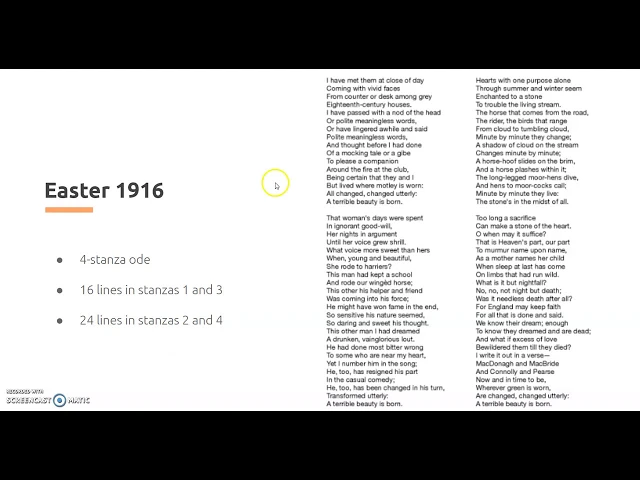
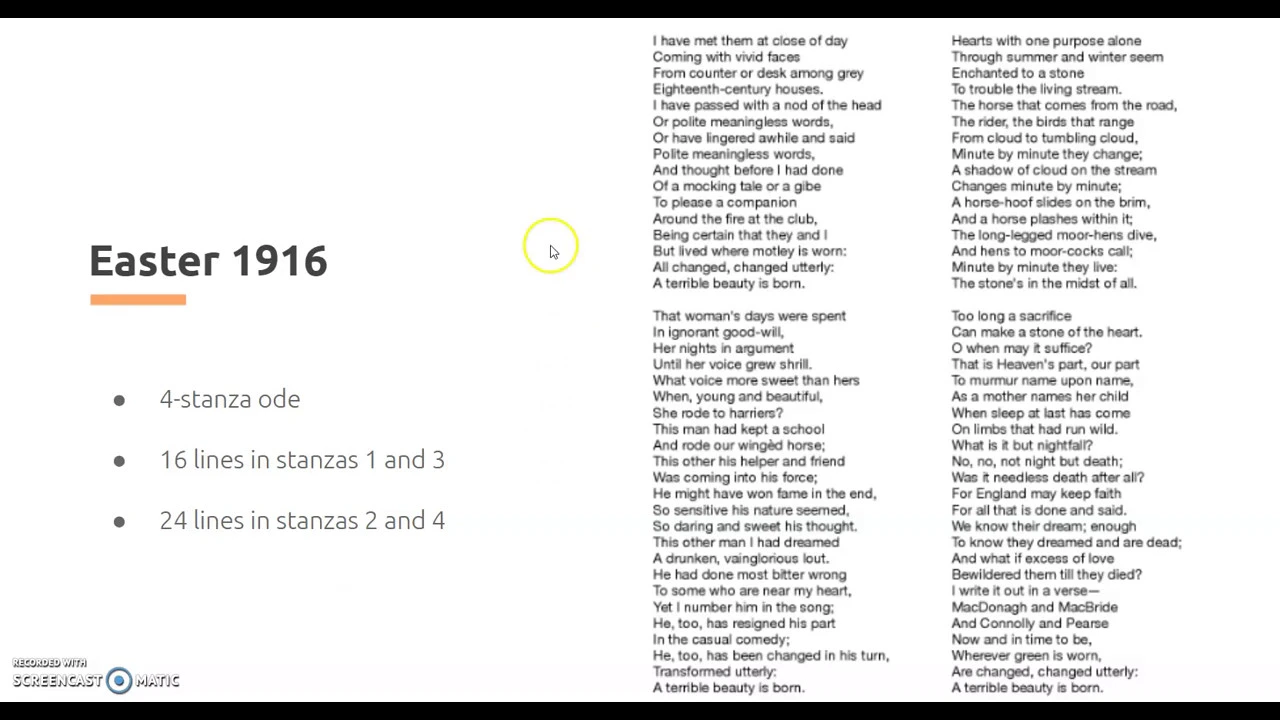
this perm he waited years to publish it it is a perma made up of four stanzas with 16 lines in the first and the third and 24 lines in the second and the fourth it's largely written in iambic trimeter but there are numerous variations the four stanzas of the firm symbolically represent April the fourth month of the year stanzas one and three are made up of sixteen lines representing both the year 1916 and the sixteen men who were executed after the Easter Rising there are 24 lines instances two and four symbolizing the fateful day of
the month on which the rising began April the 24th 1916 the irregularity of the verse gives the poem a sense of unpredictability which echoes the revolutionary event the poem responds to stuns us 1 and 3 are scenic in character evoking the landscape of Dublin City and the surrounding Irish countryside stanzas two and four are about specific people involved in the rising in the first stanza the PERT recalls meeting the rebels in Dublin before the uprising they were casual acquaintances of his with whom he exchanged meaningless small talk and sometimes he made sarcastic comments on them
with his own friends he thought they were just joking but now everything has changed in the second stanza the pert commemorates four of the rebel leaders a woman and three men and describes their contribution to the cause for independence as well as there are human imperfections both their accomplishments and their imperfections have been transformed by death in stanza 3 the poet describes the Irish countryside to contrast the rebels unchanging passion and nature's liveliness and ever-changing variety a stream and the cloud move constantly but a single-minded dedication to a cause may become like a stone which
doesn't move from its position on the bottom of the stream instance of for the poet focuses on the rebels death and wonders if their sacrifice was worthwhile he can say whether the uprising was a glorious event or whether the rebels were fanatics who died for nothing but he mourns them and knows they will be remembered in the future forever Islands a national color green is worn he names the dead rebels and says their death has changed everything this ode is the salon and austere in subject matter and turn all the stanzas except the third are
written in the first person the rhyme pattern alternates rhyming lines in an ABA B form the poets often uses Angemon and emphatic repetition of words and sounds he uses poetic devices such as alliteration and several poetic devices such as similes metaphors and oxymorons for example the repeated line a terrible beauty is born presents us with an oxymoron that almost skulls up the sublime that mixture of awe and terror which captivated the romantics the main theme of the poem is the nature of violent political changes such as revolutions as you can see in