hi everyone so me Mia fand jibi and Len homat will explain the article blockchain and governance a new way of organizing collaborations this chapter will explore the concept of blockchain governance a revolutionary approach to organizing collaborations that contrasts traditional governance mechanisms like contractual and relational governance basically blockchain is essentially decentralized cryptography based system that records digital transactions in a peer-to-peer Network the technology was initially designed to eliminate intermediaries like Bank in financial transactions thereby reducing the risks associated with centralized control this picture illustrates the basic function in of a blockchain it shows how blocks of
transactions are linked together in a linear and chronological order secured by cryptography hashes so basically each block contains a record of transactions a time stamp and a reference to the previous block forming an immutable chain finally this structure will ensure that any attempt to alter a transaction would require a change in all subsequent blocks making The blockchain Temper proof and trustworthy moreover the text explains two more Concepts which are the difference between contractual governance and relational governance later on I'll explain how blockchain governance differs from both of them which is the main discussion of this
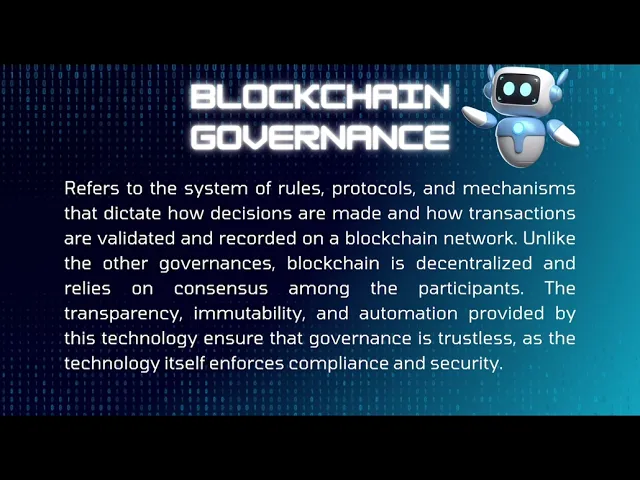
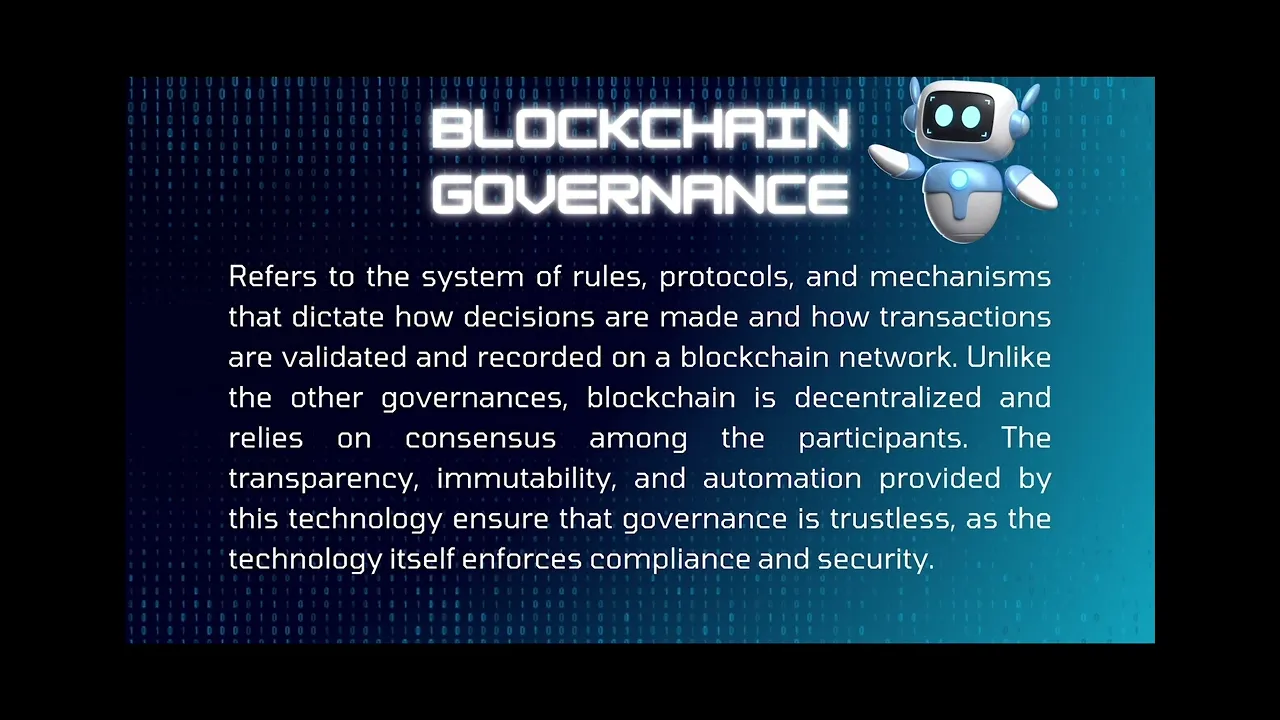
article firstly the contractual governance is literally the contract that two people have to sign so for example a company entering into a service agreement with another company the contract between two companies outlines specifically deliverables deadlines and payment terms and payment for non compliance and the second type of governance is relational governance so it's basically based on trust for example a longstanding partnership between a local coffee shop and a coffee beIN supplier blockchain governance is a decentralized code based system that dictates how a blockchain network is managed and evolves unlike the traditional governance which relies on
legal contracts or trust and social norms blockchain governance operates through decentralized consensus mechanisms and self-executing smart contracts this ensures that rules are automatically enforced by the network without needing a central Authority or trust between participants now I'll talk about the key aspects of blockchain governance so the first one is decentralization which is basically the decision-making power distributed across the network rather than being concentrated in a single Authority or organization which means that no single entity has complete control over the blockchain instead the decisions are made collectively by all participants in the network the second one
is the transparency and immutability which stands for all transactions and changes within a blockchain are recorded on a public Ledger that is transparent to all participants once information is recorded in a blockchain it is virtually impossible to alter without the consensus of the network ensuring the integrity and immutability of the data finally the third one is no Reliance on trust which means that blockchain governance eliminates the need for trust between parties lastly some of the limitations of blockchain governance are complexity of implementation codifiability and verifiability lack of flexibility as well as scalability issues blockchain enhances
cooporation by reducing opportunistic Behavior pre automated smart contracts and mutable traceable records this increases reliability making dat temper proof and Boos interest in compliance it also strengths coordination by enabling realtime informational sharing and ensuring clear roles and responsibilities through matching consensus rening the need of central management and increasing accountability blockchain's efficiency as governance mechanism by vars depending on the nature of the transaction it excels in explicit and straightforward transactions where information is easily is specified and validated however in complex transactions with high test itness work information is difficult to communicate or measure blockchain may be
less effective blockchain can replace traditional governance methods in explicit transactions providing more efficient and reliable enforcement in tested transactions it can be complement relational governance by building trust through reputation systems reducing the need for detailed contracts this makes blockchain particularly avilable and codifiable offering a faster and more cost effective alternative bringing out five w1h analysis we could find that future research should explore new blockchain technologies tailored toose specific interestes Beyond just finance and Supply chains while considering the broader social and economic impacts the stakeholders play a critical whole in shaping these applications and understanding their
benefits is a key to a driving adoption more than that the application of this tool is a current necessity while exploring the benefits that drives stakeholders to adopt the benefits of this technology in some blockchain offers an Innovative governance solution addressing inefficiencies and high cost and traditional methods especially where transparency and clear enforcement are critical it can either substitute or complement existing governance models providing a more efficient and cost effective way to manage transactions