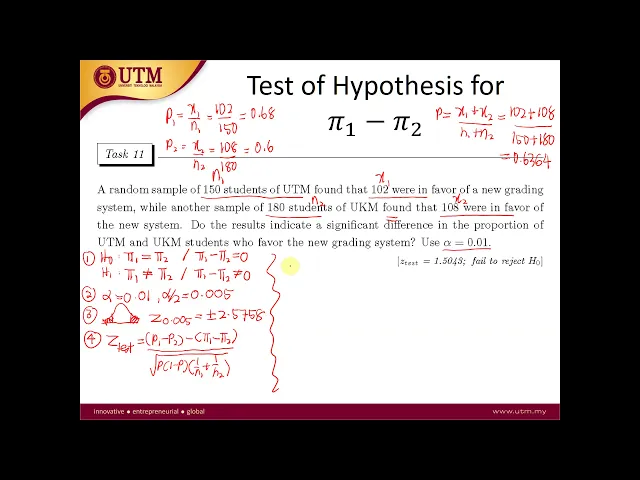
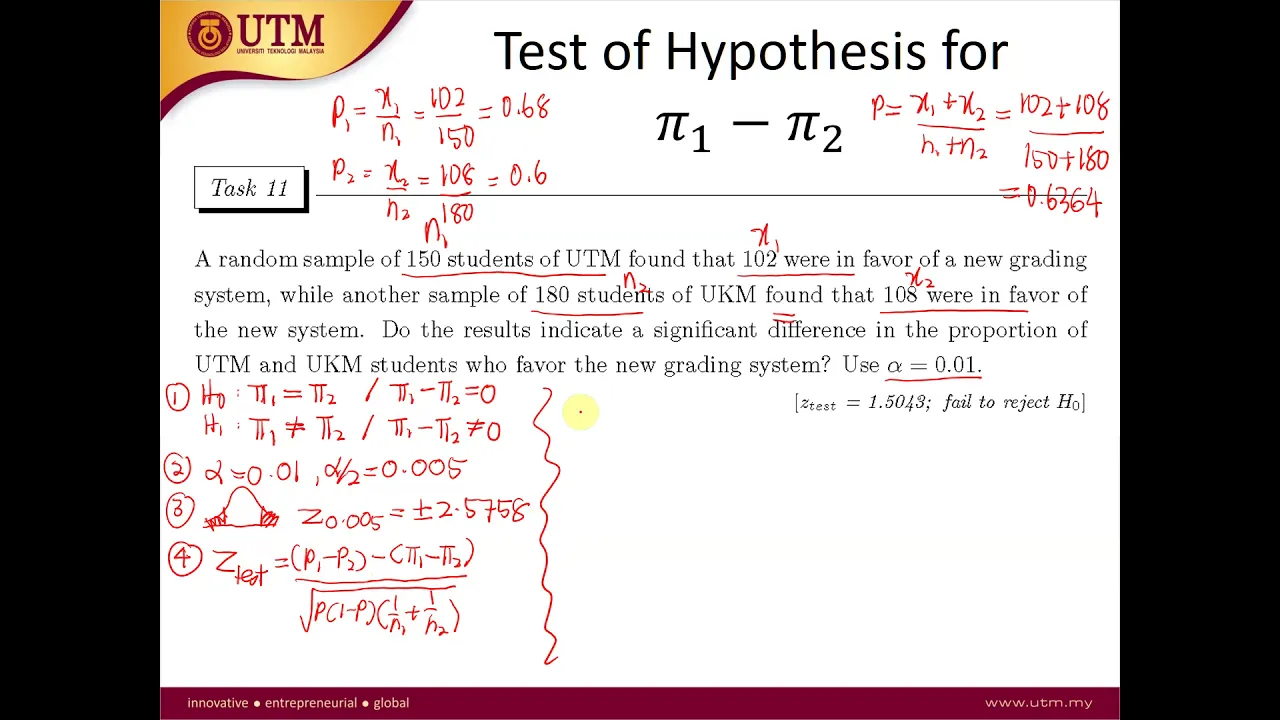
okay now we move on to the hypothesis testing for difference of two proportion so basically the steps are all the same for all parameters with just that that is very different depending on what kind of parameter you are using right so the test statistic for difference of two proportion is P 1 minus P 2 minus PI 1 minus PI 2 over square root of P 1 minus P times one minus one over N 1 plus 1 over N 2 ok where this B we have special formula for P where P is equals to X 1 plus X 2 over + 1 + and ok so as usual we will have three alternatives to side the rejection region and one side the rejection region ok so let's go to the example ok task 11 a random sample of 150 students of UTM found that 102 of it were in favor of a new grading system while another sample of 180 students of ukm found that 108 were in favor of new system new grading system so 1/5 all of UTM student is and 1 ok found out that one or two in favor so this one or two is x1 and for ukm students 180 student is n 2 + 2 + 108 - a favor in the new grading system is that your ex - yeah do the results indicate a significant difference we want to know is there any difference between the proportion of UTM and you can students who favor of in the new grading system we want to know whether there is difference in the proportion or not so we're testing on equal to and not equal to and alpha is 0. 01 okay now so before we start we have to calculate your P 1 P 2 and P ok so so we'll click here because I'm afraid that we don't have extra extra spaces for the calculation later okay so P 1 is equal to X 1 over N 1 it is equal to 1 or 2 over 1 500 equals 2 0. 68 okay while p2 is equal to x2 over and to 108 divided by one it will be close to 0.
6 okay this is p1 this is p2 and for P P is equals to X 1 plus X 2 divided by n 1 plus n 2 so X 1 is 102 plus zero point 6 3 6 4 oh yeah now we'll set our hypothesis testing so the first step is to identify your now an alternative hypothesis okay for this for this question the null hypothesis will be is there any difference between UTM and ukm proportion so pi 1 equals 2 pi 2 and for alternative pi - sorry by 1 not equal to pi - okay so you can write this way or PI 1 minus PI 2 equals to 0 and for the alternative by 1 minus PI 2 not equal to 0 because we bring PI 2 to this side so you get PI 1 minus PI 2 equals 0 ok ok for the second step is your alpha alpha is 0. 01 that step we are using that distribution now so the distribution the graph is like this okay and you have to thought to refer to the alternative hypothesis right the sign of relative so the sign here is not equal to so not equal to meaning that you will have two rejection region so two rejection region left and right side okay so if you have two rejection region means that your alpha must be divided by two so 0. 01 divided by two is 0.
005 so we need to find the value of z 0. 005 okay plus - so from your table check 0. 005 is equal to two point five seven five feet plus minus two point five seven five okay so the first step is to chocolate you're testing sticks so we are using the test so exact s is equal to P 1 minus P 2 minus y 1 minus y 2 if I buy square root of B 1 minus B 1 / + 1 + 1 / n 2 okay so we'll continue on the on here so like this is equals to you substitute all the values so we have zero point six eight six minus 0.
64 P 1 minus P 2 minus 0 4 PI 1 minus PI 2 because PI 1 minus PI 2 we can get from your hypothesis okay divided by square off your P P is zero point six three six four zero point six three six four one minus zero point six three six four is equals to zero point three six times okay so you got clay we will get one point five zero four three so the z-test value is one point five oh four three step 5 reject null hypothesis if like this less then firstly less than negative say Alphonse 0. 005 sorry or like this more than they are farm 0. 005 okay so now our Zach test is 1 point 5 over 3 1 point 5 4 4 3 is somewhere in the 9 rejection region at the white area here okay so if the test falls in this area we fail to reject because this is navigation region right so we fail to reject null hypothesis our decision fail to reject now hypothesis we're to reject null hypothesis at alpha 0.