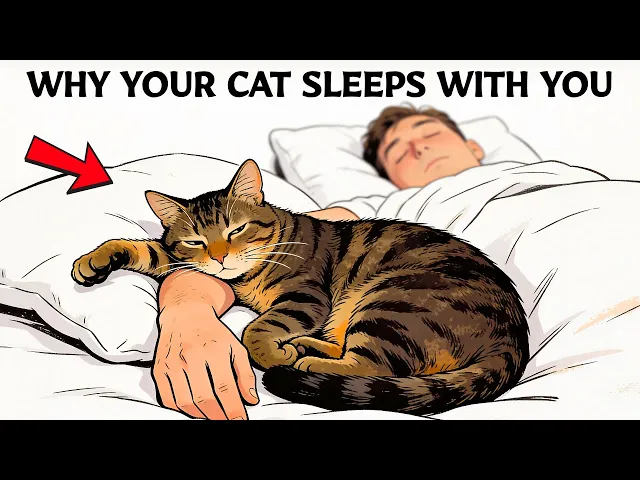
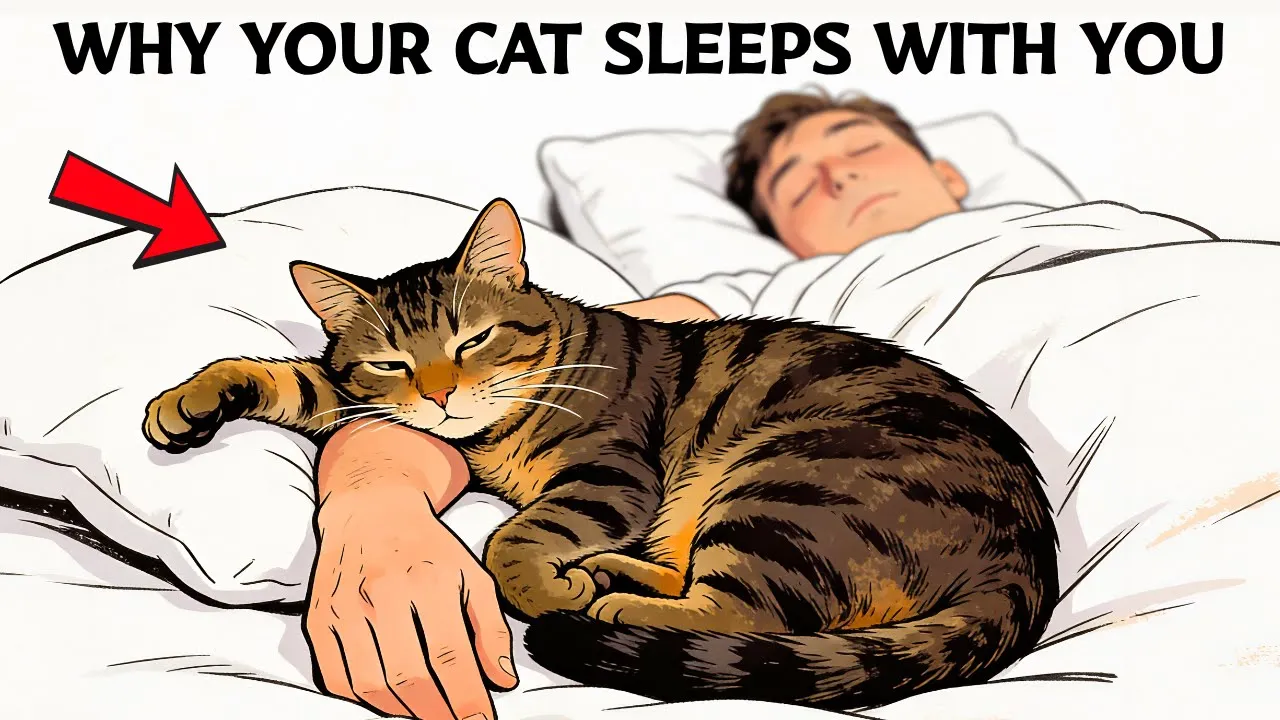
When your cat sleeps with you, do you actually know what they're trying to say? Yes, it's adorable. But behind that closeness, there's something deeper that most people miss.
It's one of the most emotionally loaded things your cat can do. And if you misunderstand it, which most owners do, you could be missing messages they've been trying to send for years. Let's start with what that nightly ritual really means.
One, it was never about staying warm. So, why does your cat actually sleep with you? Most people assume it's simple.
Cats get cold. You're warm. End of story.
But here's the thing. Cats are incredibly resourceful when it comes to finding heat. Sunny spots, laptops, radiators, laundry fresh from the dryer.
If warmth was all they wanted, they have options. So why do they keep choosing you? Because sleep is when a cat is at their most defenseless.
Every instinct they have screams at them to find somewhere hidden, somewhere safe, somewhere no predator could reach. And instead, they walk past every quiet corner in your home and climb into bed with a human 15 times their size. That's not about temperature.
That's trust on a level most owners never fully realize. A study in animal cognition found that cats form attachment styles with their owners similar to how infants bond with caregivers. When your cat chooses to sleep beside you, they're telling you something they can't say out loud.
You make me feel safe enough to let my guard down completely. And by the way, if your cat ever suddenly stops sleeping with you, don't brush it off. We'll get into what that really means at the end, and it's something most owners wish they'd understood sooner.
Two, they're blending their scent into yours. Have you ever noticed your cat pressing their head or body against you right before they settle into sleep? That's not random cuddling.
It's chemistry. Cats have scent glands along their cheeks, forehead, and the base of their tail. When they rub against you, they're leaving invisible markers behind.
But here's what most people don't realize. When your cat sleeps pressed against you, they're not just marking you. They're blending your scent with theirs.
In the wild, cats who belong to the same colony share a communal scent. [music] It's how they recognize family. It's how they say, "This one is safe.
" without making a sound. When your cat weaves their smell into yours night after night, they're performing an ancient ritual. [music] They're telling the world and themselves that you belong to each other.
This is also why your cat might sniff you intensely when you come home from somewhere new. You smell wrong. you've lost some of the shared scent and that bedtime cuddle.
Part of it is them restoring what went missing. And hey, if this makes sense to you, smash that like button and subscribe. It's the best way to help us reach more cat people who actually care about understanding their cats on a deeper level.
Three, they think they're your bodyguard. Ever wonder why your cat insists on sleeping in a specific spot? Maybe it's right by your head.
Maybe it's near your feet. Maybe it's pressed against your back. That placement isn't random, it's strategic.
[music] Here's something that might surprise you. Even a small pampered house cat still carries the instincts of a predator. And predators understand threats.
When your cat positions themselves beside you at night, part of them believes they're standing guard. This goes back thousands of years. In wild cat colonies, members take turns watching over each other during rest.
It's not just about bonding, it's survival. [music] And your cat, no matter how domesticated, hasn't forgotten that ancient code. Watch where your cat sleeps.
If they position themselves facing the door, they're watching the entry point. If they sleep near your head, they're protecting your most vulnerable area. They know they're small.
They don't care. Something deep in their wiring says, "This human is mine to protect. " Now, will your cat actually fight off an intruder?
Probably not. But in their mind, they've taken a post. They've assigned themselves a role and every single night they show up for duty.
Four, every sleep position is a message. Does your cat curl into a tight ball, sprawl out like they own the bed, sleep with their back turned to you? Each of these positions is telling you something different.
Let's start with the tight curl. This is the most protective position a cat can take. It shields their belly, tucks their paws, and keeps all vital organs hidden.
If your cat always sleeps like this, they might feel safe enough to be near you, but not quite safe enough to fully let go. It's trust with a layer of caution. Now, the full sprawl, [music] legs stretched out, belly exposed, maybe even upside down.
[music] This is the ultimate sign of security. A cat showing their stomach is a cat who believes [music] completely that nothing bad will happen to them in your presence. They've let go of every survival instinct that tells them to stay guarded.
What about when they turn their back to you? Some owners take this personally. Don't.
In the cat world, turning [music] your back to someone means you trust them so much you don't need to watch them. It's actually a compliment. And then there's the full contact press.
[music] When your cat sleeps pushed right up against you, sometimes wedged into impossible spaces. That's the strongest statement of all. They want zero distance between you.
That's not clingy. That's devotion. Five.
[music] They change their schedule just for you. Have you ever wondered why your cat seems to wake up when you do and wind down when you go to bed? [music] That's not a coincidence.
It's a choice they made for you. Cats are naturally kpuscular. That means their bodies are wired to be most active at dawn and dusk.
It's when their wild ancestors [music] hunted. It's when their instincts tell them to be alert, not asleep. So, by nature, a cat's schedule shouldn't line up with yours at all.
But bonded cats do something remarkable. They override their own biology. Researchers studying domestic cats found that cats living closely with humans gradually shift their sleep and [music] wake cycles to mirror their owners.
They stay awake longer during the day. They sleep more deeply at night. Not because it's natural for them, but because that's when you're available.
Think about [music] that for a second. Your cat's entire internal clock, built over thousands of years of evolution, gets [music] rewritten just so they can spend more time existing in your world. This is also [music] why cats greet you at the door or show up right before your alarm goes off.
They've learned your rhythm. They've synced themselves to [music] it. Not out of habit, out of preference.
Six, they feel your stress before you do. Ever had a rough day and noticed your cat suddenly won't leave your side? [music] That's not a coincidence.
They knew something was wrong before you even said a word. Cats are incredibly tuned into the people they're bonded with. And science [music] is starting to prove what cat owners have felt for years.
Your cat can read you better than you think. Studies show that cats can detect subtle changes in human behavior, body language, and even scent. When you're stressed, your body releases cortisol.
Your movements shift. Your breathing changes. Your cat picks up on all of it.
They don't know why you're upset, [music] but they know something's off. This is why some cats become extra affectionate when their owner is sick, [music] anxious, or grieving. They're not just being sweet.
They're responding to real signals you're giving off without realizing it. And here's where it gets even deeper. Sleeping beside you gives them a front row seat to your emotional state.
[music] Your heart rate, your restlessness, your breathing patterns. Night after night, they're gathering information. They're learning what your baseline feels like.
And when something [music] shifts, they notice. Seven. When they suddenly stop, listen closely.
What does it mean when a cat who always slept with you suddenly stops? This is what I mentioned earlier and it's something every cat owner needs to understand. If your cat has been sleeping beside you for months or even years and that suddenly changes, [music] don't ignore it.
Cats are creatures of habit. When they break a pattern this significant, they're trying to tell you something. Sometimes the reason is physical.
Pain, illness, or discomfort can make a cat seek out solitude. Cats instinctively hide when they don't feel well. [music] It's a survival mechanism.
If your older cat suddenly wants to sleep alone, a vet visit is worth considering. Other times, it's environmental. A [music] new pet, a new person, a change in routine.
Cats are sensitive to shifts in their territory. Something that seems small to you might feel massive to them. And sometimes it's emotional.
Cats [music] remember. If something startled them in the bedroom, or if conflict happened in that space, they might pull away to protect themselves. The key is paying attention.
Your cat chose to sleep with you because they trusted you completely. If that changes, they're not being moody. They're communicating.
So, so listen, watch, and if needed, gently help them find their way back to feeling safe again. [music] Because that nightly ritual, it was never small to them, and it shouldn't be small to you either.