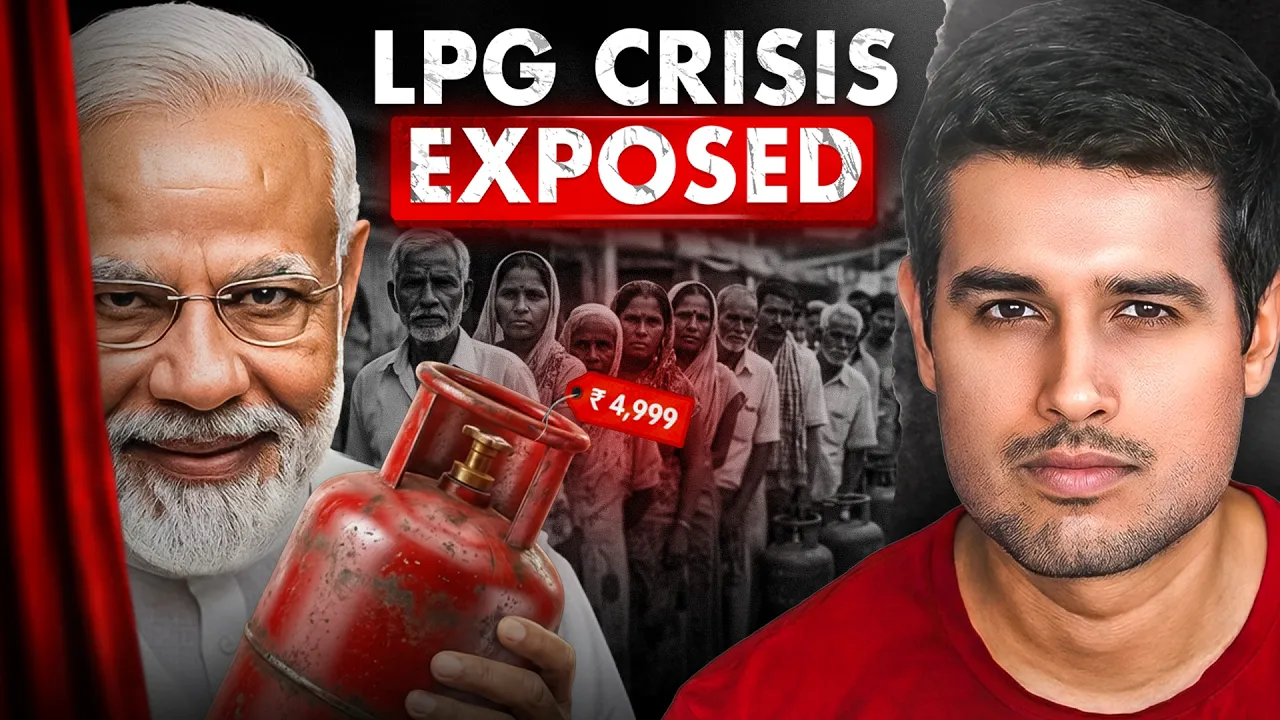
On 13th March 2026, in the Barnala district of Punjab, 66-year-old Bhushan Kumar Mittal was standing in line in the morning. He just needed one cylinder, but the line was so long that he couldn't see the end. Hours passed by, as he stood in line for several hours, and then, a cardiac arrest occurred.
Bhushan Kumar died while standing in line. Just for one LPG cylinder. On the same day, on Instagram and Twitter, thousands of people suddenly started saying the same thing.
"My cylinder was booked at 11:45 am, and it was delivered at 1:30 pm. " There was no shortage. Look at all these tweets.
Same time, same delivery, same script. Everything was copy-pasted. Hey everyone!
Let's find out the truth behind this LPG crisis in today's video. How much gas is available in the country? How much more is coming via ships?
And how long will this crisis last? Here are the answers to all the questions that the government does not want you to know. This Sunday, 22nd March, I am conducting an AI Masterclass session.
If you want to upskill yourself in the field of AI, this is the fastest and most affordable way. Here, I will personally teach you how to make images, videos, songs, and animations using AI. You will be taught how such powerful presentations can be made in just 5 minutes.
Detailed reports, resumes, and even a complete website can be created in minutes by AI. Even if you don't know anything about coding, all this has become possible today, but most people are not trying because no one has taught them. This workshop is especially for everyone: students, working professionals, homemakers, and business owners.
More than 1 lakh people have attended it so far, and the feedback from the previous session was amazing. You can see the reviews on the screen, where 82% of the people said that they learned more than they expected. So you can join quickly, the link is in the description below and in the QR code.
Every year, about 3. 1 crore metric tons of LPG is consumed in India. 60% of it comes from abroad, which means it is imported.
And the unfortunate thing is that 90% of that 60% comes through only one single passage: The Strait of Hormuz between Iran and Oman. This crisis started when Narendra Modi's "friend" Donald Trump started a war with Iran. Iran blocked the Strait of Hormuz in response, and more than half of India's LPG supplies were shut down.
The government is trying to hide this crisis, but the truth is that after the lockdown and the pandemic, the public has to stand in line for the third time. Many such videos have been released from Gorakhpur, Pune, Noida, and Delhi, showing hundreds of people standing in line for hours just to get a single cylinder. A video from Lucknow went viral, where a man lies in front of a truck full of LPG cylinders in frustration.
Go ahead. Go ahead. Go ahead.
Online booking systems have crashed in Madhya Pradesh and Gurgaon. Bookings are failing on WhatsApp. This is causing people to go to physical gas agencies, and the lines are getting longer.
The people standing in these lines were dying. After Farrukhabad, Uttar Pradesh, 75-year-old Mukhtar Ansari collapsed in the line. He died before reaching the hospital.
Just for one cylinder. The condition of hotels and restaurants is even worse. In cities like Bangalore and Mumbai, 20 to 30% of restaurants have closed.
On food delivery platforms like Swiggy and Zomato, orders have fallen by 50 to 60%. People are in such a panic that they are buying cylinders on the black market. The domestic cylinder, which is officially worth Rs 900, is being sold in the Delhi black market for Rs 2,000 to 3,000.
The commercial cylinder is priced at Rs 3,000 to 5,000. In cities like Bangalore, it is being sold for Rs 6,000. That is six times the price.
The situation is so bad that in Maharashtra, vehicles transporting gas cylinders are being given police protection. In West Dehradun, people stopped a truck and started stealing gas cylinders. In Uttar Pradesh, people broke into a gas agency and stole more than 76 cylinders.
The opposition claimed that the Parliament canteen didn't even have tea. If you asked for tea or coffee, you wouldn't get it. Why not?
Coffee and tea are missing from the Assembly canteen. And you say there is no panic? But in Parliament, the government says there is no shortage of LPG.
All the best! On 12th March, Petroleum Minister Hardeep Singh Puri said in the Lok Sabha that the domestic LPG supply is fully protected. He stated there is no shortage and that what is happening is due to panic buying and hoarding.
"Domestic supply is fully protected and the delivery cycle is unchanged. " PM Modi himself said that people who are afraid of a shortage are causing a huge loss to the country. He claimed some people are trying to create panic and are causing a huge loss to the country.
On 7th March, the government increased the price of a domestic cylinder by Rs 60. The commercial cylinder increased by Rs 115. If there is no shortage, why would prices rise?
On 8th March, the government issued an LPG control order, asking refineries to maximize production. Later, it also stated that production increased by 28% in 5 days. Emergency supplies were brought in from new countries.
If there is no shortage, why did they do all this? On 9th March, a natural gas control order was issued. A 20% cap on commercial LPG supply was imposed.
That means hotels and restaurants will only get 20% of their demand. In addition, the cylinder booking interval in cities was increased to 25 days. In villages, it was increased to 45 days.
Once again, if there's no shortage, why did they ration it? State pollution control boards are literally giving restaurants one-month permits so that they can burn biomass, kerosene, and coal. On March 14, people with PNG connections were banned from LPG bookings.
The main reason behind this crisis was not the Iran war, but the foolishness of the Modi government. People following geopolitics had understood since January that America and Israel could attack Iran. If Iran was attacked, it would likely close the Strait of Hormuz.
One didn't need astrology to predict this. That was the time to take action to increase the LPG supply, such as ordering LPG from other countries. But the government did nothing.
Even before the war, when Modi went to Israel and met with Netanyahu, he should have guessed that an attack was coming. His dear friend, Netanyahu, must have given some indication, but no action was taken. Even after the attack, efforts could have been made so that Iran would consider India its friend and let Indian ships pass, just as it is letting Chinese ships pass.
But that didn't happen. While failing to do this, there was also no backup plan for the people of the country. Forget that, after the Strait of Hormuz was closed, they should have taken immediate action.
But they didn't. The government waited for a week before acting. And what was the first thing they did in the name of action?
They misled the citizens. They lied to the people by saying there was no shortage. Tell me, will public trust in the government increase or decrease by lying like this?
The truth is, if there were a visionary leader in the country, they would have addressed this years ago. As LPG connections in the country were increasing under the Ujjwala Yojana, and the demand for LPG was rising, the supply infrastructure should have been prepared accordingly. The gas supply for 33 crore homes in the country should not have depended on the 33 km wide Strait of Hormuz.
It should never have happened. LPG imports needed to be diversified. Strategic reserves needed to be built in the country.
The most frightening thing is that India does not have strategic reserves for LPG. There are some underground caves in Mangaluru and Visakhapatnam, but they are not for stockpiling. They are just for maintaining flow.
Their total capacity is only 1. 4 lakh tons. This is equal to less than 2 days of national consumption.
Imagine, in a country of 1. 4 billion people, the LPG reserve is only for 48 hours. The overall supply chain has about 18 days of operational LPG.
But there is nothing else. This fuel is used for real imports. When the supply is shut down, the buffer is almost zero.
The government should have created LPG buffers. They should have kept other sources ready. But what did they do?
Narendra Modi went to other countries and picked fights with other leaders. Today, millions of people are paying for it. Now that the crisis has arrived, they are trying to lie and threaten people to suppress the truth.
On 12th March, the Assam Police officially tweeted that if someone spreads rumors of an LPG shortage, harsh action would be taken. They think that if they stop people from talking about the shortage, the shortage will magically end. This is the same logic used during COVID testing: if testing stops, cases will automatically decrease.
The most important question for the common people is, when will this crisis end? When will you get your next cylinder? The answer depends on three scenarios.
Scenario 1: A ceasefire happens soon. Discussions are ongoing, but Iran is demanding reparations and guarantees against future attacks. Trump also says the war will end soon.
But the problem is that Iran's new Supreme Leader, Mojtaba Khamenei, who was appointed on 9th March, is reportedly more of a hardliner than his father. He said that until US military bases are removed from the Middle East, the attacks will continue. Scenario 2.
Alternative supplies should work. India has started emergency supplies from the US, Norway, Canada, and Russia. Two ships, Nanda Devi and Shivalik, have brought in 92,700 tons of LPG.
This sounds like good news, but India needs 3 crore metric tons every year. These ships provide only a one-day supply. Just one day.
Scenario 3: The Strait of Hormuz opens without a ceasefire. Trump says the Strait will be open. Iran says not a liter of oil will pass.
Iran has laid mines. This scenario is also unlikely to happen soon. Scenario 4, the war continues, but India's supply arrives somehow.
Iran gives permission to ships coming to India. There is a lot of discussion about this. There are lies in the media.
But the current status, according to Foreign Minister Jaishankar, is that there is no blanket agreement to allow Indian-flagged ships into Iran. The movement of every ship is an individual event. India has to negotiate with Iran one by one.
The point is that until the war ends, the Strait will not open. And until the Strait opens, there will be no gas. A realistic estimate is 4 to 8 weeks, at the minimum.
The question is, what can you do? Here are some practical steps. First, use induction cookers.
The LPG crisis has increased induction cooker sales 30-fold in two days on Amazon. If the electricity in your home is reliable, this is the best backup. A good induction stove costs about Rs 2,000 to 3,000.
But remember, only flat-bottomed utensils work on induction. If your electricity keeps cutting out, this is a limited option. Second, if you have PNG in your area, Piped Natural Gas, make sure you are registered.
PNG comes through a pipeline. It doesn't depend on the Strait of Hormuz. You can check the website of your city gas distribution company.
Third, if a cylinder is being sold on the black market, complain about it. This is a criminal offense under the Essential Commodities Act. The National Consumer Helpline is 1800-11-4000.
Apart from this, you can also complain to the District Magistrate's office. The fourth and most important point: don't panic buy. If you hoard cylinders, the shortage situation gets worse.
Don't keep more extra cylinders than necessary. The unfortunate thing is that all these solutions are temporary. Especially for people living in villages.
Electricity is unreliable in rural India, so induction doesn't work there. According to reports, people have returned to using traditional stoves. And this is the most tragic part of this crisis.
The woman who had left smoky fires after years of hard work, who got the first gas cylinder in her house, and who thought that her children would no longer be exposed to smoke, is today cooking food on a traditional stove again. This woman is paying the highest price for this crisis. And not because the gas is gone, but because the people responsible for keeping the country prepared were asleep.
The same people who could have saved Bhushan Kumar, a 66-year-old man standing in the sun, just for a single cylinder. If you found this video informative, don't forget to join the AI Masterclass. The link is in the description and pinned comment below.
If you want to understand the background of the Iran war in depth, how old the enmity between Israel and Iran is, and the reason behind it, I have discussed it in this video. You can click here to watch it. Thank you very much.