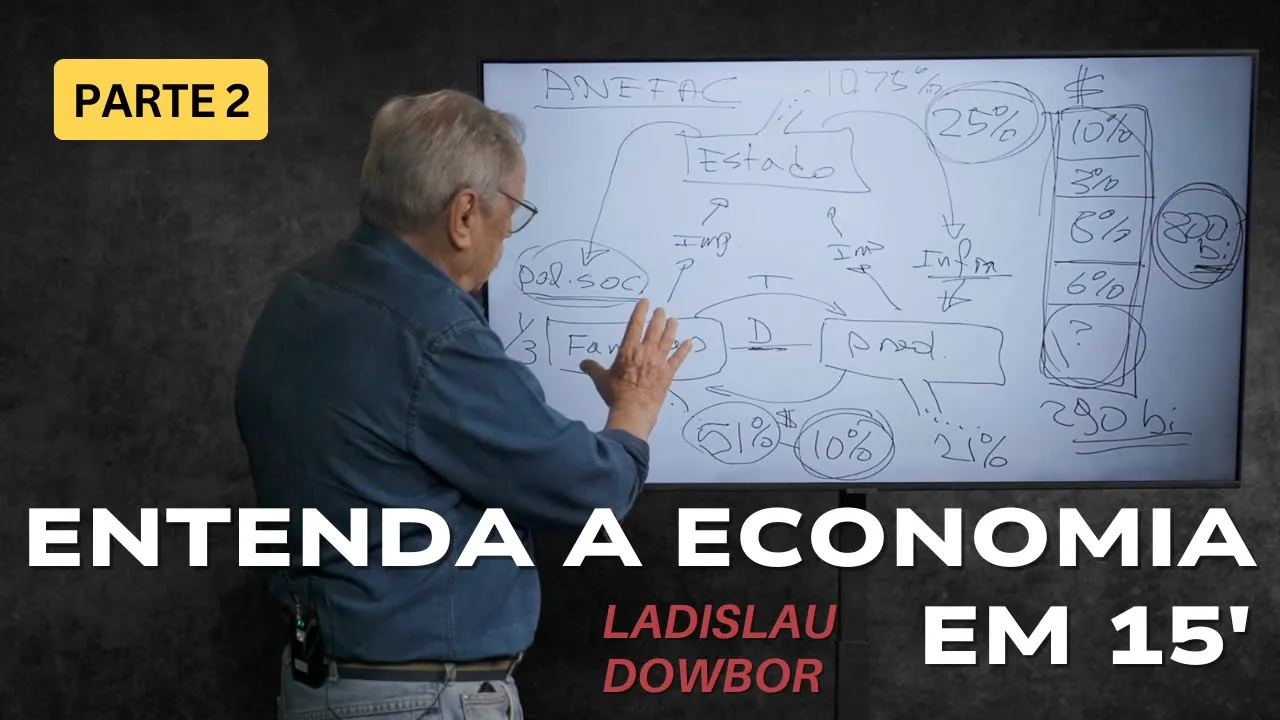
For you who saw my Understand Economics in 15 Minutes, which is an economic cycle, I wanted to show how understanding this cycle helps to comprehend various areas, as if it lights up for various sectors, to understand more in detail various aspects, because it takes on a meaning based on understanding the cycle. The cycle. Just a reminder, essentially families generate demand that drives production, both pay taxes and with that the State can finance social policies, infrastructure policies, and the whole thing keeps going.
This one makes profits, this one receives a salary, this one pays taxes and the importance of understanding the cycle is that it keeps things moving, they are not separate pieces. which actually hinders the understanding of people who try to understand things separately. Once you caught the cycle, and especially in this cycle, like the financial groups, here is rentism, rentiers, people who don't produce anything, simply drain money.
This understanding of the cycle, the idea in this second video, is to understand how this helps to understand. other areas, to detail certain systems. So, for example, when we look at families, families are general, but there are families and families.
If you take here, you have six families that are giants, billionaires, who control a large part of the economy and politics in Brazil. Then you have the top 1% richest, you have the 240. Billionaires, which is the latest data we have.
And, going down the social ladder, order of magnitude. Three quarters of families in Brazil are in precarious situations. We are the third or fourth most unequal country in the world.
That is the challenge. in Brazil. From afar, the main challenge.
Now, the impact of this inequality is dramatic. The data we have from 2022 showed 33 million people experiencing hunger and 125 million in food security. This in a country that produces only 4 kilograms of grains per person per day.
I am bringing this data because, in reality, You understand the cycle and then you can pick it up, well, families, what is it? No, there is family within family. We can start to detail and understand how the main challenges unfold.
Similarly, you can evolve to the production part. Why in recent decades has Brazil where industry represented 22% of GDP, today industry represents 10%, 11% of GDP. Because gradually you have been changing the system, particularly through through the financial drain, in the same way that families have become poorer through interest rates, here in particular, through interest rates and also through dividends paid to large companies, to shareholders, the Stock Exchange, all of this here weakened production.
Basically, And it is legal to take the production process and why it weakens. You put yourself in the shoes of a A guy who has money and could invest in a factory to produce things. He thinks the following, families are not buying because they are bogged down with this interest rate.
If I were to take a loan, 21% is the average for legal entities, this doesn't work, I won't be able to make it. And I have the alternative of investing in direct treasury, I put my money into public debt. Today, here, it was 10.
75%, now it is already at 11. 25%. Money without risk, without needing to produce.
That is, both due to the weakening of demand, as well as the increase in interest rates, and through the alternative of earning money from our taxes through public debt, the entrepreneur simply Stop investing. Brazil is deindustrializing. On the other hand, in this same production area, you have a huge transformation called reprimarization.
Many more people are investing in agriculture, exports, with the privatization of Vale, the privatization of Eletrobras, with the exportation of. When you export noble wood from the Amazon, you are exporting and making money from something you didn't have to produce. You profit from exporting iron or nickel, which you didn't produce, you are extracting.
This is connected to international interests. Moreover, since primary goods for export are not taxed, it is simply draining the country. So, if you consider deindustrialization and reprimarization, you start to understand it better.
the general weakening of our economy. Similarly, you can take the transformation of the role of the State. The State, to a large extent, was weakened in its public dimension.
Some remember that in 1997, public financing of political campaigns was authorized. Suddenly, The politician is for sale, some are for rent by season. But basically, for 18 years, between 1997 and 2015, companies were able to finance the campaigns of politicians who would then follow their own interests and not public interests.
This is a distortion. profound, which greatly weakened the State. Obviously, even more vulnerability with the Temer-Bolsonaro phase, connected to big financial groups, to the so-called markets.
That's one. Therefore, it's the political takeover of the State. And another is the autonomy of the Central Bank, where you fragmented.
the state's financial policy and the monetary policy through the Central Bank, linked to the interests of large national and international financial groups. This simply hampered, to a large extent, the state's ability to develop its essential role, social policies and infrastructure. In social policies, for example, we studied the seven private health insurance groups.
They are gigantic fortunes and it is very cool to study. You get this here, it's on my website, you can get the seven sisters, the Dora Network, Apivida, and others there. They are huge international giants that drain immense resources through a system that does not function like a market.
When you are told that you have to undergo surgery or take a certain medication, you receive it, you don't have information, it's not a choice, it's not like buying a refrigerator or buying a car, right? This, where it works in the world, works publicly, for free, universally accessible. Why does it work like this?
Because it is much more productive, it is much more efficient. We compare, for example, the United States, the annual health cost per person is 11 thousand dollars, in Canada it is 5 thousand dollars, less than half. In Canada it is among the Top of the line in the world in terms of the health level of the population, the United States are among the last in the group of developed countries.
So, this is very important because it opens the way for you to study how these areas work, education, health, security, etc. In general, these areas function in a public, free, universal manner because they are investments in people, not expenses. What's it called here, right?
And you too, starting from the State, can take all the infrastructure part, right? Because energy, telecommunications, transportation, water, and sanitation are huge networks where the State has made gigantic investments for decades, right? And suddenly you privatize Massabesp, all this infrastructure, right?
It becomes a profit base. for private groups. And there it is very complicated, because a Sabesp, for example, when you privatize, for it to sell water is profit, investing in sanitation, investing in sewage, things like that, is cost.
So, in Europe or in Bolivia, in many countries, we are in a phase of remunicipalization of systems. the re-nationalization of the various infrastructure systems, because they are large national networks that have to be planned and organized in the long term, including their scientific and technological transformation. So, in a way, what I suggest is that you take.
Do you have documents on my website for this? You address these various areas, the family, production, the State, infrastructure, social policies, and, in particular, this entire universe that people in Brazil simply do not know, do not understand how this drains over 25% of GDP without producing anything of value. This way in which this drain is organized is very important.
And then it's very interesting, because then you will begin to understand how these groups that drain the economy, financial groups, you can take, I repeat, Forbes magazine, which presents group by group, right? But you also have to understand that. These financial groups are linked with BlackRock, State Street, Vanguard, etc.
The major international financial groups. What am I suggesting? Is that in the same way we saw how the cycle operates, in particular this tripod, families, production, and the State, and how it is being shaped by the financial system, you can use this as a basis to delve into how families function, how the productive system deforms.
how to rescue the dimensions of the State and how to ensure that this money becomes useful to society again. I have written a small book that can help you a lot and it is available online for free on my website, which is Rescuing the Social Function of the Economy. It is about that, a matter of human dignity.
It is not a right-wing or left-wing issue, it is a matter of making things work in an intelligent way. because as it really is quite absurd. Good reading.