in this lesson I'm going to show you the secret map that's going to help you learn any kind of chord you would ever want to play on the guitar and that is the chord diagram learning how to read a chord diagram is an essential skill as a guitar player especially when you're getting started because it is the map of what your fingers do on the fretboard of the guitar to actually play a chord like an E minor chord or a c chord or a G chord or a D chord right and you saw as I
was playing through all those chords a little diagram popped up on screen those are chord diagrams and like I said they're just a map to show you what to play and what not to play on your guitar to make a chord sound good let's start with a very easy chord one of the first chords that I teach in my free guitar crash course which is the e- miner chord okay and if you're interested in grabbing that there's a link in the description below you can go grab that absolutely free and what we're doing here is
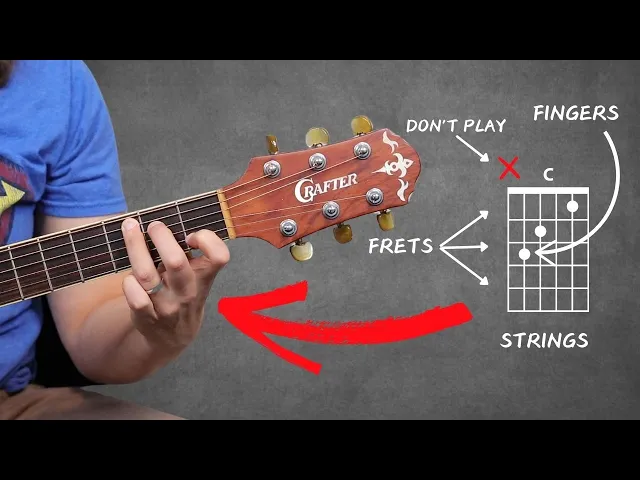
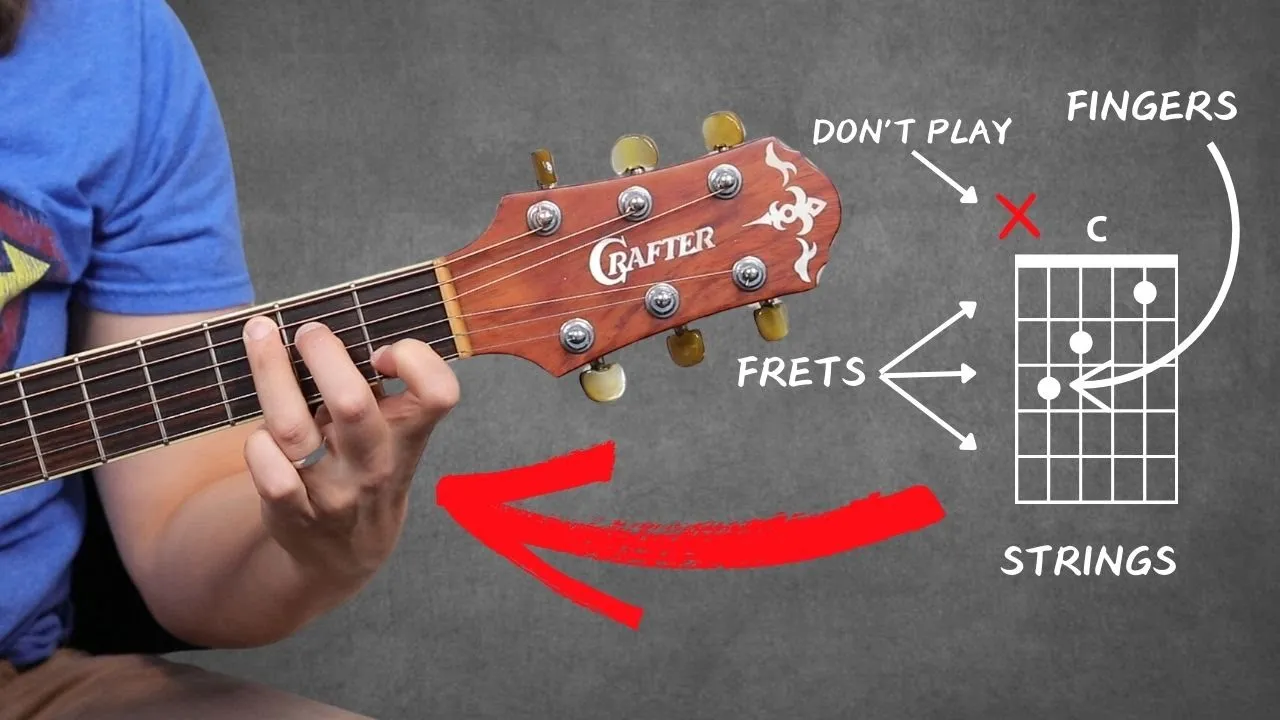
I have two fingers all right so if you look on the chord diagram you'll see that there's a bunch of lines and a bunch of blocks okay so the blocks represent the Frets and at the top of the diagram we have the first fret then the second fret third fret so forth and so on now you're also going to see some lines on that chord diagram which refer to the strings so we have the string on the bottom of your guitar which is the skinny E string so we have e b g e d a
e so what this map basically tells you is what string to play in what block now my chord diagrams are nice I give you the fingers or the common fingers that you might use to play these chords not all chord diagrams do that sometimes they'll just give you little black dots without any numbers in them and for beginners especially that's not very helpful because how do you know what finger to use right so on my chord diagrams I'm going to tell you what finger to use we're going to start with the easy one which is
this E minor chord now you're going to notice at the top there are some circles okay on these E B and G strings and then on this low E string there's little circles on the top what does that mean that means we're going to play the string open so the strings are just going to ring they're not going to have a finger on them and if you look at this E minor chord we're going to have the first finger and the second finger now if you've learned an E minor core before some people ask me
well Lauren I like to use my second and third finger that's also a very common way to play an E minor chord for the purpose of this lesson I'm going to show you my way which is the first and second finger okay first finger is going to go on the second fret so we're going to look at the diagram and you'll see it's down two blocks and it's telling us the first finger is on the a string and then right below that you'll see a number two and it's going to tell me that the second
finger is on the D string and that's all that this diagram is telling it's and it's saying you can play all six strings so E minor is a six string chord and you get to strum all six strings and it will sound good now if we go to something like a c chord you're going to see that this top string has an X okay that's telling us as much as possible do not play that string it's not part of the chord we don't want to hear it okay so if you have a c chord you're
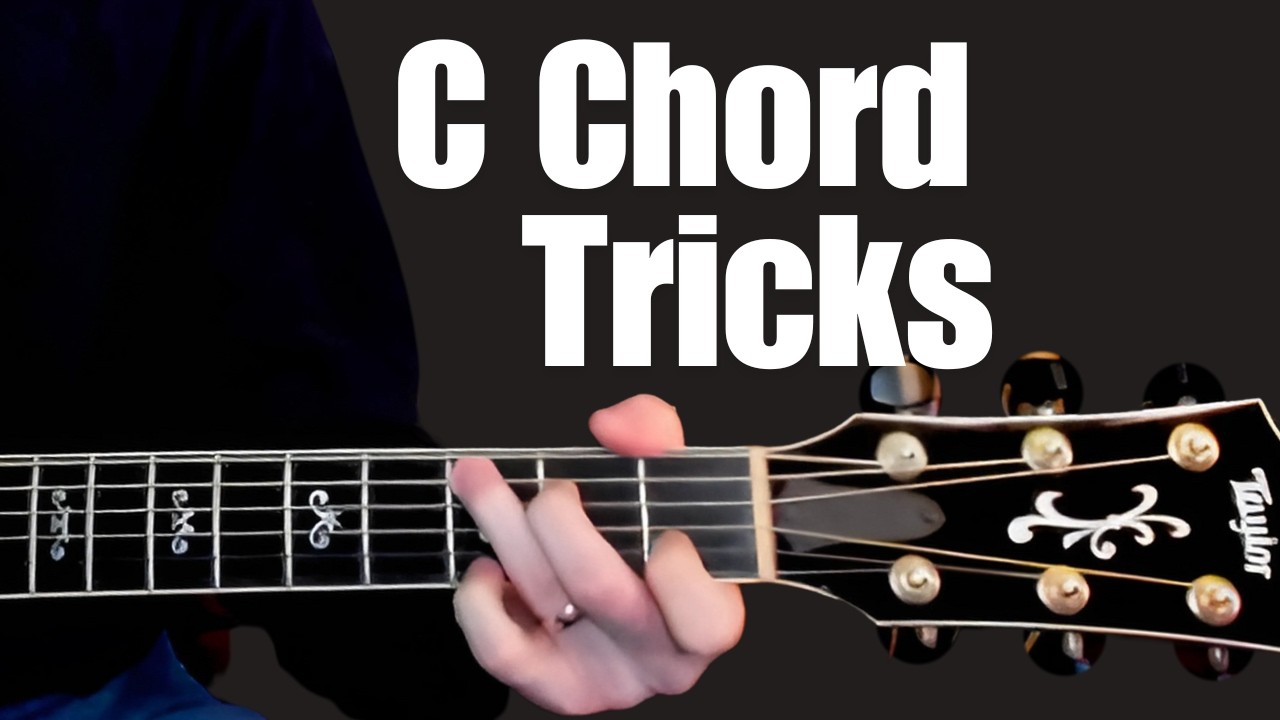
going to see this is a full c chord not the easy c chord I teach in the crash course all right you're going to see the third finger on the third fret okay of the a string the second finger is going to be on the second fret of the D string then we have an open G string first finger on the B string um first fret and then we have an open E string okay so you're going to see an x on the top which means don't play then a three a two an open symbol
at the top my first finger and then another open symbol on the bottom so if I were to strum a C chord I would only want to strum the bottom five strings if you look at a d chord you're going to see there's two x's so we're going to try not to hit the top two strings all right just some things that you need to know on a chord diagram it's going to tell you what strings to play what strings you can't play because if you do it's it might make the chord sound harsh and
I think this is a little bit I think the acoustic guitar is a little bit more forgiving than the electric guitar but if you hit bad notes on a chord it's going to sound a little off and we call that dissonance in music it's just like this little harshness things don't sound like they they blend together what we call Harmony things that work really really well together in music so you need to make sure if you see those little X's try as much as possible to not play those strings if you see opens little circles
on the top we are going to play the strings and then when you see the little black dots that indicates where your fingers go now there's one more thing I want to show you that's quite important not so much at the beginner level but as you progress in the guitar you're going to come across something that is called a bar chord now when you see a bar chord I'm going to put an F chord over here you're going to see this big thick black line that goes all the way across the fretboard and what that's
saying is we're going to take our first finger and we're going to play across multiple strings so you'll see on this F Chord my first finger is playing the top E string but it's also playing the E and B strings and you heard I muted that on the bottom that was a bad F chord and then I have other fingers playing other strings but whenever you see that big thick line across the top that's indicating a bar chord they are very hard to play I usually do not recommend them for absolute beginners until you build
up enough hand strength to actually play the chords now if you're wondering where all these names come from a chord F chord c chord D chord we're going to learn in the next lesson a little bit about the musical alphabet which is super important in understanding where some of these names come from and why so if you want to learn more about the musical alphabet go watch my next video right over there