good morning everyone uh so today I'm going to review the article which I have uh accessed from proquest uh which is a facility on senica libraries and this article is uh regarding my project of IBS 820 international business plan and this article uh kind of describes the Contemporary issues we have in the international business market and uh this article uh is by Paul Weisman and David mcug and it's posted in the Associated Press these are the details and this is the whole article I also have a related PowerPoint presentation which I'm going to share now
so the title of my PowerPoint presentation is global economy faces challenges slower growth and uncertainty and the article by Paul BisMan and David mcug the title of the article given by them in the Associated Press is economy is limping along and not sprinting and IMF expects Global growth to slow to 2.9% next year so basically uh what I I'm going to describe in my presentation today is going to be an introductory brief like what the article is about and then I'm going to identify what are the key issues which have been mentioned in the article
and which kind of affect the international business market and um then I'll have a critical analysis and commentary on it uh further I will also be elaborating on uh a piece of information which additionally supports the Viewpoint and then I will have uh how is it relevance uh like how is it a relev uh relevant to the course content which we have in IBS 820 in our senica College course of international business program and how is it related to our course outline next I will uh also describe that uh we have a current course project
which is uh hellofresh company uh which exports meal kits from Nigeria to Canada and we are going to research on it and hence I'm going to describe that if we are actually trying to export it to Nigeria what problems can we have due to the impact of some issues which occur in the international market and then I will have further some recommendations like what could be done and possible solutions and then I'm going to conclude the article so let's begin so the introductory brief uh is here and the article basically describes that global economic concerns
uh will be there and due to which there will be a Slowdown like what the expected economic growth rate was they are expecting it to be kind of slower and that's why the article uh titles states that it is uh the economy is limping and not sprinting it is ideal for an economy to be sprinting going with the flow and uh going good but uh due to some issues which we are going to discuss uh the IMF has predicted it has various factors affecting it and hence it's going to be very slower and it's not
a good thing for any business as we are in the international business market and it is not going to be a favorable condition for everyone and uh these factors include the higher interest rate which are mentioned in the article uh it's uh firstly they have also mentioned about higher interest rates the Ukraine conflict and also some other geopolitical tensions which in a way or the other will affect the international businesses in our market and it will also tell about that uh we all know in the news that we have this Israel hamus conflict which adds
to the economic uncertainty and how it will affect the global economic growth rate earlier it was predicted that by 2024 it is going to be an estimate of 3% but now IMF predicts that it is sadly going to be 2.9% and uh there were also quite few recent challenges because of the coid 19 and the Russia Ukraine conflict and this another Israel hamus conflict is going to add up to the misery of the international business market and surely have an adverse effect as they have predicted and the article also tells about the importance of these
challenges in the context of international business hence it is somewhat related to our course uh that we are studying about the international business management and when we are trying to trade with uh a uh like through a company from one country to another and how it can prove to be very difficult for a business to prosper in times where we are facing such geopolitical tensions a bad and unfavorable environment for any kind of business to flourish with all the pre previous years which have been ruined by the coid 19 pandemic Then followed by the Russia
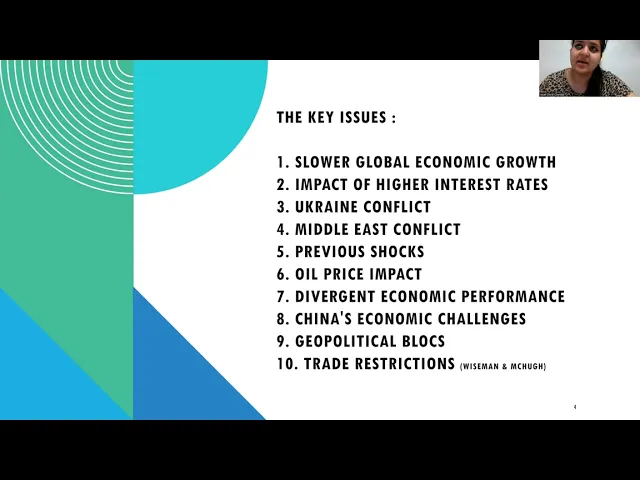
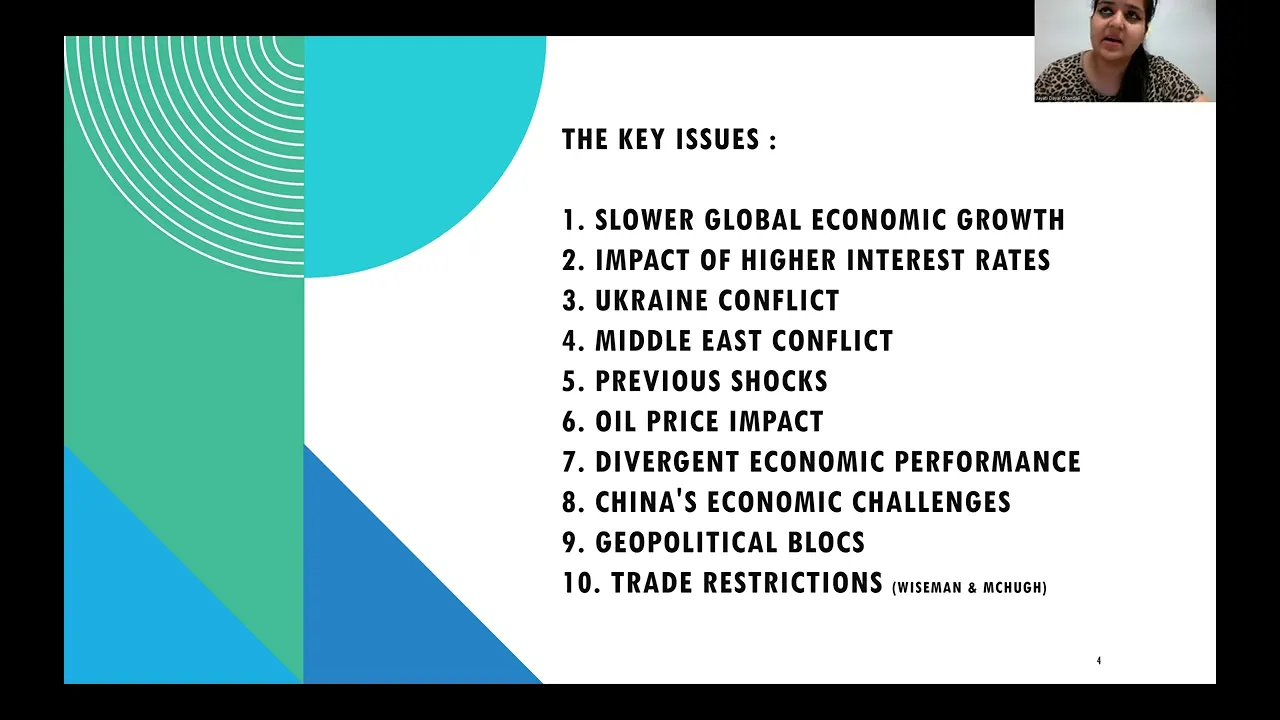
Ukraine conflict and now by this Israel humus conflict so let's begin the key issues so now I'm going to talk a little about the 10 major issues which have been described in the article so talking about the first one which is the slower economic growth rate as I already mentioned that uh it was earlier projected to be 3% and now IMF expects that there is going to be a Slowdown due to these current issues and factors factors which are affecting it in an overall way which indicates that uh it's going to go for 2.9% for
2024 the second issue in the article is the impact of high interest rates it can hinder the economic growth by making uh more people and businesses to borrow money and this can affect their spending and investment and hence it's not going to be a favorable thing for uh people who are willing to like us we are uh going to export our products uh from hellofresh from Canada to Nigeria and it's not going to be a favorable condition for them to buy and SP like spend their money on new things and invest and the next is
the Ukraine conflict we recently know a few months ago there has been the conflict in Ukraine which has disrupted many global economic activities and geopolitical tensions can have international trade and business uh like adverse effects on international trade and business and then we also have this um recently a few days ago we have come across the Middle East conflict the war between Israel and hamus which has caused uh which has added to the uncertainty to the global economy but the IMF has predicted that it it is going to have a negative impact particularly concerning the
oil prices and the instability in this region can impact the energy markets and various Industries which have a link with them and the interdependencies can also pose a great risk towards it also uh uh the previous shocks which have been given to us by coid 19 pandemic and Russia Ukraine conflict which has led to a substantial decrease in the worldwide economic output and then we have the oil price impact it uh there is a concern that due to this these ongoing conflicts um there is going to be a disruption in the oil production or trans
port in the Middle East and hence uh it is going to affect the oil prices which play a very important role in the global economy as we are progressing towards globalization we all know that it is going to affect us in some way or the other if you're dealing with the countries in the Middle East and then we have a Divergent economic performance so different countries have experienced different like varied economic outcomes for example the United States um is an energy exporter which has uh kind of weathered higher oil prices relatively well but in contrast
some European countries are more vulnerable due to their Reliance on on their energy Imports so this is also going to be another problem expected to be another problem problem and then we have the China's economics challenges the article talks a little about them also that it is as China we all know that it's the world's second largest economy and it is also facing growth challenges related to the issues in its housing market and further there are also uh this article also highlights the key issue of geopolitical blocks so the IMF expresses concern concerns about countries
forming geopolitical blocks that could hinder international trade and global economic growth uh growth as it will not allow a kind of free trade between countries and it will hinder the process of smooth functioning in the business Market international business Market the last issue uh also like the last issue in the article is about trade restrictions that there is an in inre uh in the trade restrictions imposed by countries which can limit the international trade and economic growth rate and uh this is the critical analysis uh about the article so geopolitical events significantly affect the global
economy introducing uncertainty and trade disruptions as I mentioned that all these 10 tensions do not allow countries to trade with each other freely and somehow many factors of each others countries will affect your business uh and your economic growth and overall um the the international market will be affected and then we have uh a point about oil price influence which mentions that there will be fluctuations in oil prices which will have a far-reaching impact on multiple Industries and all of this uh as we know oil plays a very crucial part in the company in the
uh global economic uh growth rate and it can also drive us towards various factors which hinder the economic growth rate and it can drive to inflation high high prices of everything and and the overall rate will surely be affected by the oil prices and energy prices and then uh the third point is resilient global economy so despite the challenges the global economy demonstrates resilience and uh accommodating monetary policies so even though we have a lot of challenges but there are some kind of responses and some monetary policies which come to the rescue and save us
from these challenges and then uh there are also Regional disparities economic disparities exist between regions with the US benefiting from energy exports while European countries reliant on energy Imports face hurdles and then we have trade Dynamics shift so there are concerns about geopolitical blocks and increased trade restrictions which are shaping the global trade Dynamics affecting the supply chain and Market access and next uh there is this article which I added the link in the end of my presentation as well it describes uh it is in the favor of the article and it mentions about the
challenges of the crossb international trade and uh there's a very beautiful line which I've added from that article which tells about the core of the central idea of the like the article by Moritz uh it says added to the global picture are rising geopolitical tensions which are damaging and shifting key commodity and energy Supply chains the economic hangover of the coid 19 pandemic with lockdowns in major exporting hubs still causing disruptions as well as soaring Transportation costs driven by broader inflamation pressures so this is in the support of the article which is uh kind of
an additional proof that whatever IMF said that others also believe so and have many articles and journals and pieces of information supporting from their research uh in support of the same Viewpoint of this article that the trade Dynamics are shifting and there are many challenges in the international trade so uh regarding the course content so we have uh two major uh Parts which refer to the course content which we have in our IBS 820 uh it is uh from the first module from our presentation of global economic Trends and drivers so it also relates about
the global economic growth which we have studied in the first module and it is highly relevant to international business because it highlights the economic factors like interest rates Global t uh like Global conflicts and geopolitical tensions on the business environment and next we also have geopolitical risks which describe about the Contemporary concern in the international business which was our project and uh it emphasizes on the importance of understanding these political tensions and trade barriers in different markets as we progress towards our own project of hellofresh exporting meal kits to Nigeria and this is the impact
which will have on our which it will have on our hellofresh uh which is exporting meal kits from Nigeria to Canada sorry from Canada to Nigeria and it describes that it will influence U operational costs of our uh products and uh of our market demand also and it will also affect the Supply Chain management due to all these barriers and how it will affect these are the four major region uh reasons which is going to be affected by the current condition of the economic Market of the international trade uh so there is going to be
the oil price fluctuations and global economic growth and geopolitical risks and trade restrictions so regarding oil price fluctuations as as our company is uh involved in export of the meal kits it can be affected by oil price fluctuations as it will affect our transportation costs and also the company's operational expenses so it will affect our pricing strategy and profit margin it's obviously going to raise the price for us and for the customer in the end as well so it's not good for our business and business plan and uh talking about global economic growth this will
affect our consumer demand as people will have low purchasing power parity which is which will be reduced and they will have less money in their pocket and they will be hesitant to spend and invest so it will affect our sales and Market expansion plans as we targeting a huge market and if people don't have money to buy things then it's going to be bad for our business bu or any business has such but as we renew ventur so it's risky for us and the geopolitical risks like the Israel Hamas conflict highlights there uh are going
to be potential disruptions to the supply chain and which could lead us to logistical challenges or delays or difficulties in sourcing some ingredients so we were planning to uh get some ingredients from the Middle East part as well but I guess it is going to pose some difficulties for us so there is going to be delay as well and um that's not favorable for our business as well and lastly the trade restrictions like um there has been geopolitical tensions as I mentioned which will lead to trade restrictions and um it will also impact the cost
and accessibility of ingredients for producing our meal kits so the company should be prepared to handle these trade Dynamic challenges as all of it will affect our operational costs market demand and Supply Chain management further moving on to the recommendations um there should be uh diversification of the supply chain what can be done to overcome all of these challenges uh the first one is diversify the supply chain so to overcome all of the geopolitical tensions oil price fluctuations it is recommended that companies and like our company like hellofresh should diversify this supply chain and it
could Source ingredients from multiple suppliers not just focus on a particular supplier from a particular region and we could look at a wider Market of supplier so that it would mitigate the risks secondly we could monitor the geopolitical developments it is very important to be aware to be vigilant about the potential impact of the issues going in the world and how it could impact our supply chain and monitor the system in a place where companies can anticipate and reach out to a plan which keeps them safe uh and then is implementing hedging strategies to uh
decrease the impact of the fluctuations like um like they mentioned that there is going to be fluctuations in the oil prices so that could also be mitigated if we try to have some um forward contracts or options to stabilize the transportation costs like we could hire a company which could surely uh provide us with a plan no matter how much the market gets affected we could enter a contract or a stable or a reliable source so that we are safe of all these issues and then is market research so we should always be very aware
of the current market trends changing economic conditions consumer Behavior the purchasing power of the public of the consumers and um it could help us know what is going to be the demand for our product and Export markets like we are aiming for Nigeria and it can help us adjust our offerings accordingly then we should also adapt pricing strategies which could accommodate with the small fluctuations or even major fluctuations which could occur in the production costs and changes in the purchasing power due to the economic Trends because if the growth rate goes down people are going
to buy less and we should be prepared and we should have a various plans if the economy goes down if it goes up if the inflation is there how much is the price and demand so we should have a strategy for all the situations and how to cope up with them then we have the Regulatory Compliance we could be uh updated we could stay updated on the trade regulations and adapt our business operations accordingly so that we are safe and ensuring the compliance with the international trade rules dealing with any potential tariff changes trade restrictions
or countries which are not supporting it is going to be helpful for us if we ensure there is a compliance lastly to conclude uh the international businesses must be prepared to adapt to the limping global economy and not which is not sprinting as the author said and the geopolitical shifts that Define the contemporary issues in international business and uh to go through these uh challenges we have to uh turn them into opportunities as it is not always possible that it is going to prove uh negatively for us it can also uh be helpful for us
as we have seen that even in the coid 19 pandemic the sanitizers and masks companies have profited so so it's always not a bad time for everyone we could turn the challenges into opportunities and it could help our international business flourish if we are very well aware and do our SWAT analysis and stay updated do our market research so we can be successful as well and companies that remain well informed about the economic Trends geopolitical developments Regulatory Compliance cancer sustain and even grow their operations in the face of uncertainties that was all from my side
and um these are the references the first one is uh of the main PDF of the article which I have reviewed and the second one is the slide where I mentioned in support of the main article this is the additional reading uh which supports the same Viewpoint and highlights more issues and challenges of the crossborder international trade and the first one is the main one which I've reviewed thank you this was all from my side my name is jand signing off uh from the project IBS 820 of the article review contemporary issues in international trade
thank you